Showing posts with label a ghost story. Show all posts

Sunday, February 9, 2025

The stages of my interpretation of Presence

In a post written earlier this month, I briefly touched on my feelings about Steven Soderbergh's Presence, but that hasn't ended my thinking about the movie, especially as I've listened to it discussed on podcasts and edited my own writer's review.

Before I go any further, let me get this out of the way:

Spoilers for Presence to follow.

Before I'd had any of these experiences with others engaging with the movie, though, I had this pressing question:

Just why, oh why, was a dead girl's ghost haunting a house her friend did not yet live in?

You shouldn't have read this far if you haven't seen the movie, so I also shouldn't need to refresh you on the plot, but let's just say you've already forgotten Presence. (I might argue that it is not as memorable as it should be.) 

The film opens with a camera flitting through an empty house -- up stairs, down stairs, around corners, through vacant rooms. Before any actors appear on screen, we get the idea that this is the POV of a ghost, moving quietly through the space as if walking on ballet slippers. And, I'm sorry to say, this was as scared as the film ever made me, just putting myself in the shoes -- or whatever footwear it was -- of this ghost. 

Soon afterward, we see a real estate agent arrive to show the house to -- and this part I really do forget -- either just a couple of adults, played by Lucy Liu and Chris Sullivan, or also to their teenage children, played by Callina Liang and Eddy Maday. Whether or not the teenagers are present for this showing (no pun intended), we meet them soon enough, because the family does buy the house and move in. And all the while we continue to see the ghost watching them at the middle distance of about ten feet away, sometimes closer, sometimes running quickly to another part of the house entirely. 

As the story goes on, we learn that not only can the teenage girl detect some sort of presence in the house, but that this presence is actually the ghost of her friend who died recently, supposedly of an overdose, but, we learn later on, actually because she was murdered. How she knows this ghost is her friend is not important, because we suspend disbelief in a movie like this -- on some things. We know, from the beginnings of the traditions of oral storytelling down through the ages to the moving image, that there are certain people who have a sort of spiritual communion with the dead, and they just "know things."

The next thing, I would argue, is the thing we cannot accept.

If we are to accept that the girl, Chloe by name, believes this spirit is that of her dead friend, we also have to accept that Chloe is correct, even though we never get any proof that it's actually her friend.

So again, I ask:  

Just why, oh why, was a dead girl's ghost haunting a house her friend did not yet live in?

For someone whose scripts are as tight as those of Steven Soderbergh, who rarely asks questions he does not answer, this seems like quite the oversight indeed.

I thought for a moment this house was empty because it was where Chloe's friend had lived, so when she died, the distraught family had to move elsewhere to start again. Too many bad memories.

But if that were the case, then surely Chloe would know that her friend used to live there, and it would have been commented on. (And, of course, way too weird to actually go through with the purchase.)

Plus, it seems rather unlikely, though not impossible, that a family would move into a house in the town where they already lived; presumably they'd have to live close by if the two teenage girls had been friends. And then of course, if they lived in the same town, there would be no way not to know this was the house where a girl had just died of a drug overdose (or so they think at the time).

Then there is the possibility that the ghost followed Chloe there, but the sequence of events is wrong for this. 

So if you are looking for an explanation beyond something lame like coincidence or randomness, the only thing I could come up with was the idea that the ghost's perception of time is not linear. Either that means the ghost could predict the future, that her friend was going to live there, which seems like an unlikely skill for a ghost, or it was just that the ghost could see all times simultaneously, and placed herself in this house in order to communicate with the girl who would soon live there. If pressed on the question himself, Soderbergh might offer some explanation along these lines.

The thing is, there is no real evidence of this in Presence. All the events we see in the film are portrayed chronologically (maybe more on that in a minute), and only knowing a source of obvious inspiration for this film -- David Lowery's A Ghost Story -- would we even be tempted to offer up such an explanation. 

But if this film is like A Ghost Story, it violates one cardinal rule of that film, also a cardinal rule of real estate: location, location, location. As you know if you saw that film, Casey Affleck's roaming ghost -- really just a sheet with eye holes -- can roam no further than the borders of the property, and roams more metaphorically across the eons, on the same plot of land (a la Robert Zemeckis' Here), in the past, present and future.

The spirit in Presence, on the other hand, seems at least once to have been able to move from one location to another, and that's just too many skills to have if she, like the aliens in Arrival, can also see all times at once. There's no satisfying explanation for why she came here rather than staying in her own house, unless it was, indeed, just to save her friend from the romantic interest who seduced her with the intention of murdering her.

So I don't really like any of these explanations.

But then I got another explanation.

When I got the review from my writer, I finally asked him about this apparent quandary, because I didn't want to ask him before then for fear of biasing his writing. (He loved the film, giving it a 9/10 on our rating scale.)

His response:

"I think the ghost was her brother!"

Well, duh. Forehead slap.

I knew the ghost at the end was her brother, but my apparently really dumb and surface-level reading of what happened was that the first ghost, having accomplished her goal of waking up the brother in time for him to save his sister from getting murder and go out the window with the murderer, had moved on to the next plane of existence. And that she had been replaced by the ghost of the brother, just deceased. Just because we are getting the movie from the perspective of the ghost, it doesn't mean it has to be the same ghost the whole time. 

But that's just what Steven Soderbergh wanted me to think, because I am viewing events chronologically, and because I am naturally inclined to believe the impressions of a person sensitive to paranormal activity, because years of watching movies have told me I should believe them. 

My critic reminded me that the psychic character had told the family that a ghost could even be haunting the house "from the future," a detail I conveniently forgot or possibly waved off at the time, like "Yeah that's one of those things psychics say."

So I guess in this line of thinking, it was the brother all along, trying to alter events in his own past. It also gives a second meaning to the title ("Present(s)"?) and it also explains why the ghost is in a house with which it would not otherwise have a connection. 

I still have questions though.

Now, you can never fully disentangle the cause and effect of time travel, though many films have tried. If the brother is indeed haunting the home from the future after his own death, he would know that he had, indeed, succeeded in going out the window with the murderer. When the spirit urgently runs down the stairs to awaken the previously alive version of himself, so he can carry out saving his sister, it's basically just acting out a preordained series of events, which is not as satisfying as him making the conscious choice. I guess at some point he did make the conscious choice, though you could argue, he only made it because his future dead self forced his undead self to do it. Which is still a choice, but it's only a choice that's possible from the choice already having been made.

Then I thought about how it would really be interesting if, in some iteration of events, the brother had not saved his sister, meaning she was dead and he was alive. Then it could only be her spirit that was in the house, going back and trying to change events so that she lives and he dies. If that's the case, though, it's extremely problematic from the prospective of audience sympathy. Any character who goes about trying to save their own skin and sacrificing someone else, especially a loved one, in the process, is an asshole, and beyond redemption. So even though that's sort of a cool from a "multiple timelines, cause and effect" perspective, it is almost certainly not what was intended. 

Another thing I didn't properly interpret was what the final shot meant, where we see the spirit ascending from the house into the sky, and go to credits. Because I was fixated on the idea that the brother's spirit had only just become the occupant of the house, I didn't think the camera ascending in the sky could be his perspective, because his sacrifice would have to continue by staying in the house if he had just exchanged places with the spirit who had been haunting the house, which I had continued to think was the dead friend. So if anything, it would be the dead friend ascending to the heavens here, though I have to admit this explanation was lost on me as well. I kind of just thought it was a cool way to end the movie. 

So I guess this means the house will no longer be haunted for its next occupant ... but how soon will that be? Now an actual dramatic death has occurred in this house -- out the window of this house -- so the next buyer might be slow to buy it. 

And of course, this cannot be construed as a happy ending for the family, who has now lost their son, and whose daughter -- even if she looks sort of upbeat in the end -- has further trauma piled on top of losing her friend. (Was she friends with both of the murdered girls? I think she only references one of them.) Surely her mental state cannot actually be better after the death of her brother on top of that? Unless she was somehow privy to this time loop conundrum involving how her dead brother's ghost woke up her living brother and prompted him to save her from her prospective killer?

And then this killer's fate doesn't sit well with me, not any better than his mere existence as a plot device, which I actually think is the most troubling aspect of Presence (though I suppose necessary for the story Soderbergh wants to tell). I guess the idea is that Chloe was conscious enough, in the moments after he had drugged her but before he had fallen asleep, to hear his various serial killer rantings and ravings, enough to tell police after the fact that he had confessed to the other murders. But then she's just a single person testifying -- a single, potentially depressed person who is recovering from the death of her own friend and brother and might not be the most trustworthy source. I guess we have to think that some evidence somewhere will back up her claim, as it seems like this teenage killer was getting careless, considering that his plan seems to have been to leave the brother alive, and the brother could just tell everyone that he'd had a drink with the guy just before he inexplicably went to sleep and woke up to find his sister dead. Sloppy, even for a teenager.

Then there's one more wild theory that isn't supported by the text but I did consider for a moment. What if the brother was dead the whole time? That would explain the mother's fixation on him prior to that, effectively her own sort of depressed mental break, talking to him when he isn't there. Maybe this whole thing is somehow her own fantasy, or the fantasy of the father, who always wanted the son to be a better man?

I thought the end result of my journey into the potential interpretations of Presence might result in a retroactive elevation of the three stars out of five I gave the movie on Letterboxd. I don't actually change my initial star rating once I've entered it, but a film can change in my mind, and that change can inform how I rank it in my upcoming year-end list (upcoming in 11 months) or on Flickchart. Once Upon a Time in Hollywood was a recent -- well, relatively recent -- example of that, as I initially didn't care for it, awarding in only two stars on Letterboxd, until it became a four-star movie for me on my second viewing. 

But I'm not sure it has done that with Presence. Any new interpretation I get has a disappointing downside to it, once you start to pick away at the rest of what's there. 

I guess it's a subjective thing how much you care about these cause and effect questions, given that if a time travel movie -- you're a lot more likely to encounter them there than in a ghost story -- works for you, you basically disregard them entirely. So in the end, maybe Presence didn't really work for me all that well, even though I absolutely loved and was enthralled by the technique for most of it.

Or maybe it's just that it's always going to pale in comparison -- pun intended -- to my #1 of 2017, A Ghost Story.

It is, ultimately, disappointing to me that only the most literal interpretation of the movie was available to me at the time I saw it, so much so that a week later, once my writer had written his review, I was still pregnant with the burning question I posed twice at the start of this piece about the friend haunting a house where she never lived and where her friend did not yet live. If this theory could so easily have holes poked in it, how could it possibly by the most likely narrative explanation for a filmmaker who has always had a fairly stringent approach to storytelling, which manifests itself in movies that are likelier to run 85 to 95 minutes than 120 to 130?

The good news, though, is that I do regularly have deeper interpretations of other films. I don't always go for the "sucker's explanation," the most obvious interpretation of the text that points you to the most shallow but least satisfying explanation. I think it has to do with how much the movie engages you in the first place, and I think by the end, I had already turned on Presence a bit.

Because there are certain things that ultimately feel like failures of the script, no matter how you interpret the larger story and where it ends up. For example, there's the whole bit where the father is considering leaving the mother because he doesn't want to be an unwitting co-conspirator in whatever financial chicanery she's involved in with her work. We never end up learning what this chicanery is, nor do we see the father take the next step toward leaving the mother. So that thread just never pays off, and it seems like someone like Soderbergh should have recognized that.

Well, Presence has caused me to write nearly 3,000 words about it on my blog, so that's proof of it doing what a movie should do: engage me. And who knows, maybe this is only the beginning of my relationship with the movie, and there's a lot more interpreting still to do. 

Saturday, August 27, 2022

My ten favorite movies that are moods

I usually like a tight and clever plot -- except when I don't.

The extreme example of not liking a tight and clever plot is any movie with spies. I don't really care who is double-crossing whom and why. I suppose spy thrillers often violate the rules of tightness in order to achieve the heights of "cleverness," but some people really go for that. I don't.

I do generally like it when something happens in the plot late in the movie to give me a little frisson of excitement, not necessarily a "twist," but something I wasn't expecting -- perhaps emotionally. But a lot of time, an emotional "twist" is more likely to be found in a movie where mood is what they're going for more than plot.

This is a roundabout way of telling you that I love a movie that is all about its mood -- but only when it's done well. A movie all about its mood that isn't done well is just an exercise in masturbation. But one that's done well ... *chef's kiss.*

What prompted the writing of this post was resuming my viewing of my previous #1s after a 39-day break to allow for my trip to America. My trip wasn't nearly that long, but I paused this project about a week before I left and it took a week after returning to unpause. I knew I wasn't going to watch any of these while I was gone, but interestingly, I could have. As it turned out, my dad and his wife suggested a viewing of Inside Out as one of our evening activities while we were in Maine with the kids -- and I watched it again even though I'd only just watched it for this project three weeks earlier. If only I'd known, I would have saved it. 

It's not often you watch the same movie twice in a month, especially when it's your fifth or sixth time seeing the movie, but surprisingly, I was hit a tad harder by it this time than on the previous viewing. Maybe it was the company, with some people in the room -- including my sister -- seeing it for the first time. (Or it could have been the fact that my older son was in the room, and he's the same age as Riley, and he also just moved house in the past year, creating many of the emotions Riley experiences. I almost wrote a post about this very thing when I watched it back in early July.)

I contemplated watching a second movie for this project, one I hadn't just watched, on the plane, since Lost in Translation was among the Qantas offerings on our flight. But I was already watching one older movie for Audient Bollywood, so I just couldn't justify yielding a second spot to a movie that hadn't come out in 2022. (Though it would have been a great scenario to watch it, given that jet lag is a big theme of the movie.)

For a time last night, I wish I had, as I was unable to scare up Lost in Translation on any of my streaming services, despite my certainty it would be there. I was going to give up and shift to something else, and may have if I'd been able to find Eternal Sunshine of the Spotless Mind on any of them either. Instead of searching up a third title, I asked myself "How lazy are you?" and just got out my old laptop to hook up to my TV via HDMI, so I could play my Region 1 DVD of Lost in Translation. It really only took about three minutes. I'm glad to know I'm not that lazy. 

I still mightn't have written this post if I hadn't come across another movie I love that's all about its mood while doing some Flickcharting this morning. So here I am.

I decided not to come up with an entirely organic list -- that's a bit too much work for me this morning -- but rather to go down through that aforementioned Flickchart to identify the ten films I've ranked most highly that are about mood at the expense of plot. This is not to say they don't have any plot, just that the plot is there to support the mood -- at least as I experience the film.

Unsurprisingly, the mood for most of these films is "melancholy." That's really what you mean when you say "mood" without any other words to modify it. 

Perhaps also unsurprisingly, these films tend to be supported by a very "moody" score or soundtrack, one that puts you in the contemplative space to appreciate what's going on with these characters. 

Without any further ado, in the order they appear on my Flickchart ...

36. Lost in Translation (2003, Sofia Coppola) - It's a testament to Coppola's excellent musical taste that all the songs on this soundtrack strike an identical tone. As I was listening, and as an owner of the soundtrack, I kept saying "Oh yeah, this song. Wait I thought this song had already played." While that might sound like a backhanded compliment, it's actually a perfect realization of her attempt to establish a tone of melancholy and displacement, one that the movie plays out expertly. There's a disappointment while watching Lost in Translation that the "relationship" between Bob and Charlotte does not have a traditionally satisfying emotional arc, as it hits a bump in the road and ends in a place of minor disjuncture. But that's like actual life, in which connections rarely land solidly. Of course, the actual conclusion to their non-consummated romance hits it out of the park in terms of emotional satisfaction, and wouldn't you know it, there's the Jesus and Mary Chain's "Just Like Honey" to allow us to marinate in that moment.

76. My Neighbor Totoro (1988, Hayao Miyazaki) - I didn't say all my choices had to be melancholy. However, there's melancholy to be had indeed in this film, undercutting the wonder experienced by the children as they discover their new country home and all the various sprites and other magical creatures who lurk in its nooks and crannies, or in the forest just beyond. Let us not forget that weighing down these children's otherwise uncomplicated excitement and playfulness is the knowledge that their mother is sick, and they don't know for sure whether she will recover. My Neighbor Totoro never gets anywhere close to a story and I wouldn't have it any other way.

79. Spring Breakers (2013, Harmony Korine) - Many of my explanations about why I love Spring Breakers, given to incredulous listeners over the years, have never been able to fully encapsulate the special trance this movie places on me. First it captures FOMO perfectly. Then it captures the delirium of the best time of your life perfectly. Then it perfectly captures that feeling of when you've stayed at the party too long and things have started to go south -- also something depicted in Lost in Translation. But again it's the way this movie wraps you in its soundtrack -- particularly the ultimate in melancholy, "Ride Home" by Skrillex -- that leaves me staring off into the middle distance in reverie. 

87. Once (2007, John Carney) - I wasn't at first sure if Once qualified, but it's certainly got the lack of plot. I mean, the characters don't even have names. This probably most closely approximates the missed but made connections between Bob and Charlotte in Translation, as a potential romance is considered but rebuffed, and we sense the profound effect these two have had on each other even though they may never see each other again. It's obvious that Glen Hansard's passionate, melancholy -- there's that word again -- music is the key to fueling this emotional journey, though we can't discount the contribution of Market Irglova, both as a singer and as Hansard's muse in its creation. 

108. The Diving Bell and the Butterfly (2007, Julian Schnabel) - Two thousand seven was a good year for making us feel more than think, though of course this got ranked with my 2008 films in the first year it was available outside France. Few things are more melancholy -- I'm going to stop calling attention to my use of this word -- than the concept of being trapped inside your brain with only a blinking eye to communicate with the world. Okay, maybe some people would call that terrifying more than melancholy. But there's something about how Schnabel depicts this condition for Jean-Dominique that effortlessly communicates his desire to grasp the beauty of life now that he is intimately acquainted with its fragility. And let's not forget the role music plays here, as there's an unforgettable sequence using U2's "Ultraviolet (Light My Way)" that might not sound memorable on the surface, but wallops you in context.

110. Ordet (1955, Carl Theodor Dreyer) - This might be a stretch and it might look like I'm desperate to prove to you that I like movies made before the year 2000, but there's no doubt that the spell cast on you by Ordet has little to do with its plot. This story of three sons of a devout Danish family, and their struggles with their faith, is the sort of thing that inspired a whole career of contemplation from the likes of Ingmar Bergman, some of whose films could end up appearing on this list. But I think it's really the quiet of their homestead, the rustling of its grass, that places you in this meditative space that carries through the whole picture, and prepares you for the high concept ending that it's best not to spoil.

134. Under the Skin (2013, Jonathan Glazer) - Scarlett Johansson makes her second appearance on this list with a film that basically has no plot at all. Well, it starts to develop something like a plot in its second half, but that's only in contrast to the first half, in which Johansson's alien cruises the streets of Glasgnow for new victims to lure into her black goo. If not for the eerie mood created by this film, it wouldn't have gotten under my skin (so to speak) and become my tenth favorite film of the last decade. But yes, there's melancholy here too -- just look at the expression on Johansson's face at the end and you will understand precisely what has been lost. (A nod to Micah Levy's score to put us in exactly the head space we need to be.)

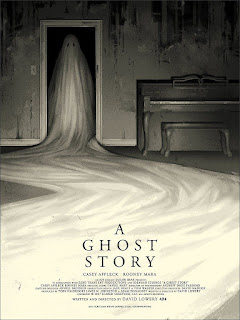
160. A Ghost Story (2017, David Lowery) - Oh the melancholy! A ghost looks on quietly, helplessly, as the woman mourning him tries to recover from his loss ... and then looks in on the next 300 years or more of the occupants of this building, just for good measure. Daniel Hart's score and Dark Rooms' "I Get Overwhelmed" do tremendous work holding us there once Lowery's images, his square aspect ratio and the performances have brought us to this place. The existential ennui climaxes in a hugely satisfying final emotional payoff.

214. The Life Aquatic With Steve Zissou (2004, Wes Anderson) - I debated whether to include Bill Murray's appropriate second appearance on this list, since I think Anderson is always about mood over plot. But in the end, the thing that connects with me so much about possibly my favorite Anderson film is this blue space it finds and remains in. The decline of Zissou's life is embodied perfectly by the abandoned, overgrown hotel on that island in the middle of the film. And Seu Jorge's covers of David Bowie songs are an essential component to the narrative and character work Anderson is doing.

296. Code 46 (2003, Michael Winterbottom) - And finally at spot #10, we get to the film I came across while Flickcharting this morning that prompted me to write this post. There are some high concepts at the center of a love story between two characters in a sun-bleached Shanghai of the future, when only rich, connected people can live "inside" and everyone else is forging documents to try to escape the harsh conditions. Winterbottom draws a very specific portrait of a future where characters slip in and out of multiple languages while they speak. But it's a Lost in Translation sort of relationship that develops between the characters played by Tim Robbins and Samantha Morton, plot taking a backseat to moments infused with significance and scored by memorable songs like Freakpower's "Song No. 6" and Coldplay's "Warning Sign."

Some I bypassed in this top 300 that didn't quite fit my concept of this post, but could have if I'd squinted a bit:

2001: A Space Odyssey (1968, Stanley Kubrick) - 12th
Solaris (1972, Andrei Tarkovsky) - 146th

I also bypassed all my choices that I consider to be straight horror films, because the best horror films are all about creating a mood and that's a sort of different category of cinematic achievement. 

Now that I've become more officially acquainted with this proclivity of mine by having written this post, I'll have to see if I'm more aware of movies presenting themselves to me as moods -- kind of like I immediately notice when a "wax stamp movie" presents itself to me. (Unfamiliar with that concept? See this post.) 

Saturday, January 22, 2022

My 25th anniversary ranking of #1s

This is not a post about 2021 movies. I promise.

It occurred to me that this January marks the 25th anniversary of the first time I ever ranked my movies from first to worst. Because of the way these things work, I just named my 26th #1 film, since I chose a #1 in January of 1997 and in January of 2022, bookending that 25-year period. (It might have even been February back then because the Oscar nominations dropped a little later in those days.) But it's 25 years, and I didn't think to mark the 25th #1 last year, so I'll have to acknowledge the anniversary rather than the milestone. Besides, I didn't decide at the start of 1996 to rank my movies that year -- I decided at the end of it. So the whole thing really did start 25, rather than 26, years ago. 

I still remember quite clearly my apartment in Providence, Rhode Island, working on that first list, which I may have actually written down on a piece of paper before ultimately committing it to permanence via Microsoft Word. I obviously didn't have my current methodology on that first time through, where I steadily add movies as I go and assign them a comparative worth, so I am building the list all year rather than right at the end. No, that first one was a matter of sitting down with a list of movies and choosing their order right then and there. I think my current system allows for better accuracy, but there was something thrilling about that initial approach.

I've moved eight times since I lived in that Providence apartment, but the lists have always come with me, safe and sound on Word documents I have regularly saved and backed up and never lost in some sort of calamity. And of course the desire to keep making the lists has also traveled with me, as intact as it was that first year -- or should I say, even more intact, as the obsession has only grown over a quarter century.

So let's honor that obsession with something obsessive.

Last night I watched my #1 of 2017, A Ghost Story, which I had mentioned in a post two days ago as an example of something I was discussing. Invoking its name got the movie in my head, as did noting Casey Affleck's entry into the two-timers club of people who have been in two of my #1 movies, a feat he accomplished this year with Our Friend. The reasons A Ghost Story came up twice in three days on my blog had nothing to do with each other, except that both times it was because it had topped one of my year-end lists. So now that I'm no longer watching 2021 movies and am free to watch whatever I like, I had to scratch that itch.

As I was going to bed afterward, I thought, "What if I rewatch all 26 of my #1s in 2022?"

At first I laughed at myself for such a suggestion. I recently got done telling you that I was only doing one bi-monthly series this year, instead of the intertwining ones I did last year, so that I had six fewer viewing commitments over the course of the whole year. So now I want to add another 25?

It's 24 actually, because I already started a couple weeks ago without realizing it. I watched Our Friend for a second time on January 10th to confirm it should be my #1 of 2021. That counts I think.

And there's something really good about that number of 26 as it relates to a calendar year. To watch 26 movies in 52 weeks just means you have to watch one every two weeks. I'm already 1/13th of the way there.

I won't commit myself to watching them at those intervals, though I'll try. If I get behind it will be easy enough to catch up later.

What will this lead up to, you ask?

At the end of the year, I will rank these 26th movies from first to "worst," like I do with the movies I watch each year, and post the results here. Think of it like that season of Survivor comprised entirely of past winners, where they competed to see who was the winnerest among them.

Rewatching some of these movies might feel a bit like overkill. Since they are among my favorites from the last 25 years, I do watch them with some regularity anyway. In 2021 alone I watched three of them, those being the two Charlie Kaufman had written (Adaptation and Eternal Sunshine of the Spotless Mind) plus a random rewatch of my best of 2018, First Reformed. (Kaufman wrote a third #1, I'm Thinking of Ending Things, but I didn't watch it in 2021 because I had just watched it a second time at the end of 2020, and there weren't enough available viewing slots in my I'm Thinking of Kaufman Things series.) I still think I need to watch those films again to be completist on this project, but I'll push them back closer to the end of the year. 

It's been longer for most of the others -- a lot longer in some cases, as you will see in a minute -- but I rewatched all my #1s from 2010 to 2019 in the year 2019 so as to consider them for the best of the decade. So those are comparatively fresh too. Still, I think it makes sense to rewatch all of those again as well, to make my impression fresher. Three years is plenty long between viewings of favorite films that it should not seem like a chore to watch them again, even if they are long like Toni Erdmann. 

This also gives me an excuse to finally do something I should have done ages ago: Rewatch the first #1 I ever selected, which is also my only #1 movie I have seen only once.

That's right, given that it was the movie that kicked off this whole thing, you'd think I'd have been eager to go back and reconfirm the greatness of Al Pacino's Looking for Richard, my #1 of 1996. I can probably thank my enthusiasm for this movie for starting the list project in the first place, and yet I've never gone back to see if my 23-year-old brain was making good cinematic choices. This despite the fact that I've owned the movie on DVD for most of the past decade after buying it from a video rental place that was going out of business.

That will likely be one of the first I rectify, but chronological order is obviously not important to me, as I've already ticked 2021 and 2017 off my list. That might have been an interesting way to go about it and it certainly speaks to the organizational part of my brain. But if I'm going to add 24 more viewings to my 2022, the least I can do is catch them as catch can. Watching them in random order seems to be a good way to randomize their impact on me as well, and even the playing field when they do all duke it out for top honors in December.

I'll probably use the same system I used to determine my best of the last decade, which is that I'll put all 26 movies in a special Flickchart account and keep dueling them until I'm satisfied with the order. Based on my current Flickchart, which includes some of these movies in my top 20, I have a suspicion about how things will go, but it's also possible that new viewings will help me reconsider my assumptions about their relative worth. I hope so or else it's really not worth doing.

One last thing, and it has to do with the backing up of these lists that has been successful so far, but is always potentially fallible despite my best efforts.

Although I won't write about these new viewings on this blog unless something else about the viewing inspires me to write -- you better bet there will be a specific Looking for Richard post when I get to it -- I do think this might create an opportunity for some blog material, and it has everything to do with committing my lists to permanence.

You can find my rankings from #1 to #whatever dating all the way back to the first list I published after beginning this blog in January of 2009. That one saw The Wrestler claim top honors. But my lists before then? They are still only saved in these Microsoft Word documents.

As having material to write about has proven something of a challenge in recent years, setting aside these prolific times at the end of the year/start of the year, I think I will periodically post the other lists on this blog, starting with the best of 2007 and going backwards. In this case I think chronological order is warranted. I'll post the list exactly as it was on the day I closed it, and then of course do some analysis, maybe even showing the order in which those movies rank for me today on Flickchart, to see how much has changed.

And then I will have versions of these lists that are safe from every calamity short of the calamity of The Audient itself going offline. 

I don't think you need or could possibly want any more on this topic for today. Just know that I'm off and running on yet another movie project, one that is assured of having a lot of quality viewing in store for me.

Wednesday, September 12, 2018

The best cry

If you swallowed all your machismo (assuming you're a man) and admitted to someone you cried during a movie, you might expect this as a follow-up question:

"Oh, which part?"

But they might not expect your answer:

"The closing credits."

That is in fact what happened to me Monday night when I saw Hearts Beat Loud, a movie I'd heard buzzed about as "this year's Sing Street." Despite this description, I went anyway. I'm a huge fan of John Carney's Once, and I even quite like his follow-up, Begin Again. I wasn't really on board for Sing Street. Don't know why.

And Hearts Beat Loud didn't take off for me at the start. It took me a while to decide whether I was watching a good movie or not. (A while = 15 minutes.) Once I started nodding my head at all the things the movie was doing right, which was everything, I knew I was loving it. I even really enjoyed the contributions of former amateur Sasha Lane, who bothered me in American Honey and a movie I saw a few weeks ago, The Miseducation of Cameron Post.

As the emotional resonance of the movie, particularly its relationship between a father and his daughter, continue to build toward a crescendo, I sat there in that kind of happy fugue you slip into when you are in the grasp of a movie that is working on you on all levels.

And when the last image faded to black, I engaged in a brief but unmistakeable bout of those small convulsions we call tears.

This also happened with my #1 movie of 2017, A Ghost Story. Hearts Beat Loud is not a contender for my top spot this year, but it does so many things right, and works on you so gradually, that the end result when the bow was tied on the movie was the same kind of small emotional outpouring.

Like applause, only wetter.

And there's something so pure about crying when a movie's credits roll. It can't be cheapened by chalking the tears up to a superior instance of emotional manipulation. If a director and a cast get it just right, they can do things even in bad movies that will make you well up. You may resent it afterward, but in that moment it works like gangbusters.

A credits cry is something different. It's usually a response to the entire movie, not just one superior moment.

It's the very rare instance that the very last moment of a movie is its emotional climax, at least in the way we usually think of such things -- a tear-jerking speech, a sad farewell, that kind of thing. Usually you get that moment somewhere in the last 15 minutes, but not at the very, very end.

So crying when you see the director's name come up on the screen is the equivalent of saying "Nailed it." Even great movies can stumble a bit with their last shot, can wrap up in ways that we don't find to be 100% perfect. There are egregious examples, like the rat running along the railing in The Departed, but there are hundreds of lesser examples of movies not knowing what their last shot should be or how to execute it.

The credits cry is kind of like saying "Yes, and that last shot was perfect. Bravo. You did it."

Don't need to belabor this probably.

If you haven't done so, see Hearts Beat Loud. Your mileage may vary on the credits tears. Though probably not if you're a dad like I am.

You can consider it this year's Sing Street if you like Sing Street and that helps you. I consider it exactly what its poster claims it to be: "The feel good movie we need right now."

Saturday, January 27, 2018

Which backs get lashed

Having kept my love for A Ghost Story entirely out of print -- though if you had listened to this podcast, you would have heard me rave about it -- I was somewhat taken aback when the first comment to greet my year-end list on Facebook was the following:

"Casey Affleck should BE a ghost. Fade into nothing. Scare people when he pops up so they run away."

As this comment came within five minutes of posting, when I was still in that delirious high of publishing the end result of "my year's work," I immediately felt a pit in my stomach.

Was I wrong to look past the involvement of Casey Affleck in this movie in giving it my highest honor for the year?

I knew this person was not trying to be funny, either, despite her at least somewhat playful use of the extended ghost metaphor. This is a woman I have consistently seen post about #MeToo, who does not consider this a laughing matter. (I mean, I'd hope no one would consider it a laughing matter, but this woman most certainly does not.)

So I had a momentary crisis about whether I had failed in my responsibility to an important social cause in completely disregarding Affleck's participation in the movie as a relevant factor in assessing it. Should I so actively promote something that has a genuine creep on screen for much of its running time, even if he is behind a sheet for most of it?

I've written a number of times in the past about my general philosophy -- I'm sure there are exceptions -- of separating the art from the artist. I mean, I've seen Woody Allen's films every year for five years running now, which is almost certainly my longest such streak in the man's entire career. I believe if a movie has something useful to add to the conversation, or may be doing something interesting, I should see it and grapple with it, even if the person who made it is not a very good person. There are a lot of not very good people making movies.

But I must admit I did not even have this internal debate when it came to Affleck and A Ghost Story. I know Affleck was guilty of some shady things, some awful things, on the set of I'm Still Here. Women are right to be skeeved out by him, and men should be sure he does not go near their daughters. Still, and maybe this is just because I did not pore over the details of the accusations against him, I didn't realize he was quite as worthy of being loathed as the level he is loathed. Especially as more and more names have come out of more and more people doing terrible things -- in many cases, worse things -- the accusations against Affleck have further receded in terms of how shocked I feel I should be by them.

And yet this woman came forward with an implicit scolding of me for supporting an Affleck project, reminding me just how angry people are at Affleck -- at how they have pulled him out of what has increasingly become an indistinguishable noise about sexual harassment, and targeted him specifically for their hatred and scorn.

I guess part of the disconnect for me is that he just won an Oscar last year, and I kind of feel like people already knew these things about him when Manchester by the Sea came out, though perhaps I am off on my chronology there. I feel like last year would have been the time to punish him, yet "we" did not. "We" awarded him with the year's highest acting honor, because he was just so damn good. (A textbook example of separating the art and the artist.)

In fact, I find myself wondering if Affleck will be allowed to hand out the best actress Oscar this year. I'm kind of suspecting no. Though maybe it would actually be a better punishment for him to throw him out there and see what kind of reception he gets than to keep him out of the show entirely.

So it seems especially strange to me that A Ghost Story should now be bearing the brunt of a delayed disgust with Affleck. Is it because people felt like they could dismiss A Ghost Story as a twee exercise, not a serious film, whereas Manchester by the Sea was something they should more obviously reckon with?

But I also know that this is not an unreasonable viewpoint, or one held by only a few people. My wife has so far boycotted A Ghost Story because of Affleck's involvement (though I hold out hope that I'll eventually get to show it to her). Another person said to me, regarding Ghost Story, "I also struggled with Casey Affleck in it in a way I wouldn't have if I'd liked the movie."

So I guess Affleck can set you off on the wrong foot with the movie, or, if you aren't liking it, become "the lightning rod," to quote that friend again.

What I guess I wonder is why we're not hearing people go on rants about Baby Driver because Kevin Spacey was in it or rants about The Disaster Artist because James Franco was in it. Some of that may be out there, but I haven't seen it.

Granted, a lot of that has to do with the timing. Most people saw and formed their opinions of those movies before the person in question was revealed to be a creep, though I can't imagine people didn't have suspicions about Franco. Maybe the backlash for things can't come retroactively, any more than you can say "Ugh, you like American Beauty? How dare you, Kevin Spacey is in that." Though it does seem to be the case that the timing of the accusations against Franco played a role in why he was nominated for a Golden Globe but not an Oscar. (Not that nominations are actually done like this, but I like to imagine the Academy hastily switching in Denzel Washington, for his performance in a movie nobody saw and which is supposed to be bad, in place of Franco.)

Of course, I'm not the only one supporting A Ghost Story, so I have company in my failure to punish the movie for Affleck's transgressions. Two critics I like very much and listen to on podcasts regularly, Michael Phillips and Matt Singer, had it in their top three for the year, and in glancing at one of those websites that compiles best-of lists from around the world, I saw at least one other where it was at the tippy top, like it was for me. I suspect there are more.

Still, I can't imagine I can go into a new ranking year with the same blase attitude about whether the people I'm watching on screen are shitheads or not. #MeToo is too important to not pay it some heed. So maybe I'll just skip Woody Allen's movie this year. I'm sure I won't miss much.

More than anything, I hope this is no long-term blight on David Lowery's beautiful film, in which Rooney Mara is also a blameless participant deserving of much praise. A Ghost Story deserves to be a film for the ages, and I hope that the incidental toxicity Affleck brought to the project does not keep it from being one.

And I also hope one day I can show it to my wife.

Wednesday, January 24, 2018

As 2017 vanishes into the ether

So here I am, rolling up to the end of another long and satisfying viewing year, giving you my year-end rankings on the morning the Oscar nominations are announced.

As I predicted, both last year and in recent weeks, I did not set a personal record for movies watched this year. I came six movies short of last year's record total of 151.

But you can't keep an obsessive list-maker down. The 145 movies I ranked this year do constitute my second highest total, eclipsing my 2015 total of 143. So I must be doing something right. Or, wrong, if you consider that I consciously tried to ease up a bit this year.

Although I probably say this every year, it was a bit of a strange year for movies, at least for me personally. My top ten will probably attest to that, with maybe as many as half the choices being movies I feel like I'd need to fight someone about. (Will you be that person? Please comment!)

I've felt myself a little out of sync with the popular consensus on movies this year, which can often be the case, but which feels especially so this year. Whereas each of my last three #1s were Oscar frontrunners in one category awarded to a feature length film, with two of them actually winning it, I expect to have one movie from my top ten at most nominated for best picture. Last year I had four. (As I'm typing this, the nominations are set to be announced in 30 minutes, so you'll probably know if my prediction was correct by the time you read this.)

Before I get to my top ten, bottom five and my top 145, I'll continue my tradition of listing my regrets. Once again this year I was denied access to some of the year's best films in my quest for completism. Here are the five that have not yet released in Australia that I most regret not seeing in time for this list:

5. Faces Places
4. Molly's Game
3. I, Tonya
2. Phantom Thread
1. Lady Bird

Four of those five were very late releasing even in the U.S, but Lady Bird opened on damn November 3rd. I guess there's one every year.

One other regret I should have been able to get: Your Name, which actually released cinematically in Australia in 2016, but not until 2017 in the U.S. I fully intended to see it in conjunction with my year of watching anime, but it's still not available on iTunes and I have no idea how to get my hands on it.

And now, the moment you've been waiting for ... drum roll please ... my top ten movies of 2017:

10. Mudbound - And Netflix breaks into my top ten. Mudbound was perhaps the best of a number of 2017 films that slow-burned their way into a mesmerizing (and in this case, rage-inducing) final act that made me realize how much I had invested myself in the characters. Don't listen to Adam Kempenaar of Filmspotting, who considers the last 30 minutes of Dee Rees' movie its primary weakness. Rather, that section of the movie crystallizes the everpresent danger in the post-war south facing a black family that has the audacity to try to prosper despite their skin color, and the couple members of a neighboring white family who have the audacity to stand up to the members of their own family who want to lynch that other family. Rees draws two separate portraits, with equal finesse on both sides, that she begins to steadily overlap as the narrative goes on. As the war veterans at its center, Jason Mitchell and Garrett Hedlund represent the optimistic look forward to a new America in which a shared worldview and experiences are more important common traits than cultural and ethnic history. Of course, the sobering side is that as we watch these characters' initial gestures of rebellion in 2017, we know anything close to racial harmony on a national level is far, far away. And according to most, not yet attained.

9. Ingrid Goes West - This film just kept on not falling out of my top ten. I must have felt some optimism about it as I selected it as part of my MIFF viewing lineup, but I wasn’t prepared for how much I would laugh, not to mention feel an unbearable sense of tension, while watching Aubrey Plaza and Elizabeth Olsen navigate their way through a vicious satire of social media, its many stars and its many more victims. “Full theater syndrome” likely had something to do with it, as this was definitely a communal experience enjoyed by our festival audience, but that couldn’t explain the entirety of my affection for Matt Spicer’s film – of which I had a sufficient quantity not to go back and watch it again to see if my initial assessment was hopelessly uninformed. Plaza fully redeems herself after being in a string of terrible movies – at least temporarily, as I saw The Little Hours later in the year – and the lead duo’s male co-stars were perfectly chosen to give the film its additional laughs, dimension and depth. I love O’Shea Jackson Jr. in Ingrid Goes West, and in my review, called Billy Magnussen “one of the more precisely realized shitheads in recent memory.” There’s a part of me concerned that this is not a very original or even very good movie, but the larger part of me had such a great time watching it that it deserves this spot in my top ten, even above films that may technically be “better.”

8. The Florida Project - They could have called this movie The Color Purple. The various lilacs that adorn the long-stay motels in Sean Baker's latest are a beautiful encapsulation of the film's attempt to find beauty in the everyday, despite convincing arguments that you're looking at something ugly. Baker makes it on to my top ten with his second straight film after Tangerine also landed at #8 in 2015. If it weren't for a moment I noticed myself thinking this movie was spinning its wheels and becoming a little redundant in the second half, it might have made my top five. Of course, then Baker's indescribably startling and moving final sequence, preceded by ten minutes that were heart-wrenching in a different way, brought the film back into the glorious focus that it had really never lost. Willem Dafoe shines, but so do the non-professionals. Baker just knows what to do with actors. He's now found two distinctly different ways to examine downtrodden lives that are graced with improbable joy, both visually dazzling despite the use of markedly dissimilar techniques, so I have to say he is both one of the most humanistic and one of the most visually talented directors going. If he hasn't yet made a #1 movie on my year-end chart, that is certainly coming.

7. The Lost City of Z - James Gray has sometimes been a big hit with me (Two Lovers) and sometimes been a big miss (The Immigrant). Since that big miss was both more recent and more similar in scope and time period to The Lost City of Z, I didn't have high expectations for Gray's latest ... which may have something to do with how swept up in it I became. If this were simply a story of one man's obsession about discovering a lost civilization in the Amazon jungle, that would likely be pretty interesting. But it's more like an anthology of stories that occur over several decades, each with a slightly different set of characters and concerns, and each with a palpable impact on a series of equally well-drawn characters back in England. In a way the person who impressed me most in this movie was Sienna Miller, who took the should-have-been-thankless role of Percy Fawcett's wife and gave it blood, agency and emotional depth. That she might have been on one of his missions, given her temperament and makeup, is believable in the hands of this movie; that she had to stay back in England, fretting about his safety yet powerless to do anything about it, was a reality of early 20th century gender politics. I think the thing that really sold me on this movie, though, is the middle portion with the guy who was supposedly much more fit for this type of thing than Mrs. Fawcett would have been, the boorish adventurer played by Angus McFadyen, and how his story plays out. The rich collection of lovingly created and beautifully shot narrative elevated this into my top ten.

6. Kong: Skull Island - This is how you make blockbuster entertainment: with just a little bit of quirk. When I think about Kong: Skull Island, I don't think about the awesome scene where the big ape goes to town on a bunch of military helicopters -- well, not first, anyway. No, I think about Richard Nixon's bobblehead doll in the helicopter cockpit as it emerges from the violent storm surrounding Skull Island. I think about Kong nonchalantly munching on a live octopus that's almost the size he is. I think about a plane nosediving into the desert as its pilot pluckishly parachutes into the foreground. I think about a man being impaled through the length of his body, down the throat, by the leg of a giant spider. Jordan Vogt-Roberts' follow-up to Kings of Summer (wha???) was a take-notice kind of experience, charged with thrills, goofy moments, WTF comedy and a genuine sense of awe and spectacle. I'm not sure how Vogt-Roberts did it, but his every decision feels like it's outside the box, a spaghetti-against-the-wall approach that should fail spectacularly. Instead, it bursts with life and soul. It was a year in which I had two movies in my top ten that would normally be written off as disposable popcorn entertainment, and Kong deserves to be here almost as much as my #2 does. (I watched it again just to be sure, and yep, it does.)

5. Coco - Just when I was thinking this was a down year for animation, I end up having three in my top 20, led by Coco at #5. Making this my third straight year with an animated movie in my top ten (Inside Out was #1 of 2015 and Zootopia #3 of 2016). I didn't have particularly high expectations for this movie, given that I hadn't liked Pixar's last three movies and that I was worried this would seem like a retread of an animated movie we just got about Dia de Muertos, 2014's The Book of Life. Well, I don't remember much about that movie, but I can't imagine I'll have any trouble remembering Coco, even if its terrifically catchy centerpiece song ("Remember Me") weren't imploring me to do so. For the first half of the movie, I was along for the ride but in the realm of being entertained rather than entranced. But entrancement soon followed, and by the time it ended, I was blubbering like a baby as the very best of Pixar makes me do. But only the very best -- and I'm happy to say that I now count Coco in that group. It's not only an ecstatic artistic creation, with a colorful and fully realized depiction of the afterlife, but it's also a surprisingly mature contemplation of mortality. Crying was especially inopportune as my four-year-old son was sitting on my lap at the time. I'm glad he didn't specifically ask about his dad's wet cheeks, or why I was heaving uncontrollably for a couple minutes.

4. The Killing of a Sacred Deer - Yorgos Lanthimos sometimes gets it wrong for me. He got it very, very right in the film that has the most successful mixing of disparate tones among many others this year, when filmmakers had a habit of throwing tones into a cauldron, stirring them up and feeding them to their audiences. Lanthimos has always been a master at mixing black comedy with something genuinely discomfiting, but I don't think I've been more discomfited, or laughed harder, at any of his films. Even more miraculously, Sacred Deer reclaimed an actor I had just three weeks earlier decided I hated when I saw him Dunkirk: Barry Keogh, who makes one of the more unsettling psychotics of recent memory, burrowing into Colin Farrell's family the way he does. Kudos also to Farrell, who has thrived in his partnership with Lanthimos and brought himself all the way back from matinee idol to indie darling. And then you have Nicole Kidman, who makes my top ten in something each year. (Last year, it was Lion.) Some seriously bad things happen in this film, and even though I spent a lot of time laughing, I could make that transition to mourn the bad things when they surfaced. Lanthimos hasn't felt more like an heir to Kubrick than he does here.

3. The Blackcoat's Daughter - If I've ever ranked a horror movie this high, I don't remember it. But after my second viewing of Osgood Perkins' film -- which is also known by its lesser original title, February -- I was as convinced that it deserved this elevated position as I was that it deserved five stars on Letterboxd. That second viewing was just eight days later, and it confirmed my feelings. Those feelings? A dark, cold sense of ice traveling through my veins as the quiet horrors unfold at an upstate New York boarding school where all but two of the girls have left for a week's winter break. Two girls and ... well, something else. (The fact that I watched it mostly after 1 a.m. at a caravan park didn't hurt the viewing experience.) Kiernan Shipka (pictured), who was previously unknown to me, gives a performance I won't soon forget as the girl who ... well, I won't tell you that either. Not knowing what's going to happen in this film is as key as it is in any horror movie I've ever seen, and this is up there with the most memorable I've seen, drawing comparisons to such classics as ... now there you go again, trying to get it out of me. This film took a long time to get to us (it debuted at TIFF in 2015) and the name change suggests some uncertainty in how to market it, but both the wait and the uncertainty have been well worth it. Perkins also intrigued me with The Pretty Thing That Lives in the House, and I can't wait to see what he does next. It'll be hard to top this.

2. Wonder Woman - Not a lot of the year’s top social issues are reflected in my top ten, but here’s one that is both socially progressive and a heckuva good time. The people who complained about the third act of Wonder Woman – the most consistent complaint I heard about Patty Jenkins’ triumph – were missing the bigger picture. Just as Get Out was a satire on race relations fed to us in the palatable package of a horror movie, this is gender equality fed to us in the palatable package of a superhero movie – which doesn’t mean that the package isn’t there. Superhero movies have to climax with a big battle in which the stakes are unclear, but the stakes of the rest of this movie proved to be massive, as women and young girls were given for possibly the first time – the first time! – a superhero in their own image. Never mind your Black Widows, your Trinitys, your various other women who have kicked ass over the years, who were inevitably written as male characters in female bodies. Diana Prince is clearly a woman, a woman who values many of the traits traditionally ascribed to her sex (a maternal instinct, a clear-eyed vision of morality), and kicks ass almost as a byproduct of her unshakeable conviction. The “hero shots” of the inestimably great Gal Gadot sent shivers down many a spine, and even brought tears to many an eye – often both in the same scene (hello, No Man’s Land). That’s why this has become the highest I’ve ever ranked a superhero movie in the history of my list keeping. This is not just any superhero movie; this is the superhero movie we needed, and that we will always need.  

1. A Ghost Story - There are years when you wrestle with what will end up in your top spot for the year. And then there are years when you see your favorite movie in August and just drop the mic, as in "It can't get any better than this." A Ghost Story was that movie this year, taking a deceptively simple setup, which risked being mistaken for a joke, and turning it into a profound contemplation of ... everything. My favorite movies bite off more than they can chew, but then chew them beautifully, and that's David Lowery's experimental treatise on existence and the human experience, disguised as a movie about a dead person wearing a Halloween costume. It's a movie about the losses we all feel and how difficult it is to let go of them ... even the loss of your own personhood, or the loss of the idea that the world will remember you beyond your, or even perhaps beyond its, physical form. Of course, as the perfect tagline reads, at its core "it's all about time." It's an interesting study in contrasts with last year's #1, Toni Erdmann, which I think I loved as much as I did because I watched it in a packed, laughing audience. I saw A Ghost Story all by myself on a Saturday morning -- I was literally the only person in the theater -- and for this movie, that was just perfect. If I weren't imprisoned by my own sense of the dramatic, like Casey Affleck is imprisoned in that house, I would have written a half dozen blog posts singing the praises of what Lowery has accomplished here, and how he's managed to do it. But I like when my #1 movie is sort of a surprise, so I held back until today. And now that today has come, I wish I could write ten more paragraphs on my favorite movie of the year. Maybe next week.

With the good, there must come the bad. Here are my bottom five, with no pictures and considerably fewer words:

5. Colossal - A colossal waste of time, of a goofy-enough-to-work premise, and of a potentially valuable message about domestic violence. This movie is as mean-spirited as it is absurd, and it's a lot of both. But, you know, if you want a movie about a woman who makes kaiju appear halfway across the world by kicking around in a sandbox, it exists.

4. The Snowman - The ways in which this movie turned into such a disaster are becoming legendary, but I needed to see for myself. It's an extremely unusual experience to have watched an entire movie without feeling like you've had any idea what's going on. If that movie is in a popular genre like the detective movie, it's even stranger. Tomas Alfredsson (Let the Right One In) will come back from this.

3. Transformers: The Last Knight - The single-film embodiment of every awful tendency Michael Bay has been bludgeoning us with for 25 years now. If I hadn't been assigned to review it I never would have seen it. I'm glad I did, though, just to remember to remain vigilant in the quest to call out overripe garbage for what it is.

2. Berlin Syndrome - Australian Cate Shortland was narrowly saved from being the first woman to direct my worst movie of the year. This misogynistic movie in which a woman doesn't try very hard to escape the man keeping her captive, which asks us to follow the man as he checks in on his ailing father and lives his life, put something actively bad into the world. For which it should be shunned.

1. The Last Face - And we save the worst for Last. Sean Penn's hilariously inept, misguided and tone deaf film about a romance between aid workers (Javier Bardem and Charlize Theron) is refugee porn at its worst. Overtly liberal intentions have rarely been so self-indulgent or clueless about how they come across. Rightly laughed out of Cannes, and laughed to the bottom of my list.

And here is the whole list, from 1 to 145.

1. A Ghost Story
2. Wonder Woman
3. The Blackcoat's Daughter
4. The Killing of a Sacred Deer
5. Coco
6. Kong: Skull Island
7. The Lost City of Z
8. The Florida Project
9. Ingrid Goes West
10. Mudbound
11. Loving Vincent
12. Darkest Hour
13. Thor: Ragnarok
14. Okja
15. I Don't Feel at Home in This World Anymore
16. mother!
17. Quest
18. Columbus
19. In This Corner of the World
20. Beatriz at Dinner
21. The Post
22. Get Out
23. The Lovers
24. Motherland
25. Girls Trip
26. Golden Exits
27. The Disaster Artist
28. Personal Shopper
29. The Lego Batman Movie
30. Hounds of Love
31. The Beguiled
32. Casting JonBenet
33. Only the Brave
34. Patti Cake$
35. Tramps
36. Free Fire
37. It
38. Logan
39. The Dinner
40. It Comes at Night
41. Dawson City: Frozen Time
42. Let the Sunshine In
43. Kedi
44. Jumanji: Welcome to the Jungle
45. Star Wars: The Last Jedi
46. Wilson
47. Valerian and the City of a Thousand Planets
48. My Entire High School Sinking Into the Sea
49. The Fate of the Furious
50. All the Money in the World
51. The Emoji Movie
52. One of Us
53. Detroit
54. Jeremiah Tower: The Last Magnificent
55. The Square
56. The Trip to Spain
57. The Shape of Water
58. Emo: The Musical
59. Lucky
60. Band Aid
61. Spider-Man: Homecoming
62. Blade Runner 2049
63. Call Me by Your Name
64. Chuck
65. Good Time
66. Rupture
67. Raw
68. Split
69. Logan Lucky
70. Gerald's Game
71. The Space Between Us
72. Jim & Andy: The Great Beyond - Featuring a Very Special, Contractually Obligated Mention of Tony Clifton
73. Battle of the Sexes
74. Three Billboards Outside Ebbing, Missouri
75. The Great Wall
76. Daddy's Home 2
77. Guardians of the Galaxy Vol. 2
78. My Cousin Rachel
79. Wonder Wheel
80. The Greatest Showman
81. Wind River
82. Going in Style
83. Life
84. Pirates of the Caribbean: Dead Men Tell No Tales
85. 47 Meters Down
86. Kingsman: The Golden Circle
87. Little Evil
88. Table 19
89. The Big Sick
90. Baby Driver
91. Beauty and the Beast
92. The Zookeeper's Wife
93. Lady Macbeth
94. Jasper Jones
95. Alien: Covenant
96. Brawl in Cell Block 99
97. Death Note
98. Atomic Blonde
99. Una
100. Downsizing
101. Dunkirk
102. The Babysitter
103. War for the Planet of the Apes
104. Aftermath
105. Snatched
106. The Girl With All the Gifts
107. The Lego Ninjago Movie
108. Cars 3
109. A Cure for Wellness
110. The Ornithologist
111. The Bye Bye Man
112. El Camino Christmas
113. The Book of Henry
114. This Beautiful Fantastic
115. The Bad Batch
116. American Made
117. T2 Trainspotting
118. Song to Song
119. Bright
120. Rat Film
121. Rough Night
122. Jigsaw
123. Girlfriend's Day
124. Ghost in the Shell
125. John Wick: Chapter 2
126. The Boss Baby
127. The House
128. The Discovery
129. Brigsby Bear
130. The Dark Tower
131. Headshot
132. War Machine
133. Geostorm
134. The Meyerowitz Stories (New and Selected)
135. The Little Hours
136. Justice League
137. Before I Fall
138. Sleepless
139. Happy Death Day
140. Paris Can Wait
141. Colossal
142. The Snowman
143. Transformers: The Last Knight
144. Berlin Syndrome
145. The Last Face

Before I leave you, a quick, new feature: "Five controversial rankings that might need clarification."

22. Get Out - The movie of the year in some very real respects, but I had some concerns with it that I couldn't totally get past. At least a second viewing brought it up from somewhere in the 40s.

45. Star Wars: The Last Jedi - As generous as I could be given all the swirling unhappy emotions this created in me, and without the benefit of a second viewing.

51. The Emoji Movie - I had a fun time, alright? Movies below it are probably better, but so what. I'm done defending myself on this one!

89. The Big Sick - I feel cruel about this one but I just never connected with it, laughed at it, or felt moved by it.

101. Dunkirk - On technical merit alone this probably deserves to be higher, but I just did not enjoy watching it.

Whew! I'm done. Well, if you consider "done" to mean "two more 2017 recap posts in the next two days." Stayed tuned. And as always, LEAVE YOUR COMMENTS! I love them, even when you're wrong.