Showing posts with label the disaster artist. Show all posts

Friday, July 6, 2018

Enough The Room already

In checking the listings for new movies that came out yesterday at Cinema Nova, for a possible Sunday night viewing, I noticed that the new Tommy Wiseau-Greg Sestero movie is now out.

I could see that movie and review it. But I’m not gonna.

It’s a bridge too far on our whole recent love affair with The Room.

Thanks to The Disaster Artist, in the past year, Tommy Wiseau has become if not a household name, then at least a name known in a lot more households than he was a year before that. He’s milked every little bit he could out of that spotlight, and I’m generally happy for him to do that. He made a terrible movie that made him famous in cult circles, and James Franco made a good movie about the making of that terrible movie that has made him considerably more famous. Good for him.

Okay, now it’s time to ease off a bit.

In that year Wiseau has become an inescapable personality on Twitter and delighted in the limited run re-release of The Room, which allowed people who hadn’t seen it (and weren’t willing to stay up for the midnight screenings) to see it on the big screen. He has made a multitude of personal appearances in which he has done his best to peddle his distinct brand of weirdness, whether it’s legitimate at this point or just playing a role.

But it seemed like it should be 15 minutes of fame and that’s it. Time to go back into semi-obscurity, Tommy.

That’s why the release of Best F(r)iends annoys me. It assumes an appetite for a lot more Tommy Wiseau. An appetite, I would think, that’s just not there.

Cinema Nova is a theater that plays The Room once a month at midnight on a Friday or Saturday night, so it’s perhaps not surprising to see it open there. I’m noticing as I look it up in IMDB that Best F(r)iends has not, in fact, gotten this type of proper release in the U.S. So maybe that’s kind of the course correction I’m looking for here.

In fact, until I just looked it up now I thought this movie was a documentary about them, which would have made it a lot more self-serving. In actuality, it’s described as a black comedy. It was even separated into two volumes when given a limited showcase in a couple locations in the U.S., which would tend to worsen the issue of our overexposure to Wiseau by artificially distending the experience of watching the movie. At least they seem to have gathered them together into one for the Australian theatrical run.

I suppose another thing that annoys me about it is that the title is kind of stolen from the Werner Herzog documentary My Best Fiend, about his toxic relationship with Klaus Kinski. That’s also why I thought it was a documentary, positing the same type of tumultuous relationship Herzog and Kinski had for Wiseau and Sestero. Thereby likening those two to two genuine cinematic greats. And thereby annoying me more.

Learning now that it is a fiction film rather than a documentary, I am slightly more interested in seeing Best F(r)iends than I would have had I perceived it as a vainglorious attempt to celebrate their mediocre celebrity. But still, I don’t really want to contribute to Wiseau’s impression of the world as needing to be all Tommy, all the time.

I don’t wish him ill, but I don’t wish him to be ubiquitous either.

Saturday, December 16, 2017

The surprise accessibility of The Room

I'd heard that Tommy Wiseau kept The Room under lock and key, tightly controlling its distribution, forcing you to either purchase it from his website (only in physical, not digital, form) or go to a Saturday midnight screening. He did this either out of eccentricity or a shrewd plan for his own maximum profitability.

Imagine my surprise, then, when I found the complete movie available on YouTube.

This may be a "known secret," but you can watch The Room in its entirety for free, as long as you are willing to put up with Spanish subtitles on the screen. And really, why wouldn't you be -- it's not like it would distract from the movie's copious amounts of artistry or anything. (In fact, I found it a useful way to brush up on my Spanish a bit.)

Since YouTube is regularly scrubbed by entities who have the copyright to various material, I thought it was strange that The Room slipped through, as Wiseau would seem to be just as keen to protect what's his as those studios. And it's not like I caught it during some limited window of its availability before it gets removed -- it's been viewed nearly 400,000 times. (And searching just now, I actually found another version, so Wiseau is really lying down on the job.)

I've already seen The Disaster Artist so I had not particularly planned to watch The Room again, at least not right now. But the same was not true of my wife. She was toying with the idea of seeing The Disaster Artist on Thursday, but had lamented only a few days earlier "I guess I'll never see The Room." Being unwilling as she was to go to a midnight screening, which is what I did when I first saw it back in 2013.

That comment prompted me to start looking into securing a copy of The Room as a surprise for her, which is when I discovered that digital isn't one of the purchase options on Wiseau's website. (To think that I might have paid $15 or whatever he saw it fit to charge for this movie, only was stopped by concerns of shipping logistics.) Then I thought to check on YouTube, and lo and behold.

I meant for it to be a surprise for our Friday night viewing, but this is when she mentioned the possible plan to see it on Thursday, so I had to show my cards. She went to see The Last Jedi instead. Funny that The Disaster Artist would have been her preference among those two. You can really tell the difference between a casual Star Wars fan and a serious one.

I enjoyed -- if that is the right word for it -- my second viewing of The Room more than my first, if only because I could actually hear all the awful dialogue rather than having an audience full of delirious fans laughing and chanting over it. Every moment with Wiseau on screen is sheer joy, though many of the other moments really drag. (Juliette Danielle as Lisa has some great random line deliveries as well.) There are some especially slow moments near the start and I was worried I might lose my wife, who was pretty tired after a holiday lunch earlier that day in which alcohol was consumed, and who has been known lately to give up on under-performing movies for lesser reasons. So I was glad when it picked up and she got in a bunch of good laughs.

Really glad I did not pay for it and now own it, though. It's bad, but it's a bad I would not subject myself to regularly. I probably will watch it a few more times in my life -- especially if it stays available on YouTube -- but actually owning it seems to over-represent my own level of affection for it.

And though I did quite like The Disaster Artist, I listened to a fairly convincing podcast takedown of it earlier that same day. When I watched The Room and found that what I had seen in The Disaster Artist did not significantly inform what I was watching now -- it did not deepen my appreciation, I mean -- that may have taken it down a notch as well. Still nestled safely within my top 20 of the year for now, though.

Saturday, December 2, 2017

Behind the scenes with weird guys

You can't plan things like this.

The last two movies I saw -- because one was released on Thursday night, and because the other had been available for a few weeks on Netflix and was really starting to itch at my viewing desires -- were The Disaster Artist and Jim & Andy: The Great Beyond - Featuring a Very Special, Contractually Obligated Mention of Tony Clifton. (And that's the last time in this piece I will write out the full title, I promise you.)

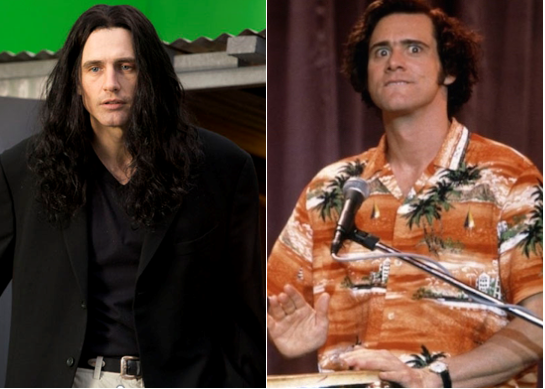
Both films happen to be a behind-the-scenes look at the filming of a movie whose production was affected -- some might say poisoned -- by the antics of a highly eccentric personality. In one, the guy couldn't help doing it -- he was just playing himself, as he always had. In the other, one highly eccentric personality was channeling another highly eccentric personality, doing it purposefully in pursuit of what he perceived to be some very specific brand of the comedic sublime.

Both films are funny, instructive examinations of these particular minds, and I enjoyed both quite a bit, though stopped short of loving either.

I came closer to loving The Disaster Artist. Not only does James Franco nail Tommy Wiseau and explore in a more serious manner the things that have been the comedic objects of much of his work (latent homosexuality among them), but the film has a ton of heart. As much as it considers Wiseau an oddball and even leans into that, it also considers his optimism and can-do spirit the perfect antidote to Hollywood cynicism. The Room was a singularly disastrous film but it was also the result of a type of purity of impulse that we usually do not see in the movies.

Jim & Andy is a fascinating document, to be sure, but I'm not sure it gets much beyond that (pun not intended). It considers how far Jim Carrey went in trying to channel dada comic Andy Kaufman, not only staying in character as Kaufman even after Milos Forman called "cut!" on Man on the Moon, but also playing Kaufman's alter ego, Tony Clifton, such that the actual "Jim Carrey" was almost never present. A cameraman shot all this behind the scenes footage and it has been sitting in the vaults for 20 years. Carrey gives modern-day interviews recalling his thinking at the time, impressive beard and all.

Both films provide a very interesting examination of what happens when the cameras aren't rolling. To be sure, they are not the first films to do this -- there's a whole interesting subgenre of films which show us what actually happened on the sets of movies we love. Few of them are quite so focused on the way a single man can hijack the production, while also shaping it into the movie we love as a result.

For those who love The Room, they only love it because Wiseau was unfailingly who he was and would not listen to well-intentioned advice. In one great example, Franco's Wiseau either refuses to listen to the suggestions of the first AD (Seth Rogen), or simply has a disconnect between hearing the advice and acting on it, as he proves incapable of filming a take in which his character does not laugh as a reaction to a story about a woman being physically abused by her boyfriend. Exasperated, Rogen's character just gives up so they can move on to the next shot. It's moments of pure and unspoiled cluelessness like this that make The Room sing. Had Wiseau had an ounce more common sense, he would have made a bad movie that no one saw. Instead, he made a bad movie that everyone saw.

Less of what Carrey was doing behind the scenes on the set of Man on the Moon is directly visible on screen. As he terrorized fellow actors (most notably the wrestler Jerry Lawler, playing himself, with whom Kaufman had a real-life mostly fake rivalry), he drove many of them to the brink of quitting the project. You get little bits of the frustration of people like Judd Hirsch and Danny DeVito. You'd have no way of really knowing that by watching the movie, except that it does feel like an uncanny embodiment of Kaufman, and if Carrey had just been switching back and forth between "Jim Carrey" and "Andy Kaufman," who knows if such a transcendent performance would have emerged. There's a telling recollection by Carrey in one of the modern interviews about how Forman felt about it. According to Carrey, Forman called him one night, out of ideas about how to regain control of his actor and bring the production in line. When Carrey threw him a lifeline and volunteered to "fire" both Kaufman and Clifton and then to do impersonations of them, Forman seemed to recognize the value of Carrey's process and rejected the idea. "I don't want it to stop," Forman allegedly told Carrey. "I just wanted to speak to Jim."

In a strange way, director Chris Smith seems to be the link between these two films. Smith, the director of Jim & Andy, was also the director of a documentary classic called American Movie. Like The Disaster Artist, that was also a movie about a Wiseau-like dreamer -- who also happened to have a long mane of black hair -- using his own resources to try to make a film. Mark Borchardt had much more meager and much less mysteriously sourced finances than Wiseau -- he borrowed much of the money from a senile uncle -- but it also cost him a lot less to make his horror short Coven (which I still have not seen, unfortunately). But in his own way he was probably just as delusional as Wiseau ... with, in some respects, an equally happy outcome. The film has turned Borchardt into a cult figure in horror and independent film communities, while Wiseau has eventually turned a profit on the $6 million he spent on The Room, though no one apparently still knows where he got the money to finance the project originally.

I saw The Room four years ago just before leaving Los Angeles, but it's been nearly those 20 years since my viewing of Man on the Moon. I'm curious to watch both again to see if I can see what I now know about these films creeping in from the corners of the frame.