Showing posts with label star ratings. Show all posts

Friday, June 5, 2026

Streak, interrupted

I don't know if I'd have any way of accurately checking this -- I could laboriously go through Letterboxd, back to 2002 -- but I've just finished my longest ever streak of watching movies that I gave the same star rating. 

Predictably, that star rating was the all-purpose, ever-reliable, ever-milquetoast 3.5 stars.

And it was a rating I gave to every new movie I watched between May 29th and June 2nd, which in this case was seven movies.

Not a huge number? Maybe. Not a huge time period? Definitely. But as I was looking at it on Letterboxd, it felt gigantic.

Now, this is the sort of streak that is utterly within my own control. I decide the star rating I'm going to give a movie, and if I were between two different star ratings, it would be easy to select 3.5 stars instead of 3 or 4 stars just to keep the streak going.

But no, I feel like each of those star ratings of 3.5 was given fairly, with no shenanigans. 

If you want to know the seven movies in this streak, they were:

Eleanor the Great
My Dead Friend Zoe
Ever After
Americana
The Crash
Fay Grim
The Death and Life of Marsha P. Johnson


I don't need to spend any additional time discussing them. Two of them I've already discussed. 

When I started watching Girl, Interrupted for the first time ever on Thursday afternoon, I sensed the streak was going to "finally" (too short to use that word) end. But I thought that's because I was going to give James Mangold's film four stars. Yes, despite reservations about the probable overwrought nature of this movie, which had kept me from watching it for 27 years, I was vibing with it well in its first half. 

It might have been around the time our heroine, played by Winona Ryder, tries to insult a nurse played by Whoopi Goldberg by talking in a racist take Southern Black accent that my feelings on the movie started to turn. (In 1999, perhaps this was not disqualifying of our sympathies, plus the movie was set in the 1960s.)

Or maybe it was during a suicide sequence that is so drawn out in the narrative that the audience is ten steps ahead of the characters during the entire staging, including the episode of verbal abuse leading up to it by co-star Angelina Jolie.

Whatever the case, Girl, Interrupted did morph into the movie I thought it would be at that point, and instead of a half-star above that 3.5, I went a half-star below. And probably could have gone lower, but I did retain the positive feelings from the first half.

Jolie? I'm not sure it's an Oscar-worthy performance, especially during the climax.

I know I'm not starting another streak because the next movie I watched, the idiotic "sharks in a hurricane" movie new to Netflix called Thrash, received a rare 1 star from me.

Wednesday, May 6, 2026

No need for 20 points of differentiation

I was listening to my fantasy baseball podcast this morning – and apologies for making this my second straight post with a baseball tie-in, though it doesn’t stay there – and they were doing a segment called the “believe-o-meter.” The task among the hosts was to submit an answer on a 1 to 10 scale of how much they believed in what a certain previously fringy player was doing this season.

Simple, right?

Except that one guy gave the answer of a 3 ½ out of 10 on one player. And another, I think sort of as a joke and to indicate his own uncertainty, gave a 4 ¾ on another one.

It reminded me how I am sometimes asked by my writers if it would be possible to introduce halves into our rating system.

ReelGood rates movies on a scale of 1/10. For those accustomed to the sort of five-star system Letterboxd uses, it’s the same thing, you just have to multiply the star rating by two. The previous editor somehow introduced a poop emoji when he wanted to go lower than 1/10, but I don’t know how he did that within the current functions available to me, and I’m not eager to repeat it anyway. 1/10 should be the minimum, just as a half-star on Letterboxd is the minimum. If you try to rate a movie 0/5 on Letterboxd, it just looks like you didn’t give it a star rating at all.

In either system that’s ten points of differentiation in quality. And ten should be enough.

We don’t need 20.

In the extremest of olden days, I think there might have only been four-point rating systems for the quality of things. One to four stars, no halves. I agree that that is too limiting to indicate finer points of quality, and so various systems involving five points (a five-star system) or eight points (four stars but with halves) were introduced. Our current ten-point scale is the best iteration anyone's thought of so far.

But the reality is, when you only regularly use a couple different ratings to indicate movies you like but don’t love – from 3 stars to 4, or from 6/10 to 8/10 – you do sometimes feel the need to indicate more nuance.

So that same former editor will sometimes say to me “I might give it a harsh 7,” or “I might give it a generous 8.” That would be talking about the same movie, but in one case you go a tick above, and sometimes you go a tick below. A rating of 7 ½ would solve the problem.

But are we really so wishy washy that we can’t take care of this problem in just ten different points? Our readers require us to be definitive, while understanding that not every film can be distilled down to a number, and that of course it’s just our opinion anyway, and opinions differ.

The real problem – and this is one I continue to come back to time and again on this blog – is that I am not making full use of the full range of ten ratings. Because I’m a bit of a softie, I give a significant number of films somewhere in that 6 to 8 range, in that I can usually find something about it that’s good enough to give it a 6. But sometimes I even feel bad about a 6, like it’s a slap in the face. And that leaves five whole numbers to indicate small gradations in films that are not very good.

I’m not going to change my rating system overnight to the one my former editor already uses, in which he reserves 8s for films he truly loves and almost never gives out 9s and 10s. That’s too far in the other direction, but it does mean he’s using more of the range, or perhaps at least is less reliant on halves. He might be using the same amount of the range, just shifted more negatively.

And I might not use the rating range as I ideally would, but at least I recognize that halves have no place on a ten-point scale.

Thursday, April 23, 2026

The default four-star documentary

I've fallen into a pattern with documentaries, which is that if they are competently made with even a hint of outside-the-box thinking, I am automatically going to give them four stars on Letterboxd.

Even if I found getting through them somewhat tedious, as I did with the 115-minute Paul McCartney documentary Man on the Run. 

Star ratings, it should be said, have two primary functions, in my view:

1) To indicate how much you personally liked a film;

2) To indicate how good this film is relative to its own goals/potential limitations. 

When it comes to documentaries, I often default to the second, more objective usage of the star rating, disregarding the more subjective usage. 

With documentaries, it is a given that you will not be equally interested in the subject matter across the whole genre. There are going to be films about things that speak to you personally, and films about things that don't. However, if you are a critic, you feel like your personal interest should be removed from the equation in assessing how well the film does what it sets out to do. In a way, this is true with any genre, since any individual critic is going to gravitate toward some and not toward others, and the star rating shouldn't suffer from that personal preference. But with documentaries I think it's even more clearly delineated.

So whether I am fully interested in the film the whole time may be more a function of whether I am fully interested in the subject matter, though I think you would also agree that a truly great film makes converts out of even people who are disinclined toward its topic. And that's why I do tend to give a well-made documentary four stars out of five, but no more than that, even if I find that its length or other parts of its execution try my patience. I think I assume that the length would try my patience less if I were more interested in the subject matter, though that's not a given, and unfortunately you can't really test it. 

The thing is, with Man on the Run, I am actually plenty interested in the subject matter. Although I am not nearly as familiar with Paul McCartney's solo career, I love the Beatles and have done so for a good 30 years now. And what McCartney did in the ten years following the Beatles' breakup is actually something I would like to know more about.

But ... 115 minutes of this was quite a lot. 

And here's the issue: it was largely undifferentiated. There are no talking head interviews in this doco, only archival footage. I should clarify that. Subjects are interviewed, but you don't see their talking heads. You see the archival footage and you hear their answers to questions -- but not the questions by documentarian Morgan Neville themselves -- over that footage. 

Even when the archival footage is as priceless as that included here, and even when it is strung together by interesting techniques in which images are played with on screen and bleed into one another, it's still too samey without the talking heads. And that leads it to feel quite repetitive, even as the narrative is moving forward through the approximately ten years that are covered here. 

Of course, there's a bit of a fallacy in saying that I missed the talking heads. Talking heads are generally the least interesting part of a documentary. So am I really saying Man on the Run would be better if I were looking at images of Paul McCartney sitting against a bland background in his early 80s?

I'm not saying that. I think all I'm really saying is that a movie does not deserve four stars if you are frequently checking to see how much time it has left, and if you don't feel specifically inspired or moved or uniquely informed by it. And that's kind of how I feel about Man on the Run.

So I didn't do it. I didn't give it the four stars. I gave it only 3.5.

And this is when I remind you, and myself, that 3.5 stars is a perfectly acceptable rating, and among some fellow critics who are harder on movies than I am, it's a great one. 

There's a funny footnote to this story.

I wrote this piece yesterday to get a head start on today. Truthfully, I just write the ideas whenever they come, and if that happens to be three in one day, I'll write them in one day (if I have time) and save them for the next available opening.

On my way home from work, after I had already written the rest of what you read above, I was listening to a podcast about pop chart history, and they were talking about one of the later albums by David Bowie -- one that critics recognized as a superlative example of his craft, but which didn't particularly connect with them or endure in their memories. The interviewee referred to critics giving it a "respectable gentleman's four stars." Which seems to suggest this is a struggle in the broader critical community, in situations where we want to show our respect for a piece of art, but also to indicate that something about it doesn't quite do it for us personally.

So maybe by this definition, Man on the Run is a four star-movie that I gave 3.5 stars -- opting, for once, for the subjective. 

Thursday, February 24, 2022

Star rating dispersal

I've started something this year that I hope will make my end of year tasks a little easier.

When I post the breakdown of my movies in my year-end wrap-up -- last year, it was 170 -- by how many got each of the ten available star ratings, it has historically required me to go through Letterboxd making little hash marks for each rating. The numbers look pretty similar each year, with 3.5 stars always having the most, followed by four and three. 

The trouble with this approach, though, is that a) it's tedious, and b) it's easy to miss one movie, and realize the numbers don't add up when you get to the end. If that happens, either you count again, which is even more tedious, or you just fudge it by adding one to one of the categories, usually the one with the most, since statistically, that's the one you were most likely to have missed. I believe I have done both things in the past.

This year, I decided to just keep track of it as I go, and save myself an hour of work next January.

So I've got my spreadsheet in which I can add the movies as I go, in a column devoted to their star rating. If I do forget and miss one, it is hypothetically easier to figure out which one I missed if I copy all the existing titles, sort them alphabetically and paste them side-by-side with my rankings, also sorted alphabetically.

The only thing I worry about is that by having a knowledge of how many I've given out in each star rating, I could be biasing myself toward stacking the deck in favor of a particular outcome. If I'm only counting at the end of the year, I have no way of knowing and the end result is sort of a surprise. But if, let's say, four stars has a chance to overtake 3.5 stars for the most in the year -- which I can glean easily enough by a glance at the list -- maybe I'm ten percent more likely to go four stars for my final viewing of the year, when I'm on the fence between that and 3.5. Do I think this is a concern in reality? No, but it did occur to me.

Anyway, I'm telling you all this because it has led to a funny realization with my first seven movies of 2022: They have been given seven different star ratings. And I can tell you for sure that this was not on purpose as an early incarnation of the thing I was worried about in the previous paragraph. 

No, I can genuinely say that my first seven films of 2022 break down as follows:

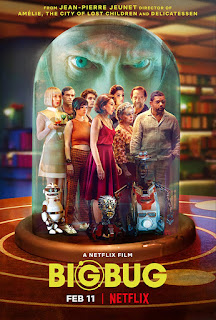
Bigbug (4 stars)
Death on the Nile (3.5 stars)
Hotel Transylvania: Transformania (3 stars)
Gold (2.5 stars)
Uncharted (2 stars)
Home Team (1.5 stars)
The Sky is Everywhere (.5 stars)

Spoiler alert for the relative placement of these films in my year-end list. 

Now, if my next three viewings are a 4.5 star, a five-star and a one-star, you'll know there are shenanigans for sure.

This obviously can't continue much longer -- three more viewings at most. And at the moment I'm not sure what my next 2022 viewing will be, so I don't know if it has any realistic shot at 4.5 stars, though I give that out with some regularity (15 times in 2021). Five and one are considerably less likely. 

But while it's continuing I'm enjoying it. I might actually be getting the most joy from having given out a .5 star rating, as discussed earlier this week in this post, since it's something I didn't do in all of 2021.

And will I miss the thing where I take a stroll down memory lane at the end of the year, making hash marks on a piece of paper (always a satisfying exercise) as I remember the movies that made up my 2022?

Could be. And hey, if that's the case, I can always ditch this new practice in 2023. 

As for Bigbug, the most recent addition to my 2022 list ... Jean-Pierre Jeunet is back! In his first feature since 2013 and the first I've seen since 2009, he crushes it. Well, four stars' worth of crushing it, anyway. Check out my review here.

Friday, February 4, 2022

Monitoring percentages and denying passes

I recently went back and added my last 50 films to my spreadsheet of all the movies I've ever seen. I get behind on this list, because it involves a bit more work than my other lists. It's not just adding a title to one Microsoft Word document -- actually four or five documents depending on the film -- which goes pretty quickly. It's adding a title, recording the director's name, recording the year, recording the running time, noting the venue in which I saw it (theater or video), and marking whether I give it thumbs or thumbs down, then adding to running totals of various categories at the bottom of the sheet. Even this would be relatively quick, but I also have a tradition of reading the review of whoever wrote about it on AllMovie, my old website from which I am now more than ten years gone, and this is what truly makes it seem like more of a commitment, not something I can just smash out in the few minutes before I go to bed.

One of the things I've become obsessed with as I maintain this list is my recording of the total thumbs up and thumbs down, which I update at the bottom of the page, and whose totals give me a percentage of likes and dislikes.

This percentage obviously doesn't change very much, as the ratio of likes to dislikes is fairly steady over time. But I do observe small changes, and it's the ones that move the "like" percentage upward that actually worry me.

For ages now I have been hovering around 67.85% movies I like, leaving 32.15% of movies I dislike. When it gets too close to 68%, I worry I'm not being hard enough on my films, and I question the very core of my critical faculties.

Right now, after the end of year period in which I watched mostly films I liked, it's at 68.06%.

What's wrong with liking more movies, Vance? Doesn't that just mean it's a good use of your time?

Sure. But what I'm really concerned with is whether I'm giving a pass to movies I actually don't like. 

It really comes down to the line of demarcation between movies given three stars and movies given 2.5 stars, which is the dividing line between a thumbs up and a thumbs down. Even though it's only the difference of half a star, it feels much larger than that. One feels like a reward; the other feels like an indictment.

I think I should be indicting more movies than I am -- or really, just realizing that 2.5 stars does not mean that a movie has no value.

I've discovered I have a tendency to give three stars to movies that are considered classics but that don't really connect with me. Like, an acknowledgement that "it must be me." The movie is considered great by other people, so that must mean it has a value that I'm missing. I'm recognizing strong techniques and observing a sort of objective quality to the film, but in the end it doesn't totally work for me.

Is that a three-star movie, or a 2.5-star movie?

I'm going to try to determine that this is a 2.5-star movie, or maybe even on the rare occasion, a two-star movie. It's not like I'm putting this assessment out anywhere in the world except on my own Letterboxd, or possibly a mention of it here if I write about it. It's not like I'm changing the conversation on the film. It's not like I'm contributing to lowering its fresh rating on Rotten Tomatoes. It's just me we're talking about here.

And I think I deserve to be honest with myself.

Even some of the movies I watched at the end of 2021 are a good example of this. I gave three stars to The Eyes of Tammy Faye, a movie I really didn't think worked all that well. I recognized good aspects to it and the movie definitely has value, but did I like it? I probably didn't really like it. 

I think on some level I was worried that I am spitting in the eye of Jessica Chastain, an actress I love, if I give a movie where she gives a really strong performance a thumbs down. Jessica will be able to take it. In fact, Jessica won't even know.

The goal of this adjustment in my methodology is not specifically to drive down that like percentage to the sub-68% range I am more comfortable with. Rather, breaching 68% has made me realize that maybe I'm just not being that truthful about a movie's actual impact on me. If I come away from a movie feeling disappointed -- not just relative to my expectations, but even in situations where I didn't have expectations -- I should not then be going to Letterboxd to give it three stars. I should not then be going to my movie spreadsheet, or a month later when I catch up again, to give it a thumbs up.

So these movies no longer get a pass. Starting now.

Having typed all this, I realize I have written at least one, and possibly multiple, posts in which I make this exact proclamation. You probably don't remember them, if you ever read them the first time, so it's "new to you." But I remember them, and it does make me feel a bit silly.

Then again, I reckon I am probably rehashing similar thoughts on this blog all the time, and when you have more than 2,700 posts, that kind of thing can't be helped. Besides, each new time I write about it, it's a reminder to actually stick to my guns this time.

Thursday, January 21, 2016

The abuse of the near-perfect score


Time for another rumination on the ways I'm struggling with correctly applying star ratings to movies.

In 2015, I successfully clamped down on throwing a perfect score to very many films. Out of 304 new-to-me movies I saw in 2015, I gave only four of them a five-star rating on Letterboxd. That's only one-tenth of one percent of the movies I saw last year.

Four-point-five stars? That's another story. I did that 34 times. That's more than 11% of all the movies I saw.

And I did see some good movies in 2015, no question about that. But were they just good, or were they really, truly great? And what is the cutoff between good and great in a star rating?

It's that same old struggle, the one that always makes me question again the validity of star ratings -- or certainly their objectivity. Their transferability.

And even though I've been trying to be less wanton with my 4.5-star ratings, a problem I've been conscious of especially during the second half of the year, I'm not off to a good start in 2016. I've seen 33 movies so far in 2016 (I know that's a lot, but January is always a busy month) and a full seven of them have received 4.5 stars. Or 21%.

It's hard to figure this out when I have people in my life who tend toward either extreme.

For one there's my editor at ReelGood, who is notably stingy with his five-star ratings (which must be doubled for ReelGood, where the ratings scale is 1 to 10). He didn't give the maximum 10/10 to any movie he reviewed in 2015, though he did give the rating twice in 2014. Not only that, but he'd tease me about each new 9 I submitted. It just so happens that I reviewed many of my favorite films of last year, resulting in seven scores of 9 out of 37 reviews I wrote, or nearly 19%. But then when you include the two perfect scores I gave, that's nine reviews of 9 or higher, or nearly a quarter of all my reviews. When you include the five reviews where I gave an 8, that's 14 of 37 with an 8 or higher, or nearly 38%. And with two of those, I wanted to give a 9 but shied away from it to maintain the sense that I wasn't just a movie-loving loon.

So I've been overpraising movies, right? Erring too much on the side of film optimism, right?

Hold on there. I just read the top 15 of 2015 of a guy in my Flickcharter discussion group, and he gave five stars on Letterboxd to ALL FIFTEEN films on the list. His rationale was also convincing: "I don't use half stars in rating; I give five stars to anything I'd be happy to say could be/is in the top 10% of movies I've seen, and each honestly makes that cut."

Wow, just imagine how tied into knots I'd be if I cut out the half stars. Making me choose between three stars and four? I just couldn't do it.

So that leaves me in the same spot I always find myself whenever I force myself into one of these exercises of self-examination: no closer to a perfect answer. I clearly want to recognize films for going above and beyond but not being perfect. Some people might give those movies four stars. I guess I've been giving them 4.5. But it does create less overall margin for error. It does create fewer spaces in which to express the subtle differences in the gradations in greatness between two separate movies.

I guess I'll just continue going with my gut, and trying not to think about it too much.

Thursday, September 10, 2015

Star subterfuge


The marketing team behind Tom Hardy's new movie has brought deceit to a new level. You might almost call it legendary.

This ad for Legend contains what appears to be an overwhelming onslaught of four- and five-star reviews praising the film. And in most respects, it legitimately is just that.

But the marketing team got greedy. I guess they couldn't find exactly 12 reviews that were at least four stars, so they added a two-star review in there.

Can't see it? It's the one between Tom Hardy's left ear and Tom Hardy's right ear.

Oh, you're meant to think it's just another 4+ review. But Benjamin Lee, critic for The Guardian, tweeted otherwise:

"Incredible way of making my two-star review seem like I didn't hate the film."

What's brilliant about this is that this ad is completely not lying. There are only two stars above the words The Guardian, and that's exactly the number of stars Lee gave the film. It's misleading, for sure, but all is fair in love, war and advertising, right?

What's not brilliant about this is that someone should have anticipated that the subterfuge would be uncovered. And if they knew Lee, who sounds a bit cheeky, then they should have guessed that he might do something like this. (I don't know Lee from a hole in the ground, but anyone who maintains an active Twitter profile is liable to say anything, as we have repeatedly learned.) Either they didn't consider that, or they did a cost-benefit analysis and decided that whatever negative publicity might be generated over a calling out of such manipulation would pale in comparison to the positivity of seeing that impressive fleet of stars.

The one real design flaw is leaving "only" four stars above the head of the Hardy on the left, which is the only place on the ad that calls attention to the fact that less than the full number of stars was given. Of course, that gets us into the whole problem that not everyone uses a five-star scale anyway. Sometimes, four is the maximum number of stars, which is why you'll sometime see (out of 4) appear after the star rating. Since maximalism is the principle at play in such advertising, you'd only do to indicate that the film had received the full number of available stars. That's why you never see (out of 5), because a) 4.5 stars assumes the existence of a five-star scale, b) it's not needed with five stars because there's no commonly used scale that includes more than five stars, and c) if it's only four stars, you don't want to be honest about it only getting 80% of the way there; you want the user to retain the belief that this could be the maximum number of stars.

Of course, beyond any star-related shenanigans, this ad also commits a cardinal sin that I've written about before, using the word "unmissable," which is barely even a word. Unless we're talking about asteroids with a mathematical certainty of hitting Earth, nothing is "unmissable."

In this case in particular, Benjamin Lee would be inclined to agree.

Monday, May 25, 2015

Giving out star ratings - for beer


If you think star ratings are a hopelessly ineffectual way of ranking movies, try using them to rank beers.

If you think that nearly every movie you see is somewhere between a 2.5 and a 4, I repeat -- try using star ratings to rank beers.

I was in a position of doing that on Friday night, as the Great Australasian Beer SpecTAPular rolled through town. (I say "rolled through town" because there is also one in Sydney, not because it's actually some kind of moveable drinking feast complete with clowns and carnies.) I went with a co-worker, and we met up with his housemate, his brother, and another friend.

Here's what you do. You buy a bunch of "tokens" (actually, thick-cut paper squares attached to each other along perforated edges). You get a paddle with a chalkboard surface with five holes in it. (You will get what I'm talking about when I post a picture at conclusion of this paragraph). You review the 118 beers on tap listed in the festival guide, and choose five per paddle, all within the same range of 20 beers. You scrawl their numbers in chalk, one under each of the holes. You then wait in line (or "in the queue") in front of six different beer stations, each of which has 20 taps. You return -- very carefully -- with samples of five beers, each in plastic cups that are about the size of one-and-a-half shots. Then, over the course of the evening, you steadily get drunker and drunker.

Here's that photo:


Because I am not a beer aficionado -- I like what I like, but I can't really "talk about" beer -- I decided to choose which beers I sampled completely randomly.

It was a blast. None of the 30 beers I sampled were outstanding -- more on that in a minute -- but the steadily getting drunker and drunker part was more than enough to make up for that. Plus, the company was good, a BBQ sandwich really hit the spot about midway through, the venue was grand (the Royal Exhibition Building, former home to the Melbourne Museum), there was a giant game of Jenga, and there was a brass band playing pop songs, so it was just a great evening.

Don't worry, we're getting back to movies. Now, in fact.

Because the others were doing it -- and because it dovetails so completely with my nature -- I gave star ratings to all the beers I sampled. Yes, all of them -- I remembered to keep doing it even as 11 p.m. rolled around and I'm not even sure I could have even written my own name at that point.

Nearly half of the 33 beers I ranked -- I had three others donated to me from others who didn't care for them -- got that middle-of-the-road, three-star ranking. That's 16 of the 33. Three-point-five was the next highest with nine, then 2.5 had four, 4 stars had two, and then one each for 2 stars and 1.5 stars. That 1.5-star beer I clearly remember -- it tasted like bargain basement raspberry soda with alcohol in it.

Wait, didn't I say I was getting back to movies?

I think the point of my comparison is that after a while, everything just blends together and you are giving a three to everything. You don't actively hate very much, but you don't love anything either. It seems like a lot of movies that come down the pike are ones that you feel like you should rate lower, but they do whatever they do well enough that they deserve at least three stars. Such was the case with Friday night's beers.

However, there's also that idea of grading on a curve. A star rating is not always an absolute thing -- you sometimes can't help but think of it in comparison to other star ratings you've recently given out. My favorite beer of the night ended up being #72, "Almonds of Steal," from Mildura Brewery. This is a funny/interesting choice for two reasons: 1) My father-in-law taught in the town of Mildura for a good portion of his career, and 2) It was quite possibly the only vegan beer there, and I'm not usually a vegan type of guy. Because it was one of the first ten or so beers I sampled, I skewed conservatively and gave it "only" four stars, expecting that it would have a number of competitors over the rest of the evening. In fact, it did not -- and the only other four I handed out, I think I did so because it seemed ridiculous that not a single other beer had made it into the four range.

I'm living through the opposite curve problem now in the movies I'm seeing, though I guess if you love movies (as I do), the only reason you'd think of it as a "problem" is because you wonder if it means you're not being critical enough. Since the beginning of May, I have only seen a single film that received fewer than three stars (2.5 for Anna Karenina) and a full nine movies that are four or higher. The other five have been three or 3.5. Of course, at times like this I wonder if the movies I'm seeing are really all that good, or if I've just established a higher-than-normal baseline with one of my recent ratings and now everything else is skewed as a result.

So what do I ultimately conclude from all this?

I don't know. I think I just wanted to write a post about drinking beer.

Thursday, July 10, 2014

Too much good stuff


Or, "The Breakdown of my Personal Star Rating System."

If I look at my month of July so far on Letterboxd, it is nearly collapsing from the weight of all the stars.

I've seen seven movies in the young month, and only two of them have received a rating of lower than 4 stars (out of 5). In fact, the number that have received 4.5 stars, which was once reserved for movies that reached my personal cinematic stratosphere, exceeds the number that received 3 or 3.5 stars (three to two). And the one I gave 3.5 stars -- in other words, the second-worst of the month -- is one I'm still thinking about three days after I saw it.

This is good. It means I'm spending my time on good movies.

But this is also bad. It means I'm losing my grasp on which movies get which star ratings.

Take Mistaken for Strangers, a very good documentary that I saw last night. Is it a great documentary? It might be. But I'm not sure about that. I have to think about it a bit longer.

I gave it 4.5 stars, not necessarily as a sign of its absolute quality, but to differentiate it from the heap of movies I've been giving 4 stars.

And this is where my true crisis lies: the loss of my understanding of what makes a 4-star movie.

Let's go back a few months.

When I came out of Nebraska and gave it a 4-star rating on Letterboxd, a friend of mine wondered what my problem was with it. "Problem?" I thought. "I gave the movie 4 stars!"

The same has happened with a couple other movies, with the same friend (I'm not picking on him, it's just that I talk movies with him a lot), to the point that I started to think of 4 stars as some sort of "insult" to a great movie. The rating I used to give to a movie that did a lot right, but not everything, was 3.5 stars. Three-point-five indicated that I thought a movie did quite a good job, but it wasn't a personal favorite.

So -- are you sitting? -- when I finally saw 12 Years a Slave a few weeks ago, and was underwhelmed by it relative to what I was expecting, I felt the only "responsible" star rating to give it was 4 stars. Three-point-five would be like some sort of slap in its face. So even though my primary instinct after seeing 12 Years was to pick at the things I thought it could have done better, there I was giving it a ranking of 4 stars on Letterboxd.

And if I gave this movie that I found somewhat problematic 4 stars, then how could I give the same rating to Mistaken for Strangers, which I may have loved?

Four stars is a tricky rating. On its own it looks quite impressive, all those stars lining up together in support of a movie. But it's still two notches below the maximum. It still means there's something wrong with the movie, flaws you can clearly pick out -- or maybe just that it wasn't in your wheelhouse, so it had a maximum potential enjoyment factor just based on its subject matter.

I don't mind being the type of cinematic optimist that's implied by giving out so many high ratings. I mean, clearly I love movies, so I would rather enjoy watching them and shower them with praise than to spend all my time grumbling about how they could have been better. I'm comfortable with the fact that on Letterboxd, I've given 174 films the highest possible rating (5 stars) and only 20 the lowest possible (1/2 star).

But I don't want one of my most reliable ratings -- 3.5 stars -- to become too weak for me to employ it without worrying that it means I don't really care for the film. Four stars is really creeping up on 3.5, with 653 movies that now hold a 4-star rating on Letterboxd and only 804 ranked 3.5. You'd think that 3 stars should be the highest represented, because that's the midway point between the lowest and the highest rating. But it's only second at 730.

And if damage has been done to the 3.5-star rating, just think how much damage has been done to 3. Three stars means I barely liked it. Some people use 2.5 to indicate that, but I use 3. If I give that out less and less, then what kind of terrible sins does a movie have to commit in order to get 2.5 and lower? There are a whole five star ratings down there that need to get their share of the love.

I do have to consider the possibility that 2014 has just been a really good year for movies. I've seen 18 films this year, and only one of those have I disliked -- and even then only mildly (2.5 stars). Only seven of those 18 films (including the 2.5-star Veronica Mars) have been given a rating under 4 stars, in part because I used the above logic to inflate the 3.5-star Lego Movie to 4. To counterbalance that, though, I'm wondering if I might have given 4 stars to both Frank and Blue Ruin, if at the time I ranked them I didn't already feel I'd been giving out 4 stars too much.

See? I don't know what anything is anymore.

And at this point, I feel almost desperate to see something that is just unambiguously god-awful.

This whole discussion just lends further weight to my appreciation of the Flickchart model, which duels movies against each other to create a customized list of favorite to least favorite. The Flickchart guys have identified the weaknesses in star ratings, and their mission statement can be summarized in this slogan that appears atop the site: "If they're all 5-star movies, which is the best?"

If I keep going in the direction I've been going, pretty much all the movies I see will be 5-star movies.

A nice problem for a cinephile to have, I guess.

Friday, November 22, 2013

Three-star animation


I've seen two objectively subpar animated movies in the past ten days - Alpha and Omega and Escape from Planet Earth - and given them both three stars on Letterboxd.

My son saw the Netflix ad for a third objectively subpar animated movie - Hoodwinked Too! Hood vs. Evil - pop up after Planet Earth, so he's in there watching it now. I'm in here, typing this, to prevent myself from giving the supposedly terrible Hoodwinked sequel three stars as well.

Something seems clear: I have a harder time recognizing mediocrity in an animated movie than elsewhere.

It's three out of five, not three out of four, but the fact remains that I am giving a passing grade to movies that should probably flunk the test of being worth my time.

I'm entirely too comfortable with rewarding an animated movie for being a "good try." I know that Disney, Pixar and Dreamworks represent really daunting standards to live up to, both in quality of writing and quality of animation, so I'm acknowledging the handicaps that other movies start out with. But that doesn't mean that all other movies deserve the star rating that translates as a modest recommendation.

There are a handful of reasons I think I'm as easy as I am on these movies:

1) The animation, especially these days, is good enough to contain some "wow" moments. Plus, I know how hard they worked on every little detail. Most animated movies are a labor of somebody's love. It's much easier to mail in a live action film.

2) Animated movies tend to get top-flight vocal talent, mostly because it's an easy paycheck and does not carry any particular stigma. Studios will be glad to learn that their money is well spent, as I do tend to be impressed by the fact that William Shatner (who, let's be honest, will do anything these days) voices the villain in Planet Earth.

3) Animated movies are usually smart enough (i.e. safe enough) to stick to conventional plotting with familiar character types. With the amount of money invested in the polished final product, it does not pay to take risks on the story, nor is it possible to slide any remotely objectionable content through.

Vanilla, though, should not be worth three stars. It should max out at 2.5, even if it's pretty well-made vanilla.

However, as I've written before (though never specifically about animated films), I feel like giving something 2.5 or less means it's a thumbs down, an entirely too grumpy dismissal of a movie that's okay to pretty good.

In fact, the last animated movie I remember really slamming was one that did take an apparent risk with its plot -- an impulse I probably should have rewarded, except I thought it was just too wrong-headed of a narrative choice. That movie was Brave, which offered us some cockamamie plot about people turning into bears. I gave it 2.5 stars, but these days tend to think of it as a two-star movie.

So am I saying I like the generic underdog hero story and panoply of colorful sidekicks better in Alpha and Omega, Escape From Planet Earth and (let's throw in one more I saw earlier this year that fits the description) Planet 51? Are they better just because they don't make any egregious errors? Are they better just because the plot was deemed safe enough by every interested financial backer?

I'm a slow learner, apparently, because this is not the first time I've tried to get tougher with my star ratings. It's not even the first time this year. You may recall that back in April, I wrote this post after seeing Trance, frustrated by the instinct that made me want to award it three stars. And I still haven't figured out how to award lower when movies deserve it -- at least not consistently, and especially not with animation.

Maybe this time, I'll do as I write. "It didn't offend me" should no longer be the standard for what gets three stars.

The generosity ends ... now. Again. 

Wednesday, April 24, 2013

The generosity ends now


I've become an old softie of late.

By "old" I mean I just started the six-month countdown to turning 40. And by "softie" I mean that I feel like a jerk if I give any movie less than three stars.

This is where Danny Boyle's Trance comes in. But more on that in a minute.

Star ratings were something I never used to worry about at all. I made no habit of generating them on my own. The only way I really officially recorded some kind of quantifiable reaction to the movies I saw was giving them either a thumbs up or a thumbs down, a judgment I recorded in a column on the Excel spreadsheet where I track all the movies I've ever seen. There were certainly some movies that caused me to agonize over this choice, but at least it was only a 50/50 decision.

Since starting to use Letterboxd a little over a year ago, though, I've been thinking of movies in terms of star ratings a lot more. I was primarily drawn to the site because it would allow me to easily record the dates of the movies I saw, making this effectively a "cloud backup" of all the other documents I keep related to the movies I watch. (I can reconstruct all my other lists as long as I have a way of determining which movies I've seen since my last successful backup, and this gives me that.)

Another irresistible element of the site is giving the movies star ratings. It's not that I don't resist this element on other sites, like IMDB and Netflix, but that something about the Letterboxd interface encourages me to use it here. So use it I do. And unfortunately, a side effect of that is that as I'm watching a movie, I keep a running dialogue with myself about what its star rating should be. It's a distraction I wish I didn't have, though I suspect this afflicts anyone who reviews movies professionally to a greater or lesser extent.

Another side effect is that I've had to sync the two judgments I'm making, the thumbs up/thumbs down and the star rating. That means I need to choose an objective standard for the lowest star rating that can earn a thumbs up from me.

This is the hard part. Letterboxd uses a scale of .5 stars to 5 stars -- I suppose you could give a movie zero stars, but it would look like you simply forget to enter the star rating at all. So I've chosen three stars as that logical midpoint. Three stars out of five is a movie I like somewhat, whereas 2.5 and lower is something I dislike more than I like.

The system seemed to make a certain amount of sense. It gave an equal number of star ratings to "good" movies (3, 3.5, 4, 4.5 and 5) as to "bad" movies (.5, 1, 1.5, 2, 2.5). Seems fair, right?

Except the thumbs up/thumbs down part of it is screwing with my head. Can I really give a thumbs down to a movie that does some things right? I'm comfortable giving that movie a 2.5 stars, but I'm not that comfortable giving it a thumbs down. It seems too harsh, too absolute. Yet I do fundamentally believe in the determinations I've made about which star ratings should go to which movies. Three is my minimum for a movie that earns more praise from me than scorn.

Now it's just a matter of recognizing when I'm scorning a movie more than praising it.

When I walked out of the theater after watching Danny Boyle's Trance last night, I had decided it was worth three stars and a very mild thumbs up. When my viewing companion asked me what I thought of it, I said that I liked it more than I didn't like it. "Really?" he said. "It was alright ..." He trailed off, indicating the "but."

And yes, what about that "but"?

The next 15 minutes were spent discussing things we didn't like about Trance. I will spare you those discussions, since you probably haven't seen it.

The point is, when you get out of a movie and your first instinct is to pick apart the things that didn't work, how is that a "thumbs up"?

It occurs to me my problem is this: If I can't give a movie my recommendation, it feels the same as saying it's worthless. Which is ridiculous. Ever heard of a noble failure? I apparently haven't.

Trance is the definition of a noble failure. It means to be a jumble, but it's more of a jumble than it means to be. It means to contain surprises, but some of the surprises just don't work. It means to have a distinctive visual scheme, but sometimes that scheme gave me a headache.

So yeah, a noble failure.

A 2.5-star noble failure.

What I need to get over is the idea that I am somehow damning these filmmakers to hell if I give them anything less than three stars. Even if they worked really hard and made a lot of interesting narrative choices, it can still not work. And if a movie doesn't work, the best it can be is 2.5 stars ... right?

My "good try" approach to star ratings has left me with an unfortunate imbalance on Letterboxd. I've got tons and tons of movies with 3 or 3.5 stars, and because I'm giving those out too freely, that lowers the standard for 4 or 4.5, because I want to distinguish those movies from the 3-star dreck. The imbalance leaves very few movies with 2.5 stars and lower. Especially neglected are the .5, 1 and 1.5 star ratings. Give out those, and you're basically saying the filmmaker is not only an untalented hack, but a bad person.

So, how to restore balance?

The first step is to stop awarding participation ribbons to people who made unsuccessful movies. Just because Danny Boyle is coming off two genuinely great films (Slumdog Millionaire and 127 Hours), it doesn't mean he's incapable of failure. And just as I would call a spade a spade, I need to start calling a failure a failure.

The generosity ends ... now.