Showing posts with label metacritic. Show all posts

Saturday, March 11, 2023

The trolls rear their ugly heads again

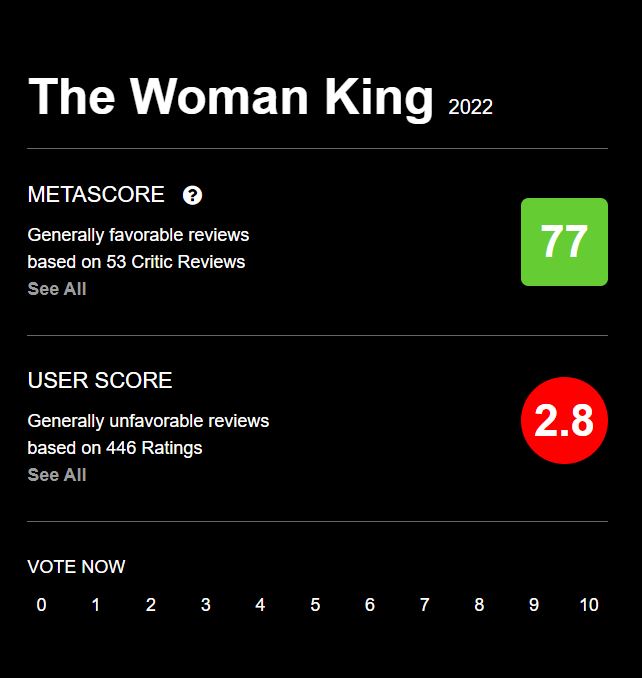
I bet you've never seen such a bright green critical recommendation next to so much angry audience red on Metacritic.

But if you have, I bet it's for another movie that triggers right-wing trolls like The Woman King triggers them.

Now I should say, I wasn't a big fan of The Woman King. I don't remember all the reasons at this point, but I can promise you, it wasn't because it puts Black people in a position of power, defending themselves against the encroachment of white imperialists. (I'll get to one of the reasons, which I think is valid, in a little bit. But there is already enough sabotaging of this movie on Metacritic that I don't want to start out this piece that way.)

The discrepancy between the 77 critic score and the 2.8 audience score is jarring enough, but it becomes even more so when you convert the latter score into numbers. Among the 446 user reviews, 112 are positive, 21 are mixed -- and 313 are negative. 

And most of those negative reviews are scores of zero.

Come on, trolls. You're not fooling anyone. 

You obviously didn't even see the movie, because why would it benefit your world view to even give it a chance? 

Here are two of the examples of what "people" -- as in, maybe Russian bots -- have said about The Woman King, just limited to what appears on the front page:

"Hollywood has no shame and would fake any insane story to attract [sic] woke audience."

"Honestly is just the regular woke racist crap as usual from the leftists."

Yeah, there's that W word rearing its head as well. Didn't some idiot conservative politician recently say that the biggest problem facing the world was woke culture? Maybe they all said it.

Because I was curious how much energy went into making a movie people liked look like a piece of shit, I decided to drill into the negative responses and see how many zeros there really were.

Audience scores start being considered negative at a score of 3. The Woman King has five scores of 3, five scores of 2, 17 scores of 1, and that means ... carry the one ... 286 scores of 0. 

Give me a moment while I burst out laughing.

If you are a serious movie person using these sites in a responsible way, you would never give a movie like The Woman King a zero on a ten-point scale. It is competently made. It has rousing fight scenes. At least some of the acting is indisputably impressive. Zero stars is what you give The Room, and only if its amateur terribleness doesn't bring you a sense of joy. It's not what you give The Woman King.

I didn't bother sifting through the actual text of this copious quantity of zero scores, but I bet there would be racist dog whistles throughout.

The thing is, the reason I had The Woman King on my mind today was because I did, indeed, not like it very much, and the idea of whether Viola Davis should have received an Oscar nomination over Andrea Riseborough came up again on a podcast. But for me, not liking it very much means 2.5 stars out of 5. It doesn't mean 0 stars out of 10. (Incidentally, I don't have an actual opinion on the actresses' comparative worthiness for an Oscar nomination because I have not seen To Leslie.)

I came to Metacritic to read an intelligent takedown of The Woman King, and instead I got ... this monstrosity. Which makes me really want to watch it again and give the things I didn't love about it the highest possible benefit of the doubt.

I promised I'd tell you one, so here it is.

There's a moment in the last 30 minutes where Davis' character comes to some realization about feelings she's been having. I wish I could remember the actual dialogue she speaks to another character, but it involves her breakthrough that she has "denied the child inside her," or something along those lines. In other words, totally bogus 20th or 21st century psychiatry speak from a self help book, not a thought a person would express to themselves 200 years ago -- especially not a person unacquainted with western critical thought, especially not a person defined by training herself as a warrior, denying all other potential distractions in the process. 

For me that moment was emblematic of other failures in the film, which led to a mildly negative experience.

Checking out the more trustworthy part of Metacritic's offerings as they relate to this movie, I was less dispirited, but still somewhat dispirited, to find the critical bias leaning so far in the other direction. Of the 53 critic reviews that had been tabulated, 49 were positive, with only four mixed and none in the dreaded red. I clicked on the lowest score of 40, issued by critic Kyle Smith from The Wall Street Journal, hoping I'd hear my muted impression of the film echoed back at me. 

I couldn't read more than the first 150 words of the review because I hit a paywall, but I also realized ... The Wall Street Journal is a right-leaning organization. So I've got to take this critic's perspective, even as carefully shrouded as it was within some opening praise for Davis, with a grain of salt.  

But should I be taking all these perspectives with a grain of salt, not just the negative ones? I started wondering whether there was some truth to the accusations of excessive wokeness by those on the right, whether they might have their finger on a real trend, even if they didn't actually watch this specific movie. If, indeed, any progressive critic is too shy to say anything negative about The Woman King because it would be failing some sort of woke litmus test. And any critic from a right-wing organization has to go more negative just to compensate.

And that by not loving The Woman King, I am somehow aligned with these people.  

It's really troubling that we live in an age where if you like something that is mediocre but has honorable intentions, you must love it to death, in order to fight off the people who hate it so much, they'll go to any lengths to drag it through the mud.

It seems that The Woman King is an ideological battleground as much as it's a battleground between Africans and European invaders. 

Sunday, November 21, 2021

Metacritic has fallen on hard times

Ever since I first became aware of Metacritic and Rotten Tomatoes, which I think was about the same time, I have been steadfastly a Metacritic supporter. That's even though Rotten Tomatoes is by far the better known and more culturally referenced method of compiling critic and user reviews to reach a single score that represents the value of a cultural item.

It wasn't a methodology thing. In the past I have looked into how Metacritic does things and how RT does things, and if anything, Metacritic utilizes the more mysterious, inscrutable means of producing its scores. I believe they have even come under fire for being less strictly data driven or less accountable to explaining their procedures.

Really, it came down to what it comes down to in a lot of these situations for me: Presentation.

I always liked how Metacritic looked -- its fonts, its layout, its whole gestalt. Meanwhile, I thought Rotten Tomatoes looked like it had been made by a child who had mastered web design -- a very competent child, but nonetheless, one who liked childish things. Like I have never gotten into the tomato splats. They just look like something you'd see on Nickelodeon's official website.

I'm not saying I feel any more favorably toward Rotten Tomatoes than I once did. I almost never visit the site.

But neither do I almost ever visit Metacritic, which has become a shadow of its former self.

The first problem I noticed a couple years ago was that the site was absolutely crippled by ads. On any page you tried to reach, there would be at least one video and usually a couple other Java-powered ads scrambling around to get your attention. Sometimes you'd have to close ads just to get to your content, but the ads themselves would contain false icons that made you think you were closing the ad when really you were clicking to learn more information about the product. Or there would be multiple ads for the same item with the content sandwiched in the middle, in a reading area that was truncated from its previous real estate.

I can be frustrated when a thing like this happens, but I also understand it. The reality is, it takes revenue to run a website. If you don't have other streams of income, you have to rely on advertising more and more. And the advertisers knew what they were doing, making their ads increasingly pernicious and increasingly debilitating to the usability of the site. (According to me, they did not know what they were doing, because any ad you perceive as pernicious should not be effectively selling the product. But it must have worked with some people because you still see these sorts of ads.)

I don't notice Metacritic being destroyed by ads these days as much as I once did. Maybe the advertisers wised up, or maybe Metacritic wised up. Now, it's an issue of functionality that has nothing to do with the effect of the ads. 

When I liked No Time to Die but was curious to see whether I liked it more or less than other critics, I went to Metacritic to get a sampling of their opinions. And this is what I found when I tried to search for it:


One of the biggest movies of 2021 cannot be found on a site dedicated to reviews of culture, through a normal search of its title.

Now, I know No Time to Die has a page on Metacritic because I googled it. That took me to the page and allowed me to see that the movie has a 68 score, which is almost exactly aligned with my own 7/10 (3.5 star) rating I gave it on ReelGood. In fact, I hesitated a little between 6 and 7, never seriously considering 6, but knowing I had enough qualms that a 7/10 was not a slam dunk. That uncertainty on my part computes to a 68 Metascore almost exactly.

Now why couldn't I have just found this by searching the site?

I suspect it has something to do with the lack of distinctiveness of the four words in the title. Those four words would appear in countless other titles, and it's possible that they just don't bring up the film when taken in combination with each other. A major malfunctioning of the site's core search architecture, to be sure, but one that at least has some sort of explanation.

But let's conduct the search from the very page itself, something that does not change the way the search performs, but just looks funny in context.

Sorry, that's a bit small, but maybe you can zoom in, or just wait for me to explain what we're seeing in the next paragraph. 

In this particular instance it does give some results, as it is searching all of Metacritic, rather than the focused movie search I did previously. The titles it does produce are not only significantly more obscure than the movie I'm searching, but they also feature common words that would appear in multiple titles. If my previous explanation for the failed search holds water, then why is the 2014 iOS game "No one dies" able to be found? Those words are certainly no more common in frequency in the database than "No time to die."

My goal today is not to roast and lambast Metacritic. It's actually far more solemn than that. It's to mourn the solid product I used to love and to visit on a weekly basis. Nowadays, I might go months between trying to use this as a resource to gauge critical consensus on a movie, and the latest James Bond movie is a reminder why.

The sad thing is that I'm not going to RT either. I'm just not looking up these critical consensuses, something I used to dearly enjoy and consider a key aspect of my engagement with the movies. 

Our relationship with any form of culture evolves over time, but when that change is forced by an external failure like this one, rather than something essential about our own changing perspectives, it's disappointing indeed.

Wednesday, July 30, 2014

Metacritic's imperfect math


It's finally happened.

A movie on Metacritic has reached triple digits.

I'm sure Boyhood is not the only movie on Metactric with a perfect score of 100, and it's not likely that it will always have this score. But for at least long enough for me to take this screen shot, it had reached those ludicrous heights of critical adoration, the likes of which I have never seen when surfing to the site.

Except, it's totally bogus.

I talked to a friend, who has already seen the movie (jealous) and loves it, about the improbable 100 scored by Richard Linklater's universally acclaimed masterpiece. And he was the first one that got me doubting its authenticity.

In an email earlier this week to me he said "How could it be a 99 a week ago? Doesn't that mean that there was 1 mixed review at least? Did they discard the mixed review? Did the reviewer clarify the review, reclassifying it as a positive?"

Good questions.

So I looked at the numbers offered up on Boyhood's main landing page, and indeed, they were all 100s except for one glaring exception: a 75 (from Slant Magazine's Ed Gonzalez) gumming up the whole works.

But with only a single dissenter out of 40, that 75 might still not be enough to reduce the film's average below 100. So I did some quick math. Assuming all the other reviews were a 100, and Ed Gonzalez' review was a 75, that would be 3975 divided by 40, which equals a 99.375 Metascore. Rounding down, as you are compelled to do in this situation, you get a 99. Ed Gonzalez himself is able to keep this movie from having a perfect score.

But tonight I delved in a little deeper. On Metactric, you can go past the landing page and see all the reviews and all the scores that are currently being tabulated for this movie. And it was here that I found that the movie did not have 39 reviews of 100, but rather, "only" 32. That is still jaw-droppingly astonishing, but it also meant that even a Metascore of 99 was likely too high for Boyhood.

It turns out Boyhood also received scores of 95, 90, 90, 90, 88, 83 and 80, in addition to good old Ed Gonzalez' decidedly contrarian 75. Some more quick math: 3891 divided by 40 = 97.275. So not only does Boyhood not deserve a 100 or a 99, it doesn't deserve a 98 either. It deserves a 97.

Why the fuzzy math, Metracritic?

Scanning Metacritic's FAQ, I think I may have my answer in this dismissively pithy response:

Can you tell me how each of the different critics are weighted in your formula?

Absolutely not.
Simply put, not all critics are equal on Metacritic. And some -- many, in fact -- don't get any love at all. Take Armond White. He's a pretty prominent critic, albeit one whose contrarian views almost destroy his ability to be taken seriously. True to form, he has a negative take on Boyhood, an excerpt of which was recently posted in a group I frequent on Facebook:

"“Hipster Patriarchy” might be a better title for Richard Linklater’s Boyhood. Depicting a white American male from childhood to adolescence, it celebrates the emblematic figure of American social power."

Needless to say, White was not one of the 40 critics who passed muster for Metacritic.

I visit Metacritic almost daily and prefer it to its most similar rival, Rotten Tomatoes. But some of the opaqueness I'm seeing in the FAQ, particularly the flippant way it is expressed, makes me see Metacritic a bit more as something elitist and capricious than something open and honest. Why can't we know you're formula? What's so great about your formula, anyway?

There's some kind of snobbery or something going on here, a form of preferential treatment for some critics over others that requires the whole thing to be shrouded in mystery. Metacritic's role in taste-making, therefore, seems sneaky and underhanded, something for them to be ashamed of. Only if you are a certain kind of critic espousing a certain kind of view can your opinion carry its full value in our system. Seems more than a little bit fishy.

Consider the tone of this part of the FAQ:

Why don't you have 97 reviews for every movie like those other websites do?


Several other websites that provide links to movie reviews have weighed the quantity vs. quality issue and come out in favor of quantity. These sites typically include links to as many reviews as there are available on the net. And lately, with every Joe Schmo posting a movie review both before and after movie releases, there are quite a few reviews for each movie (we're talking 100's of reviews for the more popular titles). True, some of these Joe Schmos--or at least the Harry Knowles--do have quality sites with useful reviews and information. But the quality of many is inconsistent at best. In addition, there is such a thing as too much information, and statistically, once we include a certain number of reviews in our calculations, adding additional reviews will not change the overall METASCORE much in one direction or another.
It's funny that I can essentially agree with what they're saying here and still be appalled that they're saying it. The Joe Schmos they refer to -- and if they are so elitist, you'd think they'd opt for the spelling Joe Schmoe rather than Joe Schmo, in part because it pluralizes better -- are actually one of the groups most responsible for me no longer having the ability to achieve gainful employment as a critic. But I don't begrudge them their right to do what they're doing -- not out loud, anyway. It's the out loud snobbery of statements like the one above that I find kind of shocking.

The above bit seems to be a direct dig at Rotten Tomatoes, but I'm starting to wonder if Rotten Tomatoes isn't more likable than its snooty rival. Rotten Tomatoes does indeed have 156 critic reviews that "count" for Boyhood, only two of which are rotten. In a system based on actual math, and using simple thumbs up-thumbs down metrics, those two negative reviews still leave Boyhood shy of that perfect 100. It carries a 99 freshness rating. (Interestingly, neither of the negative reviews belongs to Armond White. The two lonely contrarians in this case are a woman named Rebecca Cusey and a guy named Matt Pais.)

One assumes that Metacritic's 40 hallowed critics must be chuffed (to use an Australian term) that Metacritic considers them useful members of the critical community. But at the same time, eight of them must feel like their opinions don't mean a squirt of piss. Because there's certainly one thing that a perfect score draws attention to: the insignificance of the opinions of the naysayers. If a movie has a 93 or a 96 or something close to perfection, people aren't running any numbers to determine what Metacritic is actually saying. But if Metacritic says something has a perfect score and there are eight people -- that we know of -- that don't think it's perfect, one has to wonder why they even bother to post the reviews of those people. I mean, this is all about displaying only the content that conforms to Metacritic's preconceived notion of itself in the first place, right?

I'm starting to wonder if I don't have the dumbest of reasons for preferring Metacritic over Rotten Tomatoes, which is also a factor in why I like going to Mobil more than I like frequenting other gas stations. Simply put, I like Metacritic's fonts. I find its design aesthetically pleasing, and I do not find the Rotten Tomatoes design pleasing. In fact, I'd go so far as to say that Rotten Tomatoes looks cheap. Then again, maybe that makes sense -- a crisp, clean appearance for a snobby website, and something less fussy for an egalitarian democracy like RT.

As I write this post and find more and more things about Metacritic I don't like, I'm starting to view it as the kind of secretive organization that Kirby Dick railed against in This Film Is Not Yet Rated when he excoriated the MPAA. The only difference is that Metacritic is flippant about its secretive decisions, almost rubbing our noses in them, while the MPAA is just plain secretive. Metacritic, while being superficially more open by admitting its own secrecy, actually comes off worse.

Of course, none of this has any impact on my anticipation for seeing Boyhood, which, regardless of source, figures to land somewhere between a simply great film and The Best Film I Have Ever Seen. All I know for sure is that it's probably not perfect, and I don't know why Metacritic is so hell bent on telling us it is -- especially when they refuse to even tell us what their logic is in reaching that conclusion.

You'd think after writing all this I'll be ready to delete Metacritic from my favorites, but you'd be wrong. Fact is, there's still something about its snooty judgments that I crave. It speaks to my own inner snob, I guess.

Or, maybe I just like the fonts.

Sunday, July 13, 2014

Too much good stuff, part 2


Earlier this week I posited that the reason I'm seeing so many good movies could just be that 2014 is a really good year for movies.

Going to Metacritic yesterday, I seemed to have gained a certain of proof of that theory.

Just check this out. You may wish to click separately on it to see it better:


Have you ever seen the landing page of Metacritic so loaded with universal acclaim?

As some kind of indication that even the year 2014 is trying to find new ways to document its own awesomeness, Richard Linklater's Boyhood has an utterly ridiculous 99 rating. That's not a 99 that comes from just seven or eight adoring critics. Nope, that is the result of TWENTY-NINE glowing reviews.

Universal acclaim indeed.

But it hasn't just been independent films drawing the praise. Just think about how much critics have generally loved this year's summer tentpole movies. Consider these Metacritic scores for some of the summer's big releases. (Stretching the definition of "summer" back to April in this case.)

Captain America: The Winter Soldier - 70 (36 positive reviews, 7 mixed reviews, 1 negative review)
Godzilla - 62 (26 positive reviews, 21 mixed reviews, 1 negative review)
X-Men: Days of Future Past - 74 (37 positive reviews, 6 mixed reviews, 0 negative reviews)
Edge of Tomorrow - 71 (35 positive reviews, 8 mixed reviews, 0 negative reviews)
22 Jump Street - 71 (38 positive reviews, 8 mixed reviews, 0 negative reviews)

And then of course the just-opened Dawn of the Planet of the Apes, which I will likely be seeing tomorrow (despite not loving the first one), whose 79 score you see above is composed of 41 positive reviews, 4 mixed reviews and another 0 negative reviews).

That's just two negative reviews total between SIX major summer blockbusters.

Of course there are always going to be a couple duds -- Transformers: Age of Extinction at 32 (3 positive reviews, 13 mixed reviews, 21 negative reviews) and The Amazing Spider-Man 2 at 49 (1 positive reviews, 25 mixed reviews, 17 negative reviews). But in a typical summer, there are a lot more of these.

Given the overwhelming data -- which may only get stronger with late-summer releases like Guardians of the Galaxy and possibly Sin City: A Dame to Kill For -- I'm kind of surprised that I haven't heard a lot of chatter about how great this year is. Have you?

It's a heartening phenomenon, to be sure. I went into this summer thinking that there were only a couple movies I was optimistic about, but I've ended up wanting to make sure I saw most of the big releases in theaters, and genuinely regretting missing movies I thought I didn't care about, like Godzilla.

But part of me wonders if there's something artificial going on in the critical community. I'm not talking anything like payoffs from studios to say nice things. But I do wonder if critics find themselves adjusting their standards a little bit because they desire to have a positive perspective on these films they are forced to sit through. I don't have nearly enough evidence to posit this theory with any confidence, since I too have liked the movies listed above that I've seen. I just think it's logical at this point to try to figure out what's really going on, if it is indeed something other than just people learning how to make better movies.

And me, I expect my personal winning streak to continue when I get to see Snowpiercer later this month. As far as I can tell, though, Boyhood is still without an Australian release date (grumble grumble).