Showing posts with label last days in the desert. Show all posts

Tuesday, June 29, 2021

Perfect pauses: Luca and Murder, My Sweet

Haven't done one of these Perfect Pauses pieces in a while, so I figured, I might as well get in a twofer.

Of course, to do a twofer, you actually have to have two perfect pauses in the same evening, which I did Monday night.

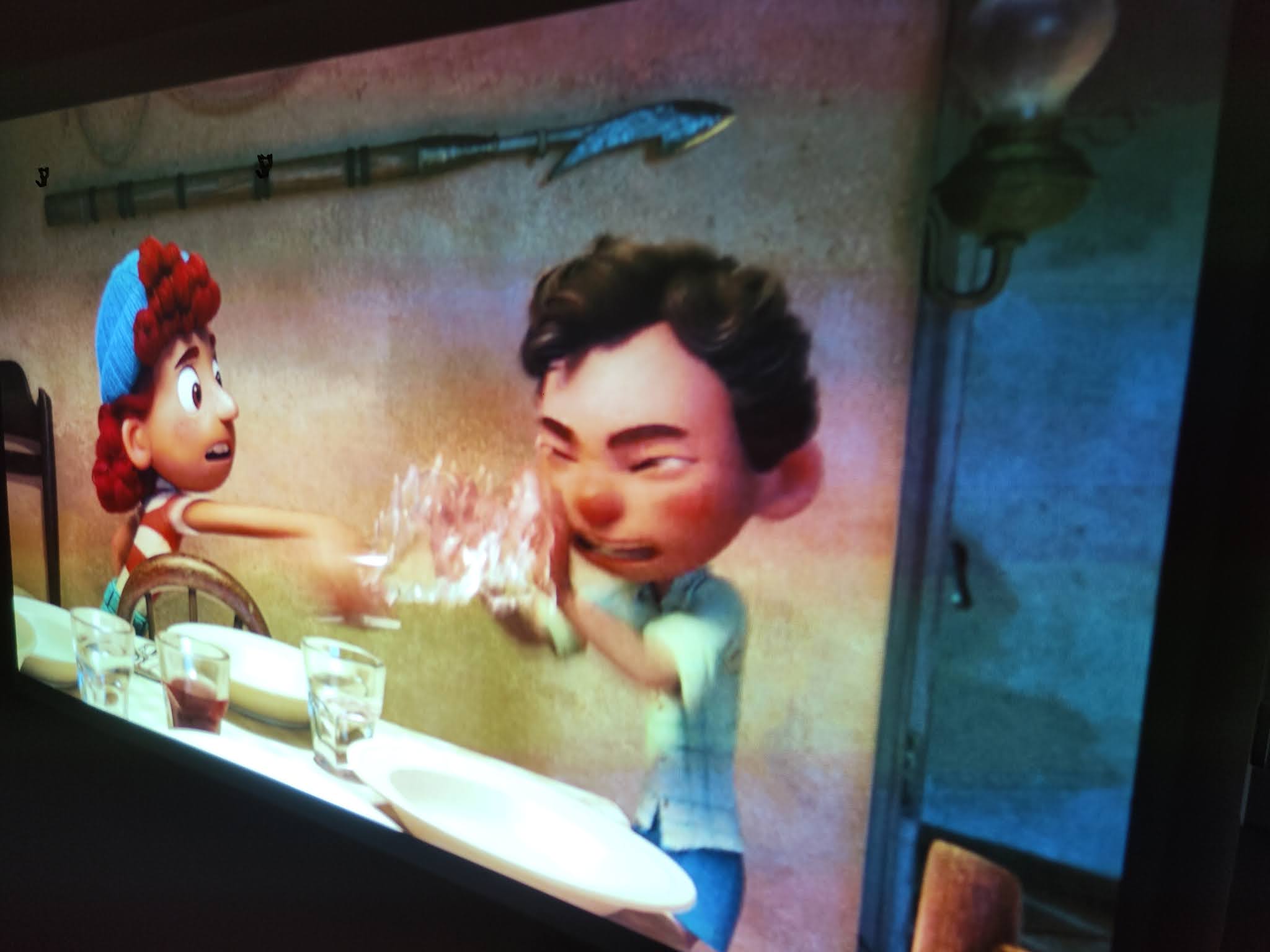
The premise of this "series" -- which has had exactly five previous entries over nearly ten years -- is that when I pause a movie at a totally unpremeditated moment, and it captures a perfect frozen snapshot of some kind of sudden action or other fortuitous story moment, I consider that sufficient inspiration to write about it here. I think you can see what makes this one good, but let's get to that in a moment.

We got to our Luca viewing at the end of our first full day on holiday this week, after a lot of toing and froing about what night was actually best to project it on the wall of our holiday house. It was about 7:30 before we got started -- an hour later than we'd ideally like, so as to get our kids to bed at a reasonable hour -- but it did in fact work out best for the schedule, considering also our dinner options in the small town here where we're staying. Most of those places are dark Monday night, so eating frozen pizzas in front of a movie was the way to go. And I'd been planning to write about this screening here anyway, so now I can let this post take care of business.

The pause came during one of our many interruptions, to do things like check on the pizza and go to the bathroom. In this case I believe it was fetching ice cream. 

In any case, I think you can see why I considered it to be such a good pause. Giulia (left) is throwing a glass of water at Luca (right), and though I didn't know the actual reason she decided to do this -- I was distracted in the few moments before the pause, while working my way over to my computer to pause it -- I did know the consequences would be significant for Luca. Like Madison in Splash before him, Luca turns into his underwater form (a sea monster) when he's doused with water, and Giulia has never seen that form.

As it turns out, it wasn't quite as big a moment in the narrative as I thought it would be -- Giulia is the only one who sees the transformed Luca, and she's almost preternaturally accepting of the fact that he's a sea monster. But the pause is still great, as it catches the water in the air and Luca's hands up defending himself. In a way, it's like the final millisecond of innocence. 

Before we get to our second Perfect Pause, I'll spare a few moments to close the loop on the Luca viewing that I first mentioned in this post. 

As you will recall, my seven-year-old was inconsolable when it turned out he watched the first hour of a movie I had been saving as a surprise for this trip. I'm glad to say this did not impact the viewing whatsoever. In fact, I think he got a certain thrill from knowing certain things about the movie before we did. However, he was also really good about not saying "Oh, I love this part" or "This is the part when ..." In fact, I could see him actively resisting the urge -- a real sign of his budding maturity.

And here's a picture of him putting a smile on Luca's face:

After we finished Luca and shuffled them off to bed -- having to call them back once for a little post-credits sequence -- I left the projector up to watch my June installment of Knowing Noir. You'll get a full post on Murder, My Sweet tomorrow, so I'll only include the Perfect Pause here:

Nothing remarkable about what was going on on screen, of course. But if you look down in the lower left corner of the screen, you'll see something pretty remarkable indeed:

So yeah, when I had to pause this movie to get a Mini Coke from the fridge (I was pretty tired at this point), I happened to stop it on exactly the one-hour mark, down to the second. 

Did I time it? I might have if this were playing on my DVD player, where you can see the timecode running as you watch. I've actually been known to time a pause to an exact time landmark just for the fun of it. 

But in this situation, on an iTunes rental, the amount of time passed/remaining is not even visible until you actually press pause, at which point it jumps up on the screen. 

It puts one in mind of The Great Last Days in the Desert Pause of 2016, when I made an unpremeditated pause that exactly bifurcated the movie -- 49 minutes and 12 seconds on one side of the movie, 49 minutes and 12 seconds on the other. (Or whatever the case was. It's a 98-minute movie, in any case.) 

For some reason, I guess I did not see it fit to write about that. 

After a night of such twin perfection, I slept well. 

Saturday, October 15, 2016

Measures of duality


On Friday night I was reading my six-year-old from his series of books about Zac Power, the 12-year-old super spy, as we are wont to do. I've noticed the phenomenon I'm about to tell you about plenty of times before, but had occasion to contemplate it anew during the reading of the book Sand Storm, in which one of Zac's chief rivals appears.

The rival in question is a 12-year-old girl named Caz. Get it? Caz? Zac? Zac? Caz? Zac works for the good spy agency called GIB, while Caz works for the bad spy agency called BIG. Get it? BIG? GIB? GIB? BIG?

But you haven't heard all of it yet. Caz' last name is Rewop. That's right. Rewop. Power. Power. Rewop. Zac Power. Caz Rewop.

It'll go right over most kids' heads -- my son hasn't commented on it yet, anyway -- but for adults, it's a stupidly obvious application of the notion that the hero and villain are two sides of the same being. They're not opposites -- the opposite of the name Zac Power would not be Caz Rewop, but, I don't know, Apichatpong Weerasethakul. Rather, they are mirror images of each other, having more in common than they have different. In fact, in extreme instances, you might argue that the only thing they don't share in common is their respective morality. Even then, though, the creator of these characters likes to emphasize the bad in the good character and the good in the bad.

It was interesting timing, then, that the movie I was watching that night also engages in a sort of literal exploration of the hero-villain duality.

Last Days in the Desert is the latest film from writer-director Rodrigo Garcia, and it couldn't portray a more symbolic struggle between good and evil if it tried. In the film Ewan McGregor plays both Jesus Christ and the Devil, who tempted him during his 40 days in the desert. Garcia makes the things they have in common manifest by having the same actor play both roles. If the side of Jesus that tempts him is personified as the Devil, I suppose to balance things out we'd also need to see the just side of the Devil as portrayed here. That complicates the duality a bit but I think the principle of the thing still holds.

If this were a children's story about super spies, I suppose his name would be Susej Tsirhc rather than the Devil, but I digress.

Garcia's rather on-the-nose choice is meant to allow one actor to explore both sides of a characterization, and theoretically give us something profound. McGregor is reasonably good in the film without quite attaining that level of achievement. So the film is worth watching but nothing extraordinary. McGregor might as well have a mini angel McGregor on one shoulder and a mini devil McGregor on the other, both advising him on what to do.

Perhaps the biggest "disappointment" about it, if you want to look at it that way, was the fact that it was shot by Emmanuel Lubezki and does not actually look mind-blowingly good. It looks good, but not mind-blowingly.

An interesting thing happened while I was watching it, though, that makes the thoughts I was already having about Zac Power and Jesus Christ and writing this post all the more eerie.

At about the halfway point of the film, I was getting really sleepy and I decided it was time for a bit of a sugar wake-me-up in the form of ice cream.

Not "about" the halfway point, though. At the halfway point.

Going over to my computer, which was tethered to the television via an HDMI cable, to press pause on iTunes, I then discovered that I had paused on exactly the halfway point of the film. There had been 49:51 that had already elapsed and there was 49:51 left to go. You could say I planned it, but when you're watching something in iTunes, the time remaining only displays when you run your cursor over the progress bar. There's no alternate method to track the minutes ticking away -- or none that I know of, anyway.

So I managed to split the movie right down the middle, into a duality of its own running time.

Even stranger was what happened about five minutes after that midway point. Another character who fancies riddles says to Jesus, "How far can a man walk into the desert? Only halfway. After that he's walking out." Probably just another way the movie is conscious of its own duality. But it had a special coincidental significance for me, given how I had just paused after walking exactly halfway into the movie, after which I was walking out of it.

I thought I'd leave you with five other explicit considerations of the duality between hero and villain, good and evil. Listed in the order I thought of them.

1) Oh God, You Devil! (1984, Paul Bogart) - The third in George Burns' series of Oh God! movies features Burns as both God and the Devil, much like in Friday night's movie. Though I don't think anything other than Borscht Belt comedy was being explored here.

2) Superman III (1983, Richard Lester) - Even at the best of times, Superman has a dual personality that includes another side of himself -- the Clark Kent side. Usually, both sides are good. In the third Superman movie, though, they explored an evil Superman, one corrupted by kryptonite -- and one who actually fights Clark Kent. I don't remember how they managed to get them into separate corporeal bodies -- I think there was a bit more suspension of disbelief than usual on that one -- but I do remember their extremely bizarre junkyard battle for control of their soul.

3) Lord of the Rings: The Two Towers (2002, Peter Jackson) - There's also a struggle for the soul of the man once known as Smeagol, now the twisted troll called Gollum. To emphasize this, Jackson uses a technique whereby the two sides of the character -- one kind and one cruel -- have a conversation with one another on how to handle the two travelers Gollum has just met. Although only one being is actually present, Jackson gives a standard shot-reverse shot setup as though there are two conversing.

4) The Dark Knight (2008, Christopher Nolan) - Back to superhero movies, one of the most commonly referenced instances of hero-villain duality is between Batman and the Joker, though in this case they look nothing like each other. However, there's a direct symbol of the two sides of a character's personality within The Dark Knight, and that's the very brief appearance of Two Face, known as Harvey Dent before he is disfigured and corrupted. The coin flip that is part of his MO -- which usually decides the fate of a prospective victim -- could also decide which version of him you're getting. But truly, the Dent side isn't there anymore, only symbolically represented by the failure to kill somebody instead of killing them.

5) Adaptation (2002, Spike Jonze) - And though I should end with something from Hitchcock, I couldn't find anything that literalized the theme in the way I'm going for here. So let's finish with a movie I alluded to on this blog only yesterday -- giving us one final coincidence with the Zac Power reading/viewing of Last Days in the Desert. In order to literally explore the dormant half of his personality, screenwriter Charlie Kaufman (appearing as a character here, played by Nicolas Cage) introduces a brother character named Donald, who is everything he isn't -- gregarious, mainstream, moronic, successful. In this case it's not really good and evil Kaufman is exploring, though -- he intermingles aspects of both in each personality, and toys with his own perception of which is which.

For more examples, check out, oh, the rest of western literature and cinema.