Showing posts with label donnie darko. Show all posts

Monday, August 19, 2024

Who drugged Gretchen during The Evil Dead?

Before we get started, let me just say that analyzing Donnie Darko is so 2007. Back in those days, which were within five years of my first viewing of the movie in 2003, I kind of obsessed over the movie and devoted some thought to each and every little nugget of it. It's not a very 2024 thing at all, as most of us have transitioned to thinking of Darko as a one-time favorite that we still love, but it occupies more of a place of nostalgia for our younger years as cinephiles who were hungry to pore over a good head trip movie, not a current going consideration.

But I watched Donnie Darko for the first time in four years over the weekend, and that 2020 viewing was also four years after my previous viewing (which was six years after the one before that). That tracks with my discovery that we -- or at least I -- tend to watch favorite movies about as often as there are Olympics or presidential elections, the most-cited example on this blog being my favorite movie of all time, Raising Arizona.

It might have been a few more years for Darko except that I also just listened to the two episodes of The Next Picture Show -- the podcast devoted to comparing a new release to a classic film that may have helped inspire it -- that dealt with Darko and I Saw the TV Glow. Now that I finally saw Glow at MIFF, I've gone back and listened to the discussion of it on three different podcasts, which I avoided at the time they were released. (And I'm glad I waited, since one of my podcasters hated this movie, and I don't know how I would have avoided having his complaints in my head when I watched it.)

On this particular podcast they liked it, with some reservations, and the whole episode devoted to Darko got the juices flowing for a rewatch. Even if that movie is more nostalgic for me than it is currently breaking my 50-year-old brain, I still love a good rewatch merely for the purposes of nostalgia.

And I did think it was worth diving into one part of the movie that had always troubled me a little bit, but I've never written about it. (Spoilers, I guess.)

In the scene where Donnie (Jake Gyllenhaal), under a trance, decides to burn down the house of self-help guru Jim Cunningham (Patrick Swayze), ultimately revealing his kiddie porn dungeon to the firefighters sifting through the ashes, he's seeing a revival of Sam Raimi's The Evil Dead at the town movie theater. (The Last Temptation of Christ is also playing here, as the marquee shows us, but that would be a whole different avenue of thematic investigation.)

His girlfriend Gretchen (Jena Malone) is accompanying him, but I can't imagine she's very enthusiastic about it because she falls asleep practically during the opening credits. It's at this point that the man in the rabbit costume, Frank (James Duval), sits next to her, and he and Donnie speak to each other across her blissfully sleeping body.

Even though I've seen this movie about seven times -- I could tell you exactly, except I didn't start recording the dates of rewatches until 2006 -- I always kind of think of this as a midnight movie they attend, hence explaining that Gretchen falls asleep almost immediately. They are the only two in the theater, which also suggests that it is playing at a strange time of night. (Though maybe a midnight movie would actually attract more excited cinephiles than an 8 p.m. showing.)

Except of course it's not a midnight movie, because during this scene, director Richard Kelly cross-cuts with an event going on at the same time -- Talent Show '88, as the banner reads, which is taking place at Donnie's school and includes a performance by Donnie's sister Samantha (Daveigh Chase) and her iconic dance troupe Sparkle Motion. The rest of Donnie's family is in attendance for this, as is Cunningham, conveniently sparing him a death by flame back at his house. (Donnie's a bit of a confused kid, but he wouldn't have lit the house on fire if there were anybody in it.)

But you get the sense Donnie would only do this if he were sure he had an alibi and his tracks would be covered. If you are at the movies with your girlfriend, you have that alibi -- but in order for her not to know you disappeared for 45 minutes or more, she has to not be conscious to bear witness.

Even as deranged -- that's too harsh a word -- as Donnie is, he wouldn't assume Gretchen would sleep for the whole movie. In fact, he wouldn't assume she would sleep at all during a primetime movie that's taking place at the same time as a family-friendly high school talent show. If she did fall asleep, it might be for five minutes, and she would at least stir a few times, even if she did ultimately resume her slumber.

You might propose the theory that Gretchen did stir, and when she saw Donnie wasn't there, she assumed he was in the bathroom and nodded off again. However, she's also alone in a movie theater with a scary movie playing, so this would work for one momentary awakening maximum. If she awoke two or three more times, and Donnie still wasn't there, she'd start to freak out, especially since she's living in fear of a crazy stepfather who is on the loose after stabbing her mother.

So the only way any of this works is if Gretchen is drugged. 

But who drugged her? Donnie? We know he takes medication, but the meds are meant to even him out, not put him to sleep. And there's nothing else to suggest Donnie is this kind of kid. Not only do we not have any reason to think he has access to these sorts of drugs, but he's fiercely protective of the people he loves. And he may just love Gretchen. 

Plus, it doesn't seem as though this was premeditated. Frank appears to him in the theater and suggests that Donnie "Burn it to the ground." And though we know, or at least think, Frank is a projection of Donnie's overactive imagination, meaning it's something he was thinking about already, he certainly seems surprised enough to have Frank appear there next to him, at this particular moment.

So is it Frank who drugged her?

As far as we know, Frank is not seen by anyone nor can he interact with anyone other than Donnie. There is clearly something "real" about Frank in that this ends up being a real person that Donnie hasn't met yet, but at this point he is imaginary, and you can't drug someone with imaginary drugs.

The notion then is that something about this scenario causes Gretchen to become entranced, something mystical that we can't explain. There are, of course, a lot of mystical things in Donnie Darko that defy explanation, but outside of the stuff directly related to the portals and time travel, there is a real-world basis for all the film's other events. For example, Donnie ends up in strange places around his town at night, but there's a terrestrial explanation for how he got there -- he slept-walked. Or at least, walked there in a trance of his own mental creation. 

There ultimately isn't likely an explanation for this, and there needn't be. Gretchen's 85-minute nap -- that's the length of The Evil Dead -- is probably more a screenwriting convenience than anything with a deeper meaning.

But one of the reasons we have favorite films is that we like to ask these questions and imagine what the answers might be. 

Tuesday, September 26, 2023

Airplane movies make a comeback

I guess if you don't have actual live baseball playing during a flight, the temptation of the internet is not a death knell for airplane movies after all.

You may recall that last week I discussed taking my first flight on which free WiFi was available. I followed that up on Sunday with my second such flight, where I doubled my single movie from the first flight, narrowly fitting in two to what was described as a 3 hour and 45 minute flight. (It took a little bit longer than that, as it turned out, because air traffic control had to slow us down to avoid congestion above Melbourne. Or so I am told that's what the pilot said. I could not hear him over the general white noise of the aircraft, in his typically calm and quiet pilot voice.) 

And because it was after all the day's baseball had been completed, I resisted the apparently irresistible pull of in-flight internet and got back to the basics of what I usually do on flights: watch movies.

Here are my thoughts on the two I watched.

How to set up 199 sequels

Will we ever tire of movies about exorcists? I suspect not. There's another Exorcist reboot coming this fall as well.

Julius Avery's The Pope's Exorcist was a fairly traditional example of such a movie, which is not to say it was bad. Actually, I quite enjoyed Russell Crowe's performance, injected as it is with a bit of humor.

But the movie apparently thinks we are ready for as many as 199 more in the Pope's Exorcist series. 

Spoiler alert -- Crowe's character, Gabriele Amorth, emerges alive from his tanglings with a demon, or the actual devil, or whatever it may be. So does his colleague, Father Esquibel, played by Daniel Zovatto. It is revealed that the place they do their battle is one of 200 such sites on earth where fallen angels turned to demons are waiting to wreak havoc on the unsuspecting people who happen to live nearby.

In discussing that their may be 199 more places where they are needed, the two characters give each other that knowing glance and say things like "We have been put on this earth for a purpose" and "Okay, but I can't do it without a partner" and "Let me check with my agent to see if I am available to shoot the sequel." Okay maybe not that last one.

When you see this familiar setup occurring at the end of a movie that is hopeful of giving birth to multiple subsequent franchise instalments, it doesn't usually expand the potential field of future engagements so infinitely, and with such a precise number. It felt rather comical. 

Also a bit comical: The family whose son gets possessed isn't checked in on before the closing credits, except for one priest telling another "The family returned to America and the boy made a full recovery." Now granted, this is supposed to be Crowe's character's story, not a portrait of the family, but it was almost as brief and hand wavy as "Poochie died on the way back to his home planet," albeit with a happier ending.

One possible limiting factor, at least in terms of the apparent intentions of the filmmakers, is that The Pope's Exorcist ends with a postscript about how Gabriele Amorth (a real person, apparently) continued performing exorcisms in service of the church until his death in 2016. Would you include such a postscript if you wanted to make 199 sequels? Perhaps it was a hedge against the film performing poorly and this being the only one.

However, the internet does confirm that a sequel is already in the works. Plus the story takes place in 1987, 29 years before Amorth's death, so that still indicates the possibility of numerous other demon-exorcising adventures in the years to come -- whether they be real or fanciful. Hey, it's worked for The Conjuring's Ed and Lorraine Warren, hasn't it?

Donnie Darko for the astronomy set

My wife started to watch BlackBerry on my recommendation, as I finally broke down her unfounded objections by telling her it would remind her of Silicon Valley. But she had to stop because she was enjoying it too much yet finding it too hard to hear all the dialogue over the aforementioned ambient white noise. We'll watch it together at home, which is good because I am looking forward to my second viewing. 

She had wanted to watch Cocaine Bear, which had been promised to her when she'd looked up online what might be playing on the flight. But either she checked in the wrong place or it had just hit its expiration date for available content. 

So I steered her blindly toward the second movie I planned to watch, Colin West's Linoleum, thinking she might get a few laughs from it because it stars comedian Jim Gaffigan, in addition to featuring Rhea Seehorn, recently of Better Call Saul.

Unfortunately, it wasn't that sort of movie.

And the sort of movie it was was, like, almost exactly Donnie Darko

I won't spoil too much about the plot, but I'll give you the general setup. Gaffigan plays the host of a science TV show like Bill Nye the Science Guy, focused specifically on astronomy, who gets booted from his show in favor of a younger man who looks almost just like him (also played by Gaffigan). So he considers trying to build a rocket to live out his failed astronomer dreams. Seehorn plays his wife and co-star on the show.

The number of allusions to Richard Kelly's 2001 cult film, a personal favorite, were so many that I had to stop counting. I'll do my best to recall them all here, two days later.

1) Both movies feature an object of unknown origin falling from the sky into a suburban neighborhood, displacing the family who lives in the house where it lands. It's part of a plane in Darko, a rocket in Linoleum.

2) Both films climax in a Halloween party at which someone is either run over or almost run over by a car. (Apparently, Linoleum is more hesitant in converting than Darko, as its car accident and rocket are both near misses, while the plane engine and the car are hits in the earlier film.)

4) Both movies present a high school setting in which an oddball boy and an oddball girl connect with one another, one of the two of them being new arrivals at the school. 

3) Both movies feature suburbia and high school as mild satirical targets, including the usage of bullies.

5) Both movies feature a mysterious white-haired woman, who they call Grandma Death in Donnie Darko and whose identity is not immediately revealed in Linoleum. (We find out Grandma Death is Roberta Sparrow, who wrote a book about time travel.)

6) Both movies feature a shot set to music where the camera follows several characters through a setting, the excellent "Head Over Heels" high school montage in Darko and an example at the TV station where the science show is produced in Linoleum. Both sequences even feature a character meeting another character and shaking hands. 

7) Both films want to fry our noodle with metaphysical and existential quandaries, with astronomy substituting for time travel here. But suffice it to say there are elements of the story that are not presented straightforwardly that imitate the notion of time travel.

8) Both movies try to get you in the end with an emotional denouement, with pretty different levels of success. 

I have no doubt Colin West would own up to all these moments as intentional allusions, not just thefts. But their sheer quantity becomes embarrassing, even if you are doing it as a form of flattery to an obvious influence.

Linoleum gets to some semi-interesting places, but falls well short of its predecessor, as well as mildly short of a recommendation from me.

And with one plane flight, order is restored in my movie-centric world. 

Wednesday, March 7, 2018

The S. Darko of Moon movies

Donnie Darko is my favorite film of 2001, though I didn't actually see it until 2003. Moon is my favorite film of 2009, one I got to crown at the actual time of its release.

Neither film needs or is capable of supporting an expanded universe, though I can see why people would try. "People" in this case being a studio with the rights to Darko director Richard Kelly's intellectual property, and Moon's director himself, Duncan Jones. (Though Kelly did try to expand the Darko universe in other ways in his other films, with poor results -- a friend and I even referred to it as the "Kellyverse.")

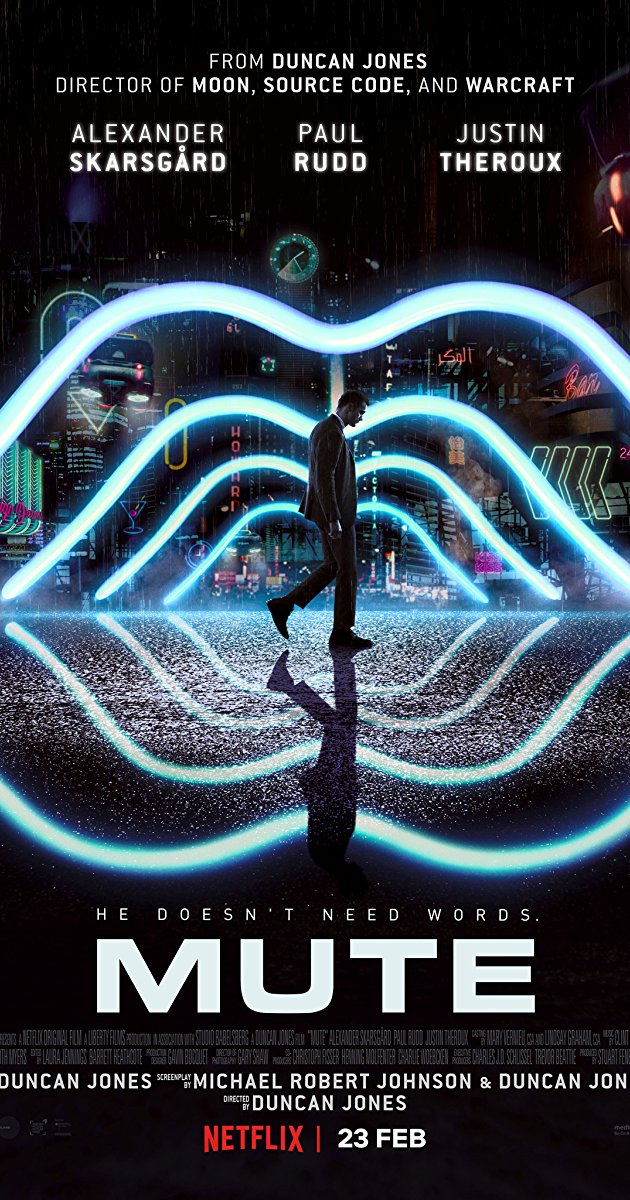
S. Darko -- released in 2009 straight to video -- was terrible. Mute -- the "spiritual sequel" to Moon released in 2018 to the modern-day equivalent of straight-to-video, Netflix -- may be even worse.

Jones was smart not to overburden his new film with references to Moon. In fact, I could detect only one scene that overtly references it, and it's really just a background shot of Moon main character Sam Bell in a courtroom on the news. (I guess that's sort of a spoiler for Moon, but you've already seen Moon, haven't you?)

But that's a level of restraint Jones does not show in any other aspect of this production. The damn thing runs for 126 meandering minutes, introducing us to awful characters in an underworld that's uninteresting. Having to watch awful characters in itself is not an issue, but when the film confuses them as kind of co-protagonists rather than the antagonists they really should be, and then even gives them morally relativistic beefs with each other, then this thing has gone way off the rails.

For all its many, many failings, S. Darko at least had the sense to exist in the same type of world with the same type of unexplained stimuli as in Donnie Darko -- wormholes, etc. It just doesn't do it interestingly, and is of poor quality in almost every aspect of its execution, most notably the acting.

The acting is okay in Mute, for the most part, but Mute's failures feel worse overall, as they are emblematic of a new type of franchising/universe-building to which Netflix is particularly susceptible. We are just coming off the cataclysmic failure of another Netflix original release, The Cloverfield Paradox, which I thought was a contender for my worst film of 2018, even at this early date. That movie was retrofitted to have elements that linked it to an existing cinematic universe, the Cloverfield universe, which itself is already a bit poorly defined, as the second film in the series was meant to exist more as a new chapter in an anthology than one that connects directly to the original Cloverfield. Needless to say, the attempt in Paradox did not work.

Mute is guilty of a similar thing, though it was premeditated and not retrofitted. The actual text of Mute has nothing to do with Moon, as the films are different stylistically and look at entirely different planets (Moon never sets foot on Earth). So the only reason it needs to be part of a Moon universe is to give the film some additional buzz for fans, to give them a reason to see what is otherwise a turd. "Spiritual sequel?" Why, Duncan? Because you decided to stick in one scene with Sam Rockwell in it? With newly minted Oscar winner Sam Rockwell in it?

Moon is full of heart and brimming with a certain type of optimism, despite being underpinned by a certain cynicism related to human beings and their tendencies. How can a movie in which the robot decides to do the right thing not be optimistic?

Nothing but the cynicism survives in Mute, a movie made even worse by the fact that it is dedicated to his father, David Bowie. This is a wretched movie that looks terrible, and its one truly sympathetic character, the character Leo (Alexander Skarsgard) who can't speak, is poorly defined and missing for weirdly large sections of the movie.

It's a waste of my time to continue picking apart Mute, but let's just say The Cloverfield Paradox cannot be my worst movie of 2018 with Mute around.

For Jones' sake, I hope he doesn't go the route of Darko director Richard Kelly, who made one brilliant film and then two awful ones, and now cannot get another movie made. Though Jones' career is on a similar downward trajectory, as his follow-up to Moon, Source Code, was liked by most people but not me, then his next movie, Warcraft, was liked by almost nobody. With two hits rather than one, Jones will probably get a few more lives than Kelly did, but if he keeps making movies like Mute, they will dry up quickly.

Sunday, June 12, 2016

Big screen Darko


I had seen Donnie Darko on the big screen before Friday night, but never the real version of Donnie Darko.

Richard Kelly released a director's cut of his 2001 film in 2004, adding some unnecessary footage and perhaps more troublingly, changing some of the songs that seems so perfectly matched to certain scenes. The one that stands out is swapping Echo and the Bunnymen's "The Killing Moon" -- a song pregnant with dread -- for the more sentimental and less evocative "Never Tear Us Apart" by INXS. The opening scene loses its entire sense of portent with this change.

Anyway, I did see that version on the big screen -- and have yet to watch it again, even though it came with the BluRay version of Darko I was gifted several years ago. The original eluded me cinematically, since I only discovered it two years after its release, in 2003.

"Discovered" may be an understatement. Saying that the movie indoctrinated me may be more accurate. I watched it at least three times within that first year, coming to own it in short order, and spent a lot of time puzzling over its marvelous details and unknowns. I also consumed a lot of tangential material related to it. It both blew my mind and touched my heart at the same time. Not a lot of movies can do both.

My affection for Donnie Darko persisted long enough for me to name it my #1 movie of the 2000's, an honor bestowed upon it in January 2010. That was also the last time I'd watched the movie prior to Friday night. It was kind of a perfunctory rewatch at the time, just to be certain that when I name a movie my best of a decade, it really deserves it. The viewing confirmed my choice, but I'd be lying if I didn't say that just a few seeds of doubt crept in. Not enough to dethrone it from the top, but enough to wonder how much longer the movie would carry the same glow for me.

Which is why I approached Friday night's screening with a little trepidation. See, I'd actually abandoned my last viewing of Donnie Darko part way through. I'd tried to watch it again in, say, 2012, when that particular Darko mood had struck me one night. But I started watching it too late, and succumbed to sleep. Often I do finish the movie later, even a movie I've already seen. But I didn't get back to Donnie Darko, and sensed that doubt growing just a little stronger.

Which is not an altogether unsurprising phenomenon. Maybe it always had this reputation, but over the years Darko has come to be thought of as a film that blows the mind of only a certain demographic of viewers -- young males. The criticism is that it's mind-blowing, but only if your mind is fairly superficial. The criticism is that it appeals to the same people who find The Matrix philosophically complex. That's not to diss The Matrix, just to say that if you are into Kant or Kierkegaard, you might turn your nose up at it. So a true intellectual probably never found Donnie Darko all that fascinating in the first place, and the rest of us are supposed to grow out of it as we mature. The reason I haven't returned to it in the four years since that last aborted viewing is because I wanted to hold on to the passion the younger version of me felt for it. I worried another viewing would further damage that passion.

But a month or so ago, I noticed a poster up for it at Cinema Nova. They were re-releasing it for its 15th anniversary. And a little checking online showed me that other cinemas around Australia were doing the same, though it's still not clear to me whether this is a formal, studio-sponsored re-release. As far as I know, it's not happening in the U.S., which is probably the strongest indication that it's more of a grassroots movement. (Or just the Australian distributor, Madman.)

It was opening at Nova on Thursday, and Friday presented a good opportunity to see it -- especially since they were starting it at the midnight movie-ish time of 10:25 p.m. I'd planned to go out for drinks and a little watching of footy (Australian Football League) with some co-workers, but I figured to be able to get away in time. (Actually, to my chagrin, I had to leave before the game was over. But it was an absolute blowout, so that reduced the crimes of which I was guilty to just being lame. I blamed it on exhaustion from a bad sleep.)

I was more excited about the screening than nervous about it not living up to my expectations, but both emotions were present. Fortunately, the former one ended up being truer. As soon as I saw the familiar font of the opening credits -- the one you see in the poster above -- I knew the movie was not going to disappoint. And it didn't. In fact, I was conscious of having a dopey grin on my face, even though this is not the type of movie that produces dopey grins in and of itself.

More than specifically a confirmation of Donnie Darko, though, this screening reminded me how great it can be to visit an old friend on the big screen. It's something I do extremely rarely. In fact, if asked to name the last film I'd seen on the big screen upon a re-release, I'd be hard pressed. Could it be the Star Wars special editions way back in 1997? That doesn't seem possible, but I suppose it is. No, I saw a director's cut of Cinema Paradiso sometime in the early 2000's. Oh, and Titantic when it came out in 3D. But let's just say it's rare. And in those instances -- including Darko itself in 2004 -- they were new versions of the movie, ones I'd never seen before.

But there's nothing like the original of something you love. And I'll be keeping an eye out for more chances to see things I love on the big screen from here on out.

My philosophy thus far has been not to "waste" a trip to the theater. Since I get out to the cinema once or twice a week at most -- a lot for your average person, but not necessarily for a cinephile -- I tend to think that those opportunities should be saved for new releases, even if they're dreck.

But it's no more a waste to see a movie you love on the big screen than to rewatch it at home in the comfort of your living room. And few people would argue that's a waste. In fact, the theater is where you're more likely to remember just what it is that makes a movie you love great.

Especially if you are no longer sure how much you love it.

Wednesday, September 21, 2011

The man with no name, the man with too much of a name


One thing that consistently gets my quills up is when characters in a movie have no name.

You know, like the main character in Drive.

In the credits of Drive, Ryan Gosling's character is referred to only as "Driver."

Fortunately, I did not actually notice that he had no name until that point. I'd certainly prefer that to the alternative: a bunch of really clumsy dialogue that trips over itself trying to come up with synonyms to the person's name. "He" and "that guy" and "the kid" (etc.) get old pretty quickly.

As soon as I realize the characters in a movie don't have names, I immediately think of that movie as some kind of Samuel Beckett ripoff. Of course, the filmmakers are not usually going for the same things Beckett was going for, but the same level of pretentiousness may be present. "The character has no name because he could be anyone, he could be your or me!" Yeah, I get it. It addresses nothing less than the universality of human experience. Good for it.

(I should pause here to tell you something that may be obvious by now: I had my complaints with Drive. One positive is that I saw it on Sunday night and am still thinking about it/processing it on Tuesday morning, which undoubtedly qualifies as a good thing.)

However, the reverse is also true. I hate it when a character has too much of a name.

No, I'm not talking about characters of Spanish heritage who have a dozen first/middle names. I think that's excessive as a cultural tradition, but it doesn't bother me and is not relevant to this particular conversation.

What bothers me -- with a few notable exceptions -- is when a screenwriter is so proud of the name he/she has created for a character that it gets repeated ad infinitum, almost like the name itself is a joke/piece of clever screenwriting. Sometimes, this name even becomes the title of the movie.

Take Charlie Bartlett. (Please, ha ha.)

As Charlie Bartlett is purely a work of fiction from an original screenplay, they could have made that character's name anything. Yet I suspect the name Charlie Bartlett was chosen because the rhyming first syllables of each name made it particularly fun to say. And then, particularly fun to repeat in quick succession in the trailer:


I actually kind of like Charlie Bartlett, but I can never think about it without thinking about the major screenwriting crutch of giving the character a snappy name -- so snappy that it can function as the movie's title. There are certainly plenty of other titles that qualify, but this is the one that always comes to mind whenever I rail about the laziness I think is inherent in naming a movie after its main character.

Ah, but remember what I said about exceptions?

I don't have this problem with Donnie Darko. No doubt, the exact same thinking applied -- instead of the rhyming of "Char" and "Bar," it's the alliteration of the two Ds that makes the name roll off the tongue easily. Either way it's cutesy.

But see, in this case, I don't care.

I think Donnie Darko is a masterpiece, and a masterpiece forgives all faults. In fact, Donnie Darko works as a good example in this post in multiple ways.

See yesterday, I had a disagreement with someone about the quality of Drive. He loved it -- I'm not exactly sure how I feel about it, but my feelings are never going to qualify as love. What I did know was that I could list a litany of small complaints I had about Drive, complaints that could certainly qualify as nit-picking. That brought up a larger discussion about the usefulness of nit-packing as a critical exercise ... and whether it should even be called nit-picking in the first place.

During that discussion I had a realization about the term "nit-picking," which is that it is almost always -- okay, always -- used negatively. If you are said to be "nit-picking," you are tearing down an idea or piece of art based on allegedly unimportant details, things you should be able to overlook.

The thing is, if you are concentrating on those details, it means that the idea or piece of art has not done enough to convince you that they were unimportant. I'd argue that the actual best way to consider the fine art of nit-picking is as "early criticism." You pick nits when you are not yet able to articulate why you did not like a particular film. As brilliant as we film fans like to fancy ourselves, sometimes we just don't immediately summon the words for why a particular film didn't work for us. Until the time that we can, we sometimes find ourselves saying things like "Yeah, I didn't like the clothes that guy was wearing, they were stupid." Better than that, I hope, but still not really to the heart of what was wrong with the film.

And so Donnie Darko entered into that discussion as well. Described even by its devoted fans as a movie that does not make perfect sense, Donnie Darko is just the kind of movie that could die under the intense scrutiny of so-called nit-picking. But see, I don't nit-pick Donnie Darko because I love it so much. I don't care that there are some things that don't make sense, and I don't care that the title is a perfect example of a movie-naming convention I find to be lazy. Donnie Darko had me at hello, and that's all there is to it.

As for Drive and Charlie Bartlett ... well, they've still got more work to do.

Exaggerated conclusion: Movie characters should have a first name but no last name. Every male character should be named Mark, and every female character should be named Julie.

Thursday, February 4, 2010

Best of the 2000's


One of the results of closing off my 2009 list yesterday was that I also closed off the decade. Meaning it was time for the gargantuan task of ranking my favorite 25 films from the years 2000-2009. Films from 2009 had until yesterday to qualify. Speak then, or forever hold your peace.

But making a best of the decade list -- I'm calling that decade "the two thousands," by the way -- can never really be a perfect project. After all, you never stop seeing films from a particular decade, so if you want a definitive list of which are the best, you have to keep revising it -- not only as you see more movies, but as you reconsider the ones you've already seen.

It actually amazes me how much your mind can change about a film over time -- sometimes, even over a short amount of time. For example, the movie listed 18th in the rankings below was also listed 18th in my 2008 rankings. Consider that. In only a year's time, the result of only two additional viewings, I went from thinking there were 17 movies better than this movie in the year 2008, to thinking there were only 17 movies better than it in the whole decade.

The following is not scientific, of course. The relative quality of movies never is. And I've gone back and forth several times about whether the movies listed as honorable mentions should be on the actual list. That kind of flip-flopping is inevitable.

I also have to acknowledge the fact that movies seen very recently may have suffered in this project. You could argue it's the other way around -- that something that's fresh in your mind has greater sway over your emotions than something you haven't seen in years. But the steps I take to counteract that emotional sway means the reverse is true. One of my honorable mentions would have likely ranked among my top 25 if I hadn't just seen it for the first time three weeks ago. I decided it was too early to determine whether this film would stand the test of time, and that's a stance that automatically puts movies from the year 2009 at a disadvantage. In another move that favored older movies, I re-watched a number of movies -- 13 total -- to help determine if they belonged, or in some slam-dunk cases, where they belonged. This meant they were given fresh emotional resonance with me.

One final rule that could have affected the rankings, but didn't: I made sure to include at least one film from each calendar year. There was no year in the last decade that I consider a total stinker, so this did not end up having any effect on my process.

I'm confident in what I'm presenting here. It may not be how I feel in five years, or even one year. But the making of a list is inevitably tied to a specific moment in time, and at this specific moment of maximum timeliness, these are the cream of my crop.

Yada yada further ado:

1. Donnie Darko (2001, Richard Kelly)
2. Children of Men (2006, Alfonso Cuaron)
3. Almost Famous (2000, Cameron Crowe)
4. Lost in Translation (2003, Sofia Coppola)
5. Eternal Sunshine of the Spotless Mind (2004, Michel Gondry)
6. Vanilla Sky (2001, Cameron Crowe)
7. Perfume: The Story of a Murderer (2006, Tom Tykwer)
8. There Will Be Blood (2007, Paul Thomas Anderson)
9. The Diving Bell and the Butterfly (2007, Julian Schnabel)
10. 4 Months, 3 Weeks and 2 Days (2007, Cristian Mungiu)
11. Adaptation (2002, Spike Jonze)
12. Moon (2009, Duncan Jones)
13. United 93 (2006, Paul Greengrass)
14. Hustle & Flow (2005, Craig Brewer)
15. Hamlet (2000, Michael Almeyreda)
16. Finding Nemo (2003, Andrew Stanton)
17. Once (2007, John Carney)
18. Forgetting Sarah Marshall (2008, Nicholas Stoller)
19. The Lord of the Rings: The Two Towers (2002, Peter Jackson)
20. The Wrestler (2008, Darren Aronofsky)
21. Let the Right One In (2008, Tomas Alfredson)
22. Elf (2003, Jon Favreau)
23. Waking Life (2001, Richard Linklater)
24. Sideways (2004, Alexander Payne)
25. Memento (2001, Christopher Nolan)

Honorable mentions: Chicago (2002, Rob Marshall), Code 46 (2003, Michael Winterbottom), The Departed (2006, Martin Scorsese), The 40 Year Old Virgin (2005, Judd Apatow), Gosford Park (2001, Robert Altman), Step Brothers (2008, Adam McKay), The 25th Hour (2002, Spike Lee), Waltz With Bashir (2008, Ari Folman), Where the Wild Things Are (2009, Spike Jonze)

Since this is 88 fewer titles to digest than the list I gave you yesterday, I thought I'd accompany today's with a few words of explanation on each of the films I've chosen. I'll go longer on the top ten and then shorten up for the last 15.

1. Donnie Darko. When have you ever been so moved by a mind-blowing suburban satire set in the late 1980s, involving time travel, astrophysics, emotionally disturbed teenagers and a six-foot-tall rabbit? If Donnie Darko sounds like it's going in many different directions, just witness how brilliantly Richard Kelly weaves them all together. (And forget that he then ceased to do another useful thing in his career.) Donnie Darko is one of the truly unique films of the last decade, and according to this guy (imagine me pointing my thumbs at my chest), it's the best.

2. Children of Men. Dystopian futures are one of my favorite film settings, and Alfonso Cuaron nails this one in part thanks to a terrific performance from Clive Owen, and one of the grittiest, most lived-in, most minutely detailed futures you'll ever see on film. If the story's hardscrabble struggle to save mankind weren't enough to sustain your attention, just soak in the cinematography, including several uninterrupted takes through battlefields and other impossible-to-choreograph settings, which represent nothing less than some of the most incredible camerawork ever performed.

3. Almost Famous. Leave it to Cameron Crowe to make me nostalgic for things I don't remember. I was born in 1973, meaning I was too young to have come of age at the same time as William Miller (Patrick Fugit), but the brilliance of Crowe's film is that he makes it delightfully easy for anyone to go on William's journey with him. Great music choices as well -- who doesn't love that scene where they all sing along to "Tiny Dancer" on the tour bus? Few films make you feel this good without also making you feel like you were manipulated on some level.

4. Lost in Translation. The apple doesn't fall far from the tree. Is it sacrilege to say I might like Sofia Coppola's second feature even more than anything her father ever made? I don't care. Dreamy, ethereal and melancholy from start to finish, but not in a depressing way, Lost in Translation envelopes you in its spell and never lets go. It's like a lullaby of alienation. Tokyo itself plays an important third character alongside Bill Murray's and Scarlett Johansson's terrific performances. I'm still mourning for Murray that Sean "IS THAT MY DAUGHTER IN THERE?" Penn ripped the Oscar out of his fingers.

5. Eternal Sunshine of the Spotless Mind. One of two Charlie Kaufman scripts to make my top 25, Eternal Sunshine of the Spotless Mind was the hardest movie title to learn since Crouching Tiger, Hidden Dragon -- but among the most worth learning. Michel Gondry's literal head trip accomplished several amazing things: 1) It demonstrated Jim Carrey's potential as a serious actor; 2) It explored the limitless existential conundrums involved in a fictitious technology for erasing memories; 3) It was one of the most heartbreaking examinations of the inner workings/obsessions of a romantic relationship. Oh yeah, and lots of great visuals.

6. Vanilla Sky. This is probably the most controversial choice on the whole list, but each time I watch this film I am more in awe of it. If Lost in Translation and Eternal Sunshine were both dreams, mostly happy ones, Vanilla Sky is the nightmare. Demonstrating his amazing range, Cameron Crowe (in his second film in my top ten) comes back only a year after Almost Famous with this sad, dark, melancholy, yet somehow exhilarating look into the possibilities of the mind and technology, one not altogether different from that seen in Eternal Sunshine. This movie may be about even more things than Donnie Darko, but at its core it's about the fragility of love, happiness and human relationships, and Tom Cruise burns brightly at its center.

7. Perfume: The Story of a Murderer. The most obscure title of my top ten -- so far. Critics were mixed on this film, but I think the ones that didn't like it were too focused on Dustin Hoffman's arguably laughable performance. But that's a very small part of what the rest of us (I reviewed it for my site) recognized as a tour-de-force from a director whose other great film, Run Lola Run, was as different from this movie as two movies can be. (Directorial unpredictability impresses me greatly.) At its core it is an engrossing period piece about a serial killer, with lush, beautiful shots of 18th century Paris and Grasse. But it's distinctive for two things I've never seen before, listed in reverse order of their brilliance: 1) It's a movie about the fascinating process of making perfume; 2) It's a movie about the sense of smell -- and the only one of its kind, as far as I'm aware.

8. There Will Be Blood. "I ... drink ... your ... milkshake! I drink it up!" That might be all the words I need to say, but I owe Paul Thomas Anderson's daunting epic more than that, and not just because I was Daniel Plainview for Halloween two years ago. (Milkshake and all.) I've heard Daniel Day-Lewis' performance described as the best of the decade, but that's not really what makes this film so indelible. This is Paul Thomas Anderson's movie, with his iconic landscape shots of the Texas plains, his deliberate long shots, his intelligent use of a brilliantly anachronistic score (by Radiohead's Jonny Greenwood), his decision to have the entire first 20 minutes be dialogue-free. This movie is disturbing, twisted and wonderful. It's the opposite of what Gordon Gekko thought -- greed is bad.

9. The Diving Bell and the Butterfly. What a major achievement for Julian Schnabel, who was always a decent director, but nothing like this. As this film is about extraordinary achievements by a man who could only communicate by moving one eye, it seems to make sense to list this film's extraordinary achievements: 1) Mathieu Amalric could have been nominated for an Oscar, even using only a single eye for much of his performance; 2) The film is in French, which is not the director's native language; 3) It is bursting with color, music and life, despite taking place mostly inside a hospital, in the mind of a paralyzed stroke victim.

10. 4 Months, 3 Weeks and 2 Days. And again, closing out the top ten, we have another singular kind of film. The quick summation "Romanian abortion drama" does not scratch the surface of Cristian Mungiu's painstakingly mounted, original film. Painstakingly mounted? Many of the scenes are feats of acting brilliance, uninterrupted takes lasting over ten minutes in real time, where a single mistake by an actor would scrap the entire shot. Original? Not only is it about the process of getting an abortion in a Communist country, which means its subject is original, but the pregnant woman is not even the film's main character -- that honor goes to her best friend -- so it's structurally original as well. It's dark, searing, and lacerating, but not even for the reasons you necessarily think it will be.

11. Adaptation. Saw this Charlie Kaufman-Spike Jonze collaboration last week for the first time since I saw it in the theater. Thought it wouldn't hold up. It did. One of the most layered, twisted, hilarious and brilliant scripts that has ever been written.

12. Moon. In a year when Transformers: Revenge of the Fallen, District 9 and Avatar were box office forces, this was the film that gave me hope for science fiction again. Sam Rockwell is absolutely brilliant, and the movie was made for cheap by a first-time director -- David Bowie's son! See it.

13. United 93. Some people think a movie this difficult to watch is a bad thing. Me? When I re-watched it last week, it brought me right back to September 11th and filled me with heartache and frightened adrenaline. Absolutely tense and riveting.

14. Hustle & Flow. Another film I thought might not hold up. Another case of being wrong. This movie is funky, raw, dirty and extremely exciting. Terrence Howard is incendiary, and his beats are even better.

15. Hamlet. Who would have thought updating Shakespeare's most famous play to modern-day New York would be anything but gimmicky? Instead, it's arresting and thematically dense. Well played.

16. Finding Nemo. This list demanded to have at least one Pixar movie, and Nemo is head and shoulders above the others for this decade, in my opinion. Still touching, and Ellen Degeneres is still hilarious.

17. Once. A master class on making music with a delicious Lost in Translation melancholy, leavened by joy and vitality. Delightful. A really simple story does not necessarily mean a really simple movie. Best soundtrack ... ever?

18. Forgetting Sarah Marshall. Jason Segel. Mila Kunis. Kristen Bell. Russell Brand. Hawaii. Dracula puppets. Hijinx. Lost love. New love. Surfing. Throw it all in a blender and you have one of the most delightful comedies of any decade.

19. The Lord of the Rings: The Two Towers. The movie that made me love Lord of the Rings movies. Even the first, which I now love after initially disliking it. If Helms Deep weren't the best battle scene ever filmed, this was also the film that gave us arguably the best digital character (move over, Na'vi) we've ever seen: Gollum.

20. The Wrestler. Features the second great performance on this list to be robbed of an Oscar by Sean Penn. Just as amazing as Mickey Rourke is director Darren Aronofsky, who pulled off a terrific 180 after his out-there The Fountain. Great insider bits about wrestling as well.

21. Let the Right One In. All vampire movies should bow down to this vampire movie. I mean it -- all of them. This is the best vampire movie ever. It's also wonderfully Swedish. Makes for a delicious night at the movies.

22. Elf. I have recently discussed with friends that this is one of the top three Christmas movies of all time. Purely joyous. Will Ferrell has never been this sweet and rarely been this funny. What every Christmas movie should aspire to be.

23. Waking Life. Praised recently on this blog. A feat of both technique (the wonderful water color rotoscoping) and intellect (the brilliant existential philosophizing that nourishes like a full meal for the brain).

24. Sideways. Like many other films on this list, brilliantly captures the fleeting half-connections that make up our lives, and their inherent melancholy. Plus, is funny as hell and really makes you want to drink wine ... even merlot. Paul Giamatti was as robbed as Murray and Rourke by not even getting nominated.

25. Memento. Didn't like it as much as I remembered when I saw it again recently, but the totally unconventional narrative structure alone means it deserves a spot on this list. Plus, with the decade he had, how could I not acknowledge Christopher Nolan at least once?

So I'd love to hear from you -- let's share. You may not have seen 113 movies in 2009, but I'm sure you saw at least 113 movies in the 2000's. Even a top ten, a top five will do. My comments section is always open.

Now, on to the teens. A new decade awaits.

Friday, November 6, 2009

A wonder stuck on one hit


Back in 2003, shortly after I first saw Donnie Darko, I was having a conversation about it with a friend. This was my second friend to show a slavish devotion to this one-of-a-kind film, the friend who introduced it to me being the first. Seeing that others were crazy about it as well helped deepen my appreciation of the cinematic discovery I'd just made.

The name of the director, Richard Kelly, came up, and I asked my friend what the deal was with him. Ordinary name, no previous credits that I was aware of. "I don't know," answered the friend, his voice rising at the end to indicate his own amazement. "He just came out of nowhere I guess."

And so I came to mythologize Richard Kelly as some kind of J.D. Salinger of filmmaking, a guy who had burst on the scene to present us this singular vision, then might just slink back into the shadows of seclusion. I cautiously dared to hope for an impressive follow-up to Donnie Darko, but I almost couldn't imagine Kelly producing anything else. It was like Donnie Darko was so mind-blowing that it could exist as the entirety of his career, and that would be enough. What else was there to say?

And maybe he should have stopped right there after all.

You see, Richard Kelly is as much a flesh-and-blood human being as the rest of us, and his subsequent career choices have each been painful reminders of that fact. The Box, his third directorial assignment, due out tomorrow, does not figure to change that.

But let's take things in chronological order.

1) Domino (2005, Tony Scott). The first time Kelly's name materialized in the credits after Donnie Darko was in this hyper-stylized assault on your senses, a truly vulgar creation designed to glamorize the life of Hollywood princess-turned-bounty hunter Domino Harvey (Keira Knightley). Tony Scott took his worst instincts and turned Kelly's script into a jittery, stroke-inducing strobe light of a movie, which fetishizes violence, cigarette smoking, and pop culture. I blame this turkey more on Scott than Kelly, but mostly because I have Kelly on a pedestal -- the bare bones of his script couldn't have been that good.

2) Southland Tales (2007, Richard Kelly). All the large-scale ideas that got smaller-scale execution in Donnie Darko get driven over the top here. A truly epic mess about a cross-section of truly idiotic characters in Los Angeles of the not-too-distant future, Southland Tales tackles nothing less than Big Brother, terrorism, nuclear holocaust, neo-Marxism, celebrity, alternative energy, drug abuse, the Iraq War, and time travel. Most bizarre is the cast of has-beens, featuring the likes of Jon Lovitz, Cheri Oteri, John Laroquette, Wallace Shawn, Nora Dunn and Curtis Armstrong, with Seann William Scott, Dwayne Johnson, Sarah Michelle Gellar and Mandy Moore serving as the supposed A-listers of the group. It's as bad as it sounds, but I'd be lying if I didn't admit that it occasionally crosses into the territory of "so bad it's good." Will probably be a cult film at some point, but not the way Donnie Darko is considered a cult film.

3) The Box (2009, Richard Kelly). As this movie has not come out yet, I am left only to speculate. But let's just say the ads have not inspired me with very much confidence. The scenario -- "if you press this button, you will be given $1 million, and someone you don't know will die" -- almost sounds chilling. But the ads have inadvertently echoed the terminology of the Saw franchise, as Frank Langella (missing the left half of his face) says the words "Make your choice," echoing the command spoken by Tobin Bell's Jigsaw numerous times throughout that series. What's more, outside of Langella, it's not a very heavyweight cast -- Cameron Diaz and James Marsden have their time and place, but a Richard Kelly mind-tripper doesn't seem to be one of them. In fact, the cast is one of the main elements that undermined Southland Tales, though that wouldn't have been good even with a slate of Oscar winners. To give a couple more first impressions: The footage looks grainy and washed out, and the poster is as generic as can possibly be, befitting an anonymous thriller from the 1980s more than a potential masterpiece from a supposed wunderkind.

4) Other projects. Kelly's name is often heard in connection with Knowing, the Nicolas Cage vehicle that came out earlier this year. He was once attached as director (The Crow's Alex Proyas eventually did the deed), and he is listed as a screenwriter on the film some places, but not others. The confusion is just as well for my current thesis, since I actually liked Knowing. Then there are a couple other films he's produced through his production company, called Darko Entertainment, including World's Greatest Dad and I Hope They Serve Beer in Hell. I liked the former and did not see the latter, but I thought the trailer for the latter looked absolutely terrible (a bachelor party gone horribly wrong -- ho hum). It's funny, in looking up Kelly's credits, I see he is also listed as an executive producer on a film I'm going to be seeing this afternoon, in an advanced screening, called Rogue's Gallery. My wife works for/with one of the other executive producers, which is how we're getting in.

Since there are really only three main films after Darko where Kelly's been credited with a significant contribution -- one of which has not even come out yet -- it may be both premature and unfair for me to go on record as disappointed in him. After all, The Box could just as easily give me those Darko chills again. I should know, from plenty of experience, that films are often much better or much worse than they appear in their ads.

So instead of specifically indicting Kelly, let me just say this: It ain't easy being a genius. You have to keep following up and following up and following up, and any future project that isn't viewed as improving on your body of work, inevitably detracts from it instead. Maybe Kelly will never again make anything nearly so good as Donnie Darko. Since I currently have the film ranked as my third-favorite of all time, I could hardly blame him for this.

Here's hoping that Richard Kelly can settle somewhere in the middle -- that he can stop monkeying around with bombastic, untranslatable visions, in a vein effort to duplicate Darko, and can just be satisfied making solidly crafted movies instead.

Before he was the director of Donnie Darko, Kelly was just a film student at USC, a guy with two short films to his credit. He was human like the rest of us, and can be so again.

Friday, August 7, 2009

Darko-centric


In honor of my friend Don (and his lovely wife and 10-month-old son) visiting this week, I thought I'd write a post about Don's and my bonding over a particular movie.

See, we have a Darko-centric relationship.

To describe our friendship in these simple terms is intentionally misleading on my part. We've known each other for over 30 years, so we obviously have tons of shared history, and then a boatload of common interests as well.

But for about the last six years, ever since he first introduced me to Richard Kelly's Donnie Darko, we seem to keep coming back to it in uncanny ways. And that makes tonight's planned viewing of S. Darko -- the sort-of-unauthorized, straight-to-video sequel -- all the more appropriate.

Don first showed me Donnie Darko on a February 2003 visit. I knew nothing about it at the time, other than that I'd seen the billboards, and I thought it looked vaguely pretentious. I was aware that Jake Gyllenhaal was the star, and I think I also knew that Drew Barrymore and Noah Wyle were in it. Other than that, it was just another movie.

All it took was one viewing for me to rank Donnie Darko among my favorite films of all time. I won't go into an extended praise session now. I will ask what the hell you're waiting for, if you haven't seen it yet.

Since then, I've watched it about five more times. And it's continued to pop up in my relationship with Don over the years. (In case you were wondering, it doesn't have anything to do with his name being Don -- that's only his blogger identity anyway. Nor does his choice of blogger identity have anything to do with the movie).

Within that first year, I made Don a de facto Donnie Darko soundtrack. We both loved Kelly's choice of music -- which he changed at his peril in the director's cut -- and lamented the fact that no soundtrack was ever pressed. So I downloaded the songs that work so well in that movie -- Echo & the Bunnymen's "The Killing Moon," Joy Division's "Love Will Tear Us Apart," Gary Jules' "Mad World," even "Notorious" by Duran Duran -- and burned a CD. Then I adorned it with images from the movie, many of them involving the mysterious giant rabbit named Frank. I believe it was somewhere around this time that he sent me my own DVD copy of the movie.

It was the next year, 2004, when I was visiting Don in Chicago, that Kelly's director's cut happened to be in the theaters. Naturally, Don and I went. As I hinted above, we were disappointed with this cut, particularly the substitution of INXS' "Never Tears Us Apart" for "The Killing Moon" in the dynamite opening bike-riding sequence. And though some of Kelly's other additions were mild to modest failures as well, it was a bit like watching the deleted scenes from DVDs you love. You have to see the extra footage just because it exists and is worth examining.

I believe it was a November 2005 visit to Los Angeles when Don and I attended an art walk, and he picked up a lapel pin that bore an artist's rendition of Frank. Or maybe I picked it up. Or maybe we both did. Anyway, the Darko theme continued.

I can't remember if anything particularly Darko-centric occurred in 2006, but in November of 2007, it was my turn to visit Chicago again. Lo and behold, Kelly's follow-up to Donnie Darko, the incomprehensible Southland Tales, was in theaters. Don and I were all excited to go see this monstrosity together. The early feedback, especially from an incredulous crowd at Cannes, told us that this would be no worthy successor to Darko, but we were determined to expose ourselves to it anyway. Unfortunately, our best intentions were defeated by our better halves, as his wife and my fiancee conspired to poo-poo the plan, leaving Don and I to eventually endure it separately.

Sometime since last fall, Don picked up his first BluRay player, so what was the logical gift for him for his birthday this February? That's right, the newly-released BluRay version of Donnie Darko. My timing was perfect -- Don had actually been monitoring its potential release on BluRay, but I managed to jump right into that window of time between the last time he checked on it and its actual release. So he didn't even know it was out yet, and was pleased as punch to get it.

So it couldn't have been too big of a surprise to him when, a few weeks back, I told him to hold off on watching S. Darko until he got out here. Released straight to video in May, it was third on his Netflix queue at the time, but he bumped it down in anticipation of watching it together.

So what exactly is S. Darko, and why is it "unauthorized"? Well, without giving too much away, Donnie Darko is not exactly the kind of movie you make a sequel to. Richard Kelly surely knew as much, which is why he had nothing to do with this. But I can see how the world created in Donnie Darko would be something its fans would want to visit again, myself included. So even though I doubted the adventures of Samantha Darko, Donnie's sister -- the S. of the title -- would be much to write home about, I knew I'd have to see it. Lending some sense of credibility: At least they got the same actress, Daveigh Chase, to play Samantha, even if none of the rest of the cast returned.

S. Darko graduated to the top of my own queue, and arrived on Tuesday, one day ahead of Don and his family. The plan, as I said, is to watch it tonight.

Where will Don's and my Darko-centric relationship go from here? It's hard to say. It does seem like we're unlikely to be in the same place when Richard Kelly's next movie, The Box, comes out on November 9th. But if the above examples tell us anything, you never know.

And if not ... well, I guess we'll just have to fall back on our 30 years of other experiences.