Showing posts with label i'm thinking of ending things. Show all posts

Monday, March 3, 2025

The streaming culprit has been identified

The only "Oscars homework" I did over the weekend was for pleasure. 

No, I didn't put in a last-minute viewing of any movies I might not have seen, in order to better make predictions about tonight's Oscars, or to feel myself more engaged in them.

Instead, I rewatched my favorite best picture nominee with my wife, which happened to be my #1 movie of last year.

And it looked great.

Yes, yet another post about The Substance on this blog, but I will probably retire the topic for a while now. I don't expect to talk about it much in the next piece, my annual "Oscar thoughts" piece, which will come many hours after the ceremony ends. Which is because for the first time in three years, the Oscars do not coincide with Labor Day here in Australia. That means I'm working today, and even after I finish work, I have two different sporting events to attend, one in which I'm just a spectator and one in which I'm participating. My 14-year-old has a basketball game at 6:05, and about a half-hour after that ends, I'll be playing tennis with my tennis partner. Then, sometime after 9 p.m. local time, I will finally watch the show.

Anyway, The Substance will come up in that post I'm sure, but possibly only in the context of Demi Moore winning, which I predict will happen. (And was reminded why she should win when I watched the film again.) After that, I'll probably put it in my personal penalty box for a while -- a term used by the hosts of Filmspotting when they've been talking about a particular movie too much. (This is my sixth post on The Audient to have gotten "the substance" as a content label.)

Before getting sidetracked, I said a few paragraphs ago that Coralie Fargeat's film looked great, and that's what I want to come back around to explain now.

A couple times in the past few weeks I have made mention of The Substance's pending arrival on my Australian streaming service Stan, and how I wasn't sure if I could watch it because the stream on Stan looked so shit. Of course, proper scientific testing ruled out Stan as the culprit, and seemed to rule in another culprit, Fetch, which is a sort of AppleTV-like product through which you play other streaming apps, such as Stan.

Wrong again.

On Thursday night I decided to do some further testing, as I really didn't want to have to hook up somebody's laptop to the TV through an HDMI cable in order to watch The Substance with my wife on Friday night. She had agreed to the viewing -- even to starting it just after 8 o'clock due to the length of the movie -- and this was my chance to get it right and make the experience involve as little pain as possible. Other than, that is, the pain, both physical and emotional, we would be seeing on screen.

So I took another stroll through my TV's various settings, both the TV itself and Fetch, and I just could not get a better idea of what to do. My 11-year-old was on the couch with me, and he put in his two cents as well. But not even the advanced technical knowledge of today's youngest generation could figure out the issue. 

Then I finally got the brainstorm that cracked the case: I needed to connect Fetch to a different HDMI port on my TV. HDMI 3 was available, as we only ever use it when the kids connect their Nintendo Switch to the TV, which they do less and less these days, as they are generally happy to just hold it in their hands. 

And suddenly, all of it -- Stan, Fetch and The Substance -- looked great. 

I do not, as of now, know why HDMI 2 looks so terrible and HDMI 1 and 3 look so great, but I also do not care. I just switched it to another port and voila, problem solved. That night I watched an old favorite, Shattered Glass, that was streaming on Stan, just to prove it was all better. And the movie looked good -- well, as good as a movie made in 2003, which was not particularly focused on looking good, could look.

I do know, now, that there is probably a setting I could tweak that relates to that HDMI port itself, a setting that is currently out of sync with the same setting on the other HDMI ports. But I have not bothered to figure that out yet.

The reason I know this is that HDMI 3 was once the red-headed stepchild of this TV's HDMI ports, because an incorrect setting in the aspect ratio was once cutting off some of the image on that port. For a long time I thought this was just a hardware error in the port, until one day I finally saw I could make an adjustment, and the port was back to performing at the same level as its brethren.

I know that HDMI 2 will someday be redeemed, but for now, it can just take a little break and sit in the corner to think about what it's done.

For a post posting on the actual day of the Oscars, I thought I should probably write a bit more about The Substance itself, so I will. However, as I was watching, I didn't know how I'd limit my thoughts to just a few. Things kept on popping up into my head, ways to name the piece, etc. I ultimately went with naming the piece after fixing the streaming issue, and I'll try to keep the rest of my thoughts fairly limited as well.

1) First, the rejected titles for this post, which I don't need to explicate at length, but you can probably imagine the things I might have said about the movie based on these titles. One was "The weirdest best picture nominee ever?" Which indeed, The Substance might be. It's crazy that a critical mass of people in the film community embraced this movie as a standard bearer for their brand. One was "A constant state of exhilaration," which was, indeed, the way I watched this movie. I think there was one other but I am forgetting it now.

2) On this viewing I particularly noticed some of the regular motifs that seem to be beyond the film's most obvious themes. One of my favorites was how Fargeat keeps going to insert shots of palm trees at night, which ends up being the final thing Elisabeth Sparkle lays her eyes on in this movie. They are at once an encapsulation of the glamor of a place like Los Angeles, and a sense of how it is distant, out of your reach. If you want to start spinning off into theories about this, it could be the idea that most of what's taking place in the film is a flashback, and the shots of the palm trees are what's occurring in Elisabeth's present tense as she confronts what happens to her at the end of the movie. This viewing convinced me that the movie is even more totally metaphor or totally fantasy even than I first thought.

3) If we are looking for more direct visual embodiments of the themes, I love the shot where Elisabeth sees the fly that landed in her former boss' glass of wine at their final dinner as colleagues. The fly is making strokes in the liquid at first, dutifully trying to escape from its watery death bed, until it inevitably consumes more sugary broth than it can handle and stops swimming. This is a world where you greedily drink in everything that is offered until it kills you, perhaps without even noticing that's about to happen.

4) The oppressive score stood out to me more on this viewing as well. The sort of harrowing metallic scratches that sound a bit like a biohazard alarm, those kind of sounds were the foundation of my now three-decade love affair with industrial music. (We're talking mostly Nine Inch Nails here, but I appreciate the imitators as well.)

5) Another rejected title for this post deserves its own separate entry. The title would have been something like "No problem with a big ending," because during the film, I realized that wild endings that don't work for everybody -- which is how my wife felt about this ending, despite saying she "really, really liked" the film -- don't seem to sidetrack me too much. I guess it depends on the circumstances, but I think both my #1 of 2018 and my #1 of 2020 -- First Reformed and I'm Thinking of Ending Things -- ended in ways that left some viewers perplexed, and may have ultimately turned them against the movie. For me, the ending of First Reformed is perfect, though I am a little less sold on both Ending Things and The Substance. With Charlie Kaufman's film, it's more "I love it despite the perplexing ending." With Fargeat's film, it's "I don't know if she needed to go that extra step" -- you'll know what I'm talking about if you've seen The Substance -- "but I'm glad she just decided to go all out." And this viewing made me sure I was glad. 

I actually think I had other things to say, but some of them have escaped my head. Besides, you know I love this movie. I thought it was important to let you know, though, that I may love it even more on the second viewing.

Because second viewings of favorite films do create some trepidation in us. What if it's not as good as I thought it was?

In the case of The Substance, it was as good as I thought it was -- in fact, it was better than I thought it was. All that time I spent slightly fretting about whether a better 2024 movie would come along was wasted fretting, because it should have been evident to me that this was my #1 from the moment I saw it. In fact, I'm now wondering if it has a serious leg up on other films from this decade -- something I think of now that we are closer to the end of the 2020s than the beginning. 

And fortunately, I had an excellent stream of it on Stan to help confirm that. 

Okay, now it's really time for The Substance to go in the penalty box. 

Sunday, February 25, 2024

Vivarium is so getting that exemption

It's still early in the decade, but increasingly less so with every passing moment.

We've all just started watching movies from the fifth release year of the 2020s, which means there are only five more to go. The fact that most of us have seen only a handful of 2024 movies is what allows us to still think of this as the early part of the decade. A year from now, we will be officially midway. If the 20s were our age rather than an agreed upon convention for denoting the passage of time, first established more than 2,000 years ago based on the birth year of a person who claimed to be the son of God, we'd be calling ourselves in our mid-20s already.

And for an obsessive list maker like me, it causes me to ponder the paucity of serious contenders for my #1 movie of the 2020s. 

It makes for a very interesting contrast with the 2010s. At this same juncture last decade, four of my eventual top five movies of the decade had already been released, and all four of my top four. Only my #5, Tanna, still had its release on the horizon, in the year ending in 6 (2016). Three of the top four were all from the very first year of the decade (2010). 

I can't see the movies of the early 2020s dominating in this same fashion, unless it is going to be a really weak rest of the decade. I've named a #1 film in each of the first four years and I've loved those films, but each time I've anointed one of them, I've recognized that it was not a serious candidate to finish the decade at #1 -- and my secret hope was that none of these four titles would actually penetrate my top ten. They were the best of their year but of course that's all relative.

This is where Vivarium comes in.

I rewatched Vivarium on Friday night for the first time since 2020, having set myself the goal of scrolling until I found a heretofore undetermined title for my Friday night viewing. It didn't take long on Amazon Prime to see Lorcan Finnegan's film pop up and decide it was time for my third viewing. 

Vivarium was, technically speaking, my #3 movie of 2019. This was because I saw it at MIFF in 2019, well in advance of the rest of the viewing public, who saw it on its wide release in 2020 or sometime after that on video. But I gave it five stars without hesitation, and if I had just seen it in 2020 like everyone else, there would have been no doubt of its appropriateness to be ranked alongside all my other 2020 films. In fact, I feel pretty confident that it would have been my #1 movie of 2020, ahead of I'm Thinking of Ending Things. (Though how interesting would that have been as a 1-2 punch of noodle fryers.)

And as I thought about it, I thought Vivarium might actually have taken each of the next three #1s as well, if it had been released in those years. As I write this, I don't actually know whether Vivarium is ranked above or below those movies on my Flickchart, so let's find out right now in real time. I'll list each as a hypothetical duel based on the rankings they already have, rather than making this decision as though it were a live Flickchart duel, and you'll see which one is higher when I present the result: 

Vivarium vs. I'm Thinking of Ending Things - Ending Things wins, 182 to 355
Vivarium vs. Our Friend - Our Friend wins, 209 to 355
Vivarium vs. The Whale - The Whale wins, 227 to 355
Vivarium vs. Skinamarink - Vivarium wins, 355 to 408

Not a very conclusive result in what I was hoping to prove, since Vivarium is only fourth ranked out of these five films. 

But I think this does indicate an interesting subconscious bias on my part. I believe the first three #1s of the decade were added to my Flickchart after I had already crowned them the best of their year, meaning I was inclined toward a confirmation bias and to elevate these films into comparatively august positions on my chart. Skinamarink was, if memory serves, the only of these movies to be ranked before it was officially named the best of its year.

In any case, if these movies came up against each other organically, I could see myself picking Vivarium in any of the four duels -- especially now that my third viewing reminded me how great it is. The film may have suffered a mild setback in my personal feelings during that second viewing, in which I think I forced my wife to watch it with me, as that was something I did in 2020 a lot more than I do now. When she inevitably didn't like it as much as I did, I think it made me a little more critical of it.

No such problem on this viewing. I was audibly laughing at twisted absurdities and saying things like "Oh my God," especially anything and everything related to that bizarre little kid. Not really a kid, as Jesse Eisenberg points out at one point, with a resigned sense of loathing: "That's not a boy." In fact, one of my big takeaways about Vivarium on this viewing -- and we might go into mild spoiler territory here -- is that the things that are observing our two protagonists may not be aliens, but rather, AI. That likely wouldn't have been what Finnegan was thinking in 2019, but today, it seems like an obvious conclusion to reach. The ways they get this "boy" wrong are very similar to the way an AI creates humans with extra fingers. This gives the film a whole creepy new interpretation that the director mightn't have even considered, which is one of the things good art is capable of doing. 

I won't go into too many more details about the movie itself because the purpose of this post is not to synopsize Vivarium or specifically to try to get you to see it, if you have not already.

What is the purpose of this post, if I can finally get to it?

It's to remind myself that I did not initially consider Vivarium eligible for the best of the 2020s. Like Agora the decade before it -- a film with a 2009 release year in its native country, but that I didn't see and rank until 2010 -- Vivarium had slipped into that crack between decades, not quite a 2019 movie but not quite a 2020 movie, and because I compiled my best of the 2010s list after I saw it, I felt like it had missed out on its one and only shot.

Now, I think there's a plausible reason to reconsider it -- to call it a 2020 movie even though it is listed on my 2019 lists, and is definitively associated with that release year by my own rules for determining such things. 

You may recall, though it's more likely that you do not, that I considered the Vivarium question in my post for the best of the 2010s. Unlike the other three movies that narrowly missed consideration due to similar release year ambiguities -- Agora, Mother and Mr. Nobody -- Vivarium was the only film that missed because of a future release ambiguity (post 2019), not a past release ambiguity (pre 2010). Here is what I wrote about it:

"The last is a film that had only festival premieres in 2019, including MIFF where I saw it, but for most of the world will be a 2020 film, meaning I have decided to consider it for the next decade even though I have already ranked it in my 2019 year-end list. We'll see how I handle the release year in parenthesis dilemma ten years from now." 

Well there you go. Just as I didn't check my Flickchart rankings before starting this post, I obviously didn't read this previous post, or remember what I had concluded from it, before I started writing either. 

So I had already made the decision that Vivarium could not slip through the cracks between decades, that it would be considered as part of the 2020s, despite the aforementioned disconnect between putting a 2019 release year in parentheses whenever I mention the film, and then including it for a consideration in a decade whose other movies start with a 2 rather than a 1.

Well, maybe not whenever I mention it. As you will see if you are reading this post relatively soon after I've written it, I have decide to challenge my own sense of the rules by listing the release year of Vivarium as 2020 in my "most recently revisited" section in the right margin. It is an ephemeral choice, as it will be gone as soon as I rewatch three more films, but I do it symbolically, out of recognition that, indeed, I am making the decision -- or rather, reinforcing a previously made decision -- to grant an exemption to Vivarium for consideration as part of the best of the 2020s.

Because who wants to get to decade's end and have a top ten bereft of the sorts of movies that decorated that most elite tier last decade? Here is a reminder of those titles:

10. Under the Skin
9. First Reformed
8. The Blackcoat's Daughter
7. Inside Out
6. Like Father, Like Son
5. Tanna
4. The Social Network
3. Rabbit Hole
2. Spring Breakers
1. Tangled

As of right now, all of those movies are better than any of my 2020 contenders, Vivarium included. (And if Vivarium does make my top ten of the 2020s, that'll mean two straight top tens for Eisenberg, star of The Social Network.)

Here's hoping the 2020s will be a backloaded decade. 

Sunday, June 12, 2022

Depressive thoughts and basketball scores

Saturday night's viewing of I'm Thinking of Ending Things takes me halfway through my 26 number one movies I am rewatching in 2022, which date back to when I started ranking movies in 1996. As you recall, it's sort of a 25th anniversary celebration that will end in a ranking of all 26 -- because January marked 25 years since I ranked my first list in early 1997. 

It also made a very good movie to watch on the night my Boston Celtics lost a golden opportunity (no pun intended) to take a potentially insurmountable 3-1 lead against the Golden State Warriors in the NBA Finals, failing to score down the stretch to turn a four-point lead with five minutes to play into a ten-point loss.

I wasn't thinking of ending things after this loss -- all that's really happened is that Golden State has gained back the home court advantage they held at the start of the series -- but I did have some dark thoughts Saturday afternoon as I considered how much of my happiness is bound up in the Celtics winning their first championship since 2008. 

All sports fans know that the passion of sports has this hold over us, in a way that the passion of movies never could. At least, I personally have never had an experience where a movie not turning out to be as good as I hoped has thrown me into a depressive funk. That could just be because I'm more forgiving than some people about the most recent three Star Wars movies.

But even if you are massively disappointed in a movie, it sticks with you for a day or two at most. I worry that if the Celtics can't find a way to win two more games against the Warriors, it will stick with me a lot longer than that. 

Which is ridiculous really. The 21st century has been one of unprecedented success across all Boston sports, with the Boston Red Sox winning four World Series, the New England Patriots winning six Super Bowls, and my beloved Celtics and hockey's Boston Bruins (who I don't follow at all) winning one apiece. And even if the Celtics have had "only" one NBA championship in that time, they have 17 overall, making them tied with the Lakers for the most of all time.

But I love this particular incarnation of the Celtics, and I worry that if they don't win, the inevitable offseason moves will tear this group apart. Who knows if the next group will be able to get this far again, a distinct possibility as the Celtics hadn't gotten to an NBA Finals since 2010. (And you can read this post if you want to see how glum I was after they lost that one. If you do, forgive the wonky formatting, as the multiple posters did not survive the change to my blog redesign some five years ago.)

The bigger issue, of course, is how you start looking inward at your life when you acknowledge what a cloud a professional sports loss casts over you. Of course this is a fleeting moment of disappointment, and everything seems magnified in that moment, but you start to analyze what other absences there may be in your life that makes it so a sports team winning or losing can you cure you or sending you spiraling. You wonder "Once this basketball season is over, what will I have left?"

That answer in my case is, of course, "A lot." So many things that I won't even list them here, because I know I don't need to. 

But during moments of mental disarray, you notice all the things you don't have -- the things that are triggering your melancholy and sentimentality. One of those things is that I have a number of friends in America whose children are graduating high school this year -- and in some cases those were children I knew well when they were younger. Moving to Australia has inevitably lost those connections, or at least vastly dulled them. As I've seen these kids in their caps and gowns on Facebook, the lyrics to Joni Mitchell's "The Circle Game" easily come to mind. "And the seasons, they go round and round ..."

I get the feeling I'm Thinking of Ending Things was written in such a state of mental disarray, or that Charlie Kaufman is possibly always in this state. Like all of his movies, it's about loss and regret and questions of self worth and ruminations about versions of his life not lived. Cleverly, it's sort of about two different characters experiencing these feelings, though of course you could focus your interpretation down to being just one of them. But it being about two expands the breadth of the mental disarray to encompass all the scattered thoughts of a mind in tumult, even those that are not unique to the experiences of either a man or a woman.

It was comforting to watch it on a night where, in reality, I didn't need to be comforted. The Celtics have gotten this far, they just need to find a way to win two games before the Warriors win two. This series is not over. That would be a ridiculous assessment of a tied series.

And yet when your mind is pecking away at itself and asking The Big Questions, only a subjective sense of how much it needs to be comforted matters.

Another reason it was a good movie to watch last night? It's cold as f--- here right now. Maybe that means it would be better to watch a movie set in the desert or on a tropical island, but I used I'm Thinking of Ending Things to augment my current circumstances, rather than as counterprogramming. Kind of like Jessie Buckley and Jesse Plemons stopping at Tulsey Town to get a Brrrrr on the most wintry night of the year. 

Hopefully the Celtics will be thinking of ending things by winning games five and six and just being done with it. 

Tuesday, January 19, 2021

I'm thinking of Kaufman and Welles

For about the past five years I've done both a monthly viewing series on this blog and a bi-monthly viewing series, which have both reset at the beginning of each new calendar year.

Twenty twenty-one is an expansion forward in that regard, as I'm not going to get six months out of the year to rest comparatively easily. 

That's right, I could not decide between two different bi-monthly series for 2021, so I decided to do both of them, intertwined. One will consist entirely of repeat viewings, while the other will be my first time seeing the film in question.

The first will start this month and is called I'm Thinking of Kaufman Things, a riff on my #1 movie of last year. Charlie Kaufman's I'm Thinking of Ending Things struck me as a kind of culmination of all the films he'd written or directed before it, though to be fair, you could probably say that about each of his films. Also "culmination" is not the correct term, since he's only 62 and could have another couple decades of films in him.

But given how many themes contained in I'm Thinking of Ending Things have appeared first in other Kaufman works, I thought it would be a good time to go back and revisit those other works, all of which I've seen, in chronological order.

It'd work out great if Kaufman had exactly six films before now, but that's not the case. Between his work as a screenwriter and his work as a director, he's got eight total films to his credit.

So here's how I've decided to handle it. I won't watch I'm Thinking of Ending Things again at the end of 2021, as I saw it twice last year and it's still fresh in my memory, so that cuts out one movie. And the two of his films I'm most familiar with -- which were also my favorite films of their respective years, just like Ending Things -- also happen to have been consecutive works in his filmography, Adaptation and Eternal Sunshine of the Spotless Mind. So I'll squeeze those two into the same month at the midpoint, leaving myself with the following schedule:

January - Being John Malkovich (1999)
March - Human Nature (2001)
May - Confessions of a Dangerous Mind (2002)
July - Adaptation (2002)/Eternal Sunshine of the Spotless Mind (2004)
September - Synecdoche, New York (2008)
November - Anomalisa (2015)

The sticklers among you will note that Confessions of a Dangerous Mind technically came out about three weeks after Adaptation, so I can't really call Adaptation and Eternal Sunshine consecutive releases. But the fact that there were two Kaufman movies in December of 2002, when he has only eight total movies in the past 22 years, is an oddity to begin with, so I think it'll be okay. (In fact, when I first envisioned this series, I had forgotten he even wrote Confessions. It made me grumpy when I realized that as it meant I had to combine the other two movies into one month.)

The symmetry of the series does work out pretty well otherwise, though, as half of the months will be movies I've seen only once (Nature, Confessions and Anomalisa) while the others will be movies I've seen at least twice, and more than four times in the case of my July movies.

In each post I'll try to reflect on how the movies relate to each other, and to I'm Thinking of Ending Things in particular.  

The other half of the year -- the months in which I usually do my bi-monthly series, starting with February -- will relate to another great director who was in our minds last year, and who would have directed a #1 film of the year for me if I'd been around back in 1941. That of course is Orson Welles, whose greatest film was the subject of the movie Mank last year, though Welles himself played only a bit part.

It was actually well before I saw Mank that I was thinking one day about how much I like Welles, if not always every movie he made, then at least the idea of him. And then I got to thinking about how I still had not seen his final, uncompleted movie, The Other Side of the Wind, which was released to Netflix in 2018.

At the time, I decided against seeing it that year in order to resolve the problem of how to rank it, as a "new release" in 2018 or just a relic that had been dug up and finished. I wrote about that dilemma here. I figured I would get to it pretty soon in 2019, but that whole year and the next both passed without me doing so. By the time this occurred to me near the end of 2020, the movie was almost totally off my radar.

So I decided to reverse engineer a series leading up to the watching of The Other Side of the Wind, which would have the added benefit of making me an Orson Welles completist.

Because you know how I like my clever series titles, this one will be called All's Well That Ends Welles. The purpose will be to "end Welles," in other words, to see the remaining films of his I haven't seen.

As with I'm Thinking of Kaufman Things, though, the numbers don't work out perfectly. There are more than six Welles films I have not seen. I tried to whittle down that number with a 2020 viewing of his version of Don Quixote, also an uncompleted patchwork that was finished in 1992. I had already watched The Stranger a month or two before that. But I didn't whittle any further than that, leaving me with the following titles still to watch:

Journey Into Fear (1943)
The Lady From Shanghai (1947)
Macbeth (1948)
Mr. Arkadin (1955)
The Trial (1962)
Chimes at Midnight (1965)
The Immortal Story (1968)
F for Fake (1973)
The Other Side of the Wind (2018)

The series is a bit problematically conceived, because I am actually closer to the beginning of Welles' filmography than I am to the end of it. Plus, it's unclear how many of these things are actually really considered feature films, and how many will even be accessible to me. Then there's also the fact that I kind of want to watch a movie I've already seen, The Magnificent Ambersons, a second time, to get a proper grasp on my feelings toward it.

But if Welles wanted to have a messy career full of fits and starts and incomplete projects, I don't know why a bi-monthly series devoted to him should be any less messy. In six installments spaced about every 60 days, I will reach my own idea of what constitutes "ending Welles" by the time 2021 is done.

Although I didn't plan this, I think Kaufman and Welles actually have a fair bit in common. They are both exceedingly ambitious in the scope and themes of their projects, and are both fascinated with existentialism, insofar as it affects the psyche of men. I would not say their films are made to the exclusion of women, but their perspectives on and relationship to women are things I'm sure I'll grapple with -- things I'll be thinking of, if you will -- as I visit and revisit their work over the coming 12 months. 

So I may have bitten off more than I usually chew, but I think it will make for good chewing. 

Come have a bite with me, if you like.

Friday, January 15, 2021

The early bird gets the worm

(I considered an image from I'm Thinking of Ending Things to accompany this post, but decided that four straight posts with artwork related to this movie would be a bridge too far for those of you who don't, you know, like the movie.)

The reason film critics jam in so much December viewing before publishing their year-end lists is that even if they've kept up with most of what's been released, an increasingly difficult prospect with the sheer quantity of things available these days, they won't have a definitive grasp on the year until the late awards season movies get released by various studios angling for Oscars.

I myself used to look forward with glee to the last two weeks of December, when I imagined that my whole top ten might be upended.

The reality is that December movies have had increasingly less impact on my year-end rankings in recent years, and I'm wondering if this is an industry change or a me change.

I'm Thinking of Ending Things marks just the latest favorite film of the year that I saw way before December. I had a second viewing of it in December, but my first viewing was September 9th.

This pattern has been continuing for long enough that I thought it was finally time to write a piece about it. 

Here, let's go back ten years. This is when I saw my favorite films, dating back to 2011:

2020 - I'm Thinking of Ending Things - September 9, 2020
2019 - Parasite - June 27, 2019
2018 - First Reformed - August 15, 2018
2017 - A Ghost Story - August 5, 2017
2016 - Toni Erdmann - August 3, 2016
2015 - Inside Out - June 7, 2015
2014 - Birdman or (The Unexpected Virtue of Ignorance) - November 17, 2014
2013 - Beyond the Hills - September 3, 2013
2012 - Ruby Sparks - December 26, 2012
2011 - A Separation - January 5, 2012

The last six years are particularly notable in this regard, as my September 9th viewing of I'm Thinking of Ending Things represented the latest in the year I watched any of those #1s. Before 2015 things lean a bit more traditionally, but even my December 26th viewing of Ruby Sparks was not a late-year release. It was when I happened to catch this movie on DVD following its July 25th theatrical release. The Birdman viewing was pre-Thanksgiving, though I remember that the movie got released in Australia the day before my list closed -- so if I hadn't seen it on a trip to America, I might have really had my list shaken up right at the end, or more likely, not been able to recognize it as my #1. (In other words, the early Birdman was able to get the worm.)

The fact that these ten years start with A Separation is significant, because that was the last time my list got a big jolt so late in the year -- in fact, actually in the new calendar year. It was a welcome jolt that year, because without A Separation, my #1 movie would have been Red State. And as much as I love Red State (it made my top 25 of the decade), I just couldn't wrap my head around having a Kevin Smith movie as my #1 of any year. Fortunately, no shenanigans were required -- A Separation really was that good. (And finished about eight slots higher than Red State on my best of the decade, as evidence of its genuine superiority in my eyes.)

So what does this all mean?

I can't discount the effect of my process on how I think about all this. The longer and more involved my year-end wrap-up posts have gotten, the more advanced preparation they require, meaning I may start to cement my thoughts on the year's films earlier than I used to. I've gotten to a point where for about two weeks at the end of my viewing schedule, I'm kind of praying not to see any really great movies because I've already rough-drafted my top ten. That said, I did see three of this year's top ten since December 30th, with Soul reaching as high as #4. 

I think it also helps to sit with a movie for a while to determine how you feel about it. Last year, I saw Portrait of a Lady on Fire on December 31st, and it ended up at #2. Could it have overtaken Parasite if I'd seen it a month earlier? Maybe. However, when I ultimately watched them both again this past April/May, I did confirm that Parasite still had the slight edge.

The biggest challenge in this regard might have come in 2013, when I saw my #3 film of the year, Inside Llewyn Davis, on the last day. At the time I wondered if it should leapfrog Before Midnight (#2) and Beyond the Hills (#1), but it was just too close to the end for me to seriously entertain that idea. Then again, time has proven me correct on that as well, or at least consistent, as Beyond the Hills was my #11 of the decade while Inside Llewyn Davis was only #23.

I also think the "late-year awards contender" is not quite as much of a thing as it has been in the past. We obviously have to disregard the highly unusual year just completed, but even in 2019, 1917 was a film that got released right at the end, while Parasite had been around longer to gather more buzz and word of mouth. Parasite ultimately won best picture. It may no longer seem like a late release gives a film enough of a chance to accumulate the necessary zeitgeist momentum. Whereas once the idea was to have good films fresh in the memories of Academy voters, meaning anything released earlier in the year didn't stand a chance, I reckon that could be changing.

Films debuting on streaming services muddies those waters further, as they don't seem to be as strategically planned for awards consideration, though there are exceptions like Mank. (Of course, such movies aren't eligible for awards at all, in most years, unless they get a theatrical release in addition to their streaming release.)

In terms of practical ways to address this -- assuming it's something that even needs "addressing" -- the first step is to realize that I could be showing a bias against films released too late in the year to earn serious consideration for my #1 spot. That will at least trigger an awareness as I watch movies late in 2021, and help me be certain to give them a fair shake.

Really, though, a #1 movie is a #1 movie. You know it when you see it. The converse was what I knew about Red State in 2011, that it was not really a #1 movie. When it's #1, you just know.

Of course, there's no guarantee that a given year will have a "true" #1 movie for you -- something you feel, beyond a shadow of a doubt, deserves to be honored alongside the other films you've deemed worthy of that honor in the past. I have never had such a year, as every movie I have ever selected as my #1 has had that certain feel to it, and almost every one received five stars from me on first assessment. (The only exception was last year, when I gave Parasite only 4.5 stars on my first viewing -- but that was obviously an overly conservative assessment, as by January it had risen all the way up to #13 for the whole decade.)

So we're off and running on a new year. I've got my first few 2021 movies lined up and ready for watching. 

If my recent tendencies are any indication, they could have a real shot for end of year glory. 

Tuesday, January 12, 2021

Ending 2020

When I first considered what I might write in the introduction to my 2020 films ranked best to worst -- the introduction you are currently reading -- I thought there were two very simple ways to go about it. 

One would be to acknowledge the year we've had, which I've already done a couple times on this blog, and which would highlight COVID and the political strife of the past year.

The other would be to talk about how this is the first time I have ever released this list on a morning other than when the Oscar nominations are announced, which is the deadline I have always set myself for completing this project. That's not happening until March this year, and I just can't wait that long.

But in the last few days I realized that something else about this list was at the risk of getting lost in the shuffle: It's the 25th one I've ever done. 

That's right, I first got the idea to rank my movies from worst to first in 1996, back when my complete list was a mere 43 titles long. A quarter of a century later, I regularly watch at least 100 more new releases than that per year. 

Times have changed, but I haven't. I still find this an incredibly personally satisfying way of taking snapshots of my current perspective on film. I doubt I will ever stop. And even if I'm no longer writing a blog when I'm a decrepit old man -- God help me, I hope I'm not, that would be sort of pathetic -- I'm sure I'll still be keeping such a list for my own private consumption.

I've been sharing this list with you on my blog for 13 years now, starting with the 2008 list less than a month after I started the blog in January of 2009. I hope you've enjoyed them, or at least enjoyed laughing at the eccentric obsessiveness of it all.

I'm going to have some controversial choices this year, especially my #1 choice, but that's probably 2020 for you in a nutshell.

So without any further ado, my top ten counted down, followed by my five worst, and then the list of all 149 films:

10. The Platform - I didn't figure that the first thematically appropriate movie I watched after the pandemic started, which was also the first of about 40 Netflix movies I reviewed for ReelGood, would endure in my top ten long enough to finish the year there. But 2020 was full of unexpected things, including this Spanish horror, which follows a similar template to other geometrically named, tight little horrors I've enjoyed over the years, particularly Cube and Circle. (Triangle is a bit more expansive in scope.) In an unforgettable metaphor for what we were already going through, when people were fighting each other for the last roll of toilet paper, Galder Gaztelu-Urrutia's film considers inmates stuck in a towering concrete prison, two per floor, who feed once a day on a banquet lowered on a platform though the shaft at the center of each floor. The lower the floor, the less remnants of food and drink there are on which to sustain yourself. You can imagine the possible permutations of that idea, and they all get explored in grisly detail. High-concept horror is my favorite when it is done this well, and the fact that it commented on our have's vs. have not's world, where we either live or die by our willingness to cooperate with each other, was just a bonus. 

9. Onward
- How does Pixar do it? Onward starts out like mid-range Pixar, even meanders in the middle, before ultimately landing in the same spot emotionally as the other great tear-jerkers the studio has produced. But I might not have fully recognized the power of the story of two elf brothers in a land where magic has grown stale from disuse, trying to complete a spell that will resuscitate their father for one day, if it hadn't absolutely wrecked my older son. He'd kill me for writing this -- though I already did in this post, when he was less likely to be so embarrassed (he's growing up quickly) -- but the very end of Dan Scanlon's film left him absolutely bawling. Like, so uncontrollably, his younger brother started asking my wife all sorts of questions about what was happening to him. What was happening to him was that he was having his first real cinematic experience of the fragility and bitter sweetness of life, the very thing Pixar perfectly delivers more than half its times out. Remembering some of those slow spots in the middle, I was going to watch Onward again before finalizing this list, but missed out on an available time slot last weekend. So instead I just went with my gut, which stated that instead of being mid-tier Pixar, this was one of the best films of the year -- which still might make it mid-tier Pixar, given how good Pixar is. 

8. Time
- Documentaries about people trying to get their loved ones out of prison should be a dime a dozen, right? Or so I would have felt going into Time if I hadn't heard the praise that preceded it. For starters, Rob Richardson was not wrongly accused -- he did rob that bank -- but he was wrongly sentenced, earning 60 years behind bars when his wife, who pled guilty, served only a couple. Sybil Richardson, also known as Fox Rich, is the tireless crusader here, but her story is told in a way most of us have never seen. The lion's share of this footage is collected videos of her family over the course of 20 years, as she works indefatigably on her husband's behalf, and as their infant children grow into impressive young men. That only hints at the ways things turned out differently than you might expect for a family unwittingly abandoned by its patriarch when he was sent to prison. It's a spine-tingling portrait of a family rising from the ashes into something glorious, but a family that nonetheless does not feel complete until that father joins them on the outside. There are rousing montages of Sybil as she speaks to other people in similar circumstances, and moments of great frustration as the bureaucracy spins her in circles. But Garrett Bradley's film closes with a jaw-dopping consideration of the titular concept, presented in a manner that transcends the form into something truly profound. 

7. Sound of Metal
- A few days into January I wrote a post "despairing" about the number of recent new contenders for my top ten, and those still yet to come. Sure enough, I watched Sound of Metal a few days after that. I think I am unduly affected by films that attempt to simulate another person's experience of the world; it goes back to Roger Ebert's definition of film as an "empathy machine" that promotes mutual understanding. Sound of Metal takes an extremely intimate and immersive approach to that by showing us what it's like for a person going deaf, in this case, Riz Ahmed's heavy metal drummer, who first loses about 80 percent of his hearing, and then the rest of it. The sound design of Darius Marder's film ranges from the somewhat familiar portrayal of tinnitus we may have seen previously, to the "underwater" quality of the indistinct sounds of near deafness, to total deafness, to the harsh distortion of the cochlear implants that mimic sound for the brain. If any of that is a spoiler, you should know going in that Sound of Metal is not the type of film where a person miraculously recovers his hearing at the end. Life is not like that. Life is, however, like Ruben Stone's desperate attempt to maintain normalcy in an existence that is finally going as he wants it after years of addiction. He's fixed his drug problems, but there may be no fix for this, and Ruben's road to acceptance of that notion is one of the most powerful cinematic journeys of the year. 

6. Feels Good Man - How can something that feels so good feel so bad? Pepe the Frog felt good, when he peed with his pants down around his ankles (the origin of the film's title) as a stoner twentysomething character in a comic book that focused on him and his animal housemates. But most of us know Pepe as an alt-right symbol of hatred, which is how the internet transformed the character through memes, to the anger and total befuddlement of its creator. Director Arthur Jones interviews artist Matt Furie and countless others about the scary phenomenon that is this unwitting little green dude, who has since been dressed in Nazi general outfits and made to look like Donald Trump. Furie is trying to reclaim his happy beginnings, without much success, but the film has an earnest hope that Furie might succeed in the long term. The film is a jaw-dropping document about how the internet works as a social paradigm, and how it can change something innocuous into something malevolent when that thing falls into the wrong hands. Feels Good Man inspires both anger and hope, and its one of the most thoroughly researched documentaries I saw this year. Possibly exceeded only by ... 

5. Disclosure - When so many documentaries you see these days are a variation on another documentary you've seen, or just completely frivolous in nature, Sam Feder's Disclosure felt like a revelation to me. It's the absolutely exhaustive -- please don't confuse that term with "exhausting" -- collection of instances where transgender characters have been depicted on film throughout cinema history, and interviews with the people most affected by those depictions. The latter group is comprised of trans actors, both male and female, as well as writers, directors, producers and so forth. (Lilly Wachowski makes an appearance.) While the stories of what these people have dealt with, both in their regular lives and in the entertainment industry, are moving as hell, Disclosure should not be confused for some kind of strident political harangue about our ignorant past. That's not what Feder or any of these interviewees is on about. In fact, on a number of occasions, the actor in question (I'll use the gender neutral term for the profession) follows up their comments by saying "But I really liked that movie." Disclosure understands these are complicated issues, which we are only just beginning to understand in the clear light of day -- the clear light of how casually hurtful we may have been in the past, and how we can do much better going forward. With films like Disclosure, we will. 

4. Soul
- Yes, you read that correctly -- that's two Pixar movies in my top ten. The last time Pixar released two movies in the same calendar year, one of them was The Good Dinosaur, which might not have even made my top 100. (Not even close, actually -- it was my #121 of 2015.) Not only did we get a wealth of Pixar in 2020, but both this and Onward were original creations, reminding us of the Pixar of old that regularly introduced us to brand new worlds each time out. The world of Soul reminds us perhaps a little too much of the other Pixar 2015 film, Inside Out, which was my #1 of that year, especially as it is also directed by Pete Docter. But when reminders are as well-made and absolutely breathtaking as Soul, we needn't quibble about similarities. I was so swept up in this story of a jazz musician fighting to return to his body so he can live out his dreams, I spent a good deal of it with chills, and I don't think that was just because we projected it on the wall of our hotel room for my son's seventh birthday. It's a chill-inducing combination of the Great Before, the environment where souls are nourished, and a lovingly created, jazz-inflected New York populated by memorable characters, scored in equal measure by Jon Batiste and my own favorite musician of all time, Trent Reznor. And yes, cue the hankies at least twice. I was so enthralled that for a moment, I thought it might be my #2 of the year. It ends up almost that high at #4. 

3. The Killing of Two Lovers - I purchased tickets to The Killing of Two Lovers at this year's virtual MIFF with a bit of a wince -- knowing I was interested from the title, but worried that something unpleasant and emotionally scarring might be about to unfold before me. Well without giving too much away, let's just say there are multiple interpretations to that title, and this film had me thinking about the good sides to humanity in this awful year of 2020, rather than the bad ones. The film is set in Utah and concerns a husband and wife (Clane Crawford and Sepideh Moafi) who are also the parents of three children, but are in the midst of a trial separation. She begins dating someone else, and he ... well, he reacts in ways that are both predictable and unpredictable. You should be worried for these two but you should not lose hope, and that's as good a 2020 message as I can think of. Director Robert Machoian films the movie in a square aspect ratio, capturing both wide landscape shots where characters are little more than a speck, and also extremely intimate shots in which their faces fill the whole frame. Life is a combination of the remote and the intimate, isn't it? Like my last year's #3 film, the 2019 MIFF film Vivarium, The Killing of Two Lovers won't reach most audiences until February, but then it is well worth you finding, and hopefully, loving. 

2. The King of Staten Island - Judd Apatow? In my top five? It's happened before. The 40-Year-Old Virgin reached not quite these heights 15 years ago, landing at #3 of 2005, and The Cable Guy, which he produced, was my #4 of 1996. Not since 2005 have I so wholeheartedly embraced one of Apatow's films, and from the evidence of Trainwreck in 2015, I wasn't sure I even liked them anymore. This movie made matters worse with its poster of a shirtless, tattoeed Pete Davidson standing on a car with his arms outstretched in the universal gesture for "Are you not entertained?" I carried all sorts of baggage in with me and yet I was entertained -- and moved, and prompted into hearty bouts of laughter, and overall, more impressed than I ever could have imagined. Apatow meanders no less than usual here, but he finds more purpose in his meandering than I've ever seen, and that is, unveiling the complexities of the life of a 24-year-old kid who has no direction and whose mother is dating a firefighter -- the very same job his father died doing. Scott Carlin just has to figure this shit out, with help from his good-natured slacker buddies, his sort-of girlfriend (the terrific Bel Powley), his mother (the equally terrific Marisa Tomei) and even his mother's new boyfriend (Bill Burr, who has also done fantastic work in The Mandalorian). It's a lovely dose of humanism that left me with an exquisite sense of its improbable perfection. 

1. I'm Thinking of Ending Things
- Charlie Kaufman can now be pronounced king of my year-end rankings. This is the third film Kaufman has written that's topped my list after Adaptation and Eternal Sunshine of the Spotless Mind, but since he directed neither of those, he keeps alive my streak of anointing 25 different directors in the 25 years I've been doing this. Given the largely negative reaction to this movie by audiences, particularly large numbers of my friends, I had to watch I'm Thinking of Ending Things again to make sure I was not just in an unusually receptive mood that night. If so, I was in that same receptive mood three months later, as I quivered with exhilaration throughout my second viewing. The critics, who have been largely supportive of the movie, have gotten it right on this one, the most Charlie Kaufman of Charlie Kaufman movies, even if the idea originated in a novel written by someone else. This is not even the place for me to try to tackle this plot, or to figure out if the movie even has a plot, but what I loved so much about this film was the kaleidoscope of possible interpretations I mentioned in my review, each of which has enough evidence to support a full journey down that particular rabbit hole. It's like the mother! of 2020. The movie was such a success with me that I've named it my favorite of the year despite scratching my head for its final five minutes, and not in the good way the rest of the movie made me scratch my head. Kaufman didn't need to stick the landing when he's sticking the rest of the movie so completely. As a final note about it, it marks my first #1 movie of all time that debuted on a streaming service, Netflix specifically -- and my first #1 I originally watched on a TV rather than a movie screen since Ruby Sparks in 2012. 

And now the five worst. These do not get pictures. Be better movies if you want pictures.

5. Dolittle - Sometimes the first movie you see in a year is the worst. Or, in this case, the fifth worst, though for a while I didn't know how I would see something less good. But then I saw the next three on this list in the space of a week, at which point, Robert Downey Jr.'s massive misfire got to go into hiding, like a frightened gorilla.

4. The Grudge - How many remakes/sequels/reboots of The Grudge have there been? I can't keep track. But I don't know how any of the previous ones could have been worse than this. It's all over the place in terms of time periods, storylines and acting styles, with the one constant of the now exceedingly boring horror iconography that hasn't probably been truly scary since the original Japanese film 20 years ago.

3. The Jesus Rolls - Oh no he doesn't. The Jesus sits there like an inert bump on a log. That this man was a bowler first and foremost in The Big Lebowski is essentially forgotten here. And unfortunately, beyond bowling, this guy ain't got much. Someone -- maybe John Turturro -- should have taken a good long look at this movie and realized how pointless it was. 

2. Fatal Affair - If the title of this movie doesn't set off warning flags for you, everything else about it will. This is what an erotic thriller would look like if it were stripped of every single hint of personality, quirkiness or character. It is Character A doing things to Character B, strung together by the most functional and expository dialogue possible. Omar Epps and Nia Long can do much, much better. 

1. Hubie Halloween - Adam Sandler said he was going to make the worst movie ever as revenge on Hollywood if the Oscars snubbed him for Uncut Gems. Which they did. Hubie Halloween had already been shot at the time he made this statement. Which only means that Adam Sandler has mastered time travel and has not yet shared this discovery with the rest of us. 

And all 149, the exact same number I watched in 2017:

1. I'm Thinking of Ending Things
2. The King of Staten Island
3. The Killing of Two Lovers
4. Soul
5. Disclosure
6. Feels Good Man
7. Sound of Metal
8. Time
9. Onward
10. The Platform
11. Eurovision Song Contest: The Story of Fire Saga
12. My Octopus Teacher
13. True History of the Kelly Gang
14. Nocturne
15. Another Round
16. La Llorona
17. Ma Rainey's Black Bottom
18. The Vast of Night
19. Bill & Ted Face the Music
20. The Forty-Year-Old Version
21. The Furnace
22. The Nest
23. Borat Subsequent Moviefilm
24. Antebellum
25. Jingle Jangle: A Christmas Journey
26. The Hater
27. The Rental
28. Palm Springs
29. Becky
30. Love in Dangerous Times
31. Emma
32. Les Miserables
33. Dick Johnson is Dead
34. Rams
35. The Assistant
36. Swallow
37. Sonic the Hedgehog
38. Blow the Man Down
39. Mank
40. Promising Young Woman
41. Tigertail
42. #Unfit: The Psychology of Donald Trump
43. Kajillionaire
44. Boys State
45. The Invisible Man
46. A New York Christmas Wedding
47. Just 6.5
48. Bacurau
49. The Prom
50. Marona's Fantastic Tale
51. Have a Good Trip: Adventures in Psychedelics
52. Becoming
53. John Lewis: Good Trouble
54. Circus of Books
55. Da 5 Bloods
56. Selah and the Spades
57. Shiva Baby
58. The War With Grandpa
59. Black Bear
60. Uncle Frank
61. Evil Eye
62. Irresistible
63. The Old Guard
64. Yes, God, Yes
65. Horse Girl
66. Uncorked
67. Spenser Confidential
68. Possessor
69. The Trip to Greece
70. Tesla
71. Black Box
72. Cuties
73. Enola Holmes
74. Roald Dahl's The Witches
75. Arkansas
76. Sputnik
77. Valley Girl
78. Hearts and Bones
79. The Personal History of David Copperfield
80. Prayer for a Lost Mitten
81. Tenet
82. Nomadland
83. Ema
84. First Cow
85. 23 Walks
86. Miss Juneteenth
87. Birds of Prey (and the Fantabulous Emancipation of One Harley Quinn)
88. The Midnight Sky
89. Desperados
90. Totally Under Control
91. Downhill
92. Color Out of Space
93. Wonder Woman 1984
94. Rebecca
95. She Dies Tomorrow
96. Saint Frances
97. Love Wedding Repeat
98. Shirley
99. The Trial of the Chicago 7
100. Project Power
101. Mulan
102. Wolfwalkers
103. The Social Dilemma
104. Hillbilly Elegy
105. The Truth
106. Burden
107. A Fall From Grace
108. Dreambuilders
109. The Burnt Orange Heresy
110. Greyhound
111. Kala Azar
112. Spree
113. Gretel & Hansel
114. Fantasy Island
115. The Secrets We Keep
116. Dogs Don't Wear Pants
117. Resistance
118. Crip Camp
119. The Willoughbys
120. All Day and a Night
121. Trolls World Tour
122. Extraction
123. Buffaloed
124. The Last Days of American Crime
125. My Summer as a Goth
126. All Together Now
127. The Trouble With Being Born
128. On the Rocks
129. Superintelligence
130. Wendy
131. The Lie
132. The Lovebirds
133. Wasp Network
134. Relic
135. A Christmas Gift from Bob
136. The Kissing Booth 2
137. Capone
138. Endings, Beginnings
139. How to Build a Girl
140. Coffee & Kareem
141. Impractical Jokers: The Movie
142. The Devil All the Time
143. Fatman
144. The Wrong Missy
145. Dolittle
146. The Grudge
147. The Jesus Rolls
148. Fatal Affair
149. Hubie Halloween

Five movies I chose not to see

In a weird year like this, the weirdest thing is that I had access to pretty much every film I might have wanted to see. There was nothing getting released at the end of the year in the U.S. in time for awards consideration that wasn't coming out in Australia until February or March. So here are five films that I chose not to see, for one reason or another (including not choosing to pay for the streaming service that carried them), which is why you don't see them in the list above:

1. Small Axe (Lovers Rock, Mangrove, Red White & Blue, Alex Wheedle, Education) - As you recall from this post, I determined that a category error for Steve McQueen's five "films" shot for the BBC prevented me from watching them in time to include them for this list, either individually or collectively. I'll worry about whether I consider them TV or movies when I watch them a few weeks from now. (The fact that Lovers Rock was the #1 film for all four of the year-end roundtable podcasters on Filmspotting -- with the technicality that one of them chose to honor all five films together in that slot -- makes me understand that I have missed out on something truly special.)
2. American Utopia - I was originally blocked from watching Spike Lee's filmed version of a David Byrne concert by the fact that it was available on HBOMax, a streaming service I do not have. However, it did play theatrically in Australia, including in the small town of Castlemaine, where I spent part of my last week before this list closed. I decided just to skip it despite its massive critical acclaim, in part because concert movies also bring up a little category ambiguity for me (but far less than Small Axe). 
3. Never Rarely Sometimes Always - Again from a rant in one of my posts (this post), you will recall that the slippery availability of this movie as a rental ultimately annoyed me too much to go out of my way to watch it. (I can't be forced into buying a movie to watch it.) This makes the third of three movies mentioned so far that factored into the top ten of the Filmspotting roundtable. But that's often the case with this roundtable, just for other reasons (like a few years ago when I couldn't watch If Beale Street Could Talk, a #1 film for one of the roundtable, because it didn't release in Australia in time, but it ultimately became my #16 film of the decade). 
4. Let Them All Talk - The only HBOMax-only movie I sort of regretted missing, as another critic I respect had it in her top ten. (I can live without An American Pickle.) I usually try to see everything Steven Soderbergh releases in time to rank it; in fact, not since 2006 have I missed ranking one of his features (The Good German) in the year of its release. (I did miss, and still have not seen, two "category error" movies of his, Behind the Candelabra and the Che movies, the latter of which are legitimate theatrical movies I suppose, but their double release in the same year gave me fits that I apparently have never recovered from.)
5. Vitalina Varela - This is just one of a handful of acclaimed films that I only started really hearing about at top ten time of the year, and you just can't see them all. I had one time slot left last night after returning from a couple nearly week-long trips out of town, in which I knew I was going to watch something I rented on iTunes to finish off this year's list, and I ended up going with Bacurau. That meant that some others like Bloody Nose, Empty Pockets and Beanpole also got left out in the cold.

And finally, five films that I thought required further explanation at the spot where they landed:

24. Antebellum - The average of my initial surprised enthrallment over the movie, the fact that I entirely stopped thinking about it a few days later, and my understanding that some people really loathe it.

40. Promising Young Woman - Shouldn't have seen such a challenging movie so close to the end. Could go either up or way down the longer I think about it.

81. Tenet - Spectacle without purpose can be pretty empty. 

99. The Trial of the Chicago 7 - Yes, it is possible for Aaron Sorkin to completely wear out his welcome.

128. On the Rocks - Sofia Coppola's latest has been given a pass by a lot of people. It does not deserve one. 

That brings us to the end. But it is just the beginning! Please comment and tell me what I got right, what I got wrong, and the 72% of these titles you have never heard of because you were spending your quarantine learning to bake or writing the great American novel. 

Friday, October 9, 2020

Syn not Skin

While making my way through podcasts discussing Charlie Kaufman's I'm Thinking of Ending Things -- four already so far, with one left to go -- I'm becoming increasingly aware of a weird phenomenon.

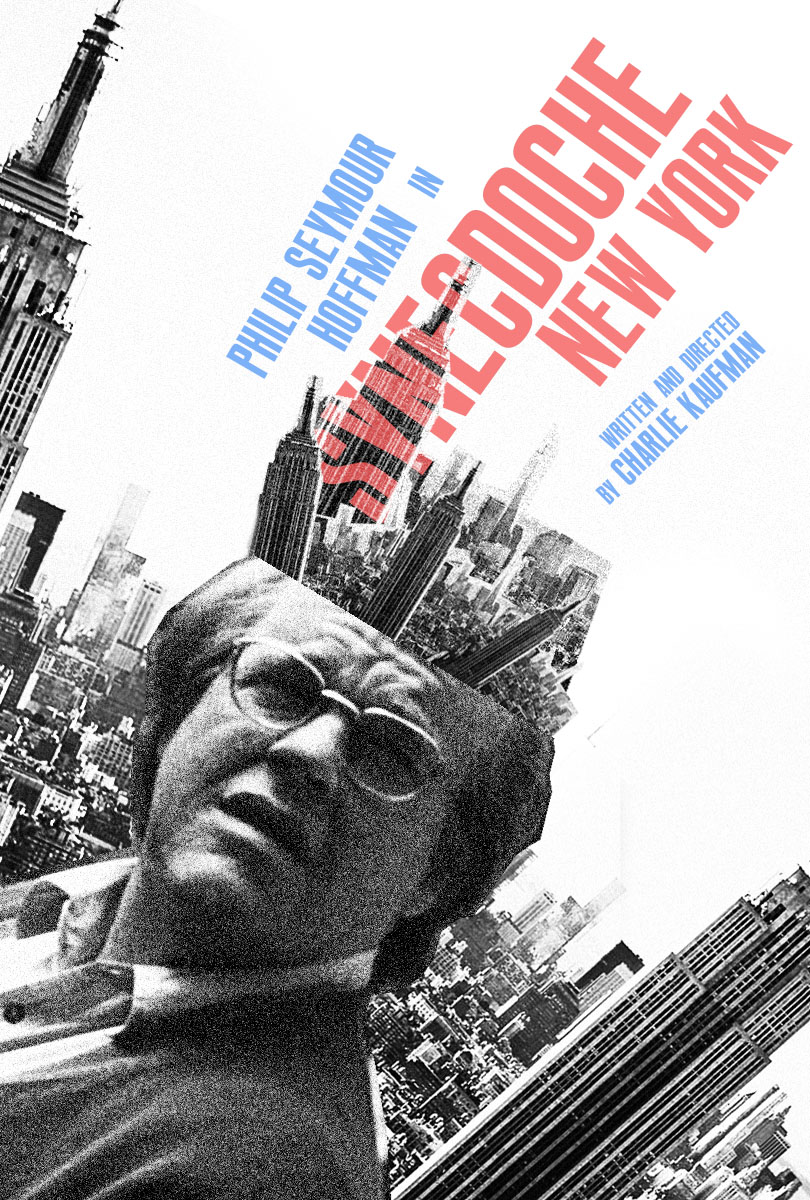
In setting up Kaufman's career to date, there has been occasion, on nearly every podcast, for the podcasters to list some of his other greatest hits, including his 2008 directorial debut, Synedoche, New York.

Now, I lived in New York City for nearly three years in the late 1990s-early 2000s, and was always an east coaster before that, so I knew right away that the film's title was a play on words that invoked the city of Schenectady, New York. 

If you didn't live in New York, and in fact let's say you lived in Paris or Munich or Tokyo, you might have no idea about the existence of a city named Schenectady, New York. So you would endeavor to pronounce the film's title phonetically, as is actually how it is pronounced: "Sin-eck-doh-key." 

But there has been a small (?) subsection of critics who do know about the city and are also not very skilled at pronouncing multi-syllabic words. They have persisted in calling the film "Schenectady, New York," almost as though Kaufman misspelled it but intended us to pronounce it exactly like the city. (Or "Skin"-ectady, as I suggested in the title of this post, as it's really more of an I than an E sound.) 

For the record, that pronunciation is "Skin-eck-ti-dee." So, only the second syllable is actually the same. 

I have heard this wrong pronunciation from the mouths of two such critics on the podcasts so far, neither of whom seem like people who should have problems with multiple syllables. 

It's just really not how it's pronounced. Yet they were dogged in their pronunciation, even when others on the podcast had occasion to say the word and pronounced it "Sin-eck-doh-key."

I had a bit of a crisis about this because I was asked to pronounce for a friend, who runs one of these podcasts himself. He had no idea how to pronounce it, so he came to me. I told him.

And then I heard these two other podcasters go against me.

So I listened to pronunciations on YouTube, which seemed to support my pronuncation, and then I listened to a couple interviews with Charlie Kaufman, where I was hoping he would say the title but he didn't. However, from those interviews, I gleaned that just as Kaufman would not want to begrudge anyone their interpretation of his films -- and doesn't provide his own so as not to infringe on those -- he would probably invite multiple pronunciations of the title as well.

The thing that finally confirmed for me was a bit online that said that there was an entire page in the press materials when the movie was released that was devoted to the pronunciation of the title. And in that bit it lists this pronunciation as "[Sih-NECK-doh-kee]," which varies from mine only in a few typographical choices in how to depict the syllables, and by including which syllable to emphasis. (For the record, I emphasize the same syllable). 

So what explains those two podcasters and their stubbornness about mispronouncing the title that is by no means unique to them?

Who knows. Maybe they are just free spirits who refuse to be pinned down to a single perspective on a piece of art, something Kaufman would certainly endorse.

Oh yeah, one final thing I'll leave you with. It's one of many in a series by the YouTube channel PronunciationManual, and it's hilarious.

Thursday, September 10, 2020

Why movies hate safety

You wouldn't think my post about the new Charlie Kaufman movie, I'm Thinking of Ending Things, would be about seatbelts.

If I were doing my job properly, I would be spending this time instead singing the praises of another great feather in Kaufman's cap, my favorite thing he's been involved with since Synecdoche, New York. (So, er, better than Anomalisa, I guess that means.) If you want to read those praises, check out my review here. 

Truth is, whenever I review something for ReelGood, it takes the wind out of my sails in terms of writing about it here. Not that I regularly write proper reviews for this blog anyway, but I definitely like to think of myself as coming here to gush if I see something I love. Eloquently gush, I should say.

Unless I find a new angle that I couldn't possibly cover in my review, though, I feel all talked out on the movie once I get to this blog. 

Hence, seatbelts.

In truth, it's actually an excuse to bring out of mothballs a post I had started a few weeks back and never posted. I've recently had plenty of opportunities to return to it, because the phenomenon I'm going to discuss seems to be everpresent in the movies.

Namely: Movie characters never wear seatbelts.

Don't think it's true? Next time you watch a movie where characters are driving in a car, check their shoulder area for seatbelt straps. You won't find any.

I suspect it's all about the appearance, that you want the actors to appear free and unencumbered, and not restricted by a safety harness. Lack of a seatbelt may also help with some movement they have to make during the scene.

But there are very few other things in today's movies that register as so out of sync with reality. In reality, most people gave up on whatever rebellious stance they had toward the wearing of seatbelts. Even with idiots who don't wear bike helmets or -- in 2020 -- masks, they recognize that a seatbelt is a useful life-saving device. They don't think it's some kind of liberal hoax to restrict their freedoms.

But movie characters, whatever their political persuasion, are almost never seen wearing seatbelts. Unless the plot itself strictly calls for a seatbelt, like they're about to stage a crash and the wearing of a seatbelt -- or, I suppose, the lack of wearing one -- is a plot point meant to contribute to why they survied or didn't survive the crash.

In I'm Thinking of Ending Things, it was particularly egregious. The characters played by Jessie Buckley and Jesse Plemons spend a good third of the movie driving back and forth from his parents' farm in a driving snowstorm. It's a good thing Kaufman didn't see it as a necessary part of the plot to have them spin off the road in slippery conditions, because they would have been right through that windshield.

I first drafted this post while watching the MIFF movie The Killing of Two Lovers, which could have been about two lovers killed by seatbelt neglect for all the time spent in cars without minimal safety precautions. I noticed it again in the final movie I saw at MIFF, Ema, in which the title character gets into the back seat of a car with a child, and does not strap either of them in. 

In a way, it's akin to the screenwriting shortcuts William Goldman talked about in his book Which Lie Did I Tell?, where he explains to us why the protagonist can always find a parking spot outside the courthouse, and why a character paying for something always has exact change. The movie does not need to waste time on the logistics that would actually accompany these transactions in the real world, like someone rooting around for change, or circling until an elusive spot appeared. 

In a way, though, it's not. You never have to show characters putting on a seatbelt. This can almost always be done off screen. But not even wearing one? You don't lose any time on this. You only lose some kind of intangible aesthetic, the importance of which eludes me anyway. I guess I'd have to see a version of I'm Thinking of Ending Things with seatbelts, alongside a version without, to really know which one I preferred from an artistic standpoint. 

And it's kind of dangerous because you are modeling behavior here. Viewers of all ages watch movies, and though the three examples I've listed are geared toward adults, I'm not willing to assume that this preference in the blocking of the scene doesn't extend to movies for kids. You may not be doing anything so pronounced as disregarding the importance of seatbelts, but I think you could be sending subliminal messages to people.

It's not just the seatbelts, either. I still see movies made today, with modern characters, where no one wears helmets on bikes. In some cases, this is also true of motorcycles. Of course, in movies like whatever recent Mission: Impossible movie it was where Tom Cruise rode a motorcyle helmetless, the character did not expect to be riding a motorcyle that day. He commandeered a motorcycle as part of a pursuit, if memory serves, so no, he would not have a helmet. But there are plenty of other examples where the character should have a helmet and just doesn't. 

With a motorcycle, I get it -- you've got your star here, and if she or she is wearing a helmet, you can't see his or her big moneymaker during that scene. But what's the excuse for no bicycle helmet? Because they make you look dorky?

I guess everything related to bicycles is a bit dorky, if you are talking about an adult. It's the main reason there has been nary a bicycle in a single season of The Walking Dead, even though that would be one of the most useful forms of transportation to survivors of a zombie apocalypse. I guess I can see why. The climax of the movie The Cure for Wellness involves Dane DeHaan on a bike, and it's absurd.

Okay now I really am getitng sidetracked.

I suppose it is dangerous to put movies in loco parentis, because viewers should know that they cannot do everything they see in a movie. But I do think there has become almost a casual disregard for safety for an infinitesimal gain. If you're reading this and you're about to go into production on a movie, just use the damn seatbelts. I don't want my kid going through the windshield because he saw your movie.