Showing posts with label australia. Show all posts

Tuesday, January 27, 2026

A brand new kind of Australia Day movie

This was the first Australia Day where I had to go digging for a title that was not already on my radar. 

Does that mean I've exhausted the available documents of European Australian settlers treating indigenous Australians horribly?

Surely not, but the movies I watched on January 26th the past four years -- Walkabout, High Ground, Charlie's Country and The Chant of Jimmie Blacksmith -- did represent the four movies I already had in my mind that profiled this way, that I had not already seen.

I don't watch Australian movies about those European settlers on Australia Day. Some Australians, or people who live in Australia anyway, surely would. But not me.

Ever since I started to really understand that many indigenous Australians think of this as Invasion Day, and call it that publicly, I relegated the mid-summer holiday to that place in mind of "it's quite problematic, but I do get a day off work at least." In fact, it's so problematic that you don't have to take that day off if you don't want to. The government has made it so you can work it and take a different day off in its place. 

My own contribution to pushing back against a certain subsection of gross white Australians, with whom I don't want to be associated, is to watch a movie on January 26th, for the fifth year in a row now, that considers the troubled plight of indigenous people in modern Australian history. 

Or, sometimes, not quite so troubled.

Oh, there's still an undercurrent of racism in Bran Nue Dae, Rachel Perkins' 2009 film that I knew, from the poster on Stan, was not going to sink me into a pit of despair, as some of those other films have. How could there not be. To depict the indigenous experience on film is to depict the experience of racism.

But it's also an extremely fun and silly road trip movie, and it's a musical!

When I say Bran Nue Dae was not on my radar, I should clarify that. I had heard the title, had probably seen it on my streamers -- particularly Stan, the Australian one -- multiple times before. But I spared it no more than a passing thought any time I'd seen it, and could not even have told you, for sure, that it was about indigenous Australians. Without having really analyzed whatever faces were on the poster, I might have thought it was African, since that creative spelling of "Brand New Day" is just as likely to be from there or somewhere else as from here. (Of course, if I'd analyzed it a little more closely and seen Geoffrey Rush on the poster, that would have cleared up any doubts.)

I've subsequently learned that the concept originated on stage in 1990, before being adapted to film two decades later. The songs are not particularly memorable, but some do get your toe tapping, and they more than exceed the minimum necessary for this to be a really fun experience.

The story is about an indigenous boy of about 16 (Willie, played by Rocky McKenzie) who lives in Broome, in the northwest part of the country, in 1969. Rocky has eyes for Rosie, played by Australian pop singer and national treasure Jessica Mauboy. However, she's being courted by a white Australian, Lester (Dan Sultan), who appeals to Rosie primarily because he can give her her big break to sing and potentially get noticed at the local roadhouse.

Willie is torn away from the potential romance when his mother sends him off to a Catholic mission in Perth, in the southwest of the country, where he's going to study to become a priest. That mission is overseen by the aforementioned Geoffrey Rush. A couple of the boys break into the refrigerator to steal Cokes and Cherry Ripes -- a local delicacy in the confection aisle at the supermarket -- and Willie is the only one who comes forward to admit he was part of the group, to save an innocent boy from being punished. When Rush punishes him severely and begins to insult him -- "I should have known one your Aborigine kind would be worth nothing," he says -- Willie escapes on foot and starts to make his way back home, on an adventure that will have lots of twists and turns and feature lots of compelling characters.

Among these are a drunken Aboriginal elder, "Uncle Tadpole" (Ernie Dingo), who originally just wants Willie's money to buy drink before softening and trying to get him back to Broome. Then there's the pair of hippies in their VW van, whom Uncle Tadpole pretends to have been hit by in order to guilt them into driving the pair to Broome. Just when you think it's the sort of story where Willie will just get passed from one pair of hands to the next -- some of them more well meaning than others -- the same group of characters are hard to fully get rid of, as they continue together on this road trip, accumulating a character played by another Australian acting treasure, Deborah Mailman, along the way. The whole time, Rush's priest is in hot pursuit, following just a few hours behind them at all their stops.

It's hard to describe how much fun and joy Bran Nue Dae packs into scarcely 85 minutes -- really only around 78 when the credits start rolling. This is also, remember, a musical, and though few of the songs are longer than about 90 seconds, it's not easy to fit all that in without shortchanging us somewhere. But no, this is just an economic package of good vibes, silliness, and yes, a few moments of more profound contemplation about the treatment of indigenous people in this society. 

Bran Nue Dae does not need to dwell on this last, though. Even with giving Rush the above line of reprehensible dialogue, the film is not all that eager to make him a one-dimensional villain, and it ends in quite a nice place for his character. 

But these things are still clearly on the film's mind. The cheeky song that follows that line of dialogue by Rush contains the lyric

"There's nothing I would rather be
Than to be an Aborigine
And watch you take my precious land away."

It's said with a song and a dance and a smile on everybody's face, maybe so that white Australians in the audience won't feel too bad about being complicit with that. But it needles them nonetheless. It's a little bit of secret protest thrown in within the context of a cheery musical, which maybe just makes it all the more subversive.

Nor does the film shy away from the sad realities of the indigenous Australian experience, even if their bite is lessened by coming within the context of a comedy. The two significant indigenous elders who appear in this film -- those played by Dingo and Mailman -- are both portrayed as alcoholics. Alcohol has ravaged the Australian indigenous communities, such that some heavily indigenous areas are entirely dry as an attempt to lessen the deleterious effects of the drug. 

One thing personally that I really enjoyed about watching this movie was that it contains a scene set in the same iconic movie theater that I visited when I was in Broome in 2023. You may recall from this post that my younger son, my sister-in-law and I attended Teenage Mutant Ninja Turtles: Mutant Mayhem when we were there on vacation. I was enthralled by this open-air theater, and seeing it in Bran Nue Dae really brought up positive memories of that trip. The movie the characters are watching in "the world's oldest picture gardens" is interrupted by a torrential rain, which is a very real risk you don't get in a lot of other cinemas, and part of the charm I found in the place. 

Bran Nue Dae ends on a very silly note that relies on highly coincidental connections between a bunch of characters who had just met each other randomly, which is a moment that places the film squarely within the realm of fantasy. Though it's an optimistic sort of fantasy that speaks volumes about the filmmakers' hope that this can, one day, really just be one happy country, where people recognize, acknowledge and embrace the ways that they are more similar than they are different. 

That the film is set in 1969, and that we haven't nearly gotten there yet, is a bit more sobering. 

Monday, January 27, 2025

The tragedy of a Black fella

It was Australia Day again yesterday. Some folks call that Invasion Day. And some folks call those folks "black fellas."

I'm not really sure if I can use the term "black fella." I know indigenous people can, and do, use it towards one another. I just don't know if I can use it because I'm not schooled enough in the history of Australian racial relations to know if there are hurtful associations with someone like me using it, or if it is actually sort of a term of endearment, which it sounds like to me. After all, I am invader too, though the invading I did was far more recent and doesn't implicate anyone in my lineage. Things were already pretty much settled by the time I did my invading. 

I do know, of course, that "black fella" is a term of othering. Or at least, a term of distinguishing one thing from another thing.

The protagonist of The Chant of Jimmie Blacksmith, Fred Schepisi's 1978 film, is, in some respects, difficult to distinguish in this way. He's got one white parent and one indigenous parent. For the white Australians of the early 20th century, that was close enough to white to earn him some chances to "make good for himself" in their society. However, it was also close enough to black to make them wary that at any moment, he might conform to their lowest expectations of his other parent.

Which, I'm sad to say, he does. Which makes this a very complicated film. 

It's adapted from Thomas Keneally's novel, which itself was inspired by true events, and it makes for my fourth Australia Day/Invasion Day in a row where I've watched a film that examines the plight of indigenous Australians -- following Walkabout in 2022, High Ground in 2023 and Charlie's Country in 2024. As an invader trying to atone, I figure it's the least -- the very, very least -- I can do. 

Jimmie (Tommy Lewis) has been raised under the good graces of a reverend and his wife, who show the same mixture of optimism and wariness described above, only disguising their racism as charity. When Jimmie is of age, he tries to "make good" in the way they have trained him, proceeding through a succession of jobs that end through no fault of his own. Each employer takes advantage of him in some way or asks something of him that is against his core beliefs, and if he's even slightly reluctant to comply, they stiff him his pay or cast their favor elsewhere. 

It's a rough existence that eventually starts to see strides in the right direction -- er, that's debatable -- when he meets a white woman he wants to take up with, Gilda (Angela Punch), whom he believes he has impregnated. (Given that he first sees her canoodling with a married farmer, it's unlikely he should have trusted her in the first place.) When the baby is born, it's revealed not to be Jimmie's, as the boy's skin color shows no similarity to his own. At this point, unfortunately, they are already married. 

This, I thought, was a really interesting inversion on a scene we see in a lot of movies, where a white man is retroactively cuckolded when the newborn he thought was his has features readily identifiable as belonging to another man. That this is flipped against Jimmie in the other direction gives an idea of just what he is up against while trying to "make good" in this world ... and is just one of the factors that sets the stage for what is going to come next.

Spoilers for The Chant of Jimmie Blacksmith.

When one particular employer denies buying him groceries as part of the pay he is receiving for building a boundary around the employer's property -- on the grounds that Jimmie has lost focus with the arrival of some friends, which the employer worries has turned his property into a "blacks camp" -- Jimmie confronts him, explaining that not only is he owed this, but he has a wife and child to feed. (Despite not being the father, Jimmie has dutifully adopted the role.)

The man holds his ground, and in order to scare the man -- who isn't at home at the time, leaving only his wife and his grown daughters -- Jimmie and his "uncle" (Steve Dodd) appear at the farmhouse wielding axes. They don't plan to do anything with the axes, it would seem, but when the matriarch goes for her gun, a bloodbath ensues that leaves only the two Aboriginal men standing.

I was taken aback by the direction this films takes, though not mostly that The Chant of Jimmie Blacksmith "goes there." My modern mind, trained on the moral logic of very careful Hollywood studio executives, finds it to be a disconnect that these "black fellas" could be guilty of anything so heinous as murder. We are not yet removed from a long period of mainstream movies where minority characters have been portrayed as saints, or given only very minor rough edges.

No, the thing that took me aback most was that having made this terrible error, Jimmie then leans into it and makes things far worse. We never lose our sympathy for Jimmie, not fully, but let's just say -- no need for further spoilers now that I've established my context -- that some of what Jimmie does after this is far less ambiguous and far more deserving of our scorn. In fact, one act is so heinous that it is almost disqualifying of our sympathy, even if Jimmie felt that the man it would hurt most was fully deserving of being so hurt.

Because Fred Schepisi is not an indigenous filmmaker, as he would need to be if he were to make a film like this today, it's hard to know just how we should view the narrative choices in this film. On the one hand, it's obvious that the film is on the side of its indigenous characters, even if Jimmie becomes problematic over the course of the narrative. On the other, it's possible for a white filmmaker to make a movie that has good intentions and still fails to depict things as sensitively as it should. I have not heard anything like that in the discourse about The Chant of Jimmie Blacksmith, but then again, I have not actually heard any discourse about The Chant of Jimmie Blacksmith. When I told my wife I was planning to watch it, her eyes widened and she said it was really good. If this movie were considered problematic by students of Australian film, I think she would have mentioned it.

What this film really does is reveal that war is ugly and that it takes down even the most well-intentioned people, on both sides. At one point in the film, Jimmie very pointedly says "Tell them I've started a war!" Rarely is having started a war considered a good thing, and certainly not here. 

The film clearly operates as a metaphor for political activism, and possibly a call to it as well. That's the same sort of political activism that expresses itself in things like renaming Australia Day as Invasion Day. Jimmie also has several lines of frustrated dialogue where he says that he specifically, or indigenous people generally, did not do anything to deserve this sort of treatment. But some of the lines are "I didn't do anything," without the clarification. If this is how they treat you when you didn't do anything, might as well do something, and at least hit your enemy where it hurts in the process. They're going to think of you the same way either way. 

There's a really good thesis statement for the film in a line of dialogue I jotted down, which is related to the way wars lay everyone low -- and in particular this war that has raged between indigenous people and the white invaders who arrived with the First Fleet in 1788. A school teacher played by Peter Carroll, who becomes a hostage of Jimmie and one of his mates when they go on the run, hears the two indigenous bickering with each other about which of the two of them is guilty of which transgression. The teacher says "If you want to stand there comparing evils, you won't end until you've put a bullet through each other's heart."

The Chant of Jimmie Blacksmith does not put a fine point on many of its ideas, to its credit, but I was glad for this one. There's no real comparison between the evils done by the white men against the indigenous population who have lived here for 60,000 years, and whatever "evils" the indigenous may have done in response to those evils. However, this movie does bemoan the fact that we far too rarely see the productive response to evil, which would be good. Far more often we see the unproductive response, which is just more evil. 

Sunday, June 30, 2024

A U.S. head start even on Australian films

On Friday night I saw the giant spider movie Sting, which hasn't yet played Australian cinemas but is already available for the lower rental price -- lower as in not the premium $19.99 gouging -- of $5.99 on U.S. iTunes.

The thing is, this is an Australian movie through and through.

It's written and directed by consummately Australian director Kiah Roache-Turner, who helmed Wyrmwood: Road of the Dead -- a very Australian film which I really liked -- and its sequel. 

It stars Australian actors -- Ryan Corr and Robyn Nevin being the ones I recognized beforehand, but also Alyla Browne, who has just been impressing audiences as the younger version of the title character in Furiosa: A Mad Max Saga. (In fact, just about the only imported actor is American Jermaine Fowler, who plays the unfortunately retrograde "cowardly Black man" in the film.)

It was most certainly shot in Australia, on a Sydney sound stage in fact, but this location is doubling for the U.S. (I thought they mentioned New York, but I don't that referenced in the plot synopsis on Wikipedia.)

And yet, it's still forced to go to the back of the line and end up as one of the standard Australian releases whose release date is time-shifted from the U.S. release. The movie came out in the U.S. on April 12th, which is why I'm already seeing it available for $5.99 -- which, I should say, is a convenient way for me to get ahead of reviewing it in time for its July 11th Australian release.

Now of course, it's very unlikely we would see this if the movie were set in Australia and the Australians were using their natural accents. I can't think of an example where Australia had to wait for an actual Australian movie, not a movie made by Australians but set in the U.S.

Still, I do find it sort of funny that the distributors had no interest in leveraging the Australian cast and crew for a world premiere of the movie in Australia, rather than a world premiere in Los Angeles. If it doesn't mean anything that a movie is made by almost exclusively Australians, why even do it, other than I suppose the tax breaks.

Sunday, January 28, 2024

A country that should belong to Charlie but doesn't

Since 2022 -- not a long track record, but you gotta start somewhere -- I have had a tradition of watching a movie featuring indigenous Australians on Australia Day, which remains January 26th despite the increasing heat that has been placed on this Euro-centric holiday.

January 26th was the day the First Fleet arrived in 1788. For many white Australians and immigrants from some countries who want to bask in the glow of white Australians, this is cause for celebration, because otherwise they wouldn't be here. For many indigenous Australians, it is a painful reminder of a history of death and marginalization that began that day. They call it Invasion Day -- because otherwise those others wouldn't be here.

The awareness of the hurtful associations of the day have grown to the point where this year, I was given the option of taking another day of my choosing as the paid holiday. I took January 26th because it worked best with my family's plans and because I don't really feel like I, as BOTH a white Australian (resident, anyway) AND an immigrant from another country, really have the right to make any sort of gesture of protest on this front.

My gesture of protest, I suppose, is showing some random numbers cruncher out there that I am watching a movie about indigenous Australians on Australian Day.

In fact, this would have been one of my final days to easily watch Charlie's Country, Rolf de Heer's 2013 film, since it's leaving Netflix on January 31st, and I'm not finding it available any other places. It follows Nicolas Roeg's Walkabout (1971) in 2022 and Stephen Johnson's High Ground (2020) in 2023. 

The viewing felt even more pregnant with meaning in 2024, since it came approximately three months after the failure of a national referendum regarding indigenous Australians. It was a campaign my wife worked on tirelessly, and even though I can't vote in Australia, I volunteered a few hours on it as well. The idea was largely symbolic. First of all, the idea was to recognize in the constitution that indigenous peoples were the first Australians. Second was to create a group called The Voice, which would be a panel of indigenous Australians who would advise the Australian government on matters relating to indigenous people. The government did not have to heed this advice; it just had to hear it. Well, even that was too much. The Yes position lost to the No position, rather handily, as a bunch of racist Australians all worried this would mean an indigenous person was going to come kick them out of their house. (I'm sure some people felt they had more nuanced and justifiable reasons for voting no, but that's not something I feel like acknowledging today. The truth is, the prime minister may have pushed this referendum through too quickly, with the average Australian not having enough time or benefitting from enough of a public awareness campaign to understand what it would mean for them to vote yes.)

I'm not sure I could have found a movie that more perfectly encapsulated the themes of rage and sorrow associated with Invasion Day than Charlie's Country, especially the year after the failure of this referendum. To boot, it stars indigenous acting treasure David Gulpilil, who we lost in 2021 -- and who actually starred in Walkabout 42 years before this, when he was only a teenager. 

Gulpilil plays Charlie, a well-known figure in a Northern Territory community outside Darwin. Charlie is generous with the money he receives through government assistance, leaving quantities of bills in front of certain people who need them, which seems to be such a regular occurrence that they don't even really gesture to thank him for it. He's also a use to the local police, whom he helps track suspects -- though in the one example we see in the movie, it's because he's actually an associate of the low-level drug dealers the police are seeking, so he knows exactly where they went. Charlie and his friend get a laugh out of that one.

No, Charlie isn't a traitor to friends like these drug dealers, because they aren't really his friends. They're just another pair of white people who play nice with Charlie because they want something from him, like the police. Besides, they charged too much for their weed.

It's taken a life's accumulation to get to this point, but in his 50s -- Gulpilil himself was almost 60 when the film was made -- Charlie is feeling the need for a mini rebellion against these whites who have moved into his community, laid claim to Aboriginal land, and trusted that he'd always be a good doggie. There are a couple incidents that have pushed him over the top. For one, the police confiscate the guns he and his friend used to hunt -- Charlie's is an illegally modified shotgun, but either gun comes without a license, and the "friendly" local police see it as an opportunity to remind Charlie who's boss. When Charlie then makes a spear to hunt, they consider that a "dangerous weapon" and take that too. 

Things start to escalate from there, but because Charlie's Country exists within the realm of realism, they don't need to spill over into melodrama to put across the point that Charlie has had enough, and that even a mini rebellion is enough to put him in his place for a lot longer than the slap on the wrist he got for the modified shotgun.

One of the things this film tackles is the thing whites brought to Australia beyond the toxic nature of their own presence: alcohol, tobacco and drugs. Alcohol has destroyed the lives of indigenous peoples, both in Australia and elsewhere in the world (like the United States), such that in some parts of Australia, individual indigenous peoples are banned from the purchase of alcohol, while in some whole large regions, specifically in the Northern Territory, it is just not made available for sale at all -- even to tourists. A glass of wine at dinner might be available in certain scenarios, but you can't go to the bottle shop, as they call it here, and buy any, due to the deleterious effects it has had on the whole community. We know this because we visited the NT in 2018 and had an effectively dry holiday. We're going there again in April. 

Charlie is actually a bit of a rarity in that he is allowed to buy alcohol, but he is not allowed to share it with others or else he may be subject to a fine or jailing. I'm not really sure how this all works, but the implication is that all indigenous adults start with a clean slate, and then an alcohol-related citation from the police causes you to become banned -- and that most indigenous adults are banned, which is a real commentary on just how pervasive this. Without spoiling the movie, it's around this topic that things really blow up for Charlie eventually.

But then you can't discount the influence of tobacco or drugs either. Although marijuana is the only drug shown here and though it plays a minor role in the proceedings, tobacco has had a major impact on Charlie's life, in that smoking has caused him to have lung issues, possibly even lung cancer, though we aren't sure of the severity of it. 

Gulpilil is magnificent here, and as I was watching this movie, I was thinking on the recent deaths of both Gulpilil and Jack Charles (known affectionately as Uncle Jack Charles), and how it has left a void in Australia's indigenous acting icons space. Probably the most recognizable indigenous actor now is Baykali Ganambarr, who starred in Jennifer Kent's The Nightingale, though there are also indigenous actors who are less instantly recognizable as such because they have enough white heritage to blur the tools we use for making such identifications.

In an era of legitimate questions about who is allowed to tell whose story, Rolf de Heer continues to position himself as a credible advocate for indigenous people, who tells their story from as close to their perspective as possible while still being white himself. De Heer has been establishing his bonafides his whole career. In 2002 he directed possibly my favorite film with indigenous subject matter, The Tracker, in which Gulpilil plays the title character. A few years later he made Ten Canoes, which follows indigenous characters living in the traditional ways in the NT. Then in 2022, I only just learned, there was The Survival of Kindness, which also has indigenous subject matter -- and could be a good candidate for an Australia Day viewing next year.

I could probably continue to offer insight on this great movie, but I've been bombarding you with content in my end of year posts, so I just want to finish with one interesting connection that Charlie's Country has to my own life.

Even though Charlie is beloved among his companions and is, generally speaking, accorded a certain respect that other "blackfellas" do not get, we see him longing for his glory days. Specifically, he thinks back to when he danced for the queen at the opening of the Sydney Opera House. And though this does not exactly mirror Gulpilil's personal experience, Gulpilil did dance at the Opera House a year after the opening in 1974.

You may remember, because I've had occasion to talk about it recently, that I was also there on the day the Sydney Opera House was dedicated by the queen, in spirit anyway -- because I was being born that day in Boston.

For a person who doesn't belong in Australia at all, here only by marriage, that made me feel included not only in the way most white Australians feel on Australia Day, but even in the experience of one Black Australian. It's a little something I can say I share with Charlie, and he might even agree.

Wednesday, August 30, 2023

Baz Jazz Hands: Australia

This is the fourth in my 2023 bi-monthly series rewatching the films of Baz Luhrmann.

I was at a disadvantage when I saw Australia in January of 2009. Several, actually:

1) I had not yet lived in Australia.

2) I was not yet a parent.

3) I heard it was bad.

Yes I had a fair number of preconceived notions about the poor quality of Australia when coming in. The film was received with howls in certain critical corners in late 2008 when it was released, and according to the date Letterboxd shows me I saw it, I only just barely crammed it in before my 2008 list closed. I metaphorically had my arms crossed before I even entered the theater, despite loving Luhrmann's previous film, Moulin Rouge. (Which I watched for about the fifth time for this series in June, you will recall.)

Then I liked the movie. Maybe I didn't love it, but I liked it plenty. And considerably more than my wife, an actual Australian, if memory serves. Another hurdle for Australia to overcome in terms of its enduring legacy in my mind.

I checked the retroactive star rating I gave it on Letterboxd, and was pleasantly surprised to see that when I entered all my films in Letterboxd in early 2012, I was feeling generously enough toward Australia to give it 3.5 stars. The Flickchart ranking is also fair, 2145 out of 6353 films ranked, good for 66%.

So you can imagine I was pretty surprised to nearly be in tears at the end of the movie on this viewing.

Yes I am a sap. We know this about me. It's one of the main reasons I (generally) swoon for Luhrmann's work. But I'd thought Australia was an exception.

Instead I watched -- across last Friday night and Saturday morning -- a grand, sweeping, 2-hour-and-45-minute epic in the old school style of big spectacles, with brave heroes and hissable villains, and damsels in distress who, it should be said, get plenty of their own agency in a manner more befitting the 21st century in which the film was made. With a storyline about surrogate parents and their surrogate child that really put a lump in my throat.

I think one of the criticisms Luhrmann receives is that he doesn't draw his characters very finely. There are things they represent, but they don't have the detail or the nuance that we believe -- correctly in most instances -- is the meat and potatoes of good character writing.

One example of this, which caused a lot of guffaws at the time, is that Hugh Jackman's character never receives a name other than "the Drover." (Because he's a cattle drover.) I admit I thought this was funny at the time too.

Now I realize that giving us inordinately complex characters is not one of Luhrmann's interests, and that does not necessarily detract from the quality of his films. I'd argue that we do get some complexity in other Luhrmann characters, often as a result of the performer's individual gifts. Some, for example, think that's what we get in the lead performance in Elvis, though I'd have to think more about that to decide if it deviates from my thesis. 

Which is this: Luhrmann is more interested in exploring archetypes, not specific people.

The Drover is perhaps the prime example, though that doesn't take even a little bit away from Jackman's performance. He's heroic and sexy and has incredible chemistry with Nicole Kidman. Did I say he was sexy? Boy is he sexy. But you can't pull off those things if you are wooden, if you are only fulfilling the needs of an archetype.

Yet even if he were, so what? It's becoming clear to me after four Luhrmann films that his films are in conversation with the very history of narrative, beyond existing as narratives themselves. Few writer-directors conjure more detestable villains. Richard Roxburgh's duke in Moulin Rouge may be at the top of that list, but David Wenham's Fletcher gives him a run for his money here. Luhrmann is exceptional at getting a sneer from an actor.

When you are watching a Luhrmann movie, you need to be going in with the expectation that he's going to paint with broad strokes, on purpose, to bring out what makes certain character types appear over and over in the history of storytelling. Some people may not like that project. I love it.

And did I love Australia on this viewing?

Maybe. Maybe I did.

The epic scope of the outback in the film's opening 90 minutes or so is perhaps something I wouldn't have appreciated as much before I lived here. Not that I've spent a huge amount of time in the outback. But I did actually visit the part of the world in which this is set in 2017. The city of Darwin and the Aboriginal territory of Arnhem Land are both places I visited, though the latter only with the accompaniment of an indigenous guide, and only just inside the boundary. See, only indigenous people are allowed to set foot in Arnhem Land unless specifically approved for a visit. 

I found these scenes glorious in scope and subject matter. In 2008 (early 2009) I also did not have the context of coming to understand the indigenous experience a little better as I have in the ten years I've lived here. I would never pretend that I understand the experience well -- that's not something I have any right to claim -- but I certainly have consumed a fair amount of art about the indigenous experience, each of which improves my overall ability to empathize with their history of suffering. At first I thought Luhrmann's handling of the indigenous themes would read as cringey or appropriative to me, but I actually think he does a pretty good job with it. It's always great to see Australian treasure David Gulpilil, who just passed in the past two years, in the role of King George.

As impressed as I was with the vistas in the film's first 90 minutes, I was equally impressed with Luhrmann's shift to the upper-class social gatherings of Darwin, which is where we see some of his most familiar interests -- romantic scenes of people dressed up in fancy outfits, dancing. We get this in almost every Luhrmann film -- possibly ever one, full stop. The attack by Japanese aircraft is then also done really well. 

I was enthusiastic enough about Australia on this viewing that I could probably continue to list things. But there was only one more funny detail I wanted to mention before I wrap up with thoughts on why the film's possible deepest resonance for me this time around.

That last detail relates to how Luhrmann establishes his villains. One thing is, of course, the sneering. Another is the conniving, murder, etc. But something I found common to both Wenham's Fletcher and a lesser villain, King Carney, played by Bryan Brown -- who ends up having something of a heart -- is that they both swig directly from the bottle when they're drinking at a fancy party. In one character detail it shows both their sense of entitlement, and how uncouth they are -- the latter a real sin in Luhrmann's world of passionate kisses in tuxedos and ball gowns.

My final thought has to do with the third lead beyond Kidman and Jackman, a young Aboriginal boy named Nullah, played by Brandon Walters.

For starters, I was overcome by how radiant a presence this boy is. Let it never be said that Luhrmann doesn't have a knack for casting. I'm not sure where he found Walters -- I could probably look it up on the internet if I could be bothered -- but there are not a lot of characters I have seen on screen in whom I have found it easier to poor my heart. Those eyes! The kid is such a natural that I'm sorry to see he has only appeared in three other projects, and only in the past few years -- unless of course that was his choice. If it was because Australia was received poorly, then I think that's truly a shame.

My reaction to both Walters and the character has something to do with what I mentioned up top, about how I was not a parent in 2009. 

I was really touched by the story of the makeshift family that develops between Drover, Sarah Ashley and Nullah. I suppose today it would read more as a white savior narrative, but just as Luhrmann avoids the most pernicious pitfalls of depicting the Aboriginal experience on screen, he also avoids them in this regard. The conditions at the time -- when so-called "half caste" indigenous children were being taken from their families to become "civilized" in white homes -- makes it inevitable that the two white heroes of this film would have to play this role toward him. However, the understanding of the importance of him going on walkabout with his grandfather, Gulpilil's King George, keeps the optics pretty good on this one.

And dammit if I didn't get emotional when a) this makeshift family is reunited, and b) this makeshift family has to send their adoptive son out into the world, to learn the ways of his ancestors, to discover how to follow the songlines that they have sung out for navigating the great outback. When you are a parent, narratives in which parents are separated from children suddenly strike you more deeply -- and I discovered on this viewing that Australia is a particularly good example of this sort of emotional manipulation, a term I use in its very best sense. 

(Yeah, I never expected to write this many words on Australia either.)

One final, final thought. I watched Australia close to what was the tenth anniversary of me living in this country. August 20, 2013 was the date I left America; August 22nd was the day I arrived in Australia, because you lose that day flying in that direction. I thought about posting about this landmark date here on this blog, but since it isn't directly related to the movies, I never did. However, I thought watching Australia for reasons other than celebrating this anniversary, and rather only because it was the next scheduled movie in this series, was pretty felicitous. 

We're up to Luhrmann's second-most-recent release in October with The Great Gatsby, which will be my third viewing.

Monday, January 30, 2023

My Australian start to the new viewing year

The first two movies I watched after closing my list were both "obligations," in that neither was chosen purely for pleasure -- whether that pleasure is derived from pure shut-your-mind-off escapism, or rewatching an old favorite, or just diving deeper into the history of cinema through some black-and-white film from the 30s. That's a bit sad because being able to watch whatever you want is one of the great joys of getting to the end of one of these gargantuan undertakings.

That's not to say I was disappointed to watch either of these films, just that they wouldn't have naturally been the first two out of the chute if all else were equal. 

As it happens, both were Australian in subject matter. I'll address each with its own sub heading.

How you can tell someone isn't Australian

The late (January 24th) end to watching 2022 movies meant that I could only take one night off (I watched the Australian Open, which I've been doing all week) before I had to get right back on the horse.

See, January 26th is Australia Day, and last year I started a tradition that I hope to do every year: watch a movie that deals in some way with the plight of indigenous Australians.

Australia Day is called Invasion Day by many indigenous people, because it marks the arrival of Europeans in this country. So while some Australian-born cinephiles might recognize the day watching something that celebrates Australians of European descent, I think it's more on the side of social justice to mourn their arrival alongside the people whose history they permanently altered. (I of course am not an Australian-born cinephile, but more on that in a moment.)

And so I watched High Ground, a film by Stephen Maxwell Johnson that has a 2020 date on IMDB but was not actually released in Australia until the end of January the next year. (It must have played a festival because it certainly wasn't released anywhere else before it was released in Australia.)

The plot is inspired by a real incident in which a couple dozen indigenous people were slaughtered by police around 1919, which was covered up to avoid the consequences. Yes, fortunately there were starting to be consequences for that sort of thing. A young man and his nephew, a child at the time, survive the incident, but are separated, with the boy being taken in by a local Christian mission and raised by them. Twelve years later, the uncle is creating havoc on local farmsteads, and some of the police want to track him down to bring him to justice, while the boy -- now a young man -- wants to get ahead and warn him. There are both sympathetic and monstrous white characters who fall on either side of the divide.

I wish I could say it was as fulfilling as the first film in the series, Nicolas Roeg's Walkabout from 1971, but Johnson is no Roeg. It has some strong parts while overall being a bit underwhelming. Still in the range of a recommendation on Letterboxd, earning three stars out of five. 

So instead of using this space to sing its praises, I'll use this space to discuss something that identifies the main villain as such -- and something I share in common with him.

The Australian character actor Callan Mulvey is a nasty looking fellow. I don't mean he's ugly, just that he has a menacing look in his eyes. He can't help it, it was the way he was born, but he's certainly leaned into it to get similar work along the lines of his role in High Ground, such as Batman vs. Superman: Dawn of Justice and Avengers: Endgame. So he's doing quite fine for himself, thank you very much.

Here he plays the nastiest of the group of policy officers, who range from virtuous with a regrettable past, to just following the rules, to this guy, who takes a sadistic pleasure in the idea of killing the indigenous. And you can tell he's bad -- or at least not from around here -- with how he handles the everpresent flies of the Australian outback.

Now, if you've never seen a film set here, you might not know that the characters in these movies have flies landing on their face and flying off again. It's just what happens. Spend enough time around it -- like, say, from birth -- and you adapt. You stop brushing them away and train your skin to deal with little pairs of legs landing on it constantly and possibly crawling around.

Not this guy. He's always telling the flies to fuck off and shooing them away vigorously.

This does serve the purpose of demonstrating that he's a cruel person -- literally, he would hurt a fly -- but I think more than anything it's shorthand for the fact that he doesn't belong here. If this person were truly designed for this climate and this country, he'd have made peace with the flies long ago.

I sympathize with the villain in this case -- and this case only -- because I, too, cannot handle the flies. I hope it's not because I'm the unwitting star in the movie of my life and the director of that movie is trying to demonstrate my cruelty. But I'm okay with the director indicating that this is not the place I grew up. Indeed, the most I start to approach insanity in my normal daily life is when I'm in a place where there are a lot of flies and I just can't get them to leave me alone. I get pretty vocal about it.

Oh well. At least I watch movies about indigenous people on Australia Day, so I hope that makes up for it.

The influence of Crocodile Dundee

I tend to forget what an impact Crocodile Dundee, the character and the movie, had on Hollywood in the late 1980s. The Rescuers Down Under reminded me. 

The 1990 film was my January draw for Flickchart Friends Favorites Fiesta, the monthly film exchange I do with other members of the Flickcharters group on Facebook, where you are randomly assigned another person and watch their highest ranked film you haven't seen. I wouldn't have thought The Rescuers Down Under would have been this movie for me on many if any lists out there, but then again, I was 16 and 17 in 1990. For someone who was eight it might have been a totally different story.

It seemed appropriate to finally get to this movie considering where I now live, but I didn't consider that it owed its existence to Crocodile Dundee until I went to add it to the list of movies from 1990 that I'd seen. 

Alphabetically, it landed directly next to Quigley Down Under, the Australian set western starring Tom Selleck.

Again I only caught this because of their alphabetical proximity. I checked the other 78 movies I've seen from 1990 and there were no other people who spent any time down under that year, at least not among the movies I've seen.

The curious thing about this particular film set down under is its lack of trying to feel authentically Australian. 

It gets some of the settings right. The landscape has some fantastical elements that I don't believe exist anywhere in Australia, like these massive waterfalls in the middle of the outback. Drought tends to be more of a problem in those parts of the country than having too much water. But overall they were going for accuracy, I would say, including starting in on an impressive shot near Uluru. They've also got some good sound effects of uniquely Australian birds and that sort of thing.

The birds may sound like Australian birds, but the people don't sound like Australian people.

There are two human characters we spend any significant amount of time with: a boy named Cody, voiced by an American boy named Adam Ryen, and a poacher named McLeach, voiced by an American man named George C. Scott. Neither had much of a career after this. (Scott actually continued working up to his death in 1999.)

Why no Australians?

My wife tells me that the prevailing wisdom at the time was that Australians could not play Australians in films intended for American audiences. See, we dumb Americans couldn't understand the accents well enough.

You might have thought Crocodile Dundee would change that. That movie obviously would not have been a hit if Paul Hogan had sounded like Paul Giamatti. But Disney was not ready to stick its neck out and take the risk.

Weirdly, though, the animal creatures -- those hailing from Australia, anyway -- do mostly have Australian accents. They're mostly side characters because our three animals with the most lines of dialogue are not from here: the two lead mice and the albatross that imports them to Australia, who are voiced by Bob Newhart, Eva Gabor and John Candy. (Gabor really didn't have much of a career after this. It was her final film role.) But the fourth most lines of dialogue go to a mouse named Jake, who is voiced by Melbourne native Tristan Rogers, and whose dialogue is perfectly intelligible.

I guess casting directors didn't realize back then that if Australians can do perfect American accents, they can certainly do more accessible versions of an Australian accent.

I'll leave the question of why two mice needed to be imported from New York City to save a child kidnapped in the outback by a poacher for another day. 

I ended the Australian streak by watching You People, the new Kenya Barris-directed film on Netflix, which starts off my 2023 movie list. It had no references to Australia that I noticed. 

And I think now for a while you will be spared from posts that involve the last something of 2022 or the first something of 2023. You've earned it. 

Thursday, January 27, 2022

A very Australian Australia Day - or was it?

Australia Day, which occurs every January 26th, is kind of a cross between Independence Day and Columbus Day. In timing, it's a middle of the summer thing, like Independence Day, and it purportedly celebrates Australian pride, like Independence Day celebrates American pride. But like Columbus Day, it symbolizes the future downfall of the country's native population due to the arrival of Europeans. The day honors the 1791 arrival of the First Fleet, which brought the first European settlers to Australia.

Among indigenous Australians it is often referred to as Invasion Day, and as such, progressive-thinking Australians cannot celebrate it unproblematically. Suffice it to say that while flying Australian flags on January 26th may have once been commonplace among Australians of all political stripes, nowadays it definitely indicates your right-wing tendencies. The most progressive may attend protests on the 26th of January; a couple years back, we attended a concert of Aboriginal musicians, which we considered to be progressive enough while also involving two young children. (The repeated use of f-bombs by the final artist, rapper Briggs, did make us laugh about the actual appropriateness of this as an activity for children. When at one point he said to put those little motherfuckers up on our shoulders -- meaning he was certainly aware there were children in the audience -- one of my kids asked why he would refer to children that way. It was funny.)

Still, regardless of what you think of it, it's a day off from work, so there can't help but be a bit of a festive air to it.

We had a pretty stereotypical Australia Day in a number of ways yesterday. Namely:

1) We went to the beach. The water was gorgeous. It was almost hot in some places.

2) We made cheeseburgers on the BBQ for dinner. Shrimp might have been more Australian, at least in terms of how the stereotypes go, but my wife doesn't like shrimp.

3) We watched a couple sets of the Australian Open. My older son surely would have watched more but I made him go to bed in the middle of the third set at just after 10 o'clock.

But I wouldn't be talking about it on a movie blog if not for

4) I watched the Australian movie I was most ashamed I have yet to see.

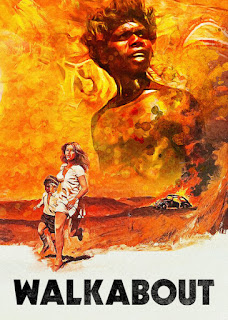
Now that I'm reading about it on Wikipedia, I can see that Nicolas Roeg's 1971 film Walkabout actually prompted an argument among critics at the time about whether it should be considered Australian. That it takes place in Australia is obvious, but the director and the two white stars are British -- the boy even being the director's son, Luc. The girl, Jenny Agutter, would go on to appear in Logan's Run and other films.

Whether the film deserves its place among the canon of "Australia's greatest films of all time" -- as in, films made primarily by Australians -- it certainly does make for an appropriate sort of Australia Day viewing, if you are looking askance at that holiday.

The story involves two Sydney children who get lost in the outback after their father commits suicide and burns their car, after first trying to kill them. What a way into the story. Led by the 17-year-old girl (the boy seems to be about eight), they try to walk home, without any real idea where they're going. After finding an oasis that sustains them for about a day before the water dries up, they are rescued by an indigenous boy, who continues their "walkabout" of the title -- killing the animals they require to survive and keeping them alive, without being able to communicate with them verbally.

One of the other things that drew me to watching Walkabout on Australia Day was it being the first role for indigenous actor David Gulpilil, who died last year. I also watched a documentary on his life last year. I was actually thinking I'd watch his final starring role, Charlie's Country from 2015, rather than his first, but I couldn't find it available on my streaming services (after borrowing it from the library in December and having to return it unwatched, due to the holidays and moving). When that wasn't available I found Walkabout on the second service (Amazon) I tried.

Interestingly, he was credited as David Gumpilil here. I'm not sure if that was an error on the part of the filmmakers or has to do with indigenous naming customs, which have to do with honoring the dead but which I don't understand fully. (After Gulpilil died, for example, his family asked that he be referred to as David Dalaithngu, but only for the first three days after his death.)

Without completely detailing what happens in this story -- such as it is -- I will say there are a lot of images of a spoiled Eden and intimations about the ways white settlers destroyed a more pure version of Australia. Because this is Roeg and he has always let his imagery rather than his words do the talking, this doesn't hit you over the head, though it's also impossible to watch the film without getting the point. There are a number of scenes of animals being killed, for example, and though it is Gulpilil's character who kills most of them, he does so humanely, with his spear, for food. The white hunters we briefly see shoot them for sport. Big difference.

Indeed the film is incredible to look at, hallucinogenic in parts, and it manages to be a film both recommended for viewings by children (it makes lists of films children should see before they turn 14) and one with intense imagery and subject matter (a father trying to shoot his own children before killing himself? Jenny Agutter appearing nude multiple times at age 17?). Although I did really like it, something about its conclusion left me a little hollow, though it's certainly compatible with the themes of the loss of innocence experienced by a people and a country.

I suppose it has a small amount of additional resonance to me as Roeg was, like me, not an Australian but trying passionately to interpret Australia as an outsider. If I one day could produce the writing equivalent of Walkabout, that would be cool, but I'll probably just continue watching an intelligently made and critical film about Australia each January 26th. This was only the second time I've watched a film set in Australia on January 26th after Phar Lap in 2014 -- a far more traditional Australian-made film about white people -- but I'll hope to keep the new tradition going from here, with an eye toward films that consider and properly honor the true owners of this land.

Friday, April 29, 2016

The fine line between Captain America and The Avengers


The following post contains very minor spoilers about Captain America: Civil War, not much more than what the trailers already show you.

Captain America: Civil War is, for all intents and purposes, an Avengers movie.

Except it's good.

Like, really good.

Which makes no sense.

Marvel Studios and Disney so tightly control the Marvel Cinematic Universe, and therefore the look and feel of their films, that when a director wants to bring his own vision to one of these movies, they just push him out. Bye bye, Edgar Wright. We want Ant-Man to be less interesting than you want it to be.

But for some reason, the Captain America movies have stayed above the fray. Civil War is no exception.

Which makes no sense.

These movies should be of a piece, yet the Captain America movies -- be they directed by Joe Johnston (the first movie) or the Russo brothers (the last two) -- are consistently superior products.

I'm sure someone could figure out why, but it's not going to be me.

As Joss Whedon has gone from Marvel golden boy to Marvel whipping boy, it's easy to just suggest that Johnston or the Russos are better directors than he is. But that's a pretty weird conclusion. None of those guys has the track record Whedon has, and just because his last Avengers movie was a stinker, it doesn't taint his previous output -- both for Marvel with the original Avengers, or in general as a writer/director/creator. Can we really say that these other guys "get" Marvel more than Whedon does?

And yet this is basically an Avengers movie. The Avengers are called out by name constantly in Civil War. Like Superman before them (about a month before them), they are culpable for wanton destruction and accused of being indifferent to the resulting loss of life. Just because the Hulk, Thor, Nick Fury and, um, Cobie Smulders are missing from this, it doesn't mean it's not really an Avengers movie. They've just replaced those guys with Spider-Man, Ant-Man, Black Panther and Bucky Barnes. (And who knew, by the way, that Captain America's movies would be so much about Bucky, well beyond The Winter Soldier and probably on into the next three or four installments?)

What I thought I would object to in this movie is the fact that everybody needs to be in it. As the paragraph above indicates, it's about the same amount of everyone as in the overstuffed Age of Ultron, but what seemed like it would make it worse is that they kept on adding new people. The introductions of Ant-Man and Spider-Man particularly had me worried. There wouldn't seem to be enough for everyone to do.

Yet Civil War somehow figures that out, too. Ant-Man and Spider-Man are both basically comic relief, and boy are they fun. They are used just the right amount, sprinkled in for flavor, rather than relied on heavily to bear out complete narrative arcs. (And there's one awesome Ant-Man thing that I don't think any of the trailers have spoiled yet.)

I'm wondering if we just find the Captain America brand name a surefire indicator of quality -- if, in fact, that's why this story contains the Captain America banner rather than the Avengers one. I mean, it's never too late for a series to curdle, but something about Captain America just continues to hum along at a creative peak. What's strangest about this is that the original, The First Avenger, was something I wasn't looking forward to in the slightest. I was worried this character would be terminally square, jingoistic in a completely unironic and probably painful way. The First Avenger figured to make me embarrassed about my country of citizenship. Instead, the three Captain America movies may well be my favorite three movies from the MCU.

I don't know that I should question it. Maybe I just need to accept it and move on.

Some other thoughts on Civil War ...

America first

If you're wondering how I've already seen this movie, well, I'm kind of wondering that too.

As I came out of the theater yesterday, I asked myself, "Wait, wasn't it the first weekend in May that Captain America and Batman v. Superman were fighting about back in 2014 or something? As far as I can tell, it's not May yet -- even here in Australia."

And indeed, when I got home, I checked IMDB, and the movie doesn't open for another eight days in the U.S.

No such delay here. A week and a day before its U.S. release -- which is really one more additional day because of the time difference -- Captain America has hit Australian theaters. Except they don't call them theaters here, or even theatres. They call them cinemas.

When it comes to movies and their release dates, Australia often taketh away. But sometimes, Australia giveth.

Imperfect teeth

There's a moment in Civil War when Robert Downey Jr.'s Iron Man tells Chris Evans' Captain America that sometimes he wishes he could punch him in his perfect teeth.

This was only a few minutes after I realized he couldn't say the same thing to Black Widow.

No, not just because heroes don't usually threaten to punch women in the mouth. Rather, because Scarlett Johansson's teeth are not perfect.

When she's on the phone with Steve Rogers following [a particular incident that I won't spoil here], the camera goes close on Johansson's mouth, and that bottom row of pearly whites is anything but straight. In fact, the teeth in ScarJo's front middle are actually trying to crowd each other out, one in particular protruding crookedly in front of the others.

Before you think I'm teeth-shaming Scarlett Johansson, I'll let you know why I'm bringing this up. It reminds us again why Johansson is awesome -- she's not perfect, but the combination of her appearance and her charisma often convinces us that she is.

In fact, in reality, she's just the girl next door with crooked teeth.

Okay, so that's being a bit disingenuous. She's a person of otherworldly beauty. But her beauty is not inaccessible, as you might think it were. There's a natural component to it, a regular component to it, nearly undetectable imperfections that ground her in our world. This despite the fact that someone actually made a "realistic" robot version of her. One with perfect teeth, I might add.

And sure, it could just be because she could never afford to take enough time off from acting to get braces. But I like to think that she just doesn't care. And that's cool.

A well-trained audience

People have figured out this Marvel thing by now.

Most of the time when you go to the movies, and the credits start to roll, you lose three-quarters of your audience right there. A hardy few will stay to look at the names of all the key grips and dolly grips, but most of them are gone -- to the bathroom, to the car, what have you.

Well, not in Marvel movies, at least not anymore. For a time, these people were leaving early and missing the now two extra sequences that appear -- one about a minute into the credits, and one after all the credits have rolled. But now everyone is hip to this. In my audience, we lost no more than ten percent, and even those who did leave, didn't do so until after the first installment of additional footage. The rest of us waited to the bitter end. It was really a rather unusual experience, a bunch of people looking at their phones with the lights up, still plastered to their seats.

And I'm proud to say I was able to figure out essentially what the final bit of footage would be. I won't tell you what it is, but I will say that I correctly guessed both characters that would appear in it and what the essential nature of their interaction would be.

Marvel may not contain all that many surprises these days, but Captain America continues to be the exception to that rule. He was the first avenger, and I'm increasingly convinced he's also the best.

Wednesday, December 31, 2014

A strong year in Australian cinema


I promised you a recap of my Australian Audient series, but I always knew I wanted to combine it with a reflection on movies that were actually released in Australia in 2014. So read on, because that's the very hybrid I've written.

I chose Australian Audient as my 2014 monthly series because I wanted to deepen my appreciation of Australian cinematic history, and begin to commune cinematically with my new country. This in turn seemed to sharpen my awareness/appreciation of the new Australian movies coming out ... especially relative to the scarcity of titles from decades past.

Weirdly, even given the entire history of Australian cinema to choose from, there were only a few titles I had to leave off my shortlist of movies to watch for this series. Granted, many of the classics are movies I have already seen, either on my own or shown to me in the 10 years I have known my wife. But I was still rather amazed at the relative paucity of titles to choose from, especially in places you'd think you'd be able to find them (the local video store, public libraries, etc.). What also surprised me was how relatively recent Australia's cinematic history is. I didn't watch a single movie in the series made before 1980, and in fact, sitting here right now, cannot think of examples of movies made prior to then other than Wake In Fright ... which had to be unearthed even to be rereleased to audiences last year. (I should have rewatched Not Quite Hollywood: The Wild, Untold Story of Ozploitation! before I started the year, but most of the movies featured there are out of print and almost impossible to get your hands on, anyway.)

(Okay, there's also Mad Max (1979) and Picnic at Hanging Rock (1975).)

So that got me thinking about the here and now, and how surprised I was/am at the quality coming out of this country. Or maybe not even so much the quality as the international prominence of these films ... since some of them did disappoint me.

And seeing one after another really interesting, internationally recognizeable or in some other way globally relevant film hit the theaters, I started to gain a sense of paternal pride over my newly adopted home. I started to see Australian cinema as "the little guy" showing up big on the world stage.

The ironic thing about this viewpoint is that now is perhaps the worst moment in the history of Australian cinema to talk about local successes. As my wife, who is very close to all this for her work, will attest, Australian audiences are less interested than ever about shelling out money to see homegrown movies -- a truth rendered indisputable by the anemic box office for these films. She attributes this to the historically limited appeal of the subject matter of Australian movies -- for a while, there were a lot of domestic dramas and low-level crime movies that didn't have high-concept hooks -- but also to the skyrocketing ticket costs. If you have only $20 a week to spend on the movies, are you going to spend it on a movie about Sydney drug addicts, or Guardians of the Galaxy?

Yet I still find the slate of Australian movies released this year, as a whole, to be a really exciting bunch, one that got a lot of international play. Here's just a few of them:

The Rover (David Michod). The post-apocalyptic follow-up from the director of the internationally acclaimed (and Oscar-nominated) film Animal Kingdom. One of my disappointments, but a film that contains a lot of things I like.

Felony (Matthew Saville). An Australian crime drama written by and starring one of Hollywood's rising stars (Joel Edgerton), featuring another rising star (Jai Courtney) and interesting enough to have attracted one of Britain's great living thespians (Tom Wilkinson). The pride goes into overdrive on this one, as I count the director among my friends.

The Babadook (Jennifer Kent). Considered by many to be the best and most exciting horror film of the year. William Friedkin even calls it the scariest movie he's ever seen. Who knew Australians could make horror movies?

These Final Hours (Zak Hilditch). Surprised this did not get an American release, given its gritty take on an arriving apocalypse. I include this here even though it didn't have the international (or local) success it should have, in part because it was such a deft entry into the end-of-the-world genre, and represents a big canvas type of thinking that is often absent from Australian films.

Tracks (John Curran). This feels like a little bit of a cheat as it was directed by an American, but it stars it-girl Mia Wasikowska and deals with a woman trekking across half of Australia on foot. It got a U.S. release and I suppose functioned as kind of a thematic precursor to Jean-Marc Vallee's Wild.

Charlie's Country (Rolf de Heer). Haven't seen this, but know it will be brilliant. Rolf de Heer (Ten Canoes) knows what he's doing, and he brought his latest sensitive look into the lives of Aboriginals all the way to Cannes.

Predestination (Michael & Peter Spierig). This has the polish of a Hollywood movie and stars Ethan Hawke, but has not actually been released in the U.S. yet. Undoubtedly the best-looking Australian film of the year, and it's absolutely massive on the concept front, involving all sorts of time-travel pretzel logic.

Wolf Creek 2 (Greg McLean). As much as I loathed this movie -- and I loathed it -- it is nonetheless a horror franchise that has made a splash internationally. With the exception of something like the Mad Max series, Australian movies are also not historically known for spawning sequels.

The Water Diviner (Russell Crowe). Only just released this week and isn't coming out in the U.S. until April, but it's Russell Crowe's directorial debut, and that has to be worth something in terms of prominence.

I, Frankenstein (Stuart Beattie). Well, it was shot here, and is listed as a joint Australian-U.S. production, but this feels more like a regular Hollywood movie.

There, that's ten. Did I convince you? I'm not sure if I convinced myself.

So okay, let's move on to the portion of this post that explicitly wraps up Australian Audient.

I don't usually go to the trouble to look back on the series I write on The Audient -- or maybe it was just that last year's series, Famous Flops, ended up being such a dud for me that I wanted to leave it behind as quickly as I could. But in the case of Australian Audient, the series achieved such a focus and seeming cohesiveness that I looked forward to each new entry, rather than it feeling like homework. In the rear view mirror, it looks to me like a nice little project I can wrap up with a bow and move on from. (Because if I had to do a second year of Australian Audient, I'd really be scraping the bottom of the barrel for movies I both hadn't seen and could actually get my hands on.)

I don't have too much profound to say in terms of overarching comments, but I did want to note that there was only one film I saw for this series that I genuinely did not like. And even that film was more silly than awful.

So I'll just end by ranking my films and offering the star ratings I gave them on Letterboxd. I don't know, just because.

1. Breaker Morant (1980, Bruce Beresford) - 4.5 stars
2. Rabbit-Proof Fence (2002, Phillip Noyce) - 4.5 stars
3. Strictly Ballroom (1992, Baz Luhrmann) - 4 stars
4. Gallipoli (1981, Peter Weir) - 3.5 stars
5. A Cry in the Dark (1988, Fred Schepisi) - 3.5 stars
6. Phar Lap (1983, Simon Wincer) - 3.5 stars
7. Tracks (2014, John Curran) - 3.5 stars
8. Dead Calm (1989, Phillip Noyce) - 3 stars
9. Mystery Road (2013, Ivan Sen) - 3 stars
10. The Rover (2014, David Michod) - 3 stars
11. Garage Days (2002, Alex Proyas) - 3 stars
12. BMX Bandits (1983, Brian Trenchard-Smith) - 2 stars

Maybe moving to Australia has turned me into an old softie. Haven't spent enough time with Mick Dundee yet, apparently.

Bonus points to Phillip Noyce, the only director who got two movies into the series.

Okay! You are also owed a preview of my 2015 series. So here's what I'll be doing:

I started these monthly series way back in 2010 to help me achieve particular goals. Well, one of my longest-standing film goals is to see all the Oscar best picture winners. I'm still at least 20 short, probably more than that, despite acknowledging this goal as long as ten or 15 years ago.

So in 2015, I will knock a dozen more off my list. My monthly series will be Audient Auscars -- see what I did there? -- and will involve whichever dozen of the following are easiest to get my hands on:

The Broadway Melody
Cimarron
Cavalcade
The Life of Emile Zola
All the King's Men
The Greatest Show on Earth
Around the World in 80 Days
Gigi
West Side Story
Tom Jones
My Fair Lady
Patton
Gandhi 
Platoon
The Last Emperor

And quite possibly the 2014 best picture winner if I don't see it before my ranking deadline.

Okay, so 15 I haven't seen, not 20.

If I manage to get my hands on all of these, I'll only have three (or four) still to watch at the end of 2015. Let's see if I can do it.

See you back here in January.

Tuesday, April 26, 2011

I'm getting worse at this


Used to be, just a little bit of smart planning, and I'd be guaranteed to successfully execute a theatrical double feature.

You know, the kind where you pay for the first and sneak into the second. I do it -- I admit it. I've admitted it numerous times on this blog.

Starting at the beginning of 2011, though, I've now had three attempts in a row that were marred by some kind of bad luck or brushes with the law. At least the one this past Saturday was considerably less traumatizing than the other two.

Just to refresh your memory, the first double feature I attempted in 2011 was to see The Green Hornet and Blue Valentine. That one was kind of botched from the get-go, in the sense that I'd been intending to see Blue Valentine and Another Year, but when they switched which movie was playing in which wing of the building, I had to drop Another Year for a movie that was playing in the same wing as Blue Valentine. I successfully saw both movies, but I lost my wallet somewhere in the process. I ended up getting it back, but not for three weeks, and I'd already ordered a new license and credit cards by then, plus suffered about four days of depression related to the loss.

The second botch was at the drive-in, and it also involved The Green Hornet. We paid to see Battle: Los Angeles and The Green Hornet, knowing that we intended to switch theaters after Battle: LA to try to finish with Hall Pass and Red Riding Hood. But the "drive-in cops" (guys in golf carts) stopped us from entering the second theater, and in a panic of indecision, we simply left the grounds and drove home.

This past Saturday night I was supposed to see Water for Elephants and Hanna. I even cased the joint earlier in the day to make sure that the movies were playing in the same wing. This was no certain task because Water for Elephants was actually playing on three screens, only two of which were in the same wing as Hanna. But I timed things out perfectly so that my 8:00 showing of Water for Elephants would have led directly into a 10:00 showing of Hanna. I wouldn't be able to use the bathroom between movies, because the bathroom was on the other side of the ticket taker from me. But as long as I wasn't too desperate after the two-hour Elephants, I should be able to hold on for the 1:50 Hanna, especially since it would be starting immediately, with no downtime in between.

And it should have worked out perfectly. I even snuck in two cans of soda and other snacks in my skateboarder pants -- you know, the ones that are torn, too small and should be replaced, but are still useful because of their large additional pockets. My bladder was in fine shape at the end of Elephants and everything.

The problem was, this is a very nice theater, with lots of very nice but very attentive ushers. The screening room where I saw Elephants was the first in the wing, its door right next to the ticket taker. Perhaps to prevent the very thing I was trying to do, they had extended one of those cordons, the ones that recess back in on themselves like a tape measure, out from the exit of the theater to directly where the ticket taker was standing. So instead of just ducking off to my right as I exited, I would have had to go around the ticket taker, who would see me exiting this screening room and know I was up to something. With no time to adapt to this sudden realization, I just let the flow of the exiting crowd carry me out, and just like that, it was done. No second movie.

For a moment I considered trying to pull some bologna like just flashing a stub and walking back in with confidence, to get down to the Hanna theater. But part of having very nice, very attentive ushers is that you feel a lot worse trying to pull one over on them. It's one thing to see a second movie as a "crime of opportunity" that involves little to no consternation on anyone's part. It's another to actively deceive the theater staff in order to see a movie for free.

The other thing I did wrong was that I reversed my usual philosophy about which movie you're supposed to see first. Because there's always the chance that you won't see the second movie, for one reason or another ("too tired" could always be a reason), you should see the movie you're more interested in first. In order to do that with Hanna, however, I would have had to go to a 7:30 Hanna and a 9:55 Water for Elephants. That would have left me with a good half-hour of downtime, during which I would still have been torturously prevented from using the bathroom. What's more, the extra time would mean I'd have to dodge people cleaning theaters, etc.

Fortunately, I liked Water for Elephants enough that I didn't mind it being the only movie I saw. Sure, the presence of Robert Pattinson sent off some warning flares. But I also know he's trying to move away from Twilight and forge a serious acting career, so I didn't expect this movie would be aimed at teenage girls. At least, not only at teenage girls.

The beauty of Water for Elephants, in fact, is that for the first time in a long time, I didn't know what to expect. I hadn't heard any review of it, in part because there was no new Entertainment Weekly this week after last week's double issue. I hadn't even heard any buzz, positive or negative. All I knew was the footage from the ads, which made me think of three different films for which I have decent to high levels of affection: Moulin Rouge!, Big Fish and Australia. If Water for Elephants could fit into the same category as those films, we'd have a winner.

But I didn't know. It's so strange to go to a movie not knowing anything about whether it's supposed to be good or not. Just by our immersion in the cinematic world, we film fans usually have a pretty good idea whether a movie is getting praised or panned, even if it hasn't come out yet. Therefore, seeing it is always a matter of living up (or down) to those expectations, of exceeding (or failing to exceed) them. It was quite refreshing to come into a movie with no expectations -- except for those I could glean from my own analysis of the trailers.

One thing that struck me about Elephants was that it made me feel like I'd never seen a movie about the circus before. Surely that isn't true -- I can name a few off the top of my head. But one of the things this movie does well is that it gives you a supposed insider's look into the business of circuses, and has a couple compelling storytelling techniques to assist with that. For example, one of my favorite sequences was when Pattinson's character is led through the train carrying the Benzini Brothers circus, by the inevitable salty old character who takes him under his wing. Director Francis Lawrence didn't achieve it all in one take, but it still had a similar feel to Martin Scorsese's famous shot in Goodfellas, where Henry Hill is led through a microcosm of the underworld (you know, the restaurant scene). Did I just compare Water for Elephants to Goodfellas? Yep, I think I did. Another scene involves the wonder and awe of seeing a 1930s big-top erected from the ground up, accompanied by just the right score. In these ways, Water for Elephants is something of a "circus procedural," I guess you could say.

But what I really liked was how grandiose it was. Not only the big-top, not only the menagerie of animals, and not only the amazing titular elephant, named Rosie, who makes you love an elephant like no movie has ever made you love an elephant. But just every piece of the cinematography. There's a scene where Pattinson's Jacob and Chrtisophe Waltz's August climb atop the train as it chugs through the American countryside, and view that countryside while walking the length of the train. The whole scene is bathed in this glorious moonlight and just looks gorgeous. I love seeing someone work on a big canvas like this.

The epic quality of the movie was also mirrored in the central love triangle between the vicious August, his beautiful but fearful wife Marlena (Reese Witherspoon) and Jacob. This is old-world movie stuff, with Jacob as a righteous hero, Marlena as an imprisoned soul desperate to escape, and August as a hissable villain, whose treatment of human beings and animals is equally malevolent. Waltz is brilliant again, after his obvious brilliant turn in Inglourious Basterds, and then taking (the again aforementioned) Green Hornet off. In fact, something about the whole production was so giant and old-world that it reminded me of another movie: Titanic. Similar love triangle, similar story told in flashback from the present day. Similar impact? No, but you're talking about the second-highest grossing film of all time, so that's asking a lot.

Compared to the four films I mentioned, I found it to be not as good as Titanic or Moulin Rounge!, almost as good as Big Fish, and better than Australia. That's not saying much for those of you who didn't care for Australia, but I did, so it's good praise from me.

And a word about the director, Francis Lawrence. I had him pegged as a total genre director, as he'd previously helmed Constantine (which I liked at the time, not so much in retrospect) and I Am Legend (which I liked a lot and still do). Turns out that branching out into epic period stuff looks good on him. He really had the feel for it.

And it's not for teenage girls. It's a movie that should speak to the romantic that exists in most of us, but it also has good substance. Ever been curious about how a fringe circus survived during the Great Depression? What desperation will drive men to do? Water for Elephants wraps that in there, too.

Okay, enough shilling. Let's just say that it was nice to walk away from my single feature, feeling as satisfied as I might have felt if I'd seen two.

Thursday, January 22, 2009

Give or take an S


Or, "How to tell if a theater is on its last legs."

My wife and I finally saw Baz Luhrmann's Australia last night. She's Australian, so this was long overdue. In fact, we made a thwarted attempt a few days before Christmas, but failed to check the showtime on the actual day, and by that time they'd changed it. We had heard it was bad, but for my wife, seeing the movie was part of the duty of being an Australian ... or something to that effect. Me, I just like big spectacles.

We waited long enough that now it's only playing in the second-run theaters, which is how we found ourselves at one particular second-run theater in downtown Culver City last night. It's actually probably the closest theater to our home, but there are a number of reasons we usually don't go -- many of which were confirmed last night.

I ended up liking the film fine -- or in any case, I could find no reason to get all up in arms about its poor quality. It was a giant throwback Hollywood epic, some very cheesy stuff happened, and it looked really good. What else were you expecting?

But maybe I liked it because I actually saw Autralia, minus the S. That's what it said on my ticket: Autralia. When I noticed this, I shared a story with my wife about having come here last Memorial Day weekend, which I chose to kick off via an after-work movie on Friday. The movie I saw then? Baby's Mama. That's right, Baby's Mama. While I commended them on what would ordinarily be a correct usage of grammar, that was not, in fact, the title of the movie. Then my wife came up with a real zinger: The S wasn't available for Autralia because it had already been expended superfluously on Baby's Mama. It really wouldn't surprise me if this theater actually did have a finite supply of the letter S. And don't think it was just that they didn't have enough characters to fit the whole title on the ticket. Baby's Mama is two characters longer than even the complete word Australia, counting the apostrophe and the space.

The funny thing is, I've seen one other film at this theater since it became a full-on second-run joint sometime in 2007. That film was Religulous, and in that case -- when the word was entirely made up -- they spelled it correctly.

Other ways we can tell they've basically given up at this theater ...

1) The men's bathroom has no mirrors. Oh, it's not like there isn't any space for them -- it's that they were actually removed. You can see the little splotches of putty where they used to adhere to the wall. Either the mirrors broke and they were just too cheap to replace them, or they actually feared that the mirrors would be vulnerable to vandalism, so removed them as a preemptive strike. Either way, I'd bet some guys on dates are pretty bummed not to be able to primp themselves in the bathroom. Then again, maybe they don't care that much if they were taking their date to a second-run theater in the first place.

2) There are only six other people in the theater, no matter what movie you see. Maybe it's the fate of a second-run theater that you never get big crowds, but it's really unnerving to be in a theater that only has a smattering of people in the lobby at any given time, and then even fewer at your particular movie. I guess I don't usually go on Friday nights, but I feel like I can make an educated guess about this. The silence is deafening.

3) And speaking of silence ... They don't play music or even a rotating slideshow in the theaters before the movie starts. Yeah, those trivia questions are brainlessly easy -- but at least it's something to look at. The silence, of course, is much worse than the lack of visuals. I've been at times when everyone there was seeing the movie by him/herself, which means there wasn't even an undercurrent of chatter -- just thick, soporific silence. And if you do have someone with you, talking is difficult anyway because your every word is picked up by everyone else in the theater. Unnerving.

4) They've let the place go. Not only were there things just stacked randomly and left in full view of the public, but the actual screen on which we watched Autralia was in dire need of repair. There was a worn-through patch to the lower right of the center of the screen, and whenever the film stock was bright, that flaw was really distracting. I did get used to it -- eventually.

5) Moviefone can't even get their listings right. Granted, it's a little confusing, because there's a first-run theater just a couple blocks away. But when I went to see Religulous the day before Thanksgiving, I had actually been intending to see Role Models. And I swear I read the moviefone.com page correctly. Nonetheless, Role Models was not playing at this theater -- and I probably should have known, considering that it was released only 2-3 weeks before that. But who am I to question what I see online? And I was extra cautious to make sure I was right, because when I went to see Baby's Mama, I had actually been intending to see Forgetting Sarah Marshall -- and it too was playing at the nearby first-run theater. I think in that case it might have been my fault, but it did have the effect of making me extra cautious on my next attempt -- as it turned out, to no avail. I did eventually see Forgetting Sarah Marshall, but have yet to see Role Models.

I think I've taken up enough of your time for today. Tune in bright and early tomorrow morning to see my top ... however many it will be ... of 2008.