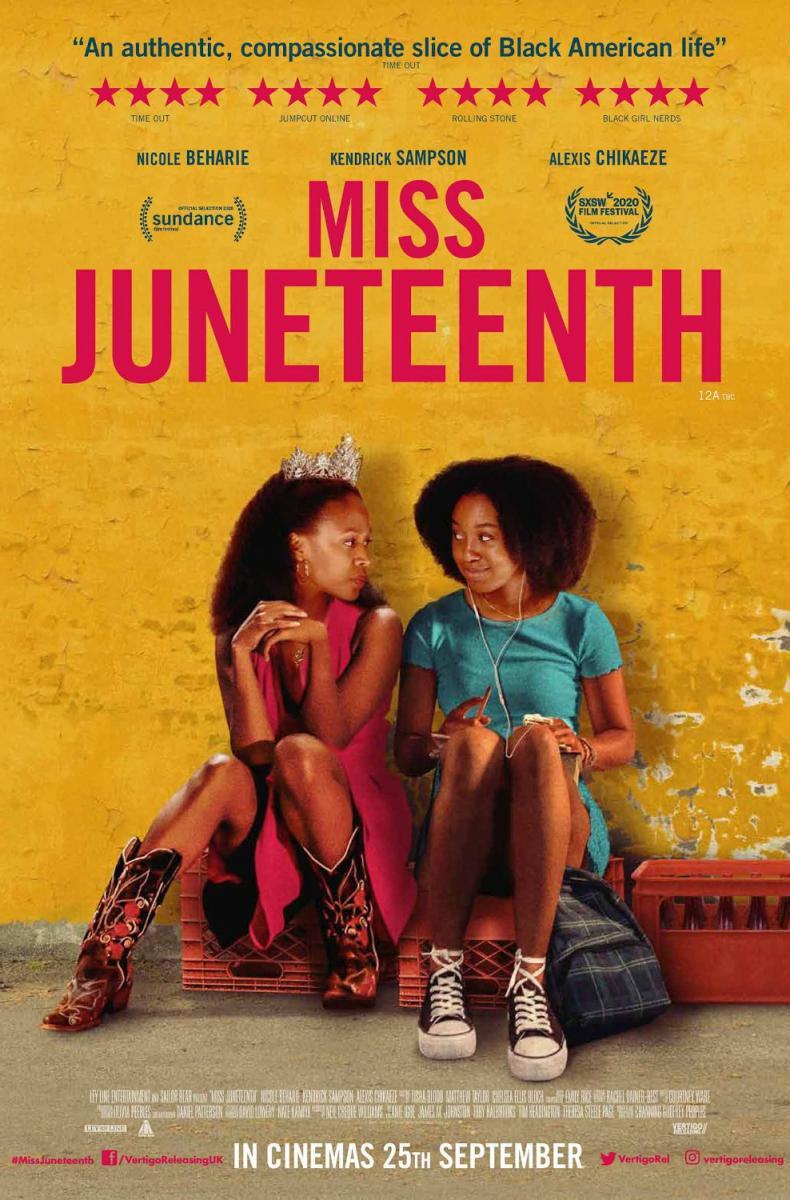
Showing posts with label racial politics. Show all posts

Friday, March 20, 2026

The cinematic equivalent of having a Black friend

For my March monthly viewing in Flickcharters Friends Favorites Fiesta, I was assigned Dan O'Bannon's 1985 The Return of the Living Dead, which I did not particularly love. When I wrote up my little blurb in our Facebook group, I felt like I needed to prove that I liked other campy gore effects movies, dropping the names of both Killer Klowns from Outer Space and Dead Alive. To be honest, I don't really remember how gory KKFOS may or may not be.

After the fact, I pondered why I felt like I had to list my bonafides, in order to prove that I wasn't just opposed to this sort of movie.

Surely no one cares whether I do or don't like campy zombie movies. The stakes of this opinion are not very high. Even if there's someone out there who thinks I "didn't get" that it was deliberately bad in some respects, well, so what. I can't usually control what other people think, especially in a group where I've met none of these people in real life.

However, I did continue to have to sort of defend myself by saying things like "it was lacking a certain something" and "it didn't hit my sweet spot." Making sure they knew that I had a sweet spot, and that under the right circumstances this sweet spot could be satisfied by campy zombie movies. 

It made me think a little bit better of people who protest they aren't racist, and to prove it they mention that they have a Black friend. 

Of course, if they are actually racist, well, I don't think better of them on that score. But I do think better of the instinct to prove you like something by talking about a similar kind of thing you like.

Maybe it would be easier to talk about this in terms of movies, while still keeping the racial component. 

Sinners has been an interesting movie to have in the zeitgeist. Because it is so clearly defined as a Black movie, liking it or not liking it could appear to speak volumes about the rest of your preferences, and indeed, about you as a person who either prejudges or does not prejudge people. 

You can be in one of two camps:

1) Liking Sinners, which proves you might like other Black movies and are, in theory, not a racist;

2) Not liking Sinners, which means someone could think you don't like Black people.

I'm in the former category, as you would know from the fact that I ranked Sinners as my #2 movie of 2025. And I do, on some level, feel like that opinion relieves me of the need to defend some of my other choices. My lowest ranked movie of the year, the Ice Cube version of War of the Worlds, obviously stars a Black guy, as well as some of the rest of his Black family members, though the rest of the cast is multi-racial. I thought the director, Rich Lee, was also Black, but I just looked it up and discovered that he is not. In any case, I didn't have to defend myself against hypothetical accusations of racism for hating War of the Worlds because Sinners was propping me up, at least this year.

I've got some other friends here in Australia who are in the other camp, who have lots of things they nitpick about the movie -- which I do acknowledge has some pretty significant pacing problems in its second half. They seem to feel less guilty about potentially being thought of as racist, or rather more secure in their own progressive core, because these guys don't worry too much about talking about all the other Black movies they love. However, I have an American friend who sends out his rankings to a group of people in an email, and this year he said, regarding his middling ranking of Sinners:

"And in 2025 the biggest question that I will get is “What is your goddamn beef with Sinners?  Are you a goddamn racist?”  I assure you that I am not a racist.  I just don’t really like it when actors play more than one role in a film…specifically, I REALLY don’t like it when the same actor play twins (except for The Krays and Dead Ringers)."

In starting off with a discussion of a 40-year-old zombie movie, I've worked myself around to something a bit more interesting here. Why do we worry so much about being misconstrued here? Do we worry that it's actually true?

No I don't think that's it. But it's more like a couple lines of dialogue I always think of from Glengarry Glen Ross, where Ed Harris and Alan Arkin are discussing the fact that Arkin's character, who proclaims his innocence, gets nervous talking to the police. Harris assures him it's not because he's guilty of anything or has anything to hide, in fact, just the opposite: "You know who doesn't get nervous talking to the police?" Harris' Dave Moss asks. "Criminals."

So an actual racist would never talk about his possibly fictitious Black friend, and an actual person who doesn't like campy zombie movies would never pretended he liked them. (Though, I suppose, if the Black friend were actually fictitious, that might say something ... usually in this situation, the person is just exaggerating the closeness of their relationship with some Black guy they know.)

Okay that's about enough of that. 

Sunday, February 8, 2026

Movies that hate their Black characters

Earlier this month I posted that I didn't have a formalized plan, in terms of scheduled viewings, for honoring Black History Month on my blog. Never have. Too close to the end of my ranking year to start up another big project that involves multiple viewings in the very first month after I'm free from that previous commitment. 

However, I do seem interested in digging into issues related to Black representation on film this month, as evidenced by that post and now this one. The unspeakably awful decision by Trump to post the racist video of the Obamas was just the cherry on top -- and should be the cherry on top of his disqualification as president, but we know it will just be on to the next scandal, soon forgotten. 

The thing that triggered the current post was Gaspar Noe's Climax, though I'm using the poster for another movie because I just used Climax on a different post two days ago. 

First off let me say that the representation of Black characters in film is very complicated. I don't need to go into the whole history here, which I did as recently as three years ago. So yeah, this isn't the first time I've written about issues like this on the blog. But we've gone from representing them carelessly, leaning into pernicious stereotypes, to representing them way too angelically, such that a Black character in certain movies can't even be guilty of an impure thought, let alone an impure action.

The good news about maybe the last ten to 15 years is that we've landed somewhere in the middle, where we recognize the disservice we're doing with either extreme, and actively seek to find a middle ground. In other words, to make these characters real human beings.

But there's that part of us that's still in there, that worries when a film seems to be making them too human. 

Take Climax, for example. 

I don't think you can say that Noe is racist, or if he is, he's hidden it so well that he's been able to use Black actors to compose a third or more of his primary cast of about 20 in Climax. Or really, Black dancers, I should say, because the cast are dancers first, actors second. 

But let's consider what some of these Black characters do in this narrative, and again in this post we have CLIMAX SPOILERS

The character Dom repeatedly kicks and knees a woman in the stomach, even after the woman has just said she's pregnant. Dom believes this woman has spiked their punch with acid -- she didn't drink any due to the pregnancy -- but it's a pretty big and callous gamble on the idea that the woman is lying about her pregnancy. Dom also participates in an effort to eject a man out of the building and into the snow. That man later dies. 

The character Taylor is obsessed with the romantic life of his sister, five years younger, and as the evening goes on, we learn that this obsession goes beyond that of the standard overprotective brother. He's actually got a sexual interest in his sister that he acts on under the influence of the acid, in addition to telling her that he loves her -- which we take to mean that he's in love with her. He's also just led the lynching party of the man who was ejected from the building with the accusation that he spiked the punch, simply because this man has been dating (and having sex with) his sister.

The characters Kyrra and Cyborg, in the early stages of the evening, have a conversation in which they talk humorously about their sexual prowess and what they would do to various women there. It's humorous to them anyway, and seems harmless at the time despite the graphic content -- it could just be "locker room talk." But later, we see them carrying out these desires -- not necessarily without consent, but with dangerous abandon, and in the middle of the dance floor. These two are also part of the lynch mob of the man they expel from the building, Omar.

To be clear, the remaining characters in this movie are also pretty rotten in their own ways. There are only a few characters who are actually harmless, actually possibly good people either under the influence of LSD or not. And the character who actually spiked the punch is not one of the Black chraracters. 

But assaulting someone with the possible outcome of causing them to abort their fetus, whether you believe the prgenancy is real or not? Framing your sister's boyfriend so you can have sex with her? Talking about violating women and then proceeding to actually do it, whether it's consensual or not?

Yes, these are not good looks for these four characters.

I should say that there are at least three other Black characters who aren't guilty of any shocking behavior, and then there are a number of others who are mixed race. But the four characters above are quite clearly of African descent, on both sides of their heritage.

There is certainly a fair amount of conversation about this on the web. People pointed this out in their reviews at the time. For me, I was so caught up in the other crazy things this movie was doing to really focus in on these unfortunate characterizations. 

But it brings us back to our original idea about how to find the middle ground between portraying Black characters as barbarians and as saints. Surely it would be okay for one or two of these characters to behave abominably. But when Noe has negative behaviors he wants to dole out between multiple characters, and he has nearly 20 to choose from, couldn't he have given some of these plotlines to white characters?

I'm not sure how seriously this cuts into my feelings about the movie, but it cuts into them enough to go public with my thoughts about it.

The reason I've chosen The Ballad of Wallis Island as the poster for this post is that there is a different sort of uncharitable characterization of this film's only Black character, one that gave me enough pause that it ate away at me a bit, and made me wonder whether the movie truly belonged in my top ten of 2025.

Just to briefly summarize the relevant plot points, the characters Herb McGwyer and Nell Mortimer, both white, were once part of a successful folk duo, and were in a romantic relationship as well. That was maybe a decade ago, but they've been summoned to the same small island off the British coast to play together once more -- and maybe, at least McGwyer hopes, to rekindle the romantic relationship. 

The only trouble is, Motimer already has a husband: Michael, who is a Black American. He doesn't represent unfortunate stereotypes in the way the Climax characters do; he's an intellectual who favors bird watching. 

But as the story goes on, we also realize that he's bitter and mean. He has one vindictive speech where he dresses McGwyer down for being a has-been, or a never was, and he does it with cruel relish. In a movie with essentially five main characters -- including two who live on the island -- he's the only bad guy. 

The fact that these two movies leave a bad taste in my mouth for two very different characterizations of Black characters gives some idea just how deeply complicated this issue is. I don't want Black characters to be shown as violent and aggresive with insufficient empathy, but I also don't want Black characters to be effete and intelligent ... with insufficient empathy.

So empathy is the crux of the issue here, isn't it? What these five characters have in common is that they engage in cruel behavior thoughtlessly. They are being mean for its own sake, I would say, whether that meanness is actually of a criminal nature, or just emotionally toxic.

Clearly there is a greater risk of Noe being a racist -- the web has other examples of his perceived deficiences in this area -- than the director (James Griffiths) and writers (stars Tom Basden and Tim Key) of The Ballad of Wallis Island. The latter are making a more genteel sort of film to begin with, and they respond to a commendable desire to add some diversity to a cast that might have just as easily been all white. The only problem is, the role they had available for this diversity was the one functioning as the antagonist within the context of the film, and not just an antagonist because he's providing a narrative impediment to the protagonist's goals. He's providing actual malice, some would say unwarranted malice, toward the protagonist.

But then we're back to our original question. Should these characters be saints? Can Black characters never be villains or bad actors?

I think it is a "know it when you see it" sort of thing. If a film leaves you with a bad taste in your mouth, maybe that's reason enough to suspect that there's been an insufficient amount of nuance applied to the representation.

If you don't get the bad taste until your fourth viewing -- or you still name the film as part of your top ten, even with the bad taste -- then I guess that tells you how much work on this we all still have to do.

But it also recognizes the inherent complexity I've touched on multiple times. Artists should have the presumption of innocence until proven guilty, and maybe, in trying to make this a more diverse world as represented on film, they just haven't done it as delicate a job as they might have. 

Tuesday, February 3, 2026

Black is beautiful

There, how's that for a subject line that will get your attention?

I don't do anything on my blog to acknowledge Black History Month, which is a bit of a shame. I certainly could. I mean, it's only February 3rd, so I could even do it this year. If we are looking for precedent with other themed months, look no further than Pride Month in June, when I watch one pride-themed movie each week.

Why don't I do this in February to celebrate Black creatives and films with Black subject matter? I mean, this is certainly something in my thoughts, at least as much as issues related to pride. 

I think part of it is that I've just recovered from my big end-of-year push, and I don't really want to be getting myself back into a big month-long project -- even just one viewing per week -- right after I've freed myself from watching the films from the previous year. I want February to be a bit loosey goosey, where I watch whatever I want, whenever I want, both new (to me) movies and rewatches. Heck I'll watch a few actual new movies as well. Gotta start 2026 sometime.

But I thought the least I could do was use a spot at the beginning of February to address the latest controversy regarding race-related casting, sparked this time by that douche-nozzle Elon Musk.

I'm only going off a headline here because I don't want to dignify Musk's comments by actually reading the article. But apparently the thing is that Musk thinks Christopher Nolan has "lost his integrity" by casting a Black woman -- Lupita N'yongo, to be specific -- as Helen of Troy in July's The Odyssey.

Please.

What he thinks he's saying, or at least wants us to think he thinks he's saying, is that Helen of Troy was blonde and that any representation of her should acknowledge that.

What he's really saying is much more sinister:

A woman known as essentially the most beautiful woman of all time could not possibly be Black.

Please.

I don't know why these people want to keep coming out against any form of "woke" casting. It's the same people who said that Ariel in The Little Mermaid couldn't be Black and that there was no such thing as a Black Targeryan in the Game of Thrones spinoff.

Can't we just, like, stop?

And when I say "we," I certainly don't include myself in that group.

I'm not going to dignify Musk's comments any further by actually offering him an explanation about why Helen could have dark skin. I understand some people have dignified him in this way. 

It's not even worth it to do that, even if you have a "good" argument. The argument doesn't need to be "good." The only argument needed for race-blind casting is that people in any audience want the opportunity to see themselves in characters they see on screen. We got over a long time ago the idea that there might be Black people in the upper crust society of a show like Bridgerton, when of course we know that is not historically accurate, and to keep having this argument about any new character who comes up for cinematic representation, maybe for the first time in our modern era, just sullies us all. 

There are only a few characters I think it does not make sense to have played by a Black woman, or not without the very casting being part of whatever your confrontational, satirical aims are with the film. Just a few off the top of my head:

1) A slave owner! Probably not a good idea to have a Black character owning Black slaves. 

2) Eva Braun! We don't have to pretend there's a world where Hitler would have been married to a Black woman.

End of list.

As if we needed any more reasons to talk about what a complete and utter piece of shit Musk is. 

Monday, January 27, 2025

The tragedy of a Black fella

It was Australia Day again yesterday. Some folks call that Invasion Day. And some folks call those folks "black fellas."

I'm not really sure if I can use the term "black fella." I know indigenous people can, and do, use it towards one another. I just don't know if I can use it because I'm not schooled enough in the history of Australian racial relations to know if there are hurtful associations with someone like me using it, or if it is actually sort of a term of endearment, which it sounds like to me. After all, I am invader too, though the invading I did was far more recent and doesn't implicate anyone in my lineage. Things were already pretty much settled by the time I did my invading. 

I do know, of course, that "black fella" is a term of othering. Or at least, a term of distinguishing one thing from another thing.

The protagonist of The Chant of Jimmie Blacksmith, Fred Schepisi's 1978 film, is, in some respects, difficult to distinguish in this way. He's got one white parent and one indigenous parent. For the white Australians of the early 20th century, that was close enough to white to earn him some chances to "make good for himself" in their society. However, it was also close enough to black to make them wary that at any moment, he might conform to their lowest expectations of his other parent.

Which, I'm sad to say, he does. Which makes this a very complicated film. 

It's adapted from Thomas Keneally's novel, which itself was inspired by true events, and it makes for my fourth Australia Day/Invasion Day in a row where I've watched a film that examines the plight of indigenous Australians -- following Walkabout in 2022, High Ground in 2023 and Charlie's Country in 2024. As an invader trying to atone, I figure it's the least -- the very, very least -- I can do. 

Jimmie (Tommy Lewis) has been raised under the good graces of a reverend and his wife, who show the same mixture of optimism and wariness described above, only disguising their racism as charity. When Jimmie is of age, he tries to "make good" in the way they have trained him, proceeding through a succession of jobs that end through no fault of his own. Each employer takes advantage of him in some way or asks something of him that is against his core beliefs, and if he's even slightly reluctant to comply, they stiff him his pay or cast their favor elsewhere. 

It's a rough existence that eventually starts to see strides in the right direction -- er, that's debatable -- when he meets a white woman he wants to take up with, Gilda (Angela Punch), whom he believes he has impregnated. (Given that he first sees her canoodling with a married farmer, it's unlikely he should have trusted her in the first place.) When the baby is born, it's revealed not to be Jimmie's, as the boy's skin color shows no similarity to his own. At this point, unfortunately, they are already married. 

This, I thought, was a really interesting inversion on a scene we see in a lot of movies, where a white man is retroactively cuckolded when the newborn he thought was his has features readily identifiable as belonging to another man. That this is flipped against Jimmie in the other direction gives an idea of just what he is up against while trying to "make good" in this world ... and is just one of the factors that sets the stage for what is going to come next.

Spoilers for The Chant of Jimmie Blacksmith.

When one particular employer denies buying him groceries as part of the pay he is receiving for building a boundary around the employer's property -- on the grounds that Jimmie has lost focus with the arrival of some friends, which the employer worries has turned his property into a "blacks camp" -- Jimmie confronts him, explaining that not only is he owed this, but he has a wife and child to feed. (Despite not being the father, Jimmie has dutifully adopted the role.)

The man holds his ground, and in order to scare the man -- who isn't at home at the time, leaving only his wife and his grown daughters -- Jimmie and his "uncle" (Steve Dodd) appear at the farmhouse wielding axes. They don't plan to do anything with the axes, it would seem, but when the matriarch goes for her gun, a bloodbath ensues that leaves only the two Aboriginal men standing.

I was taken aback by the direction this films takes, though not mostly that The Chant of Jimmie Blacksmith "goes there." My modern mind, trained on the moral logic of very careful Hollywood studio executives, finds it to be a disconnect that these "black fellas" could be guilty of anything so heinous as murder. We are not yet removed from a long period of mainstream movies where minority characters have been portrayed as saints, or given only very minor rough edges.

No, the thing that took me aback most was that having made this terrible error, Jimmie then leans into it and makes things far worse. We never lose our sympathy for Jimmie, not fully, but let's just say -- no need for further spoilers now that I've established my context -- that some of what Jimmie does after this is far less ambiguous and far more deserving of our scorn. In fact, one act is so heinous that it is almost disqualifying of our sympathy, even if Jimmie felt that the man it would hurt most was fully deserving of being so hurt.

Because Fred Schepisi is not an indigenous filmmaker, as he would need to be if he were to make a film like this today, it's hard to know just how we should view the narrative choices in this film. On the one hand, it's obvious that the film is on the side of its indigenous characters, even if Jimmie becomes problematic over the course of the narrative. On the other, it's possible for a white filmmaker to make a movie that has good intentions and still fails to depict things as sensitively as it should. I have not heard anything like that in the discourse about The Chant of Jimmie Blacksmith, but then again, I have not actually heard any discourse about The Chant of Jimmie Blacksmith. When I told my wife I was planning to watch it, her eyes widened and she said it was really good. If this movie were considered problematic by students of Australian film, I think she would have mentioned it.

What this film really does is reveal that war is ugly and that it takes down even the most well-intentioned people, on both sides. At one point in the film, Jimmie very pointedly says "Tell them I've started a war!" Rarely is having started a war considered a good thing, and certainly not here. 

The film clearly operates as a metaphor for political activism, and possibly a call to it as well. That's the same sort of political activism that expresses itself in things like renaming Australia Day as Invasion Day. Jimmie also has several lines of frustrated dialogue where he says that he specifically, or indigenous people generally, did not do anything to deserve this sort of treatment. But some of the lines are "I didn't do anything," without the clarification. If this is how they treat you when you didn't do anything, might as well do something, and at least hit your enemy where it hurts in the process. They're going to think of you the same way either way. 

There's a really good thesis statement for the film in a line of dialogue I jotted down, which is related to the way wars lay everyone low -- and in particular this war that has raged between indigenous people and the white invaders who arrived with the First Fleet in 1788. A school teacher played by Peter Carroll, who becomes a hostage of Jimmie and one of his mates when they go on the run, hears the two indigenous bickering with each other about which of the two of them is guilty of which transgression. The teacher says "If you want to stand there comparing evils, you won't end until you've put a bullet through each other's heart."

The Chant of Jimmie Blacksmith does not put a fine point on many of its ideas, to its credit, but I was glad for this one. There's no real comparison between the evils done by the white men against the indigenous population who have lived here for 60,000 years, and whatever "evils" the indigenous may have done in response to those evils. However, this movie does bemoan the fact that we far too rarely see the productive response to evil, which would be good. Far more often we see the unproductive response, which is just more evil. 

Saturday, July 15, 2023

Low energy

I can't profess to be an expert on Kenya Barris. I probably should be, considering that I have a friend who wrote for the show he created, Black-ish, for many years. That show has existed entirely since I moved to Australia and lost my connection to network television, so I haven't seen a single episode.

But I've consumed some Barris in recent years, and I'm starting to get an idea of his style. Which can be described thus:

Low energy.

That describes the remake of White Men Can't Jump, which he wrote and produced, to a T.

What do I mean by low energy?

Characters have no distinctive facial expressions. They talk out of the sides of their mouths. Even the extremities of emotion result in no real change in their outward appearance. Any comedic bit is played at the lowest possible wattage, such that you're not even sure it's a comedic bit.

Only with the benefit of having seen White Men Can't Jump do I realize this is kind of what I was getting at in my review of You People, which he wrote and directed (and produced) earlier this year. Here is what I wrote about that film's uneasy relationship with laughs:

And so the result is that there are not a lot of laughs, a problematic outcome when the movie is structured as a series of outrageous set pieces in a standard comedy format. As you’re watching, you can tell the scene calls for a laugh, if you are at all a student of how these films are written. The punchline, though, is usually a cringe rather than a laugh, and sometimes these seem exaggerated beyond what might really happen. And while cringeing is valuable, especially since it forces you to confront the true irreconcilable differences being explored here, you sometimes get the impression the filmmakers wanted the laugh but couldn’t deliver.

Prompting cringes is, of course, different than low/no energy. There's quite a bit of cringey racial humor in White Men Can't Jump, too. But I think it all goes into this vaguely contemptuous mode that Barris brings to the screen, where characters are "low key" disdainful of each other (I hate the phrase "low key" but it applies here), which manifests itself in a flatness in which minimum effort is required or displayed.

What I am now realizing is Barris' style, an intentional choice, first registered to me as a total lack of charisma by Jump stars Jack Harlow and Sinqua Walls. I have no experience with Harlow, but seeing that he is a rapper made me roll my eyes a bit. Just because you can rap doesn't mean you can act, especially if you are a white rapper, I would argue. 

With Walls, though, I know he can act. He was my favorite part of the admirable but ultimately unsuccessful horror film Nanny from last year, where his personality, playing a doorman at the building where the title character works, shined through easily. In Jump, Walls seems almost challenged by the material, so limited is the range of his emoting -- which I now attribute to choices by Barris and director Calmatic.

I might not have this impression of Barris had it not been for my primary example of seeing him on screen as an actor. That was in his 2020 Netflix show BlackAF#, a lightly fictionalized version of Barris' own life in which Rashida Jones plays his wife and there are about four or five kids in the family. The limited range to his performance style may be an indication of the fact that he is not, first and foremost, an actor. However, it also seems to be an extension of this philosophy of not giving another person, especially another person who can be described as a fool you have to suffer, any bit more of your personal energy than absolutely necessary. The result was a weird disconnect in the narrative payoffs of that show, whose 35-minute running time for episodes was also a violation of normal situation comedy rules. In the end part of each episode where Barris, playing in many ways the typical sitcom dad, is supposed to be on the receiving end of a mild comeuppance, he instead proved himself the smarter -- or on the receiving end of such a mild comeuppance that it could barely be recognized as such.

We of course have to pause here to discuss the elephant in the room, which You People spends its entire running time discussing: race. There is every chance that Barris has made a choice to limit the range of emotions of his characters to counteract a long and pernicious history of Black characters asked to play the fool and dance around like clowns. Cinema history has had enough of that and Barris does not need to oblige anyone's desire to see a single minute more of it. 

I'm not sure the opposite of clowning, though, is having so little affect that it is confused for a total deficit of charisma. And that's what comes across to me in the performances of Harlow (who is of course white), Walls, and other characters in White Men Can't Jump. The whole film feels like it exists within parentheses, asserting its existence so lightly that it never grabs hold of us and certainly never builds any narrative momentum toward a climax. This may be a choice, but it is the wrong one dramatically for a film like this, if the result is so bland and so parenthetical.

The thing is, Barris isn't so far removed from a movie in which this was not the predominating style. In reviewing his IMDB credits, I am reminded that Barris co-wrote the 2017 film Girls Trip, which was a true favorite of mine that year. I'm not sure you could enforce a stultifying performance style on this film's MVP foursome: Regina Hall, Jada Pinkett-Smith, Queen Latifah and Tiffany Haddish. But at that time, maybe Barris wasn't trying to either. Which means he can get back there. (He also co-wrote Coming 2 America, which maybe isn't guilty of the same issues either. But that film didn't entirely work for me so it's not a great example in the current discussion.)

I suppose we also have to acknowledge what we are comparing it to. In the original White Men Can't Jump, the jump-off-the-screen charisma of Wesley Snipes, Woody Harrelson and Rosie Perez is a thing to be reckoned with. You can't walk away from any ten-minute slice of that movie without a lasting impression of the personality of these characters. They may go big sometimes, but it's an equal opportunity bigness, where you have a Black man, a white man and a Latinx woman all acting at the same volume. And it's the volume we need for a comedy. Their performances are what have made that movie an enduring comedic classic in certain circles.

Barris has turned the volume way down on everyone in his movie. There may be good intentions behind it, but the results are entirely forgettable. Not only will 2023's White Men Can't Jump not endure over the years, it may not even endure over the course of the weekend in which you watch it.

Friday, November 11, 2022

The progress that might not really be progress

Warning: The following post contains major spoilers for Alex Garland's Men, the Australian horror movie Sissy, and Enola Holmes 2. How's that for a motley crew? (I'm a poet and I don't know it.)

The history of representation of Black characters on film has gone through a number of stages, as follows:

1) No representation. At least none featuring actual Black actors. You wanted a Black character, you put a white actor in blackface. Think Birth of a Nation.

2) Careless representation featuring many stereotypes. Black actors could appear in movies, but they were maids, butlers, criminals, or any other member of society considered lowly by the white ruling class. Sadly this goes all the way from around Gone With the Wind through the 1970s, with some notable exceptions.

3) Overly generous representation that bends over backwards to apologize for previous negligence. This is the phase where if a Black character appeared on screen, he or she was upstanding or saintly or a nuclear physicist or in some other way defied the cruel stereotypes of the past. This was a step in the right direction but was problematic in its own ways.

4) The current phase. In this phase, a Black actor can play anybody: a character previously conceived of as white (like a comic book hero), a character in a historical setting in which there were only white people around, or -- and I think this is the crucial one -- a villain.

I think most people can confirm the general accuracy of this arc and can appreciate that each stage is a step forward from the previous one. But that's not to say that even our current, most enlightened phase doesn't come with its own challenges. And even as I talk about these challenges, I expect to stumble over them and am wary of my chances of getting out exactly what I want to say.

It's the villain part I'm worried about. 

In a way, it is a sign of ultimate progress that a Black character can go back to being a villain -- as long as it is not the sort of villain that screenwriters wrote carelessly back in Stage 2. The sort of villain I think of as dying out around the time of the 1987 Christopher Reeve movie Street Smart, which I wrote about here

No, we don't want some villainous pimp played by a Black actor, or if we are going to go that way, it has to be one villainous Black pimp in a movie with six heroic Black pimps. 

But what kind of Black villain do we want? 

It's something I intend to explore over the course of three movies I've seen during the last month, though in each instance, you could argue whether this character is actually the villain, merely villain-adjacent, or the end product of greater villainy. And it's been inspired by hearing the Slate Culture Gabfest do a spoiler discussion of the first movie I'm going to discuss, Men -- a discussion I avoided months ago since I hadn't seen the movie, and to which I have now circled back.

1. Men

Since I've already given the spoiler warning, I can tell you something you probably already know, you discerning cinephile who has probably already seen Men: It's basically a two-hander between Jessie Buckley and Rory Kinnear, with Buckley playing the main character and Kinnear playing almost every other character. There are two other female actors who have smaller roles, and there's one other male actor, seen only in flashback: Buckley's character's dead husband, played by Paapa Esiedu. He's the actor of color, as you might have guessed.

It's unclear whether the film sees him as the villain in the end, which was one of the issues the Culture Gabfesters had with Garland's strangled, possibly misogynistic message. But using all available traditional signifiers, he's shit. He's clearly unstable, as the arguments we see with her show. She wants to leave him, and his response is to threaten suicide. In another argument immediately preceding his death, he hits her -- an action he immediately regrets, but she goes off on him and kicks him out of their apartment. It's moments later that he dies, though the movie leaves it ambiguous whether he jumped off the roof or fell while trying to climb down into their apartment from the floor above. Neither reflects particularly well on him -- either it's the culmination of the threat he used to manipulate her into not leaving him, or he's making a dangerous assault on the privacy she justifiably requested after he hit her. 

2. Sissy

In this movie, the title character is a woman played by Aishee Dee, the grown-up version of a girl nicknamed Sissy as an abbreviation of her given name, Cecilia. She's become a successful social media influencer, but she's never gotten over the betrayal of her best friend Emma when she was younger. The younger Sissy was already showing psychopathic tendencies, which manifested themselves in other 12-year-olds not relating to her, and her clinging too dearly to Emma. When Emma found a different best friend, a best friend who also bullied Sissy, Sissy ended up stabbing the bully in the cheek with a gardening trowel.

When they are both adults, after years of not seeing each other, Emma runs into Cecilia in a pharmacy and invites her to her bachelorette party weekend, where Cecilia is responsible for the deaths of multiple others at the party -- each sort of by accident, but each in a way that might have been avoided if she weren't, you know, crazy. 

3. Enola Holmes 2

This one is kind of the ultimate realization of Stage 4, where actress Sharon Duncan-Brewster is revealed -- remember my spoiler warning -- as Moriarty, the rival to Sherlock Holmes, with her name (Mira Troy) being an anagram of that name. Moriarty was, of course, never envisioned as a Black woman by Sir Arthur Conan Doyle, but that's kind of the point of this newest phase of representation, to question our assumptions and to expand the limitations of literature as it was conceived more than a century ago.

Points for the fact that Moriarty is the smartest person in the room -- even outwitting Holmes, who is like the smartest person ever -- but detract points for the fact that Moriarty is basically the personification of evil. At least as envisioned here, she does wicked and cruel things for sport. She orchestrates deaths and deceptions and might actually cackle if that weren't deemed a too on-the-nose depiction of villainy.

Each portrayal is worth lauding in some respect, but each is also problematic. And each gives ammunition to a racist in the audience who is inclined to believe the worst about a person whose skin is darker than his. (Or hers. Women can be racists too.)

In Men, we have a person who embodies weakness of character. Hitting a domestic partner is pretty much the ultimate sign of weakness, but the mind games this man plays are even worse. He's basically blackmailing his wife into staying with him, telling her that if he kills himself, it will be her fault. He's gambling that having such a tragedy on her conscience will keep her from leaving. Whether he was bluffing or not, we don't know, because he might have actually fallen. But the impact of his rash action -- whether that action is killing himself or trying to climb down the side of a building -- is the same. He's basically decided that if his life is ruined, he'll do his damnedest to ensure hers will be too. 

Sissy thinks it's getting away with something here I think, because in the immortal words of Chris Rock in one of his earliest comedy albums, "Blacks aren't crazy." Because mental illness is not traditionally one of the negative character traits a racist might ascribe to a Black person, the depiction here of a mentally unstable Black central character is, in its way, defying stereotypes. But it's also exceptionally cruel from a filmmaking perspective, in part because it doesn't seem like a natural outgrowth of the young Sissy, whom we meet on old video tapes she watches. Played by actress April Blasdall, the young Sissy is sweet and adorable and doesn't seem in the least like a person who could generate, and then hold onto, psychopathic rage. This portrayal then has a credibility problem, and as with the character in Men, we ask: Why did the filmmakers choose to make the Black girl crazy? Was it something more than race blind casting?

Enola Holmes 2 might be the least offender, but it also gives us the only character who has complete agency over her villainy. She's not the product of bullying or a possible immigrant in an interracial marriage who might have cracked under the strictures of white patriarchy. This is a puppetmaster whose machinations are utterly premeditated, making her actually malicious. The filmmakers hope that by crediting her with genius-level intelligence, they are also avoiding the pitfalls of racial stereotyping. But anyone who is inclined to think that Blacks are scheming and conniving and hiding behind a shield of fraudulent victimhood need look no further than Moriarty to find support of their toxic thought processes.

Now it should be said that a racist is going to use whatever evidence that suits him (or her) to reinforce his (or her) worldview. If we try to make Black villains beyond reproach, we are moving back to Stage 3, where they aren't really even villains anymore. And even then we aren't really helping change the mind of a racist.

But I still insist that something doesn't sit as comfortably as it should about any of these portrayals. 

Of course this whole discussion is a product of excessive thinking -- some might say over-thinking. The excessive thinking that governs our entire discourse about race today is, itself, a reaction to the failure to do so before now. The whole idea of being woke is to analyze representation in such a way as to find its shortcomings and to improve upon them. In the past, no one would have given these characters a second thought -- but then again, they likely wouldn't have had these undeniably complicated characters to consider in the first place.

So it goes back to the question:

What kind of Black villain do we want?

I don't know that I have the answer for this. 

It should be said that in each of these cases, there is a potentially worse villain. In Men, most of the most malevolent behavior is given to Kinnear's character, even if he might ultimately be imaginary, some sort of manifestation of the main character's trauma over the death of her husband. In Sissy, we're supposed to end up hating the white bully the most, because not only did she trigger Sissy when she was younger, but it's her failure to bury the hatchet that causes the bachelorette party to go off the rails. In EH2, a white factory owner is ultimately arrested for his nefarious role in knowingly using phosphorous that was fatally poisoning the girls who worked in his match factory.

But I'd be lying if I didn't say that I lingered on the three portrayals of the Black villains -- that should be an obvious statement given how much I've just written about them. 

I think there is a Stage 5 in this trajectory toward greater enlightenment, though it's a pie-in-the-sky stage that will take a lot longer to arrive:

5) Forgetting about race entirely when watching movie characters.

And this one will be truly hard to attain, but it's out there, somewhere, as a potential endpoint to this whole discussion. If we can one day slough off all our preconceived baggage about skin color and how to justly portray characters who have that skin color, it might one day truly not matter who plays what role, and what the filmmakers may be saying -- even if accidentally -- by making such choices. 

I'd like to get this stage because I don't want to have to think about this stuff each time a casting director makes choices like they made in Men, Sissy and Enola Holmes 2. These were commendable choices with excellent intentions, choices made with the aim of getting us to Stage 5 sooner. If no one makes these choices, we truly won't ever get there. 

Until then, though, there'll be a fine line to walk between putting characters of color on a pedestal, and making them guilty of craven things that remind bad people of their oldest and deepest prejudices. 

Monday, October 3, 2022

The best way to talk about diverse casting is not to talk about it

It was only two years ago when The Personal History of David Copperfield was released. It was during an early pandemic lull in June, when we Victorians thought we might try to sneak back out and see a few movies. The cinemas had tentatively reopened after the first wave of COVID. They were on the verge of closing again for a much longer period of time, but while they were open, Copperfield was one of two movies I snuck out and saw.

The significance of this was that it was one of the first times I remembered seeing a period piece in which the ethnicity of the performers was entirely disregarded in the casting decisions. Victorian England (different Victorian) was, in reality, composed exclusively of white people, but the cinematic depictions of it needn't be. Not only was there Indian Dev Patel in the lead role, but the supporting cast had as many Blacks as it had whites, and at least one Asian. 

It was, of course, not the first instance of casting without regard for race. As just one example that comes to mind, it was as long ago as 1993 that Denzel Washington appeared in Kenneth Branagh's Much Ado About Nothing, though that would have hardly been the first instance either. Oh, Black people got to appear in Shakespeare, but it was usually as Othello.

Even though this sort of casting has continued in the 30 years since then, it has largely been of the token variety. We all know this. The Personal History of David Copperfield was the first time I remembered this sort of thing not seeming like tokenism.

It's crazy that that was only two years ago, because nowadays it is simply not tenable to make a movie, or a TV show, that does not have a significant percentage of its cast representing diverse ethnic backgrounds. That goes for any sort of film, though you might notice it more in a period piece because it more strikingly cuts against what you know to have been the ethnicity of the characters during the time period being depicted.

Fans of Game of Thrones and Lord of the Rings have certainly noticed it.

I've been fortunate not to have been too exposed to this, since I don't spend any time on reddit or other channels where fans can air their grievances. Nor have I seen either The House of the Dragon nor The Rings of Power. I do know, however, that there is diverse casting in both projects, and that some percentage -- maybe even a significant percentage -- of the fan base is not too happy about it.

The first time I encountered this was related to The Rings of Power. Although I don't hang out on reddit, I do get email notifications from Quora, having looked up something on there once and unwittingly become a subscriber to these notifications. One guy was complaining about the casting of Black elf characters, going into some deep mythology about skin tones in Tolkien and how there's an opportunity to cast Black actors as some certain race of mythological creatures who were known to be Black. I immediately downvoted the article. I hope others have too.

I should have assumed the same thing was happening with House of the Dragon, and indeed, it is. An ad for the podcast Beyond Black History plays during inning breaks when I listen to baseball games, and the host teased one upcoming topic about why Game of Thrones fans can't accept a Black Targaryen. 

Sigh.

Without listing all the reasons the arguments of these haters are ignorant -- you already know those reasons -- I thought instead I would address my own approach to talking about diverse skin colors in the movies I review:

I don't.

Oh, I did back when The Personal History of David Copperfield came out. Here is what I wrote at the time:

However, there is one major step forward – if not for Iannucci himself, then certainly for society – which makes The Personal History of David Copperfield worth not only watching, but also celebrating. And that is the film’s joyous embrace of race-blind casting. While other films content themselves making token gestures in this regard, Iannucci jumps in whole hog.

In the title role, Dev Patel is of Indian descent. His love interest, Agnes, is played by Rosalind Eleazar, whose father is Ghanian. Her father in the film is played by Benedict Wong, a Brit of Chinese descent. If I don’t go on listing, it’s only because there are too many more examples to count. The effect is to be watching a multiplicity of cultural backgrounds in every composition of three or more characters, as the film cheerfully mirrors an idealised version of our modern society. Whereas Iannucci’s usual cynicism is missed from some parts of the film, its absence here is most welcome.

That perspective has held up over the past two years. I'm proud of what I wrote back then, at that cultural moment.

However, now I write nothing, and I think that's better.

Here are the problems with mentioning diverse casting:

1) At best, you run the risk of sounding condescending, or simply of virtual signaling. "Black people get to play roles that used to always be played by white people. Good for them." You risk sounding like you are patting someone on the head.

2) At worst, you look racist, if you stumble into an accidental criticism of the choice -- or especially an intentional criticism of the choice. "In the novel, the author describes the snow white skin of the protagonist, a detail that tends to be lost when they cast a Peruvian actress in the role." I think most of us would know to stay away from this, but not all of us.

3) The whole point of diverse casting is that eventually, one day, we are supposed to not notice it.

As critics, the least we can do is help that day arrive sooner. 

It's not like I don't notice it. Oh I notice it. Every time. 

But what purpose does it serve for me to draw attention to the fact that Cynthia Erivo, who plays the blue fairy in Disney's terrible Pinocchio remake, is Black? Even if I am trying to credit Disney for its good sense, I've already set back the cause by devoting 25 words to it. If the reader knows that Cynthia Erivo is Black, they will conclude that Disney has paid attention to diverse casting and they will either reward Disney or punish Disney for it in their own head. (The latter is not a group of people I'd really want to hang out with, though.) 

Besides, I don't think any critic needs to congratulate a studio for making a decision that is most in line with current righteous thinking, and thereby is not the riskiest decision they could make, but rather, the safest. 

So instead, in my plot synopsis portion of the review, I just put Erivo's name in parenthesis next to the character name, and made no further mention of her in the rest of the review. (She appears only in that one scene and doesn't ultimately play much of a role in the success or failure of the film.)

Ditto for the diverse casting in Bodies Bodies Bodies. Ditto for the diverse casting in Lou. Ditto for the diverse casting in Persuasion, which is probably the most direct corollary to David Copperfield. Since my reviews have pictures with them, and since these diverse cast members usually appear in those pictures, readers can figure it out for themselves if they care about it at all.

Neither do I want some sort of medal for telling you that I no longer mention diverse casting in my reviews. I just want you to, maybe, if you also write reviews or discuss entertainment online in any fashion, consider following my lead. (Nor do I actually think I am a "leader" here, just to be clear.)

The great thing about the prevalence of diverse casting is that, if I myself am to be taken as evidence, it has become commonplace enough to accelerate the very thing it is trying to accomplish. If I were to mention it every time it happened, I'd be writing about it in every review, and that would not serve a purpose for anybody. In reality, it is not, or should not be, any significant factor in why a film does or does not work. And tackling this core question is what you're supposed to spend your entire review doing. 

There is one exception to this rule: if the film itself talks about it. If the diverse skin tones of the cast is text within the film -- something it openly grapples with, something that contributes significantly to the themes being discussed -- then yes, of course, talk about it. You'd be wrong not to.

But it the film doesn't care what color the characters' skin is, why should you? 

Thursday, September 22, 2022

I finally saw: Catwoman

Yesterday I wrote about classic movies that everybody should have seen by now. Then I went to watch a terrible movie that everyone should have seen -- at least if you are a cinematic masochist who likes witnessing trainwrecks.

Or so I thought Catwoman would be. It was not.

I didn't exactly like the movie -- 2.5 stars on Letterboxd was the highest I would go -- but neither did I find it the laughingstock it was supposed to have been, the kind of movie I knew I would eventually watch just to howl in disbelief at its miscalculations.

I actually did laugh at the movie a couple times. There are some clumsy bits. But really, it's not so terrible at all. There are one or two goofy moments with Halle Berry's performance, but overall I think she's fine. There are a few times when the editing is a little bit off. Some of the visual effects don't look great, but then again some of them do. I actually think the way they have Berry leaping around like a cat is mostly pretty effective.

So now I am trying to think why critics at the time thought it was so awful, or whether it was just that audiences didn't go, which drove the narrative that it was bad. I'm not going to do a deep dive into the 2004 Catwoman reviews to answer my question. Rather, I will put forward some theories of what it was that might have turned a fickle critic against it, leading audiences to follow suit and similarly shun it.

1) It was directed by a man named Pitof. Some people get instantly annoyed when they see that a director has chosen a nickname or a pseudonym as the way they are professionally credited, such as McG or Tarsem. Then again, I haven't met anyone who is annoyed by the name Kogonada, so I don't know. (Pitof was born Jean-Christophe Comar, and I guess Pitof is a nickname.) Well, any Pitof haters got their wish as he never got to direct another feature film after this one flopped.

2) There's a really tiresome opening credits sequence that lasts for seemingly five minutes, which takes place over ancient Egyptian depictions of cats, other cats throughout history, newspaper headlines in which cats appear, and then, comically, what also appears to be pictures of modern-day housecats. The credits are not fatal to the success of the film, but it's conceivable they put some critics in a bad mood from which they never recovered. In any case, I am reminded why most superhero films don't have opening credits any more, just the title and the name of the production companies.

3) As I said, there are a few times I found the editing off a bit. The editing is by Sylvie Landra, who worked on some of Luc Besson's earliest films, which I believe were fine in terms of their editing. Maybe Pitof steered her in the wrong direction. Again, though, I only really noticed this in the opening 15 minutes of the movie, when I still thought it was going to be a disaster.

4) It's the first -- and so far last -- on-screen depiction of the character that does not involve Batman or appear to take place in Gotham City. This is Patience Phillips, not Selena Kyle, and I just confirmed on Wikipedia that the story they've chosen does not appear to spring from the comics in any specific way. The movie was originally envisioned as more directly related to the Catwoman we had already met in Batman Returns, with both Tim Burton and Michelle Pfeiffer involved, but that idea from the mid-90s morphed into this one from 2004. Clearly the final film did not benefit from the delay.

5) Racism, maybe? Although Halle Berry has had crossover appeal the entire time she's been famous -- in other words, her race never prevented people from all quarters declaring how beautiful she was and ranking her alongside more traditionally praised white beauties -- you can't discount the idea that some critics might have thought this was some early incarnation of woke culture and they didn't like it. 

6) The scene where a digital cat breathes upon Patience's dead body, thereby giving her the powers of Catwoman, is, indeed, downright laughable.

I had a peek on Wikipedia at a sampling of the critical response at the time, and Roger Ebert at least talked about the character's lack of strength and agency -- I'm not sure I agree with that -- as well as the way they accentuate Berry's appearance and sexuality through the way she's shot and costumed. I guess I have to agree with the second one. Setting aside all my own woke credentials for a moment, this part didn't bother me because I really enjoyed looking at her. She has kind of the most perfectly designed face and cheekbones I've ever seen.

Although Catwoman is not necessarily a movie anyone should be "proud of," it's not nearly the misfire I expected it to be, and I'm wondering if those involved with it got on board as quickly as they could with the critical disdain for it, in order to be on the right side of history as soon as they could. Berry herself described it, only semi-sarcastically, as a "piece of shit, fucking godawful movie." I wonder if she really felt that way or just wanted to wrest control of the narrative surrounding it as decisively as she could.

As soon as I started to realize I didn't hate Catwoman, I of course interrogated that feeling and tried to see what was wrong with me that I couldn't summon the 2004 critics' and audiences' extreme dislike. And my brain went to a moment on a podcast that I listened to sometime within the past year -- presumably a discussion of The Batman -- where some critic came tepidly to the film's defense. I can't remember exactly what he said, but it was something to the effect of Catwoman being "misunderstood" at the time. That was probably as close as he could come to admitting a slight affection for it, without his own critical credibility suffering. 

Interestingly, I'm pretty sure this critic was Black.

And maybe that's the cruelest thing about the resounding rejection of Catwoman in 2004: It was one of the first superhero movies where a person of color was permitted to occupy the starring role. Looking back from where we find ourselves in 2022, the glee critics had in trashing the movie seems problematic. Even if many of them appeared to have praised Berry herself, that might have only been an attempt to avoid looking problematic, something that would have already been possible in 2004, if obviously not to the same extent as today.

Interestingly, I think if Catwoman were released in 2022 -- some of the visual effects still look pretty good -- it would receive a far different reception. It might still not be hailed as a great movie -- it isn't a great movie -- but I think we would be more careful in how we discussed it, and I think some of the things the film was trying to do would now be a bit more heartily embraced. Now granted, some of those things were themselves problematic, like Berry's skin-tight outfits. But maybe some of its gestures toward representation were, indeed, keenly considered and successfully realized. You can't say Catwoman was ahead of its time, but maybe you can say we as a society were behind the times back then.

I definitely watched it because I wanted a laugh. But I have to be honest when I say that the film didn't inspire the guffaws that I wanted, and by the time I got to the end of it, I wished I hadn't wanted them in the first place. 

Monday, February 28, 2022

A Madea homecoming

I thought I'd slide this one in under the wire for Black History Month, though I don't know if the conclusions I reach will feel particularly empowering.

You might look at this post and say "You're slipping, Vance. Just using the name of a new movie as the subject matter of your post, in its entirety? You can do better than that."

The more observant of you will notice, though, that this is not what I'm doing. If I were putting a title in the subject of my post, the words would all be capitalized, and there would be italics. 

In this case, the homecoming to Madea in my Sunday night viewing of A Madea Homecoming is a personal one. And I don't even need to italicize the word "Madea" because it is the name of a franchise. I don't italicize casual references to "Batman" and "Star Wars," unless I am talking about 1989's Batman or 1977's Star Wars. With a whopping dozen titles in its extended universe over 17 years, there are now more Madea movies than there are either Batman or Star Wars movies (only just). 

It's a homecoming for me because I used to watch most of these movies. I saw five of the first seven, starting with Diary of a Mad Black Woman in 2005. I saw Madea's Family Reunion and Meet the Browns before missing my first, which was Madea Goes to Jail. I also missed I Can Do Bad All By Myself before I was back on board for the next two, Madea's Big Happy Family and Madea's Witness Protection. Tyler Perry has been a busy man, as there have been a number of films he's directed since 2005 that are only Madea adjacent, some of which I have also seen (The Family That Preys, Temptation: Confessions of a Marriage Counselor and A Fall From Grace, while I've missed such films as Daddy's Little GirlsWhy Did I Get Married? and its dubiously titled sequel, Why Did I Get Married Too?). 

I suppose calling them "Madea adjacent" is not fully accurate, since if there were an explicit connection to Perry's drag matriarch, they would be part of the extended universe on Wikipedia. I think of them as Madea adjacent, I suppose, simply because they involve Perry. That's how prominent this character has been for him. 

But I haven't seen any of the Madea movies -- A Madea Christmas, Boo! A Madea Halloween, Boo 2! A Madea Halloween and A Madea Family Funeral -- since I moved to Australia, which is probably not a coincidence. Before these movies started debuting on Netflix -- A Madea Homecoming is the second to do so -- you had to either see them in the theater (something I still don't think I've ever done) or rent them. Suffice it to say that movies that specifically examine the experience of Black people in America, that aren't also critically acclaimed, have only belatedly become available in Australia in any real way. If the latest Madea movie had a theatrical debut, I doubt it would actually play in Australian theaters, even today. For the distributor, I imagine it is a simple cost-benefit analysis, and they've determined that the cost to advertise and distribute Madea movies in Australia is not justified by the historically paltry benefit of expected ticket sales.

But I always wanted to watch these movies, not because I thought a) I'm the target audience for them, or b) I had any real chance to enjoy them as much as Perry hoped I would. In truth, I have enjoyed a number of them, and if I hadn't started out impressed by Diary of a Mad Black Woman -- impressed with reservations, I should note -- then maybe I never would have continued. It's sort of a miracle I did, considering how much I hated Madea's Family Reunion

No, I wanted to watch them for the film critic idealism of giving every widely released film an equal opportunity (loaded phrase there) to be reviewed. And also for the attempt to use Roger Ebert's empathy machine -- that's what he called cinema -- to put myself in the perspective of the people who were its target audience. Even if Madea's hijinks are a tad to broad for me personally, I thought I could figure out how to judge them on their own terms, and decide what worked and what didn't work within that specific context. Plus there was also a melodramatic story in each of these that was running parallel to the Madea hijinks, with Diary of a Mad Black Woman in particular establishing that template. Just because I'm calling it melodrama -- even Perry would probably call it melodrama -- doesn't mean I'm undercutting it, as some of that material is quite effective.

I did review a handful of these for AllMovie, where I was writing back in the 2000s, including each of the first three -- though probably none after that, given how I wound down writing for that site in 2011. Mission accomplished I suppose.

Now in 2022, on the last day of Black History Month, I am trying to decide whether I will review A Madea Homecoming.

For one thing there is the whole Australian audience thing I alluded to earlier. I'm pretty sure that my largely hipster audience on ReelGood is not going to care that much, if at all, about the latest Madea movie. It's what the distributors decided ages ago when they decided against an incursion into Australia. It's not these hipsters' fault; they just weren't raised on it. And they rightly identify a lowest common denominator aspect to it that keeps them away, even if they are trying to be more woke. They might read a Madea review as a way to gawk at it and see what I'd say about it, but not because of any actual interest in seeing the movie.

Or maybe they identify the thing that I've identified over the years that make me hesitant to even watch these movies: 

How negative can I be about them before it starts to seem like I'm engaged in a sort of race-based cruelty, or at the very least, like I'm tone deaf and uncharitable?

Aye, there's the rub. Because Perry's Madea movies are made specifically with the least discerning potential audience members in mind -- audience members who are drawn to the broadness and ability to laugh at themselves unselfconsciously -- they rarely make for truly accomplished cinema. Perry randomly throws in a few attempts at creative scene transitions, but they stick out for how indiscriminately they are used, calling attention to the attempt to be something that these movies clearly aren't. 

When you are accustomed to judging something according to relatively high standards for use of the tools of cinema, it's hard to engage with a film that doesn't care about that at all -- especially when it's made by someone demographically different than yourself. 

It's an issue I keep returning to on this blog: how to engage with art made by creators of other genders, races, sexual orientations or gender identities, and say you dislike the work without it seeming like a function of your constitutional inability to relate to it.

If I do review the movie -- and I really need the content this week, which is why I chose to watch it on Sunday -- I know there is no chance I will give it any more than two stars, which translates to 4/10 on ReelGood's rating system. I'll give you a couple reasons why, after a SPOILER warning.

The film opens with one of the broadest sequences I have seen in any of these movies. The recurring character played by David Mann, Mr. Brown, is preparing a BBQ for his son's visit, in celebration of his son being named valedictorian of his class. Madea and her perpetually incorrect brother, Joe (also Perry), are watching these preparations with bemusement. Brown is overwhelming the BBQ with lighter fluid, finishing up one bottle and going on to the next. He goes through about three normal sized lighter fluid bottles this way, then moves on to the sort of gas can you keep in the back of your car if you run out of gas and have to walk to a gas station, complete with the long nozzle. He continues this activity despite Joe finally coming out to tell him he's put on too much. 

Of course he's put on too much. An infant would know he'd put on too much. But he keeps going. For like five minutes.

When he finally lights the match, he immediately goes up in flames and runs around the yard. For like five minutes. Okay maybe one minute. As if discounting the possibility that he could burn to death, neither Madea nor Joe does much to help. Madea "hilariously" fills up a tea cup of water to try to douse him. When that has little effect, she tries the hose, only to find its stream to be piddly. Finally she gets Joe to trip Brown so his own body contact with the ground will douse the flames, something Brown might have figured out himself if he weren't in an (understandable) state of total panic. Of course, neither would this probably really work. 

As you might guess, Brown only has a few burnt piece of clothing, notably the ass missing from his pants. Otherwise he's fine. 

I have no idea if a Black audience finds this funny. I did not find it funny. The whole scene is ill-conceived and makes everyone in it look bad. 

Fortunately, there's nothing else quite this broad in the movie.

For me, Madea movies have always been saved, if they were saved, by the plot that does not directly involve Madea. There are some movies in the Madea cinematic universe -- like Meet the Browns -- that only feature her tangentially, like one broad comic scene, usually involving her toting a gun, that is at odds with the rest of the movie, but is shoehorned in for audiences who just came to see Madea. Madea is best used like a spice, in small rather than overwhelming quantities.

This implies that most of these movies are up to something different and often socially progressive, which is the real saving grace of the Madea series. These movies have tackled domestic abuse and other serious topics over the years.

A Madea Homecoming gets off on the right foot in this regard. After the broad opening, we meet Brown's son Tim (Brandon Black) and his "friend" Davi (Isha Blaaker). (I don't actually know if we "meet" Tim or if he was in other movies that I haven't seen.) You'll see why I use those quotation marks on "friend" in a moment. They're driving home and talking about how Tim really wants to come out to his family, and how Davi is encouraging him but is reluctant to do the same himself. It is heavily implied that these two are lovers, and some physical contact they make further invites that interpretation.

This is very promising. The Black community has struggled with its acceptance of homosexuality, which would be a politically prudent venture as Blacks and gays both have a friend in the Democratic party. Perry wants to tackle this and confront the audiences who may love Madea but not love gays.

Except then he backs off. Rather incredibly, it is revealed that Davi is not lovers with Tim, but rather, has been carrying on an affair with Tim's mother, Laura (Gabrielle Dennis). See, I told you it was melodramatic. At first we think Tim is so shocked at this revelation because Davi has been simultaneously carrying on an affair with him and his own mother, which would raise a lot of questions indeed. I mean, we're sure, based on what the film has told us, that Tim and Davi are dating. As it turns out, he's just mad because Davi didn't tell him, and because it's weird for Tim's best friend to be dating his own mother, meaning Davi could potentially become Tim's stepfather. 

So instead of confronting audiences with two gay men in love on screen, Perry gives us only one gay man who is not seen in a sexual context whatsoever. Baby steps, I guess. But this is a rather shocking form of purposeless misdirection, and I'm almost tempted to watch it again just to determine how bogus it really is, how heavily the film implied, if not outright stated, that Tim and Davi are in a relationship.

So how can I write a review of A Madea Homecoming without saying that the film bungles both the broad Madea scenes and the positive social messaging?

How indeed. And I'm still trying to decide whether I will.

I can't artificially inflate the grade. I could talk myself into a 4/10, but this film is really more of a 3/10 at best. I didn't really laugh -- again, not the target demographic -- and I didn't get the feels from anything the film was trying to do politically. 

So what value does it serve for me to review this film for a bunch of Australian hipsters who wouldn't watch it anyway, for whom my low rating is basically a confirmation of the bias they already bring into it? 

It's like when someone is behaving like a jackass on the road, and when you finally pass them, you can't resist the urge to look over and see who it was. This is almost always a fraught activity. You are effectively trying to figure out if the driving confirms some sort of pre-existing bias in yourself. The only time it wouldn't confirm that is if the person in the other car looked exactly like you.

I don't watch Madea movies to confirm biases, either my own or anyone else's. But I'm not in the habit of censoring myself either.

Stay tuned to see if this pops up in my reviews to the right. This could be a thorny one. 

Wednesday, October 20, 2021

Can movies set in 2020 be COVID-free?

I saw what may be my favorite new 2021 horror on Wednesday night. It's the latest in the Welcome to the Blumhouse series on Amazon that began last October with four entries, and has another four this October. I don't know that I'll get around to seeing and reviewing all four like I did last year, but Black as Night encourages me that maybe I should give the others a chance.

I won't go into too much detail about it since I plan to review it and link my review to the right as I always do. However, I'll tell you that it's a vampire movie set in New Orleans, but with a welcome twist: Unlike the vampire Lestat and his cohorts in Interview With the Vampire, almost all the characters are Black.

What I do want to discuss is that the film is quite clearly set in 2020, yet COVID is nowhere to be seen.

Of the new movies that appear to have been conceived in toto since the pandemic began, they tend to fall into two categories: they're either set in an indeterminate time period, or they are about COVID itself. Now, I can't say for sure that the origins of Black as Night don't go back further than the start of 2020, though I can say that parts of 2020 make their way into the plot.

The movie has a lot to do with race, more than you might expect, but also carried out without a particularly heavy hand. And Maritte Lee Go's film knows its history, as Hurricane Katrina is a touchpoint discussed a couple times, particularly the effect it had on the local Black population.

Another reference to race, albeit brief, is by one of the more powerful vampires, though I won't tell you which in order to keep the surprise and because it's not necessary for the current discussion. In rattling off a list of years in which racial intolerance reared its ugly head, this character finishes with the year 2020. He doesn't go into specifics, but we in the audience know this was the year that several deaths of Black Americans at the hands of police galvanized the Black Lives Matter protest, most prominently the death of George Floyd.

We in the audience also know that this was in the thick of the COVID-19 pandemic, an improbable but powerful diversion of our attentions from the thing you would have thought would be the only thing anyone was talking about in 2020. 

The New Orleans in this film, though, is not one where anyone is wearing masks. There's no social distancing. And the only people who are sick are those who have been bitten in the neck.

If you want to know when in 2020 it takes place, it's the summer, because our main character, who also narrates -- Shawna, played by Asjha Cooper -- talks about it as if she's looking back on it from a future date, referring to it as "the summer I killed vampires." We also know that she visits the tombstone of a character who dies early in the movie, and the tombstone lists the date of death as late July of that year.

No COVID though.

Does this matter?

I'm thinking no. That may especially be the case a few years from now, when we'll still obviously remember that 2020 was the first year of COVID-19, but when maybe we'll be lucky enough not to have that fact be the first thing that jumps to our minds.

It's an interesting question though. The other surrounding years may blend into each other, and we may have difficulty remembering whether something occurred in 2017 or 2018. At the very least, those years were not defined by the most radical change to our daily lives probably since September 11th. But filmmakers will always have to consider how they choose to portray 2020 on film, and whether they acknowledge the elephant in the room if they do.

Of course, there's always the argument to be made that vampirism itself is a metaphor for COVID. Like COVID, it's contagious, though unlike COVID, it does require actual physical contact. 

I think this might be a stretch though. If Black as Night is about anything from 2020, it's about social justice, and far be it from me to suggest that COVID has to worm its way in there to get an equivalent level of the viewer's attention, even if only for the sake of "realism." If you are making a movie about vampires, "realism" is probably not your first consideration anyway. 

It may be that this is only a "problem" right now, when movies are being set in "present day," and that encompasses the year 2020. A few years from now, a movie will only be set in 2020 if someone specifically wants to evoke that year -- which would probably be because their subject is either COVID, Black Lives Matter or the presidential election.

I suppose if Shawna is remembering 2020 in a future year, the fact that she spent it fighting off vampires will certainly be the most memorable part to her

Sunday, June 20, 2021

Well done, America

I only just this morning learned that the U.S. had made Juneteenth an official national holiday. (It only happened two days ago, so I guess that's not so bad.) 

This after only learning last year there was a thing called Juneteenth, as a result of watching the movie whose poster I'm including here.

Just another reminder that while we can sometimes be slow on the uptake, it's never too late to make things right.

I don't blame myself, really, for not knowing what Juneteenth was until last year. You can't seek to acquire more knowledge about things you did not know were things. Maybe if I'd been a little more clued in in certain areas, I would have known about it, but alas, I was not.

It's much easier -- and fair, I think -- to blame the United States on the whole, specifically an education system that didn't think it was worth us knowing about June 19th, 1865, the day slaves in Texas were finally made aware of their emancipation by Abraham Lincoln three years earlier. Maybe it wasn't part of any of my curricula growing up because it's sort of an odd thing to celebrate -- not the day Lincoln actually emancipated the slaves, but the day the final slaves were granted their freedom. It tends to draw attention to the fact that thousands of Americans were enslaved three years longer than they needed to be. 

But it's another right step by the Biden administration to help redress those wounds, and continue to heal the new wounds created by the events of last year and the Trump administration on the whole. 

As for the movie? I wish I could say that it's a resounding success, but I can only give it a modest recommendation. If you'd like to get into more of my thoughts, you can read my review here.

I'll leave you with a photo that makes me smile, just as the people in this photo are smiling -- not because they knew the cameras were on them, but because Biden's signature authorizing Juneteenth as a national holiday was a great moment in modern American history.

Friday, March 12, 2021

Limping my way to a Coming 2 America post

I saw Coming 2 America on Sunday night. It's now Friday and I am finally forcing myself to write something about it.

This is not because it's hard to write the word "meh," but because I felt like I wanted some more insightful thoughts on why I thought the film was "meh."

Plus I have struggled with why I thought it was "meh," which gets into the everpresent self-scruitnization of a modern critic into why he may not like a film that strays from his own perspective. (I say "he" because it's the male critics who have to do this the most -- female critics are well practiced in considering films that stray from their perspective.)

In my review for Coming 2 America, I likened it to another long-delayed sequel from last year -- actually two long-delayed sequels, but I only went into detail about the one I felt more strongly about. Those were Bill & Ted Face the Music and Borat Subsequent Moviefilm, both of which I gave four stars out of five.

Coming 2 America? I gave it 2.5 stars.

I can go into why if you like, but the review already does that. You can find it here.

The comparison to those movies is germane, especially Bill & Ted. The last movie in the Bill & Ted series came in 1991, while Coming 2 America's predecessor was in 1988, so they are both more similar to each other than they are to Borat. So we can leave off talking about Borat

Now, the difference in my feelings towards the two films may have to do with a difference in my expectations. I was expecting not to like Bill & Ted Face the Music, so when I liked it, it was a pleasant surprise. I was expecting to like Coming 2 America, so not liking it all that much was a steady downhill slope to disappointment.

And sure, I think I can reasonably argue that Bill & Ted has a better script, a better resuscitation of the characters' core traits by the actors, and an overall more imaginative way to explore the logic of the world it has provided us. It may not even require arguing; it may just be self-evident.

But I started to doubt myself after the movie ended, following a speech from my wife that was close to a harangue.

She liked Coming 2 America a little better than I did, I think, though not considerably. However, she was definitely attuned to the possible complications of a negative review from a racial standpoint -- a negative review she knew I was about to write. (Or mixed, at the very least.)

Her points were well-considered. No matter how successful it may ultimately have been, Coming 2 America was a triumph in a similar way to the original was a triumph, which I discussed in my piece about the original a week ago. Namely, it gathered together a cast of almost exclusively Black actors, who gave us an entertainment that crossed over in a way that was no small feat in 1988. Even 33 years later, you could argue this is still no small feat -- and that a movie that does so with the celebratory atmosphere of a number of songs and dances, and successful shout-outs to its predecessor, is worth cutting a little slack, maybe even worth celebrating.

"And think about that before you write your review," she seemed to say with her eyes, or sort of actually said with her words. "Think about the power you wield from your soap box."

I did think about it. I thought a lot about it.

In fact, one night I lost sleep over it. It was Tuesday night, I think. I had a stress dream that combined worries I have about my job, where I deal with financial issues and where senior members of my team are leaving at the end of the month, with worries I obviously had about this review. I dreamed I was trying to handle Prince Akeem's finances and was in woefully over my head.

I did ultimately write the review, which I've linked to you above, and it does not call this movie a turd. In fact, I don't think it's a turd, so it's appropriate that my review doesn't convey that.

I do think it's worth only 2.5 stars out of 5, which translates to a 5 in my site's rating scale. But I gave it a 6.

If you're trying to be woke in 2021, you have to consider how much of your own baggage you are bringing to the perspective you publish to the world. And I couldn't help ask myself:

"Do I like Bill & Ted Face the Music better than Coming 2 America because the characters are white and I can relate to them better?"

Even if you don't believe something like this is true -- and I don't -- I do think it's worth asking yourself the question. Or, asking yourself if other people will ask that question, which is the big Worry with a capital W.

You can think yourself in circles on this topic if you're not careful. On the one hand, you know you should not engage in the criticism version of affirmative action, boosting the rating of a film because you are concerned about how a negative appraisal of that film makes you look, or because you think it needs "help." On the other, you need to consider the way the differences in your perspective and the perspective of the film may play themselves out in your perception of it.

Is that worth a single point on a ten-point rating scale?

It may be. 

On the other hand again, Coming 2 America is not exactly outsider art. Its director and two of its three writers are white, and it comes from a corporate place. Also, Eddie Murphy himself is one of cinema history's most white-tested Black stars. 

I'm not sure if I would have thought about this issue so much if not for my wife's impromptu post-movie speech. But I think speeches like that are worth listening to, their wisdom worth heeding. And if it means saying I like a movie that is genuinely funny in some parts, and enjoyably fan servicey in most parts, a little more than I actually do, I suppose that's a small sacrifice to make.

I posted the review on Wednesday, and have slept well enough since then.