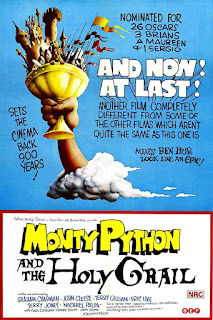
Showing posts with label monty python and the holy grail. Show all posts

Tuesday, September 22, 2026

Monty Python and the Holy Grail, live and on stage

Or, "I finally saw: Spamalot."

Spamalot, the musical adaptation of Monty Python and the Holy Grail, has existed for 21 years. Now, those 21 years have not been a particularly fruitful time for musical theater in my life, though we have tried to make up for it some in the past decade. In the seven years immediately before its Broadway debut, I lived in New York for three years, where I went to a handful of Broadway shows, and I dated a woman for nearly two years, who was involved in the promotion of musical theater, so I saw a fair bit of that in Los Angeles.

But Spamalot came along at just around the time I started dating my wife, who is not a musical theater buff -- though she does like going to shows. I'm not sure we ever went to a live musical during the eight years we were together in Los Angeles before moving to Australia, where we have tried to make up for it a bit lately.

All this is to say that my first exposure to Spamalot is long overdue. Not only am I huge Monty Python fan, which you might not know because I don't have occasion to touch on it here, but The Holy Grail is my sacred text. In fact, there are two things in particular you should know about the film, which I may have told you before, but if so, that was ages ago:

1) My first time seeing King Arthur's fight against the black knight is the hardest I have ever laughed. Is that definitely true? No, of course not. I might have laughed harder at some random thing somebody said sometime. But I can't remember that random thing, and I can remember The Holy Grail. So if ever asked my memory of my hardest laughter ever, this is the answer I give.

2) From the days when I performed Monty Python skits on stage at the place I used to work in the summers -- and I may have performed a half-dozen of them -- I still, to this day, have the dialogue memorized from the "Constitutional Peasant" sequence of the film. I did this on stage in 1987 as all the three speakers in the scene, back when I was a guest on that island rather than staff. I have no idea if it worked at all, though there was at least polite laughter. Anyway, it became permanently ingrained and I can still dictate it, if anyone were ever interested in that sort of party trick.

My actual interest in tracking down Spamalot, though, has been fairly low.

I'm not sure why this is, really. A sense that it could never be as funny as the film? A slight wariness from having read Eric Idle's memoirs and finding them a tad self-indulgent? (He's a relentless name dropper.) Whatever the reason, I never leapt at the opportunity to see it nor did I feel any FOMO that I hadn't seen it. Nor do I even know if I ever actually had the opportunity to see it. (According to Wikipedia, it probably would have been on North American tours in 2008 and 2009.)

That opportunity finally came this past weekend, when my sister-in-law got us tickets to it for a Saturday matinee for its nascent run in Melbourne. She's been initiating all sorts of cultural activities this year, though many of them are with my older son, who dutifully accompanies her even if he doesn't have any actual interest in these things. (Oh to be a fly on the wall when they watched Anthony LaPaglia in Death of a Salesman.) These were the end of the previews, and the proper Melbourne run is now launched. (The only thing, incidentally, that distinguished this from the proper run is that they addressed the audience after the final curtain, which I'm sure they will no longer do.)

The story, such as it is, pretty closely follows the plot from The Holy Grail, though some of the scenes are out of sequence. But the actual title is a callback to a separate Python sketch from 1970 called "Spam!" And because this was the likely to be the only time Python material would ever be staged, Idle -- the show's co-writer with John Du Prez -- needed to fit in "Always Look on the Bright Side of Life," which is actually from the Python film Life of Brian

Before I get too deep into the show, I should tell you that someone famous played King Arthur. Or at least locally famous. Australian actor Stephen Curry -- and yes that is the same name as the basketball player -- has 84 credits on IMDB, most of them Australian content, though not obscure Australian content. I took notice of him in a film I really like called Hounds of Love. But he's also been in The Castle and Rogue, and you might know him from what I assume was a very small role in Thor: Love and Thunder. (Anyway, small enough for me not to have remembered he was in it. Though then again, I was not particularly following the career of Stephen Curry with the foreknowledge that I would one day see him in Spamalot.)

I thought the second act worked a lot better than the first. Even though there is a professorial type who occasionally says things in his capacity as a narrator -- which reminded me a little bit of the similar character in The Rocky Horror Picture Show -- I still feel like this story is fairly lacking in context, and its first act density of songs without any plot momentum further complicates the problem. Plot was never the strong suit of Monty Python, as even in a generally coherent story like The Holy Grail, they were fundamentally stringing together unrelated sketches that followed a central theme. That feels like even more of a problem on stage, when you are relying on a narrative spine to carry you through, particularly when the songs are inevitably going to slow down that progression. Here I felt that there were sometimes only about four lines of dialogue before it was time for another song, and because Python has a wicked digressive streak, these songs rarely actually furthered the narrative. (There's one song where a character complains about the fact that her part is too small, although this is actually in the stronger second act.)

This is a good time to pause and acknowledge how Idle has made gestures toward preventing this from just being a sausagefest, like the film. (The Python ensemble themselves usually played the female roles, with one important exception that I will touch on two paragraphs from now.) One way to gender diversify is that there are four women who basically serve in the role of backup dancers, though there are many actors doing multiple duty in order to keep the total ensemble to under 15 people, so they do have other, more consequential showcases. But there's also a female lead, who does sing that song about her small role, and this is The Lady of the Lake, who in the film is responsible for bestowing Excalibur on King Arthur and making him king -- though is not an actual character. Here she keeps showing up and has about five songs, so it's strange that one of those songs is that the story hasn't checked in with her in a while. 

One of the reasons the second act is better is that it has most of the actual skits we enjoy. I thought they might not be able to include the black knight fight due to the impossibility of knocking an actor's arms and legs off on stage, but instead they just make use of the large screen at the back of the stage that plays animations throughout, including Idle playing God. In this instance, they have the black knight on the back screen and Arthur fighting him, coordinating his sword clashes with those of the two-dimensional image. And then at four key junctures, his two arms and legs are lopped off. It works, but of course did not make me laugh like in the mid-1980s. 

I could continue to list the various scenes, but it's probably better to mention what they don't include. And one of those is the scene alluded to earlier that has the lion's share of the film's women, which is that scene where one of the knights spends an interlude in a castle full of sexually aggressive women. This is the only part of Holy Grail that totally turns me off -- it's just not remotely funny -- and I thought it was a wise decision of Idle to consign this to the dust bin of history. The only set piece that I enjoy that they didn't include is the one where the knights must cross the chasm and are asked a serious of questions, where if they get them wrong they fall into the chasm. I think this might have just been cut for time.

Unfortunately, the overall impression of the scenes they do include is that they sort of pale in comparison to my love of the sacred text. I realize this would not be a problem for everybody, but it is for me. For example, during the scene where the French guard taunts the knights, all I could really focus on was how the actor was intentionally changing the inflection on the lines so it was not a direct impersonation of the actor from the film. While I certainly understand that instinct, I guess the thing that I loved about Python was the familiarity, the exact sound of the words and the exact line deliveries, that resonated so much with me that I still have them in my head today. I know a piece of original stagecraft is not just trying to regurgitate the film, but most of these scenes just weren't that funny to me. Maybe I've heard them too many times before.

There were some "cute" executions of famous moments from the film, which were, I believe, intended as a wink at the meager options available in a stage performance. For example, a rather small inflated cow is catapulted on the knights by said French guards, while the catapulting of the Trojan Rabbit is on the video screen on the back. Then I was wondering how they would do the fight against the other rabbit, the one that kills so many of the knights in the film. It's a stuffed rabbit thrown at the neck of one knight, who holds it to his throat and mimics it chomping his neck. Obviously you can't get a rabbit to fly around the stage. 

Spamalot shows its age in a couple spots. I didn't love the bit where it starts to talk about itself as a Broadway musical, which would have tickled us in 2005 but feels a bit old-fashioned now. More problematic is the song where they talk about how you can't have a Broadway show if you don't have any Jews. My wife and I agreed that this became dated very fast. Not only don't we want to teach people like my children that Jews are associated with the entertainment industry, but the last few years have also not been a great climate for making light of anything related to Judaism. I suppose that's in the text, so if you want to mount Spamalot, you have to include it. Then again, these are sketches, so any individual part lifts right out.

Oh and do you want to know how it ends? Famously, the film doesn't have a proper ending. The remaining knights get arrested by London police officers. Here, after they use the holy hand grenade of Antioch (which was a pretty funny scene) to blow up the rabbit, they get a clue to the location of the grail, which is that it's under one of the seats in the audience. Sure enough, that unwitting audience member gets to come up on stage with the cast. We debated afterwards whether it was the same seat for every performance or if they vary it up. I took the former position and my wife took the latter. My thinking: they could improvise the dialogue that's related to the specific seat number, but it would be easier just to use the same one every time. You don't usually have to worry about repeat audiences, and if anyone's coming back for a second time, surely it means they love the show and are not going to fault it for using the same seat over and over again. 

And then, because they've previously acknowledged that a Broadway show has to end with a wedding, Arthur gets married to the Lady of the Lake, revealed to have a name: Guinevere. Which brings thing back in sync with Arthurian legend. 

My overall impression was eventually a positive one. I'm glad to say that the show was salvaged a bit by its second half. But I found the first half to be pretty groan worthy, I'm sorry to say. 

My kids? Well there's not much chance this will push them down a Monty Python rabbit hole, to make yet a third reference to rabbits. The whole thing must seem very odd and dated to them. While we were taking our seats at the start, they used that back screen to play skits from other films and from the TV show, and the kids just looked at them dumbly, without having any context or without being on their wavelength. My older son even asked "Is this the thing we're here to see?" which I thought was funny.

The director came on stage afterwards to thank us, as a preview audience, and to award us by emailing every ticket purchaser with a discount code to come see the show again during its proper run. I was impressed to learn that they had only rehearsed for 13 days. It's not a show heavy on sets or staging logistics, but I still think that's pretty impressive. 

I definitely would not see Spamalot again, so my sister-in-law can use that discount on herself or maybe a friend. But it does feel like by seeing it, I've finally scratched an itch I may never have known I had. 

Saturday, April 27, 2024

Adjacent to Python, not adjacent to good

Terry Gilliam directed or co-directed two of my top 50 movies on Flickchart, those being Monty Python and the Holy Grail (#41) in 1975 and Time Bandits (#29) in 1981.

In between, he directed one of the least funny turkeys I have ever seen.

That's 1977's Jabberwocky, which I finally saw last night on Kanopy. That delay seems unimaginable for a person who grew up steeped in Monty Python, and who, in fact, memorized an entire scene in Holy Grail which he can still quote today. (Which will actually come up in a minute.) But that's just an indication of how little people who liked Python actually talked about this movie, even though it features fully half of the Python players and is directed by one of them.

Based loosely (if at all) on the Lewis Carroll poem, Jabberwocky acknowledges its connection to Carroll by kicking off the action with that poem's famous opening: "Twas brillig and the slithy toves ..." I guess these words are being spoken, or at least thought, by a butterfly, because they end when a poacher (played in his one quick scene by Python Terry Jones) steps on and crushes the butterfly while tromping through the woods. A few moments later, this character is going to be skeletonized by the titular beast, unseen at this point, which at least set me up for something interesting.

Nope.

Poor Michael Palin, saddled with being the movie's main character and having to act out a movie's worth of bad ideas by Gilliam and co-screenwriter Charles Alverson. He keeps his chin up and at least is a beacon of sweetness within all this grossness and drudgery.

Yes, if there's something Monty Python collectively understand, it's the grossness and drudgery of the Middle Ages. Most of the characters in Holy Grail and in this portion of Time Bandits look like gnarled gnomes with bad teeth. Python think it's funny what cretins these people were, and mostly, they're right. Just think of the scene in Time Bandits where John Cleese's Robin Hood -- ah, what Jabberwocky might have done with a good dose of John Cleese -- is giving out stolen goods from the rich to the poor, but the price of each receiving their small amount of riches is that one of Hood's goons, with teeth practically coming out of his forehead, must punch them square in the face. And it's not just men, as this menace is knocking the block off of women as well.

That might not have worked, tonally, but by the time Gilliam had made Time Bandits, he knew a) how to pull off the tone and b) that small doses were all we needed. Jabberwocky is essentially one hour and 45 minutes of a goon punching you in the face, and it's as unpleasant as that sounds. 

There are jokes here about shitting, eating grossly, bawdy sexuality, inbred-looking royalty, terrible hygiene and the general awfulness of people. Under the right circumstances, some of this stuff might make me laugh. Since none of it did -- I literally did not laugh once -- each new flailing attempt just stacked the deck against this movie. The most I can say is that I appreciated what they were trying to go for once or twice, but they were quite far from achieving it.

Why does this stand in such stark contrast to Holy Grail and to Time Bandits, which also features Palin as well as Cleese? Is Charles Alverson that much of a detriment to Gilliam's comedic instincts?

Because this is, really, very close to those two movies in many respects. It looks shoddy, which is a feature not a bug of Holy Grail (and a product of its mid-70s origins to some degree). It has the bawdy humor that Gilliam explores more credibly in Time Bandits. There are even some things that are so directly explored in the earlier film that they would be considered rip-offs if the same creative talent were involved. For example, Palin's character is named Dennis, which is the same name as the character who talks King Arthur's ear off in the aforementioned "constitutional peasant" scene in Holy Grail. (You don't remember me aforementioning it? That's the scene I memorized when I was 14 and can still recite to this day.) There's a black knight in Jabberwocky, just as there is in Grail, and there are rude guards at the top of a tower, just as there are in Grail, although all they do is urinate off the tower. 

That's a good metaphor for what is being traded off between these two movies, though. Although the French guards delivering their complicated insults in Holy Grail has faded over time for me as one of that film's best sources of humor, more silly than masterful comedy writing, it's Shakespeare compared to two guys urinating off the top of a tower.

I do think this gives us an idea of how important the other Pythons -- who included Graham Chapman and Eric Idle in addition to the ones we've already mentioned -- were to the writing process of Holy Grail. When you only have some of them, and when the one who is directing it has not yet come into the visual powers that would later distinguish his career, you get a lowbrow, mean-spirited and unfunny slog like this. 

I thought this might make me a Gilliam completist, but just checking now, I see I have not yet seen The Brothers Grimm, one of two movies he directed in 2005 (along with Tideland). That one was not well received, so I won't rush to fit it in.

In a year in which I am reviewing outlier movies from favorite directors, Jabberwocky does not qualify. In fact, looking over Gilliam's filmography for this piece, there are actually more Gilliam movies I dislike than like. While the two movies I've discussed glowingly in this piece are obviously my favorites, Twelve Monkeys is also around my top 100 on Flickchart, clocking in at #127. From there, though, things drop off pretty steeply, as only one movie he has made since then -- and that's nearly 30 years -- has gotten three stars from me on Letterboxd, which is The Imaginarium of Doctor Parnassus, and I may have been generous with that rating. All the others since 1995 are some sort of misfire, and I'm no fan of Adventures of Baron Munchausen, which came before Twelve Monkeys, either. (I like Brazil fine, but not as much as most people.)

In the grand scheme of things, it should not be a surprise that Jabberwocky stinks, because Gilliam missed more than he hit. And we now know he's not a great guy either, aligning himself with right-wing politics, so you know, he and his shitty 1977 movie can go eff themselves. 

Monday, February 7, 2022

Revisiting my own childhood arm-removal cinematic trauma

I didn't choose to watch Cat People on Saturday night because I'd just written a post about how the removal of a knight's arms and legs in Monty Python and the Holy Grail was too much for my younger son. It actually came up while I was Flickcharting, and I thought "I haven't seen that in yonks!" ("Yonks" is a term of either Australian origin or Australian frequent usage, which means "a really long time.")

Once I'd selected Paul Schrader's film and rented it from iTunes, though, I realized it had also been the occasion for me to contemplate the consequences of the removal of an arm, at an age when I was too young to fully process such violence.

The two couldn't be more different in tone or in outcome, of course. The knight in Holy Grail seems destined to live a productive, if immobile, life after not only losing one arm -- "it's just a flesh wound" -- but also the other, and then both legs. Like if someone wheeled a cart up to him and put him on it, he'd just carry on from there. It's all very funny. 

Ed Begley Jr.'s zookeeper in Cat People, on the other hand, has his left arm torn from its socket by a furious black leopard -- a man transformed into a black leopard, but he doesn't know that -- and proceeds to bleed out on the ground, his blood spattering on the shoes of our protagonist and running down the drain. 

Even at that age I remember thinking "You can survive the loss of an arm, can't you? I see people missing arms all the time."

Not if you lose it in this gruesome fashion, I guess.

So what age was that, exactly?

It's hard to say. Cat People was a movie my mom taped off of The Movie Channel sometime around 1985, when we had that cable channel for a very short time, a year or two max. Pretty much every movie we had was from 1982, 1983 or 1984. Cat People is in the first group.

I wouldn't have watched it in 1985, I don't think. That would have been too early. I spent most of 1985 being 11 years old, turning 12 in October. 

But at some point probably no later than 1987, I made a habit of secretly watching parts of this movie, at some point watching all the parts, if not in one sitting then over multiple sittings. One sitting would have been hard because my parents can't have condoned me watching this. Certainly not my dad, but even my mother, the one who described to me what happened in The Exorcist and Jaws when I was way too young to learn these things, wouldn't have allowed me to watch this movie in good conscience.

It wasn't just the violence. It was the sex, or really, the nudity. Which may have been the real reason I was watching it.

I counted four different sets of bared breasts in the movie when I was watching it Saturday night. Two prostitutes -- although I suppose the second might not technically be a prostitute -- and also our two main female characters, played by Nastassja Kinski and Annette O'Toole. The Kinski nudity was certainly story-related, but the O'Toole nudity was just plain gratuitous.

I guess that was 1982 for you.

I remember Kinski's nudity having a profound affect on the young me. It wasn't like it was the first nude woman I had seen in a movie -- I'm pretty sure I had already seen Revenge of the Nerds by this point, and stayed up late to catch a glimpse of Cinemax during sleepovers at my friend's house -- but I think it was the first time I remembered seeing what I considered to be the protagonist of the movie without a stitch of clothing. I thought nudity was only for cheap throwaway side characters, not the lead.

But here was Kinski, naked as the day she was born, stalking a rabbit through the woods late at night. 

I'm not sure why that scene was the one I remember watching, since Kinski is naked at least two other times in this film (and at all times does not wear a bra, which I guess was also more common back then). Maybe it speaks to how few times I actually saw it all the way through. Or maybe it's that this nudity was not intermingled with violence, as it was with the prostitute who gets her leg mauled by the leopard, or the woman I earlier called a prostitute just because she goes to bed so quickly with Malcolm McDowell's character, and then acts very much like a prostitute trying to arouse a john when she's in bed with him. Oh, she does kill that rabbit, but it's entirely off screen.

In any case, it was the violence I came here to talk about today, not the titillation. (Nor to call anyone a prostitute who isn't a prostitute.)

Although a number of scenes from this movie linger with me from those young days, as does David Bowie's haunting theme song, it's the scene where Begley's character dies that had the biggest impact on me.

The tearing of his arm from its shoulder is rendered very realistically. We see bone and organic connective tissue as the arm separates from the body, both on the departing arm and on the stump it leaves behind. Then there's the look of wordless shock and horror on his face as he falls to the ground and blinks while his blood gushes out in torrents. When something that sudden and traumatic occurs to you, there are no words, and maybe you don't even have the energy to scream as the life leaves your body.

I think it's probably realistic, too, that this would be a killer injury. We go through our young lives as budding cinephiles trying to figure out which injuries are life-threatening and which are not. Like, by the time you're 13, you probably know exactly where in the body a gunshot wound will kill you and where it won't, even if you are only using the flawed standards of movies that are only making the most minimal stabs at realism.

So by the time I saw Cat People I already thought that the loss of an arm was one of those things you could survive. He'd be back up and at it, hobbled but not broken, just like the prostitute with the mauled leg. 

Nope. 

As I was watching Saturday night, I even wondered aloud whether this had actually killed him. Schrader cuts out of the scene when John Heard's curator tells someone to call a paramedic, and I immediately wondered if I might have misremembered that the character is killed by this injury. But subsequent scenes confirmed it.

I suppose if your arm had been torn out of its socket by a black leopard while you were both in a hospital setting, there would be some chance doctors could stop the bleeding in time to save you. But not when you're at the zoo, and not when a doctor is going to see you 15 minutes later in the very best of circumstances. 

It really contributes to the lethality of the cat to have him kill the zookeeper in this scene. Even in a cage, even when you are taking precautions, this thing can kill you.

My only quibble about the scene was not whether the loss of the arm would have killed him -- I'm quite convinced of that now -- but why he needed to stick his arm in the cage in the first place. He's trying to subdue the leopard with some electric prod, but I wasn't clear why the leopard even needed subduing at this point. They weren't trying to move him or anything, just trying to get him to stop freaking out. Easier just to walk away and let him sleep it off.

In any case, the death of Ed Begley's character really did stick with me for a long time. I don't think I was worried about a black leopard killing me, the way you might become irrationally worried about a shark after the aforementioned Jaws.

No, this scene in Cat People affected me more profoundly and more abstractly. It made me confront the possible suddenness of death. One minute this guy is whistling a happy tune, hosing down cages and feeding ornery animals their nightly hunk of meat. He hasn't a care in the world. The next minute he's on the floor, blinking the last blinks of his life as he uses his dying thoughts to ponder the abrupt change in his circumstances.

I really enjoyed my rewatch of Cat People, probably the first time I'd seen it since the early 1990s. I'd never seen it other than on that VHS tape we owned, and since I was gone off to college by 1991, perhaps I hadn't seen it since the 1980s. And in fact perhaps that was the only time I saw it, since I haven't given myself credit for multiple viewings on my list of movies I've seen more than once. Though that was developed retroactively within the last 20 years, so it is not infallible.

It was also useful to watch it within the context of Schrader's career, a career I was not familiar with at all back then. (As Taxi Driver was definitely too grown-up for me to have watched by then -- plus my mom never taped it off The Movie Channel.) 

It's interesting to ponder that this is the same man who directed First Reformed and The Card Counter. He's had a varied career, but both types of film seem to speak to something essential about him. It might take a little while longer for me to ponder what that is.

Cat People is also one of those films that benefits immeasurably from its period score, rather than being hamstrung by it. The Bowie song -- which first appears to us as an ominous synth background during the opening sacrifice scene, accompanied by drumming and his ethereal humming -- is just one example. Giorgio Moroder's score is a haunting masterpiece, as was pretty much everything Moroder created for the movies. (He's still alive, and possibly still working?)

The music sets a tone that is probably the thing that lingers most for me about Cat People -- even more than poor Mr. Begley and the arm he will not see again until they both get to heaven. 

In the case of poor Mr. Begley, that's just a few minutes from now.

Sunday, February 6, 2022

Catapulted animals were not enough

It seems hard to imagine I don't yet have a blog tag for Monty Python and the Holy Grail, a foundational comedy in terms of establishing my sense of humor, which also features what I informally consider the moment I laughed the hardest in my entire life. (A thing like that could only ever be informal.) 

For those of you who have seen the movie -- all of you, I hope -- it's the scene where King Arthur cuts the knight's arms and legs off. If you haven't seen the movie, that probably doesn't sound very funny, but the fact that his opponent keeps pluckily fighting and taunting Arthur, despite being increasingly limbless, left me absolutely rolling on the ground when I first watched it at about age 14. 

If you want another indication of my love for this movie and its origins deep within my maturation, around about 1987 I memorized the Constitutional Peasant scene from Holy Grail in order to perform it at a talent show at the place I used to vacation in the summer. It wasn't repeat viewings of the movie that allowed me to memorize it, as I'd seen the movie either zero or one time at that point, but the skit had been extracted for one of their comedy albums, which I listened to constantly. I played all three parts on stage, and to this day I can still recite every single word of that probably three-minute scene.

You'll be glad to know I did not subject anyone to this recitation when we watched it together on Friday night, something I had secretly hoped might be possible relatively soon, and became so when my 11-year-old's friend, who was sleeping over, requested it. I'd had the discussion with my wife whether the movie was appropriate when I'd been planning to show Time Bandits at a movie night at a friend's house last year, which had to be cancelled due to COVID. At this movie night they have a tradition of showing a short film beforehand as an appetizer, and I thought it would be fun to watch the armless and legless knight scene as a perfect preparation for the sense of humor in Time Bandits. At that time, my wife judged the scene too gory for the kids who would be in attendance, and I'd settled on the Knights of Ni instead -- though of course the viewing never happened.

I'm not sure if something changed in her mind since then, or if it being requested by the guest was the deciding factor, but we chose to go forward with Holy Grail during our pizza dinner on Friday night.

Initially I did not think I would watch the film, even though I desperately wanted to. I felt like I'd seen it relatively recently (2017), but that wasn't the main source of my hesitation. Rather, it's that your son doesn't typically want his dad hanging around when he's trying to watch a movie with his friend on a sleepover. 

What changed this was the idea that the kids should start eating their pizza while watching the movie, and because the adults were eating the same pizza at the same time for our dinner, we would start watching the movie with them. My son did not seem to want me to bugger off, so the default choice was to continue watching the movie. 

Part of the reason I was desperate to watch it was that I love to partake in my kids' first viewing of one of my favorites. It was the same reason I was disappointed when my wife suggested a viewing of Back to the Future on a playdate a couple years back, and why she was disappointed when I went ahead with a viewing of The Princess Bride with the kids while she was out of town.

But specifically in the case of Holy Grail, I wanted to see if the same sort of humor birthed in me by Monty Python could be birthed in my son -- either son, really, but the eight-year-old is probably not ready for it yet (though he was also in the room, as you will soon see). That was something I shared -- do still share -- with my own dad, and I wasn't much older than this when it first got started. (I have even performed Monty Python with my dad, but I think times have changed enough that I'm not deluding myself into thinking this would or could happen with my sons.)

Well, it was a total failure.

My son laughed at exactly one scene: the scene where the French taunter catapults a cow at the knights of the round table, and follows with a fusillade of chickens and other small barnyard animals. My son was cracking up hysterically in that scene. Not to the same extent that I cracked up during my original viewing of the armless and legless knight, but enough that I thought this movie was going to be a win for him.

Nope. 

He bailed by the scene that I always think is the worst in the movie, The Tale of Sir Galahad, in which Michael Palin's Galahad finds himself in a castle full of horny women. I have always sat there stony-faced during this scene, and my son did that one better: He got up off the couch and said he was going to do something else.

"Oh just wait," I told him. "It's almost over and it gets better again after this."

"I don't like any of the movie," he clarified. "It's bad."

What happened to those catapulted animals?

My first indication of possible failure should have been that he sat there stony-faced not during one scene, but many, particularly the armless and legless knight. The catapulted animals should have more obviously registered to me as the exception than the rule. 

The timing of his departure was specifically that the topic of conversation became sex, which makes my son squeamish. He doesn't seem bothered by it the many times it comes up in our viewings of Futurama, but in a more realistic context it seems to really agitate him. And if I'm being honest, that's the point I'd bolt from the movie if I weren't enjoying it, and if I bolted from movies as a general practice, because The Tale of Sir Galahad is bad.

There was a chance to win him back, because the guys had not yet had their dessert, and it makes sense to keep watching while you eat your ice cream. This was also my son's friend's hope, since he was the driving force behind the viewing, and was constantly talking about how good a scene was going to be, and even spoiling elements of it -- something that couldn't have helped matters.

But the Knights of Ni didn't make him laugh either, so that was that. I continued watching the film but they didn't. 

One of the things I thought was sort of uncool about my son's abrupt departure from the film was the way it risked the displeasure of his friend. Since we've just moved, I think it's especially important to remind the friends from the old neighborhood, whom it takes an effort to see, that you are cool and fun. Storming out of a movie your friend chose is not a great way to do that, even if you say that the friend can continue watching. (He didn't. He's already seen the movie obviously, and at least in his case he recognized it was good to do the thing his friend wanted to do.)

So I don't have a lot of hope for Monty Python making a convert of my older son. At least not yet.

The funny thing is that it looked like it could have been a win for my younger son ... if not for the gore mentioned earlier.

Although he came in with a mind closed to the film -- in part because the poster on Netflix shows a rabbit with blood on his teeth -- he was kind of warming to it against his better judgment. In fact, he was visibly becoming interested in the prelude to the legless and armless knight, more properly referred to as the black knight, in which the knight fights another opponent. My son thought it was hilarious when he kicked that knight in the balls, and it looked like he was hooked.

He did not find it so hilarious when the black knight thrusts his sword through the helmet of the other knight, killing him and letting obviously fake blood spew forth.

We know this is sort of part of the joke, though it's probably bloodier than it needs to be, but my eight-year-old? All he saw was a man killed in gruesome fashion. 

And it didn't help that the man who killed him was then deprived of his arms and legs -- even though the fact that he was not bothered by it probably mitigated some of that. 

So one son didn't care about the violence but didn't find it funny, the other found it funny but cared about the violence. I guess it's good he also bailed well before the scene where Lancelot storms the castle and kills half of the wedding party, or where a flying rabbit bites out the knights' throats.

Now I wonder if we might have burned our best opportunity to give birth to Monty Python fans.

Had we waited a few years longer -- to the age I was when I first learned Python -- we might have gotten an older son who was better able to get the humor (and not get turned off by "old movies"), and a younger son who was better able to withstand the violence (and not get turned off by "old movies").

It's hard with these things. You are so eager to show these great things to your kids that maybe you sometimes jump the gun. 

Then again, I blame my son's friend. I was not planning a viewing of Monty Python and the Holy Grail anytime soon -- at least not outside my own fantasies. 

Either way, the gun has been jumped, as it was for Star Wars movies. They like the Star Wars TV shows but not the Star Wars movies. Maybe the key would be to show them Monty Python's Flying Circus.

I do wonder, though, if Monty Python and the Holy Grail, being an "old movie," ever really stood a chance, even if the humor had been more accessible and even if the violence had been less graphic. Curing them of their dislike of things made before their lifetimes may only come with maturity, and maybe when they're more mature they'll feel inclined to give movies like this a second chance.