Showing posts with label settling the scorsese. Show all posts

Saturday, December 17, 2022

Settling the Scorsese: Kundun

This is the final installment in my 2022 bi-monthly series in which I finish watching the feature films of Martin Scorsese that I hadn't seen. There are still a couple random documentaries that might or might not be feature length.

I've known a fair number of people who were really into Tibet and the Dalai Lama.

I have never been one of them.

I have the basic idea of his permanent exile in India and how lots of people want to free Tibet from Chinese rule. That'd be cool. I'm all for it. But do I have a huge amount invested in it one way or another? No.

I don't know if 1997's Kundun, the final Scorsese film I had not yet seen, resonates more for the people who are invested in Tibet than it does for me, but it didn't resonate for me very much at all.

A number of problems here:

1) The acting. The two primary actors chosen to depict the man born Tenzin Gyatso -- identified in his infancy as the 14th Dalai Lama, the Tibetan spiritual leader -- are, like, not good. This is not their fault any more than it was Jake Lloyd's fault he wasn't good as Annakin Skywalker. Tenzin Thuthob Tsarong and Gyurme Tethong are as good as they had any reasonable expectation to be, but unfortunately, the reasonable expectations were pretty low. They just can't carry the weight of the drama.

2) The drama. But that's also the problem: the weight of the drama is diffuse and unspecific. Scorsese and screenwriter Melissa Mathison are not able to create many moments in this film that feel any more significant than any other moments. Kundun tries to build a thematic structure that goes beyond just retelling moments from the first quarter century of the Dalai Lama's life -- the still-living Dalai Lama was born in 1935 and escaped to India in 1959, which is when the film ends -- but either that structure doesn't register, or the significant events of his life, beyond his actual escape, just aren't very cinematic. Then again, neither is his escape as depicted here.

3) The score. When unable to produce narrative peaks unto themselves, Scorsese compensates by draping Philip Glass' oppressively earnest score over the whole thing. We rarely get a respite from the score, which I'm sure is not bad musically, but is used so consistently that it wears out its appeal in really short order. And when the music is telling you in every single moment of the film just how important this all is, none of it feels important.

I could go into a lot more specifics of why Kundun didn't work for me, but it's the end of the year and I have a lot more pressing things to spend my time on. Plus, I suspect I don't need to convince you that the film is mediocre. It has the reputation of being one of Scorsese's least remembered films, which seems like an especial failure considering how prestigious the subject matter is and how much it clearly means to so many people.

But hey, at least the thing wasn't chockablock with Catholic iconography.

I will finish with one final thought on why the film didn't register with me. I said earlier that I know a number of people who are/were really into Tibet and the Dalai Lama. Well, I actually know at least one person who has met him, a guy I grew up with and have known since we were maybe six years old.

I'm not actually sure what he's doing now, but the early stages of his career involved both Tibet and work in the music/entertainment industry that brought him into the orbit of guys like the Beastie Boys and Spike Jonze, who were both big into Buddhism and Tibet. Now that I'm googling it, I think my friend (we would have been friendly once, though it was more a proximity friendship than an actual one) must have been involved in the production of the documentary Free Tibet, about the 1996 Tibetan Freedom Concert in San Francisco, on which Jonze worked as a cinematographer while the Beasties organized and headlined the concert. The timeline would have been exactly right for that.

In any case, rumor among mutual friends was that this guy met the Dalai Lama, but what's more, the Dalai Lama was charmed by the goatee he wore at the time and gave it a little tug while chuckling playfully. It's a great story to say you had your goatee tugged by the Dalai Lama.

But that's not the Dalai Lama I saw here. This Dalai Lama was bland and humorless and given to awkward pauses that lasted a lot longer than they should have. (Where's Thelma Schoonmaker stepping in to tighten things up?) I was hoping Kundun would showcase a Dalai Lama with the lightness and sense of humor demonstrated in the goatee-tugging incident, the traits I now identify with the man, both from this story and from other footage I see of him. Scorsese couldn't figure out how to get even one moment like that, nor am I certain that his actors would have been able to deliver it.

One final, really final, thought: I had always thought the movie was pronounced "KOON-DOON," but from hearing characters in the movie say it, it seems it's more like "KUN-dun." For some reason this qualifies as one final disappointment.

Well I must say the Settling the Scorsese series was itself a disappointment. I didn't really care for any of the first three films I saw, Who's That Knocking at My Door, followed by New York, New York and The Color of Money. Things did perk up with New York Stories, especially Scorsese's segment, but that was only a short film's worth of work from him. The Age of Innocence was a standout, finally, but Kundun just brought things back to earth with a thud. Oh well. I guess I'd just been wise with my previous selections from the filmography of a man who remains, without a doubt, one of the all-time greats.

My disappointment with my unseen Scorsese does not translate to a disappointment with this sort of bi-monthly format for finishing off the filmography of a great director. And I already have my subject -- or possibly subjects? -- picked out for 2023. I'll let you know about that sometime in January. 

Wednesday, October 5, 2022

Settling the Scorsese: The Age of Innocence

This is the fifth in my 2022 bi-monthly series in which I finish the Martin Scorsese narrative features that I haven't yet seen. 

However the previous four films in this series went -- and there was finally one I liked in August -- I knew that I probably had a treat in store come October.

I've read Edith Wharton's The Age of Innocence, and by that I mean I listened to an unabridged audio book of it back in 2012, when I was commuting between the San Fernando Valley and my office in El Segundo, which regularly took the better part of an hour. You can have your own definition of reading if you want, but if I listen to every word of a book I consider myself to have read it.

And I loved it. I got caught up in Wharton's writing and in the wistful romance at the film's core, plus in how it resolved itself. We've all had an ache for a person we could not have because it conflicted with our values, or some other part of our reality. Wharton's novel captures that melancholy perfectly, and then some.

And so does Scorsese's film, I'm glad to report. 

Yes I really liked The Age of Innocence, but I'm trying to decide how much of that credit to give to the film, and how much to give to the source material. 

If I had not read the book, I'd just be like "Great film, 4.5 stars." Since I've read the book, I might instead be like "Great film, 4 stars." (I still haven't entered my star rating on Letterboxd as I try to work this out.) 

I'll talk about the things the film does well as a film, but first, a little plot synopsis.

It's New York high society of 1870. Daniel Day-Lewis' character, Newland Archer, is from one powerful family, and he's betrothed to a young woman from another powerful family, May Welland, played by Winona Ryder. Another relation of the Wellands is the Countess Ellen Oleska (Michelle Pfeiffer), whose Polish count husband she has left back in Poland due to his philandering and other disgraceful behavior. Because society tends to shun women who walk out on their marriages, she is having trouble being received in polite New York society upon her return, though with the help of May, Newland and their various other family, friends and acquaintances, she starts to make headway as a woman living on her own in the city in which she was raised as a child.

Newland is brought into greater acquaintance with the countess when his legal expertise is called upon to advise her in the matter of her desired divorce from her husband. A bit of a proto feminist, Newland starts to be taken in by the countess and her poignant fight for her own freedom -- a largely symbolic fight since she already enjoys the freedom of being an ocean away from her husband, possibly never to see him again. As his admiration turns into attraction, and the attraction becomes mutual, Newland pushes for a shorter engagement to May, feeling like being married will answer the question of his split attentions. It isn't as simple as that for any of them, including May, who rightly suspects his reasons for hastening the marriage, even though he denies them and even though she feigns believing what he says.

I'm not sure why The Age of Innocence struck me more profoundly than other stories about star-crossed lovers. I feel like the sort of romantic period of American history, combined with Wharton's splendid writing, could be the reason. Though there are a lot of people who write splendidly and a lot of periods of history that are romantic in their way.

I suppose it captures in a particularly poignant way that feeling of being in a relationship, a relationship that you really value, while also feeling your heart pulled in another direction. It's something everyone has experienced at some point in their lives, and it creates an extraordinary sense of tumult in a person's mind. I think Wharton's novel really captures that tumult.

We see that most in this film in Day-Lewis' performance, the small changes in his expression at the receipt of new information, the struggle to produce a facade of ease for his wife, when he feels anything but ease. Although the attraction between Newland and the countess is not based on anything hugely dramatic, such as an intense mutual experience, we believe its development and we believe that these kindred spirits would reach out to each other in a society that doesn't think the way they do.

It's clear why Scorsese was drawn to the material, and would become even more clear in the context of Gangs of New York nearly ten years later. Although his film career was forged in modern-day New York, Scorsese yearns for an understanding of the city that dates back hundreds of years, or 120 years in this case. The sets have been magnificently created and lovingly detailed, and Scorsese's camera takes in every detail. It may be no surprise that coming off of Goodfellas, whose Copa tracking shot is one of its most famous components, Scorsese would provide a similar tracking shot here, through a mansion during a ball. We get acquainted with the players in this society just as we got acquainted with the mobsters at the Copa.

He also uses a trick that I've seen before, that I remember from films like Bram Stoker's Dracula and Moulin Rouge!, where there's a soft focus "spotlight" of sorts drawn around two characters, to isolate them from the hubbub around. In this case it's between, of course, our two romantic leads at the opera. There's a classic feel to it, and the cinematography here resembles something from maybe two decades earlier. I couldn't help but think of something like Barry Lyndon.

Scorsese's Christian themes are, fortunately, not foregrounded here, though I assume they're lurking somewhere in the background that I didn't specifically notice.

I was compelled to look for a thing that I always heard about The Age of Innocence, which is that there is a careless modern-day wrist watch in one of the shots, or something of that nature. But googling it now, I see I must have confused this with another film because I can't see anything about it. 

In summary this is an extremely handsome and well-acted film, my favorite in the series so far, but maybe not something that I expect to dwell on in the coming weeks -- even as much as I love the themes it addresses. Whether it's because Scorsese isn't the perfect match for the material, or just that his specific interests don't bring more out of it than what is native to the source material itself, I'm not sure. Hey, I shouldn't have to be arguing myself into thinking it's Great, when many films are merely great. This is one of those films.

I'll wrap up in December with Kundun, assuming I find a place to get my hands on it. The pickings are slim right now on that front. 

Wednesday, August 24, 2022

Settling the Scorsese: New York Stories

This is the fourth in my 2022 bi-monthly series finishing off the feature-length directorial efforts of Martin Scorsese.

I'm not sure what it says about Martin Scorsese that my favorite movie so far in this series is the one that was only one-third directed by him. At least his third was my favorite of the three thirds.

New York Stories was his 1989 collaboration with Francis Ford Coppola and Woody Allen, in which they each made a 35- to 40-minute film about the city they love. I had hoped to make a little game of figuring out which one was Scorsese's without any further cues, not that it ultimately would have been much of a mystery, given that Allen and Mia Farrow appear in one of the films and Talia Shire appears in the other. The exercise was ultimately rendered moot by the fact that each film has its own opening credits sequence, but before that played, I'd pegged the first film, which I would learn is called Life Lessons, as Scorsese's just from the instant reliance on Procol Harum's "A Whiter Shade of Pale." That's a Scorsese choice through and through.

It features Nick Nolte as a talented abstract artist in the vein of Jackson Pollock (who get name-checked here). He's obsessed with the lesser, probably not actually talented artist who is his tenant in the giant loft space he owns and splatters with paint, which is presumably in the meat packing district. She's played by Rosanna Arquette during Arquette's peak fetching period. (That's not meant to be a lewd comment about Arquette, just that she's really adorable here, her slightly buck teeth peeking through her full lips in this way that's full of piss and vinegar and challenging anyone in her path.) They've had a bit of a relationship but she has dropped him for a performance artist played by Steve Buscemi, who has subsequently dropped her on a trip out of town, leaving them both miserable.

Nolte's Lionel Dobie is still devoted to her because he (rightly) believes that acting maturely is the only way he has a chance to get back together with her, though it's clear he hasn't got much of a chance. But there's a lot of passive aggressive playing of loud music -- when he paints, which seems to be all the time, he's always blaring some sort of classic rock -- and he's able to more or less see into her room, or at least see shapes of what's going on in there. It's not a healthy situation. 

However, it does showcase a filmmaker at his healthiest. There have certainly been bits of technique by Scorsese that I admired in the three previous films in this series -- Who's That Knocking at My Door, New York New York and The Color of Money -- but never have I found him in bracing command of the tools of cinema as in this little film, which most people would probably consider a trifle. I should remind you, of course, that Scorsese was making splashy displays of his ability in the films around this period -- The Last Temptation of Christ is right before and Goodfellas is right after -- but I have obviously seen those films. For the purposes of this argument, I am comparing Life Lessons to the other films in this series, which left me less than impressed.

Thelma Schoonmaker's editing is certainly part of it. There are masterfully constructed sequences of Nolte slathering acrylic on canvas, somehow building toward a masterpiece that you believe might actually be a masterpiece. That's one thing I liked about Life Lessons, was the belief that the art was actually legitimate art and not some terrible facsimile that is supposed to be amazing if only the production designers cared enough about getting a good artist to do it. That goes for Buscemi's performance art as well. (And while we're on Buscemi for a moment here, it struck me as funny that he is described by Nolte as handsome, and not in a sarcastic way -- which is probably the last time anyone has ever used that word in connection with Buscemi.)

But back to that editing. It has that real Schoonmakerian (that's not a word) confidence that marries well with Marty's moving camera, which he uses to great effect here. The loft feels like a completely alive creative space anyway, what with Nolte slathering paint like a madman, but the camera and editing give it a further kinetic quality that makes it a joy to watch.

Technique aside, I just enjoyed this little slice of a story. We've all been in a situation where the thing we love and want is right outside our grasp, but keeps us hoping by never departing completely. It can result in a high degree of melancholy (making "A Whiter Shade of Pale" the perfect soundtrack) that we only hope does not bubble over into something darker (which does happen here, though only in a minor, low-stakes way). I really liked both of the lead performances. Nolte is always in command of his craft, especially when he's playing someone a bit eccentric, and I really believed Arquette as a woman drawn to the celebrity and obvious greatness of this mentor, but not to him physically or romantically, who also doesn't know what she's doing and has serious doubts about her own skills as an artist.

Those themes about art and artists also shine through, and they don't have to take a back seat to Marty's usual Catholic distractions. In fact, only in the space where Buscemi performs -- which appears to be an abandoned subway track -- was there any Christian iconography I could detect, in the form of a statue of some sort of angel. Scorsese wants to remind us his preoccupations are still there, but he can do other things as well.

It's really telling that I felt the urge to write a lot more, thematically, about the 35 minutes of this film than about the two hours, or sometimes two-plus hours, of the other three films I've watched. 

While I'm here I suppose I should reserve a comment or two about the films by Coppola and Allen. Coppola's, the second, was easily the film's weak link. Called Life Without Zoe, it's a sort of flight of fancy co-written with Sofia, which deals with a young rich girl who favors dressing up in costumes as she prances her ways through balls and other elements of fantasy high privilege in New York. At my most charitable, I would call it cute -- knowing that Coppola the elder probably made it as a favor to this daughter, and that Coppola the younger would explore these notions much more convincingly in her future work, perhaps most notably Marie Antoinette.

Allen's Oedipus Wrecks was a hoot. It's very typical Allen material, dealing with a man (played by him) who feels bedeviled by his own nattering Jewish mother, who disapproves of his relationship with a shiksa (Farrow). When the three are attending a magician show, his mother is chosen to participate in an illusion where she climbs into a box that the magician pierces with multiple swords. When the magician opens the box, she's actually disappeared -- and she later turns up in the sky over New York City, like some sort of nattering God, who passes all her judgments and neuroses down to Allen except that everyone else in New York can also see, and more importantly here, her. It has a funny resolution and I was pleased to see Larry David appear in a cameo. (Though I'm not sure "cameo" would have applied at the time, since he wasn't famous -- I'm thinking of it that way largely in retrospect.)

Speaking of cameos, character actor Paul Herman has a small part in each of the three films. Nice touch.

So yeah, New York Stories left me feeling happy all around, and I think things will get better from here to finish the series, with The Age of Innocence due in October and Kundun due in December.

Wednesday, June 22, 2022

Settling the Scorsese: The Color of Money

This is the third in a bi-monthly 2022 series watching Martin Scorsese's remaining feature directorial efforts that I haven't seen.

I have to say, this Martin Scorsese series is not going well.

After being underwhelmed, to put it kindly, by Who's That Knocking at My Door in February and New York, New York in April, June made it 3-for-3 with The Color of Money. I think I liked it better than those two, but the margin is pretty narrow.

In order to prepare for this, I watched The Hustler in late May. I didn't love The Hustler either, but I got what it was going for. I'm not sure if if it's the intention of these movies to make our skin crawl from spending so much time stuck in smoky pool halls. If so, good job, you succeeded.

Knowing what Paul Newman's Eddie Felson went through in that movie -- including the suicide of his girlfriend, played by Piper Laurie, ex-wife of the man I wrote about yesterday, Joe Morgenstern -- I feel like I want to shake him for continuing to live his life in these slums infested with degenerate gamblers.

Maybe it is a failure of having the right expectations coming in. I didn't of course see The Color of Money in 1986, but I had friends who did, and I got the idea it was supposed to be really cool. At age 13, we didn't like movies because they probed the tortured souls of desperate people. We liked them because they were cool. We liked them because Tom Cruise looked awesome making trick shots and whooping people at billiards. 

I guess that happens here, but it never felt thrilling to me. It never gave me the sense of something to aspire to. Even if you are ultimately going to demonstrate the hollowness of a particular pursuit, because it's a movie, first you have to make it look sort of cool, right? Maybe the 48-year-old me just doesn't see it that way.

It occurs to me that there's an interesting parallel here with Lightyear, which I saw on Sunday, about five days after I saw Money. If you'd like my Lightyear review, it's here, but I'll give you a taste of the relevant part right now. If you know the premise of Lightyear, you know it's supposed to be the movie Andy and in his friends saw that all made them want a Buzz Lightyear toy in the original Toy Story. Having seen the movie, I have no idea how they'd think a kid who aspired to see brave and uncomplicated heroes on screen would have liked this movie at all, much less immediately demanded an action figure of the same character.

I similarly don't get what drew the 12- and 13-year-olds who were my peers to this movie. (I was 12 for three more days when it was released on October 17th of 1986.) Yeah it starred Cruise, but it was not as easy as I expected it would be to wish ourselves away into his shoes, the way we did for movies like Top Gun, and if we had seen them by this point, Risky Business. The fact that pre-teen boys seem to develop a fascination with pool, independent of films like this, surely helped. (Don't know if they do anymore nowadays -- I'm not even sure if my 11-year-old knows what a pool table is.)

Don't get me wrong, Scorsese does try to make it look cool, at least on the level of interesting camera angles capturing balls scattered all over tables, or resoundingly chunking home into the nearest pocket. Thelma Schoonmaker's editing shines in these scenes, and Newman and Cruise certainly picked up enough skill at pool to make some good shots and make it all look very believable. Knowing what we know now about Cruise, he wouldn't have had it any other way.

But the scenes between the pool games don't offer us a life I want to live, or would have wanted to live even in 1986. There's a lot of fighting and anguish, some of which I didn't fully comprehend even though I was paying attention and only nodding off a little bit. I thought this movie reached some weird, sudden emotional crescendos that had nothing preceding them in the dialogue, at least that I could figure out. Suddenly people were mad about something and quitting on each other and, well, I guess I must have been nodding off more than I thought I was.

And like I said earlier, I wanted to shake Newman. Maybe I expected him to resemble a more stereotypical, probably lazier version of this character, where he'd be three steps ahead of everyone, winking slyly and staying above the fray. But Eddie Felson is right smack dab in the middle of the fray, no better off now than he was 25 years earlier, no wiser for all the miles he's put on that pool cue. Perhaps the disappointment of that, even if it was the point, was something I never got over.

As for how this fits into Scorsese's career? Well I suppose it contains the criminal element Scorsese always flirts with, though I couldn't see his obsession with Catholicism rearing its head. Maybe I just wasn't looking for it. I'm sure there were crucifix shapes embedded in the mis en scene had I been more observant.

But the Scorsese I've seen so far in 2022 has not really whet my appetite to be more observant, even though the director's undeniable mastery of cinematic language should invite that. The Scorsese movies I've missed to this point in my life, I appear to have missed for a reason.

In August I'll be watching New York Stories, only one-third of which Scorsese directed. I'll watch all the segments, not just his, though it helps to have a little less to talk about, seeing as how I will be off to America for the first 20 days of the month and squeezing this in to the last 11. 

Saturday, April 30, 2022

Settling the Scorsese: New York, New York

This is my second in a 2022 bi-monthly series finishing the final six Martin Scorsese movies I haven't seen.

A lot of work has just gone into staying on schedule in this series.

The definition of "on schedule" encompassed two things:

1) Watching the next Martin Scorsese movie I hadn't seen during the month of April; 

2) Having that next movie be the next one, chronologically, I had not seen.

For a while there it didn't look like I could accomplish the latter, but then when it appeared I could, it seemed highly dubious that I'd be able to accomplish the former.

I've known since the start of the series that I'd have a hard time getting my hands on New York, New York, the 1977 musical drama starring Robert De Niro and Liza Minnelli. My streaming services, YouTube and iTunes all came up empty for a movie by one of Hollywood's most celebrated directors. If I were to have a hard time finding something Martin Scorsese directed, I'd think it would be Boxcar Bertha, which I'd seen before this series started, or Who's That Knocking at My Door, which I watched to start this series in February. I would not expect it to be a film that starred two Hollywood icons.

Yet the outlook on New York, New York was bleak enough that I had to consider excluding it from this series, which would fatally undermine the whole idea behind the series. I could buy it on Amazon as a last resort, but I usually stop short of that nuclear option in a context like this -- I get fussy about what it means to add a movie to my collection, especially one I've never seen. But it wouldn't be the first movie I'd bought as the only means of watching it, and besides, the concept of a "collection" is not what it was prior to streaming. 

The problem, then, became that it was only available via region 1, the region that includes the United States. This was never an issue for me in the past, but I have recently said goodbye to our region-free DVD player due to a malfunction with its tray. If I couldn't get this movie in Australia's region 4, Amazon was no help to me anyway.

It's worth pointing out that I still don't pirate movies. I'm still paranoid about some government agency arriving at my house and deporting me. I don't need that. (Plus a small part of me is worried about viruses.)

The options were clear: Drop the chronological order of the movies in the series, and hope I could work out the New York, New York issue at some point later in the year, or exclude the movie entirely. Exclusion had been an idea I'd put forth when I first introduced this series, if I couldn't ultimately find this film, and in that scenario, I was planning to make Killers of the Flower Moon, the new Scorsese movie, my final movie in the series. Except that movie just got pushed to 2023. 

Well, around the middle of the month, something came along to unlock the possibility of actually watching this movie before the month was out. And that was my revival of my old laptop as a region 1 DVD player, as discussed in this post. Fairly quickly after making this discovery, I recognized its possibility to benefit me in terms of Settling the Scorsese. I got on Amazon quick smart and ordered a shipment of the New York, New York DVD from America, with an expected arrival date of April 29th. That left me a fairly short window to receive and watch the movie before the month was out, but at this point I realized what a person should never forget in this scenario: I am the person setting these deadlines and, without a doubt, am the only one who actually cares about them.

Instead of taking longer than advertised to arrive from the U.S., as shipments of all kinds usually do, the movie arrived Wednesday of this week, and I watched it on Thursday.

The technical challenges were not over yet. Oh no. I had to deal with one more annoying thing that threatened to drive me mental. Because my laptop was set up for my son's use, it kept asking to sign in to Microsoft to allow him to send access requests and the like to his parents. And every time this screen would pop up, it would jump to the front -- not just in front of the movie as it played in the background, but kicking the movie out of view entirely, so I could only hear the dialogue. Every time I would quit this application from the task manager, it would pop back up, and I couldn't stop the service because I didn't have administrator access on my son's login (and don't remember the password to log in as an administrator). Each time I thought I'd solved the issue, I'd get comfortable in my arrangement of beanbag chairs in the garage (where I continue to isolate with COVID), only to have it happen again five minutes later. 

Finally, I determined that if I shut off the WiFi on the computer, it would no longer pop up this window because there was no way to verify my son's sign-in information. (I would have just put in the password but I didn't know it/remember it.) At this point I finally watched the rest of this movie -- this very long movie -- unmolested.

I wish after giving you a dozen paragraphs of preamble I could tell you that I liked New York, New York, but I did not like New York, New York

In fact, at the start I hated it, and not just because I had an obnoxious sign-in window interrupting my experience every couple minutes. I hated the characters, especially De Niro, who I found to be one of the most unpleasant movie characters I'd met in quite some time.

Oh, it's not because this is one of De Niro's classic violent louts whose toxicity is built into this hair-trigger tendency to whack you or at least hit you at a moment's notice. I suppose saxophonist Jimmy Doyle is violent, in a certain way, but it's mostly limited to verbal abuse and a tendency to grab Minnelli -- first his unwitting and unwilling love interest, then his unaccountably willing wife -- by the arm and either walk or in one direction, or refuse to let her walk in the other. 

No, it was his pure obnoxiousness -- which back then was supposed to pass as some sort of charm -- that put me out on Jimmy Doyle, and I never got back in. He meets Minnelli's character, Francine Evans, on VJ Day in New York, at a celebration where a big band is playing. It's clear she has utterly no interest in him -- like, utterly, not just being coy -- yet he pesters her and pesters her and pesters her. This goes across three or four different scenes in their lives, where Francine makes it as clear as day that she wants nothing to do with him, yet he keeps trying to kiss her and get her phone number and grab her by the waist. After a while I also found her deplorable -- first for allowing him as many liberties as he takes with her patience, and then for finally reciprocating.

Because of course she has to reciprocate. These are the two main characters in the movie -- she's a singer, he's a saxophonist, and they are destined to be together both professionally and romantically. But I hated them both for representing both sides of the classic on-screen relationship, where the woman resists the man and the man wears her down by some combination of dubious charm and brute force. 

Now, to be clear, the movie does not ultimately land on Jimmy's side. He continues to display reprehensible and immature behavior, and it doesn't get him what he wants in life -- eventually. But that doesn't mean I wanted to spend two hours and 40 minutes watching things trigger his fragile ego and light his short fuse to toxic masculinity. I wanted Francine to be smarter than succumbing to Jimmy Doyle and she just isn't, for most of the movie.

The plot? Well they get married, go on the road with a band, start to become successful, and then start to go off the rails when Francine gets pregnant and Jimmy doesn't handle it well. Because of course he doesn't. Anything that comes along that could possibly take away the only two things he appears to crave -- professional success and Francine's singular devotion to him -- is a threat. So naturally he turns into a big baby all over again.

I would have hated this movie from start to finish except that I found some of the things that happen in the final third slightly redemptive. For one, Jimmy finally starts getting punished for his terrible behavior, which was very satisfying. But then the film also becomes more of a musical, capitalizing on Minnelli's abilities and even going on one of those flights of fancy from old Hollywood musicals that I don't really love, which is the extended musical sequence that lasts about 15 minutes. In New York, New York this worked for me, probably in contrast to what had come before -- I desperately needed it at this point.

Two last observations about New York, New York before I finally release you from my grip today:

1) I noticed a few distracting edits, cuts from one shot to the next that didn't follow from the previous one in terms of the staging. That led me to look up whether Scorsese's long-time collaborator, Thelma Schoonmaker, was that editor on this movie, and in fact she was not -- that job went to the trio of Bert Lovitt, David Ramirez and Tom Rolf, none of whom I have heard of. (Which isn't hugely surprising as there are only a handful of editors I could actually name.) The interesting thing to note is that Schoonmaker -- who did work with him on his debut film, Who's That Knocking at My Door -- was back on board for his very next film, Raging Bull, and has not left his side since. I'm wondering if Scorsese also noticed those bad edits and said "Okay, it's time to bring Thelma back."

2) I had no idea that this movie was the origin of the famous Kander and Ebb song that plays at the end of victories by the New York Yankees at Yankee Stadium, popularized by Frank Sinatra. If I'd known the actual name of that song, I would have -- it's "Theme from New York, New York" -- but I didn't. Given the ensuing cultural prominence, or lack thereof, of Scorsese's film -- I mean, you can't even watch it without buying it, and your DVD region options are limited -- I simply could not believe it had birthed such an iconic song, even if that song gives me the shits a bit as a fan of the Boston Red Sox. Nor could I believe that the song had only been around for 45 years -- it feels more likely that it was a hundred years old than less than 50, probably because it was already from an archaic musical form at the time it was first written. I was far more likely to guess that the movie took its title from the Sinatra song, and when I heard little bits of the familiar music being worked out by Jimmy Doyle throughout the movie, it was a bit of an Easter egg for those of us in the audience who were well aware of the song as a cultural institution. It's hard to believe that when Minnelli does finally sing it at the end of the movie -- making her, and not Sinatra, the one from whose lips it originally came -- that it wasn't some sort of big payoff for an audience who had been waiting the whole movie to hear it. In fact, they were hearing it for the very first time. 

I've given each of the first two movies I watched in this series only two stars out of five. I hope to improve on that with the next film in the series, 1986's The Color of Money in June, which will require a viewing of 1961's The Hustler at some point before then. 

Tuesday, February 8, 2022

Great minds think alike

The coincidences I write about on this blog are usually limited to my own internal film viewing schedule, or sometimes, something external that others might have already observed, but if so, I haven't yet read their take on it.

The topic of today's post is something probably no one but me could have recognized, lest they were both readers of my blog and listeners to a particular podcast I'm going to discuss. (Which describes at least one of my readers.) That makes it internal, but it very much involves something from the external world.

As you would know -- I'm assuming regular rather than first-time readership here -- I have just begun a bi-monthly 2022 series in which I watch the films of Martin Scorsese that I haven't yet seen. It's called Settling the Scorsese

So has Filmspotting -- only they announced theirs after mine.

The stalwart podcast, one of the first movie podcasts out there, has recently developed a pandemic-era recurring series called the "oeuvreview," in which they "review" all the films in a director's "oeuvre." A cleverer term I may never have heard, even if it doesn't roll off the tongue.

They started in 2020 with Christopher Nolan, rewatching all ten of his previously exiting feature-length films leading up to the release of Tenet, one of the few tentpoles that did actually come out in that COVID year. They repeated the series last year, in this case also filling in some blind spots, and watched all the Jane Campion they had or had not seen, culminating in the release of The Power of the Dog.

On Sunday as I was taking a morning walk, I caught up with their January 28th episode, in which they announced an oeuvreview with modified rules for 2022. Because they could not possibly watch all the films of Martin Scorsese leading up to the release of Killers of the Flower Moon -- unless they wanted to do little else with the available hours of their weekly podcast -- they selected only the films that one or both of them had not seen, which gave them about that same range of seven to ten films that had been discussed between Nolan and Campion.

I stopped dead in my tracks.

If it were possible to stop further, I would have done so when they announced the titles they were going to be watching -- five of which were five of the six I am watching for Settling the Scorsese. In fact, the only film I'm watching that they're not watching is New York Stories, which is not a proper Scorsese feature, since he only directs one of the three stories, though I was forced to use it because there were only five Scorsese features I hadn't seen. 

So let's review the coincidences as they pile up:

1. Filmspotting decided to watch Martin Scorsese films in 2022, just like I did.

2. Filmspotting had to modify their existing rules for the series in order to do this, making it all the more unlikely.

3. Their goal was expressly to become Scorsese completists, which is also my goal. 

4. Between the two hosts, they also had to have not seen the same films I had not seen.

The only title I remember them mentioning they were going to watch, that I had already watched, was Boxcar Bertha, which I picked off on a random Monday night in July of 2016. There may have been one other but it didn't stand out to me.

So one or both of the hosts shared my conclusion that Who's That Knocking at My Door, New York New York, The Color of Money, The Age of Innocence and Kundun all did not rise to the level of a viewing priority before now.

Adam Kempenaar was especially aghast that Josh Larsen had not yet seen The Color of Money, as Adam said it might have been the Scorsese film he'd seen most. Seems like Adam was probably in a position to watch this when it came out in 1986, and then rewatch it on repeat on cable, but Josh and I were not, and we never made time for it as adults. 

This seems like my best shot to get a third on-air mention on Filmspotting. The previous two came 1) when I emailed them to point out that a phrase they made a game of trying not to say -- "a whole nother" -- actually appears in the dialogue in Star Wars, and 2) when I made a donation to the podcast. I've emailed them one or two other times, but the witty observation of that particular message did not make the cut.

Even though they haven't been reading nearly as much listener feedback on the show recently -- really only during their "Massacre Theatre" segment, in which we have to guess the film scene they're massacring with their bad acting -- I do think I have a chance to get on air with Settling the Scorsese, which I emailed them about less than a half-hour after hearing their announcement of the upcoming oeuvreview. (In fact, the moment I got home from my walk.)

Especially since it is indisputable that I did not steal the idea from them. I posted my first announcement of Settling the Scorsese on my blog on January 12th, and their podcast didn't drop until 16 days later.

I've "stolen" ideas from them in the past. For example, I decided to catch up with, and write about, Krzysztof Kieslowski's colors trilogy -- Red, White and Blue -- after hearing them discuss it. 

But never has this granddaddy of film podcasts stolen from me, and it's a great day.

Of course, they didn't really. But there are enough coincidences with this one to make a person wonder.

If you listen to Filmspotting, keep your ears open. You might soon be hearing my name. 

Saturday, February 5, 2022

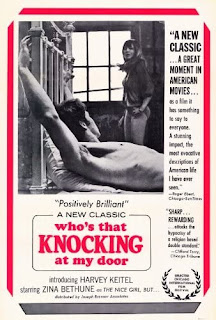
Settling the Scorsese: Who's That Knocking at My Door

This is the first in my 2022 bi-monthly series watching the films of Martin Scorsese I have not yet seen.

The post I wrote yesterday about stars and thumbs couldn't have had a better first example of my newfound determination not to overpraise films I don't actually like that much. 

Who's That Knocking at My Door, the 1967 feature debut from Martin Scorsese -- and the debut feature of this series, Settling the Scorsese -- has all the hallmarks of a film I have tended to give too much credit in the past:

1. It represents the early work of a great director.

2. It showcases all the thematic preoccupations that would come to define that director.

3. It's done in an artful, some might say arthouse, style, that isn't instantly accessible.

4. It's in black and white.

(I should clarify. I have no problem with black and white -- in fact, I love it -- but a black and white film long past the era when that was the dominant means of presentation carries with it a different sort of meaning. It tends to signal that you must honor the artistic pretentions, some might say pretentiousness, of the artist.)

5. It makes bold choices with camera placement, editing, use of freeze frame, music, etc.

But did I like this film?

No, not really.

In addition to being Scorsese's debut, it's the debut of Harvey Keitel as an actor, and that's also interesting. And it's also the sort of thing that might cause me to overpraise the movie just for its historical significance.

But did I like this film?

No, not really.

The use of Keitel -- something Scorsese has gone on to do five more times -- reminded me of another director, and how much the (later) beginning of his own career resembled that of Scorsese's. That's of course Quentin Tarantino, who has worked with Keitel only three times, but certainly would consider Scorsese one of his influences, even though I haven't specifically heard him pontificate on that particular subject.

What reminded me of Tarantino about this was the way Keitel's character, J.R., is always going on about John Wayne to his girlfriend, who is nameless (a telling Scorsese detail), but who is played by Zina Bethune. His various short disquisitions about Wayne and his specific roles and films felt like something right out of a Tarantino diner scene. Like Tarantino a quarter of a century later, Scorsese was interested in paying homage to his cinematic influences, which would have included westerns (though that doesn't appear all that much in his work), not to mention the French New Wave (which is all over this film).

What didn't remind me of Tarantino was the way this movie has no effing story.

Who's That Knocking at My Door is probably what you would consider a consummate hangout movie, in that mood and character are prized over narrative. But to me it's the worst kind of hangout movie, as it is mostly a mishmash of conversations without context, and actually really not that much about character at all. If we're going to spend this much time with J.R. and the rowdy New York boys with whom he roughhouses -- who are quite clearly early versions of the characters in Mean Streets -- then it would help to feel like we were getting to know any of the other characters. But we don't even really get to know J.R., who remains fundamentally a mystery despite being in nearly every scene.

What we do know about J.R. is that he's got overdeveloped Catholic guilt, a point belabored in the tedious montage of Christian imagery that closes the film -- and belabored in Scorsese's career, one could argue. He won't sleep with his girlfriend, so instead he goes and sleeps with prostitutes and other loose women. (Not sleeping with her is to keep her unspoiled, not him.) It was all there from the start.

If I haven't given you much plot synopsis it's because there isn't much to give. It might actually have the shortest plot synopsis I've ever seen on Wikipedia, just two paragraphs and a total of 217 words. Now of course, some brand new and less significant films have shorter synopses, but this is the first film by The Great Martin Scorsese (I don't know why I capitalized that, I do really think he's great), and it's 55 years old. If there were more to the movie the plot synopsis would be longer.

There is a central plot point, which is the girl's revelation that she was raped by a former boyfriend. J.R. recoils in horror at this story but not out of sympathy for her. First he doesn't believe her, which is crazy. Secondly, he assumes she was "asking for it." Then he thinks she's spoiled now and rejects her. Nice guy. This is not the end of this topic but it might be best for me to leave some of the movie unspoiled. Can't keep the girl from being unspoiled, but can keep the movie that way.

Throughout there are interesting techniques and brazen choices, circling cameras and popular music, some of an ironic nature. Thelma Schoonmaker was with him from the start and some of the editing choices are very interesting, especially during a montage of sex and nudity when J.R. goes off the deep end at one point. There's also use of freeze frame as previously mentioned.

But the most telling part of my assessment of the film is the way it brought to mind another director whose early films bothered me. That's Jim Jarmusch, who had to get a couple misfires out of his way before he start hitting with Down by Law in 1986 and really started hitting with Mystery Train in 1989. The one I really hate is Stranger Than Paradise, which I know operates as a gateway independent film for a lot of people. I loathed it and this reminded me of it in certain parts, though I like this better. 

Look, it is interesting to witness the origins of the man who has come to be considered one of the greatest directors in cinema history. But I actually don't know if the presence of many of his career-long obsessions in this first film is actually a positive or a negative. Although he would certainly branch out in subject matter over time, I'm worried that many of these early films will just be hitting the same notes over and over again, and I've got a few left to get through in this series.

We'll see how I go in April, when a film that sounds similar in subject matter by its name alone -- 1977's New York, New York -- is next up. If I can find it, that is, as this has been a problem so far. If I can't, I guess I move on to The Color of Money in '86 and figure out later on what I do about the total number of films in this series ... or maybe circle back to it later if I can get myself more comfortable with the idea of piracy. (And if I can do that, might as well do it now and keep the chronological order for April.)

Oh, and did I give Who's That Knocking at My Door the 2.5 stars I said I'd give such a film in yesterday's post?

No, I did that one better. Only two stars. 

It's a true assessment of my boredom and disappointment watching a film that felt a lot longer than its 89 minutes would suggest. 

Wednesday, January 12, 2022

Settling the Scorsese in 2022

For the first time ever in 2021, I did two intertwined bi-monthly series -- I'm Thinking of Kaufman Things and All's Well That Ends Welles -- the former running every other month starting in January, the latter every other month starting in February. Although this sounds funny to say about six additional movies over the course of a whole year, it was too much. I decided I needed at least every other month off from a specific obligation to this blog, even if it was a self-imposed obligation.

But one of the two formats for my 2021 bi-monthly series was something I really enjoyed and want to continue in 2022, starting in February, even if it was a bit misconceived from the start. (Credit where credit is due, though: It was actually a format I first did in 2019 with Spike Lee.)

In All's Well That Ends Welles, I wanted to use the six bi-monthly slots to finish the films Orson Welles directed that I hadn't seen. Unfortunately, that wasn't six films, but eight -- and that's not including some stuff that I decided didn't quite qualify as a directorial feature. So I had to double up in two different months, and I still don't know, given the wonky career he had, whether I can rightly say I've watched every "film" where Welles was the primary creative force.

Things will be a lot cleaner in 2022 when I shift focus to Martin Scorsese, leading up to the release of his new film, Killers of the Flower Moon, currently planned for late 2022.

There are, indeed, exactly six films Scorsese has directed that I have not yet seen, though none from the past 25 years. Chronologically, they are as follows:

Who's That Knocking at My Door? (1967)
New York, New York (1977)
The Color of Money (1986)
New York Stories (1989)
The Age of Innocence (1993)
Kundun (1997)

The fact of having exactly six titles pleases me -- even though Scorsese directed only one third of New York Stories -- but that doesn't mean there aren't challenges ahead in this series. Or at least one challenge, which was that at the time I originally checked a few months back, I could not find a good way to see New York, New York. Given that it is a Scorsese film, I have to imagine a method will be revealed to me that does not involve piracy, but for now I don't know what that method is. As currently scheduled, I've got until April to figure that out.

And if for some reason I can't find it -- thereby fatally undermining the inspiration for the series -- at least I can slot in Killers of the Flower Moon as the last movie, if the timing works out for that.

Some other notes on the films on the docket:

I have not seen The Hustler, so I should probably watch that before I get to The Color of Money in June.

I can't believe I haven't yet watched The Age of Innocence, as I listened to Edith Wharton's novel on audio book a full ten years ago and loved it. 

Killers of the Flower Moon was not actually part of the inspiration for this series. I don't know all that much about it, except that it involves Native American subject matter. It was more of a retroactive justification for the series that created a bit more news worthiness.

To be honest, the way I settled on Scorsese -- so to speak -- was that I tried to think of another great director whose filmography might require only a few more viewings from me to complete, and Scorsese jumps to mind in any conversation that starts with brainstorming great directors.

The clincher? I knew that Settling the Scorsese would make a great name for the series.

So indeed, I will start settling the score with Marty in February with Who's That Knocking at My Door?, another movie I know almost nothing about.