Showing posts with label synedoche new york. Show all posts

Wednesday, September 29, 2021

I'm Thinking of Kaufman Things: Synecdoche, New York

This is my penultimate edition of a 2021 bi-monthly series revisiting the films of Charlie Kaufman.

In the previous four instances of this series, I spent a lot of time talking about the ways the movie(s) I watched that month related to other movies written or directed by Charlie Kaufman.

This month, when taking notes, I found myself just writing down a lot of snippets of rich and meaningful dialogue. That's certainly an equally valid way of "thinking" about Kaufman.

I'll still do a little talking about how this film fits into Kaufman's body of work, but I may not concentrate on a bunch of superficial (yet still interesting) similarities between Synecdoche, New York and other Kaufman films. You could easily argue that Kaufman reveals himself most in the superficial details, but you could just as easily argue that nothing in a Kaufman movie is accurately described as "superficial," since he has clearly done so much thinking about every minute piece of the puzzle. 

The film it reminds me of most is, it probably goes without saying, Adaptation. Kaufman was literally a character in that film, and Caden Cotard, the main character in this film (played by the late great Philip Seymour Hoffman), is the character most clearly a direct analogue for Kaufman among his rich collection of characters. But the similarity presents itself most in a phenomenon I described in the opening sentence of my review of Adaptation for AllMovie nearly 20 years ago:

"Critics charged with the divine headache of describing Adaptation, in all its twisted magnificence, should find it appropriate that the story concentrates on the paralysis of writer's block, brought on by the impossible urge to say everything."

Synecdoche, New York is chock full of that impossible urge, and it is a divine headache indeed. If a 300-word review of Adaptation was insufficient to tackle its many complexities -- that was the word length I was writing back then, for the princely sum of $20 a pop -- then I have no idea what I would have done with a similar length allotment for Synecdoche. Fortunately, I didn't see that movie until after I stopped writing for AllMovie.

In fact, it was only just after I stopped writing -- like, one week later. That wasn't in 2008 when Synecdoche came out though. To give you some indication how different my movie viewing was back then, I didn't see this movie until Thanksgiving of 2011, November 21st to be exact. Only one week earlier, I had watched Sorry, Thanks, the last movie I ever reviewed for AllMovie. (I didn't stop out of choice; they changed their financial model to stop using freelancers.) 

The timing of my first viewing of Synecdoche, New York is interesting for a couple reasons. For one, it is absolutely unimaginable to me that I could have let three years elapse before getting around to watching it. Not with Adaptation and Eternal Sunshine of the Spotless Mind both having claimed my #1 spot for their respective years. I lose that much trust in Kaufman just one film later, just because I don't really like how the trailer looks and some people say they didn't get it? What a fool I was.

But then there was the timing of what was going on in my life, and this is something that is only just occurring to me now. When I wrote that review of Sorry, Thanks, that was my last paying review gig -- to date. Six weeks from now, that will be ten years ago. Sure, I say I get paid, in a manner of speaking, for the reviews I currently write because I have a critics card that gets me into screenings for free ... when there isn't a pandemic on, anyway. But actually receiving direct compensation for the work that I consider my passion? Hasn't happened in ten years.

And I'm pretty sure I had that existential pit in my stomach when I watched Synecdoche just a week after filing my last review for AllMovie. I surely knew that the film criticism industry was changing, and that the chances of me getting paying work as a critic again were slim to none. So a movie that does a deep dive into the idea of your life passing you by, of measuring your accomplishments and the accomplishments you are still likely to make in the future, would have resonated with me quite a bit at the time. Even if I didn't consciously realize it until now.

But Synedoche, New York is about so much more than that. It might take me 10,000 words to talk about the things it's about. But hopefully you've already seen it, so you already know. 

So instead of doing the rigorous comparisons between movies to isolate similar themes -- you know, what's been the bread and butter of this series -- I'm just going to finish with the string of quotes/exchanges that I jotted down from Synecdoche, which in and of themselves reminded me of Kaufman's entire body of work. Even those that might require explanation, I will just leave to you to sort through. 

Forthwith:

"It's been a year."
"It's been a week!"

"The murky, cowardly depths of my fucked up being."

"It's about everything. Dating, birth, death, life, family. All of that."

"I'm fun."
"Oh sweetie no you're not."

"You wish you were a girl?"
"I think I would have been better at it."
"It's a drag in a lot of ways."

"I'm aching for it to be over. The end is built into the beginning."

"There are a million little strings attached to every choice you make. You destroy your life every time you choose. But you may not know it for 20 years. And you may not ever trace it to its source. And you only get once chance to play it out."

"No one wants to hear about my misery, because they have their own."

"Everyone is disappointing, the more you know someone."

"This is everyone's experience, the details hardly matter. You are everyone."

"As you learn there is no one watching, and there never was."

"I know how to do the play now."

That's pretty much the last thing Caden says in the movie, though it's at least the third time he's said it. He's got his head on the shoulder of the actress who plays the mother in the dream of Ellen the cleaning woman, who as far as I can tell is a character Caden never even met. He either heard of her or just made her up. That's how deep the rabbit hole goes. 

After that, Dianne Wiest, the director in his earpiece, gives him a final stage direction that I only properly understood on this third viewing:

"Die."

Caden complies.

This series will die, so to speak, after one more installment in November, when I watch Anomalisa for only the second time.

Friday, October 9, 2020

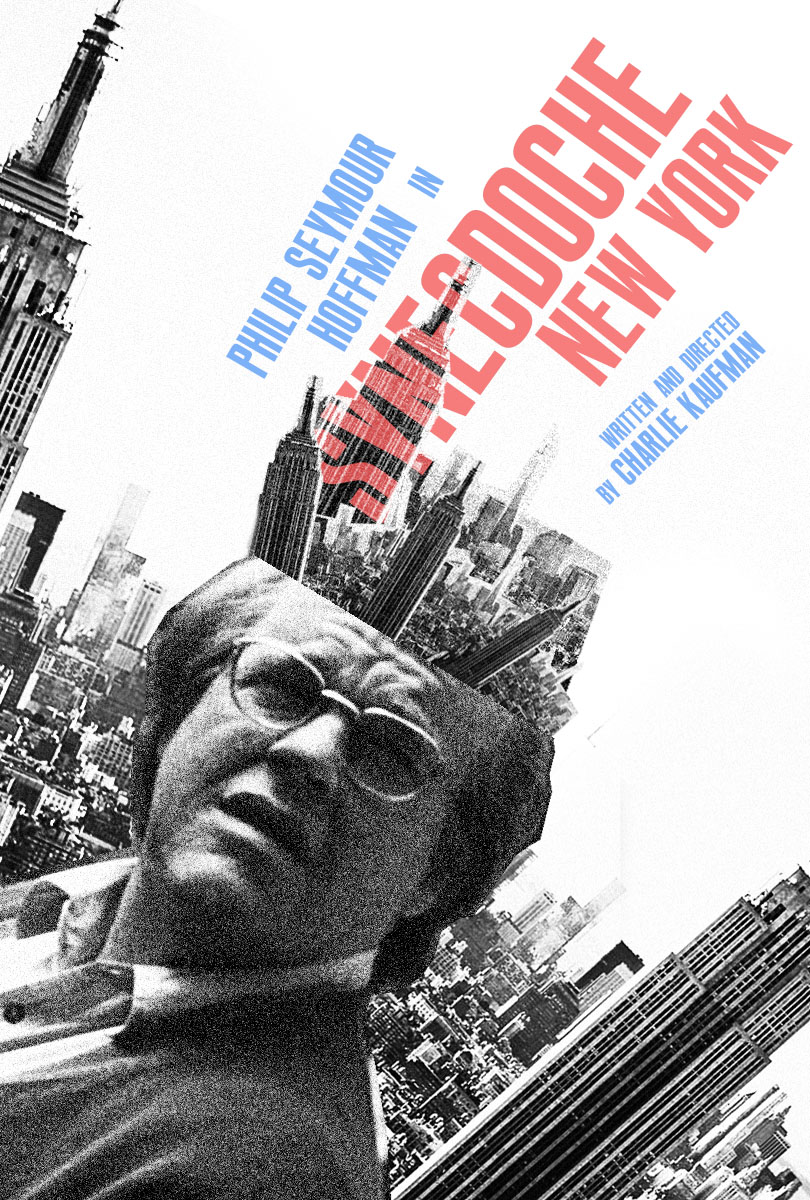
Syn not Skin

While making my way through podcasts discussing Charlie Kaufman's I'm Thinking of Ending Things -- four already so far, with one left to go -- I'm becoming increasingly aware of a weird phenomenon.

In setting up Kaufman's career to date, there has been occasion, on nearly every podcast, for the podcasters to list some of his other greatest hits, including his 2008 directorial debut, Synedoche, New York.

Now, I lived in New York City for nearly three years in the late 1990s-early 2000s, and was always an east coaster before that, so I knew right away that the film's title was a play on words that invoked the city of Schenectady, New York. 

If you didn't live in New York, and in fact let's say you lived in Paris or Munich or Tokyo, you might have no idea about the existence of a city named Schenectady, New York. So you would endeavor to pronounce the film's title phonetically, as is actually how it is pronounced: "Sin-eck-doh-key." 

But there has been a small (?) subsection of critics who do know about the city and are also not very skilled at pronouncing multi-syllabic words. They have persisted in calling the film "Schenectady, New York," almost as though Kaufman misspelled it but intended us to pronounce it exactly like the city. (Or "Skin"-ectady, as I suggested in the title of this post, as it's really more of an I than an E sound.) 

For the record, that pronunciation is "Skin-eck-ti-dee." So, only the second syllable is actually the same. 

I have heard this wrong pronunciation from the mouths of two such critics on the podcasts so far, neither of whom seem like people who should have problems with multiple syllables. 

It's just really not how it's pronounced. Yet they were dogged in their pronunciation, even when others on the podcast had occasion to say the word and pronounced it "Sin-eck-doh-key."

I had a bit of a crisis about this because I was asked to pronounce for a friend, who runs one of these podcasts himself. He had no idea how to pronounce it, so he came to me. I told him.

And then I heard these two other podcasters go against me.

So I listened to pronunciations on YouTube, which seemed to support my pronuncation, and then I listened to a couple interviews with Charlie Kaufman, where I was hoping he would say the title but he didn't. However, from those interviews, I gleaned that just as Kaufman would not want to begrudge anyone their interpretation of his films -- and doesn't provide his own so as not to infringe on those -- he would probably invite multiple pronunciations of the title as well.

The thing that finally confirmed for me was a bit online that said that there was an entire page in the press materials when the movie was released that was devoted to the pronunciation of the title. And in that bit it lists this pronunciation as "[Sih-NECK-doh-kee]," which varies from mine only in a few typographical choices in how to depict the syllables, and by including which syllable to emphasis. (For the record, I emphasize the same syllable). 

So what explains those two podcasters and their stubbornness about mispronouncing the title that is by no means unique to them?

Who knows. Maybe they are just free spirits who refuse to be pinned down to a single perspective on a piece of art, something Kaufman would certainly endorse.

Oh yeah, one final thing I'll leave you with. It's one of many in a series by the YouTube channel PronunciationManual, and it's hilarious.

Saturday, November 26, 2011

The uncontrollable slippage of time


Warning - this post contains major spoilers about several films. Proceed with caution.

Given the creative talent behind it, it's hard for me to believe it took me three years to finally watch Synecdoche, New York.

I simply love the work of Charlie Kaufman. Two movies he wrote were my favorite movies of the years they were released -- Adaptation in 2002, Eternal Sunshine of the Spotless Mind in 2004. Being John Malkovich was also in my top ten of its year, and although I didn't see it in time to rank it for the year it was released, I even liked Human Nature pretty well.

But Kaufman's directorial debut was bad-mouthed by enough people that I just didn't prioritize seeing it. I'd heard it was ponderous, and I didn't necessarily like the footage I'd seen, nor what I knew about the plot. If it weren't for how ponderous I heard it was, though, I surely would have seen it. In essence, I allowed other people to turn me against a man whose entire body of work had spoken to me. Maybe I just wasn't in a ponderous place at that time in my life.

I don't know what came along in the last two weeks that finally changed my mind -- I'm not feeling particularly ponderous now, either -- but I impulsively promoted Synecdoche, New York to the top of my Netflix queue. I guess I imagined it might be fun to watch over Thanksgiving. I quickly learned that my wife was still carrying the same prejudices against Synecdoche that I'd carried, so it was pretty clear I'd be watching it by myself. Which I did on Sunday night after she went to bed.

Oh man. Simply put, I loved this film. It started a bit slow for me, but once it got going, it was bursting with just as many ideas as his previous films. I'm not going to say it was better than Adaptation or Eternal Sunshine, which are both in my top 100 films of all time. But there's a good chance I like it better than Malkovich, which I have not revisited since I saw it in the theater.

I'm not going to go into too many of the particulars of Synecdoche right now, or try to explicate the many fruitful ideas about the creative process, introspection, fear, intimacy, alienation, artistic paralysis and mortality that get bandied about in this movie. However, I do want to talk a little bit about what I've identified in the subject of this post as "the uncontrollable slippage of time."

See, the main thrust of Synecdoche is a playwright (Philip Seymour Hoffman) using his genius grant to write and execute a massive play about his life. His goal is to make a brutally honest piece of art, but in doing that, he loses his filter about what to include and what not to include. The project becomes so big that the set grows to the size of several football fields, actors are rehearsing numerous scenes simultaneously (with no audience anywhere in sight), and the playwright regularly writes scenes based on things that happened in his real life only hours beforehand. It's a clear metaphor for Kaufman's renowned affliction of wanting to cram his entire experience of the world into his work, which was a main theme in Adaptation.

So what ends up happening is that he works on this project for decades, as the lives of he and everyone involved become hopelessly intertwined, and eventually, nothing exists for him (and even them) except this play. What I found fascinating was how Kaufman portrays the passage of time. The characters don't just get older -- they get older in fits and starts, without any of the cues filmmakers typically use to indicate time passing. Hoffman's Caden Cotard struggles with his own skewed perception of time quite prominently, especially when it relates to his estranged daughter, who moved to Germany with his ex-wife (Kaufman regular Catherine Keener). When learning that she has become an exotic dancer whose body is covered with tattoos of flowers, Caden screams "But she's only four years old!" Later, on her death bed, she has become so estranged from him that they literally do not understand each other. They have to wear headsets to communicate, as his headset translates her words from German to English and hers translates his from English to German. This from a girl who had developed a full vocabulary in English before moving to Germany, and has American parents. Clearly, that's not "realistic" -- it's just a metaphor for their estrangement. But it's quite an effective one.

Numerous passages in this film show the march of time as an element Caden can't control. The movie makes evident that Caden was "supposed to" end up with Hazel (Samantha Morton), who seems to be his soul mate. In fact, so clearly were they intended for each other that Hazel ends up getting involved with the actor who plays Caden in the play, and Caden ends up getting involved with the actress who plays Hazel. Yet their relationship is defined by botching these key moments, these opportunities, and then watching helplessly as time hurries them away into other entanglements that keep them separated.

All of this is underscored by the fact that it's becoming the actual future, making everything seem a bit more alien and spartan, mirroring the character's inner life. Not only are there those headsets that serve as translators for Caden and his daughter, but the sky starts to fill with dirigibles -- as though dirigibles are going to be the favored method of transportation of the 2020s and 2030s. (Interestingly, the TV show Fringe offers the same prevalence of blimps in its alternate version of Earth.)

I found the ending of Synecdoche to be chilling. Caden is an old man, and the set is finally empty of people. All these characters in his life have died or disappeared, leaving only an empty set and one actress who came on board late in the process for a very fringe role in his life. (She plays a character from a dream experienced by a character who is, herself, imaginary. Yep, that gets at how much Caden has crawled inside himself.) In the film's final shot, he sits next to her on a bench and rests his head on her shoulder, as the last ounces of life seem to be on the verge of trickling out of him. "Okay, I've figured out how I want to do the play ..." he says as the screen fades to white.

This particular combination of elements really affected me, and made me realize how movies that deal with similar topics of lost time and regret have a special claim on me. After this long preamble, here are a couple others:

Vanilla Sky (2001, Cameron Crowe). I think there's a lot of brilliant material in Vanilla Sky, but the end was the part that really drove it home for me. When Tom Cruise's David Aames finally realizes that he's been cryogenically frozen for 150 years, and his apparent waking life has just been an extended lucid dream, it's devastating. As he's riding up in a glass elevator toward the top of a skyscraper, the future world visible in the background at too great a distance to know it's even the future, the full weight of what's happened to him sinks in -- the idea that all the events he thought were current in his life actually played themselves out a century-and-a-half ago, and everyone he knows has been dead for a century. There's something about that moment I find exquisitely melancholic.

Click (2006, Frank Coraci). I discussed this a little bit in my Double Jeopardy series in the summer of 2010, when I revisited films that I thought I might have liked too much. If you think Click is just a regular old lowest common denominator Adam Sandler movie, think again. The remote control that takes over Michael Newman's life makes literal this idea of "the uncontrollable slippage of time." Early on, Michael figures out the remote control that allows him to pause and fast-forward his life will also save his preferences (against his will) and apply them automatically. So when Michael wants to fast-forward through the mundane elements of life to get to his next promotion -- which he expects to be just a couple months off -- he actually loses years of his life when the promotion doesn't come as soon as he expected. And then again when other saved fast-forwarding scenarios arise. Before long Michael is an old man at the wedding of his grown son, having lost his wife (Kate Beckinsale) to divorce at some time between then and now -- a time Michael can't remember because he never mentally experienced those moments, living through them unconsciously as an emotionally disengaged automaton. These future scenes all take place in the 2020s or 2030s, just as in Synecdoche, lending an additional sense of sadness and loss to them.

Bicentennial Man (1999, Chris Columbus). If you thought I was crazy when I just waxed poetic about an Adam Sandler vehicle, you might think me more so when discussing a Chris Columbus movie that was Robin Williams' follow-up to the much-reviled Patch Adams (and aims similarly at a viewer's soft and squishy parts). Well, let me relieve you a little bit by telling you that I don't think Bicentennial Man is a great movie. However, it sticks with me more than it should because of how the robot servant named Andrew, played by Williams, tries over the course of two centuries to become a real human being. He is the property of one family during this time, handed down from generation to generation, as young children become old men and die, and the future steadily becomes more futuristic around them. Something about Andrew's status as a robot -- essentially immortal as long as he is maintained -- makes the issues of the perception of the passage of time more interesting. For example, how does a robot mark time, if he cannot think or feel precisely as a human does? I suppose, now that I think about it, that A.I.: Artificial Intelligence shares a lot of common story elements with Bicentennial Man -- in fact, when Haley Joel Osment's robot sinks to the bottom of the ocean, I seem to remember him being down there for decades if not centuries. But I actually sort of don't like A.I., so I'm not going to include it here.

You know, when I first had the idea to write about this, I thought I'd be including a) more titles, and b) more titles that I truly love. I've listed these movies in the order that I like them, and by the time you get to Bicentennial Man, it's only a mild and hesitant thumbs up. I'm sure there are a half-dozen other movies that fit this bill that I'm just not thinking of, where a character or characters age into a future world, without being able to stop their progression toward the inevitable long enough to prevent themselves from making life-altering mistakes. They are at the tip of my tongue, but will come no further.

Oh well. You probably don't need a thousand more words from me today anyway. You are either shopping for deals or recovering from yesterday's over-indulgence, and just because I'm at work having a really slow day, it doesn't mean you are. (But if you think of any obvious ones that fit the theme that I missed, I'd love to hear about them in my comments section.)

Today at least, spend your precious time on something other than my blog, before it slips away and is gone forever ...