Tuesday, January 17, 2012

John Carter had me at "hello," lost me at "how are you?"


When I hunger for new cinematic visions that seem to represent a clear departure from things I've seen previously, John Carter is the kind of movie I think of.

Or so I thought from the first trailer, anyway.

Here's that first trailer:


Of course, everything that was minimalist, ominous and visionary about this first trailer felt pedestrian in the trailer I saw last week, before either Tintin or War Horse.

Here's that trailer:


Now I think it just seems like any other gladiator movie, any other ripoff of Star Wars, with one shot that seems like a ripoff of Avatar (which itself was a ripoff of oh-so-many things).

So I don't know where I stand with respect to John Carter. Am I excited to see it? Watching that first trailer again just now, I felt so. Watching the second trailer again reminded me that I might not be.

I think it gets at the difference between a teaser (which, even at 1:45, the first trailer essentially is) and a trailer (which tells you more of what the movie is essentially about). And so that explains the title of this post, which you thought was just a clever riff on the oh-so-current cultural reference, Jerry Maguire.

See, the teaser is kind of a "hello." It says "Hi, I'm a thing. You may or may not have known I was a thing, but this footage is designed to give you that knowledge and get you a little excited." A teaser is great, because it leaves open the possibility that the movie could go in so many different directions from what you're seeing. How skillful, for example, to give us the detail that this man started in 19th century England before ending up on Mars. That bit of information is meant to give you the Keanu "Whoa" reaction.

However, once the full trailer is revealed, it can no longer hide what it's about. That's the "how are you" -- literally, how is the movie. How do those images we've seen coalesce into a story.

And that's where John Carter appears to trip. Clearly, Disney thought its best bet to get a big audience on the first weekend (still almost two months off) would be to highlight the movie's action. You'll notice that 19th century London makes no appearance whatsoever in the second trailer -- that only confuses people who came for an action movie.

But what we're left with is a bunch of lame Star Wars prequel stuff, including gladiator footage that seems to be right out of Attack of the Clones (that was the movie where they fought in an arena while chained up, right?). Then there's a bit of warmed-over Braveheart ("He will fight for us!") or any of the countless movies that involve a rallying speech to an underdog army.

I guess I'm giving away the change in my excitement level by the poster I chose to accompany this post. If I'd still been in giddy-teaser-phase, I might have led with this poster, which is even listed as the "teaser poster" in the file name (I hadn't consciously realized there was such a thing, but it makes as much marketing sense as a teaser trailer):


Oh, how I long for those days when John Carter could still have been about anything.

John Carter seemed to have the cross-genre potential of a movie like Cowboys & Aliens, where elements of our past and elements of a science fiction future fit together naturally in a way that both expands and blows our mind.

Oops, except Cowboys & Aliens didn't pull that off, either.

Here's hoping John Carter pulls it off better than Cowboys & Aliens. If it doesn't, not only will it fail to be the first awesome movie of 2012, but it may not even be worth watching on video.

Saturday, January 14, 2012

The King is Staying Alive


There's a video store near my house called Movies & More. Maybe the "more" is what's keeping it afloat, since most walk-in video stores are having a really hard time these days.

I've never been inside, but I walk by it when I go grocery shopping at the supermarket nearest my house.

In the front window there are six posters. Four flank the door, two on each side, and two are above door level, one each above the two pairs of lower posters.

Four of those posters you would expect. Two have no business being there whatsoever.

The four lower posters, right now, are Abuction, Conan the Barbarian, Final Destination 5 and Dolpin Tale. All movies that hit theaters in August or September, all movies that must have hit video in the past week or two. All movies you would expect to see there.

The two upper posters?

The King and Stay Alive.

The King was released in U.S. theaters on May 5, 2005. Stay Alive was released in U.S. theaters on March 24, 2006.

Huh?

They say that the video store is a relic of yesteryear, but this is ridiculous.

The King is a title I vaguely remember. It probably caught my attention because it stars Gael Garcia Bernal. I now discover it was also directed by James Marsh, who has since gained a reputation as a successful documentarian (Man on Wire, Project Nim).

Stay Alive I remember as an anonymous slasher movie.

What in God's name either of these posters is still doing in the window of a video store is beyond me.

Why is Stay Alive still stayin' alive? Why is The King still king?

The only possible explanations I can imagine are:

1) The creative teams involved in these films have a personal relationship with the store's owners.

2) Being the two upper posters, they are somehow too difficult to reach.

The really funny thing to me is, it could be a case of false advertising. One of the knocks against brick-and-mortar video stores is that they have a finite amount of shelf space. As such, they must make decisions about what to stock and what not to stock based on potential profit. I remember one of my complaints about Blockbuster in the dwindling days of its dominance is that it stopped stocking even some titles that I thought would be slam dunks -- the specific example I wrote about at the time was The Full Monty. The explanation I got? "If it doesn't rent once in a year's time, we stop stocking it."

This may not be such an issue for the mom-and-pops, who don't have to devote an entire wall to copies of Transformers 3 when it comes out on video. But let's say they do follow the same guidelines. How many times could The King and Stay Alive possibly get rented in a year? Well, maybe more than otherwise since the damn posters are still up. But even then, it can't be much. What if I walked into that store and couldn't actually get either of those movies?

But as I said, I've never walked into that store. I probably should support the neighborhood video store, just because video stores are an institution I would not like to see vanish from the face of the earth. And by sticking with the giants (Netflix, Redbox), I am surely contributing to their demise.

What a shame that the most compelling reason for me to go inside that store is to scream:

"WHY THE HELL DO YOU HAVE POSTERS FOR TWO RANDOM MOVIES THAT ARE FIVE YEARS OLD IN YOUR WINDOW?"

It's Friday the 13th ...


... so where's my crappy horror movie?

The Devil Inside couldn't have waited one more week to come out?

Friday, January 13, 2012

Steven Spielberg Today: A Portrait in One Evening


Which is a fancy way of saying: I did actually manage to complete the Steven Spielberg double feature last night.

It's my second straight year with a themed double feature at the end of the year. (Yes, I know it's January -- we're talking about "end of the year" in terms of the previous year's films.) While last year I attended a Jeff Bridges double feature -- Tron: Legacy and True Grit -- in the week between Christmas and New Year's, this year I managed two Spielberg films -- The Adventures of Tintin and War Horse, though I should hardly need to name them -- a couple weeks later. (Both at the same theater, Pacific Theaters in downtown Culver City, where the staff is so skeletal that you buy your ticket at the snack bar and no one even rips it as you walk back to the screening rooms. After that, you're free to sneak in to a second movie without any fears of discovery.)

And naturally, I thought of a lot of different things to talk about. In fact, I've got four subheadings: One about the general experience, one about Tintin, one about War Horse, and one about both.

So let's get right to them:

Candy stimulation

If I were going to watch the 146-minute War Horse starting at 9:30 p.m., I knew I needed to come stocked with candy to stimulate me back into consciousness. I'm not as young as I used to be, and I get up a little after 6 every morning.

Last night's haul: A big resealable bag of Reese's Pieces, a box of Hot Tamales candy, a bag of sour gummy worms, a Cadbury Peanut Butter Egg and two small Redbulls. (Don't worry, I didn't finish it all.)

But last night's foods were chosen not for any preference I have toward them -- they were chosen merely for their potential efficacy. And in some cases they were testing a philosophy of what foods had a better chance to keep me awake when everything in my body said "sleep."

Let's start with the Red Bulls. This is actually my third time bringing Red Bulls with me to the theater in the last couple weeks. I started two weeks ago with The Girl With the Dragon Tattoo, and continued last week when I took in the double feature of Tinker Tailor Soldier Spy and Carnage.

To be clear, I'm not a Red Bull guy. I definitely had a period in my life when I thought Red Bulls were sort of cool, and I sort of liked drinking them. But they were never a natural fit for me, and it's debatable how much they actually do to keep me awake. I've been bringing them to the movies because the theory is solid, but after three trips to the theater with Red Bulls in jacket pockets (and jacket bunched up in my arms as I enter the theater), the jury is still out. I will say that I haven't more than nodded off in any of those movies, but I can't be sure the Red Bulls were responsible. However, when I brought two cans the last two times, each time I drank only one -- which means either that it worked so well that I didn't need a second, or that I didn't think a second would accomplish anything that the first hadn't been able to accomplish.

Now, the candy. The Reese's Pieces are a good energy crutch because there are a lot of them, and you can eat them regularly like you'd eat popcorn. (Plus, I really like them, and plus, they make an appropriate accompaniment to a Steven Spielberg movie.) Chocolate is supposed to stimulate you plenty. The problem is that I opened them too soon in the grand scheme of the evening. I didn't want to save all my food until the second movie, so I chose the Reese's Pieces to eat during Tintin. I hadn't intended to eat them all, but I have a hard time saving my concessions once they're open. A popcorn never lasts longer than the first 15 minutes. And I apparently hadn't learned my lesson from eating my Reese's too fast in a 9:50 showing of We Bought a Zoo just before Christmas, then fighting sleep for most of the movie.

So that left me with only non-chocolate candy stimulants for War Horse. Except, of course, that peanut butter egg, as my emergency "nuclear option."

The Hot Tamales and the sour gummy worms were both tests, as neither of them were things I'd normally pick out from a concession stand. (Gummy worms, maybe; Hot Tamales, no.) I figured the bursts of sour and cinnamon would be just what I needed to get my endorphins pumping a little bit, send some energy out to my extremities. I had to hope they would work at least as well as the chocolate, because I knew there was a chance the Reese's Pieces would be gone by the end of Tintin. (The philosophy was that they'd operate in a similar fashion to my Altoids, which I always have with me, and which serve as an emergency final option if all else fails and if I need some repetitive eating just to keep me awake. They're marketed as "curiously strong," so each has the ability to give me a little kick in the head.)

The cinnamon bursts did the trick. In fact, I didn't even finish the box and never opened the gummy worms, in part because a whole bag of Reese's Pieces and 2/3 of a big box of Hot Tamales leaves you feeling pretty oogey. But I did indeed feel like each one lit a little flame in my palate, temporarily warming my skull and keeping my eyes wide open.

The nuclear egg option was not needed.

Andy Serkis as a ... human?

It's been a good ten years for Andy Serkis. An actor capable of getting only bit parts in live action, Serkis has turned himself into the very face of motion capture technology, starting in 2002 as Gollum in two Lord of the Rings movies, then continuing on to King Kong in 2005 before again garnering awards buzz as another primate, Cesar, in last year's Rise of the Planet of the Apes.

And so it's funny to see him just playing ... human.

That's what he does in Tintin, playing Captain Haddock, who functions as the title character's boozy sidekick. He gives a good performance as usual, but it was his first motion capture role that made me ask ... why Serkis?

The captain doesn't look at all like Serkis really looks, but that's hardly an issue -- of his previous "mocap" roles, only Gollum is actually based on his own physical traits. Serkis is lauded for both his exceptional vocal work and his uncanny understanding of how to move his body. However, neither of these seem to be put to maximum use in Tintin, either. His Scottish brogue could have just as easily been done by Gerard Butler; in fact, I even checked the credits afterward to see if it was Butler, before remembering that duh, of course it was Serkis. And I don't necessarily see what special body movements he's bringing to Haddock, since all the other actors (most prominently Jamie Bell and Daniel Craig) are playing humans as well and doing the body movements just fine.

Good job, Vance -- the first time you write about the great Andy Serkis on your blog, you're dumping on him.

That's not it, actually -- I do think he's great. I guess my point is, not every motion capture role can be a role that needs an Andy Serkis.

Then again, even if you don't need an Andy Serkis, why not hire Andy Serkis? At least you know he doesn't command the same salary as some of the bigger stars, and there's got to be some benefit to the fact that he's used to having those little ping pong balls attached to his body.

And oh yeah, you know he'll give a great performance every time out.

I don't understand movie bidders

There are any number of scenes in War Horse that are supposed to remind you of scenes you've seen in other movies -- in fact, War Horse is as much an exercise in homage as it is its own entity.

The ones I found most frustrating, however, were the two different scenes devoted to people trying to outbid each other at auction for an item that holds great value to them -- in this case, the titular horse.

How many movies do I have to see where the two bidders are wincing over each higher bid as the crowd gasps behind them, unable to be sure if they can afford the price they're paying -- and then one of them submits a bid that is, like, three times the amount of the previous bid?

I guess it's the only surefire way to make a movie bidding war dramatically interesting. I mean, otherwise you're left with the winner having been the guy who outlasted the other, who kept submitting higher bids in the smallest possible increments until the other guy decided he'd reached his limit. After all, this is how every single bidding process in the real world goes down.

But in a movie, nothing could be less interesting. Which is why the first bidding war goes in increments like this:

"One guinea!"
"Two!"
"Three!"
"Five!"
"Six!"
"Eight!"
"Ten!"
"Eleven!"
"Twenty-five!"
(Crowd gasp.)
"Thirty guineas!"
(Another crowd gasp.)

Sold.

Couldn't these two men have worn each other out in the late teens? Maybe. But I guess it would have been boring.

So then (spoiler alert) the horse is for sale again later in the movie. This time, the ridiculous topper bid is 100 guineas. (The previous bid had been 25). Major crowd gasp there. Not only that, but the winning bidder tells everyone that he'd sell the jacket off his back to bid higher, then sell his entire farm to go to 1,000 if need be.

Ah, movies. So much suspension of disbelief required.

Two different Spielbergs have much in common

On the one hand, people are saying that The Adventures of Tintin and War Horse showcase two different versions of Steven Spielberg -- the old-fashioned director unashamed to make an homage to old-fashioned filmmaking (War Horse), and the technologically innovate director ready and eager to embrace the latest techniques (Tintin). (Funny, I feel like we were just having this discussion about Marty Scorsese.)

But seeing these movies back to back made me realize how much they have in common, in really funny ways. Forthwith:

1) Both movies prominently feature a drunkard who's trying to quit drinking. (Or at least theoretically wants to.)

2) Both movies include references to unicorns.

3) Both movies feature an incredibly heroic animal capable of incredibly improbable feats. (Not sure how they got the horse to do some of the things he did in War Horse.)

4) Both movies clearly hearken back to earlier points in Spielberg's career. (Numerous scenes in Tintin seem right out of an Indiana Jones movie, while I suspect Jeremy Irvine was cast as the lead in War Horse because he is a dead ringer for E.T.'s Henry Thomas.)

5) Both movies include a bidding war for a desired object (a model ship in Tintin) that eventually comes down to a "name your price" scenario.

6) Both movies feature a large amount of gun violence with little actual blood, keeping them family friendly. (Hilariously, in Tin Tin, a man gets machine-gunned down at a door, but doesn't have a single entry or exit wound when he falls through the doorway.)

7) The animals in the movies are named Joey and Snowy.

8) Both movies are largely unable to develop their human characters beyond the level of archetype.

9) Both movies were released in December of 2011. (Okay, I'm running out of legitimate comparisons so I guess I'll stop there.)

So?

Tintin = Innovative storytelling and visuals, no soul
War Horse = Plenty of soul, even more cheesiness

Thursday, January 12, 2012

Released at the discretion of Netflix?


Yesterday I received the movie Higher Ground in the mail from Netflix.

The funny thing is, that was the first day of its official availability.

Which means the movie actually got shipped out on January 9th, a day before it was officially available.

Now, I know that Netflix doesn't rip open a box of new movies every Tuesday. I'm sure they've had them in stock for plenty of time, and Tuesday is the day they are allowed to unleash them on the world -- Tuesday being the traditional release date for new DVDs and BluRays.

But I found it kind of funny that they were allowed to/inclined to jump the official release date by one day on shipping, meaning I'd theoretically be able to enjoy it on the actual first day of its release. I guess that makes a certain sense -- if I had been picking it up from Blockbuster or another movie rental business with physical locations, I'd have been able to see it yesterday. But it still struck me as getting some kind of extra benefit from Netflix, which was nice to see.

That's all.

Wednesday, January 11, 2012

The dumbing down of Arclight Cinemas


Tomorrow night I'm scheduled to catch one of my final true theatrical priorities among 2011 movies: The Adventures of Tintin. In fact, I'm even thinking of making it an (illegal) Steven Spielberg double feature, following up the 7:30 Tintin with a 9:30 War Horse -- even though it's asking for trouble to start a 146-minute movie at 9:30 p.m.

A friend gave me a $20 gift card to Arclight Cinemas for Christmas, so I was originally going to use this to visit the nearby Arclight location known as "Arclight Beach Cities" in Manhattan Beach. In fact, I may still, but I think the times work out better at the theater mentioned above (in downtown Culver City).

Scanning the movie options at Arclight Beach Cities, however, I came to a rather disappointing realization:

Arclight isn't arthouse anymore.

And in fact, the "arthouse multiplex" -- a concept that only a big city like Los Angeles can support -- may no longer be supportable after all.

Before we go any further, I should tell you all a little bit about Arclight Cinemas.

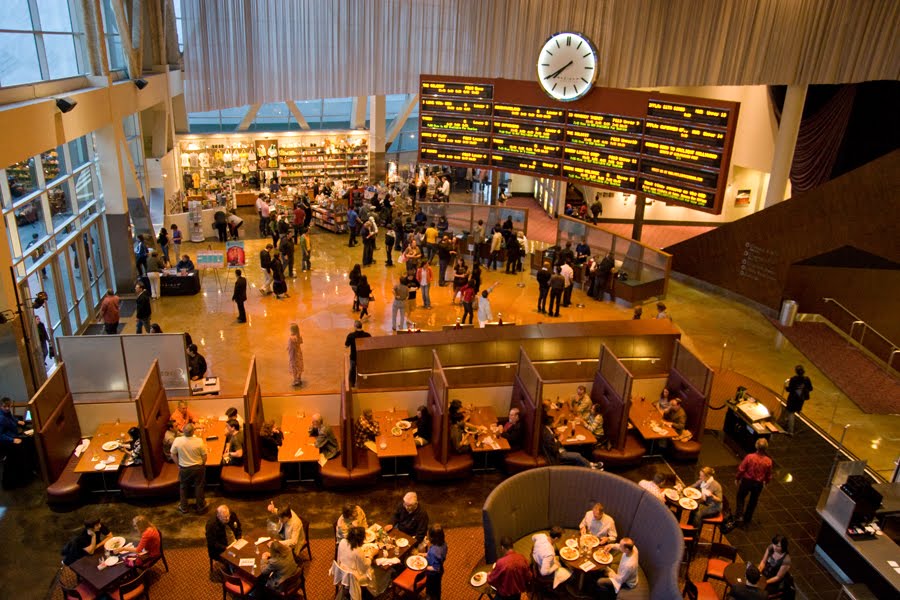
The original Arclight is in Hollywood, where it is and has been the crown jewel of Hollywood moviegoing. It's got something like 14 screens on two floors -- well, three floors really, as the main floor has only the ticket windows and a restaurant, and you can take escalators either up or down to catch your movie. The lobby is simply breathtaking:


In its heyday, not only did the Arclight offer the latest in independent cinema and limited releases, but it also pioneered a concept about seating that I think is rather brilliant. (It was the first I was aware of to do this, anyway.) If you are late for the show, you simply won't be seated. So below each movie on the screen you see here, it says things like "Now available for seating" and "NOT available for seating." It's all part of Arclight's mission to give you a luxurious moviegoing experience, uninterrupted by jackasses picking their way to their seats five minutes after the movie has started. It's also one of the first places I remember seeing gourmet food at a movie theater -- you can get a chicken-apple sausage sandwich with watermelon salsa. Believe me, it's good.

You do pay extra for all these frills, but they're worth it. More worth it than anything was that Arclight carried movies I couldn't find elsewhere, because they had not yet reached the regular multiplexes, and probably never would. It was even worth the 30- to 45-minute trip to Hollywood.

But as is the case with any successful concept, it expanded. The Arclight concept is now in three other locations -- Sherman Oaks, which is in the San Fernando Valley; Pasadena; and the aforementioned Beach Cities in Manhattan Beach. Each of these locations has steadily watered down the concept a little bit, leaving that grandiose clock and the color of the wood paneling as the signature Arclight detail, not the movies they show.

But I didn't think it had gotten this pedestrian. Here's what's currently playing in Arclight Beach Cities:

Alvin and the Chipmunks: Chipwrecked
Hugo

New Year's Eve
Mission: Impossible - Ghost Protocol
Sherlock Holmes: A Game of Shadows

The Adventures of Tintin

The Artist

The Descendants
The Devil Inside
The Girl With the Dragon Tattoo
Tinker Tailor Soldier Spy

War Horse

We Bought a Zoo
Young Adult

Perhaps this list of movies does not leaving you gasping with incredulity. I mean, there are some movies in there that were not widely carried at other theaters, such as Tinker Tailor Soldier Spy. But TTSS is not what I'm talking about when I think of Arclight's unique, rare offerings of yore. The Descendants and The Artist may not have made it into every backwater multiplex in the country, but they are also two of the frontrunners for best picture, meaning Arclight can't claim it as a novelty to carry them. (Especially since I saw The Descendants in the theater before Thanksgiving.)

The movie that really concerns me on this list, however, is The Devil Inside.

When the movie that claimed the honor of "first wide release of 2012" came out last Friday, the only thing I could think to write about it, in my normal Friday spot, was to make an INXS joke. So I didn't.

Since then, I've thought of two other things:

1) So, are we going to get movies about demons possessing religious people every January from now on? (See The Rite in 2011).

2) So, does the first movie of the calendar year really need to be shown by Arclight?

This, more than any of the other titles on that list, is what worries me that Arclight is slowly but surely morphing into Just Another Theater Chain. If that happens, I'll be really sad to see it.

I think it's indicative of two dispiriting trends, one of which is probably more important than the other in terms of guiding Arclight in its choices about what to screen. The most important trend is, of course, the economy, or more broadly, the times we live in. A large theater trying to stay afloat in a tough economy, and competing with a myriad of sophisticated home video options, simply must take on its share of crowd pleasers in order to turn a profit. The Twilights (which probably played at all the Arclights) prop up the theater and give it the opportunity to play the Take Shelters.

The second trend that worries me, however, is that I suspect the audiences are really getting increasingly less sophisticated, and increasingly in need of popcorn movies as opposed to the acquired taste of the nourishment provided by independent cinema. I have no evidence of this, at least none that is concrete. But I think it's a legitimate worry.

However, before you lose all hope that a multiplex devoted to arthouse movies can survive in this economic climate, I should let you know that the original Arclight still gives us hope.

The Arclight in Hollywood is currently playing Extremely Loud and Incredibly Close and The Iron Lady, two movies that have not yet had their wide release, and is the only theater I'm aware of playing Pariah, which I'd really like to see in the theater but probably won't. It's also in the midst of a one-week return engagement for Drive, for people who like that movie.

However, even the Arclight in Hollywood is playing The Devil Inside.

I'll just try to think of The Devil Inside as the devil that must exist inside the Arclight, allowing it to shine the rest of its light of angelic, cinematic goodness.

Monday, January 9, 2012

How not to write a synopsis


As a guy who's done a lot of film writing in my day, I've also synopsized a lot of movies.

And by this I don't mean I've summarized the plot of a lot of movies -- that's not the point of a synopsis. If you want that -- and I sometimes do, if I've been falling to sleep during the second half of a movie -- wikipedia usually has excellently detailed outlines of movie plots from beginning to end (even if they are not always excellently written). The spoiler alert is assumed.

The synopsis is really to give readers a taste of what the movie is about -- to give them about what the trailer gives them, assuming it's a trailer with the standard level of exposition. Roughly approximated, it's about as much information as you would learn in the first ten or fifteen minutes of the movie -- who the characters are, and what their (overt) goals seem to be.

And so it's very important not to write a synopsis based on information you could have only gleaned by watching the whole movie. If you're going to synopsize a movie for public consumption after you've seen it, you have to be oh-so-careful to remember what information you learned, when.

This is why I'm pulling out an example from one of my own former colleagues for this post. It's not because he's a bad guy (in fact I don't know him personally), and I actually think he can be quite a strong writer. It's because he pretty much blew some of the key surprises about Mission: Impossible - Ghost Protocol by failing to adhere to this simple synopsizing protocol (if you will). (But because I don't want to throw him under the bus, I'm not going to name him or the site name in this post.)

And because this plot synopsis will constitute a spoiler for those of you who haven't seen the movie, I'm going to invite anyone in that category to stop reading right now.

Okay, we good?

Actually, there's really only one sentence in his synopsis that's relevant to today's discussion, so I'll include only that. (Which will also make it less likely that you'll track down who I'm talking about.) Here's what he wrote:

"As the movie opens, Ethan Hunt (played once again by Tom Cruise) is busted out of a Russian jail, where he was imprisoned for taking revenge for the apparent death of his wife (Michelle Monaghan)."

If you've seen the movie (and I'm assuming everyone who's still reading has, or doesn't care if they haven't), you know that there are actually three violations of synopsizing etiquette in this sentence. In possible order of their magnitude:

1) At the beginning of the movie, we know only that Hunt was in a Russian prison. We have no idea why he was there until much later, when it is part of a key reveal in the plot.

2) That key reveal is that his wife was killed, and he took revenge on those who killed her. However, this reveal probably does not come until an hour in, at which point, we are supposed to take it at face value. Plot synopses are all about the parts of the plot we are supposed to take at face value. So even if her death was revealed in the first 15 minutes, and therefore appropriate as part of a synopsis, you wouldn't want to call it an "apparent" death -- that only signals to the reader that things are not as they seem. (Imagine synopsizing The Sixth Sense and referring to Bruce Willis' character as "a psychiatrist who may or may not be alive.")

3) By giving Michelle Monaghan's name in parentheses, you are essentially telling the reader she appears in this movie -- something that doesn't occur until its final five minutes. Sure, you could just be reminding the reader of what he/she knows from Mission: Impossible III, but unless an actor or actress appears in the cast of the current movie, parenthetically mentioning them in connection with a character name is misleading at best. (Of course, she could have been killed in the opening of this movie, but once they start watching, viewers will quickly realize that's not the case -- and have the rest of the movie tarnished for them at that point.)

People who write about film for a public audience have such a sacred responsibility to respect the intentions of the filmmakers, not to mention create the best possible circumstances for a viewer to receive and benefit from those intentions, that I can't help but write about this. I know that my appreciation of this incredibly fun action movie would have been severely compromised if I'd read this synopsis before I saw the movie.

So I hate to single you out, So-and-So from Such-and-Such website. But my own intentions are only good ones. And if you do happen to read this, maybe it'll help make you a better synopsizer -- and help save some of your readers from having future movies casually spoiled through careless writing.

Sunday, January 8, 2012

A pretty backhanded award


Organizations will do year-end awards for almost anything.

Sometimes, this will make them look silly.

Exhibit A: Redbox's 2011 Movie Awards.

As a regular Redbox customer, I received a link to this five-minute "awards show" (made with flash animation) in my inbox on January 1st. A number of smaller awards were handed out first, followed by the grand prize: the movie most rented from Redbox kiosks in 2011.

If you want to know who won, well, my poster art has already ruined that surprise for you. (As well as possibly giving you a special feeling in your special area.)

That's right: Just Go With It, the Adam Sandler-Jennifer Aniston vehicle that most critics (including this one) did not like, was rented more than any other movie in 2011.

If you're being generous, there's a temptation to take that honor at face value. It's got to say something about the movie's popularity if it was rented more times than any other movie, right?

Right -- it says something. But maybe not what a casual observer would think it says.

If we unpack this a little bit, you'll see what I'm talking about.

Okay, for starters, in order for a movie to be a popular rental, that likely means it was not a popular movie to see in the theater. Unless you think there were a legion of Just Go With It fans who loved it so much on the big screen that they re-watched it as a rental, you're talking about rentals by people who wanted to see it, sort of, but not enough to pay theater prices.

Then you've got to consider how long a movie was eligible to be rented. A movie that came out early in the year, like Just Go With It (February 11th theater, June 7th DVD), had much longer to possibly be rented within the calendar year than a movie that came out in the summer. It stands to reason that there are a number of summer movies that might have overtaken Just Go With It if they'd been released a month or two earlier, or if the window were extended past the end of December.

And then you've also got to consider Redbox's internal considerations about how long to actually carry the movie in kiosks. While this calculation is likely a function of whether it's still earning them money, we can't really be sure what factors were involved in how long they made it available. It's possible that other popular movies were pulled sooner for reasons we wouldn't even know about.

Not to mention, finally, that Just Go With It was only competing with other movies that Redbox chose to carry in the first place -- though I'm sure that anything obscure enough not to be carried by Redbox would never be a serious competitor for this award, if it had been carried.

Those are only the empirical factors. I'd say there are things you can assume that detract further from this supposed "honor." Me, I'd guess that Just Go With It was primarily being rented because of the woman above, Brooklyn Decker, whose jiggling boobs were a focal point of the advertising campaign. Perhaps the jiggling boobs were not enough of a factor to get people out to the theater, but they definitely held enough sway (pun intended) to get people to plunk down the cash money for a dollar rental. (Plus, some people who rented it might have wanted to "be alone" when they watched it, if you know what I mean.) Who knows how much the rentals of Just Go With It would drop without those two double Ds.

At least the most rented movie was actually from the year 2011, giving the award a slightly greater sense of legitimacy. I suppose if you want to submit an argument on behalf of Just Go With It, you could say it beat out all the holiday movies from 2010, which should have made plenty of hay in the first half of 2011, when Just Go With It was still in limbo between theater and video.

The real problem with any "awards show" in which the big winner is Just Go With It is that it has pretty much zero prestige. (Not that "prestige" is what they were going for, of course -- any time an award is given out simply for popularity, you have no control over the results.) A lack of prestige is pretty consistent with an unmanned kiosk where you rent videos -- it's as "common" as things get.

The rest of the award winners bear out that idea. Here, take a gander at them:

Most rented action movie: The Green Hornet. See previous discussion of movies with early release dates (January 14th) having a distinct advantage.

Most rented action star: Angelina Jolie, Salt. Really? Does anyone even remember that movie? And who decided to rank a star independently of the movie in which she appeared, unless they were going to mention other movies in which she also appeared?

Most rented family movie: Rango. Which came out in March.

Most rented horror movie: Insidious. Which came out in April.

Most rented comedy and funniest couple: Just Go With It, Adam Sandler/Jennifer Aniston. I am starting to wonder how they even chose which awards to give out. The funniest couple award came from survey responses, as did the random tidbit (included in connection with the most rented family movie) that Redbox customers had the most fun with the minions of Despicable Me. Damn, I'm starting to like Redbox customers less and less all the time.

Most rented drama: The Tourist. Okay, so Redbox customers really like Angelina Jolie.

Most rented actress: Natalie Portman. Sheer quantity of movies is obviously a factor, as they mentioned Black Swan, No Strings Attached, The Other Woman, Your Highness and Thor -- all of which were in theaters by May. But at least you've got the reigning best actress here, which adds a little prestige.

Most rented actor: Owen Wilson. Again, quantity is a factor, with How Do You Know, Little Fockers, Hall Pass and Cars 2, though I think it's cheating a bit to include Little Fockers, since it's a supporting role.

The most puzzling award, however, was the Lifetime Achievement Award. I guess they're speaking only of Redbox's lifetime, because it didn't go to some big name who's been in the movies for decades. It went to Kevin James, who has been starring in movies for about five years. And the reason it went to him was because Paul Blart: Mall Cop was the fastest movie to reach one million rentals.

Again I say: People can only rent a movie if you are stocking it in the kiosk.

And if Redbox customers held Paul Blart: Mall Cop in such high esteem that it was stocked long enough to be rented one million times, well ... I want to distance myself from them even further.

But I'm the one who has just spent the better part of an hour writing about this.

So I ask you:

Who's the fool? Who looks silly?

Saturday, January 7, 2012

Tyler Perry is bad at math


Nope, this is not just an opportunity to take an easy potshot at a sometimes easy target.

In fact, I'm going to start today's post by praising Madea's Big Happy Family, the latest entry in Tyler Perry's series of Madea movies. A movie I pilloried in this space based on my perception of self-loathing in its catchphrase "Good afternoont" (see post here) was actually one of the most purely entertaining Perry movies I've seen. In fact, the Madea character herself, who has frequently caused me fits, may have been my favorite thing about it. Best use of the character yet, I say.

I wasn't planning to fit this movie in before my year-end rankings close (January 24th), but I happened across it at the library and needed something to watch at the gym. I'm glad to say that it did one better than helping me get through my exercise -- I was actually laughing, regularly, and when not laughing, I was enjoying the drama surrounding social issues. (Perry is known for alternating wildly between tones in his movies, and this one was no exception.) The cast was uniformly strong, but the character that made me laugh the most was the spiteful "baby mama" of Bow Wow's character, played by Teyana Taylor. Whenever Taylor says his name -- Byron -- she draws out the last syllable for the next ten seconds:

"By-reeeeeeeeeeeeeeeeeeee

(breath)

eeeeeeeeeeeeeeeeeee

(breath)

eeeeeeeeeeeeeen."

I don't know, it just made me laugh.

(For the record, Bow Wow is now crediting himself as Shad "Bow Wow" Moss.)

However, I do have some nits to pick about Perry's ability with numbers, especially when he's casting actors to fill out the seemingly limitless branches of Madea's family tree. Specifically the ages of the actors, and the likelihood that they could be parents and children to each other.

I'm looking at two relationships in the movie in particular, and before I go on, I'll give you a spoiler alert, since not everything about the nature of these relationships is known at the beginning of the movie.

There. Have all the Tyler Perry fans who haven't yet seen this movie left the room?

The biggest surprise reveal in the movie is that Byron and what he thought was his sister Kimberley (Shannon Kane) are actually mother and son. She got pregnant when she was 13, so her mother (the great Loretta Devine) raised the baby as her own baby.

The thing is, The Artist Formerly Known as Bow Wow (and Lil Bow Wow before that) is 24, while Kane is only 25.

It's one thing to say that baby-faced Shad Moss can play younger than his age, which is nothing new for actors. Hell, Michael J. Fox was still playing teenagers when he was 40. But this movie doesn't present Byron as a teenager -- he's definitely in the workforce, or at least trying to be (he loses his job at one point during the movie). And so it's quite another thing to tell a beautiful actress like Kane that she can play ten years older than she really is. That kind of thing doesn't usually go over well with actresses -- or anyone in the movie business, come to think of it.

But that's probably not the strangest parent-child age relationship in the movie. The movie also features a mostly separate plot about a character who just goes by the name Brown (David Mann) and the character who is allegedly his daughter, Cora (played by gospel singer Tamela Mann). ("Allegedly" because this parentage is not straightforward either.)

There are three very strange things about having these characters play father and daughter:

1) Both actors are exactly 45 years old.

2) For reasons known only to Perry, Cora's age is actually given in the movie, and she is supposed to be 58 years old. So not only is she also playing at least ten years older than she actually is, but that means that David Mann is playing 30 years older than he actually is, if you average out the potential ages he was when he fathered her, erring on the side of making him younger, and call him 20.

3) David Mann and Tamela Mann are actually married in real life, which is probably part of the reason Perry did it, as an inside joke.

Of course, Perry himself is only 42, and his Madea character is supposed to be in at least her mid-70s, seeing as how she's Cora's mother.

Now, if we are going to proceed from the assumption that Perry was trying to be at least somewhat realistic, there are two things we can conclude:

1) There is a somewhat crude if ultimately complimentary saying about black people, which is "Black don't crack." Which, unpacked, is supposed to indicate that African Americans don't show signs of aging as quickly as those from other races -- their skin does not "crack." If you are to believe this notion, you could say that Perry is either using this notion to his advantage to cast by skill set rather than age appropriateness, or simply making fun of the notion.

2) Perry's movies are all about uncovering the pernicious underbelly of the African American experience in the United States -- when they're not all about broad physical humor, that is -- so the young age at which many African American girls become mothers could be one of the notions he's trying to wrestle with. Actors really can be close in age to each other, and play parent and child, if that parent him or herself was only a child when he or she became a parent.

But really, this level of analysis is probably not necessary at all. Cinema is all about illusion, and these days, actors can play a lot older than they are (through makeup) or younger than they are (through digital enhancement) in a way they couldn't in the past. Why be limited by age considerations if you know you have an actor who is right for the part? As long as the viewer isn't distracted, you're in the clear.

I guess I was distracted -- enough to write this post, anyway. But I still liked the movie plenty well. I went in with my arms crossed, and I came out with them open.

Before I leave you for this Friday, I do have one final question:

What the hell am I supposed to call this movie?

I am currently listing it as Madea's Big Happy Family in my Most Recently Seen section to the right. However, there's ample evidence that the official title is Tyler Perry's Madea's Big Happy Family, and that's how I first listed it when I updated my blog last night after seeing it.

What a tongue twister. It's terrible to have those two words with apostrophes right next to each other, but it is in keeping with the naming convention for the last however-many Perry movies. The last two I saw before this I refer to as Tyler Perry's The Family That Preys and Tyler Perry's Meet the Browns. But that apostrophe situation gave me pause this time around, and I chose to use an earlier naming convention for this one. Namely, when Madea's Family Reunion came out back in 2006, Perry's name was not part of the title, either officially or unofficially. At some point along the way, however, he took a lesson from Bram Stoker's Dracula and Tim Burton's Corpse Bride and got on board with full authorship as part of the title.

Since I really don't want to include his name in the title this time around (because of the grammatical awkwardness), I'm seeking any excuse not to. However, most sources do seem to list it as Tyler Perry's Madea's Big Happy Family, while Madea's Big Happy Family is the name of the stage play that inspired the movie. To confuse matters, the wikipedia entry for the movie is listed under Madea's Big Happy Family, but the first sentence of the entry calls it Tyler Perry's Madea's Big Happy Family.

Don't be surprised if I've changed my mind again by the time you read this.

Friday, January 6, 2012

Getting acquainted with ... Doris Day


This is the 11th in my Getting Acquainted series. If you don't know what it is by now, screw you. Kidding! I watch three movies a month that feature a cinematic talent who is generally unfamiliar to me. After that month, we're fast friends.

If we played a game of word association with the name Doris Day, I might have said things like "the 1950s" or "wholesome" or "movie star." Those were the general ideas I had swirling around in my head about this actress, whose iconic status did not necessarily make me any more certain who she really was. (Is -- she's still alive. But she hasn't been acting for the past 40 years.)

It was a little interview with her on NPR -- I think it might have been Weekend Edition -- that got me interested in putting her on my list for this series. I didn't necessarily know that Doris Day was equally famous (if not more so) as a singer, so it was with a little surprise that I heard her introduced in the context of the song "Que Sera Sera." What surprised me more was that the song appeared in Hitchcock's The Man Who Knew Too Much. Suddenly I wondered if I were unacquainted with Hitchcock. I hadn't seen The Man Who Knew Too Much, but "Que Sera Sera" didn't sound like a song that would appear in a thriller, let alone a Hitchcock thriller.

Suddenly I became very intrigued, and decided I needed to get to know Doris Day. It made sense to start with the film above, since any opportunity to add another Hitchcock to my list is always appreciated.

The Man Who Knew Too Much (1956, Alfred Hitchcock). Watched: Saturday, December 10th

But before I watched The Man Who Knew Too Much, I decided to watch The Man Who Knew Too Much.

In case you weren't aware, Hitchcock first directed a version of The Man Who Knew Too Much in 1934. (Yep, this guy had a long career.) It featured Peter Lorre in the villain role. In fact, I would have watched my first Doris Day movie ten days earlier, except that it was this version, not the version I wanted, that was available on Netflix streaming. I didn't realize that until I'd sat down to watch it on Thursday, December 2nd. So I watched something else that night, but decided I might as well squeeze in Hitchcock's original version before I got to his remake -- might make an interesting exercise. Besides, his original was only 75 minutes long, meaning I could watch it over a cup of coffee, right?

Wrong. It actually took me about three sittings to get through the original, in part because I always tried to watch it when I really should have been going to bed for the night. But also because it was damn near incomprehensible. That's a pretty stiff criticism to deliver about a movie made less than a decade into the talkie era, but I found it to be incredibly choppy, and it had terrible sound. I could see why Hitchcock wanted to give the story a second shot.

And really liked the remake, starring Day and the great Jimmy Stewart. The story revolves around a trip by the MacKenna family to Marrakesh, in which the family meets a strange Frenchman who ends up getting killed under mysterious circumstances a couple days later. As he's dying he whispers a secret in the ear of Stewart's Ben MacKenna, leading to Ben's unwitting possession of too much knowledge. The secret relates to an assassination plot in London several days hence, and in order to find out what Ben knows about it, those behind the plot kidnap his son. Ben and his wife Jo (Day) are under strict orders not to go to the police, so they begin a risky mission to use the clues they have to find their son and foil the assassination plot.

It's classic Hitchcock in a lot of ways, including the virtuoso sequence in London's Albert Hall in the third act, which goes wordless for ten or so minutes as only the key orchestral piece plays on the soundtrack. The parts that didn't seem to logically fit into Hitchcock's ouevre were the parts that interested me most, however. Such as this uplifting Day song, used twice as a showpiece -- both at the beginning and at the end. Which likened those moments more to the typical Day fare I'll explore later than to Hitchcock. It's such a good song that I won't go so far as to say it stands out like a sore thumb -- if it stands out, it's a neutral to positive standout. I just thought it seemed like a strange addition in a Hitchcock movie, which only goes to demonstrate that Hitchcock was first and foremost an entertainer, with populist sensibilities.

Day's performance was also quite good. Stewart's character initially keeps her in the dark about what has transpired involving their son, and in a moment laden with a certain darkness that shouldn't be pondered too closely, he actually drugs her before telling her that their son has been kidnapped. This is surely meant as an act of benevolence, to keep her from become paralyzed with shock and panic. She still has those reactions, since she becomes aware of the kidnapping before the drug has entirely taken its effect, and she plays them quite convincingly.

You don't really need to know my detailed analysis of the whole movie -- these Getting Acquainted pieces are long enough without me having to delve into the particulars of technique in a Hitchcock film. So let's move on to the next movie.

The Pajama Game (1957, George Abbott & Stanley Donen). Watched: Friday, December 16th

When I saw this title in Day's filmography, I must admit I did not immediately recognize it as the name of a beloved Broadway musical. Instead I thought it would be something light and fluffy along the lines of Gidget, which is the kind of prototypical Day movie I thought I wanted to see. (To be clear, Day does not appear in Gidget -- but I thought she made movies like Gidget.) Maybe I thought the character would actually spend the majority of the movie in her pajamas, talking about boys.

What I got instead was a story about a labor disagreement in a pajama factory.

Who knew?

Although I am a lover of Broadway, I did not love The Pajama Game. I thought it was okay. My biggest issue was its appearance. Save one outdoor sequence at a company picnic, which brings the film temporarily to life, The Pajama Game takes place almost entirely in grimy interiors that are shot poorly. You'd think that a musical would take pains to be colorful and effervescent, but this one didn't. Not only are the set design and costumes drab, but the camera never seems to be at the right depth. All the musical numbers are shot from what seems to be a distance of about 15 feet away, which gives neither a sense of grand scope nor a sense of intimacy -- both of which are key to the charm of a musical. I did find a number of the songs catchy, though.

What surprised me is the different perspective this gave me of Day. It still wasn't what I was expecting, but it wasn't what I was expecting in a different way. As a union type who stands up for employee rights in the factory, Day was a bit gruff -- more of a Laverne than a Shirley. (Yeah, the pajama factory made me think of the bottling plant where Laverne and Shirley worked.) I had the sense that Day wasn't anybody's idea of a pinup model, and this confirmed it. However, it also made me realized I had miscalculated again on my assumption that she was involved with wholesome fluff. The Pajama Game is wholesome enough, I guess, but it definitely has its ribald moments, as well as drunkenness in several key scenes and a homicidally jealous knife thrower. Also, it's no fluff. The story is about workers fighting the big bosses for a minimal raise, almost like a precursor to Norma Rae or something.

Day's character is involved in a romance, with the new superintendent, played by John Raitt (Bonnie's father). However, it develops in fits and starts and has a pretty unsatisfying arc. What's more, I didn't find Raitt charming at all. The characters' positions on opposite sides of the labor dispute give their relationship some inevitable edge, but the problem was that I didn't see much reason why they fell for each other in the first place. And even some nice songs didn't do much to bridge the gap in my understanding. I just found them incompatible and without chemistry.

I should say, for the record, that this film was enormously popular.

With Six You Get Eggroll (1968, Howard Morris). Watched: Saturday, December 31st

After The Pajama Game, my December was quickly swallowed up by the holidays and having family in town for the next ten days. However, I did finally squeeze in my final Day movie on the final day of the year. (See what I did there?)

With Six You Get Eggroll came on my radar entirely because of its title. I'd seen it on the shelves at the library, and had pondered renting it as long as a year or two ago, simply because of that title. (And for some reason, was under the mistaken impression that Walter Matthau appeared in it.) I couldn't fathom what the title meant, but it seemed vaguely racist. Its grammatical incorrectness (there should either be an article before "Eggroll," or the word should be pluralized) made it sound like something a Chinese restaurant owner would say in broken English.

In fact, the line of dialogue is actually spoken by a young American child while at a Chinese restaurant, and his comment refers to the restaurant's apparent policy of giving out free eggrolls if your party exceeds a certain size. Since his widowed mother (Day) married a widower (Brian Keith) with a daughter, the four of them make six when combined with his two older brothers. So it's like The Brady Bunch, minus two.

I actually adored this film, and I adored Day's performance in it. (So I "adored Doris," you might say.) In one sense, this is the light, fluffy Day I was looking for, if only because it's really funny and she is one of the main reasons it's so funny. It does indeed have a sitcom setup, with Day's Abby falling for Keith's Jake, then trying to negotiate all the pitfalls of cohabitation with four bickering children, two of them teenagers. However, it wouldn't be entirely accurate to call it "fluff." There are some serious moments of apparent irreconcilable differences and the possibility of infidelity, though they all have warm, comic resolutions. (With one weird exception of a particular night when Jake cancels on Abby to go dancing with another woman -- she sees him out with this other woman, but the subject never actually gets addressed between them, oddly enough. He actually stands her up twice and gets let off the hook. Go figure.)

But back to Day's performance. At the very start I got worried, since her character runs a lumber yard, and I was already getting flashbacks to the blue collar milieu of The Pajama Game. But her job basically disappears from the narrative, which becomes more about the difficulties of single motherhood and finding a new life partner with three kids in tow. Day is pitch perfect as the the mother who has seen it all, whose innate instincts on refereeing her children kick in without a second thought -- which doesn't mean they aren't accompanied by a perfectly timed roll of her eyeballs. In fact, what's so great about Day's performance comes down to her impeccable comic timing. This really could be one of my favorite comedic performances I've seen from an actress. At first I wasn't sure what I thought of Keith, but I really came around on him as the movie moved along.

What's odd is that I found her adorable physically as well. While I found her appearance attractively bland in The Man Who Knew Too Much and really quite scruffy in The Pajama Game, a decade later I found her as cute as a button. I suppose that could have to do with the genre shift to straight comedy, which clearly suits her talents, as well as the fact that she dresses up well in the attire of the late 1960s.

One noteworthy aspect of this movie: It was interesting to see how much a G rating would let you get away with back then. Today, this movie would be rated at least PG, possibly PG-13, just from "adult subject matter" alone. There's all sorts of ribald material in this movie, from the neighborhood seductress who tries to bed Jake, to some rather bold sexual innuendos, to the revealing short skits in a nightclub during a surprisingly protracted musical number that screams "This movie takes place in the 1960s!" I also found it interesting that two of Abby's kids stand up in the bath, and you not only see their butts, but you get a very brief view of their frontal nudity. So what wouldn't even appear in a movie today was rated G back then.

One of my favorite things about With Six You Get Eggroll is the cast. All sorts of actors we would know better later on appeared here, including Barbara Hershey as Keith's teenage daughter, George Carlin as a wise-cracking waiter at a drive-in, Alice Ghostley as a zany housekeeper and Jamie Farr as a zany hippie. (The firecracker climax involves several police cars, several arrests, a mobile home, a man using a teddy bear to cover his privates, and a whole slew of hippies. If that doesn't make you want to see it, I don't know what will.)

Sadly, With Six You Get Eggroll was not a success, and it was actually the last movie Day appeared in. That's too bad -- as far as I'm concerned, she had just tapped into her potential.

Okay, thus ends the final Getting Acquainted of 2011. I do intend to resume the series after a one-month break in January. I use each January to gorge on films from the previous year before I finalize my rankings at the end of the month. January of 2012 will be no different.

But when I resume in February, I think I'm going to make some format changes. I love Getting Acquainted because it keeps me from getting complacent in my desire to continue watching older movies and becoming more familiar with cinematic greats. Without a structured way of doing that, I could easily become slack in my resolve.

However, I'd be lying if I didn't say that these monthly write-ups have become something of a burden for me. I've created this artificial pressure to say something long and profound about each movie I watch, and when I'm doing it with three movies each month, the urge to procrastinate is powerful indeed. That's why I'm only getting to these write-ups by the 5th or later of the following month -- it just seems like a big effort to compile my detailed thoughts on three films, especially when the first one is something I saw as long as a month ago, whose details may be escaping me by now.

So in 2012, I vow to keep the Getting Acquainted project going, but to write about it here in only abbreviated form -- just an acknowledgment that I watched the movies, then a few quick hits about each. Hey, we all only have a finite amount of available time, and if given the choice, I'd rather spend that time watching the movies than writing about them.

See you back here at the end of February ...

Thursday, January 5, 2012

"Please don't let me die!"


Some movies are so good that you don't need to rewatch them very often.

That seems like a strange thing to say, but it's true. I think I've talked about that on this blog before. When these movies come up for discussion, you just nod, and you don't even need to say anything. It's understood that they're great, and even if you haven't seen them in ten years, that doesn't mean that they are any less so, or that you appreciate their greatness any less or any differently.

Die Hard is one such movie. It might be 15 years since I've seen it all the way through, though I've certainly seen little pieces here and there since then. Monday night, we decided to watch the whole thing, as a final bit of our Christmas season on my last paid holiday until Memorial Day. (Don't forget, Die Hard takes place on Christmas Eve.)

I didn't feel as viscerally enthralled watching it as I expected to feel. Some visceral thrills are possible only on a first-time viewing, and never repeat themselves. But I did appreciate the hell out of it, especially the minor details.

I frequently refer to Die Hard as the greatest action movie of all time, but I think that's a pretty commonly held sentiment. It definitely ushered in a new golden era of action movies -- or more accurately, like any trendsetter, it spawned a sting of inferior imitators. (Everything for about the next decade was pitched as "Die Hard on a ______.")

The thing that made it so different from many of the action movies in the Schwarzenegger mode that had preceded it, as well as many of the action movies that have followed it, is the simple understanding of what would make us love John McClane so much:

He's human.

The feats McClane pulls off in this movie are, for the most part, in human scale. Sure, it's questionable whether anyone could truly survive the gauntlet of physical abuse he endures. Sure, it's helpful that he picks the exact right moment to jump off the roof before the bomb is detonated. And sure, it's really helpful that he can defy physics while falling down that shaft, first falling out toward the center of the open space, then falling back in the opposite direction toward the outer walls, allowing him to improbably grab the lip of an opening on the way down.

But no individual feat is presented as something there's no way a human could pull off. And even when the movie starts to veer toward that territory, McClane's reaction to the feat in question brings it back to human scale.

Take that moment on the roof. McClane is muttering to himself about what he's doing and why he's doing it, and the fact that he must be crazy. It's a trademark Bruce Willis character trait, showing up prominently in Pulp Fiction and other films as well. A lot of it is conventional comic relief, and therefore not all that noteworthy.

But this moment stands out:

"Oh God, please don't let me die!"

He's about to plunge himself over the edge of a skyscraper, relying only on the fire hose tied to his waist to stop his fall and prevent him from pancaking on the sidewalk below. Arnold Schwarzenegger or Charles Bronson (when I first saw the poster for Die Hard, I thought it was in the vein of Charles Bronson's ouevre -- that tells you where action stood at the time of its release) would never say such a thing -- they would be stoical in the face of such steep odds. Which might make them extra macho, but wouldn't do much for their believability as characters.

A great action hero, pleading with his lord and savior not to die? Before Die Hard, we assumed it would rob him of all his authority. On the contrary -- it made us relate to him, and consider his feats all the more impressive because they were performed by a real person, just as scared as you and I would be in that situation.

(And speaking of his "lord and savior," I couldn't help but notice on this viewing that McClane does make a couple references to a higher power. At one point he talks about whether or not he'll get out of this situation alive, and says "That's up to the man upstairs." The funny thing is, you could say things like this back in the late 1980s without it being a political statement, because there was not a religious divide dominating the country the way there is now. Oh sure, there was still that debate -- the fundamentalists were called The Christian Coalition back then -- but it didn't seep into our sociopolitical fabric to the extent that it does now. I'm sure none of us thought John McClane's several invocations of God's name meant that he was a Christian or that Die Hard functioned as some kind of right-wing propaganda. Ah, to return to those simpler times.)

Oh, and having just seen Mission: Impossible - Ghost Protocol, don't think I didn't notice how much the Burj Khalifa sequence owes to this scene. I won't go into any more details for those of you who have yet to see it.

Another scene that has always stood out to me for its realism is the scene in the bathroom, when McClane has to pick all the glass out of the soles of his feet. That more than anything serves as his second act crisis, the moment when he loses confidence and is not sure he can go on. Just think about that -- after being shot at, punched, kicked and dropped down air shafts (some of his more perverse tortures still lay ahead), the thing that could finally stop him would be scampering over a floor covered with glass. A screenwriter for a standard action movie wouldn't have even considered that as a stumbling block for its hero, because the presumption is that Arnold Schwarzenegger's feet are made out of iron that's impervious to a million little cuts.

As he's picking the chunks of glass out of his feet, he's nearly crying. Yes, this kind of thing would be extraordinarily painful, and he's not just going to bounce back from it. It's going to take every ounce of his remaining stamina just to be able to keep on walking.

And regarding his running commentary to himself ... how great that instead of stoically beating up Alexander Godunov's character, he's screaming at him that he's going to fucking kill him while he's doing it? The rage and adrenaline are building up in this man, possibly the only thing that allows him to continue surviving. It's what a normal human would do. A conventional action hero, on the other hand, would consider it a solemn responsibility to beat up this man, not the act of fury and vengeance indicated by the stream of profanity Willis lays on Godunov.

I don't suppose these observations are new to the discussion of Die Hard -- I mean, of course they're not. But just as we take great films for granted, we sometimes take for granted why they're great, and writing a few paragraphs on it on a January morning can be a nice reminder.

Tuesday, January 3, 2012

Drive out the old year, drive-in the new


Parents going out on New Year's Eve without needing a sitter?

Mission: Possible.

On Saturday night, we rang in the new year with Mission: Impossible - Ghost Protocol and The Sitter at the Mission Tiki Drive-in in Montclair -- the site of both successes and failures in our moviegoing past. And we got to be (semi)-responsible parents by having our son right there in the back seat with us. (Better than leaving him at home with Jonah Hill, right?)

It had been a rather late-developing plan. The initial idea was to do more or less what we did for his first New Year's, which was go out for an early dinner at somewhere that was fancy enough to serve us a celebratory cocktail, then return home for a movie (last year, it was the thematically appropriate countdown movie Run Lola Run).

But this past Wednesday Mission Tiki sent me its weekly email advertising its offerings for the upcoming weekend, and it was clear they would be open on New Year's Eve. In fact, we were being told to "ring in the New Year under the stars." Since we'd failed to decide on a movie (Roland Emmerich's 2012 had been batted around, but did we really plan to see this behemoth a second time?) or a place to eat, going to the drive-in would take care of both, as we'd buy sandwiches to picnic at the theater. In fact, the sandwiches and the $7 entry fee per head might make the whole evening about as expensive as just our two celebratory cocktails.

We'd learned our lesson about trying to switch screens between the first and second movie (see the "failures" hyperlink above), so we needed to be convinced that both the movies were ones we a) at least sort of wanted to see, and b) had not already seen. The only one of the four pairings that met our criteria was M:I - GP and The Sitter. (With The Adventures of Tintin and Hugo, we'd both seen Hugo; with Sherlock Holmes and The Darkest Hour, she'd seen Sherlock Holmes; and with Chipwrecked and We Bought a Zoo, I'd seen Zoo. And besides, not even at a drive-in would I see a chipmunks movie.) And since they repeat the first feature after the second one finishes, we could risk switching screens at that point and might even catch The Adventures of Tintin. (Though it would be weird watching the clock strike midnight in the middle of a movie.)

Ah, but there was one more criterion we haven't mentioned: They both needed to be movies we'd be willing to see in the compromised environment of the drive-in. Here was where I almost tripped us up.

See, everyone's been talking about how great Mission: Impossible is -- and specifically how great it is in IMAX. If there were ever a movie to see in IMAX, this was apparently it. I knew that most of the action set pieces had been shot with an IMAX camera, but I didn't know what most of those set pieces were, meaning I might be able to claim bliss by virtue of ignorance. However, the film's most famous set piece -- Tom Cruise climbing the outside of Dubai's Burj Khalifa, the world's tallest building -- would always haunt me if I didn't see it in IMAX. This is what I wrestled with once my wife had decided she was on board for the drive-in, lured particularly by Mission: Impossible.

I wrestled for less than a day. Ultimately, I felt pretty fortunate in the first place that my wife wanted to wade back into the unknown dangers of going to the drive-in with a toddler, and if I got hung up on whiny technicalities ("But I wanna see Mission Impossible in IIIII-MAAAAX!"), I'd run the risk of throwing a wet blanket over the whole affair. You can't see every movie you want to see in the ideal setting to see it. Sacrifices must be made for the greater good.

So we got all our ducks in a row and left around 5:25 for a 7 o'clock show -- in other words, at least ten minutes later than we'd wanted to leave. It's funny, because after last time, we swore we'd never be running late to the drive-in again. Last time, we were fumbling with our walkmen (that's how you don't bother the sleeping baby with the sound) as the opening credits were rolling, desperately trying to find the correct FM station on cheap equipment we'd bought for $10. When we got a late start Saturday night for the hour-long drive, I felt the same nerve-jangling scenario arising again.

Never happened. In fact, we were parked and ready to go at about 6:40 -- early enough even for me to sneak off to the bathroom for, ahem, something more than a trip to the urinal. (Since I don't want that innuendo to be misunderstood, I'll remove its usefulness as an innuendo by explaining: I had to go #2, and was already worried that I wouldn't have the time for it, leaving me in a potentially desperate situation during the movie.)

The place was dead. We thought there was a decent chance parents would see this as a way to get out with their kids for New Year's Eve, especially with two family-friendly double features playing. But we were one of only about a half-dozen cars facing our screen when we got there, and that number only doubled by the time the show started.

It went mostly smoothly. Our son slept all the way through to the Burj Khalifa sequence. At this point, my wife got into the back seat and fed him the bottle we'd warmed up at home before we left -- and I started to panic. See, my wife had left her walkman in the front seat -- I think she didn't want to get tangled up in the headphone cable. I thought she'd planned to just hand him the bottle -- he can drink it without our assistance -- but she stayed back there until he was done, and even comforted him when he wouldn't return to sleep. So I was filled with that sinking certainty that she was missing ten minutes of the plot (the scene where they set up the fake exchange at the Burj Khalifa), and it started distracting me terribly. Eventually I went diving for her walkman on the passenger side floor, and handed it back to her. It was only later that I learned that she was hearing the scene fine, albeit at a quieter volume -- there was a car less than ten feet to our right, and they were playing it at full volume.

Whew. Had the chance to ruin the whole movie for her.

Our son was up for a good 90 minutes at this point, but surprisingly, it was not that much of a distraction. We each took turns rocking him in place in the carriage, and even though he didn't go back to sleep, he was pretty docile. And all you really have to be doing is facing the screen with your headphones in. Who cares if you're standing up or sitting in the car? Seeing the movie is the important part.

And so it was that we didn't care that we both watched the first half (the weaker half) of The Sitter outside the car, as a sign of solidarity to the other person who wasn't doing the rocking/pushing. He finally went back to sleep, and we both watched the more heartfelt second half of the movie back inside the car.

We had decided beforehand not to stay for The Adventures of Tintin when it played again at 11. We knew that things would time out perfectly for us to get home just before the ball dropped if we were lucky, and that was a goal worth striving for. Being on the roads before midnight, rather than after, would also cut down on the knucklehead factor in terms of other drivers. But the people at the Mission Tiki made it easy for us anyway, taking the microphone during the closing credits for The Sitter and thanking us for coming -- "We are now CLOSED." So much for ringing in the new year. My guess is that they looked at the paltry attendance and figured that they could at least salvage something from the evening by sending their staff to a local party in time for midnight.

Sure, it wasn't like the old days at the drive-in. We didn't get to eat as much of the wide variety of food we'd brought as we'd planned, because it's much harder to locate where you put things when you're trying not to rustle and crinkle too much around a sleeping baby. (And that was even with my wife taking precautions to organize everything better than last time.) We lost a small bit of each movie to baby logistics. And listening to the movies through our headphones rather than the car's radio was a definite step down in the auditory experience.

But hey, as a New Year's Eve activity with a 16-month-old? First rate.

And we did get home before the ball dropped. In fact, it was 11:49 when we pulled up outside our house, and though our son woke up and started wailing, I appeared to have him down by about 11:58.

As soon as I exited his room, he started wailing again. But by now, it was a mere 80 seconds to midnight. We decided he could endure 80 seconds of wailing and watched the ball drop in Times Square -- three-hour tape delay, of course -- then finished the countdown with the customary kiss at midnight. In that moment, we really didn't notice the screaming baby soundtrack.

Just two parents finding that compromise between the way things used to be, and the way we're so glad they are now.