Sunday, March 12, 2023

I finally saw: Don't Say a Word

You'd be right to question the wisdom of going back to catch up with those disposable, interchangeable detective thrillers from the 1990s and early 2000s that you didn't see at the time. For the most part, they existed for that exact moment in time, and had no artistic merit that would prompt a critical viewer to go back and grapple with them 20 years later.

But Don't Say a Word did have that little sing-songy part of the trailer that my friends and I must have seen 50 times back in 2001: Brittany Murphy singing "I'll never tell ..."

Just to write out the words doesn't do it justice. "Tell" really has two syllables, like "teee-elll."

But if you were watching network TV in 2001, as I was in my first months after moving to Los Angeles, they played this ad constantly, so you'd remember it. And if you were like me and my friends, you mocked it out of sheer exhaustion from seeing it so many times.

So after an abortive attempt to watch Sharknado on Amazon due to technical issues -- another "I finally saw" candidate when I do get to it -- I switched over to Netflix and found this.

And two of the reasons I selected it were obvious:

1) An increased appreciation of the aging Michael Douglas, who I watched and enjoyed in The Kominsky Method, and who will not be with us forever;

2) An appreciation I always had for Murphy, who is already not with us.

I hoped the movie would be a real tete-a-tete between these two. The singy-songy "I'll never tell" certainly suggested that Murphy's psychiatric patient was toying with Douglas' child psychologist, and that the thing she wouldn't tell was something she was holding back for spite, in order to make Douglas squirm.

In reality, she isn't the antagonist, and the actual antagonist is far more banal. It's Sean Bean, who is both a jewel thief and a kidnapper, and that jewel thief also committed a bank robbery. So really, it's every cliche you can think of thrown into a blender and reduced to something colorless and bland. 

There's also a different protagonist than you might expect, or at least a third protagonist in addition to Douglas and Murphy, which is Jennifer Esposito playing a detective tracking a killer. Right, so Bean has also killed some people on his path to finding the lost jewel. A number in Murphy's head is the thing she won't tell, and that will lead to the jewel, or else Douglas' kidnapped daughter will be killed.

So yeah, it certainly would have been fine if I'd never seen it.

Saturday, March 11, 2023

The trolls rear their ugly heads again

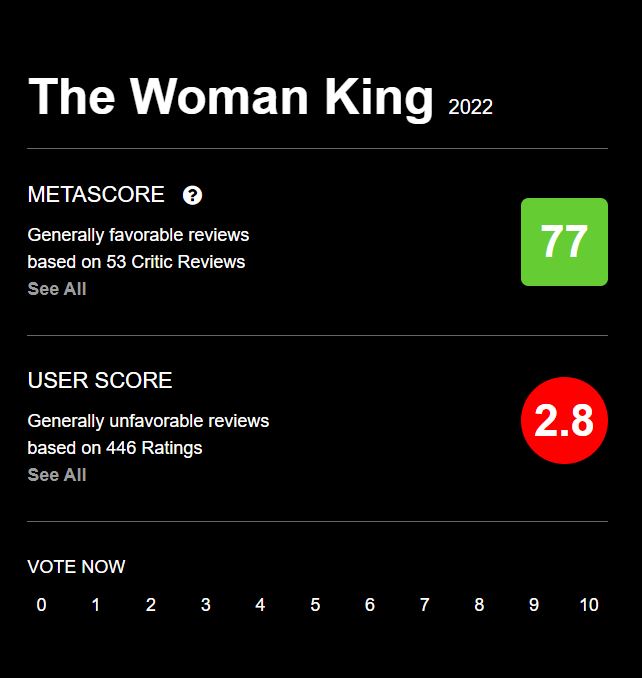
I bet you've never seen such a bright green critical recommendation next to so much angry audience red on Metacritic.

But if you have, I bet it's for another movie that triggers right-wing trolls like The Woman King triggers them.

Now I should say, I wasn't a big fan of The Woman King. I don't remember all the reasons at this point, but I can promise you, it wasn't because it puts Black people in a position of power, defending themselves against the encroachment of white imperialists. (I'll get to one of the reasons, which I think is valid, in a little bit. But there is already enough sabotaging of this movie on Metacritic that I don't want to start out this piece that way.)

The discrepancy between the 77 critic score and the 2.8 audience score is jarring enough, but it becomes even more so when you convert the latter score into numbers. Among the 446 user reviews, 112 are positive, 21 are mixed -- and 313 are negative. 

And most of those negative reviews are scores of zero.

Come on, trolls. You're not fooling anyone. 

You obviously didn't even see the movie, because why would it benefit your world view to even give it a chance? 

Here are two of the examples of what "people" -- as in, maybe Russian bots -- have said about The Woman King, just limited to what appears on the front page:

"Hollywood has no shame and would fake any insane story to attract [sic] woke audience."

"Honestly is just the regular woke racist crap as usual from the leftists."

Yeah, there's that W word rearing its head as well. Didn't some idiot conservative politician recently say that the biggest problem facing the world was woke culture? Maybe they all said it.

Because I was curious how much energy went into making a movie people liked look like a piece of shit, I decided to drill into the negative responses and see how many zeros there really were.

Audience scores start being considered negative at a score of 3. The Woman King has five scores of 3, five scores of 2, 17 scores of 1, and that means ... carry the one ... 286 scores of 0. 

Give me a moment while I burst out laughing.

If you are a serious movie person using these sites in a responsible way, you would never give a movie like The Woman King a zero on a ten-point scale. It is competently made. It has rousing fight scenes. At least some of the acting is indisputably impressive. Zero stars is what you give The Room, and only if its amateur terribleness doesn't bring you a sense of joy. It's not what you give The Woman King.

I didn't bother sifting through the actual text of this copious quantity of zero scores, but I bet there would be racist dog whistles throughout.

The thing is, the reason I had The Woman King on my mind today was because I did, indeed, not like it very much, and the idea of whether Viola Davis should have received an Oscar nomination over Andrea Riseborough came up again on a podcast. But for me, not liking it very much means 2.5 stars out of 5. It doesn't mean 0 stars out of 10. (Incidentally, I don't have an actual opinion on the actresses' comparative worthiness for an Oscar nomination because I have not seen To Leslie.)

I came to Metacritic to read an intelligent takedown of The Woman King, and instead I got ... this monstrosity. Which makes me really want to watch it again and give the things I didn't love about it the highest possible benefit of the doubt.

I promised I'd tell you one, so here it is.

There's a moment in the last 30 minutes where Davis' character comes to some realization about feelings she's been having. I wish I could remember the actual dialogue she speaks to another character, but it involves her breakthrough that she has "denied the child inside her," or something along those lines. In other words, totally bogus 20th or 21st century psychiatry speak from a self help book, not a thought a person would express to themselves 200 years ago -- especially not a person unacquainted with western critical thought, especially not a person defined by training herself as a warrior, denying all other potential distractions in the process. 

For me that moment was emblematic of other failures in the film, which led to a mildly negative experience.

Checking out the more trustworthy part of Metacritic's offerings as they relate to this movie, I was less dispirited, but still somewhat dispirited, to find the critical bias leaning so far in the other direction. Of the 53 critic reviews that had been tabulated, 49 were positive, with only four mixed and none in the dreaded red. I clicked on the lowest score of 40, issued by critic Kyle Smith from The Wall Street Journal, hoping I'd hear my muted impression of the film echoed back at me. 

I couldn't read more than the first 150 words of the review because I hit a paywall, but I also realized ... The Wall Street Journal is a right-leaning organization. So I've got to take this critic's perspective, even as carefully shrouded as it was within some opening praise for Davis, with a grain of salt.  

But should I be taking all these perspectives with a grain of salt, not just the negative ones? I started wondering whether there was some truth to the accusations of excessive wokeness by those on the right, whether they might have their finger on a real trend, even if they didn't actually watch this specific movie. If, indeed, any progressive critic is too shy to say anything negative about The Woman King because it would be failing some sort of woke litmus test. And any critic from a right-wing organization has to go more negative just to compensate.

And that by not loving The Woman King, I am somehow aligned with these people.  

It's really troubling that we live in an age where if you like something that is mediocre but has honorable intentions, you must love it to death, in order to fight off the people who hate it so much, they'll go to any lengths to drag it through the mud.

It seems that The Woman King is an ideological battleground as much as it's a battleground between Africans and European invaders. 

Friday, March 10, 2023

Finishing the Rocky series -- but not with Creed III

I finished the Rocky series on Tuesday night, but the newly released Creed III was not the final piece in the puzzle.

Oh, I did see Creed III, but that was Monday night. You can read my review here.

No, on Tuesday I night, I finally corrected the strangest oversight in any long-running movie series where I've seen the majority of the films. I finally saw Rocky II.

Yes, Rocky II came out in 1979. Yes, that was 44 years ago.

Here's how the oversight happened. 

Rocky III was the movie that came out closest to when I started caring about movies. In 1982 I was still only eight for most of the year, so I didn't see it in the theater -- I'm pretty sure my parents would have thought it was too intense for an eight-year-old, and they would have been right.

But the release of Rocky III was perfectly timed to be available on The Movie Channel a few years later when we got cable. We recorded it on VHS and it quickly became one of my favorite movies, one I have probably watched close to ten times, though probably only once in the past 30 years.

At that point I went forward rather than back, catching the subsequent movies as they released. I only finally broke the chronology in 2013 -- just about a month before leaving for Australia, in fact -- when I went back and watched the original Rocky. Hard to believe that I only watched the original Rocky ten years ago, but it's true. And I gave it five stars. Really connected with me, so to speak. 

You'd imagine that finally seeing Rocky would have put a viewing of Rocky II pretty urgently on my schedule, but that did not happen. I had to watch three Creed movies -- and love the first one in the same neighborhood that I loved Rocky and Rocky III -- before I finally sat down with it on Tuesday night.

I didn't finally put it on the schedule one night after seeing Creed III because that movie left me so jazzed up about boxing movies. If you checked out that review, you've seen that my reaction to Creed III was positive but on the tepid side, a somewhat generous 7/10 on ReelGood's rating scale. 

Rather, I made a claim in the review I had already finished but not yet posted, which was that Rocky and Creed were the two best Rocky movies. (Rocky III figures in there somewhere for me, as the review also states, but I decided I didn't want to die on the hill of calling it the best.) 

It didn't seem fair not to consider Rocky II as a candidate for that honor if I hadn't even seen it.

Well, Rocky II isn't one of my top three Rocky movies, but it did have enough going for it. Like its predecessor, it's a very gritty 1970s film. The first way I noticed this was through its title card. Not the first title card -- which does pan the title across the screen in giant letters -- but the second title card, the one you mightn't have thought was even necessary given the first one. But it looks like this:

That is, of course, not from Rocky II, but from the original Rocky. The internet was not forthcoming on the one from Rocky II.

But it looks exactly like this, though I think the lettering might have been yellow.

A very unassuming choice, especially when you are following a movie that didn't have any pretensions -- making it a justified choice in that movie -- but then blew up as a popular and critical success. A very 70s choice. A very hard hat, lunch pail, working class choice. In fact, I believe the background images are the city as shot from a moving car from a bridge, not dissimilar to the opening credits of the TV show Taxi.

In other words, a very Rocky choice.

I wasn't sure how quickly the tone of the series would pivot from what works so well in Rocky to what works so well, but is very different, in Rocky III. The answer is, pretty slowly. Rocky III is equally light on the boxing scenes, only getting to them at the beginning (establishing the series' tendency to recap what happened at the end of the last movie through exact footage from that movie) and at the end. In between, it's a lot of growing pains, early trappings of fame, mild domestic discord, and training sequences. In other words, good stuff except that Rocky already did that better than this movie could hope to, and in my mind I was hungering for something a bit more like Rocky III.

The quantity of boxing was clearly something the filmmakers sought to correct by the time of the third movie, which features not only the recap of Rocky II at the start, but also the exhibition fight against Thunderlips, the first fight against Clubber Lang, and the second fight against Clubber Lang. Boxing from start to finish is a more exciting way to grow the franchise into the new model for what blockbusters could be. Don't forget that we'd only just really started to become acquainted with this form of blockbuster four years before Rocky II with the release of Jaws, so Hollywood had not yet identified how to lather up such a movie with non-stop action.

I admit I did fall asleep several times during Rocky II -- pausing as I always do -- but that's more a commentary on me than the movie. I always fall asleep, for at least a little bit, during movies I watch at home these days. I'm sure it is impacting my overall experience in some way, but I just haven't found in my new house that perfect balance between comfort and rigidity, the kind of sitting position that keeps me awake but is also relaxing. In the old house, our coach was backed up against a wall, so when I sat on the floor leaning back on it -- my preferred viewing position -- it provided exactly what I need. In this house if I try to do that, and if no one is sitting on the couch to weigh it down, I push it backwards. So instead I sit on it, or lie on it, and well it's pretty easy to guess what will happen from there.

One thing I enjoyed about Rocky II was seeing Rocky's start as a pitchman. When he gains his fame from the bout against Apollo Creed, which he does not win in the first movie, he needless to say comes into a little bit of money, and also is sought after to hawk products. He's so bad at reading his lines, though, that he gets fired by the exasperated director. Which is just as well because he also thinks doing this is shit. He's much better at this by Rocky III.

It's interesting to note that he's also intended to be retired way back at the start of this movie, after his one fight inflicted so much damage on him that his wife Adrian can't stand to watch him continue to take a pummeling. So that means the idea of him being retired is something that was being grappled with as early as the start of the second movie ... and that his retirement doesn't actually take for the full length of five more movies. 

I had wished we'd spend a little more time with Creed. Given that the last three movies in this series have borne his name and been devoted to his legacy in some way, it was useful to spend some more time with him and see how much that feels justified. Of course, in Rocky II he is still just basically a villain, even baiting Rocky to fight him again with cheap insults in the newspaper. In this movie, he's the one living in the fancy house, insecure about his standing within boxing and the controversial result of his fight with Rocky. Creed wouldn't become the beloved figure so mourned in the three Creed movies until Rocky III, and then of course especially in Rocky IV, so seeing him here really wasn't that instructive. 

There's also a long sub plot about Adrian going into a coma while she's pregnant -- at least I think I've got that right. This is where I was dozing off a bit.

I did find the final fight pretty rousing, but I realized I already knew its main beats -- from the start of Rocky III. So yeah, I'd already seen Rocky over-punch on his last swing of the match, leading him to lose his balance as both he and Apollo fall to the mat at the same time. Only Rocky gets up. It's a sufficiently epic climax to a boxing match, but I'd already seen it so it didn't hold any surprise for me.

I say that I have now completed the Rocky series, but is that really true? 

Apparently, it is not true.

Although I said Creed III was the time to end things in my review, that may have been more wishful thinking than Hollywood reality. Perhaps I thought Michael B. Jordan et al would show the restraint that previous Rocky movies have never shown, even though I had no reason to assume that. I mean, Adonis Creed is actually retired at the start of Creed III. Perhaps I didn't think it was possible for two different Creed movies to start with him as retired, because it would just be too silly. Then again, when has a character being too old ever stopped Hollywood before? We're preparing for the next Indiana Jones movie this summer.

But yes, Michael B. Jordan has confirmed -- perhaps hot off the box office success of this movie -- that Creed IV is already in the works. It's true there are storylines they have not yet explored. Spoilers for Creed III, but Adonis Creed has not yet lost a fight while holding the championship belt. In other words, he hasn't had his Rocky III lowest moment.

So all I can say is that I'm a Rocky Cinematic Universe completist for now. Who knows, maybe the only way for Adonis to fully shake off the baggage of his father and his former trainer is to end up appearing in more RCU movies than either of them. 

Wednesday, March 8, 2023

Audient Bridesmaids & International Women's Day: Women Talking

The next movie I'm scheduled to watch in my periodic Audient Bridesmaids series -- in which I'm working my way through, in reverse chronological order, all the movies I haven't seen that were nominated for best picture but didn't win -- is scheduled to be Barbara Streisand's The Prince of Tides from 1991.

But a movie has come along to usurp its spot in line -- that is, assuming Women Talking does not come up with an upset win for best picture this weekend. 

That certainly seems like the wrong entry point to discussing the lone 2022 best picture nominee I hadn't seen, given that I watched it in conjunction with International Women's Day -- and that the very idea of a bridesmaid might be considered fundamentally anti-feminist, if not in casual usage, then certainly on a day like today. 

Nonetheless, it's true -- I expect it to become officially eligible for this project next week, except that I've removed it from the queue preemptively.

The only reason I didn't see Sarah Polley's latest before my list closed was that it wasn't released in Australia until about three weeks after that -- February 16th, to be exact. In fact, I almost missed it, as the 4 p.m. showing in the theater downstairs from my work was the only one still on the schedule.

Probably unusual for a recently released best picture nominee before the Oscars have even aired, but that could be an indication of the tepid reception it's getting from audiences. (I haven't checked the box office, either here or in the U.S., and on a day designed to celebrate equal treatment for women around the world, I don't want to depress myself like that.)

Truth be told, I didn't contribute to its box office either. I used my critics card. However, I told myself that if they turned me down for any reason, I'd still pay for it. That's something I guess.

At least it'll show a ticket printed for this movie in its one showing on International Women's Day, which was being honored right above where I was watching the movie by a rally at the end of the street. I didn't know that was happening until after the movie got out, and trams on Collins Street were actually stopped for the gathering to occur. I would have liked to linger, except I had to get home to help with dinner. (In fact, I'm writing this at the train station, having missed stopping my train from departing by about three seconds.)

It hasn't been a lucky train day for me. In the morning, a track was broken, meaning buses replaced trains for part of the route in, and a trip that should have taken about 50 minutes took two hours. I even left home in time to catch an earlier train, in order to leave work early for Women Talking, all for naught.

But enough about me and the logistics that are very tangential to the aim of this post. Let's get to this movie.

At the start, the reaction was tepid from me as well. There is a purposeful artifice to Sarah Polley's approach to this story of women deciding whether they will leave a Mennonite community after multiple women of multiple ages have been drugged and raped by the community's abusive men. But we are wise to take heed of Polley's opening on-screen text: "What follows is an act of female imagination." As in, "Don't try to graft your version of realism onto it."

The first 30 minutes of the movie are very discourse heavy, as about eight women from three generations in three families debate two options that all the women in the community have voted on: whether to leave the community, or stay and fight. "Fight" is to be taken not in a physical sense, though one of the women has already tried to attack one of the men accused of these crimes. The men have shown themselves only too willing to quell any physical threat from the women with a violent retaliation that would be way out of scale with what the women intend. There were not enough votes for the option "stay and do nothing," so that has been taken off the table -- in itself a victory.

Because the women have purposefully not been educated -- they can neither read nor write -- they have asked a sympathetic man from the community, who had been away at university, to record the minutes of their meetings. 

But because they have no formal or information education, one does wonder if they would express themselves as eloquently as they do here -- as eloquently as a screenwriter like Sarah Polley is capable of having them express themselves. At the start I was distracted by the notion that this is more appropriately one woman talking than eight, one voice rather than eight different voices of eight different characters who have eight different life experiences, even as sheltered as they are in this community.

Then I realized: This might be a problem if Polley intended to do that and didn't succeed. I don't think she intended to do that at all.

In their conversation -- which relaxes into less didactic scenes, not all located in this one barn, as the movie moves along -- the women have what amounts to an extended philosophical discussion of the meaning of forgiveness, its possibility to exist as such if not given genuinely and without coercion, and the extent to which it is even deserved by these awful men. And in this extended conversation, with its ebbs and flows and diversions, we do meet these characters and learn more about their individual histories, what makes them distinct, and what makes them not just Polley wearing slightly different masks.

I won't say that my early misgivings about Women Talking were forgotten by the end of the movie, but they were certainly banished to the distant background -- enough for me to award the film four stars on Letterboxd, when I started out thinking it might get only half of that.

How much did I contribute to the cause of International Women's Day by watching Women Talking today? When I didn't even pay for a ticket?

Not much, probably. 

But it's not my role, really. My role is not to tell you all that women are equal to men and that women should be treated with respect and that assault against women in any form is a reprehensible act of cowardice by the man who perpetrates it. You already know this anyway.

My role is to listen, like the scribe who took the minutes for these women listens.

Even he steps beyond what is asked of him at times -- he can't help it. He does so in the meekest way and with the most earnestly helpful intentions, but his input is still not what's wanted by the women present -- not in that moment, not in that way.

We men can't help ourselves sometimes. We don't always know what to do. Often we don't know what to do. Even the best of us switch off listening mode and go into fixing mode. Even the best of us have a chivalry we can't always turn off, a chivalry that might be totally at odds with the situation and further accentuate a patriarchal mindset that is anathema to a day like today. On my various train rides today, I wondered if today, especially today, I should give up whatever seat I might have to a woman. Before immediately realizing that's not what International Women's Day is about, not in the slightest.

It's about listening, and making whatever change we need to make in our own lives so that the next International Women's Day feels just a little less direly needed than this one.

Monday, March 6, 2023

Strong skills of deception

When I started to watch the new Amazon movie Somebody I Used to Know on Saturday night, from the description of the trigger warning I thought it might be the streamer's next The Voyeurs.

The movie allegedly contained "Strong nudity, strong crude sexual jokes, strong sex scenes."

Not quite.

I'd take them in order except that I'm not even sure I remember any of the strong crude sexual jokes. So let's start with the other two.

Strong nudity?

That was certainly the promise to the single male Amazon viewer trawling for flesh, because the movie stars Alison Brie, often considered to be quite the attraction to such a demographic. 

The movie doesn't lie about this -- parts of her naked body are seen twice -- but it's not in a sexual context at all. In fact, it's in the context of nudism. 

In the first situation, she streaks across a golf course. So does Kiersey Clemons. However, they're shot at least a hundred yards away, and it is not titillating in the least. 

The second is almost like a makeup call for the first. Brie's character is interviewing an actual nudist at the end of the story, who is seen fully from the waist up but is also in her 50s if not her 60s. The reverse angle shots of Brie are specifically shot in such a way to cover her up. Then at end of the interview, she does shift enough so that you are given a full view of her upper half -- almost as if the movie is saying "Okay, guys, here's finally what you came for, but ha -- you had to watch the whole movie first!" It's debatable that that's what they came for.

Strong sex scenes?

These don't involve Brie or Clemons. In fact, they involve Julie Hagerty, who'll be 68 in a couple months. 

In fact, they don't even involve any nudity from Hagerty herself. In one of the scenes you see the naked butt of her sexual partner, who I think is played by Leigh Guyer. In the other scene, you just see him under the covers pleasuring Hagerty, but that's more implied activity than anything visual. In either case, both scenes are played for comedy, like "Ha ha, old people don't have sex!"

Strong crude sexual jokes?

Did somebody pretend to fellate a bread roll at some point? I don't really remember.

In any case, the point of this piece is that while none of these descriptions may be technically inaccurate, the use of the word "strong" oversells them considerably -- and leaves you nowhere to go when you've got a movie that is really shocking sexually. 

Let's say someone was actually using these as a trigger warning, rather than a promise of goods contained within. Too many of these and it's a total boy who cried wolf situation, and suddenly you are watching Salo or Caligula and thinking "Oh my God what just happened."

However, in researching the artwork for this piece, I found at least Amazon has a totally honest alternative poster for Somebody I Used to Know -- honest in what they believe is the reason you're watching this movie, and honest in terms of what they're actually giving you. 

Behold:

Saturday, March 4, 2023

Audient Classics: The Exterminating Angel

This is the third in my 2023 monthly series rewatching movies from before I was born that I loved, but that I've seen only once.

The thing about movies you love is, if you loved them, you've usually found a way to write about them on your blog at some point -- especially if you've had that blog for a long time. And since I've now passed the 14-year mark on The Audient, it's getting increasingly likely that choices for a rewatch series are movies that I saw, and wrote about, during that time. 

At least with my first piece on The Exterminating Angel in 2016, it wasn't the sole focus of that piece. It was a piece that combined two movies about dinner parties that went disastrously wrong, the other being The Invitation. Still, I'll write about it now before I see what I wrote about it then.

Thursday night found me in a particularly interesting fugue state to watch this movie.

An hour before I started, I scarcely felt myself capable. To get my steps in, I'd taken an hour-long walk before dinner. That isn't the kind of thing that normally wipes me out, but it did this time, or at least the end result was that I was collectively wiped from a busy day at work and, I don't know, maybe the last three years of my life. My wife had also talked about being extremely tired, and we'd even COVID-tested my younger son when he came home from school because of some sniffles he was reporting. He was negative and neither of us really felt our "symptoms" were enough to warrant a test for ourselves. That's proven to be the right choice as I felt fine again yesterday.

Because I was going to be out all day yesterday -- I didn't return home until after 1:30 last night, in fact -- I made sure to do an extra dose of the normal nighttime chores on Thursday, putting away enough laundry for three families before it was finally time to sit down with the movie. And then I noted, well, maybe this was a partial explanation: I was starting to get a migraine. My migraines aren't usually painful, but they do involve the blotchy visuals that present a bit like retinal burns, and they can last for more than a half-hour.

So it was exactly in this condition that I did sit down with Luis Bunuel's film. I might have called an audible if not for the fact that I had already seen the movie and knew that its Spanish language dialogue was not going to be crucial to consume in toto, seeing how little it has to do with establishing a rigid plot. 

The plot of this movie basically is: A bunch of fancy Spaniards attend a dinner party, and then they can't leave.

They get to what we would think of as an ungodly hour, but it might not be for the Spanish. In that country where we famously know that they often will have dinner at 11 p.m., a 3 a.m. evening is not particularly out of the ordinary. But at that time that they would usually close up shop and go home, instead they all start reclining on the fancy furniture and camping down for the night, the result of a sort of unspoken group decision. A few comment on the apparent absurdity of it, but not with any aim of resisting.

A week later, they're still there. Not only in that house, but in that particular room of that house. 

And since all but one of the servants left before this even started, the only ones they're sharing the house with are a trio of lambs running up and down the stairs, and a bear cub that can be seen climbing the various columns and bannisters.

Yep, this is Bunuel at his finest alright.

We don't actually know it's a week -- one of them says it feels like a month. But before long the passage of time becomes difficult to discern, the guests begin hallucinating -- one even sees a disembodied hand creeping around the room -- and their collective sanity is hanging by a thread.

I'm quite certain there is a specific inspiration for this satire beyond just Bunuel's typical interest in warfare between the classes. In fact if I remember reading something about it at the time, there may have been coded references to a particular government or foreign conflict or something of that nature that 1962 audiences would have understood.

I could look that up, but I prefer not knowing. I like thinking that Bunuel's surreal ideas spring just from his imagination, not from something so banal as a political protest. 

The visual splotches of my migraine did dissipate after maybe 15 minutes, but at certain junctures of the movie I had to give way to short naps. That's become increasingly common in my movie viewing, but in The Exterminating Angel it seemed particularly appropriate. I was watching a movie about people who couldn't understand how they'd found themselves draped over the furniture, sleeping the night after an ordinary social outing, rather than at home in their beds. And I woke from these one or two naps with a similar sort of disorientation, draped over my own couch, my TV having gone into a screen saver mode, showing images that were not from 1962, but rather, deserts and oceans and other random bits of beautiful photography from the 21st century. It was dreamlike for certain.

If I liked it a little less this time, it's only because The Exterminating Angel is such a wonderful oddity that subsequent viewings can't compare to your initial discovery of it.

Let's see what parts of Exterminating Angel I chose to focus on in 2016.

Well, it's only fair that I don't correct earlier mistakes made in this piece. The sharper of you will already know that I got the location of the movie wrong. Although Bunuel himself was Spanish, this movie is set in Mexico, which makes the original lateness of the hour I mentioned less of a cultural tradition. Oh well, egg on my face I guess. 

Actually as it turns out, I didn't want to tell you even as much as I've told you in this piece (which is not nearly all of it) because I thought it was so lovely to discover the plot developments of The Exterminating Angel without them being spoiled in advance. There's only a single paragraph devoted to the movie, as the piece existed largely as a vehicle to discuss five other movies (also briefly) in which disastrous dinner parties occur. Those were Clue, Gosford Park, It's a Disaster, Rope, and Bunuel's own The Discreet Charm of the Bourgeoisie.

That last is something I should also rewatch, though not for this series -- I'd like to at least vary up the classics I watch by subject matter, filmmaker and country of origin. 

Let's see what April has in store. 

Friday, March 3, 2023

Jungle hospitality

I decided I was going to treat Wednesday night as a "shut your brain off" night at the movies, and I thought my brain would be shut off quite nicely by The Rundown, a 2003 film by Peter Berg, one of the first star vehicles for Dwayne Johnson. (I thought it was the first, but then was reminded of his prior appearance in The Scorpion King, which I also had not seen.)

The version I watched on Netflix, though, had the international title in the movie itself, even if it had the U.S. title on the Netflix menu. That title was Welcome to the Jungle.

I found this particularly funny because it's not the only movie Johnson has made called, at least in part, Welcome to the Jungle.

As you may recall, the 2017 Jumanji reboot was called Jumanji: Welcome to the Jungle.

Guns N Roses are raking in royalties left and right.

It made me wonder if there are other actors who have appeared in two movies with (mostly) the same name that were not actually related to one another. I'm sure it has happened at some point. 

I also wonder if Johnson thought it was funny that they titled the Jumanji reboot this, or whether the international name for The Rundown may have actually factored into what to call the movie.

I also wonder why they thought The Rundown was not a suitable title for this movie in non-U.S. markets.

I'd hoped to derive more enjoyment than I did. For one, it looked really shitty. Whoever lit this movie and chose the film stock did a very poor job. 

It also felt pretty rough from Berg as a director. He's gotten a lot more polished since then, but this was the first action movie the former actor directed, having debuted as a director five years earlier with Very Bad Things (for which I have a soft spot). The action wirework is laughable. The way people fly around when kicked is ludicrous. 

Though he gains footing as he goes, Johnson also doesn't look that comfortable in this movie. His charisma does start to come out as it goes along -- which is not necessarily a case of gaining comfort, since movies are shot out of sequence -- but at the start it's pretty much non-existent.

Interestingly, I found that he seemed most comfortable in a comedic scene, in which he's been temporarily paralyzed due to a toxin in a jungle fruit, and he has to try to shoo a monkey away from the still paralyzed bodies of him and Seann William Scott. He and Scott not fully able to move their mouths, but still trying to get the monkey to get lost, was comedic gold, and previewed that Johnson really had a fitness for this sort of performance -- which he would continue to explore, notably in Jumanji: Welcome to the Jungle and particularly in its sequel.

Also: It was funny to see he him when he had hair.

I was originally going to call this post "Two decades of Dwayne 'The Movie Star' Johnson," until I noted the earlier release dates of The Scorpion King. It's funny to think that he's been on screen for so long, because I still kind of thinking of him as transitioning from wrestling relatively recently. 

Yeah, and Mark Wahlberg was a rapper just yesterday too.

Monday, February 27, 2023

The rise and fall of Alden Ehrenreich

When was the last time being cast as Han Solo made somebody less famous?

Trick question! Only two people have ever been cast as Han Solo, and we certainly know how it worked out for Harrison Ford.

But it's a trick question that does have an answer, which is: 2018, when Solo: A Star Wars Story was released.

Have you heard from Alden Ehrenreich since then?

I haven't. But then again, I didn't watch the 2020 TV series Brave New World. But then again, that's the only thing Ehrenreich has appeared in these past five years.

It makes me almost sorry for having written this post, when Ehrenreich was first cast, and the only thing I'd ever seen him in was the disappointing Coens movie Hail, Caesar! Simply put, I questioned his ascendancy ... and it appears everyone else soon started to do the same.

In fact, until I saw him in the movie that prompted the writing of this post, I had forgotten that I had forgotten him. 

Could it really be that Solo was so underwhelmingly received that it did, indeed, put the brakes on Ehrenreich's career?

I wouldn't have thought so, but I don't know what else to conclude. I did a little light googling to find out if I'd missed some story about how he opted out of the entertainment industry, or had some scandal that got him cancelled, but of course I found nothing.

Well, he clearly hasn't opted out of the industry because he has a starring role in Elizabeth Banks' Cocaine Bear.

And guess what? I really liked him! It was by far my favorite Alden Ehrenreich performance to date.

Sadly, he and O'Shea Jackson Jr. were the only things I really liked about the movie. It had a few very fleeting moments of inspiration, when it approached being the thing I wanted it to be, but then would go back to being about as uninteresting as a movie about a bear addicted to cocaine could ever be.

But I felt myself rooting for Ehrenreich, strangely enough, and feeling good about the fact that he has two more movies set for a release in 2023, one of which is from one of the biggest directors we have: Christopher Nolan. 

Now, there are 13 actors listed a head of him on the cast list for Oppenheimer -- but I guess it's a start.

So maybe this piece should really be called "The rise and fall and rise of Alden Ehrenreich." And maybe now he's coming into the charisma that wowed everyone else, but not me, back when he first came on the scene. 

Sunday, February 26, 2023

Baz Jazz Hands: Strictly Ballroom

This is the first in my 2023 bi-monthly series rewatching the six films of director Baz Luhrmann.

Twenty-twenty three is starting to seem, quite early on, like the year where I'm regurgitating a lot of previous output. Last month's first entry in my monthly series, Audient Classics, involved revisiting Sherlock Jr. -- which I had seen and written about as part of my 2016 silent movie series, No Audio Audient. It was the second movie in that series.

Now, it's the third movie of 2014's Australian Audient that I'm revisiting. Strictly Ballroom came up as part of that series, and I wrote my thoughts on it then. And even though that's nearly nine years ago, I feel like my takeaways this time will be very similar. As we did with Sherlock Jr., I'll write it up first and see what I said back then after the fact.

I'm worried I'm going too heavy in that regard in 2023 and I'm going to regret it. Of the 30 films I expect to watch in 2023 as part of four recurring series -- that would be 12 for one monthly series, and six each for three bi-monthly series -- only six of those films will be new to me, those being the three each from Kathryn Bigelow and Jane Campion in Campion Champion and Bigelow Pro. Well, I do tend to rewatch a lot of movies each year -- 26 former #1s in 2022, as you know. I guess my rewatches will be just a little more curated than usual this year, though I may find myself growing weary of it sooner than I thought -- especially if I wrote about those movies on here the first time.

Well, let's dive into Strictly Ballroom and see how we go. I don't expect there to be a lot of Baz Jazz Hands overlap after this, since I don't recall writing about Baz Luhrmann's other films, though I've certainly mentioned my love for Moulin Rouge! at least in passing.

In addition to seeming like a blueprint for a number of future Luhrmann movies -- Rouge! and The Great Gatsby in particular come to mind -- one thing that really registered to me this time was how Australian this movie is. That's something I would have noted the first time but also would have appreciated more today, after being in the country for nearly ten years, as opposed to the six months I'd been here at the time I first saw it. Certain templates of an Australian male that I've come to know quite well are firmly on display here, certain ways of saying things that strike me as so uniquely Australian. There's a scene where the lead, Scott Hastings -- played by a man, Paul Mercurio, who is today a member of the Victorian Legislative Assembly -- asks another dancer, who is also Scott's best friend, what he thought of Scott's new dance steps. The friend, played by the wonderfully named actor Pip Mushin, thrice states "I don't know," in this particular way where each one-syllable word has at least three syllables, yet it all comes out with a sort of dismissive rapidity that just made me crack up.

You might argue that this is a template for another Luhrmann movie, Australia, since these are his only two films set in his native country. But this is a look at a "real" sort of Australia, even as it is drenched in fantasy, whereas Australia represents a very cinematic sort of Australia, the type an outsider might make. I'll probably have more thoughts on that in August, when that movie comes up on the schedule.

How real? In the opening scene we see Scott and his soon-to-be former partner competing in the Waratah Championships, which just sounds so parochial. Waratah means a number of different things in Australia -- it's the name of a plant, and there's a place called Waratah Bay here in Victoria -- but the name is meant to indicate a little backwater competition, even though the dancers here are considered candidates to take home the coveted top prize at the Pan-Pacific Grand Prix Dancing Championship. Which in its way could not seem further away from Waratah.

Even though it shows Luhrmann's more modest origins, before he became "Baz Jazz Hands," the movie does reflect a certain ambition in terms of its soundtrack. It uses Strauss' "Blue Danube Waltz" at the beginning, then later scores a key sequence of romantic escalation between Scott and his dance partner/love interest Fran (Tara Morice) to a cover of Cyndi Lauper's "Time After Time." (Sung by Morice, I am now learning.) The movie also features as its theme song "Love is in the Air" by Australian disco star John Paul Young, which I think I always thought was a Burt Bacharach song.

The movie also really showcases Luhrmann's tendency to view the world through a sort of warped, fish eye lens. Some extreme closeups of characters reminded me of things we might see from Terry Gilliam, specifically the scene involving Jim Broadbent in Time Bandits. (That may be no coincidence, as Broadbent would go on to appear in Moulin Rouge!) Things like this would have registered Luhrmann as a filmmaker with a particular aesthetic specificity, the kind that might win him a Shakespeare adaptation starring major Hollywood actors his next time out.

Though of course, the swoony romance itself would have been a bigger factor in making him the logical interpreter of Romeo & Juliet. As I tend to be in most Luhrmann films, I was really taken with the sweetness and earnestness he brings us in the development of the feelings between Scott and Fran. It's obvious they're going to get there because that's the sort of movie this is, but Luhrmann was even back then capable of framing iconic moments to enrich that journey. 

One last random observation. The lead, Paul Mercurio, is almost a dead ringer for fellow Australian Guy Pearce. Although I don't see a lot of mentions of their similarity on the internet -- just one query about whether Pearce was in Strictly Ballroom -- don't tell me you don't see it:

I've always thought Australian men have a tendency to look a certain way that signals they are Australian, which I can't really define, but which I know when I see. This could be an extreme example of that ... or just a coincidence.

Okay, let's see what I said the last time I wrote about Strictly Ballroom.

Some similar sentiments, though maybe not as many as I thought. I remembered writing about the technique where Luhrmann pans from a lower to a higher floor of a building (or vice versa), a technique with echoes in later films, so I specifically didn't mention it this time, though I did still enjoy that quite a bit. This paragraph stuck out to me in particular for repeating some of the sentiments I've just written, but is also notable for its failure of fact-checking:

"It's interesting to see how much of the Luhrmann flourishes already exist here. One is what we will call the "frenetic close-up," where Luhrmann swoops his camera in at the unnaturally frenzied face of a character, making them appear almost grotesque. Think Jim Broadbent dancing in Moulin Rouge! Another is his earnest repurposing of pop music, as (cover versions of) both "Love is in the Air" and Cyndi Lauper's "True Colors" are used prominently and to emotionally cathartic effect."

As it turns out, the Cyndi Lauper cover was not "True Colors" but rather "Time After Time," which came out around the same time and was also a ballad, so it was easy to confuse them. And the "Love is in the Air" that appears here is not a cover, but actually the original.

Okay, in April I'll catch William Shakespeare's Romeo + Juliet for the first time in 27 years. I certainly won't have any old thoughts to compare that one to, though I am currently watching Claire Danes in the TV show Fleishman is in Trouble, so that might make an interesting point of comparison. 

Friday, February 24, 2023

Stilled voice

Earlier this week I lost a true mentor from my teenage years. He was a coach but he was not my coach. He was the group leader for the high school aged kids at a place I went during the summers, and under his leadership we laughed, we cried, we played games, we participated in trust activities. It was the most growth a 14- through 17-year-old could ever expect to glean from a single week's vacation, repeatedly annually. 

The man was an incredible physical specimen -- he once worked out with Arnold Schwarzenegger -- which just makes his passing at age 74 all the more incomprehensible. Sure, most people aren't a spring chicken at 74, but this guy was. He was still running road races. He was kayaking when he had the shocking heart episode that left him effectively brain dead. He was removed from life support five days later and still, somehow, lived another five days in his bed at home, with his loved ones around him.

I'm not here to give him another complete eulogy that highlights everything he did and everything he was, and how he could see right into your soul and express to you, both wordlessly and with words, that you were loved. I've written a couple of those on social media and I also wrote a handwritten six-page letter to his widow, who was just as important to me.

But I did want to relate how I happened to have watched Terence Davies' Distant Voices, Still Lives the same night I found out. 

Or rather, copy and paste what I wrote about the film in Flickchart Friends' Favorites Fiesta, since it depicts my melancholic state when I watched it in a way I can't convey any better by changing a few words here and there. 

Here's what I wrote:

I went on quite the journey trying to find a film of [Redacted]'s I could watch in February. The hand I was dealt was his #1, Terence Davies' The Long Day Closes, but as anyone who has been following posts on this page learned, I couldn't find it in any form without purchasing it for about $60, which I was not willing to do. Then I shifted to Rosetta, his #12, having first made certain I could see it. But the YouTube copy I'd selected was -- you guessed it -- only in French with no subtitles. French is the language I know best other than English, but after one minute I just knew it would not be possible.
The next two I tried to find were also unavailable, though my searches for them started to feel increasingly cursory. Those were Come and See (#28) and Yi Yi (#32), both of which have been on my list to see -- I've been looking for Yi Yi for 20 years it feels like.
Finally, appropriately, I landed sort of back where I started, with a film by Terence Davies. Distant Voices, Still Lives (1988) is Mike's #36, and there it was, sitting easily available on Kanopy.
It was a good place to end up for a number of reasons.
It caught me in a very contemplative mood. Earlier that day I had learned that an old mentor of mine from when I was a teenager had unexpectedly died of a heart attack, which is crazy because he was super fit, even though was 74 at the time. The melancholy of learning this blended directly into Distant Voices, Still Lives, which is like a treatise to memory, particularly the most melancholic sorts of it.
I don't know whether to call this a movie or an art installation, and please believe me when I say that's a compliment. These dreamy memories are hung on sort of a loose narrative framework, but the film does not even invite you to try to learn much of substance about its group of disparate characters seen in a working class British neighborhood in the 1940s and 1950s. Their substance is their very anonymity.
The first half of the movie ("Distant Voices") deals largely with the death of the paterfamilias, who was played by the one actor I recognized, Pete Postlethwaite. He's a miserable bastard alright, but his passing is still the occasion for a strange sort of sorrow among the family he so regularly shunned and abused. We see them contemplating him and engaging in activities related to his memorial, interspersed with these horrible things he did, but also these moments where it was clear he was trying the best he knew how, which are incredibly touching. The film seems to suggest that even when people are horrible, their passing is the occasion to consider mortality itself and extend them a sort of forgiveness and attempt at understanding.
I don't recall ever seeing such purposeful technique by Davies, though I should say I've only seen two or three of his other films. The film is so committed to immersing you in the collective memory of this neighborhood that it is quite literally a sepia-toned photograph come to life. There's one device where you're sure it's an actual photo until the people start moving, another photo of the departed father hanging on the wall behind them, and the camera sort of holds them in place and moves to each of them as it shows us some memory associated with that particular person. It was in these moments that I was really reminded of an art installation, and the sense of being in a fugue state of memory is palpable.
Another way this movie delves into a sorrowful kind of melancholy is that it has far less dialogue than it has groups of people singing pub songs, songs that are clearly central to the very fabric of both their larger culture and the immediate culture of this neighborhood. Everyone knows each song by heart, everyone understands the sorts of sentiments and pains bound up in each lyric. There are times when this film just travels from face to face as it captures each of these increasingly familiar faces, singing along with what might be a funeral dirge for an entire generation. An intentionally artificial construct has never felt so truthful and so insightful.
The second half ("Still Lives") moves ahead a few years and was actually shot a few years later. There is some progress as the family has moved past the long shadow of their deceased father, but they are clearly older, and the film makes it clear that you never steer clear of tragedy for long. The songs continue and so does the loss of life, but we also see weddings and births and the lifeblood of this community continuing to pump. It's thrilling in a way that seems to be entirely anathema to the subject matter.
Obviously I was pretty blown away by this, and I think being in the right mood to receive it helped immeasurably. I don't know if it will crack my top 500 but it might. Let's find out:
Distant Voices, Still Lives > Strike a Pose
Distant Voices, Still Lives > The People vs. Larry Flynt
Distant Voices, Still Lives > The Age of Innocence
Distant Voices, Still Lives < Ponyo
Distant Voices, Still Lives > Timecrimes
Distant Voices, Still Lives > Dirty Rotten Scoundrels
Distant Voices, Still Lives < Picnic at Hanging Rock
Distant Voices, Still Lives < Berberian Sound Studio
Distant Voices, Still Lives > Waking Ned Devine
Distant Voices, Still Lives < Apocalypto
Distant Voices, Still Lives < The Past
Distant Voices, Still Lives > Shane
469/6206 (92%)
Wow, pretty strong. In fact it beat three films ranked higher than 500.

Thanks [Redacted]!

Obviously my mentor was a better father than Pete Postlethwaite's, by so many orders of magnitude that you wouldn't talk about them in the same breath, in the same book, even in the same written language. But the fact that it dealt with the loss of a father -- my mentor's daughters were on either side of me in age -- just made the universe's choice of this film for me on this particular night seem even more profound. 

The songs in Davies' film only increase the sentimentality and solemnity of the experience. My mentor used to leave us entranced during campfire sing-a-longs of the song "All My Trials," popularized by Joan Baez. He was a maestro on the acoustic guitar just like he was a maestro in life, with a singing voice that was both gentle and clear.

And now that voice is still.

I saw him only once in the past 30 years but I will miss him terribly.

Rest in peace.

Monday, February 20, 2023

I'm not adding anything to the end of Salma Hayek's name

Salma Hayek is now Salma Hayek Pinault.

Nah.

I noticed the change to the way she was credited when writing up my review for Magic Mike's Last Dance, but I just blew it off.

No disrespect to the person who has now shifted the way she self-identifies to reflect the identity of a man she married 14 years ago. But I'm just not going to do it.

When you are credited the same way for 30 years, that is your brand -- no matter if you divorce the person who gave you that name, if you marry someone new with a different name, what have you.

I might have accepted the name change if she'd changed it professionally when she married Francois-Henri Pinault in 2009. At that point I would have only been aware of her "Salma Hayek" credit for 15 years, and it would have been more of a "Courteney Cox Arquette" or "Rebecca Romijn-Stamos" situation. (I believe the hyphen belongs in one but not the other, but I can't be bothered to look it up.)

But whatever you think of the wisdom of changing your identity to reflect your union with David Arquette or John Stamos, you could argue that each of those names gained something sonically from the addition. With Rebecca Romijn, the first syllable of "Stamos" has a rhyming vowel sound with the second syllable of "Romijn," which I think makes it catchy sounding to the ear. With Courteney Cox, I'll only say the "Arquette" flows well enough and doesn't ruin anything.

"Salma Hayek Pinault" just doesn't sound right to me. As I was listening to the Filmspotting hosts discuss the third Magic Mike movie, they referred to her alternately as Hayek and Hayek Pinault, and the latter just never sounded right. Plus I suppose you could drop the Hayek altogether and just refer to her as Pinault, which really doesn't sound right -- and doesn't give the casual listener, raised on another name, any idea who you're talking about.

Women who marry and take their husband's last name have dealt with this kind of identity crisis throughout history, and as a man, I once welcomed the prospect of giving my own name to another person. But my wife did not actually take my name, and I'm glad she didn't -- she has a cooler last night than mine (literally, for anyone who knows her) and it certainly sounds better with her first name than mine would. Her first name ends in an A sound and my last name begins with an A sound, so the two words have no defining break between them and get kind of slurred together if you were to say them quickly. It's much better that she stuck with her maiden name, which I suppose is not actually a maiden name if you never changed it -- it's just her name. 

Maybe because I have it in my own family, I don't want or need Salma Hayek to take her husband's last name. But it's also been different for famous women, particularly famous women in the entertainment industry. You create a brand when you start out, and it sometimes isn't even your own name that you start out with anyway. It's common for people to take a stage name that at least changes their last name, but sometimes they change their first name as well. 

Salma Hayek has a particularly good brand, sonically, because it does a similar thing to what's going on in "Romijn-Stamos," where the second syllable of "Salma" has a rhyming vowel sound with the first syllable of "Hayek." The four total syllables also make for probably an ideal name length, though I might be biased there because my own name has four total syllables.

The "Pinault" doesn't do anything sonically -- and in fact, I'd argue it doesn't do anything, for anybody, except possibly her husband's ego.

And for her daughter. When I googled it I found that back in 2010, when Hayek legally changed her name, she attributed the decision to her feisty three-year-old daughter, who asked why she had only one last name. (Which is particularly uncommon in Latin culture, where there can be all sorts of last names, many of which are dropped in casual reference to the person.) 

But Hayek didn't change her credit until Puss in Boots: The Last Wish, if IMDB is to be believed. Again according to google, she had to finally overcome studios' objection to affixing the Pinault, which she has apparently been trying to do for years.

It's interesting because I probably have a professional obligation to refer to someone the way they are credited. And I noticed the change in time to use the correct credit in my Magic Mike's Last Dance review (which you can read here). 

But I don't know ... I just couldn't do it. Salma Hayek has been Salma Hayek since I first noticed her in Desperado in 1995, even though that's not a great movie. She was too good at creating her brand and now I refuse to acknowledge a new one, like Dunkin' Donuts telling me to start referring to the company as Dunkin'. I just won't do it.

At least my stubbornness is on the side of a sort of feminism. 

Sunday, February 19, 2023

I dropped Wild Things on someone else's Netflix viewing history

The AirBnB we stayed in this weekend has a couple smart TVs, a large one in the living room and one mounted on the wall near the ceiling in the bedroom. I used one each night, both to watch things on Netflix. (I was the only adult present, as I took the kids out of town for two nights to give my wife some alone time in our house for her birthday weekend. We went to Gumbuya World, an amusement park that has rides, waterslides and a zoo, though we only did the first two.)

The one in the living room appealed to me because of its size, but not its convenience. It's one of those TVs that has access to all the apps you could possibly want, with none of them logged in. That means you could either log in with your own information or not use them at all. So I did log in with our Netflix username and password in order to watch the romantic comedy The Incredible Jessica James, which was a perfect little slice of light, under-90-minute viewing for a Friday night.

It was on Saturday night that I realized I had a problem by having logged in with our details on the other TV. The TV is smart -- it's right there in the name -- so it remembers those preferences. It does not require us to keep logging in each time.

I figured this out, of course, because someone was indeed logged in on the TV in the bedroom, though it didn't seem like the owners' account. Or at the very least, if it did belong to the owners, they had been inconsistent with their application of their login, only putting it on one of the two TVs in the cottage.

In any case, the profiles on this Netflix account did not match what I knew to be the name of the guy I had been in touch with regarding the booking, Brian. These profiles belonged to Katherina, Steven, Harrison and Nixon, the last two of which were children.

Though something was a bit goofy with the settings. You know how Netflix goes into screen saver mode and shows you a bunch of slides of current offerings? I tend to get mesmerized by this and might sit there just watching it for ten minutes, playing little games like trying to guess the title before it appears on screen. Well, this particular screen saver mode was showing everything from the Little Rascals movie, presumably a selection that would only come up on a kids profile, to Anaconda, a movie where people get eaten by a large South American snake. (Incidentally, the last day to watch The Little Rascals on Netflix is February 28th. I better get on that.)

Seeing this account logged in made me realize that we could be the next account still logged in when the next people who stay at this house get here, possibly as soon as Sunday night. So I better get us logged off the living room TV.

At first I was unsure how to do this. The app version on the smart TV does not include an option for logging out, or not one that I could easily see anyway. You can exit Netflix, but of course once you get back in, it's still you.

I did ultimately figure out how to remotely log out using the website, though at first it was ambiguous which session needed to be logged out, because its geographical location did not match the geographical location where we were. But before we left, our profiles were indeed safe from the next guests.

I cannot say the same for Katherina, Steven, Harrison and Nixon.

Though it didn't occur to me until after I started watching Wild Things on Saturday night that I might be creating a problem for someone.

I think it was the Katherina profile I used to watch the steamy 1998 Florida noir, which has more double crosses than a whole convent of nuns. (When they make that sign in front of their chests, is it considered a "double cross"? It's a stretch.) But I'm not sure if that makes the situation better or worse.

In theory, I realized too late, Katherina or Steven would see the title appearing on their recently watched movies, and have no idea how it got there -- except that the other might have watched it surreptitiously and then later denied doing so. Just going on heteronormative assumptions here, Steven might have snuck in a peak at illicit Denise Richards boobs, but put it on his wife's profile to "hide" the "crime." Alternatively, if Katherina were have doubts about her sexuality and Steven suspected them, it might only push that conversation further into uncomfortable places.

I supposed I could delete the movie from their viewing history, but I think this is another thing that can only be done from a computer, not from an app. So Katherina and Steven (and Harrison and Nixon) may be stuck with my viewing of Wild Things. (And let's not dismiss the possibility that Harrison or Nixon are reaching an age when they are curious about the opposite sex, or well past that age, and it might look like they hacked into a parent's account to watch some illicit Denise Richards boobs.)

I say it didn't occur to me until after the fact that I could be causing a problem for this other family, but I can't deny that I thought two other things simultaneously, failing only in putting two and two together. Those things were 1) being out of town is a perfect time to watch some illicit Denise Richards boobs, 2) it being someone else's Netflix account means there will be no record of it that will come back to bite me.

Of course, every time I confess something like this on my blog, it means I'm obviously not that interested in keeping it a secret. Anyone who wants to come here and read this will know that I watched some illicit Denise Richards boobs on Saturday night. But will I tell my wife what I watched on Saturday night, when she was watching Everything Everywhere All at Once back at our hourse? Probably not.

Though it didn't honestly occur to me until after the fact that my viewing might not be causing a problem for me, but it could be causing a problem for someone else.

Well, there wasn't any way around it assuming I wanted the novelty of watching a movie in bed, something I never do. If I couldn't log my own account out in the living room using the app, I certainly couldn't log out theirs. 

In truth, Wild Things is a lot more tame than I remembered. It only actually has two nudes scenes -- or only two female nude scenes anyway. The other female nude scene belongs to Theresa Russell in a rather explicit sex scene, but then you also get to see Kevin Bacon's schlong, which I remembered. So Katherina could have been watching not for secret lesbian reasons, but to get a two-second glimpse of Bacon dick. 

And I didn't actually watch it for prurient reasons, per se. It took a fair amount of scrolling before I finally found it. In fact, my first instinct was to watch The Flintstones, if you can believe it. The Flintstones in Viva Rock Vegas was, like The Little Rascals, another movie disappearing from Netflix on February 28th, as the screen saver showed me. I thought "Hey, I never saw the first one of those, maybe this would be a good opportunity." But Netflix wasn't carrying it, and just jumping straight to the sequel somehow seemed wrong. I mean, I'd be totally lost.

But when Wild Things did come up, I confirmed it pretty quickly as the choice. For one, I've started 2023 with a number of repeat viewings of movies from that vintage (Pi, Orgazmo, The Sixth Sense). Nineteen ninety-eight is 25 years ago, which makes now a useful round number of years later to reconsider those films. Secondly, it was always considered rather "wild" -- it's right there in the title -- and I wanted to see how much that held up, given the way it got gums flapping back in the day. Being able to watch it without my wife walking into the living room and wondering aloud why I was watching it was only really the third consideration.

As for Katherina, Steven, Harrison and Nixon ... good luck sorting out the issues that illicit Denise Richards boobs may have caused you.

And if this is just the owners' account but with weird dummy names thrown in for misdirection, well, now they think I'm some perv I guess.