Saturday, October 7, 2017

The horror prodigy I don't care about

One of the most ascendant names in horror, or possibly filmmaking in general, has got to be Adam Wingard. If you don't believe me, in addition to the output he's already given us in the past five years, which I'll get to in a minute, he's also been tapped for the American remake of Kim Jee-woon's I Saw the Devil, and a future film in Legendary Pictures' MonsterVerse, Godzilla vs. Kong, which are both announced for 2020 at the moment.

But in four features since he really broke, all of which I've seen, Wingard is 0-for-4 with me.

The most recent on that list is Death Note, the Netflix original film I saw last night. Like some (but not all) of Wingard's other films, it looks great. The story is ultimately underwhelming, though, and in the end it couldn't even get to three stars for me, falling short at 2.5.

That should seem familiar, and in fact represents almost a high watermark for Wingard's work. You're Next made it to three stars, grudgingly; last year's Blair Witch, only two, and that might have been generous. The Guest matched Death Note's 2.5 stars, but the way I think about that movie is much worse than a 2.5 star film.

What does Wingard have that I am missing?

Even in his contributions to these recent horror anthologies, which is probably when I started thinking of him as ubiquitous in the horror world, he comes up short. I didn't really care for The ABCs of Death, and when I looked up his segment, it was Q is for Quack, a self-referential short in which the filmmakers are annoyed with being assigned the letter Q so they try to kill a duck (which goes horribly wrong). I don't even remember this, but the description does not sound good. (Though when I look it up on my post devoted to The ABCs of Death, I did rank it seventh out of the 26th films, but my comment was "Predictable resolution to the two directors' outside-the-box 'What do we do with the letter Q?' short, but it was funny enough." Not exactly a ringing endorsement.) Then I have a limited fondness for V/H/S, but just discovered that he directed the framing story, which was not what I like about that movie.

I suppose there are two movies of Wingard's that people really celebrate, those being You're Next and The Guest. I'm not on that same page. I was actively disliking You're Next until one of its twists was revealed, and I thought that was clever enough that I elevated it to three stars. The Guest, however, was sour for me from the start and never recovered, feeling especially cliched in its house of mirrors finale.

Death Note starts out promisingly enough. It's based on Japanese source material with which I am not familiar, and in both instances it deals with a magical notebook that can kill anyone whose name you write in it, as long as you are also picturing their face when you write it. I guess that helps the book distinguish between the world's 73,822 John Smiths.

It's definitely in Final Destination territory in terms of its look and feel, and how many of the deaths rely on Rube Goldbergian mishaps. That's a good thing for me as I really like the first two Final Destination films.

But then the monster shows up.

His name is Ryuk, and he looks pretty cool:


And it was probably a good decision to have him voiced by Willem Dafoe, at least on the surface.

But what happens is that Dafoe's delivery is primarily comedic, making Ryuk not very scary at all. Plus the ADR is not very good, so Dafoe's dialogue does not sound as though it's emanating from Ryuk. Making him even more of a distraction than something scary. Really, the character is just a nuisance.

I like the high concept of a book that will allow you to kill any person whose name you know and whose face you can picture, and the story considers the power of such a book in some interesting ways. The problem is, the film covers a lot of this territory in its first 30 minutes, then spins its wheels for another hour. That hour is devoted primarily to the book's many rules, some of which seem to contradict each other and not all of which are ever learned. The film even jokes about how many rules there are, self-referentially. The problem with this is that what the book can or cannot do is never satisfactorily established, leaving it possible for the writers to fly in with any deus ex machina rule to write themselves out of a corner. With so many rules it's not even possible to determine what might be a plot hole and what might not be, which is a problem.

If what he did with an existing property in Blair Witch is any indication, I'm not particularly hopeful for his remake of I Saw the Devil, a film that does not beg for a remake. And my affection for Kong: Skull Island is such that I don't want to see anyone other than Jordan Vogt-Roberts make a future King Kong movie, and especially not someone whose worth I haven't liked so far. That's how I felt and continue to feel about Gareth Edwards, whose Monsters disappointed me before Godzilla disappointed me even more, and then Rogue One even more than that relative to my expectations. So I supposed it's good that he's not making that announced clash between the two monstrous titans ... but I'm not any more hopeful for Wingard's potential.

In a year in which I feel out of sync with the popular impression of a lot of films, I suppose it's not a surprise that I also feel out of sync with the popular impression of Adam Wingard.

Whether he'll ever get me in sync with him remains to be seen.

Friday, October 6, 2017

Maximalism

I saw Blade Runner 2049 last night.

You haven't seen it yet, so I'm not going to spoil it for you.

Even to tell you whether I liked it or not. Just don't go to Letterboxd if you follow me there, because you'll see my star rating.

I did want to use today's blog slot to post a funny Blade Runner 2049-related picture, though ... or should I say, Blade Runner Twenty Fourty Nine.

Please note not only the odd decision to spell out the year, but also the careless decision to misspell "forty."

Cinema Kino is one of my favorite places to see a movie, only a few blocks from my work and staffed by nice people. But I have to rib them publicly just a bit for this strange choice as well as this inexcusable gaffe. (It's also not where I happened to see the movie -- this was taken at lunch yesterday.)

It's a real case of maximalism, a particular contradiction when you consider that much of what makes the original Blade Runner captivating is its keen sense of minimalism. (Whether the sequel follows suit, I won't tell you, but I will say that it's hard to be truly minimalist in a movie that runs two hours and forty-three -- or should I say fourty-three -- minutes.)

When I posted this on Facebook, a friend joked that they had lost the box that contains the numbers. Something like this may in fact be the case. This is Australia, after all, where up until recently I'd see numerous instances where an event was posted somewhere, but the time it started was not posted. That type of thing. They're just a bit more laid back over here, and can't be shamed if something appears to have been sort of half-assed. Half of the ass is sometimes all they have to give, and I love them for it.

I did think it was possible simply because this is an arthouse cinema, and generally does not play as many sequels, not that most sequels even have numbers in them these days.

Still, I'd have gone with just "Blade Runner" rather than spelling out the whole title ... and then also misspelling it.

Thursday, October 5, 2017

A documentary crisis

I know I got burnt out from watching documentaries in two years of vetting movies for the Human Rights Arts & Film Festival (HRAFF), but this is ridiculous.

Of the 75 films I've ranked so far in my upcoming year-end 2017 list, only two of them are documentaries -- and they're both films I watched at the tail-end of last year's HRAFF viewing period.

I'm taking HRAFF off this year in part because it takes up too much of my precious viewing time during the last four months of the year, in part because my wife is incredibly busy this year and needs 100% of my availability, and in part because I need a break from the cavalcade of non-fiction film viewing, as my love for that form has suffered these last two years.

It's a love that's been slow to recover, apparently.

Or has this just been a bad year for documentaries?

Last night I rented Jeremiah Tower: The Last Magnificent from iTunes, as the beginning of an attempt to rectify this deficiency in my viewing schedule. I haven't watched it yet. I wouldn't have rented it if it weren't this week's 99 cent rental, but it was. And I probably wouldn't have rented it if I hadn't known it was a "real documentary" -- in other words, not some pseudo TV special or other special interest feature -- because a review of it still sits in my podcast feed of unlistened Joe Morgenstern reviews. But I do know that, fortunately.

I think it may be a bad year for documentaries, as I cannot think of any prominent ones that have crossed over to the zeitgeist (or, the documentary version of the zeitgeist, which is far more niche). But the bigger problem is what I have discussed before, which is that in the age of streaming, documentaries have been the first films to lose their status as "real films."

If I were truly generous, I would consider any moving picture of feature length a "real film." But in reality, I still need to set some aside in the ghetto of what we would have once considered "straight to video." Nowadays, that term has lost some of its meaning, as truly legitimate films are debuting on Netflix and never getting released theatrically. But it's kind of easy to figure out which fiction films would have been released cinematically in the olden days, and which would not have. The creative talent behind them is usually a tip-off.

Not so with documentaries. Since few documentary directors are household names, and since documentaries tend not to have the same featured players as other documentaries, you can't tell just by looking at a documentary whether it's one that we once would have seen in the theater, or one that would have gotten fobbed off to TV or some lesser format. There are some exceptions, like the 2016 film from Ava Duvernay that debuted on Netflix called 13th, which ended up reaching a lot of viewers and becoming talked about. But where might it have been without the director of Selma associated with it?

A larger problem documentaries have, at least for me, is the issue of their subject matter. A friend rants about what he calls "inconsequential documentaries," or some similar term, which are highly specific movies about eccentric things that no one really cares about. Movies like that can be fun, of course, but I agree with him that there have been far too many of them in recent years. I got that vibe majorly from a film released earlier this year called Chicken People -- one of the few 2017 documentaries I'm aware of -- that looked at people who entered their chickens into competitions, not unlike dog shows. Without even having discussed that film with him, I agreed implicitly with the perspective on that film I'm sure he has, which is that neither of us needs to see a movie about championship chicken specimens and the goofy people who breed them. Like many other "inconsequential documentaries," the Christopher Guest mockumentary of it is impossible because it already basically is a mockumentary itself.

But then the other problem is documentaries that are too consequential, too much like homework, too heavy to contemplate in a world where the news depresses us on a regular basis. For last year's HRAFF we considered not one but two documentaries about people who go into the rubble in Syria to pull out bodies, hoping to find some live ones. That's got the opposite problem. It's too sobering and has no possibility for humor.

So what's the middle ground?

Is it Jeremiah Tower? Could be. The movie is about a celebrity chef, which certain seems inconsequential enough. But he pioneered California cuisine, and maybe there's something more substantial in that, if it looks at interesting trends in culture and lifestyle.

Well, Joe Morgenstern saw it fit to review, so maybe that's proof of its value in itself.

Can you offer any suggestions of essential 2017 documentaries I need to get on my schedule?

My year-end list is depending on you.

Wednesday, October 4, 2017

Movies that seem like passwords

In scanning down the list of movies I've seen with my critics card -- a list I have no purpose in keeping other than obsessiveness -- I couldn't help but notice that consecutive slots were taken up by Mother! (or is it mother!?) and Patti Cake$.

And I thought "Those would make good passwords."

For those of you who don't know, I reset passwords. It's one of a hundred things I do in my job working on a service desk, but it's one of my most regularly recurring tasks, something I do as many as five times on an average day. I've even got my personally developed script down exactly:

"Okay, I'm going to give you the password in upper and lower case letters and numbers and symbols, and I'm going to use the military alphabet, so for example if it's the letter 'A' I'm going to say 'alpha.'"

I say these exact words as many as five times a day, and then I get a password that looks something like this -- D!7*(xB -- and give it to the end user.

(And yeah, I've got my military alphabet down cold, because I'm a hard-ass muthafucka.)

Don't know where that came from. Maybe it's all this talk about Patti Cake$. Or, the talk I'm about to launch into.

Setting aside all discussions of the quality of the movie, which I liked a lot (it's a bit like Hustle & Flow meets 8 Mile), its title makes for a valid password in my organization's complex 7 password criteria. In order to set a valid password, it has to be at least seven characters long and contain three of the following four: an upper case letter, a lower case letter, a number and a special symbol. (What makes them so "special," I don't know.)

Patti Cake$ certainly qualifies. It's 10 characters long, has two upper case letters, seven lower case letters, and a valid "special symbol," which is no guarantee -- it won't accept just any old weird symbol you can find on your average keyboard. In part to avoid conflicts with coding, I assume, the [ and the { and even the & are right out. You can't even use a ~, but I suspect that's because it's a major pain in the ass to have to explain to your average person what a "tilde" is, especially when most of them don't know the difference between a colon and a semi-colon. (Making matters more complicated, in Australia the parenthesis is referred to as a "bracket," while [ is called a "square bracket" and { is called a "fancy bracket.") Strangely, you can select either < or >, but for some odd reason, when these characters come up as part of a system-generated password, they prevent you from successfully setting a preferred password, which begs the question why they appear among the eligible characters in the first place.

The one area Patti Cake$ falls short is by containing a space, so you can just knock that right out. Oddly, though, the space is recognized as part of password if you are cutting and pasting and accidentally cut a space either before or after the password. The system will reject the password under those circumstances. Don't ask me. I don't understand these things.

The other thing that makes this a good password is that a common method of setting a complex 7 password is to type a real word that's easy to remember, only replace certain letters with symbols or numbers that look like them. The most common are things replacing an "a" with @, an "i" with 1, an "e" with 3 or, yes, an "s" with $.

Now Mother! is a slightly different story. Let's again set aside discussion of the film's quality (I liked it, it's like ... well, I'm not even going to get into what two or maybe 50 movies "meet" each other in this movie). If this were your password, it would perfectly qualify by being exactly seven characters, containing no spaces, having both upper and lower case letters and using a valid special symbol (the exclamation mark is also sometimes referred to as a "bang," but only among IT geeks, never to the general public).

Lately, though, I'm seeing the title written as mother!, lower case, and damn sex, lies and videotape for making other films think they can come along and do this. If that is indeed how Darren Aronofsky intended the title to be, it's no longer a valid password as it is missing the upper case letter, giving it only two of the four necessary content criteria.

Now if you want a valid administrator password, then you need to opt for the movie I'm seeing on Thursday night: Blade Runner 2049 (again excising the spaces). Administrator passwords have the stricter standard of a complex 13 requirement, which still permits you to use only three of the four (there are no numbers in my current administrator password) but requires it to be at least 13 characters. Blade Runner 2049 clocks in at 15 characters, even without the spaces.

I gotta stop taking work home with me.

Tuesday, October 3, 2017

The month that turns cinephiles into cliches

I like watching horror movies in October as much as the next guy. In fact, you might say I informally got things started when I watched (for about the seventh time) The Cell on Sunday night, the first of October.

I just don't like devoting structured viewing series to watching them as much as the next guy. And I'm a guy who likes structured viewing series.

I don't know why they think they're so original -- and that "they" might include you, dear reader, so if so I apologize -- but cinephiles of all stripes and sizes can seem to agree on one thing: When the calendar flips over to October, you're supposed to watch one horror movie per evening until Halloween.

Every year around this time I am inundated by people posting in my Flickcharters Facebook group, telling us about this great idea they have to watch a horror movie per night for all the 31 nights of October, like they are the first one ever to think that up.

You'd think this would only be the rubes who had just tumbled off the turnip truck, but no. For every guy who tells us that his 31-day movie night started and he just watched Cooties, there's the guy who has a far more sophisticated but essentially similar approach. Maybe it's only horror movies made before 1940, or only those made in Eastern Europe. But no level of cinephile credibility is spared from this cliche idea.

Now don't get me wrong -- I don't think it's a bad idea. I just think it's funny that it seems to strike each of these people as an idea that originated with them.

Probably the most inviting thing about it is that it's one of the easiest viewing series to be sure you can complete. I'll explain why.

1) Horror movies are plentiful. Especially in the era of streaming, there are just so damn many choices available that it's easy to find not only dozens, but hundreds of horror movies you've never seen. And you don't even have to scrape the bottom of the barrel. There's so much horror available out there that you can probably fill up 31 days with only legitimate ones you haven't seen.

2) Horror movies are short. If you're watching a movie per night over an extended period of time, as I can attest having done this recently myself, it helps to have choices that are short. That way you can do other things you may need to do and still squeeze one in -- even go out for the evening, possibly.

3) Horror movies are well defined. While some genres overlap with other genres, horror movies tend to be easily recognizable as horror movies. This is not to say there's no overlap between horror and other genres -- the horror comedy is many people's preferred method of consuming horror -- but horror is usually the most recognizable genre association for these films, making it easy to opt them in to your selection pool. And lending itself to easy categorizing on the aforementioned streaming services.

What's more, nearly all cinephiles have an interesting relationship to horror, whether they metaphorically bathe in the genre's blood or squeamishly resist for fear of getting nightmares. Because in that squeamish resistance there's a part of them that's compelled, since people are drawn to what they fear, and this is the time of the year when they seek to confront those fears.

Which is one of the reasons people don't do, say, 25 nights of Christmas movies leading up to Christmas: They don't have particularly interesting relationships to Christmas movies. That's an even more well-defined set of movies and they also tend to be short, but by being such a select set, there's a greater chance you've already seen the good ones. And the bad ones are really not worth your time. Whereas bad horror movies will often still scare or disturb you at some point, or at least cross over into "so bad it's good."

I like watching horror movies during October too. Nothing wrong with it. In fact, I encourage it. I will probably try to sprinkle five to ten among this month's viewings.

I'm just not interested in watching 31 horror movies in 31 days, and not only because it means I wouldn't be able to watch many/any other types of movies during an important time for new releases in building toward my year-end list.

Mostly, it's just because someone else, a million others, have already had the idea, and I don't want to be a cliche.

Sunday, October 1, 2017

The logistical perils of constantly smoking

One way to signpost that a film is taking place in another era is to have everyone constantly smoking cigarettes, especially in places we would never expect it within the context of our modern social contract. Infinitely Polar Bear leans into that one pretty hard.

Surely because it was true to life -- the film is based on the childhood of its writer/director, Maya Forbes -- Mark Ruffalo is smoking a cigarette almost every time we see him on screen.

It's certainly something I've seen in the movies before, but I didn't consider until last night how difficult that really is.

You hear people say "My old man smoked two packs a day," so all of those cigarettes -- 40 of them -- have to fit in somewhere. (Two packs is about the upward limit. You never really hear "three packs a day," though if you did, maybe Ruffalo's character would be that guy.)

If we say that the average person is awake for 17 hours each day -- some more, some less, smokers probably more -- then that means more than two cigarettes an hour for every hour you're awake. In and of itself that doesn't seem totally unmanageable, until you consider that you spend some of that time involved in activities where you just can't do it (showering, for example). Let's say a cigarette every 20 minutes then, throughout the whole day.

If you're keeping up this pace, it does mean you are usually going to be involved in actually doing things while you're smoking. And that's what I noticed about Ruffalo's Cam Stuart.

As in here:


And here:


And here:


And here:


(Okay, I suppose he's not actually doing something in each of these photos, but I couldn't find any shots online of him smoking while repairing a bicycle or fixing breakfast for his kids. And how great is that last shot -- he's still working on one while starting another.)

There are three things that seem difficult about smoking constantly:

1) You'd always be getting smoke in your eyes. Most people who smoke actually spend more time holding the cigarette than they do actually taking a drag from it, but when you smoke constantly, you need your hands free for other things. And with that lit cigarette between your lips, about three inches from your eyes, the smoke would be a constant irritant.

2) The cigarette would always be going out. I suppose expert smokers are better at this, but it seems you need to be holding the cigarette in order to properly drag from it. If you don't drag from it, it goes out. So it would seem you'd need to be constantly lighting a stub of a cigarette ... unless you're just leaving it in there as kind of a safety blanket before ultimately discarding it in favor of a freshie. (I don't think anyone calls new cigarettes "freshies.")

3) It would be hard to talk. If you are trying to keep a cigarette clamped between your lips, you can enunciate no better than a mumble.

But whether it seems unlikely or not, it certainly seems to be something that people actually did at one point. And I suppose in the case of someone like Cam Stuart, based on Maya Forbes' real-life father, the cigarettes were indeed a safety blanket of sorts, to help him cope with his manic depression and emotional instability.

And though this seems like a flippant entry point into discussing the film, I really liked Infinitely Polar Bear. As I started watching it I thought "Uh oh, another indie comedy-drama about an eccentric, dysfunctional family," of which there are literally hundreds. But this film does distinguish itself in a number of ways, which go beyond just the really good performances. One thing I really liked about it is how much the two daughters, whom Cam is trying to raise while his wife (played by Zoe Saldana) is off at business school, are handled as full characters -- real people who have a mature involvement in the plot, not just occasional cute reminders of the stakes. Their situation with their dad has forced them into premature adulthood, as even at the ages of about 12 and 10 they play a major role in taking care of him -- both physically and emotionally. Surely because one of the two is modeled after the director -- and played by her daughter, Imogene Wolodarsky -- the children have a more integral role in the plot than they might if the film were written from the perspective of one of the adults. But there's a difference between experiencing something from a particular perspective and getting young actors to convey that perspective with a sophistication of craft, and Wolodarsky and the actress playing her sister (Ashley Aufderheide) have really helped Forbes pull it off.

On a side note, it wasn't only the odd title, which does get something of an explanation, that drew me to Infinitely Polar Bear. The polar bear is the mascot at my alma mater, Bowdoin College, so it was something I had to watch eventually. If I see another few movies in which the polar bear plays a prominent role, either literally or metaphorically, I can join them with The Golden Compass and give you a "top five movies featuring polar bears."

Friday, September 29, 2017

Pretty rough

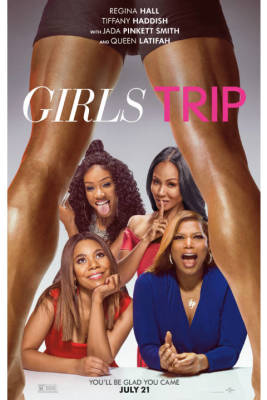
Before I had seen either of them, I heard Rough Night and Girls Trip being compared to one another quite a bit. Well, twice at least, on two different podcasts.

Although the podcasters deemed both films to have a bit of value, it seemed pretty clear that Rough Night was considered the mildly superior effort -- a problematic distinction since Girls Trip has a cast of primarily African-Americans (with one notable exception), while Rough Night has a cast of primarily whites (with one not-so-notable exception). Just because the distinction was problematic, though, didn't make it not true, and I worried a bit about that going into them.

When I saw Girls Trip three weeks ago, though, my fears of its inferiority -- not with respect to Rough Night, which I hadn't seen yet, but in general -- were immediately laid to rest. Simply put, I loved the movie. I thought the tone was great, the set pieces were suitably hilarious (if not all totally successful), and the friendship between the characters seemed real.

None of these things were true for Rough Night, which I saw last night. In fact, I found it pretty rough.

Which I have to say is kind of a relief.

I don't want to go around artificially inflating the value of movies made by and starring African-Americans, though I do breathe a sigh of relief whenever I genuinely love one. This is for a couple reasons, some societal and some specific to me. For one, especially in the post-"Oscars so white" era, I want primarily black films to be genuinely appreciated by people, and not just included in awards discussions for reasons of liberal do-gooder tokenism. Box office is probably the better way to determine how well a movie is legitimately liked, and in the case of a movie like Girls Trip, probably the only way, as awards talk won't enter into it. In that regard I'm glad to say the movie seems to have been a smashing success, bypassing $100 million at the U.S. box office -- which is $80 million more than Rough Night made.

For me personally, though, it helps reinforce my critic's oath to remove my own personal demographics as much as possible from my judgment of a film. As I am a white male about to turn 44, there are certain films that are more likely to be aimed at me than others, and your average person tends to gravitate more toward films aimed at them. In fact, a friend who saw Girls Trip and thought my 8/10 review here was generous said "I don't think I was the target audience." Well, as a critic, you are always the target audience. You're supposed to divorce yourself from your particular biases and see the films through the eyes of the person it was meant for. Any time a Girls Trip comes along, I am relieved to be reminded that I'm still making good on that implicit oath.

Rough Night, it turns out, deserved to make only 20% of what Girls Trip made. My own numerical grade, had I been reviewing it, would have been 50% of what I gave Girls Trip, or 4/10.

Both films feature a core group of four college friends who get back together for a wild weekend that celebrates their previous wild times, and as might be expected, they have differing personalities with all personality types represented -- the uptight one, the crazy one, etc. A fifth outsider is added in both cases as well, though she plays more of a role in Rough Night than Girls Trip.

The big difference is how much these four feel like they were actually friends in college. They do in Girls Trip and they don't in Rough Night -- though I suppose I should acknowledge that Rough Night has the responsibility to be all things to all people, while Girls Trip can exist as more of a niche product intended for African-American audiences (and anyone else who happens to want to watch). Perhaps because Rough Night needs to offer us an array of demographic types, including a heavier one, a lesbian one (who also functions as Jewish one) and a black one, it convinces us a little less that they were all friends in college, despite a scene showing them in those days. Girls Trip also has this scene, and I suppose in a sense, they are more "like" each other in that they are all black women. But chemistry is the biggest factor here. The Girls Trip women have it; the Rough Night women don't.

Comedies like this place a lot of stock in their set pieces, and here I noticed a big distinction as well. The set pieces in Girls Trip go somewhere, literally. They all take place in different locations. I couldn't help feeling claustrophobic as I watched Rough Night as they keep ... coming ... back to that house. It's a nice house, but I got tired of looking at it.

Then I had my basic problems with some of the logic of Rough Night, and spoilers will follow here if you want to tread carefully. So they accidentally kill the "stripper," who is actually a diamond thief who shows up at this house at about the time the stripper was supposed to show up (though why, we never learn). They then spend what seems like hours trying to dispose of his body -- enough that Scarlett Johansson's character says they have to hurry because they can't dispose of a body in broad daylight. Only then does the real stripper finally come, with no explanation for his lengthy delay, so of course they mistake him for a police officer (because he's dressed as one). If the stripper doesn't show up until 2 in the morning, or whenever the film would suggest this is supposed to be taking place, shouldn't he not bother coming at all? The failure to explore the consequences of all their misdeeds also seemed to be a lame concession to Hollywood happy endings.

Then I absolutely hated the subplot about Johansson's fiancee, who because of one of those classic "I can't hear what you're saying because your cell phone reception is bad" misunderstandings believes that she is going to leave him. So he puts on adult diapers and drives all night to Florida to try to get her back. Any time spent on his dumb shenanigans -- including an unnecessary scene devoted to picking out the wrong brand of diapers, and a scene where he runs out of money and has to wash windshields at a gas station for gas money, a delay that would counteract the need to drive without stopping and wear diapers -- is wasted time. Never mind the fact the drive ultimately takes him no longer than a couple hours anyway, as he arrives in Florida while it's still nighttime, at a time that could have been no more than four or five hours after the misunderstood phone call.

Both films address their racial politics in ways that are telling in terms of how obliquely they address them. I really liked the head-on way Regina Hall's character tries to tell token white Kate Walsh which black catchphrases she should not be using. Walsh's character is indeed there to represent a certain type of cluelessness, a certain way whites try to appropriate black culture, but as the film goes on it's clear she has a good heart and means well. The film doesn't put here there just to make fun of her. Meanwhile, in Rough Night, the one black character is Zoe Kravitz, who it should be noted is very light-skinned. I note that only because if you are being cynical, you could suggest that she was cast because she had a skin tone that would not put off the target audience -- though I of course am not that cynical (right). I don't remember the exact exchange that occurs about her race -- I think there is exactly one -- but another character essentially accuses her of not being black enough. It's never explained why she is not black enough ... we should assume at least it's not because of her skin tone, because that's outside her control and no one could be that cruel, but because she doesn't "act black," which is perhaps even more troublesome.

So the box offices have spoken, and though I don't know how these films did in Australia, I was pleased at least that my theater was pretty full when seeing Girls Trip, and a lot of people were laughing. I sometimes worry about how "black movies" will play here ... and I'm not always in the cinema myself to judge in person, unfortunately.

In terms of Australia, I should end by saying that one of the bright spots in Rough Night is Kate McKinnon and her Australian accent, which is largely on point. Now, getting four American actresses to play Australians, and to showcase who can do the best Australian accent in a raucous weekend in, I don't know, Fiji ... that's something I would pay to see.

Thursday, September 28, 2017

Asian Audient: Enter the Dragon

This is the ninth monthly installment in my 2017 series Asian Audient, in which it should be fairly obvious the types of movies I'm watching just from the name of the series.

I had gone this far in my life without seeing a single movie by one of the great cinematic icons of all time, Bruce Lee. It was long past time to rectify that, and this series gave me a good opportunity, but it was perhaps not quite the oversight I originally thought it was. Instead of having dozens of movies I had missed seeing, the man had only five, I was surprised to learn, before dying of an allergic reaction to pain medication in July of 1973. Five in which he does the things he's celebrated for doing, I should say, as preceding that was a career in roles that didn't depend on his fighting skills. In terms of martial arts roles, it was only five. I suppose he's a bit like James Dean in that way -- he made a big impression in a comparatively short amount of time.

Of these five, I was then sort of surprised to learn that Enter the Dragon was his final completed film, though one he started came out five years after his death (Game of Death). As the only title I would have immediately associated with Bruce Lee, it seemed more likely to be the film he released at the height of his heyday. But ah, he was at the height of his heyday when he died -- it's not like, at age 32, he was already winding down. Enter the Dragon was, in fact, released after he had already died, giving it something in common with The Crow, the film his son Brandon died while making some 20 years later.

Needless to say, for legitimate cinephile reasons and many other reasons, I was glad to finally get a Bruce Lee film under my belt. But I sort of had to cheat to do it.

When I set out on this series, I had a fairly specific idea of what constituted an "Asian film," even though there were thousands of films that would adhere to that standard. It could be anything from any country, but one thing was clear: It needed to have been made by Asians, starring primarily Asians, set in Asia, and spoken in an Asian language.

I broke at least one of those rules to watch Enter the Dragon, but it was totally unwitting.

As I did not research Enter the Dragon before watching it, I had no notion that a wide variety of Lee'c co-stars were westerners, and even more troublingly, the film was in English. At first I thought it was only dubbed in English, as it was clear the dialogue was done in post. But I noticed that the dialogue was always matching the shapes their mouths were making, so it was shot in English (but without sound), and then recorded in English by people who could probably enunciate their dialogue a bit more clearly than the Asian actors, or possibly by those actors themselves.

At first I tried to switch the spoken language to Chinese, but the option did not exist on the BluRay. I could hear French, Italian and a couple others, but not Chinese. Which I guess makes sense, as the film was not actually recorded in Chinese, so why make it available on anything but the DVDs that are specifically tailored to a Chinese-speaking audience. When Lee's western co-stars started appearing on screen not long afterward, I realized I was watching a movie that was made in English and seen by most of its audiences that way. It was also directed by an American, Robert Clouse, and what's more, I realized that it was one of only two of Lee's five key works that was in English.

Not exactly what I was going for in this series, but it was an honest mistake, and with only a few days left in September, it was too late to switch to another option for the month.

Besides, I really wanted that Bruce Lee movie.

I ended up mostly happy with the movie, at least with Lee's contributions. And I loved that it was kind of a blaxploitation crossover, featuring Jim Kelly as a wiry African-American with some percentage of Lee's skills. I did wish it had gotten to the action sooner and a bit more regularly. There's a fairly dead portion of the first hour which contains few set pieces and squanders a lot of time on development of the spy plot in kind of uninteresting ways. It didn't totally lose my attention, but let's just say I was distractable. I wasn't totally following the plot at all times, though I was also aware I didn't need to be in order to get the essence of why it's thought of as a classic.

And most of that comes down to Lee's performance in the last 20 minutes of the film or so, first in the scenes in which he's fighting hordes of oncoming minions, and then in his final showdown against the "Big Bad," who keeps on marking him with the three parallel slashes of his Wolverine-like claw.

I guess I wasn't 100% certain why Lee was such an icon, but I was pretty sure it had to do with him being that much more badass than the next guy. The ending really showcases that. Not only do we get all the Lee in-fight vocalizations, which seems to be where my friends and I probably culturally inherited our tendency to say "hi-YA!" when pretending to be martial artists, but we get the quick snapping and whipping of his moves, his brutal takedowns of opponents. While much of the choreography felt in line with what I've seen in many other similar movies, there was one shot that really drew my attention to something distinctive about Lee's moves -- whether it was warranted or not. In this shot there's an opponent with his back to the camera, and as Lee kicks him, he wipes him off the side of the screen quick as a flash, like so much insignificant trash.

The guy was badass, no doubt, and I look forward to seeing more of his films. Even though this is his most famous, and pretty much all the posters I've ever seen of Lee come from here, I suspect his Chinese language films have a bit more authenticity and credibility than Enter the Dragon. I'm not going to say you can see its Hollywood influences, especially not by today's standards, though I suppose then you probably could. I do suspect that particularly The Big Boss, Fist of Fury and The Way of the Dragon would conform a bit more to what I thought I was looking for from a Bruce Lee movie. I wasn't looking for or expecting the 70s cheese on display here, though I did appreciate it on some level in its own right.

I wonder how it must have been for American audiences just becoming acquainted with Lee in Enter the Dragon, to know that he was already dead. Surely many of them would have seen his earlier films, but often a foreign actor doesn't come on Joe Blow's radar until he makes a crossover film, and this seems to have been Lee's first real crossover. The sense of lost and wasted talent must have been akin to my thoughts upon first seeing and falling in love with The Crow, particularly Brandon Lee's performance ... and then realizing I would never see another one.

Okay, it's Halloween next month, and to celebrate the occasion I expect to return to Japan for the fourth and final time in this series with Ringu.

Monday, September 25, 2017

A concentrated dose of Bridget Everett

When I first saw Bridget Everett, she was wearing an outfit something like this. It wasn't this one, exactly -- in fact, it was a red dress that left as little to the imagination as this, but I couldn't find any stills I liked of that online so I went with this one instead.

It was as the closing act on an episode of Inside Amy Schumer, or possibly a Schumer concert movie, and it had what I'm sure was the intended effect on me. Bridget Everett is a confronting person. Her comedy is raunchy, her confidence is off the charts, and she's in on the joke. If Amy Schumer is supposed to be a knowing variation on the way women sell themselves as sex objects -- but one that shows she still has a fair bit of vanity and still wants to be considered sexy -- then Bridget Everett is the utterly vanity-free version of that. Oh, I'm sure Bridget Everett considers herself sexy -- with that kind of confidence, how could you not? -- but her very persona is about eschewing vanity. She's not "ladylike." She's not "a size six." She doesn't care if a dress makes her look good or if it functions purely as a prop in her in-your-face brand of do-anything-for-a-laugh comedy.

This discomfited me a bit. I didn't know what to make of her. We're used to being able to see someone perform and instantly categorize them as some version of a known commodity. And I'd like to say this was a good thing; the ideal me would definitely say that. The real me left with a funny taste in my mouth, one I couldn't quite reconcile.

This was maybe as long as a year ago -- heck, maybe longer. I didn't think of Bridget Everett again until I saw her in two movies this past weekend.

The first came Friday night. It was Eli Craig's follow-up to a favorite of mine from a few years back, Tucker and Dale vs. Evil. Little Evil, as this one's called, is a Netflix original horror-comedy that looks at an antichrist child -- think Damien in The Omen -- from the perspective of the boy's well-meaning stepdad. Adam Scott is that guy, Evangeline Lilly is his wife, and Bridget Everett is a fellow "stepdad" -- a lesbian woman playing the father role, so to speak, in the relationship with her new wife and her wife's daughter (or was it son? I can't remember).

When I saw Everett come on screen, I thought "I know that woman from somewhere." And then, after not too much longer: "Oh yeah, that was that woman gyrating and pulsating around in a red dress on Amy Schumer." Because I think the dress warrants some attention, here, I'll include one of those less-than-ideal pictures:


Although I'd not known what to make of Everett the first time around, a positive impression formed more quickly and more concretely this time. In Little Evil Everett makes for a truly distinctive entry in the age-old "funny best friend" trope. She constantly calls Scott's character "bro" and acts basically like a douchy guy for most of the movie -- a douche with a heart of gold, though. I wasn't sure I liked Everett on Amy Schumer but she was super likable here. She pulls that off without resorting to any of the usual softening tactics that make you like an edgy character. Everett gets to be likable on her own terms, without losing any of that edge. Her character's dialogue and actions are a constant surprise, and a good one at that.

The rehabilitation of Bridget Everett -- or rather, my comprehension of her value -- took another big step forward when I saw her turn up in Patti Cake$ on Sunday night. Here she plays the alcoholic train wreck of a mother to the title character, an oversized New Jersey girl named Patricia who wants to become a rapper (Danielle Macdonald). She's perfectly cast as the bawdy former singer who spends her evenings trying to relive past glories by drinking herself into oblivion and singing karaoke at the local bar.

What impressed me so much this time is not that she has great comic timing and can give turns of phrase her own distinctive spin, but that she can play drama, too. You wouldn't necessarily expect dramatic nuance from a woman who goes on stage and pulls her dress over her head, revealing her underwear, and knowing that this will be funny rather than sexy. But it's really there. There's real pain in this woman who didn't become a great rock 'n roll singer like she hoped, and now must try to get by on the meager support offered her by her 23-year-old daughter who tends that bar and does odd catering jobs. But there's also a bit of hidden menace, a bit of spiteful superiority, that suggests this woman could knock your block off too.

I'd say there's probably not a wide range of options for a comic actress who looks like Bridget Everett does, and Rebel Wilson has already kind of given us a template for the type of career a woman like this can have -- funny, but possessing sexuality that's the subject of slapstick humor more often that it is anything else.

But in these two very different roles, Everett has already given us a glimpse of her possible range. Sure, she can play a comedy sidekick MVP in a broad comedy, as Wilson would. But indie drama, which requires getting in touch with a real inner anguish, is also something she does with distinction.

More than anything she's memorable, which is becoming increasingly uncommon even with "pretty faces." You may not be sure what you think of Bridget Everett from one performance. But then watch another one, and you will be.

Saturday, September 23, 2017

The quest for 5,000

The next new-to-me movie I see will be my 4,900th, which for all you math whizzes out there means I have just a hundred to go before a major milestone.

I've got to recognize that milestone through something clever and distinctive, but I just can't figure out what viewing #5,000 should be. And it may take every one of those hundred more viewings, which figure to take between four and five months, to land on something suitable.

Can you help?

I guess to be a real help you'd need to know which movies I've seen and which I haven't seen, and I'm not about to post a list of 4,899 films (though I suppose I wouldn't put it past me either). But maybe you can help with the type of film it should it be.

Should it be the greatest film that exists that I've never seen -- a kind of white whale? Should it be the longest feature film I've ever seen? Or should it just be something that deals with the concept of 5,000 or has 5,000 in the title?

It may, or may not, be instructive to look at how I've celebrated previous thousand-film milestones.

My 1,000th film was not something I consciously chose for the occasion. It was the Mel Gibson vehicle Payback, and it must have been 1999, the year of its release, though I definitely watched it on video (it came out in March). I obviously recognized the milestone was approaching because I made note of the title, but I apparently didn't see it fit to schedule something worthy of the occasion. So that's right out in terms of helping us.

Number 2,000 was a different story. List fever fully had its grip on me by then, and I chose Casablanca, which was what I considered my most prominent film on my list of shame at the time. That was only in 2005, which means that yes, I have watched nearly 3,000 films in the last 12 years. A bit scary, but true.

For 3,000 I went for pure cleverness. I had not yet seen the Bernie Mac vehicle in which he plays a former baseball great coming out of retirement to pursue his own milestone, the 3,000 hits that had only barely eluded him when his career was cut short by injury. So Mr. 3000 it was. That was in 2010, in the era of this blog, so you can read about it here if that floats your boat.

I guess I've been speeding up as I go, because after taking 26 years to hit 1,000, another six to hit 2,000 and another five to hit 3,000, viewing #4,000 came along only four years later in 2014 -- four years and three months, to be exact. That's when I watched F.W. Murnau's Sunrise, another in the "great films I haven't seen" tradition. Maybe it being silent also made it seem "special" for the occasion. That's discussed here.

It'll certainly be less than four years for the next thousand, unless it somehow takes me nearly a year to watch my next one hundred. And though it's probably a bit dangerous to reflect on the life choices that have made this increasing speed possible -- there must be something I'm sacrificing -- this will be the first thousand films that have taken place entirely within the era in which I had children, meaning more time at home and more time with the TV set.

If you look at it as a system of alternating philosophies, going back and forth between neglected greats and clever choices, it would be time for another clever choice. But no film comes to mind with the word 5,000 in it, like it did for Mr. 3000. Let's see what IMDB has to offer:

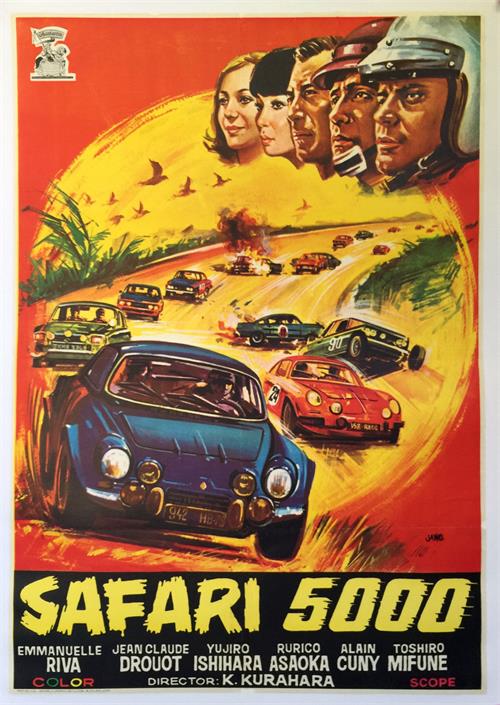
Safari 5,000 is a nearly three-hour 1969 Japanese film that I would almost surely not be able to get my hands on.

The 5,000 Fingers of Dr. T is a 1953 musical written by Dr. Seuss.

And that's it in terms of features. And no, shorts and names of TV episodes will not work for these purposes.

So maybe I need to neglect the alternating system and go again for "greatest film I haven't seen yet." But as I've been doing my due diligence on catching up with the greats, there's no longer an omission as glaring as Casablanca, or even as Sunrise. Sure, there are titles I could put in there, but would they seem 5,000-worthy?

Five thousand is, in a way, the most significant milestone to date, other than maybe 1,000. Milestones are always more interesting when they involve round numbers. It might be the most significant milestone I will ever have, since there's no guarantee I will live long enough to double my current output. (Though if I stay at this increased pace, it could take less than 20 more years to get there.)

So 5,000 could warrant a different approach for honoring the milestone, and that's where something like length comes in. Needless to say, there are behemoths out there I have never made time for. But do I really want to spend all day watching Shoah for my 5,000th movie?

Well, as I said, I've got four or five months to figure it out.

It's possible during that time, something will hit me like a bolt of lightning, announcing itself as the obvious choice. Or, I'll have to compromise and just go with something "good enough." And then there's the part where reality encroaches, where I lose some ability to choose #5,000 by factors outside my control, like movies I may be reviewing. I'd like to think I would be careful about that, but once you get to #4,999, you're out there without a net, and might "accidentally" see something unintended as your next choice -- or suddenly have difficulty sourcing that choice.

Anyway, let me know if you've got any good ideas.

If worse comes to worst, The 5,000 Fingers of Dr. T is available for rental on iTunes.

Tuesday, September 19, 2017

Cat's Away 2: The Right ending

I am ready to collapse in a heap, and take at least one night off from watching movies. (Well, exactly one night, as I am already scheduled to see Mother! on Wednesday night so I can podcast about it on Thursday.)

But before I do that, I must wrap up Cat's Away 2, the second nearly week-and-a-half-long personal film festival I've run in the past two months while my wife has been on trips out of the country.

When the first Cat's Away ended, I explained that I chose Pulp Fiction for closing night over Do the Right Thing because Pulp Fiction was "more fun," or maybe even just "fun." One intrepid reader challenged me on that, explaining (correctly) that Do the Right Thing is also fun in its own way. "Cat's Away 2 is when you realize Do the Right Thing IS fun," he wrote.

Well, I rose to the challenge.

Spike Lee's 1989 masterpiece is one of my most long-neglected films. I currently rank it #10 on my Flickchart, but it's been since sometime in the late 90s, I would guess, since I've seen it. And I suppose the sense that it's "work," that its confrontations about race are not something I'm always eager to sit down with, have contributed to the delay in revisiting a movie I obviously love. Part of that love, I suppose, is a belief in the film's importance, which can make a film great but maybe not always something you want to unwind with. But Do the Right Thing is a film that needs to be revisited more often than every 20 years.

What struck me on this viewing is that the film is not as "realistic" as I may have considered it. Certainly, Lee works in a general realm of realism in recreating a combustible Bed-Stuy neighborhood on the hottest day of the summer. But this movie is more an impressionistic view of racial disharmony than probably an accurate depiction of the ways people really relate to each other. The racism we view in our everyday lives -- with notable exceptions like Charlottesville -- tends to be more subtle, more of an undercurrent, nothing so confronting as we see here.

But Lee's role as a filmmaker is to confront. He's giving us a direct feed into the rage he feels as a black man in America -- and boy do I wish that rage were something that the 28 years since then have helped heal. But Do the Right Thing feels as relevant in 2017 as it ever has, which makes it even more worth revisiting.

This movie is not just about rage, though, and that's where the "fun" part comes in. Lee does deceptively complicated work of setting up a whole neighborhood here, one that feels composed of real people who have real relationships with each other, and not always contentious ones. Moreover, they have fun together. There's a lot of humor, love and mutual appreciation in this film, which keeps it bouncy and not as ponderous as you might expect from a finale like this one has. Even after its finale, though, it shows gentleness and love -- Mookie and Sal, who should logically hate each other after what has transpired, end on terms of a kind of mutual respect. This is a neighborhood with ties that bind, even if deep-seated prejudices keep them apart.

Usually I rebel against cinematic adaptations of plays because I think it's too easy to see the film's stage origins, which often contribute to making it feel small. But when a film is not adapted from a play, as Do the Right Thing is not adapted from a play, but only feels like it might be adapted from a play because of its setting and scope, that's something different. Part of Lee's method is to be intentionally theatrical, as you would on a stage, and it's part of what makes the film so affecting. When I think of Mother Sister letting out those desperate wails at the end -- "No! No! No!" -- I think of a piece of drama that is intentionally constructed as something like Greek tragedy. Even within itself, her reaction is not "realistic." Just moments before, she had gotten caught up in the rage directed at Sal's Pizzeria, yelling "Burn it down!" with the rest of the crowd. That she is bemoaning what has happened, as if she played no role in it or tried to prevent it, is not therefore "realistic." Instead, her cries are like the cries of the wounded soul of the American psyche, and in that regard they are incredibly powerful.

As we wrap up, here's a chronological list of my viewing:

Inception
Silence
Trainspotting
T2 Trainspotting
Schindler's List
Personal Shopper
Moana
Blow Out
To Die For
Song to Song
Peeping Tom
Spring Breakers
Singin' in the Rain
The Lego Ninjago Movie
Watchmen
Do the Right Thing

That includes:

- Seven movies that were new to me
- Nine rewatches
- All sixteen movies in English except for some random German (Schindler's List) and Japanese (Silence), and some thick Scottish accents
- Eight movies from the 2010s
- One movie from the 2000s
- Three movies from the 1990s
- Two movies from the 1980s
- One movie from the 1960s
- One movie from the 1950s
- Five library rentals
- Three movies from streaming
- Three movies from my own collection
- Four iTunes rentals
- One movie in the theater
- And a variety of different genres and styles

Will there be a Cat's Away 3?

At the moment, not that I can see, and that's fine with me. Intense periods of film watching like this are great, but would I want them to last longer than they do? Not really. By the end I'm exhausted. And two in the space of two months just increases the exhaustion factor. Ready for a return to regular life.

My wife is indeed going out of town for three nights at the end of October, but three nights does not a film festival make.

But will I be watching movies those nights?

You betcha.

Monday, September 18, 2017

Cat's Away 2: Watch man

Second-to-last night of Cat's Away 2.

I'm a watch man. That's what I am. I'm a man who watches. Movies, I watch.

What, you think you could come up with a better title?

Ah, maybe you could.

Anyway, I'm also a man who is running out time and running out of steam. Because I'm sticking to a post-a-day schedule, and because I've had a very busy Monday, this post is the only thing standing between me and closing night of this festival. So I will be almost comically brief in my recap of Sunday's movies, which surely deserve a bit more ink than I'll be giving them.

Singin' in the Rain

The Sunday morning time slot on one of my marathon movie weekends is usually reserved for an old favorite I know like the back of my hand. Singin' in the Rain is an old favorite, one my lists tell me I have seen more than once, but I don't even know it like the back of someone else's hand. I can't remember how long it's been since I've seen it, but suffice it to say a lot of it felt very unfamiliar to me. Such as:

- I would have sworn the title number came in the first 20 minutes, but it doesn't arrive until the hour mark.

- I was quite surprised to learn that the film has one of those 10+ minute fantasy dance numbers that seem to afflict films of this period; I say "afflict" because they always seem like filler, and because it's one of my chief complaints about films like An American in Paris and Oklahoma! If even Singin' in the Rain has one, I guess I have to rethink my thoughts on the subject.

- How is Donald O'Connor not a household name? That "Make 'Em Laugh" number is a show-stopper, as my fellow podcaster, Blake Curtis, told me it was.

I barely finished the film in time to run out of the house to go meet my sister-in-law and my kids to see ...

The Lego Ninjago Movie

Thoughts:

- Love these advanced screenings, even if the movie ends up not being great; the celebratory air, the free tickets, the free popcorn and drink, the paper masks of Ninjago characters. (I guess that last one is only for this movie.)

- My three-year-old is a dick. Not three minutes into the movie he made my sister-in-law trek out to the car to get his blankie, a trip that took them 20 minutes. He then made her take him for a walk again later in the movie. I don't think she cared -- I had asked her to help in such a scenario because I was reviewing the movie and needed to give it my full attention -- but it annoyed me. He wasn't like this in his first movie, Cars 3.

- Lego may be trying to start up a cinematic universe, just like everybody else is doing, but this is its first clear misstep. Maybe the problem was not having a built-in audience for the characters, and therefore having to do more work and potentially alienating adult audiences, but I just never really fell in sync with this movie. It repeats the same comic and emotional beats of its two better predecessors, and spends much of the time offering about the same level of visual coherence of your standard Transformers movie. Stay tuned for my review.

Watchmen

- After I got the kids to bed I sat down for all three hours of Watchmen. Yes, I seem to have been powerless to play anything abut the 185-minute director's cut on my BluRay. Aren't these things supposed to come with the theatrical option?

- But that's okay, because that was when Zack Snyder was a good director. Yes, we may forget it, but there was a time. I was curious to watch this in the wake of his two failed movies featuring Superman, to see if the bad tendencies were still there back for this movie that I loved, but had since come to think of as sort of a guilty pleasure. Nope. I'm still comfortable calling this movie kind of visionary. And the added scenes didn't stick out the way added scenes sometimes do, to the extent that I could only be sure of one addition: a couple scenes related to the death of Stephen McHattie's retired Watchman, who probably died in the graphic novel, but never did in the version I saw twice and ranked in my top ten eight years ago. And had not seen again since ... until last night.

Sorry, movies, for the short shrift. I'll make up for it with a killer closing night post tomorrow.