Thursday, November 8, 2012

Yes.


I'm going to take a day off from discussing movies and just enjoy.

Wednesday, November 7, 2012

These actors will be sad tomorrow (I hope)

If I were 10% less tired or 10% more willing to churn out something unoriginal, I would come up with some kind of movie-related list to honor Election Day. I mean, I've got to recognize the day somehow. Even with about four posts backed up, I don't feel like I can just write any ordinary old post on this first Tuesday in November.

But you've already seen other people tell you the best (or worst) movies about presidents, the best (or worst) movies about elections, and any other feature you can imagine as a variation on these themes: who would play Barack Obama and Mitt Romney in the movie, which candidate has a better favorite movie of all time, whether there are more good movies with red in the title or with blue, etc.

So instead, I just decided to give you a bunch of faces of Hollywood Republicans looking sad.


Yep, that was juvenile. But politics makes us all into infants throwing tantrums.

Go vote, everyone -- and while you're at it, vote for Obama, won't you?

Tuesday, November 6, 2012

The sacrificial sleuth

 
SPOILER WARNING: The following post freely discusses plot details from The Loved Ones, Misery and The Shining. If you haven't seen those movies and don't want elements of their plots spoiled, stop reading now.

After sitting on our disc from Netflix for about two weeks, my wife and I finally watched The Loved Ones this weekend. Since my wife's Australian and so is this movie, I figured it would be a slam dunk for her. Unfortunately, I made a bad assessment of what type of movie it was. This poster made me think it was a campy horror comedy, maybe a Mean Girls meets Shawn of the Dead kind of thing. A bunch of kids at the prom have to fight off zombies, or something like that.

Uh uh.

This movie is straight up torture porn. Okay, not really -- the term "torture porn" is usually employed negatively, suggesting a movie that exists only for the purpose of tapping into that reprehensible part of our id that wants to see all the ways a human being might be made to suffer. The Loved Ones has much more of a brain than that.

But it is shocking in all the ways that torture porn is shocking, and that's what made me regret showing it to my wife, who would probably have preferred cinematic comfort food when she was sick, rather than seeing knives hammered into feet and power drills entering skulls.

What I really want to talk about related to The Loved Ones, however, is a cinematic trope it made me aware of, which I'm labeling "the sacrificial sleuth."

Since you bypassed the spoiler warning and presumably have seen this movie, you know that Lola Stone (Robin McLeavy, pictured in the poster) and her father (John Brumpton) have a hobby of kidnapping beautiful teenage boys, torturing them and then lobotomizing them. They store these lobotomized creatures in a dungeon under the floor boards of their living room. The film's protagonist, Brent (Xavier Samuel), manages to interrupt the process on the verge of his own lobotomy, and a chain of events leads to him being pushed into this dungeon, where the lobotomized creatures intend to make him their next meal. He wards off that threat (rather too easily, if you ask me), but he's still trapped down there.

Fortunately for him, there's a sleuth on his trail. The father of his best friend's prom date (Andrew S. Gilbert) is a police officer, and has pieced together enough clues to determine that Lola may have been responsible for kidnapping Brent. The police officer (Paul by name) drives to Lola's house, sees a bunch of blood on the floor, and breaks in with his gun drawn.

When I saw what was happening next, I was overcome by a sense of deja vu.

As the trap door to the dungeon has been left open following Lola and Brent's most recent skirmish, Paul is naturally drawn to the edge of the opening. He's barely had time to register a bloodied Brent standing among zombie corpses before he gets a cleaver to the head, falls in and takes his place among the bodies. Meaning Brent will have to find another (rather convenient and frankly improbable) way of escaping.

I've seen this kind of red herring savior before.

The first example that occurred to me was Rob Reiner's Misery. For much of the movie's running time, we see Richard Farnsworth's local sheriff (Buster by name) slowly and steadily investigating the disappearance of novelist Paul Sheldon (James Caan). He's doing it almost as a hobby, going on hunches and a sense that something isn't right, where we're led to believe that a lesser investigative mind would just assume (as most people do) that Paul is dead. Buster's sleuthing eventually leads him to the house of Annie Wilkes (Kathy Bates), which is indeed where Paul is being held captive. As in The Loved Ones, Buster has only seconds to realize that he has, indeed, found Paul, before Annie shoots him in the back, killing him. 

But as I thought about it more, I thought of another example, also from the work of Stephen King. For the whole of Stanley Kubrick's The Shining, we follow Scatman Crothers' Dick Hallorann during his winter-time retreat to Florida. (In fact, Filmspotting recently revisited The Shining, and the hosts noted just how much we check in with Dick, down to the minute details of his life that don't seem to be important.) Because Dick and Danny Torrance share "the shining," Dick steadily becomes aware that things are not going well back at the Overlook Hotel. Thus begins Dick's long trek back to the hotel -- another journey that is covered in minute detail. He arrives just in time to get an axe in the lower back.

It made me wonder how many other times in movies (or stories in general) we see this trope -- the secondary character who comes to save the day, only to die instantly.

The reasons for the near-immediate death of this character are sort of obvious. He can't save the hero, because the hero has to find his own way out of the mess he's in. The hero is the hero precisely because he summons a kind of inhuman ingenuity to save himself from a seemingly impossible situation.

So then why have this secondary character at all?

My guess is that the audience needs a red herring savior, needs this sense of a possible outside force who will arrive to save the day when it seems unlikely that the hero will be able to do it himself. Since Paul Sheldon has two destroyed ankles and a total lack of mobility, there's no way he's going to be able to overcome Annie Wilkes and crawl through a snowy Rocky Mountain winter to safety, right? So we need to feel like Sheriff Buster is going to put together the clues to rescue Paul. We need to feel the hope that Paul himself does not feel.

When this sleuth is sacrificed, it creates an even greater crisis for the hero. How will he escape now? And so he must be the master of his own destiny. He must find the strength to make a daring play that should never work, but does, because he's used his intellect to outsmart the villain in the end.

While the resolutions to The Loved Ones and Misery are far more similar, including the gender dynamic between the torturer and the tortured (and the fact that there are people being tortured in both films to begin with), The Shining differs a bit from those two. Dick Hallorann isn't really a detective putting together clues, and the hero is Danny, the boy, who only passively kills his father by continue to run away from him. But the dynamic of the outsider arriving to save the day, only to be cut down immediately, is the same in all three.

Can you think of other films that use this same trope? I'd love to hear about it. And let's just hope I've seen the movie you're mentioning, so you don't have to give me a spoiler warning. 

Saturday, November 3, 2012

Excess animation discrimination


Almost exactly three years ago I wrote a post called "Animation indiscrimination," in which I decried my lack of selectivity when choosing animated movies to see in the theater. I was operating under the general principle of "if it's animated it must be good," and one particular viewing really showed me the limitations of that perspective.

Well, watching the dismal Astro Boy must have really had a profound impact on me, because since then I've gone in the opposite direction.

In the three years since Astro Boy, I've seen exactly eight animated movies in the theater. That's less than three per year. For the record, they were Disney's A Christmas Carol, The Princess and the Frog, How to Train Your Dragon, Toy Story 3, Tangled, Rango, The Adventures of Tin Tin and Dr. Seuss' The Lorax. I've seen a couple others on DVD as well.

My general antipathy toward watching animated movies has even led me to shun both of the last two Pixar releases upon their theatrical releases. Granted, Brave and especially Cars 2 do not purport to find Pixar at its finest, but still.

To be sure, this trend is not just an overreaction to my assumption that all movies with state-of-the-art animation must be good. Part of it has been conscious, and has related directly to an event in August 2010: the birth of my son. Since he's been on the scene, I've thought it might be wise to stockpile movies he'd want to watch with me in a couple years. The fewer of these I'd already seen, the more I'd enjoy it when I eventually watch them with him. And if he loved them, it would mean one fewer of many viewings I might ultimately have to endure.

But I also think there come moments in people's lives when they undergo a transition. One day you like something; the next day you've grown out of it. And as I've pondered before on this blog, this transition may have been happening to me over the past couple years. Though there have been features that have reminded me what it felt like to discover animation for the first time (Tangled), there have been more movies that have struck me as only so-so (Rango, How to Train Your Dragon) or just as dismal as Astro Boy (The Lorax).

Of course, when confronted with realizations like this, most people want to blame external forces rather than themselves. And I think there's some validity to that. As with the rest of the film industry, the last couple years have seen the rise of sequels as the current standard bearers for animation. At times I just feel like I'm being stampeded by Shreks, Madagascars and Ice Ages. I react not only by getting out of the way, but becoming depressed about the state of things today. The surest sign of getting old is when you find yourself repeating "They don't make 'em like they used to."

All of this is an excessively long preamble to tell you that I am hoping to see my first animated movie in the theater since The Lorax when Wreck-It-Ralph comes out today. Ralph has just enough of a combination of originality and promise to seem like a good bet to break my current animation losing streak. Which probably dates back almost a full two years, to when I saw Tangled in November of 2010.

In fact, if it were anything shorter than 120 minutes, I might even see it this afternoon, when I get off work at 2:30 but don't have to pick up my son until 5:30.

In fact, I'm really disappointed that it is two hours long, because this is one where I need to strike while the iron is hot. I'm concerned that if I don't, it will fade among my priorities as we get deeper into November, and the year's prestige pictures start asserting their own claim to my attentions. And as much as this post finds me resolving to see Wreck-It-Ralph in the theater, I have to admit that the footage I've seen is not quite as unambiguously awesome as I hoped it would be. I'm not the viewer I was three years ago. Whereas then, I embraced any excuse to see an animated movie in the theater, now I embrace any excuse not to. The possibly slightly-less-than-awesome quality of Wreck-It-Ralph could easily sap my resolve.

But here's hoping it doesn't. I have enough reminders these days that I'm an adult. When the kid inside does want to come out to play, I want to let him.

Friday, November 2, 2012

Kill Bill Vol. 3


I hate to sound uncharitable, but The Man With the Iron Fists seems obvious, derivative and played-out.

Part of the reason I hate to say these things is that I usually like to encourage people from other walks of life, such as RZA from Wu-Tang Clan, to try their hand at making movies. If they have the opportunity to do so, more power to them. I would if I had that opportunity.

But RZA's directorial debut just seems too on-the-nose. One thing that even casual fans know about the Wu-Tang Clan is that they fetishize kung fu. What more predictable way to exercise that fetish than to make a wire-work kung fu movie that also features fancy weapons, busty women, and a generous dose of badassery? And, of course, a trailer song in which RZA and fellow Wu-Tanger Rakewon are featured?

The casting of Lucy Liu gives it an overt connection to Quentin Tarantino's two Kill Bill movies. In fact, on the surface level, she appears to play almost the exact same role here as she did there: the badass female leader of a gang of skilled male fighters who are probably not as skilled as she is. There's even a moment from the trailer that directly recalls a moment from Kill Bill Vol. 1, where we see Liu from the shoulders up, moving forward at a determined pace. Reminds a person of that moment in Tarantino's movie where Liu skips down that board room table to chop off the head of a naysayer, doesn't it?

Since The Man in the Iron Fists is "presented by" Tarantino (seriously, that's his only credit related to this movie on IMDB), none of this may be much of a surprise.

And that's kind of the problem: I want a surprise here. I don't want RZA's directorial debut to be just a wet dream of the iconography he loves. Though perhaps he wouldn't be making his directorial debut at all unless that's what he were going to make. Not everyone can be twentysomething Sarah Polley directing a movie about Alzheimer's. Most people write what they know.

There is actually one surprise here: Russell Crowe. It just doesn't seem like Crowe would be making a B-level kung fu movie, or even an A-level kung fu movie, under most circumstances. Then again, these are not most circumstances. As it turns out, Crowe and RZA know each other from making American Gangster, in which RZA made one of a dozen acting appearances over the years. I guess someone even as generally brutish as Crowe is capable of doing favors.

Hey, The Man With the Iron Fists might be good. If you are lining up to see it this weekend, don't let me dissuade you.

I just think it would have been a lot cooler seven or eight years ago.

Thursday, November 1, 2012

I never meant to see: Exorcist: The Beginning


Well it looks like I'm just creating new periodic features on my blog left and right these days. I created a new one yesterday, and a Devil's Night screening last night inspired me to create another new one today.

This periodic series will be called "I Never Meant to See," and it will highlight films that were thrust into my path quite unwittingly. In an age when we have so much choice about what to watch that we rarely have to settle on something just because "it's the only thing on," it's become increasingly rare that we need to see things we hadn't otherwise planned to see. It seemed interesting to me to explore how we end up watching movies we wouldn't have normally sought out.

First up is Exorcist: The Beginning.

I love love love William Friedkin's The Exorcist, but I've never seen any other films in the Exorcist series and suspected there was really no reason to. Exorcist: The Beginning came my way because I recently received it as a birthday present. A friend who also regularly reads my blog (hi!) gave me this and another DVD that I really hope he got out of the cheap bin (just because I hope he didn't spend too much money on me). The other DVD, Traffic, was, I believe, the serious half of the gift -- an excellent film I have probably praised to him before, which he correctly surmised I did not already own. I don't want to sell Exorcist: The Beginning short by calling it the joke half of the gift, and he certainly didn't describe it as such after I opened the present. But let's just say this movie has less of a logical impulse behind it, given that he and I have rarely discussed horror, and I don't think we've ever talked about the original Exorcist and my love for it. Besides, it's directed by Renny Harlin, who has become something of a Joel Schumacher-style punching bag in cinematic circles.

I hope my friend isn't offended if I admit that I decided to watch it while carving my jack o'lantern last night. Hey, what can I say, multi-tasking is a part of our everyday lives these days. Even with movies I'm really loving, I pause them regularly and sometimes do other things. I knew it would make an ideal companion to my exercise -- something that would fit the Halloween theme perfectly, but would probably also be okay only to be receiving 87% of my attention at any given moment.

I remembered that there had been an Exorcist: The Beginning, but so little was it still on my radar that I couldn't remember how recently it was released. It could have been anywhere from 2002 to 2008, I figured. The release date was not immediately evident from a cursory scanning of the box, so it wasn't until I started watching it and made a general assessment of the age of Stellan Skarsgard that I put it closer to 2002 than 2008. As it turns out, it's from 2004.

My first impression, and one that ended up lingering, is that the movie may owe more to Raiders of the Lost Ark than The Exorcist. In fact, I'll include an asterisk in my writing for every direct link to Raiders. The Beginning follows the story of Father Merrin, the character played by Max Von Sydow in Friedkin's movie, as a younger man who has strayed from the church. He's now an archeologist*, and is involved in a dig for a buried religious artifact* -- actually, a church that has no business being here as it dates to an era before Christianity was known in this region of Africa. He's no longer a priest as a result of events involving the Nazis* in World War II, which are revealed to us as we move along. People who enter this subterranean chamber* continue to have strange things happen to them, signs of possible devil possession. And in a climactic scene, he even tells a character "not to look at or listen to"* any of the devil's lies.

Sorry, by synopsizing the movie by only showing its Raiders connections, I didn't give you a very good synopsis.

For much of the running time, the movie is a lot less scary than it wants to be. Yes, there's some disturbing stuff -- in one memorable scene, an African woman gives birthday to a stillborn child that's basically a rotting baby corpse covered with worms. But there's also some stuff that's just plain ridiculous looking, like a child being attacked by digital hyenas that just don't cut it as organic parts of the environment. The problem really is that you feel a mounting impatience as you wait for what you know is coming -- a true devil possession that resembles, in some form, the possession of Regan MacNeil in The Exorcist. A variety of isolated and generally disconnected images of horror aren't really enough to sustain us in the meantime.

What turned the movie -- which is well executed in most respects -- from a mild thumbs down to a mild thumbs up is, in fact, the climactic devil possession requiring the exorcism. It gives us what we're expecting in terms of iconic imagery from The Exorcist, and here uses CG effectively to add to it. One of the scariest elements of The Exorcist is the devil's dialogue, not only the horrible and uncensored content, but the sound of that voice (or several voices) coming out of that body. The Beginning understands this part of what makes The Exorcist scary, and has a good amount of fun with it in the final 10-15 minutes.

More than anything, I'm glad I saw Exorcist: The Beginning for the same reason I wanted to create this new periodic feature on my blog. There sheer quantity of movies in existence means that many of them necessarily disappear into the ether unless we go out and grab them. And because I have a generally democratic concept of what I'll watch -- really, I'll watch almost anything -- sometimes it's nice to have random movies thrust back onto your radar, when they should have long ago been gone from it forever.

I mean, if I'm going to accomplish my stated yet admittedly impossible and also ridiculous goal of seeing every movie that's ever been made, I can't be forgetting about movies like Exorcist: The Beginning, now can I?

Happy Halloween everyone.

Wednesday, October 31, 2012

I finally saw: A Nightmare on Elm Street


A couple times on this blog I've sought your feedback on what movie I'm most embarrassed I haven't seen.

I've mostly considered the true classics as primary contenders for this honor, but there are plenty of movies it's surprising I haven't seen because of my audience demographic. In other words, everyone else my age with more or less my background has seen this movie, but I haven't.

A Nightmare on Elm Street would certainly qualify. That is, until I finally saw it on Saturday night.

So I'm introducing a new feature on my blog called "I Finally Saw," where I'll discuss movies that were new to other people in the 1980s or 1990s, but are only new to me today. Will they hold up? Will I be able to put myself in the mindset those people had when they originally saw these movies? That kind of thing.

I may never have seen it, but I've definitely had impressions of A Nightmare on Elm Street since it came out in 1984. A lot of my friends saw it right around that time, even though we were only 11 going on 12. I wasn't one of those kids who gravitated to horror movies at a young age. I didn't like to be scared until the past decade or two, and the disturbing things I imagined happening in A Nightmare on Elm Street (I found this poster particularly disturbing) were things that I ran from rather than embraced.

Before I go on, I'll say that if you are like me and hadn't seen this, you deserve a SPOILER WARNING.

So one of the things that surprised me about this movie is the low body count. Unlike many other slasher movies, which offer up a good six or eight characters to kill off, Nightmare introduces us to a mere four teenagers, only one of whom ends up getting killed by Freddy Krueger's famous finger knives. Of the other two, one gets hanged and another (Johnny Depp) is basically vaporized into a geyser of blood.

Some of the structuring of the deaths kind of surprised me as well. In what should be a scene with life-or-death stakes, Depp's character falls asleep while standing guard as Nancy (Heather Langenkamp) enters her dream to confront Freddy. Given how much emphasis is placed on not falling asleep, thereby letting Freddy kill you in your dreams, it's rather amazing that the script doesn't kill off either of these characters when Depp starts to snooze. Under ordinary horror movie morality, death should be the just punishment for a weak character not taking the threat seriously enough and falling asleep on the job. But Depp's death occurs later under sort of lame circumstances. He's supposed to come over to help Nancy (a second time) at midnight on a particular night, but falls asleep. What's lame about it is that he actually falls sleep twice, and the first time is awoken at about 11:40 -- in other words, with plenty of time to cross the street to Nancy's house before midnight, but not so much time that he'll accidentally fall asleep again while waiting. Yet he does accidentally fall asleep again, and this is when he buys it.

Another thing I found strange is that none of the deaths show Freddy's actual participation at the moment of death. On the one hand, that's by design. Freddy is not actually present in the real world; he's only killing them in their dream. So when the first victim's stomach is sliced to ribbons and she's dragged up a wall, it's appropriate that we don't see it, because Freddy isn't actually "there." It's useful for the audience to see what her boyfriend perceives is happening to her. But once this is accomplished, wouldn't it be better to see Freddy taking a more hands-on approach in the next two murders? Instead, we just see a guy in a prison being hanged by his own bed sheets, and a volcanic spray of blood coming out of a bed.

Now, the stuff that surprised me in a positive way. The Freddy stuff we actually do see managed to be pretty disturbing. Oh, I'm not saying I had nightmares myself about it, just that it was objectively more scary than I thought it would be. Like, when he's struggling with one victim who manages to peel the features off his face, revealing a cackling skull. Or the ominous quality of Freddy's arms as they extend 15 feet out the side of his body. Or like when another victim asks Freddy what he is, and he slices open his skin as his wordless answer, unleashing worms and maggots.

And that leads to another surprise about Freddy: I thought he was a lot more of a talker, and specifically, a wisecracker. In fact, he doesn't talk nearly as much as I expected, and there are almost no groan-inducing puns. My guess is that this aspect of his persona doesn't really take off until the sequels -- all of which, not surprisingly, I have also not seen.

Still, A Nightmare on Elm Street seems a bit more dated than other seminal horror movies from this period. It doesn't have the timelessness of Halloween or even the original Friday the 13th, which is probably a reflection of it being filmed deeper into the 1980s than either of those films. (In fact, Halloween wasn't made in the 1980s at all, having come out in 1978.) So perhaps I'm just expressing a preference for the 1970s horror aesthetic over the 1980s horror aesthetic.

I can tell you one place that Nightmare steps horribly wrong. In an ending that leaves things wide open for the multiple sequels, and expresses for certain that Freddy isn't dead (the way he's dispatched barely even suggests he might be dead), Nancy's mother is pulled through the window of her front door in the film's final shot, presumably by an unseen Freddy on the other side. You're supposed to be chilled by this, right? Uh uh. It's so obvious that the body being pulled through the window is a doll that it's downright funny. The doll's legs even catch on the side of the window in a way that make them bounce in a completely doll-like and completely inorganic manner.

Regardless of this unintentionally funny image the film left me with, I'm glad I "finally saw" A Nightmare on Elm Street, and ultimately I rate it pretty highly simply for its place in horror history.

Also, now I finally get that Simpsons Halloween special where Groundskeeper Willie gets burned in the boiler room and attacks Bart and Lisa in their dreams.

Tuesday, October 30, 2012

And the award for "Strangest Use of Hugh Grant" goes to ...


There are many strange (and usually wonderful) things about Cloud Atlas, but probably the biggest (also wonderful) disconnect for me was seeing all the various incarnations of Hugh Grant.

Grant is an actor who has been used in one very specific way throughout his entire career: a handsome and charming Englishman given to stumbling over his words and finding himself in delightfully awkward situations.

Suffice it to say that this does not match any of the six incarnations of Grant from Atlas. I would love to show you all of them here, but google images is not cooperating with me -- the movie probably hasn't been out long enough for any stills to be available other than those specifically selected by the studio's publicity team. And besides, part of the fun of seeing Cloud Atlas is trying to recognize who everyone is in each scene.

But here, how's this for starters?


Can't you just see him stammering? "I, well, I rather think that this makeup makes me look just beastly. I'm really a rather quiet fellow."

Obviously the award in this post's title does not exist, but there's an Oscar for which Cloud Atlas seems like a shoe-in: best makeup. This film is as brazen a display of makeup chutzpah as you are likely to see, probably ever, in a movie. Whether it all works or not is open to debate. But most of the dozen recurring actors play at least one different race or one different gender from their own, and even when they are their own race or gender they are not always recognizable. The closing credits offer us a glimpse of the roles essayed by each actor or actress, and the audience I watched with gasped in amazement during these revelations.

So yeah, even with movies like The Hobbit entering the discussion, Cloud Atlas seems likely to leave the rest of the field in the dust when it comes to the makeup category. And if not "best makeup," then at least "most makeup."

In fact, everything about Cloud Atlas is some kind of "most" -- most characters, most genres, most time periods, most different locations, just plain most ambitious. I like the comment by critic A.O. Scott: "This is by no means the best movie of the year, but it may be the most movie you can get for the price of a single ticket."

He's probably right about both, but I'll say only probably. The more I think about Cloud Atlas, the more it may scramble its way up that messy hillside toward greatness.

Sunday, October 28, 2012

A thing I'm starting to understand about The Hobbit, and my TV


I've been aware that Peter Jackson was shooting the (formerly two, now three) Hobbit movies at the higher rate of 48 frames per second (twice the normal 24).

Whenever I've heard that mentioned, I've kind of nodded along and thought "I guess I'll see what that looks like when the time comes."

On Wednesday night over at a friend's house, I learned what that looks like in the course of us talking about it. And now I worry I've been seeing what it looks like ever since we got our new TV.

You know how I've had such a hard time (in this post and in this post) discussing what I meant when I said that the picture looks "shitty" on many of our picture settings? I described it as "the Masterpiece Theatre effect." Essentially, this setting on my TV makes things look like they had been shot on home video with poor lighting. Other places I've heard it described as a "1970s soap opera" or "cheap reality TV." It's a picture setting on my TV that I avoid at all costs.

Yeah, that's what 48 FPS looks like.

Uh oh.

There's a reason Jackson's "great new innovation" has been controversial, and so far, poorly received. I didn't know that reason was that it made The Hobbit: An Unexpected Journey look like one of the least expensive productions of all time, rather than one of the most. 

The increased frame rate -- which abandons the 24-frame paradigm we have known all our lives -- is supposed to be easier on your eyes, especially in the case of 3D. Less blurring, more clarity. But that also makes it look significantly less like a movie.

The weird thing about this frame rate is that it's a complicated sort of unpleasantness. At the same time that certain aspects of the picture look really crappy -- especially the lighting -- others are undeniably clearer and have higher definition. In fact, sometimes you feel like you are right there in the same room as the actors on the screen.

But that's not what most of us want out of a movie. We don't want to feel like we can reach through our TV screens and touch the actors. We want them to have an incredible sense of realism, sure, but we want that to be filtered through the pleasant sheen of 24 frames per second. It's probably the reason people tend to be so happy with BluRay, as opposed to certain kinds of HD. BluRay takes what you're intended to see it and promotes it to its greatest possible clarity, within the limitations of the way it was shot. That's a good thing. HD takes beautiful people and shows you the blemishes that keep their skin from being as beautiful as you have always perceived it to be. And that is not a good thing -- unless your only desire is to heckle them and take them down a peg.

I don't want my movies taken down a peg. I want them on that pedestal that confers them a certain beauty, even if the story elements they're depicting may be ugly.

I was asked recently in a discussion group on Facebook whether I would see The Hobbit in 48 FPS if given the opportunity.

I now know that the answer is no, and that I'm even worried whether it will look okay when projected at 24 FPS.

Saturday, October 27, 2012

If Neo and Lola had a baby


Three directors.

Two men and one former man who now identifies as female.

Two siblings (once brothers) and one who isn't related to them.

Two Americans and one German.

The directors of two of the best films of 1999 (The Matrix and Run Lola Run).

Lana Wachowski and Tom Tykwer and Andy Wachowski, as they are credited. Always in that order. (Ladies first I guess.)

However you slice it, Cloud Atlas is going to be interesting.

But will it be good?

Cloud Atlas looks like the classic example of a love-it-or-hate-it movie, and so far, the hate-its seem to be winning. You could say that its 52 Metascore means that those two opposing sentiments are averaging out almost perfectly, but if you were translating that score into a letter grade, it would be an F, not the C you would expect for a love-it-or-hate-it movie. (Then again, a straight translation doesn't work -- whereas a score of 59 or lower is an F in school, you're really probably looking at a Metascore of 25 or lower for the equivalent of an F. So I guess 52 probably really is a C, since it is described as "Mixed or Average Reviews.")

Yeah, I probably could have reconfigured that last paragraph to remove my faulty initial assumption altogether.

In any case, Cloud Atlas looks very much like the next installment in my series of movies that are "Too Shebulba," as described in this post. To refresh your memory, the term was inspired by Darren Aronofsky's The Fountain, in which the characters appear in several different time periods and the futuristic version of Hugh Jackman is left whispering the word "Shebulba!" at a tree floating through outer space. One of my commenters corrected my spelling of the term, explaining that the character is referring to the Mayan underworld Xibalba. However, the term was born as "Shebulba," and that's how it will stay for my purposes.

In fact, if Cloud Atlas most closely resembles one single movie, I'd say The Fountain is it. Especially as it seems to focus on a man and a woman whose love affair stretches out over generations and in different incarnations of themselves -- here Tom Hanks and Halle Berry, there Jackman and Rachel Wiesz. And if it does really resemble The Fountain, that's bad news for me, since I found that movie to be an interesting failure at best.

But then I return to the directors themselves, and consider some of the boundary-pushing movies they've made over the years. I mentioned The Matrix and Run Lola Run, but each director or directing pair has a second movie that I absolutely love -- in the case of the Wachowskis, even more than The Matrix, and in the case of Tom Tykwer, slightly less than Run Lola Run. The Wachowskis' Bound is among my 30 favorite films of all time, and Tykwer's Perfume: The Story of a Murderer is probably among my top 50. Both movies mesmerize me, and both demonstrate that these directors or directing teams have the kind of range that could make them perfect choices for an ambitious opus like Cloud Atlas.

I will probably find out Sunday night. Until then, I will continue to marinate in a sense of wary anticipation about what kind of weird and potentially brilliant oddity lies ahead of me.

Friday, October 26, 2012

Posters for Chasing Mavericks

Here is the official movie poster for Chasing Mavericks, a new surfing movie releasing tomorrow:


However, below is the one I'm most familiar with, as it appears on the outside of that building I always tell you about, the one on my way to work that has given itself over full time to monolithic movie advertisements:


I don't know how well you can see it, but everything that's dark in this image is an immense wave, the crest of which runs along the upper right third. There's also a miniscule surfer you can see on the far left edge of that crest. In the upper right corner are the words "Actual Size." Yep, that's a pretty effective ad.

But forget these two. Shouldn't this really be the poster for Chasing Mavericks?


Thursday, October 25, 2012

The rise of directors named Ben


I notice patterns. It's who I am.

Not all the patterns I notice mean anything. But that doesn't mean I won't write about them here.

Like, what's up these days with all the prominent directors named Ben? Or some variation of that spelling?

Earlier this year, Benh Zeitlin took the film world by storm with his memorable feature debut, Beasts of the Southern Wild. A young whippersnapper by industry standards, Zeitlin just turned 32.

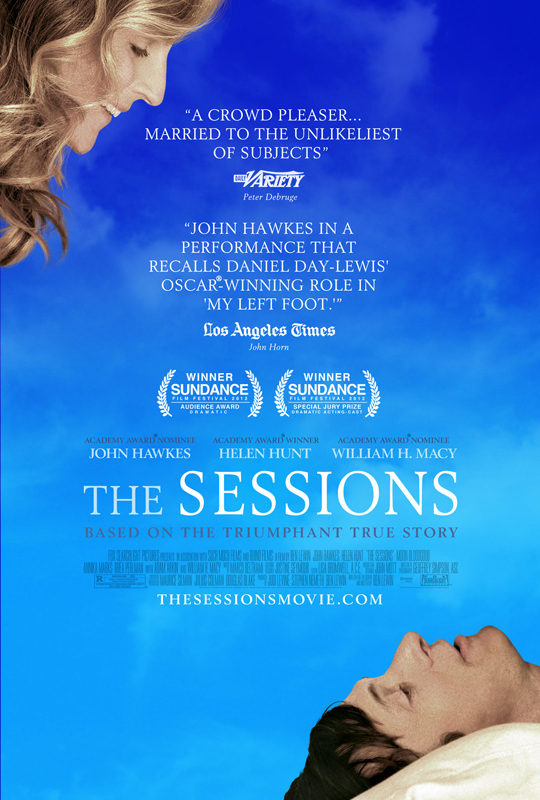
But you don't have to be a young Ben (or director Ben Younger) to be making a name for yourself in 2012. Last Friday, one of the most buzzed about movies of the fall, The Sessions, opened. Its director? A 66-year-old Australian named Ben Lewin, who hadn't made a feature since 1994's Paperback Romance.

Meanwhile, one of the most buzzed about movies of the year, period, is Argo, directed by Ben Affleck.

Could the best director race this year feature three Bens? There's an outside possibility that it could.

Unfortunately, that's about as much evidence as I can give you. Though I will have a little bit more when Ben Stiller's The Secret Life of Walter Mitty comes out next year. That one should be interesting. 

Like I said, it's a pattern that doesn't mean anything. Nothing to see here. Move along. Move along.