Tuesday, October 3, 2017

The month that turns cinephiles into cliches

I like watching horror movies in October as much as the next guy. In fact, you might say I informally got things started when I watched (for about the seventh time) The Cell on Sunday night, the first of October.

I just don't like devoting structured viewing series to watching them as much as the next guy. And I'm a guy who likes structured viewing series.

I don't know why they think they're so original -- and that "they" might include you, dear reader, so if so I apologize -- but cinephiles of all stripes and sizes can seem to agree on one thing: When the calendar flips over to October, you're supposed to watch one horror movie per evening until Halloween.

Every year around this time I am inundated by people posting in my Flickcharters Facebook group, telling us about this great idea they have to watch a horror movie per night for all the 31 nights of October, like they are the first one ever to think that up.

You'd think this would only be the rubes who had just tumbled off the turnip truck, but no. For every guy who tells us that his 31-day movie night started and he just watched Cooties, there's the guy who has a far more sophisticated but essentially similar approach. Maybe it's only horror movies made before 1940, or only those made in Eastern Europe. But no level of cinephile credibility is spared from this cliche idea.

Now don't get me wrong -- I don't think it's a bad idea. I just think it's funny that it seems to strike each of these people as an idea that originated with them.

Probably the most inviting thing about it is that it's one of the easiest viewing series to be sure you can complete. I'll explain why.

1) Horror movies are plentiful. Especially in the era of streaming, there are just so damn many choices available that it's easy to find not only dozens, but hundreds of horror movies you've never seen. And you don't even have to scrape the bottom of the barrel. There's so much horror available out there that you can probably fill up 31 days with only legitimate ones you haven't seen.

2) Horror movies are short. If you're watching a movie per night over an extended period of time, as I can attest having done this recently myself, it helps to have choices that are short. That way you can do other things you may need to do and still squeeze one in -- even go out for the evening, possibly.

3) Horror movies are well defined. While some genres overlap with other genres, horror movies tend to be easily recognizable as horror movies. This is not to say there's no overlap between horror and other genres -- the horror comedy is many people's preferred method of consuming horror -- but horror is usually the most recognizable genre association for these films, making it easy to opt them in to your selection pool. And lending itself to easy categorizing on the aforementioned streaming services.

What's more, nearly all cinephiles have an interesting relationship to horror, whether they metaphorically bathe in the genre's blood or squeamishly resist for fear of getting nightmares. Because in that squeamish resistance there's a part of them that's compelled, since people are drawn to what they fear, and this is the time of the year when they seek to confront those fears.

Which is one of the reasons people don't do, say, 25 nights of Christmas movies leading up to Christmas: They don't have particularly interesting relationships to Christmas movies. That's an even more well-defined set of movies and they also tend to be short, but by being such a select set, there's a greater chance you've already seen the good ones. And the bad ones are really not worth your time. Whereas bad horror movies will often still scare or disturb you at some point, or at least cross over into "so bad it's good."

I like watching horror movies during October too. Nothing wrong with it. In fact, I encourage it. I will probably try to sprinkle five to ten among this month's viewings.

I'm just not interested in watching 31 horror movies in 31 days, and not only because it means I wouldn't be able to watch many/any other types of movies during an important time for new releases in building toward my year-end list.

Mostly, it's just because someone else, a million others, have already had the idea, and I don't want to be a cliche.

Sunday, October 1, 2017

The logistical perils of constantly smoking

One way to signpost that a film is taking place in another era is to have everyone constantly smoking cigarettes, especially in places we would never expect it within the context of our modern social contract. Infinitely Polar Bear leans into that one pretty hard.

Surely because it was true to life -- the film is based on the childhood of its writer/director, Maya Forbes -- Mark Ruffalo is smoking a cigarette almost every time we see him on screen.

It's certainly something I've seen in the movies before, but I didn't consider until last night how difficult that really is.

You hear people say "My old man smoked two packs a day," so all of those cigarettes -- 40 of them -- have to fit in somewhere. (Two packs is about the upward limit. You never really hear "three packs a day," though if you did, maybe Ruffalo's character would be that guy.)

If we say that the average person is awake for 17 hours each day -- some more, some less, smokers probably more -- then that means more than two cigarettes an hour for every hour you're awake. In and of itself that doesn't seem totally unmanageable, until you consider that you spend some of that time involved in activities where you just can't do it (showering, for example). Let's say a cigarette every 20 minutes then, throughout the whole day.

If you're keeping up this pace, it does mean you are usually going to be involved in actually doing things while you're smoking. And that's what I noticed about Ruffalo's Cam Stuart.

As in here:


And here:


And here:


And here:


(Okay, I suppose he's not actually doing something in each of these photos, but I couldn't find any shots online of him smoking while repairing a bicycle or fixing breakfast for his kids. And how great is that last shot -- he's still working on one while starting another.)

There are three things that seem difficult about smoking constantly:

1) You'd always be getting smoke in your eyes. Most people who smoke actually spend more time holding the cigarette than they do actually taking a drag from it, but when you smoke constantly, you need your hands free for other things. And with that lit cigarette between your lips, about three inches from your eyes, the smoke would be a constant irritant.

2) The cigarette would always be going out. I suppose expert smokers are better at this, but it seems you need to be holding the cigarette in order to properly drag from it. If you don't drag from it, it goes out. So it would seem you'd need to be constantly lighting a stub of a cigarette ... unless you're just leaving it in there as kind of a safety blanket before ultimately discarding it in favor of a freshie. (I don't think anyone calls new cigarettes "freshies.")

3) It would be hard to talk. If you are trying to keep a cigarette clamped between your lips, you can enunciate no better than a mumble.

But whether it seems unlikely or not, it certainly seems to be something that people actually did at one point. And I suppose in the case of someone like Cam Stuart, based on Maya Forbes' real-life father, the cigarettes were indeed a safety blanket of sorts, to help him cope with his manic depression and emotional instability.

And though this seems like a flippant entry point into discussing the film, I really liked Infinitely Polar Bear. As I started watching it I thought "Uh oh, another indie comedy-drama about an eccentric, dysfunctional family," of which there are literally hundreds. But this film does distinguish itself in a number of ways, which go beyond just the really good performances. One thing I really liked about it is how much the two daughters, whom Cam is trying to raise while his wife (played by Zoe Saldana) is off at business school, are handled as full characters -- real people who have a mature involvement in the plot, not just occasional cute reminders of the stakes. Their situation with their dad has forced them into premature adulthood, as even at the ages of about 12 and 10 they play a major role in taking care of him -- both physically and emotionally. Surely because one of the two is modeled after the director -- and played by her daughter, Imogene Wolodarsky -- the children have a more integral role in the plot than they might if the film were written from the perspective of one of the adults. But there's a difference between experiencing something from a particular perspective and getting young actors to convey that perspective with a sophistication of craft, and Wolodarsky and the actress playing her sister (Ashley Aufderheide) have really helped Forbes pull it off.

On a side note, it wasn't only the odd title, which does get something of an explanation, that drew me to Infinitely Polar Bear. The polar bear is the mascot at my alma mater, Bowdoin College, so it was something I had to watch eventually. If I see another few movies in which the polar bear plays a prominent role, either literally or metaphorically, I can join them with The Golden Compass and give you a "top five movies featuring polar bears."

Friday, September 29, 2017

Pretty rough

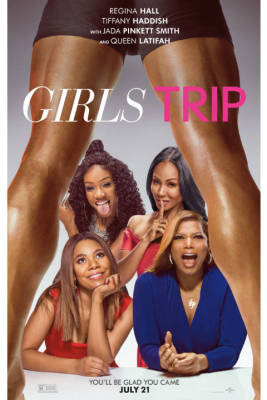
Before I had seen either of them, I heard Rough Night and Girls Trip being compared to one another quite a bit. Well, twice at least, on two different podcasts.

Although the podcasters deemed both films to have a bit of value, it seemed pretty clear that Rough Night was considered the mildly superior effort -- a problematic distinction since Girls Trip has a cast of primarily African-Americans (with one notable exception), while Rough Night has a cast of primarily whites (with one not-so-notable exception). Just because the distinction was problematic, though, didn't make it not true, and I worried a bit about that going into them.

When I saw Girls Trip three weeks ago, though, my fears of its inferiority -- not with respect to Rough Night, which I hadn't seen yet, but in general -- were immediately laid to rest. Simply put, I loved the movie. I thought the tone was great, the set pieces were suitably hilarious (if not all totally successful), and the friendship between the characters seemed real.

None of these things were true for Rough Night, which I saw last night. In fact, I found it pretty rough.

Which I have to say is kind of a relief.

I don't want to go around artificially inflating the value of movies made by and starring African-Americans, though I do breathe a sigh of relief whenever I genuinely love one. This is for a couple reasons, some societal and some specific to me. For one, especially in the post-"Oscars so white" era, I want primarily black films to be genuinely appreciated by people, and not just included in awards discussions for reasons of liberal do-gooder tokenism. Box office is probably the better way to determine how well a movie is legitimately liked, and in the case of a movie like Girls Trip, probably the only way, as awards talk won't enter into it. In that regard I'm glad to say the movie seems to have been a smashing success, bypassing $100 million at the U.S. box office -- which is $80 million more than Rough Night made.

For me personally, though, it helps reinforce my critic's oath to remove my own personal demographics as much as possible from my judgment of a film. As I am a white male about to turn 44, there are certain films that are more likely to be aimed at me than others, and your average person tends to gravitate more toward films aimed at them. In fact, a friend who saw Girls Trip and thought my 8/10 review here was generous said "I don't think I was the target audience." Well, as a critic, you are always the target audience. You're supposed to divorce yourself from your particular biases and see the films through the eyes of the person it was meant for. Any time a Girls Trip comes along, I am relieved to be reminded that I'm still making good on that implicit oath.

Rough Night, it turns out, deserved to make only 20% of what Girls Trip made. My own numerical grade, had I been reviewing it, would have been 50% of what I gave Girls Trip, or 4/10.

Both films feature a core group of four college friends who get back together for a wild weekend that celebrates their previous wild times, and as might be expected, they have differing personalities with all personality types represented -- the uptight one, the crazy one, etc. A fifth outsider is added in both cases as well, though she plays more of a role in Rough Night than Girls Trip.

The big difference is how much these four feel like they were actually friends in college. They do in Girls Trip and they don't in Rough Night -- though I suppose I should acknowledge that Rough Night has the responsibility to be all things to all people, while Girls Trip can exist as more of a niche product intended for African-American audiences (and anyone else who happens to want to watch). Perhaps because Rough Night needs to offer us an array of demographic types, including a heavier one, a lesbian one (who also functions as Jewish one) and a black one, it convinces us a little less that they were all friends in college, despite a scene showing them in those days. Girls Trip also has this scene, and I suppose in a sense, they are more "like" each other in that they are all black women. But chemistry is the biggest factor here. The Girls Trip women have it; the Rough Night women don't.

Comedies like this place a lot of stock in their set pieces, and here I noticed a big distinction as well. The set pieces in Girls Trip go somewhere, literally. They all take place in different locations. I couldn't help feeling claustrophobic as I watched Rough Night as they keep ... coming ... back to that house. It's a nice house, but I got tired of looking at it.

Then I had my basic problems with some of the logic of Rough Night, and spoilers will follow here if you want to tread carefully. So they accidentally kill the "stripper," who is actually a diamond thief who shows up at this house at about the time the stripper was supposed to show up (though why, we never learn). They then spend what seems like hours trying to dispose of his body -- enough that Scarlett Johansson's character says they have to hurry because they can't dispose of a body in broad daylight. Only then does the real stripper finally come, with no explanation for his lengthy delay, so of course they mistake him for a police officer (because he's dressed as one). If the stripper doesn't show up until 2 in the morning, or whenever the film would suggest this is supposed to be taking place, shouldn't he not bother coming at all? The failure to explore the consequences of all their misdeeds also seemed to be a lame concession to Hollywood happy endings.

Then I absolutely hated the subplot about Johansson's fiancee, who because of one of those classic "I can't hear what you're saying because your cell phone reception is bad" misunderstandings believes that she is going to leave him. So he puts on adult diapers and drives all night to Florida to try to get her back. Any time spent on his dumb shenanigans -- including an unnecessary scene devoted to picking out the wrong brand of diapers, and a scene where he runs out of money and has to wash windshields at a gas station for gas money, a delay that would counteract the need to drive without stopping and wear diapers -- is wasted time. Never mind the fact the drive ultimately takes him no longer than a couple hours anyway, as he arrives in Florida while it's still nighttime, at a time that could have been no more than four or five hours after the misunderstood phone call.

Both films address their racial politics in ways that are telling in terms of how obliquely they address them. I really liked the head-on way Regina Hall's character tries to tell token white Kate Walsh which black catchphrases she should not be using. Walsh's character is indeed there to represent a certain type of cluelessness, a certain way whites try to appropriate black culture, but as the film goes on it's clear she has a good heart and means well. The film doesn't put here there just to make fun of her. Meanwhile, in Rough Night, the one black character is Zoe Kravitz, who it should be noted is very light-skinned. I note that only because if you are being cynical, you could suggest that she was cast because she had a skin tone that would not put off the target audience -- though I of course am not that cynical (right). I don't remember the exact exchange that occurs about her race -- I think there is exactly one -- but another character essentially accuses her of not being black enough. It's never explained why she is not black enough ... we should assume at least it's not because of her skin tone, because that's outside her control and no one could be that cruel, but because she doesn't "act black," which is perhaps even more troublesome.

So the box offices have spoken, and though I don't know how these films did in Australia, I was pleased at least that my theater was pretty full when seeing Girls Trip, and a lot of people were laughing. I sometimes worry about how "black movies" will play here ... and I'm not always in the cinema myself to judge in person, unfortunately.

In terms of Australia, I should end by saying that one of the bright spots in Rough Night is Kate McKinnon and her Australian accent, which is largely on point. Now, getting four American actresses to play Australians, and to showcase who can do the best Australian accent in a raucous weekend in, I don't know, Fiji ... that's something I would pay to see.

Thursday, September 28, 2017

Asian Audient: Enter the Dragon

This is the ninth monthly installment in my 2017 series Asian Audient, in which it should be fairly obvious the types of movies I'm watching just from the name of the series.

I had gone this far in my life without seeing a single movie by one of the great cinematic icons of all time, Bruce Lee. It was long past time to rectify that, and this series gave me a good opportunity, but it was perhaps not quite the oversight I originally thought it was. Instead of having dozens of movies I had missed seeing, the man had only five, I was surprised to learn, before dying of an allergic reaction to pain medication in July of 1973. Five in which he does the things he's celebrated for doing, I should say, as preceding that was a career in roles that didn't depend on his fighting skills. In terms of martial arts roles, it was only five. I suppose he's a bit like James Dean in that way -- he made a big impression in a comparatively short amount of time.

Of these five, I was then sort of surprised to learn that Enter the Dragon was his final completed film, though one he started came out five years after his death (Game of Death). As the only title I would have immediately associated with Bruce Lee, it seemed more likely to be the film he released at the height of his heyday. But ah, he was at the height of his heyday when he died -- it's not like, at age 32, he was already winding down. Enter the Dragon was, in fact, released after he had already died, giving it something in common with The Crow, the film his son Brandon died while making some 20 years later.

Needless to say, for legitimate cinephile reasons and many other reasons, I was glad to finally get a Bruce Lee film under my belt. But I sort of had to cheat to do it.

When I set out on this series, I had a fairly specific idea of what constituted an "Asian film," even though there were thousands of films that would adhere to that standard. It could be anything from any country, but one thing was clear: It needed to have been made by Asians, starring primarily Asians, set in Asia, and spoken in an Asian language.

I broke at least one of those rules to watch Enter the Dragon, but it was totally unwitting.

As I did not research Enter the Dragon before watching it, I had no notion that a wide variety of Lee'c co-stars were westerners, and even more troublingly, the film was in English. At first I thought it was only dubbed in English, as it was clear the dialogue was done in post. But I noticed that the dialogue was always matching the shapes their mouths were making, so it was shot in English (but without sound), and then recorded in English by people who could probably enunciate their dialogue a bit more clearly than the Asian actors, or possibly by those actors themselves.

At first I tried to switch the spoken language to Chinese, but the option did not exist on the BluRay. I could hear French, Italian and a couple others, but not Chinese. Which I guess makes sense, as the film was not actually recorded in Chinese, so why make it available on anything but the DVDs that are specifically tailored to a Chinese-speaking audience. When Lee's western co-stars started appearing on screen not long afterward, I realized I was watching a movie that was made in English and seen by most of its audiences that way. It was also directed by an American, Robert Clouse, and what's more, I realized that it was one of only two of Lee's five key works that was in English.

Not exactly what I was going for in this series, but it was an honest mistake, and with only a few days left in September, it was too late to switch to another option for the month.

Besides, I really wanted that Bruce Lee movie.

I ended up mostly happy with the movie, at least with Lee's contributions. And I loved that it was kind of a blaxploitation crossover, featuring Jim Kelly as a wiry African-American with some percentage of Lee's skills. I did wish it had gotten to the action sooner and a bit more regularly. There's a fairly dead portion of the first hour which contains few set pieces and squanders a lot of time on development of the spy plot in kind of uninteresting ways. It didn't totally lose my attention, but let's just say I was distractable. I wasn't totally following the plot at all times, though I was also aware I didn't need to be in order to get the essence of why it's thought of as a classic.

And most of that comes down to Lee's performance in the last 20 minutes of the film or so, first in the scenes in which he's fighting hordes of oncoming minions, and then in his final showdown against the "Big Bad," who keeps on marking him with the three parallel slashes of his Wolverine-like claw.

I guess I wasn't 100% certain why Lee was such an icon, but I was pretty sure it had to do with him being that much more badass than the next guy. The ending really showcases that. Not only do we get all the Lee in-fight vocalizations, which seems to be where my friends and I probably culturally inherited our tendency to say "hi-YA!" when pretending to be martial artists, but we get the quick snapping and whipping of his moves, his brutal takedowns of opponents. While much of the choreography felt in line with what I've seen in many other similar movies, there was one shot that really drew my attention to something distinctive about Lee's moves -- whether it was warranted or not. In this shot there's an opponent with his back to the camera, and as Lee kicks him, he wipes him off the side of the screen quick as a flash, like so much insignificant trash.

The guy was badass, no doubt, and I look forward to seeing more of his films. Even though this is his most famous, and pretty much all the posters I've ever seen of Lee come from here, I suspect his Chinese language films have a bit more authenticity and credibility than Enter the Dragon. I'm not going to say you can see its Hollywood influences, especially not by today's standards, though I suppose then you probably could. I do suspect that particularly The Big Boss, Fist of Fury and The Way of the Dragon would conform a bit more to what I thought I was looking for from a Bruce Lee movie. I wasn't looking for or expecting the 70s cheese on display here, though I did appreciate it on some level in its own right.

I wonder how it must have been for American audiences just becoming acquainted with Lee in Enter the Dragon, to know that he was already dead. Surely many of them would have seen his earlier films, but often a foreign actor doesn't come on Joe Blow's radar until he makes a crossover film, and this seems to have been Lee's first real crossover. The sense of lost and wasted talent must have been akin to my thoughts upon first seeing and falling in love with The Crow, particularly Brandon Lee's performance ... and then realizing I would never see another one.

Okay, it's Halloween next month, and to celebrate the occasion I expect to return to Japan for the fourth and final time in this series with Ringu.

Monday, September 25, 2017

A concentrated dose of Bridget Everett

When I first saw Bridget Everett, she was wearing an outfit something like this. It wasn't this one, exactly -- in fact, it was a red dress that left as little to the imagination as this, but I couldn't find any stills I liked of that online so I went with this one instead.

It was as the closing act on an episode of Inside Amy Schumer, or possibly a Schumer concert movie, and it had what I'm sure was the intended effect on me. Bridget Everett is a confronting person. Her comedy is raunchy, her confidence is off the charts, and she's in on the joke. If Amy Schumer is supposed to be a knowing variation on the way women sell themselves as sex objects -- but one that shows she still has a fair bit of vanity and still wants to be considered sexy -- then Bridget Everett is the utterly vanity-free version of that. Oh, I'm sure Bridget Everett considers herself sexy -- with that kind of confidence, how could you not? -- but her very persona is about eschewing vanity. She's not "ladylike." She's not "a size six." She doesn't care if a dress makes her look good or if it functions purely as a prop in her in-your-face brand of do-anything-for-a-laugh comedy.

This discomfited me a bit. I didn't know what to make of her. We're used to being able to see someone perform and instantly categorize them as some version of a known commodity. And I'd like to say this was a good thing; the ideal me would definitely say that. The real me left with a funny taste in my mouth, one I couldn't quite reconcile.

This was maybe as long as a year ago -- heck, maybe longer. I didn't think of Bridget Everett again until I saw her in two movies this past weekend.

The first came Friday night. It was Eli Craig's follow-up to a favorite of mine from a few years back, Tucker and Dale vs. Evil. Little Evil, as this one's called, is a Netflix original horror-comedy that looks at an antichrist child -- think Damien in The Omen -- from the perspective of the boy's well-meaning stepdad. Adam Scott is that guy, Evangeline Lilly is his wife, and Bridget Everett is a fellow "stepdad" -- a lesbian woman playing the father role, so to speak, in the relationship with her new wife and her wife's daughter (or was it son? I can't remember).

When I saw Everett come on screen, I thought "I know that woman from somewhere." And then, after not too much longer: "Oh yeah, that was that woman gyrating and pulsating around in a red dress on Amy Schumer." Because I think the dress warrants some attention, here, I'll include one of those less-than-ideal pictures:


Although I'd not known what to make of Everett the first time around, a positive impression formed more quickly and more concretely this time. In Little Evil Everett makes for a truly distinctive entry in the age-old "funny best friend" trope. She constantly calls Scott's character "bro" and acts basically like a douchy guy for most of the movie -- a douche with a heart of gold, though. I wasn't sure I liked Everett on Amy Schumer but she was super likable here. She pulls that off without resorting to any of the usual softening tactics that make you like an edgy character. Everett gets to be likable on her own terms, without losing any of that edge. Her character's dialogue and actions are a constant surprise, and a good one at that.

The rehabilitation of Bridget Everett -- or rather, my comprehension of her value -- took another big step forward when I saw her turn up in Patti Cake$ on Sunday night. Here she plays the alcoholic train wreck of a mother to the title character, an oversized New Jersey girl named Patricia who wants to become a rapper (Danielle Macdonald). She's perfectly cast as the bawdy former singer who spends her evenings trying to relive past glories by drinking herself into oblivion and singing karaoke at the local bar.

What impressed me so much this time is not that she has great comic timing and can give turns of phrase her own distinctive spin, but that she can play drama, too. You wouldn't necessarily expect dramatic nuance from a woman who goes on stage and pulls her dress over her head, revealing her underwear, and knowing that this will be funny rather than sexy. But it's really there. There's real pain in this woman who didn't become a great rock 'n roll singer like she hoped, and now must try to get by on the meager support offered her by her 23-year-old daughter who tends that bar and does odd catering jobs. But there's also a bit of hidden menace, a bit of spiteful superiority, that suggests this woman could knock your block off too.

I'd say there's probably not a wide range of options for a comic actress who looks like Bridget Everett does, and Rebel Wilson has already kind of given us a template for the type of career a woman like this can have -- funny, but possessing sexuality that's the subject of slapstick humor more often that it is anything else.

But in these two very different roles, Everett has already given us a glimpse of her possible range. Sure, she can play a comedy sidekick MVP in a broad comedy, as Wilson would. But indie drama, which requires getting in touch with a real inner anguish, is also something she does with distinction.

More than anything she's memorable, which is becoming increasingly uncommon even with "pretty faces." You may not be sure what you think of Bridget Everett from one performance. But then watch another one, and you will be.

Saturday, September 23, 2017

The quest for 5,000

The next new-to-me movie I see will be my 4,900th, which for all you math whizzes out there means I have just a hundred to go before a major milestone.

I've got to recognize that milestone through something clever and distinctive, but I just can't figure out what viewing #5,000 should be. And it may take every one of those hundred more viewings, which figure to take between four and five months, to land on something suitable.

Can you help?

I guess to be a real help you'd need to know which movies I've seen and which I haven't seen, and I'm not about to post a list of 4,899 films (though I suppose I wouldn't put it past me either). But maybe you can help with the type of film it should it be.

Should it be the greatest film that exists that I've never seen -- a kind of white whale? Should it be the longest feature film I've ever seen? Or should it just be something that deals with the concept of 5,000 or has 5,000 in the title?

It may, or may not, be instructive to look at how I've celebrated previous thousand-film milestones.

My 1,000th film was not something I consciously chose for the occasion. It was the Mel Gibson vehicle Payback, and it must have been 1999, the year of its release, though I definitely watched it on video (it came out in March). I obviously recognized the milestone was approaching because I made note of the title, but I apparently didn't see it fit to schedule something worthy of the occasion. So that's right out in terms of helping us.

Number 2,000 was a different story. List fever fully had its grip on me by then, and I chose Casablanca, which was what I considered my most prominent film on my list of shame at the time. That was only in 2005, which means that yes, I have watched nearly 3,000 films in the last 12 years. A bit scary, but true.

For 3,000 I went for pure cleverness. I had not yet seen the Bernie Mac vehicle in which he plays a former baseball great coming out of retirement to pursue his own milestone, the 3,000 hits that had only barely eluded him when his career was cut short by injury. So Mr. 3000 it was. That was in 2010, in the era of this blog, so you can read about it here if that floats your boat.

I guess I've been speeding up as I go, because after taking 26 years to hit 1,000, another six to hit 2,000 and another five to hit 3,000, viewing #4,000 came along only four years later in 2014 -- four years and three months, to be exact. That's when I watched F.W. Murnau's Sunrise, another in the "great films I haven't seen" tradition. Maybe it being silent also made it seem "special" for the occasion. That's discussed here.

It'll certainly be less than four years for the next thousand, unless it somehow takes me nearly a year to watch my next one hundred. And though it's probably a bit dangerous to reflect on the life choices that have made this increasing speed possible -- there must be something I'm sacrificing -- this will be the first thousand films that have taken place entirely within the era in which I had children, meaning more time at home and more time with the TV set.

If you look at it as a system of alternating philosophies, going back and forth between neglected greats and clever choices, it would be time for another clever choice. But no film comes to mind with the word 5,000 in it, like it did for Mr. 3000. Let's see what IMDB has to offer:

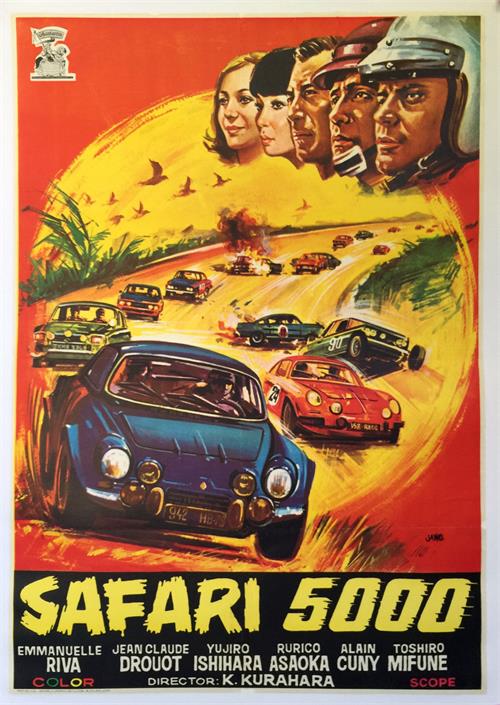
Safari 5,000 is a nearly three-hour 1969 Japanese film that I would almost surely not be able to get my hands on.

The 5,000 Fingers of Dr. T is a 1953 musical written by Dr. Seuss.

And that's it in terms of features. And no, shorts and names of TV episodes will not work for these purposes.

So maybe I need to neglect the alternating system and go again for "greatest film I haven't seen yet." But as I've been doing my due diligence on catching up with the greats, there's no longer an omission as glaring as Casablanca, or even as Sunrise. Sure, there are titles I could put in there, but would they seem 5,000-worthy?

Five thousand is, in a way, the most significant milestone to date, other than maybe 1,000. Milestones are always more interesting when they involve round numbers. It might be the most significant milestone I will ever have, since there's no guarantee I will live long enough to double my current output. (Though if I stay at this increased pace, it could take less than 20 more years to get there.)

So 5,000 could warrant a different approach for honoring the milestone, and that's where something like length comes in. Needless to say, there are behemoths out there I have never made time for. But do I really want to spend all day watching Shoah for my 5,000th movie?

Well, as I said, I've got four or five months to figure it out.

It's possible during that time, something will hit me like a bolt of lightning, announcing itself as the obvious choice. Or, I'll have to compromise and just go with something "good enough." And then there's the part where reality encroaches, where I lose some ability to choose #5,000 by factors outside my control, like movies I may be reviewing. I'd like to think I would be careful about that, but once you get to #4,999, you're out there without a net, and might "accidentally" see something unintended as your next choice -- or suddenly have difficulty sourcing that choice.

Anyway, let me know if you've got any good ideas.

If worse comes to worst, The 5,000 Fingers of Dr. T is available for rental on iTunes.

Tuesday, September 19, 2017

Cat's Away 2: The Right ending

I am ready to collapse in a heap, and take at least one night off from watching movies. (Well, exactly one night, as I am already scheduled to see Mother! on Wednesday night so I can podcast about it on Thursday.)

But before I do that, I must wrap up Cat's Away 2, the second nearly week-and-a-half-long personal film festival I've run in the past two months while my wife has been on trips out of the country.

When the first Cat's Away ended, I explained that I chose Pulp Fiction for closing night over Do the Right Thing because Pulp Fiction was "more fun," or maybe even just "fun." One intrepid reader challenged me on that, explaining (correctly) that Do the Right Thing is also fun in its own way. "Cat's Away 2 is when you realize Do the Right Thing IS fun," he wrote.

Well, I rose to the challenge.

Spike Lee's 1989 masterpiece is one of my most long-neglected films. I currently rank it #10 on my Flickchart, but it's been since sometime in the late 90s, I would guess, since I've seen it. And I suppose the sense that it's "work," that its confrontations about race are not something I'm always eager to sit down with, have contributed to the delay in revisiting a movie I obviously love. Part of that love, I suppose, is a belief in the film's importance, which can make a film great but maybe not always something you want to unwind with. But Do the Right Thing is a film that needs to be revisited more often than every 20 years.

What struck me on this viewing is that the film is not as "realistic" as I may have considered it. Certainly, Lee works in a general realm of realism in recreating a combustible Bed-Stuy neighborhood on the hottest day of the summer. But this movie is more an impressionistic view of racial disharmony than probably an accurate depiction of the ways people really relate to each other. The racism we view in our everyday lives -- with notable exceptions like Charlottesville -- tends to be more subtle, more of an undercurrent, nothing so confronting as we see here.

But Lee's role as a filmmaker is to confront. He's giving us a direct feed into the rage he feels as a black man in America -- and boy do I wish that rage were something that the 28 years since then have helped heal. But Do the Right Thing feels as relevant in 2017 as it ever has, which makes it even more worth revisiting.

This movie is not just about rage, though, and that's where the "fun" part comes in. Lee does deceptively complicated work of setting up a whole neighborhood here, one that feels composed of real people who have real relationships with each other, and not always contentious ones. Moreover, they have fun together. There's a lot of humor, love and mutual appreciation in this film, which keeps it bouncy and not as ponderous as you might expect from a finale like this one has. Even after its finale, though, it shows gentleness and love -- Mookie and Sal, who should logically hate each other after what has transpired, end on terms of a kind of mutual respect. This is a neighborhood with ties that bind, even if deep-seated prejudices keep them apart.

Usually I rebel against cinematic adaptations of plays because I think it's too easy to see the film's stage origins, which often contribute to making it feel small. But when a film is not adapted from a play, as Do the Right Thing is not adapted from a play, but only feels like it might be adapted from a play because of its setting and scope, that's something different. Part of Lee's method is to be intentionally theatrical, as you would on a stage, and it's part of what makes the film so affecting. When I think of Mother Sister letting out those desperate wails at the end -- "No! No! No!" -- I think of a piece of drama that is intentionally constructed as something like Greek tragedy. Even within itself, her reaction is not "realistic." Just moments before, she had gotten caught up in the rage directed at Sal's Pizzeria, yelling "Burn it down!" with the rest of the crowd. That she is bemoaning what has happened, as if she played no role in it or tried to prevent it, is not therefore "realistic." Instead, her cries are like the cries of the wounded soul of the American psyche, and in that regard they are incredibly powerful.

As we wrap up, here's a chronological list of my viewing:

Inception
Silence
Trainspotting
T2 Trainspotting
Schindler's List
Personal Shopper
Moana
Blow Out
To Die For
Song to Song
Peeping Tom
Spring Breakers
Singin' in the Rain
The Lego Ninjago Movie
Watchmen
Do the Right Thing

That includes:

- Seven movies that were new to me
- Nine rewatches
- All sixteen movies in English except for some random German (Schindler's List) and Japanese (Silence), and some thick Scottish accents
- Eight movies from the 2010s
- One movie from the 2000s
- Three movies from the 1990s
- Two movies from the 1980s
- One movie from the 1960s
- One movie from the 1950s
- Five library rentals
- Three movies from streaming
- Three movies from my own collection
- Four iTunes rentals
- One movie in the theater
- And a variety of different genres and styles

Will there be a Cat's Away 3?

At the moment, not that I can see, and that's fine with me. Intense periods of film watching like this are great, but would I want them to last longer than they do? Not really. By the end I'm exhausted. And two in the space of two months just increases the exhaustion factor. Ready for a return to regular life.

My wife is indeed going out of town for three nights at the end of October, but three nights does not a film festival make.

But will I be watching movies those nights?

You betcha.

Monday, September 18, 2017

Cat's Away 2: Watch man

Second-to-last night of Cat's Away 2.

I'm a watch man. That's what I am. I'm a man who watches. Movies, I watch.

What, you think you could come up with a better title?

Ah, maybe you could.

Anyway, I'm also a man who is running out time and running out of steam. Because I'm sticking to a post-a-day schedule, and because I've had a very busy Monday, this post is the only thing standing between me and closing night of this festival. So I will be almost comically brief in my recap of Sunday's movies, which surely deserve a bit more ink than I'll be giving them.

Singin' in the Rain

The Sunday morning time slot on one of my marathon movie weekends is usually reserved for an old favorite I know like the back of my hand. Singin' in the Rain is an old favorite, one my lists tell me I have seen more than once, but I don't even know it like the back of someone else's hand. I can't remember how long it's been since I've seen it, but suffice it to say a lot of it felt very unfamiliar to me. Such as:

- I would have sworn the title number came in the first 20 minutes, but it doesn't arrive until the hour mark.

- I was quite surprised to learn that the film has one of those 10+ minute fantasy dance numbers that seem to afflict films of this period; I say "afflict" because they always seem like filler, and because it's one of my chief complaints about films like An American in Paris and Oklahoma! If even Singin' in the Rain has one, I guess I have to rethink my thoughts on the subject.

- How is Donald O'Connor not a household name? That "Make 'Em Laugh" number is a show-stopper, as my fellow podcaster, Blake Curtis, told me it was.

I barely finished the film in time to run out of the house to go meet my sister-in-law and my kids to see ...

The Lego Ninjago Movie

Thoughts:

- Love these advanced screenings, even if the movie ends up not being great; the celebratory air, the free tickets, the free popcorn and drink, the paper masks of Ninjago characters. (I guess that last one is only for this movie.)

- My three-year-old is a dick. Not three minutes into the movie he made my sister-in-law trek out to the car to get his blankie, a trip that took them 20 minutes. He then made her take him for a walk again later in the movie. I don't think she cared -- I had asked her to help in such a scenario because I was reviewing the movie and needed to give it my full attention -- but it annoyed me. He wasn't like this in his first movie, Cars 3.

- Lego may be trying to start up a cinematic universe, just like everybody else is doing, but this is its first clear misstep. Maybe the problem was not having a built-in audience for the characters, and therefore having to do more work and potentially alienating adult audiences, but I just never really fell in sync with this movie. It repeats the same comic and emotional beats of its two better predecessors, and spends much of the time offering about the same level of visual coherence of your standard Transformers movie. Stay tuned for my review.

Watchmen

- After I got the kids to bed I sat down for all three hours of Watchmen. Yes, I seem to have been powerless to play anything abut the 185-minute director's cut on my BluRay. Aren't these things supposed to come with the theatrical option?

- But that's okay, because that was when Zack Snyder was a good director. Yes, we may forget it, but there was a time. I was curious to watch this in the wake of his two failed movies featuring Superman, to see if the bad tendencies were still there back for this movie that I loved, but had since come to think of as sort of a guilty pleasure. Nope. I'm still comfortable calling this movie kind of visionary. And the added scenes didn't stick out the way added scenes sometimes do, to the extent that I could only be sure of one addition: a couple scenes related to the death of Stephen McHattie's retired Watchman, who probably died in the graphic novel, but never did in the version I saw twice and ranked in my top ten eight years ago. And had not seen again since ... until last night.

Sorry, movies, for the short shrift. I'll make up for it with a killer closing night post tomorrow.

Sunday, September 17, 2017

Cat's Away 2: Marathon within the marathon

Just a few more days/nights left of Cat's Away 2, the personal film festival I'm running while my wife is away -- a sequel to the one I ran in July/August.

There have been a lot of ways Cat's Away 2 has mirrored Cat's Away, and one of those is that my sister-in-law again took my kids for a sleepover on the Saturday night my wife was away. That has meant that from early Saturday afternoon onward, I was free to do any goddamn thing I pleased. And of course, I please to watch movies.

I've always got a boundless optimism at the start, when I think this time, finally, I will squeeze five movies into Saturday. But anytime I've ever done this type of thing, which has included trips to hotels to hold movie marathons, I have never made it to five on the first day. That could be because I have not purposefully chosen short movies (and did not this time), but it's also likely because I'm drinking beer and by some point in the second movie, I need a nap. Yesterday's experience fit that description to a T, and again I watched four movies before summoning myself off to bed.

The first of these was:

To Die For

I'd seen (and loved) Gus Van Sant's film when it first came out, but not seen it again since then. Strangely, I always think this movie came out in 1997, when actually it was 1995. What's so strange about that is not that I would get a date wrong, but that I always think with absolutely certainty that I ranked To Die For in my top ten of the year it came out. Not only that, but I feel like I remember seeing it in the theater in Rhode Island near where I lived in 1997. But this is impossible, since I didn't start keeping rankings until 1996, and, well, it came out when I was in my last year of college in Maine. Nevertheless, and despite writing this out now, I will probably make this mistake again in the future.

I had forgotten that To Die For was structured as a pseudo documentary, including interviews with various involved players. Of course, there's a lot of action pictured that could not appear in a documentary, so it's really just a stylistic affectation on Van Sant's part more than an attempt to contribute to the then-burgeoning genre of the faux documentary/mockumentary. In any case, the format totally works. I especially liked Illeana Douglas' interviews. In fact, this movie made me really miss Douglas' distinct contributions to cinema at large.

Speaking of the cast, I'd forgotten how many big names are actually in this. I remembered the likes of Nicole Kidman and Joaquin Phoenix, but I could not have told you Casey Affleck was in it, nor Kurtwood Smith, nor Holland Taylor, nor Dan Hedaya, nor Buck Henry, nor Wayne Knight. If pressed I might have remembered Matt Dillon. Anyway, it was a joy to see them all so young.

I really enjoyed catching up with this film again, it's a delight, but I was weirdly distracted during the movie. Who knows, maybe it was an early onset of that "this marathon is slipping away from me and I'm not making the perfect choices" paranoia.

Song to Song

If that kind of paranoia were setting in, it would have been the perfect chance to bump my second movie from the schedule. My 30-day iTunes rental of Terrence Malick's latest still had 20 days to go, and I had a sense that I wasn't going to like it all that much, having already written a borderline sarcastic review of his last, Knight of Cups (which you can read here if you're so inclined). I pretty much assumed I'd be able to recycle that review for Song to Song, which has not come out here yet and which I will be reviewing. But these "no kids marathons" have included such new-to-me comparative stinkers as The DUFF and Megamind in the past, so I have never shied away from a movie just because of its likely suckitude.

And suck Song to Song did. I'll save most of my vitriol for my review, but my God is this man clueless about the value of his work in the cinematic landscape. You can't remake the same movie over and over again without becoming a joke, but that's what Malick has done since The Tree of Life. I actually kind of liked To the Wonder, but the man descended into pure self-indulgence with Cups, and Song to Song just doubles down on that. (I suppose Voyage of Time was also in there, but as that was intended for IMAX I don't know whether to count it as an actual feature from him, and I didn't see it.) If not for Emmanuel Lubezki making his films so beautiful looking, who knows where he would be.

I find myself kind of shocked that so many good actors still want to work with him. Rooney Mara, Michael Fassbender and Ryan Gosling are all at the tops of their games and the tops of producers' wish lists right now, and Natalie Portman is only a small step down from there. What could these people be thinking? During the movie I found myself imagining a hypothetical foursome for Malick's next movie, and came up with Robert Pattinson, Emma Stone, Channing Tatum and Kristen Stewart. The only thing ruining that theory is Pattinson and Stewart working on the same movie together. But it's a Malick movie, so they might not even need to see each other.

If it had been 90 minutes, that would have been one thing. But two goddamn hours and nine goddamn minutes??

Peeping Tom

It might have been five straight hours of Lubezki except I decided by random choice not to watch The Revenant. I put Peeping Tom and The Revenant, both of which are library rentals, in my hands, closed my eyes, swapped the boxes around enough until I could not remember which was which, and then held up the winning choice. I'm just as glad as even Lubezki's beautiful camera might have been too much for me for five straight hours.

Peeping Tom was a late contender for the lineup, as I only picked it up at the library a couple days ago. I decided it fit into the "movies I would have to explain to my wife if she were around" category. I first saw Michael Powell's career-killing movie about five years ago, and remember being very disturbed by it. When you factor in Psycho, 1960 was a crazy year for films that pushed the psychosexual envelope, and I thought it would be good to confront it again. (Psycho itself would have probably been the better choice, had it been available, as it's been something like 25 years since I saw that.)

I didn't remember the movie as well as I thought I did. I still like it quite a bit, but I was not as disturbed as I expected to be. The protagonist, Mark Lewis (Karlheinz Bohm), is pretty weird, but I think I thought he was a bit more Norman Bates-like than he is. Yes, he's a perverted guy with a debilitating sickness that causes him to murder women with the knife end of his tripod leg (still a creepy and very phallic image), but I guess I thought he was a bit more sinister than he actually is. And I didn't remember the ending at all. Maybe it was one of those I watched late at night when I was falling asleep, and only thought I took it all in.

One thing I think is interesting is how little his love interest, played by Anna Massey, pays attention to her own radar for creeps. She sees a bunch of absolutely bizarre stuff from Mark -- that choice to show her the film of himself as a child with a lizard thrown on his chest is reminiscent of Travis Bickle's choice to take Cybil Shepherd to the porn movie in Taxi Driver, in terms of reading the room. Yet she still flocks to him. I suppose it's just a narrative convenience, but it makes her a sort of memorable character in a weird way.

Spring Breakers

And I closed with my fifth -- yes, fifth -- viewing of Spring Breakers.

I've said all I really want to say about Spring Breakers in numerous previous posts. You can check them out by following the tag at the bottom of this post. This may just be the fastest I've reached five viewings on any movie, as it's been just four years and five months since its release. But I can only guess as I really don't have anything else to compare it to. Actually, it likely loses that battle to Pulp Fiction, which I saw four times in the theater and surely once on video before five years had passed. But that's pretty damn select company.

I'd say I always learn something new about Spring Breakers whenever I see it, but I didn't this time. I was just reminded of how much I love it.

I did think it was an interesting viewing on the heels of Song to Song. I often think of Spring Breakers as a bit of a film in the style of Terrence Malick, and I think I probably don't even need to explain why. Breakers does the "pastiche of non-chronological images" film correctly, though. It doesn't adhere to an absolute chronology, no, but when the images are shuffled, they are only shuffled within a short window of time in the narrative. The overall thrust of the film is clearly forward, and the images captured by cinematographer Benoit Debie each say something different about where the characters are in the story. What makes Song to Song so infuriating by comparison is that the images would play just as well at any point of the story as any other, robbing it of a sense of a beginning, middle and end. Sure, there's a narrative throughline and a story you can see the contours of, but the overlapping and repeating structure of the film -- like, endlessly repeating -- gives it a sense of no definite narrative thrust and no momentum toward an ending. Its detractors may argue that Spring Breakers has no story, but they'd be fools. You can tell that even more clearly when Malick is the point of comparison.

Sunday: An anticipated three more films, and the return of my kids.

Saturday, September 16, 2017

Cat's Away 2: Trailers work

Night #6 here. Cat's Away. The second one.

When you're doing a double feature in the type of film festival I'm doing -- in other words, where you can't start until late because your rascally kids need one more thing before they go to sleep -- it helps if you can watch the first movie with them. And start it at 7:15.

So Friday night saw the return of Movie Night, a slot filled by Harry and the Hendersons during the first Cat's Away. That title was chosen to scratch an itch for my son, who was (still is?) in a phase of intense curiosity about Bigfoot, as well as to feed my own idle curiosity -- the type of curiosity I have about any film I have not yet seen.

This time, the choice was just for me.

That's right, neither of my kids were into the idea of Moana, a film they had already rejected when it was in the theater -- which was the primary reason I myself have not yet seen one of last year's most prominent animated releases, which I always try to get on my year-end chart. When I suggested it, bracing myself for the blowback, my older son balked at the idea and the younger one more or less followed suit. I knew this was shaping up to be another one of those conflicts where my older son wants me to watch some type of feature-length Pokemon thing, while I want to watch a "real movie." Because it's on Netflix, I didn't even have the argument that I had committed to it by renting it.

But I had a trick up my sleeve.

It's called a trailer.

I don't know why I've never thought of this before, but a trailer is the perfect way to get a child interested in a movie he thinks he doesn't want to see. Disney knew what they were doing when they cut an action-heavy trailer for Tangled, to sell it to boys who didn't think they wanted to see a movie where the girl was the hero. A similar dynamic exists in Moana. There's a fair bit of action, including a set piece involving pirates (coconut pirates, but still), and on IMDB I happened to get that trailer that played up the boy stuff. (I don't know if there's actually a "princess version" of the trailer -- possibly not.)

Probably all it really took was a glimpse of the lava monster that serves as this film's "big bad," and my older son was sold. He didn't even need to finish watching the trailer. Meanwhile, the younger one was saying "When are we going to start watching Iguana?"

Fortunately in one respect but unfortunately in another, they ended up liking the movie more than I did. It was fortunate as it meant there was no mid-movie rebellion, which might have happened even though they knew the choices were to watch the movie or go to sleep, but unfortunate because I really wanted to love Moana. And didn't.

There's no doubt it's Disney's most technologically advanced film to date, which should come as no surprise, and the verisimilitude of the imagery -- not to mention the use of some magical water effects -- gave me chills with some regularity. But this is also one of Disney's most formulaic films. Every story beat came at us from miles away, and it led me to the cynical notion that this script was constructed using time code -- at exactly 5:38, this needs to happen, and at exactly 26:14, this needs to happen. And so forth.

My favorite recurring bit was probably Maui's moving tattoos. For some reason they reminded me a bit of Hercules, a Disney film I always liked that I'm due to rewatch.

The other brilliant thing about the kids watching the first movie with you is that when it's over, they're really ready to go to sleep. Even the younger one was asleep within five minutes of me depositing him in his bed.

Which allowed me to turn to:

Blow Out

Brian De Palma's 1981 film has always occupied a special spot among my cinematic fears of the horrifying unknown. And here's how I think that must have happened.

Around the time Blow Out become available to watch on The Movie Channel, the only cable station we subscribed to when I was growing up, I had probably just seen and fallen in love with Grease. I must have then wanted to see another movie starring Danny Zuko.

It was at this point I suspect my mother must have told me the reasons why I couldn't see it, and in her trademark clueless fashion, gave me more specific details why than I wanted. This is the woman who went into detail describing gruesome aspects of Jaws and The Exorcist before I was even ten years old. While I remember those stories quite well, I don't remember what she said about Blow Out, only that it gave me the idea that something truly disturbing, possibly of a sexual nature, occurs to a character in this film. The fact that I didn't know what it was might have made it worse, as it allowed my mind to fill in the details.

That impression has persisted to this day, though I obviously have made no attempt to fill in those missing details before now. But I threw Blow Out on my brainstorming list for the first Cat's Away upon seeing it available on our streaming service, Stan, and Cat's Away 2 afforded it an actual time slot.

Unfortunately, I came away disappointed with both that horrifying unknown and the movie itself. There's a serial killer in this movie who strangles women and then carves a bell design into his victims, which on the face of it sounds bad. But there's not much in the way of graphic violence, and certainly nothing to cause someone to discuss this films in hushed tones. Certainly nothing that compares to either The Exorcist or Jaws. I kept waiting for this big awful thing to happen, and it never did.

And as might be expected, the film has not aged all that well. The distracting musical clues, some slow-mo, stuff like that all place it in the early 1980s. Which is not always a problem and ideally, should never be, but you can't help the impression a film has on you. While John Travolta gives a pretty good performance, I thought his co-star, Nancy Allen, was actually kind of awful. She's not meant to be a smart character -- she's an escort -- but the performance itself is pretty stiff.

I did enjoy the aspects of the film that reminded me of another movie involving a foley artist, Peter Strickland's Berberian Sound Studio. I have to wonder if Strickland's film was influenced by Blow Out, as both films touch on the idea of trying to record the perfect scream for a B horror movie. And perhaps if I'd seen them in that order I would have thought Berberian was derivative of Blow Out, though they differ significantly after the main basic setup. While Berberian becomes a psychological horror, Blow Out becomes a paranoia thriller, and I did appreciate the way this fits into a tradition from around that time that mostly involves the films of Alan J. Pakula. Blow Out also has a very memorable shot involving fireworks at its end. Ultimately, though, it was just a three-star movie for me.

If two movies were good, why not another four or five on Saturday? My kids are going for a sleepover at their aunt's house, so ... watch out.

Friday, September 15, 2017

Cat's Away 2: Assessing Assayas

We've now crossed the halfway mark in the nine nights my wife will be out of the country, during which I'm squeezing in as many movies as I can.

I've only seen two movies by Olivier Assayas, which is a surprisingly small number of movies for someone I have so many opinions about.

I guess I should say I don't have opinions about him personally, as I have never heard him interviewed and don't even know what the man looks like. (Not that my opinions about him would have anything to do with his appearance, of course.) But the two movies of his I've seen have stuck in my craw, in a bad way, to the extent that I roll my eyes when his name comes up in conversation.

The first Assayas I saw, Something in the Air (also called Apres Mai or After May), didn't offend me or anything, and I probably would have considered it merely shrug-worthy had Adam Kempenaar of Filmspotting not sung its praises so vociferously. It's a semi-autobiographical look at a young revolutionary coming up in the radical late 1960s in France, a sort of coming-of-age story about a young man finding his voice and heading down a path that leads to him becoming a filmmaker. It's made very well but I just found it boring, and in the context of knowing it is autobiography, probably just a tad indulgent and self-congratulatory.

It was my second Assayas, The Clouds of Sils Maria, that made me really grumpy about the man. I found this to be an over-long bore that was pedestrian where it thought it was profound, was extremely curiously paced, and was not even as well acted as it received acclaim for being. Meanwhile, that acclaim for the film in general was deafening, and I just couldn't make sense of it. That led to my Unified Theory of Assayas, which is basically that the man makes pretentious movies that are not nearly as good as people seem to think they are.

I probably ought to see Summer Hours before I feel like I can really judge the man, but I didn't say my judgment of him was rational, did I?

Not being on the same wavelength as Olivier Assayas did not mean I was not going to see his newest film, Personal Shopper, despite some people repeating back to me my own complaints about Assayas in the context of this considerably more divisive film. I'm a fan of Kristen Stewart, even though she didn't do it for me in Sils Maria, and I always like a good ghost story. So I held my nose and took the plunge, with 22 days remaining on my 30-day iTunes rental.

And now, finally, I "get" Olivier Assayas.

So yes, I liked Personal Shopper quite a bit, though I suppose saying that I "get" Assayas is a bit misleading. That suggests he's doing the same thing he always does, but a switch has been flipped in me, and now I understand it better. This movie feels like him doing something different -- something different that I get.

Yeah, there are a fair number of superficial things it has in common with The Clouds of Sils Maria -- Kristen Stewart, her character's relationship with a female celebrity, the existence of unexplained and supernatural occurrences. But there's a big formal difference here that privileges Shopper over Maria. Part of the reason Maria felt so elongated is that it has an overabundance of dialogue-heavy scenes, many of which serve little purpose in pushing the narrative forward. Shopper has far fewer of these. It's much more of an atmospheric film that shows rather than telling, and makes good use of the little telling it does do. I didn't emerge from this experience feeling exhausted by the amount of dialogue that had fallen on my ears without really getting anywhere.

I was also genuinely surprised, and for the most part pleased, by the extent to which Assayas went for the traditional scares of a ghost story. When I heard that this film involved Stewart's character trying to commune with her dead twin brother, I imagined the supernatural elements of it being very low rent, not for budgetary reasons, but in order to fit with the sensibility I imagined Assayas to have. I figured it would be along the lines of "it's a ghost story because if you squint very hard, you might be able to trick yourself into believing it's something other than the wind moving that curtain." But no, this film goes for it on several occasions, even using genuine visual effects to create a spiritual presence whose physical existence is virtually indisputable. This surprised me and chilled me. In fact, it's rare that I am this chilled by a movie that does not explicitly try to align itself with the horror genre.

I'm not saying every part of the movie totally worked for me, and I must admit that in the last 20 minutes or so, four straight nights of starting more than two-and-a-half hours of movie viewing after 8:30 finally took their toll on me, and I was nodding off a bit. But it was a kind of "atmospheric nodding off," where the film's ethereal aesthetic choices and themes kind of blend with your exhaustion to bring something profound to the fore.

Keep surprising me, Assayas. Maybe we'll get along fine.

Thursday, September 14, 2017

Cat's Away 2: Second viewing of a one-timer

This is my fourth post in a nightly viewing series occurring while my wife is off gallivanting in other countries.

Schindler's List has been kicking around the upper reaches of my Flickchart for some time now. It had been nestled somewhere between 50th and 100th for some time, but then a big win jumped it inside the top ten. That was a bit of a skewed result, part of the fallout of a decrease in my enjoyment of The Empire Strikes Back the last time I saw it. It's back down to 35th after that aberration that shot it temporarily all the way up to #7, but 35th is still incredibly high for a film I've seen only once -- easily my highest ranked one-timer. In fact, you have to go all the way down to 83rd to get the next movie I've seen only once: Malcolm X.

Well, it was time to do something about having only that single viewing.

Schindler's List was a one-timer in the most literal sense, that I had seen it only one time. But it was also a one-timer in the way you hear that (word? phrase?) most commonly used: You might find it brilliant, but you can only stomach seeing it once. Length is also a factor in movies that are sometimes classified as "one-timers," but behemoths like The Lord of the Rings: The Return of the King are easier to take down multiple times despite their bloated run times because they don't have wrenching subject matter. The three-plus hour run time, combined with the Holocaust, tend to make a second viewing of Schindler's List an unappetizing proposition indeed. (Unless you have someone to make out with, eh Jerry Seinfeld?)

But Schindler's List is a movie I knew I loved, and though it's sad and horrifying, I knew that I didn't find it difficult to watch, per se. My larger issue was finding it difficult to find the time to watch it, and if you are going to rewatch something like Schindler's List, how useful is it really to watch it in four 45-minute chunks?

Enter Cat's Away 2. Time to see Schindler's List for the first time in 24 years and figure out if it really deserves to hang around the upper echelons of my chart.

Not that I've been finding it easy to carve out the time anyway. Wednesday night was complicated by my sons staying up until nearly 10 o'clock playing in their bedroom, and one of them having a bout of diarrhea that came on too quickly for him to get to the bathroom in time. (At least he was wearing a "Pullup," an overnight diaper.) Then there was the little detail that Hurricane Irma played havoc with my wife's travel plans to her final destination, and because of power outages and lack of WiFi, I had not heard from her in about 36 hours. A call from her sister just before the kids' bedtime, inquiring whether I had heard anything, made my background concerns real, and I spent the first 45 minutes or so of List fretting about it and checking my phone for a possible email from her. When I finally got it, I breathed a sigh of relief and could finally "enjoy" the movie -- if that's the right word for it.

I'm not going to go into a detailed analysis of Schindler's List, but I do want to make an observation about why I continue to love it, which also sheds light on another film with certain things in common with List, with which I also recently fell in love. That film is The Battle of Algiers, which is similar to List primarily in this way: It's an anachronistically black and white film that depicts true event in history. When I watched Algiers, slowly going from mildly bored to fully engrossed and agape, I put my finger on what makes it so interesting: It seems like less of a film than an historical document, an artifact that shows reality rather than someone's fictitious interpretation of it. The color scheme, or lack thereof, is certainly manipulating us in creating this impression, as it feels like something that was really from the era it purports to be from. The commitment to realism of both films cements the impression.

This commitment to realism is especially impressive for Steven Spielberg, who has made numerous other "important" films, but none in which he so clearly repudiates his innate sense of theatricality. Spielberg's "movie instincts" often serve him well, but they might hamper him in any attempt to give us a documentary-style film. Even though Spielberg is justifiably one of the most successful and beloved filmmakers of all time, Schindler's List is as great as it is because it does not feel like a film Spielberg made. That may seem like a contradiction, but I don't think it is for the following reason: This is the film, more than any other, that proves how little he was limited by the conventions that might otherwise seem to define him.

There's very little in this film that feels like an indulgence. One of the reasons the ending, when Liam Neeson's Oskar Schindler finally breaks down in tears, is as powerful as it is is because Schindler has been a model of composure prior to that. In the ultimate in life-or-death stakes, Schindler has been playing a role so hard, with such subtlety and with such a sense of how important his perfect performance is, that when he can finally afford to drop character he drops it totally, collapsing in an emotional heap. Spielberg's own dedication to craft has been equally fierce. He rarely gives in to anything like sentimentality in this film, a film that might call for it more than any other he's made, and Schindler's breakdown at the end helps us recognize the restraint that has thus far been on display.

It was interesting to me how well I remembered this film I hadn't seen in almost a quarter century. I suppose it's indelible like that. I might not have needed to see it more than once to appreciate or even confirm its greatness, but I'm so glad I have.

And does it deserve to be near the top of my Flickchart?

Hell yes.

It's almost Thursday night, and I'll finally get a respite from viewing experiences that crack the 150-minute mark. I really, really need it.