Friday, June 19, 2020

Best of 2020 thrown all out of whack

I greeted the news that the Oscars would be pushed back by two months with something of a shrug. They used to be at the very end of March, so having the ceremony in April would not be that big of a difference. We certainly would have well and truly moved on to the new year by then -- in a normal new year, which next year may not be, we'd already have a handful of "summer blockbusters" by the end of April -- but if they think it's necessary, well, so be it.

Until I realized the effect it was having on the end of the actual 2020 calendar year.

In tandem with the announcement, though making much smaller headlines, they announced that the eligibility period would extend until the end of February. That means that a January 13th 2021 release of some crap like Happy Deathy Day 3 is going to be eligible for a 2020 Oscar. Or does that mean the dreck like that will be pushed to the beginning of March instead?

Other than wreaking havoc on what we tend to think of as a movie year -- and that the best movie of 2020 could come out in 2021 -- it creates chaos for us film critics eager to release best of the year lists.

December is, of course, the traditional time to do that. On my blog, I wait until two or three weeks into January, as that is the cutoff I've set for myself, to let me catch up with movies that are getting a little bit of a later release, especially here in Australia.

That's not just an arbitrary deadline, though. My deadline for finalizing my list has always been the day the Oscar nominations are announced, which is usually sometime between January 10th and 20th.

This year, that date will be sometime in March ... mid-March, at the earliest, if movies that qualify are still being released at the end of February.

Will I keep my 2020 list open until mid-March before declaring my best of the year? Will critics accustomed to unveiling their choices during the holiday season, when they become part of the general flow of end-of-year festivities, similarly hold off until late February? Will they still get screeners by the end of the year, even if the movie isn't premiering until late February, allowing them to preserve the December release date for their lists? In which case, how out of sync will mine be with theirs? Or will they just exclude those movies from contention? Or hold them off until 2021?

You could get a scenario where a film wins best picture at the Oscars, and a particular critic ends up considering it their best film of 2021. That's just not right.

And what about the 2021 movie year? Does that year get shortened by two months? Or is there some kind of proportionate staggering backwards, with the following year's eligibility extended to the end of January 2022, until we finally return to a "normal" year?

Some of these answers are probably out there on the internet. But what was already going to be a weird movie year, in which most of us put a lot more stock than usual in a bunch of random Netflix movies, just got a lot weirder.

I know that how critics handle their end-of-year lists is just about our smallest and most luxurious concern at a time when the world is being torn apart by virus and social strife, and that the presidential election will be as much theater as anyone needs this year.

But it made me realize that something I thought was sacrosanct -- unveiling my best of the previous year in mid-January -- is also not free from the changes wrought by our crazy world.

If the baseball season beginning in late March/early April is not sacrosanct -- even though that's been happening for something like 150 straight years now -- then I suppose I shouldn't spend too much time worrying about whether you get to read my thoughts on the previous year in film at the same time you usually do.

Thursday, June 18, 2020

Audient Authentic: On the Bowery

This is the sixth in my series Audient Authentic, in which I watch classic (pre-1990) documentaries I have not seen, in chronological order.

On the Bowery represents a slight change in the direction of this series in that it is not actually a documentary.

We don't think of documentaries as being staged, or if they are, there is a specific purpose behind staging that keeps it within the realm of non-fiction.

Lionel Rogosin's 1956 film is definitely, without a doubt staged, or at least, featuring "scripted" (partially improvised) dialogue occurring within a mostly natural setting. It's a movie about indigent men on the Bowery (the contemporary name for what is now called Skid Row in New York), and takes place mostly in the bars, sidewalks and flophouses in which they spend their time. The actors are playing themselves, using their real names.

Just when I hesitated about whether this was really an appropriate entry in this series, I noted that the world at that time gave this film its documentary stamp of approval. It was nominated by the Academy as Best Documentary Feature, and it won the top documentary award at the Venice Film Festival. The category is best described, I suppose, as "docufiction."

I would have become aware of the film when it had a BluRay release in 2012. At the time I thought it might have been a recovered film, or something of that nature, but according to Wikipedia, no, that was just a BluRay release. The poster I've chosen is obviously from that release, not something that was designed back in the 1950s. And though I liked the other available posters, this one spoke to me the most.

On the Bowery was also selected for preservation by the National Film Registry as a work that was "culturally, historically or aesthetically significant." And no doubt it was. But that does not mean it particularly connected with me, unfortunately.

I do think there's something quite profound about the shots Rogosin captures of actual homeless people sprawled across the sidewalks and pushing around their pushcarts. That would have been a radical project in 1956, to document that. I suppose that's the "docu" part of the "docufiction" that speaks to me as significant.

The "fiction" part was harder to find as much value in. A couple main characters go through a couple days of hard drinking, scrounging for money, and telling each other war stories in and outside bars. They are given and reject opportunities through the type of poor willpower that dropped them from grace to begin with. They flirt with types of recovery and then fall back off the wagon.

The biggest difficulty, I think, with really becoming engaged in their stories was that I was having trouble hearing them. I reckon the sound mix was pretty bad to begin with, and then the copy I watched on YouTube just drove the dialogue even further into the background noise. To make matters worse, there were Spanish subtitles on the screen. Instead of really focusing on the dialogue, I found myself kind of reminding myself of my lost Spanish, making matches between the English and Spanish words in the hopes of getting some synapses in my brain to start firing again.

I don't think On the Bowery was ever intended primarily to be some kind of great drama. These are not actors, but rather, really downtrodden men who happened to be able to hit their marks and string together some lines of dialogue in a credible fashion. I wish Rogosin had just opted to go full documentary and had interviewed the people, instead of having them try to execute some kind of fairly paltry narrative. As it is, it feels kind of like we're just skating around their issues rather than facing them head on.

That said, On the Bowery has been praised for its depiction of alcoholism, which has been a major factor in people becoming homeless since homelessness was first identified as a thing. I do think the way these men keep getting a small amount of money, and then keep blowing it in a bar, showcases a sad truth of why it's so difficult to make effective strides toward curbing homelessness.

In July, as the American summer and the Australian winter really take hold, I will move on to the 1960s in my steady creep toward 1990.

Wednesday, June 17, 2020

The role I can play in making things better

The past three weeks have been a time of real contemplation for thinking people. I define "thinking people" as those who realize the world has a problem with racism, and that it's time to do something about it. Oh, the rest of you may have brains that function, technically speaking, but I don't think you are really using them if you want things just to go back to the way they were, or worse yet, actively oppose efforts to raise up people of color and treat them with the kind of respect you would expect for yourself.

The contemplation is not around whether things can change, but how, and more importantly, how I myself can make that change.

Many of us have been guilty for too long of thinking that just by not being racist, we are doing our part. Sure, it's good to vote for candidates who will increase opportunities for minorities rather than limit them, and to walk around the world in a way that makes things better for such people rather than worse. But only doing the bare minimum, and congratulating yourself for doing that, is a type of privilege that we can now all recognize as problematic.

We can and should educate ourselves by reading the articles on social media that our friends post, by attending rallies, by making donations. Those things are all good, and they are all things that we all can do.

But today I want to focus on what I specifically, using the platforms available to me, can do.

Before I get into that, I want to say that I'm sorry I have not written about this earlier on this blog. I did touch on my feelings at the start of the month, when the justified outrage couldn't be contained to only peaceful protests and there were incidences of looting. It already feels like a long time ago that we were getting new video footage of police using heinous methods to control crowds. In fact, I'm almost a bit behind now as trans rights have temporarily taken the majority of headlines. (I'm actually planning to review a documentary that considers depictions of trans people on film, Disclosure, that drops on Netflix later this week.)

If I have not returned to the subject sooner, well, now you have some information on why. You now know that my mom was dying.

Because I'm not ready to return to frivolous posting on this blog quite yet, now is the time to speak up about the change I intend to make in the world. It's a change I have already been making for some time, and will continue to explore.

I need to back up again, though.

I live in Australia, a country that does some things very well (hey! almost no coronavirus!) and some things very poorly (hey! stealing indigenous children from their families to be raised in white families as recently as the 1970s!). Although the legacy of treatment of indigenous people is very bad, at least the government is doing something about it now. Before any public gathering -- I mean, any -- an organizer will give thanks to the traditional owners of the land on which the event occurs. The government has also made various formal apologies over the years.

Of course, that does not mean racism no longer exists in Australia. Ha. As if.

Since this is a film blog, today I want to talk about a form of racism that relates to the movie industry, and sad to say, is borne out of commercial practicality.

Of the films made by and starring people of color in the U.S., only a small percentage of them are released in theaters here. That's maybe 20 percent. So while we do get mainstream movies like What Men Want from last year, as well as most movies that explore the minority experience through an independent lens, I don't think a Madea movie has been released here in ages, if ever. The handful per year of black-focused romantic comedies with lesser known casts never see the light of day either. They may pop up on video, but a theatrical window is almost unheard of.

This has always saddened me. But at the same time, if these movies are not selling tickets, then you can understand why a distributor would not book a theatrical run for them. This is a business, and it hasn't been the position of a distributor -- though I hope this might change -- to book a movie just for the optics of it, knowing it will be a financial loser.

Now, that does not mean that Australian audiences do not want to watch movies about the experience of people with brown-colored skin. Any given year, there are a handful of movies that come out that document the experience of indigenous Australians, and many people I know make it a point to see those movies. Good on them.

But it still saddens me that certain types of American-focused films will play here -- in other words, those starring whites -- while certain others will not.

As a film critic, I'm not having any of it. And I have not been having any of it for years now.

As I now run the site I write for, ReelGood, I am now thinking as an editor as well as a critic. And thinking as an editor means running content that you believe will be relevant to your audience. It's running content that will increase clicks and eyeballs, rather than being content without much social media engagement just because it's the right thing to do or you are making a particular stance.

But that hasn't stopped me from continuing to write reviews of as many African American-centric films as I can. Whether or not my imagined audience of Australian hipsters have grown up on such movies, I have used the space available to me to show them that they should care about them, even if they don't.

Before I go too much further, I should point out that I'm not asking you to give me a medal here. I'm not some civil rights hero. I'm just trying to do my part, within my range of reasonable influence, and posting about it is my way of letting you know, and making you think about these issues too. And I'm not saying I couldn't do it better in the future, because I think I can. We all have room for improvement.

So dating back to when I reviewed movies for AllMovie from 2000 to 2011, I tried to get to as many movies made by and for African-Americans as I could. I guess I've always thought that these movies were a tad under-served by a film-reviewing establishment that was composed largely of white men. Especially in instances where people were fighting to review the movies they thought spoke to them most, movies made by and starring Tyler Perry got the short shrift.

For the better part of 20 years, I have been trying to be the exception to that rule.

Again not looking for a pat on the back. But this year alone I have reviewed a large number of movies aimed at African-American audiences, and in a sense, the pandemic has helped with this. The pandemic has pushed me to Netflix for most of the new movies I've reviewed, where I don't worry about whether these movies are getting released in Australian cinemas. They're getting released on Netflix, which means Netflix is endorsing that their audiences, everywhere, should see these movies. And I'm trying to do that too.

I thought about listing them, but I'm not going to do that. It's like listing all your black friends. Ick.

Now, there is a flip side to this. You still have to be a critic. You still have to say a movie is not good if it is not good. And I will never sacrifice my critical integrity, at least not knowingly. It pained me to admit that All Day and a Night, directed by the co-writer of Black Panther, was only a 5 out of 10. But admit it I did.

The thing is, allowing a movie made by and for African-Americans to be judged as you would judge any other film is the type of equality we need to fight for. It may seem better to follow the childhood wisdom "If you don't have anything nice to say, don't say anything at all," and just leave the movie unreviewed. But is that really promoting equality? I think not. I think it's the film criticism equivalent of the "magical negro" and other well-meaning but ultimately heinous portrayals of minorities on film.

The key, I've discovered, is that if you do have something bad to say, say it with fairness, not with snark. I can understand any criticism a person has of a movie if they are respectful in that criticism. And though it's sometimes fun to write a snarky review, when the movie really deserves it, maybe that's not as valuable a form of criticism as we might think. Maybe the lesson is to be a bit more fair toward all films, so that your behavior toward minority-made does not stand out as tokenism.

I think some critics are afraid to review black films because they aren't willing to compromise their integrity, but are worried that they will dislike a disproportionate number of those films that they watch. And then, having to admit their feelings, they will look like someone who doesn't understand the black experience at best, or is racist at worst.

But you know what? Maybe we don't understand the black experience as well as we should. I mean, definitely we don't. Maybe watching more of these movies is a first step toward doing that. After all, Roger Ebert called movies a machine for generating empathy. When, if not now, has that been a more important function?

And you know what again? Having watched a good percentage of the movies aimed at African-American audiences over the years, I've learned that I am not significantly more likely to dislike a film made by a black director than one made by a white one. I hope that's obvious, but this is a time where even obvious things need to be said. We may have this perception that the film is not going to be as good because the black creative team does not have the finances or the experience that their privileged white counterparts have, which is of course true and part of the problem to begin with. But by watching and promoting the films when they are good, we can help bring the quality of the work to the collective attention of those who control the purse strings and the opportunities.

And even if you don't like a movie, there are ways to say that tastefully and tactfully, and maybe focus on the things you do like. Again, it's about respect. We don't have to focus on the failures of a particular film. We can focus on the promise the artist shows for the next one.

Reviewing Da 5 Bloods is not one of those instances of going out on a limb for an unknown black director whose work should be seen. Spike Lee has been directing for nearly four decades and is universally acknowledged to be an important voice in cinema, whether you gravitate toward his films or not.

But I include the poster for Da 5 Bloods because it is yet another film in this weird 2020 that has come out just at a time where its themes speak to our current moment, and need to be heard. I reviewed it just as I reviewed Prentice Penny's film Uncorked a couple months ago, and just as I will review the work of the next black director whose film hits Netflix or, God willing, maybe even an Australian theater.

Black lives matter, black voices need to be heard, and I'm going to continue trying to do right by both of them.

Monday, June 15, 2020

A portrait of my mother in five actresses

I think three is the right amount of anything before it starts to become tedious and people start to become sick of reading it. I don't mean to suggest that you are callous and would not read more than three tributes to my mom. But I posted thrice about my mom on Facebook, and that felt right, and now this will be my third and final post on The Audient as I reflect on her in the days since her passing.

Today I'm reflecting on the fact that I regularly saw my mom in famous actresses on screen.

It's sort of unique to my mom, at least among my parents. I don't regularly see my dad on screen, which I suppose could have something to do with his bushy moustache, which is an increasingly irregular look for any actor to wear. He reminds me a little bit of Wilford Brimley, if you want to know, though I would probably hesitate to tell him that as most people would probably not construe that as a compliment.

But my mom was different. Maybe she had more classic movie star looks, but I felt like there were always actresses in whom I saw her.

You'll be glad to know that none of these actresses were actresses I had a crush on. Although it's icky to even bring that up, I did want to clarify just to ward your mind off going to those places.

In each case there is a physical similarity with my mom, and in some cases a personality similarity. But each time one of these actresses comes on screen, I see her. And now, those experiences will make me smile just a bit more.

The picture I've chosen above is the one we selected for her obituary, and it's obviously closer to her age at the time of her death than the one I included in Saturday's post. I didn't choose it for how much it makes her a doppelganger to any of the actresses below, because she wasn't. But each of them suggests something about her to me.

Forthwith:

1. Mary Tyler Moore

I'll start with Moore because she gives the single on-screen performance, in Flirting With Disaster, that reminds me most of my mother. That would probably not be construed as a compliment either. But when she was in her younger years, before she became such a mellow elder, my mom carried a fair bit of anxiety and neuroses around with her, just as Moore's Pearl Copeland does. Moore performs this personality type with such precision that I can't help see my mom every time I see this movie (most recently two weekends ago), even though it is certainly an exaggerated version of those traits I saw in my mom. There's this one particular moment that is my favorite. In a hurt rant to her adopted son (Ben Stiller) about why he's seeking out his biological parents, she says "Why are you doing this?" -- and in the same breath applies lip balm to her suddenly chapped lips, expanded them in that way that allows you better access to their entire surface area. It's the combination of a highly emotional moment with a mundane act of personal maintenance that makes me laugh, and reminds me of something my mom would have done. I note this one with a special sense of wistfulness, as Moore is the only one on this list who is no longer with us.

2. Mary McDonnell

I swear it's just a coincidence that the first two actresses on this list are named Mary and so was my mother -- Mary Ann, actually, but close enough. I don't have a signature role for Mary McDonnell that reminds me of my mother, like I did for Mary Tyler Moore, and that is sort of how the rest of my choices will go. But I've chosen a picture from one of my favorite McDonnell films, Grand Canyon, as it may have been the first time I met McDonnell where she was a modern-day character, rather than, say, a woman raised among the Lakota in the 19th century (Dances With Wolves). (She's of course also wonderful in a film that's in my top 20 of all time, Donnie Darko.) I think of this one particular scene -- it may actually be the one from this photo -- where her world is spiraling into chaos, and if I remember correctly, Los Angeles is shaken by an earthquake. (It's been at least two decades since I saw this, so forgive the gaps in my memory.) She's just busy checking to see if everyone is okay, and then, in an unrelated event, her neighbor collapses. She picks up the phone to call 9-1-1, and I remember the way she tries to convey what's happening with this sort of thousand-yard stare on her face. "Heart attack?" she offers. Life comes at us all at once sometimes. The scene doesn't specifically remind me of my mom, but it's a moment that always sticks with me from that movie.

3. Jane Fonda 

Although Fonda began her movie career before anyone else on this list (a year before Moore), I've only seen nine of her films, and no character she played reminded me of my mom in particular. So I'm going to include a picture from one film and discuss another. The picture is from Klute, which I don't really remember, because the young Jane Fonda reminds me a bit more of the pictures of my mother as a young woman than the current version of Fonda (going very strong at 82) reminds me of the version of my mother in the last years of her life. But the film I'll actually talk about is one of Fonda's most recent roles, This is Where I Leave You. There's a bit of Moore from Flirting With Disaster in this role, though I hesitate to say that as I don't want to create this impression of my mother as a neurotic, emotional woman. The movie is actually about sitting shiva for her husband, who has just died -- an occasion which collects her three children in one place, leading to drama related to their collective unresolved issues. There's a commitment to doing things properly that my mother would have supported in her younger years, before she relaxed into a contented retirement. But I think the reason this role reminds me of my mother is that Fonda's character announces to her children during this shiva that she's in love with a woman and that her husband supported it before he died. That doesn't describe my mother either, but a readiness to accept others -- regardless of their skin color or background or sexual preference -- does.

4. Sigourney Weaver

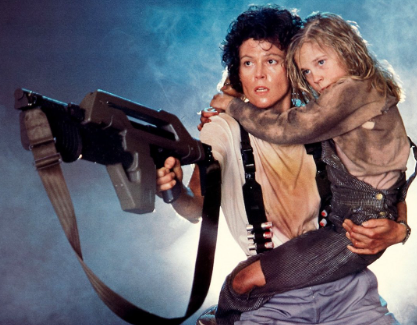
I first determined a physical similarity between my mom and Sigourney Weaver before I saw any of the Alien movies -- Ghostbusters, maybe. But this still from Aliens is undoubtedly the right one to include in this portrait, not only for the physical similarity (my mom actually had her hair cut pretty much like this at one point) but for the symbolic value of it. There may be no better cinematic embodiment of motherhood than Ellen Ripley, even as she fights another mother (in a badass mech suit). Ripley would have done anything and everything to keep her charge safe, just as my mother would have -- she fought for my sister and me countless times, though of course, rarely in the life-or-death scenarios you see depicted on your typical movie screen. The similarity between my mother's mothering and Ripley's goes one further, though. As you know, Newt was not Ripley's biological daughter, which just makes the mothering instinct all the more pure as it is not informed by self-interest. After my sister and I graduated high school, my mother started a job as a regional coordinator for young Europeans and South Americans coming to work as au pairs in the Boston area. I know she was a mother to them when their own mothers were far away. In a very real way, she kept them safe. (As a side note, I got to see Weaver on screen just two nights before I learned of my mother's passing, in Galaxy Quest, when I already knew the end was probably a matter of days rather than weeks or months.)

5. Susan Sarandon

The four others came quickly to mind, but I had to stretch a bit to round out this list to an even five. And I don't love the fact that Susan Sarandon has lately gone off her rocker, politically. But when I googled "actresses who look like Sigourney Weaver" just to help me out a bit, I found that the internet thinks Sarandon looks like Weaver -- a thought I had honestly never had. I had, however, noted the similarity previously between my mom and Sarandon, lesser than these others though it may be, so I've included her here at #5. Again, I don't have a signature Sarandon role that reminds me of my mom -- the photo I've chosen is from Elizabethtown, even though I don't like that movie, just because I thought the physical similarity to be better than some of the others I've considered. But something Sarandon has done in almost all of her roles -- saving, maybe, The Rocky Horror Picture Show -- is to project a sense of strength, of composure, of confidence that I feel is a good fit for my mother. Oh sure, she had the neuroses I've alluded to a couple times in this post. But when it counted, my mom was strong. She could have the seriousness of purpose embedded into that look we all know when Sarandon looks you straight in the eyes to tell you something. On the flip side of things, Sarandon could also have a playfulness that was my mom's bread and butter. Current politics aside, Sarandon does both sides of the coin the way my mom could.

This is my last tribute to you on my blog, Mom, but it is not goodbye. You will be with me always, on screen and in my heart.

Sunday, June 14, 2020

Thirty years since I saw Ghost on the road with my mom

I didn't expect to write another remembrance of my mom today, or at least, I had a different kind of remembrance that I thought I'd write rather than this one, which will now probably come tomorrow.

In fact, after I finished writing yesterday's post, I almost went back to edit it to include the story I'm about to relate. In the end, I decided just to leave it as is.

But then Saturday night, after my wife and I watched a show together and were heading toward our separate entertainment options for the night, I hopped on our streaming service Stan, not knowing what I was going to watch. I decided to jump into the Trending Movies section, and there it was, trending for no particular reason I can think of: Ghost.

It seemed like a sure sign that there was one more film story about my mom that was left to be told.

I ended up watching Ghost, just as I did back in the summer of 1990 with my mom. That first viewing came on a road trip to see colleges. I had thought that we took the trip during the academic year, and maybe we did. But the movie came out on July 13th of that year. So either our trip was actually in the summer, or the movie was such a hit that it stayed until theaters until September or October. I guess at that time, I might not yet have been seeking out as a matter of course those hit movies that remained in theaters for four or five months.

We lived in the Boston area, but there were a handful of schools I wanted to visit in New York, in Pennsylvania, and as far away as Kenyon College in Ohio. We took a road trip that lasted five or six days. I'd say we split the driving, but I would have only just gotten my license within the past six months, possibly even less depending on when the trip actually was. So in reality, she probably did most if not all of it.

There were some funny stories from that trip. One involved a tour at, I believe, The Rochester Institute of Technology, which was always an unlikely fit for me as I intended to be an English major. We sat in on a slide show before going on the tour, but I had to go #2 in the middle of the slide show. I guess I didn't know how close it was to the end, so I kind of took my sweet time on the toilet as I am sometimes wont to do. When I emerged, I realized everyone had been waiting for me so they could start the tour proper -- God, it might have been ten minutes they were waiting. Embarrassing as hell, but my mom and I were soon laughing about it. We joked that we should make sure we ask, on every future college tour, if they had bathrooms. (Weirdly, this story came up organically when talking to my wife on Saturday night, in a context completely unrelated to Ghost -- my son had had a similar thing happen when we were visiting friends earlier in the day.)

Then there was the incident on our way home, when we stopped in Western Mass for the afternoon. I had been working on a scrap book and photo album from our most recent visit to the island conference center off the coast of New Hampshire, Star Island, that was so near and dear to my heart. Wanting to spend some more time on it, I sequestered myself in a small room on the second floor of a historic library in the town where we stopped. The librarians forgot I was there and closed the library at 5 o'clock without knowing I was still inside. When I tried to leave and stepped outside the room, it triggered an alarm. The police came and everything.

But the story I want to recount today has no funny details, no Seinfeldian moments of embarrassment or misunderstanding. It was simply our chosen evening activity on one of the nights of the trip. We were in another small town, I think it was in New York, and there was a movie theater in the town. I can't remember if we had choices or if it was just one of those single-screen theaters that have since pretty much disappeared from the landscape, even before COVID but especially now. Ghost was either our only option or one of just a couple, and we went to the 9 o'clock show.

Simply put, I thought it might have been just about the greatest movie I'd ever seen.

I think there was something symbolic about the effect Ghost had on me. It was one of the first movies I remember being really moved by. I think I cried at a couple different junctures -- probably the same junctures that teared me up on Saturday night -- which would have also been a first or a near first for me. It may have been the first time that a romance touched me the way this one did.

The symbolic thing about it was that on this trip, I was planning my future. I was figuring out where I might spend the next four years of my life, after finishing my senior year that is. As it turned out, I ended up in Maine for college, but I didn't know that at the time. At the time, this was a preview of my young adulthood, and my mature emotional response to Ghost was there to usher me into it.

I don't think it's possible my mom loved Ghost as much as I did, but I do think it was a big win for her too. I remember her specifically mentioning the part at the end where the receding shape of Patrick Swayze's Sam Wheat begins intermingling with the other beings of white light, standing in a welcoming line, until he is indistinguishable from them.

I'm not a particularly religious person, but I believe in the wonder of the unknown enough to think that my mom could have had a similar experience to Sam Wheat this past Monday.

Although this might have just been a one-off nice memory for me and my mom, it ended up being something larger than that in the long-term effect on the way I watch movies. And I'm not just talking about the part of me that grew up while watching that movie, the part that, in some way, start to grapple with mortality.

No, I think our Ghost viewing became a standard that I keep trying to attain to this day. Since that day, I go out of my way to see a movie when I'm out of town, when I'm on vacation, when I'm on a business trip. There's something about seeing a movie away from home that makes you remember the experience. And I think I'm still chasing the high of that night my mom and I saw Ghost, in a small town in New York, probably at a single-screen theater, in August -- yes, August it was -- of 1990.

That was 30 years ago. And 30 years is an important number for my mom and me. My mom was almost exactly 30 years older than I am, as she was born in October of 1943 and I was born in October of 1973. Our birthdays are only a week apart.

Gone are the days that I'm 30 years younger than my mom. She's no longer aging while I continue to do so. I've already gotten closer to her age by almost a week. One day, if I'm lucky, I will surpass her 76+ years.

So she was the age I am now when she saw Ghost with me. It's kind of profound to think about. She got a bit of a head start on me in the parenting department, as she had a 16-year-old when she was 46, and my oldest turns ten in August. Who knows, maybe his birthday on August 25th was the same day we saw Ghost.

Which makes for another interesting coincidence. The last time I saw part of Ghost -- which would have been my sixth or seventh viewing, had it been completed -- was when we were in the hospital in 2010, in August, waiting to be discharged. In other words, 20 years after August of 1990. It was the movie we were halfway through on the hospital TV when the doctor finally signed on the dotted line.

The reason we were there?

The birth of that very same son who turns ten in August.

Circle of life, I tell ya.

I don't really believe in signs, but stumbling across Ghost on Stan on Saturday night may have been one.

The universe delivers you what you need, especially when you're mourning. And on Saturday night, I needed to see Sam Wheat become indistinguishable from those other beings of white light.

Saturday, June 13, 2020

The hardest "in memoriam"

Over the years, I've written eulogies on this blog for, it looks like, 19 movie stars, directors, or others who have touched my cinematic life. It's probably more, but that's the number I remembered to give my "in memoriam" tag.

The 20th will undoubtedly be the hardest.

If you wondered why I left up a post entitled "The interchangeable erotic thriller posters of yore" for an entire week -- especially given that it was already incompatible with our current moment of coronavirus and protest -- well, I'll tell you now.

I lost my mom this past Monday.

And in a very real way, I have her to thank for my becoming a cinephile.

First, let's discuss the necessaries. She had dementia, which means we were expecting this for a number of years -- even long before she started showing signs, as her mother also had it. The pace of her illness gained an alarming speed in the past year -- she was living in her own home as recently as last October -- but in the case of dementia, a faster decline is probably more merciful anyway.

I'm doing better than I might have expected, for a number of reasons. For one, my sister was able to be there with her for her last week in hospice, when she was moved to a place where visitors were allowed. I could not travel to the Boston area from Australia of course, but I was able to see her on video chat and speak to her when my sister held the phone up to her ear. I told her what I wanted to tell her. In each instance she gave an indication that she knew I was her son, something I had already prepared myself not to be possible when I considered this outcome years ago. She knew she was loved.

Then of course there's all the love and comfort people provide you via Facebook, email, phone, text and in person. If you haven't been through it, maybe you don't know just how amazingly the people who care about you step up for you in times of sadness. Especially if they've been through it, they know what it's like, and now I will be even more likely to step up for them in the future, having gone through this myself.

Because of all this, I am doing well. Maybe not well enough to write a blog post before now, but well.

I won't go on in too much detail about the type of person she was, though I hope you love this photo from the early 1960s as much as I do. I've written her obituary as well as a more informal tribute on Facebook. Unless you happen to know me personally, you don't really need to read those things, and if you do, maybe you've already read them.

I will, however, try to describe my mother's role in my movie history.

I think my mom was always a cinephile, but I didn't fully realize it until recent years. I always knew what she considered her favorite two films, which were Ken Russell's Women in Love (1969) and Hal Ashby's Harold and Maude (1971). I watched them both when I was in my early twenties because I was curious to learn more about the depth of her affection. I must say Women in Love didn't make much of an impression on me, though now that she has passed, I will likely watch it again. Harold and Maude, on the other hand, has become a favorite that I have seen four times, most recently Tuesday night Australia time, when I watched it in her honor.

It may be no great surprise that this was my favorite Harold and Maude viewing, given the circumstances, nor that I got emotional during the climax, which finds Maude slipping away from Harold after taking poison tablets on her 80th birthday. Cat Stevens' score in general, and song "Trouble" specifically, certainly helped with my tear ducts in those final scenes. (My mom's love for Cat Stevens transferred to me completely, and I finally saw him in concert for the first time a couple years ago.) And though I could probably write a whole post about it, I'll just say quickly it was not lost on me that Maude chose the timing of her death in a way similar to how Mom chose the timing of hers -- opting, to the extent she could, to decline quickly, and spare her loved ones years of being the burden she never wanted to be. She didn't make it to Maude's 80, but she was close enough at 76.

I don't remember my mom watching a ton of movies when I was growing up, in part because that wasn't as easy to do back then. She would watch them when they came on TV, I think, but since many of the ones that she watched wouldn't have interested me at the time, and she would have watched them after I had gone to bed, it wasn't something I noticed specifically.

But around 1984, we subscribed to The Movie Channel on cable. Not HBO, not Cinemax, but The Movie Channel, which was telling as it contained no non-movie content. As my dad has never been a cinephile -- though he does love a good movie as much as the next person -- this decision was undoubtedly spearheaded by her.

We didn't stay subscribed to The Movie Channel for more than a year or two, which I think was possibly a conscious decision not to pay for something we weren't using. I think maybe the kids were using it, and that could have been part of the problem, because at one point there was a real effort to curtail our TV watching. As a parent now whose kids are way too addicted to TV, I get it.

But why wasn't my mom using it? Oh, she was, in her way. She wasn't sitting down to watch a lot of movies, but she sure was collecting them.

Before the days when you could watch movies on your TV whenever you wanted, you had to either sit down to watch when they were scheduled to air, or record them for later viewing. And when we had The Movie Channel, my mother went on a recording binge. She filled several plastic bins with the VHS tapes of movies she recorded off The Movie Channel, intending to watch them I'm sure. Maybe some she did watch. The collection mentality was what interested me, as I have become quite the collector myself. See all my movie lists, which are the type of movie "collection" you keep when you don't see it fit to spend a lot of money amassing a large physical collection. A certain frugality was something I inherited from her as well.

As a kid I would look at those titles with fascination, as examples of an adult movie world I could not yet access. Fitzcarraldo. Phar Lap. Equus. Victor/Victoria. Paris, Texas. Whose Life Is it Anyway? Breaker Morant. Dozens of others. The thing they all had in common is that they were relatively new releases during the time we had The Movie Channel.

But my mom also recorded movies for me from that time. Some of those I still consider masterpieces, like Time Bandits and WarGames. Others were guilty pleasures that I still think of fondly only because I wore them out at the time, like The Pirate Movie. (My crush on Kristy McNichol helped with the wearing out of that one.) Whatever the movies were, I first fell in love with movies during those years. Without my mother pushing to order The Movie Channel, and then operating the VCR before I could, I can't be sure my love for cinema would have taken hold at that key juncture of my development.

My mom may not have watched many of the movies she recorded, or maybe she did. The joke was always that she recorded them but didn't watch them, as we assumed that if she did, she would have recorded something else over them. But maybe she watched them and just wanted to keep them in her collection. It's what we collectors do.

Whatever the case was, she made up for it in the last ten years of her life. Again always a fan of something free, my mom really benefited from the vast movie collection of her local library in Bedford, Massachusetts. Since she did not live with the man who was her partner for nearly 20 years until he died in 2018, seeing him only on weekends, she had plenty of time during the week to watch movies.

And watch movies she did. I don't think I really had a sense how many she was watching until a visit in 2018, when we looked at the Bedford Library collection together. I thought I would curate a list of films I loved that she hadn't seen, but it was extremely difficult, as title after title were things she had already watched. I did finally amass a collection of about ten such films, but I don't think she actually watched them after I left. By then movies were already less able to hold her attention, I'm afraid.

But before that, she would watch them, and would ask my thoughts on them when we talked on the phone, or over email, before email was beyond her capabilities. Her observations ran the gamut from explorations of key themes of the films in question, to discussions of which men in the films were attractive or not attractive. She wasn't ashamed of being a little superficial in her appreciation of a beautiful face. I always think of Jeremy Irons as one of her favorites.

Over time, she often did not remember the names of the films even a few days after seeing them, though she could still talk about them, and I was often able to supply the name based on her description of the plot. Some ten-minute portion of every phone call was reserved for a catch-up on movies, and I always looked forward to those ten minutes.

When I get dementia -- a near biological certainty, it feels like -- I've told my wife that she should just sit me in front of my favorite movies, which are sure to speak to some core of my inner being, even after I've become untethered from other parts of myself. This is, in a way, how my mother spent her own decline, except in her case it wasn't favorites she watched. She may have watched some favorites, but her hunger for the films she hadn't seen yet -- a hunger I share -- defined that period of her movie watching life.

And in a way, that was a supreme act of optimism for her own future. She didn't say "Well, this is the beginning of the end -- better watch Harold and Maude a dozen times." No, she kept going on that impossible quest to see every movie she hadn't yet seen -- which I also share.

When your loved ones pass, one of the things that gives you comfort is recognizing the ways you see yourself in them. I owe so much to my mother for making me the person I've become. Those personality influences are more far-reaching than film, of course. But on a film blog, I'll place special emphasis on how she shaped me as a lover of movies. It's just one of the many gifts she gave me.

Thank you, Mom.

Saturday, June 6, 2020

The interchangeable erotic thriller posters of yore

Did I say something about Bruce Willis?

If you've been keeping up with the blog, you know I've watched three Bruce Willis movies in the past month, and written about each. Friday night would have been the fourth, totally unwittingly -- as in, I didn't realize it was another Bruce Willis movie until after I'd already decided to watch it. The Sixth Sense had been mentioned on one of my podcasts this week, and that gave me a hankering to catch up with it for the first time in at least 15 years. Alas, it was not available on either of my streaming services, and I didn't want to watch it enough to pay for it.

While looking for it, though, I did notice something extremely funny in the search results of my Australian streaming service, Stan.

The Sixth Sense is, quite obviously, not an erotic thriller. But it is a thriller, so I guess that triggered a number of erotic thrillers lurking around in Stan's database on the search algorithm. Better to provide you irrelevant results than no results at all.

I couldn't help but laugh at those results, which, on the second row, looked like this:


A five-poster wide image isn't great for the blog layout, which is why I've excerpted two of these posters for the artwork above.

Looking at these five posters side by side, it reminded me how similar the marketing campaigns for erotic thrillers used to be -- and how basically gone from the landscape that marketing approach is now. If you saw a poster like this in the lobby of your local multiplex in 2020 -- assuming it was open, of course -- you'd get a good laugh at it. It would be too cheesy by half.

But in the years 1987 to 2004 -- which covers the range of release dates for these movies -- these posters were plentiful. So plentiful, in fact, that a search for a fairly different type of movie could bring up a random swath of these posters and have them be almost identical to one another.

In a full three of these posters, the man is plunging his mouth deep into the neck of the woman, though in two of them she is looking elsewhere. The two others are perhaps the more suggestive, as both parties appear to be naked in the Indecent Proposal poster, while Josh Hartnett might just be doing the "lift and fuck" in Wicker Park.

The other similarities are rather funny as well. Three of these have sensationalist two-word titles -- a kind of platonic ideal for the erotic thriller -- which could probably be used interchangeably for each other without compromising one iota their ability to describe the plot. The other two? Place names.

I don't have any good way to search it, but I wonder how many other movies made during this period have a poster that's almost identical to these. There could literally be hundreds. Of course, if a five-panel wide image doesn't work very well on a blog, neither does one that goes a hundred across.

Rather disappointingly, when you search for any of these other titles individually instead of The Sixth Sense, the results are less satisfying. Some of these pick each other up, but none of them pick up all five in a row the way The Sixth Sense does.

Of course, if I did actually want to choose a Bruce Willis movie, I'd have my options there as well:


Not streaming though, unfortunately.

Friday, June 5, 2020

The rising sun, in full bloom

I may have seen only six of Marilyn Monroe's more than 30 films, but I feel like 20% of her filmography is enough to give me a good idea of her strengths ... but more especially, her limitations.

Oh, she struck me as a capable actress, and certainly a beautiful woman, and certainly a terrific flirt. But I didn't know she had any real skill until I saw her last film, John Huston's 1961 The Misfits.

As I was watching this film -- which was also Clark Gable's last -- I couldn't help but be reminded of Brandon Lee in his last film, The Crow. He was just starting to come into bloom, just starting to shows us the depths of his charisma and pathos. I feel the same about Marilyn Monroe here.

I don't know if it's a common critical opinion that this quirky black-and-white modern-day western represented Monroe's best work, though I do know she hated her own work in it. We may not be wise to trust her at this self-destructive phase of her life, which ended the following year, after she was fired from the film she had been working on. Again, not a Monroe scholar, but she strikes me as someone who would be harder on herself than anyone would dream of being on her.

But I was just floored by how much work she seems to put into this performance, and by that I don't mean that it looks like work. I mean that she obviously showed an interest in improving her craft and becoming a more serious actress. And though there may be other great examples that I haven't seen, I don't know that they could exceed what I saw on screen this time.

Monroe's recent divorcee is not perhaps exceptional as part of her whole career, as she played a naive innocent on a number of occasions. But I don't know that I've ever seen her play a naive innocent so thoroughly convincing about her utter lack of guile.

She's so charming in this movie that the men have to resort to amateur poetry to describe her. One tells her she has "the gift of life," the only way he can think of to sum up her intoxicating mixture of delightful pep and an earnest belief in the goodness of others. Another says "When you smile, it's like the sun coming up." And indeed, it is.

But what I find most fetching about Monroe here -- in terms of her craft, I mean -- is not the coy smiles and the genuine moments of pure joy. It's the way her eyes react to all the new information she receives in this film, how her blind optimism is buffeted by a thousand small shocks. Even when she drifts to the side in a particular shot, no longer its focal point, she's still reacting. Those eyes also express an awkwardness about her own place in this mixed-up world, her discomfort at being a distracting beauty when she feels and judges at a level not nearly so superficial.

Oh, and then there's that great scene where she joyfully hits a paddleball over and over again to win a bet.

Maybe it was the mixture of traits Monroe shows us here that made her more than just another pretty face, more than just a wispy voice that always sounded a bit like self-parody. Maybe by missing 24 of her films I've missed the boat. But I'm glad I saw her last one, because now I want to go back and find the real actress that may be hiding in those two dozen others, behind the facade of her persona.

Monday, June 1, 2020

As the world burns

I don't usually like to let major world events, especially tragedies, go completed unrecognized by me on the blog. Only part of that is the fear of looking callous by prattling on about viewing schedule coincidences while people are hurting. The other part is that, while these things are on my mind, I do actually want to write about them, movie blog or no.

I haven't written anything yet about the death of George Floyd or the protests that have followed, or the riots that have followed that, and indeed, I have prattled on about viewing coincidences here on the blog. It wasn't an intentional decision to hide my head in a hole and escape from the world, though that could have been part of it. I suspect it has more to do with the good fortune of living in Australia, where police tend to kill a lot fewer minorities, and the very justified conflagrations in the U.S. this past week just don't need to happen.

But just as not writing anything about it on Facebook ultimately got the better of me, now my apparent neglect on the blog is too much for me to handle as well. So I'm going to come out from that hole, at least for a few paragraphs, and write the post I might have actually written at the start of the pandemic if I hadn't gotten behind.

As I watched the riots start to take hold in the U.S. -- as few as possible, as I have been selective in my video viewing -- my first thought was of a movie I saw only two months ago.

That was The First Purge, the latest in what I am starting to consider a very politically astute series hiding in an exploitation package. I had thoughts I wanted to share about it when I watched it on March 26th, but ended up making mention of it only in passing in a post that was otherwise devoted to Marisa Tomei. (The connection being that Tomei appears in the movie.)

The thoughts were that I was shaken by the world presented in The First Purge, and how little it probably differed from our own. The Purge: Election Year had, you may remember me saying, reduced me to a blubbery mess when I watched it a few weeks after the 2016 election, as it shows a world of evil fascists trying to wipe out poor people and minorities. The fact that it had a Hilary Clinton-like presidential candidate in it, and that she was nearly sacrificed by reprehensible white male politicians in the film's climax, just made the immediacy of it all the more relevant.

In this Purge prequel, we see where it all began. The same extreme right political party has only just taken grip of the U.S. political system, and introduced the concept of a single 12-hour period where all crime is legal. In order to assess the viability of the idea on the rest of the country, they select one confined area -- Staten Island -- as a test site. The site has been chosen, we come to realize, for its large percentage of blacks and other minorities.

Except it's not blacks and minorities who start the trouble that does, eventually, engulf the island. The actual residents of Staten Island kind of just think it's a hoot, and restrict their rebellions to innocuous behaviors like partying in the streets. No, when things flare up, it's because this extreme right government has sent in masked mercenaries with automatic weapons. They start to kill indiscriminately, with two clear goals in mind: 1) to exterminate as many blacks and minorities as possible, and 2) to make it look like they did it to each other.

Can you think of something more prescient for the days we are living through now?

The most chilling aspect of this past week's rioting is that I suspect much of it was started by people who didn't originate in those neighborhoods. I'm sure there are more videos out there, but one particular video I watched showed a figured dressed all in black, carrying an umbrella, his face totally hidden by a gas mask. The interprid cell phone cameraman caught him dispassionately walking along the front of a Minneapolis AutoZone, smashing all its windows with a hammer, then leaving the scene.

Suspicious of his motivations -- and rightly so -- a couple black bystanders follow him and try to confront him. Tellingly, their confrontation is with words only, and the only moment it verges on violence is when he lashes back at them. No, they want to call this guy out on what he's done. When he turns to lash at them, you can see this is a white agent provacateur who has come in just to foment chaos. His only agenda is to frame the black people who would surely be blamed for looting that AutoZone.

It boiled my blood.

How many versions of that guy were dispatched to different places around the U.S., with the single goal of creating the conditions where black Americans would be injured or killed, or at the very least, blamed for vandalism they didn't commit?

It made me think of the cold, military purposefulness of the First Purge mercenaries, let loose to destroy and marginalize and strike a decisive blow in a race war they had already been winning for centuries.

Sunday, May 31, 2020

Richard Jenkins double feature

We made it an evening of favorite comedies on Saturday night. We'd already queued up Step Brothers, noting it had been a while since we'd last seen it (2015), and then had time for another short one afterwards. Turns out, it had been a lot longer since we'd last seen Flirting With Disaster: 2009.

The choice of the second movie was certainly influenced by the first. As I was going through the folder of DVDs I brought with me from America, I landed on Flirting because a) we wanted to keep the comedy vibe going, and b) it would allow for a double feature of movies featuring the great comedic actor Richard Jenkins. Or, Richard E. Jenkins, as he was once credited.

Not only did this make a great 1-2 punch of exasperation and perfect line deliveries, it also made an unexpected two-movie exploration of families constructed, reconstructed and deconstructed in unusual ways.

In Step Brothers, of course, you've got a new family unit that is composed of two sixtysomething adults (Jenkins and Mary Steenburgen) and their two adult children who still live with them (Will Ferrell and John C. Reilly). The parents are both successes in their respective fields and the kids have no fields at all, yet we are invited to try to see the similarities between them that would make them legitimately related. Ferrell's gentler nature mirrors that of his mother, whom he describes as a saint, though not his asshole brother (Adam Scott), who must have taken more after their dad. Meanwhile, we finally see the relationship between Reilly and Jenkins bear fruit at the end, when Jenkins explains that he always wanted to be a dinosaur, even in his late teenage years. It explains some of the fantasy focus of the adult Reilly.

In Flirting With Disaster, we've got Ben Stiller's character desperately seeking to belong to biological parents, to see in them traits that he has. With each misstep they make on their journey, it takes usually less than an hour to determine the person he's meeting is not actually related to him, but by that point he has already identified apparent physical and behavioral similarities to the people he's meeting -- kind of like how you can read yourself into any horoscope if you squint hard enough. His potentially rivalrous relationship with his own previously unknown brother (Glenn Fitzgerald) is explored, and we see Stiller in all manner of possible family dynamics. Then of course there is also the unconventional family of Jenkins' character with his husband, played by Josh Brolin.

The common factor is Jenkins, but I'm not going to posit any kind of match between actor and subject matter. It's surely just a coincidence.

What isn't a coincidence is how great Jenkins is in both films. Neither part is a lead role, though he does have plenty of screen time. But he's got the presence and the comic instincts to steal scenes from those he does appear alongside. His apoplectic rage at the step brothers is comic gold, and his reaction to getting dosed with acid after eating the wrong quail in Flirting With Disaster is legendary. "Is this a musical table?" "Good night Tina!"

His delivery is, of course, first rate, as he can put a cynical spin on a line of dialogue with the best of them. But this time around I took particular note of the work he does with his face. His look of absolute adoration as he takes in the bullshit slung by his new stepson, the asshole brother Derek, is just hilarious. He's a sixtysomething man glowing with a school girl crush. It's a variation on that same look that is so great when he wishes Tina good night in the middle of his acid trip. This is a first-time experience as well, and for this moment at least, it's a good one.

As Jenkins is now 73 and hasn't appeared in a film since The Shape of Water, I worry that there will be a paucity of future Jenkins roles for me to appreciate the way I appreciate these two. Then again, he's in two 2020 movies that have yet to release. Miranda July's Kajillionaire, at least, seems like it has the potential for Jenkins to again wrestle with the absurdities of life the way only he can.

Saturday, May 30, 2020

Sleepy Bruce Willis

I swear I'm not on some Bruce Willis kick, all evidence to the contrary. Yesterday I wrote about how I watched my second quarantine-themed Bruce Willis movie of quarantine, and one day later, I've already watched a third Willis flick. This one isn't quarantine-themed, unless you count one scene where a couple guys rob a store wearing half-masks that are basically surgical masks. That was the only possible connection to COVID-19 I could make.

In fact, I certainly wouldn't have watched Cop Out on Friday night if it weren't for a discovery I made the night before, shortly after finishing Surrogates. I can't remember what bit of internet research it was that led me to it, but I stumbled across the information that Willis acted in a stage version of Stephen King's Misery, which ran from late 2015 to early 2016. He played Paul Sheldon, of course. (What, did you think he played Annie Wilkes? That was Laurie Metcalf. Would have really liked to see this.)

I messaged the surprising information to a friend, another big Stephen King fan, and he responded that he didn't think Willis would have the chops for that. I countered that Willis does have the chops, he just doesn't usually use them. In this case he might, since he would obviously not have taken that role for a paycheck. In all other cases, at least lately, he tends to phone it in.

So Friday night, as proof of my theory, I decided to watch him phone it in.

I had heard awful things about Kevin Smith's movie -- both that it was bad, and why it was bad. The latter, at least, was according to Smith himself, who hasn't been shy about talking about how difficult Willis was to work with. I'm not googling his exact quotes now, but I think it was both an attitude issue and a preparedness issue. Like maybe Willis didn't want to be there, hadn't learned any of his lines, and was an asshole to everyone on set.

I was inclined to believe it, even as I also subtracted points from Smith for blaming the failure of a movie on one of the actors. For directors, in most cases, the buck should stop there. Or at the very least, accept the blame publicly even if you don't privately.

But in the ten years since Cop Out was released, I hadn't had occasion to see for myself how terrible Willis was in the movie, which would likely either confirm Smith's comments or render them as overblown blame-shifting.

The thing I remembered before watching was that I thought Willis looked "sleepy" on the poster. That was what I wrote in this post, a decade ago. It was a slightly different version of the poster than the one here, a version where he looks sleepier. I can't use the same one due to my long-standing rule of not using the same poster art twice for two posts on my blog -- even when they are separated by ten years. Anyway, that's why I'm invoking the adjective "sleepy" in the subject of this post, even if it comes a little closer than I'd like to Trump's lame characterization of Joe Biden as "Sleepy Joe."

Well, Willis may be sleepy in this movie, but I'd argue it's a lesser sin than other elements of Cop Out that are way too awake.

The worst scene in a very bad movie is not a Willis scene at all. He's in it, but he's on the other side of the glass of the interrogation room where Tracy Morgan is busy hamming his fool head off. Screenwriters Mark and Rob Cullen -- Smith can't take the blame for the script, at least -- apparently thought it was a good idea for a five-minute scene in which Morgan's character plays bad cop to a perp, roughing him up with lines he's gotten from movies. The joke is supposed to be that the lines start out as from cop-related movies, but devolve into famous quotes from any movie. It's actually a funny idea, but it goes on at least four times as long as it should, and Morgan doesn't sell it well. That could be because he's also wildly putting the perp in headlocks and pushing his head into the interrogation table while trying to deliver his lines.

Willis' responses, on the other side of the glass, are pretty sleepy, but they aren't what makes the scene so painful to watch.

This is just one example of the typical mode of Cop Out, an early tone setter. Willis is not good in it, and maybe he isn't as engaged as he should be, but his disinterest wouldn't have stood out to me if Smith hadn't called attention to it. There's no doubt the movie is quite bad. It's reasonable, I suppose, to conclude that Smith was so worn down having to cater to Willis' diva mentality that he had nothing left for the rest of the movie.

It occurs to me that Cop Out represented an interesting turning point for both men, in different directions. It's only a year after Surrogates, in which I thought Willis was quite good, and definitely engaged enough. After this, though, he started steadily sliding into where we find him now, selling his phoned-in performances for increasingly smaller paychecks on increasingly smaller movies. (The theory works better if you disregard Looper in 2012, in which he is again quite good.)

On the other hand, it's only a year before Red State, which is still the best directing Smith has ever done if you are considering both the performances of the actors and the overall craft of the film. I know most people don't like that film as much as I do -- it made my top 25 of last decade -- but I hope most people at least acknowledge that it is good by Smith's standards. You can see him having used the experience of Cop Out as motivation to be better. The win streak continued with Tusk before he came back down to earth again.

Well, one thing I can tell you for sure -- tonight will not be my third straight Willis movie.

Friday, May 29, 2020

What we all need right now are some surrogates

My self-proclaimed outside-the-box quarantine-themed viewings continued last night, as I saw my second Bruce Willis quarantine movie. And by that I mean not only was it my second Bruce Willis movie during quarantine, but it was my second Bruce Willis quarantine-themed movie during quarantine.

The first, Twelve Monkeys, dealt with an actual virus. The second, Surrogates, deals with how we cope with threats from the outside world, a virus being only one possible example.

So all you peons out there, watching your "obvious" quarantine movies, need to check out the movie where people put artificial simulacra of themselves into the world to avoid getting killed. It's got loads of current relevance.

I was actually a fan of this comparatively under-the-radar 2009 sci fi flick back from the start, but given how far under the radar it flew, I hadn't really considered watching it again in the intervening 11 years. Then the other night it jumped into my mind for reasons I can't remember, and then stuck there to the point that I paid good money to rent it after not finding it on any of my streaming services. (It's just the kind of movie that should have been hiding away somewhere among Netflix's offerings, much as its characters are hiding away, but no.)

If you aren't familiar with the basic premise, it looks at a world in the not-too-distant future where people (known pejoratively as "meat bags") stay at home all the time, and instead of going out themselves, they pilot around androids that do all their real-world interfacing for them. Some look like their hosts, some look 100% different -- which makes sense, as they are, in a way, walking and talking chat room avatars. That 47-year-old man pretending he's a 22-year-old coed is entirely possible, maybe even encouraged, in this world.

The technology allows the actual humans, the people susceptible to violence and accident and disease, to stay at home in the protection of their apartments, where they sit in comfortable dentist chairs and connect up to a rig that allows them to see the world through the eyes of their robot surrogates. They can get into fist fights or jump off buildings or have sex with whoever they want, all while their increasingly fragile bodies stay at home, safe against everything except the ruination caused by lack of exposure to fresh air and lack of the use of one's muscles.

As I watched these "meat bags" walking around their apartments, unshaven, in bathrobes and slippers, squinting painfully against the stray beams of sunlight that reach them, I saw ourselves in the time of quarantine.

For the more enterprising of us, it's not that bad. We venture out for exercise and grocery shopping, using masks as the technologically viable alternative to having our own personal robots. We do get out and we do move around.

But some of us have probably gained an additional ten percent of our previous body weight, have lost any real inclination toward personal hygiene, and are the willing prisoners of devices and other virtual experiences that help us escape from the drudgery our lives have become.

And how good would it be, right now, to actually have a surrogate? The surrogate can go to the store, go to the movies, ride in a packed subway, even do your job -- and if your job is a dangerous one, your surrogate can do it without even wearing a helmet. In short, surrogates can keep the economy going in times of pandemic.

Alas, no one thought it fit to invent surrogates, even though Jonathan Mostow's film came out 11 years ago, even though the film series that helped inspire it -- The Terminator and The Matrix -- predated Surrogates by even longer than that. Why did they spend so much time on other things, like Tik Tok and chicken sandwiches with Krispy Kreme buns?

Of course, having your surrogate live your life for you is no way to live life, the movie is sure to let us know. Nor would we want to, I hope, in the long run, though this movie has interesting ideas to explore about how virtual reality could increasingly be a replacement for real life experience. During a pandemic, though -- when a vaccine is still probably more than a year away -- it could be handy.

Until then, we'll probably all be slightly hairier and more bathrobed versions of ourselves, squinting at the sunlight.