Sunday, April 1, 2018

Neill Blomkamp used time travel technology to make Elysium

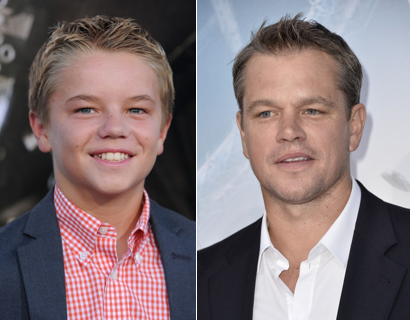
As I was watching Elysium for the second time last night, it occurred to me that the actor playing a young version of the main character, credited as Maxwell Perry Cotton, looked almost exactly like the actor playing an older version of the main character, credited as Matt Damon.

It turns out they should have both been credited as Matt Damon.

In looking up this uncanny similarity after the movie ended, I discovered that director Neill Blomkamp recently released a bombshell: both actors are Matt Damon.

No, he didn't do some kind of Boyhood-type project of filming over many years, starting with Damon when he was about ten, then waiting for Damon to reach his early 40s before filming the lion's share of Elysium.

In fact, what actually happened is probably more incredible. While experimenting with his cyberpunk visual effects and the various machines that are featured in Elysium, Blomkamp inadvertently cracked the long-sought formula for time travel. Instead of publicizing his discovery, he kept it a secret in order to make Elysium the best and truest feeling version of itself.

He needed help from someone else, though: Matt Damon.

Blomkamp discussed his idea with Damon of traveling back to 1980 to talk the ten-year-old version of himself into appearing in a film 33 years in the future. Damon, ever committed to his roles, slept on it for a night and agreed. He first asked Blomkamp if it would cause any rips in the space-time continuum, and Blomkamp assured him that as far as he understood, it would not.

So Damon found his younger self in the greater Cambridge, Massachusetts area in a local Baskin Robbins eating bubble gum ice cream. At first the younger Damon didn't believe him, but he'd just seen The Empire Strikes Back and had decided that he wanted to be like Han Solo someday. Or really, the guy who played Han Solo. Older Damon happened to catch younger Damon just after he'd decided to pursue his career as an actor. He was overjoyed to learn that he had succeeded in his goal, and after being assured that it would not cause any rips in the space-time continuum, agreed to accompany older Damon back to the present of 2013.

Young Damon shot his scenes in only three days, and as they had a time machine, they got him back to that Baskin Robbins only a few minutes after he'd told his parents he had to go to the bathroom. Someone was actually in the bathroom at the time young Damon materialized there again, but he was a man in his late 80s and suffering the beginning stages of dementia, so no one believed him.

Blomkamp had to bring the young Damon back one more time when he realized that the young actor would be expected to appear on the red carpet before the premiere of the movie. Hence the picture you see above. When it came time to return him, they used that moment in the Baskin Robbins again, but this time brought him back just before the old man began doing his business.

Because Blomkamp could not reveal to the world that Matt Damon had been the world's first time traveler, and thereby lose control of his invention, which he planned to use again in future films, he came up with the name "Maxwell Perry Cotton" for the young Damon.

However, after a recent viewing of Black Panther, Blomkamp came to the realization that technology that can help the world must not be hoarded and kept secret. So Blomkamp came forward to tell his story, in the hopes that maybe his time machine could next be used to, I don't know, go back and kill Hitler or something.

He said he'd be a fool not to share this gift with the world.

Saturday, March 31, 2018

Audient Auteurs: Jean Cocteau

This is the second in my 2018 series watching two movies per month by auteurs whose films had previously been unknown to me.

Jean Cocteau turns out to have been just the type of filmmaker I was hoping to discover in this series. Not necessarily because I liked his films, though I did, but because he really fits my idea of an auteur -- an artist with a distinct vision whose films are immediately recognizable as the work of the same person.

There are two very specific things I found in the Cocteau films I watched, and I'll tell you what those things are before I reveal the films themselves. The first was an opening that breaks the fourth wall and exists completely outside the the apparent themes and/or time period of the movie, as Cocteau himself gives a short amount of narration talking about the film itself in its status as a story we collectively share (both of these films' stories existed in the culture before he filmed them). One of these films even has its opening credits on a chalkboard, which is very much not in keeping with the location or art direction of that film, but underscores the idea of the film itself being an academic exercise of sorts.

The other thing is that Cocteau is a surprise visual innovator who had a knack for special effects -- something I found a bit surprising, I guess, because what I assumed about him was that he was just an arthouse guy, existing alongside technical progress in filmmaking but probably not participating in it. In both of these films he uses camera tricks to execute magical phenomena that deepen the sense of wonder generated by his subject matter. I'll save the specifics until I'm actually discussing the films.

But first a bit about Cocteau. He lived from 1889 to 1963 and was a man of man titles -- artist, designer, writer, playwright and director. His film output was actually relatively small given all the other things that occupied him, and the people who occupied his time -- his Wikipedia page lists a number of famed associates in its opening paragraph, who are all from all walks of celebrity, from visual art (Pablo Picasso and Salvador Dali) to music (Edith Piaf and Igor Stravinsky) to film (Yul Brynner and Marlene Dietrich). As a writer he was associated with Marcel Proust, and he also excelled in set design. I wouldn't be surprised to learn that he also designed buildings and composed symphonies. He appears to have been a true renaissance man.

He made only nine feature films, which is significant because they were stretched over exactly 30 years from 1930 to 1960. The two films I watched were right in the middle of that period, and the second was the middle film in a trilogy that comprised an entire third of his filmography.

1. Beauty and the Beast (1946)

I was especially interested to see Cocteau's take on Beauty and the Beast after having recently revisited both Disney's classic take from 1991, and Disney's dull live-action take from 2017. And as it so happened, I could borrow it from the library, which was how I acquired a total of three Cocteau films, only two of which I needed to watch this month.

The film of course follows all the beats of the story I was familiar with, though that chalkboard title sequence did indeed put me on alert for something far more weird. Once the film actually starts, though, its narrative is actually fairly straightforward, with a few key differences that may in fact be more true to the source material for all I know. The primary one of those is that when Belle returns to her village, she does so for something like a week before the climactic return to the beast's castle. I believe there might have been some teleporting involved as well, though as I saw this nearly two weeks ago and did not make notes at the time, some of the details are a bit fuzzy.

Speaking of fuzzy, I really liked Cocteau's design for the beast. He's quite cat-like and hairy. I think maybe for an older film, I expected him to be clearly studly with a few tufts of hair thrown around to make him seem a bit superficially grotesque. But no, this is clearly an "other," and it's easy to see why Belle would fear him. Curiously, this Belle (Josette Day) does not seem to fear him to the same extent as the others I've seen, and also comes around on him more quickly, without many of the montages of increasing affection the other incarnations rely on. I guess I found that a bit strange, especially since the film does have a lot of slow and plodding parts, which means they had the time for it. But it shouldn't surprise me that Cocteau chose to spend his energies elsewhere than giving us a conventional narrative thrust.

Specifically, he's interested in the beast's magical mansion. There are of course no clocks or candelabras that come to life and speak in French accents. To have even attempted something like that would have been silly. But that doesn't mean Cocteau doesn't have other ways of depicting a mansion that "comes to life." When Belle walks down a hall lit by candles, the candles are held aloft from the walls by human arms. See below:


The mansion is also adorned with faces in the ornamentation at various junctures, like there might be on a door knocker or other internal accoutrements. Doors open magically by unseen hands. Little design details like that appear throughout, without any apparent living souls in the mansion other than our two title characters.

It's hard for me to describe Cocteau's perspective on this story beyond his contributions to the art direction. I don't know that he necessarily cares about the larger themes of beauty being skin deep and the value of true love. And as discussed previously, he does not particularly care to tell the story by providing us the exact things we feel we need when we feel we need them. For example, I was waiting to be told that the beast has been cursed and is trying to attain his prior human form by racing the ticking clock of a flower losing its petals. That never happens, and in fact I don't think we know why he's a beast at all (though he does return to human form at the end, and he and Belle elevate into the sky -- more seamless special effects by Cocteau). Neither are the men back in Belle's village who are trying to save her as sinister as, say, Gaston, though it's ultimately clear why the beast is a preferable match.

In the end though I did get caught up in this movie's spell, and liked it quite a bit. I felt like I had been in the presence of someone with a unique perspective, and enjoyed a bit of an eccentric take on a story that's already been told to me a number of times in its more straightforward form. It's also interesting to me that this was one of the first, if not the first, feature length versions of this story audiences got -- most of the previous ones I've looked up on IMDB seem to be shorts. Maybe that explains a bit more the ways Cocteau stuck to the existing story, as you need to have a definitive version out there in order to feel free to wildly diverge from it.

2. Orpheus (1950)

My second Cocteau film was also his second film in a very distended trilogy, which certainly wasn't envisioned as such when he began it. Ordinarily this would not be an ideal place to start with three films on the same theme. But in talking with a friend, I was convinced that as long as I did not start with the third film -- The Testament of Orpheus (1960), which I also had from the library -- then the second was a reasonable place to start. After all, the first was 20 years earlier than that, and a silent film, giving it quite a sense of being disconnected from these other two, which are only separated by ten years. The Blood of a Poet from 1930 is considered the first in the so-called Orphic Trilogy.

I was less familiar with the story of Orpheus than the story of Beauty and the Beast, though I've seen Marcel Camus' Black Orpheus and of course know the broad strokes of the myth. This film put me in mind of Luis Bunuel at the very start with its sense of absurdist social commentary. Set in modern-day Paris, it begins with a riot at a place called the Poets Club, and someone deadpanning a phone call to the police as if this type of thing happens regularly. Poets being particularly unruly and violent types.

The film does not continue in quite that vein of black comedy, as it becomes more mystical and involves the travelings between the land of the living and the land of the dead, as the does the myth on which it's based. And here is where one of Cocteau's patented camera tricks comes in. When a character has died and is "revived" to serve as an operative for the spirits of the dead, he or she rises from the ground as the film is played backwards. It was shot as a person falling, but then reversed. It's not that this trick is so hard, probably, but that it comes on so quickly and seamlessly, often when there has been a long period without anything like that. It's all the more startling for its suddenness, and seamlessness.

A couple other tricks I wanted to point out. There's one bit where the characters travel through mirrors by wearing these special gloves, as mirrors are the gateway between realms. In the same shot, Orpheus himself is unable to do so, and bangs on the solid mirror -- again, seamlessly. Also liked a shot where he later dips his hand into an apparently solid mirror, and its now-watery surface receives him. Then there's the bit in the land of the dead that reminded me of the technique Spike Lee would later make a hallmark of his style, where one character is progressing forward on a platform without moving his legs, while another character pursues in the normal fashion. The two planes ultimately separate into action in the foreground and a screen in the background, though it is not at first apparent that this is what's happening. All part of creating a great mood.

I probably shouldn't dive too much into the story, as there were parts of it that escaped me, though I didn't care at all. Suffice it to say that Orpheus is a famous poet who is becoming obsessed with these cryptic messages that are coming to him through a certain station on his car radio. They are in fact being sent by the personification of his death (played by Maria Casares) and her minions. (I should say that Orpheus himself is played by Jean Marais, who plays both the beast and the Gaston character, called Avenant, in Beauty and the Beast.) Orpheus begins neglecting his pregnant wife (though she shows no signs of pregnancy), so she is killed by being hit by two men on motorcycles, who take several lives in this movie (they are the executioners, of sorts). This kicks off the story proper that we know, where Orpheus must get his wife back from the land of the dead but must pay the price of never being able to look upon her again.

Interestingly, though, the main romance of the story seems to be between Orpheus and the actual personification of his death, who falls in love with him. This must ultimately be mediated in a sort of afterlife courtroom, at which Orpheus makes his agreement to save Eurydice by not being able to look upon her. It's a bit convoluted but in the best possible sense, as in, you do not care. There's also a spirit played by Francois Perier, who is in love with Eurydice. It makes as much sense as it needs to.

And there continues to be a fair bit of black comedy sprinkled in, as in the absurdity of having to walk around their modern-day Paris home without him looking at her. The spirit who loves Eurydice, named Heurtebise, constantly intervenes to prevent an accidental look. Some of these scenes play like farce. It's a welcome mix of tones, as the land of the dead stuff is very mystical and ponderous in an existential sense. It all comes together to make a film I really dove into, and want to see again.

Okay. I've got my guy picked out for April. We'll stay French with Robert Bresson, and I will likely be watching Au Hasard Balthazar and Mouchette. Both are available on Kanopy, the library-affiliated streaming service to which I now magically have a free membership through the Melbourne Public Library. Join me, won't you?

Friday, March 30, 2018

Failing to finish off the bad guy

Spoiler alert ... though for which movies, I probably can't say without that itself being a spoiler. Um, I guess you've been warned. They're fairly prominent movies though. 

When I think of movies that frustrate me because the good guy(s) didn't take their golden opportunity to finish off the bad guy(s), the first one that usually comes to mind is Pan's Labyrinth. When Mercedes gains her advantage over Captain Vidal, some additional plunges with her knife would have made quick work of him. Instead, she just cuts out the side of his mouth to give him an extra clownish leer, then runs off. I mean, the good guys are supposed to be defined in part by their mercy, but damn, kill that guy.

It comes back to haunt her, of course, as Captain Vidal (SPOILER) ends up fatally shooting Ofelia.

Last night I added another movie to that list, though it was a movie I had already seen once before. A movie that most people don't even want to see once, let alone twice.

There are a lot of things a person could discuss about The Human Centipede (First Sequence), some of which I talked about here. The most interesting and gross stuff will probably be left on the cutting room floor today. Instead, I want to talk about their failure to finish off the bad guy. (Is a human centipede a "they" or an "it"?)

It's a similar situation to Mercedes in Pan's. In fact, the size of the implement is even about the same, if I remember correctly -- a scalpel or an exacto knife. The Japanese man who fronts the 'pede gets and hides the knife until the maniacal surgeon has his back turned. He then stabs the man in the foot and in the leg before almost totally incapacitating him by taking a large bite out of his neck. He then summons his inner coach and marches the two women surgically fused to him up a spiral staircase toward their hopeful exit from the house.

Why not just pull that scalpel back out of the surgeon's leg and, I don't know, plunge it repeatedly into his eyes and neck?

Having not delivered the surgeon a fatal blow, they've of course left him to pursue them only a minute or two later. And although he doesn't kill either of the segments of the centipede that die -- the Japanese man at least takes the power for himself by killing himself, while the back woman dies of infection and malnourishment -- he does prevent their escape, which certainly prompts the Japanese man to give up hope. (His sudden realization of his own culpability in this punishment for leading a wayward life is a really impressive sequence.)

It doesn't detract from the movie, just as Mercedes' half measure doesn't detract from Pan's Labyrinth. But really. Finish the deed, man.

I thought I'd try to give you a half dozen other examples of movies where the good guy failed to deliver the decisive blow, but to be honest, I have a busy day today, and I haven't posted for nearly a week, so I just need to get this thing up. (Start of the baseball season has lots of demands on my time -- a topic for another day, or maybe not.)

And as for The Human Centipede ... what can I say, I love this movie. There are certainly diminish returns in the sequels, and the third one falls off the table into total repugnance. But not only is this one smartly considered and paced, but it's well shot and even well acted. The first time I watched it I felt the performance of the women in the opening scenes was a bit distracting in its quality, but this time I felt totally differently. Tey just behave like young tourists without great street smarts would behave, and I totally buy it.

Also, it's not easy to spend the largest portion of a movie with your mouth grafted to somebody else's butt, whimpering. Their constant stream of desperate crying is not only one of this film's most believable elements, it's also not easy to pull off. So props to them on that.

Saturday, March 24, 2018

The cynicism of Ocean's 8

It's dangerous to characterize a movie that qualifies as a "female version of something" as cynical. Even if it didn't risk offending half the population, it would also run contrary to traditional logic. The cynical approach is not to make something just because it could sell tickets to women, today's largest ticket-buying group, but rather to doubt it will do so effectively, so to make it secretly a movie of and starring men, that only sounds like a women's movie. I guess there could be a couple different types of cynicism at play here.

What I find cynical about Ocean's 8, beyond its attempt to cash in on recent trends (which any smart commercial item should probably do), is that its chosen its title strictly with sequels in mind.

When the title for this movie was first announced, the question on some lips was undoubtedly "Why eight?" Some skeptical feminists might have said "What, we get three fewer than the guys do?" Other optimistic feminists might have said "Yup -- it takes three fewer women to do any task than it would take guys."

Neither is really true. It's all about having sequel titles that don't overlap with existing titles.

If you want to make a sequel to Ocean's 8, what do you call it? Ocean's 9, of course, if you are staying consistent with the series' previous titling convention. Useful -- that title's not taken.

Then if you want to make a sequel to that, what do you call it? Ocean's 10, of course, if you are staying consistent with the series' previous titling convention. Useful -- that title's not taken either.

If you want to make a sequel to that, well then you have to get creative. But the original Ocean's series had only three movies, so maybe they are keeping their expectations realistic. Then again, anything a guy can do, a girl can do better, right?

Maybe the long con, as it were, is to have the seventh movie in the series be Ocean's 23, and get everyone who's still living (have we lost Carl Reiner yet?) together for a big crossover movie between the 13 Ocean guys and the 10 Ocean women.

Cynical? I guess in this day and age, "pragmatic" is the correct term.

Thursday, March 22, 2018

Revisiting a bottom-ranked film

I've been ranking the new releases I see each year for 22 years now, from first to worst. Never before Wednesday night had I had the pleasure of revisiting a movie I'd ranked last.

However, having given a second viewing to the film that claimed that ignominious honor in 2005, I now wonder if more of them might be worth seeking out.

Saw II was always a strange choice for the movie I ranked 73rd of 73 in 2005, in part because it had at least one very good thing about it. Namely, its opening is one of the most effective contained horror scenes I've ever seen.

So imagine how bad I must have thought the rest of the movie was.

If you don't recall that opening scene, the poster I've chosen may job your memory. The movie opens on a guy trapped in one of Jigsaw's traps, which had not yet become old hat in only the second movie. Around his head is clamped a nasty device that Jigsaw likens to a venus fly trap, kind of like an iron maiden for the head. It'll snap shut if the guy doesn't cut out the key from where it's been surgically implanted behind his eye. He has a knife to use, but he has only one minute to do it. Things turn out pretty much as you might expect.

That scene floored me for its use of tension, time, and the hopelessness of doing yourself severe bodily harm to save your own life under those conditions.

The rest of the movie, apparently, erased any memory I had of it.

But I'd wanted to see that opening again for ages. In fact, within the past year, I went looking for Saw II on my various streaming services for just that reason. But I came up empty.

Imagine my surprise, then, went I did a deep dive into my My List on Netflix Wednesday night and found it sitting there.

I had intended to watch only that opening, but then I decided to leave the rest on in the background. I had some work I needed to do, some emails I needed to send, and I could at least give half my attention to what was going on.

And this time, I liked the whole movie.

In fact, I sat there wondering if something would strike me as howlingly funny or awful about it, the kind of reaction you usually have when you decide to send a movie all the way to the bottom of your year-end rankings. It never happened.

If I'm to put myself back in the shoes of 2005 me, I think my issue was probably that I didn't like the basic setup. I was really taken with the setup of the first Saw, just three (or was it four?) guys in a room trying to determine if they will use a hacksaw to cut off their feet in order to survive. Of course, it was also my first introduction to torture porn through the granddaddy of that genre, which counted for something.

In the sequel, I didn't like the idea of a half-dozen people trying to make their way through a house as they go through a series of grueling tests. I also don't think I liked the tests themselves. Once the plot proper started rolling, I got off the ship quick.

But I think Saw II benefits from the existence of so many subsequent Saw movies, some of which are half-decent but most of which offer very diminishing returns. I've seen them all, including the most recent last year, which should tell me how much the series got under my skin, so to speak. And Saw II was definitely a part of that.

This time I cherished the twists and found the individual tests much more interesting. It wasn't just the guy with the mouse trap about to mash his head. It was all of it. There's some damn clever stuff in this movie.

So what was wrong with me when I first saw this movie? I mean, it's not a masterpiece, but worst of the year? It makes me wonder how many other judgments I've made over the years that just plain weren't supported by the movie in question. I mean, maybe The Emoji Movie is actually bad.

I don't expect my reconsideration of Saw II to kick off a whole series of checking back in on bottom-ranked films, but hey, it could. I've already got my year-long viewing series set for 2019, but 2020 is still up for grabs.

Another reason I might have reconsidered this before now is that its director, Darren Lynn Bousman, made a movie I kind of love a few years later called Repo! The Genetic Opera. That's not a popular opinion -- that movie undoubtedly made the bottom end of people's rankings in 2008. But I was really taken with it, and remember thinking "This is the guy who directed Saw II? Wow." Maybe it wasn't the leap forward in quality I thought it was -- not because Repo wasn't of higher quality, as many people might think, but because the leap from Saw II was a lot smaller than I thought it was. (Bousman also directed Saw III and Saw IV before then, but I digress.)

At the very least I feel like I'm correcting a wrong that never should have been done to Saw II if only because of the strength of that opening scene. If a great movie is four great scenes and no bad ones, or whatever the quotation is, then a movie with one great scene and lots of bad one has got to be at least mediocre. And the thing is, I don't even know exactly which scenes that bad ones were supposed to be.

Hey, I can be wrong. Anyone with opinions can. Our fallibility just makes us more interesting.

Though if I ever find myself reconsidering the merits of my worst of 2017, Sean Penn's The Last Face, I will become pretty concerned about my critical faculties. 

Wednesday, March 21, 2018

Tomb Raider is not important for any reason

Sometimes it seems like we're living in an era where every new film that comes out is important.

It's important because it creates some kind of online debate. It's important because it demonstrates what some member of some underrepresented group can or cannot do. It's important because it's some kind of referendum on what kind of audiences will see what kind of movies. It's important because its main character has the potential to be a role model to millions of viewers.

Well, Tomb Raider is not important for any reason. It's just a bad action movie.

On the surface, it may seem like another one of those movies. Even though action movies with a female lead are probably more common than action movies with a male lead these days, just because of how skittish Hollywood is and how little it wants to seem like it's part of the problem, an argument could be made that Tomb Raider was some kind of bellweather for the prospects of female-driven action movies, or some kind of feminist celebration of strong female characters.

But nope. It's just a bad action movie.

And that's okay, other than the fact that I feel like I sort of wasted two hours of my time. Man was it boring. And not even boring in an important way.

In retrospect, they should have hired a woman to direct this film instead of yet another European hack with a ridiculous name (I'm looking at you, Olivier Megaton). I actually quite liked Roar Uthaug's last film, The Wave, but man is his name ridiculous. And I'm sure any number of female directors would direct action far better than he did here.

But nope. It's just a bad action movie.

Who is Lara Croft, anyway? If I'd played the games I'd probably know. If I remember the Angelina Jolie movie I'd probably know. But even in the Angelina Jolie movie, I got the sense they were basically happy with it just being a character who popped out of a video game, without any useful backstory or recognizable human characteristics. If I remember correctly.

So one interesting thing this movie does, while still being a bad action movie, is make Lara a bit more human. In a weird bit of disorientation that turned out to be my favorite part of the movie, she starts out as just a bike messenger who picks up hot food from restaurants and delivers it to customers. That's like the least video game thing I've ever seen. My favorite part of the movie was when she agreed to serve as the "fox" for some kind of fox hunt on bicycles, where a bunch of men had to catch her on a bike before she stopped trailing paint from a paint bucket with a hole punched in it. It was weird but it was my favorite part of the movie.

But it's still just a bad action movie.

I also noticed how they took pains to show Lara getting hurt, occasionally crying or screaming in a way that was perhaps too feminine for modern tastes, and displaying horror the first time she kills someone. I liked all these bits.

But it was still just a bad action movie. And not important in any way.

At least this Lara is not a sex symbol. She wears some of the same getup as Jolie did, mostly for the sake of visual continuity I imagine, but she's not as large-chested and she doesn't have the hot pants (if memory serves, though my memory is already fading in the hour-and-a-half since I left the theater).

That's something. But it still doesn't make the movie good. It still doesn't make it worth arguing about over Twitter. It sill doesn't make it an example we need to hold up of what cinema is doing right or cinema is doing wrong.

It's just a bad action movie. Let's leave it at that and move on to the next one.

Monday, March 19, 2018

Seeing CG through my dad's eyes

Those of us who see a lot of movies have a hard time remembering when we did not feel jaded about
CG. We still remember the times it blew us away (Terminator 2, Titanic, The Matrix), but feel much more likely to dwell on its lesser incarnations as it has become inescapable on the cinematic landscape (too many to name).

But what if we never saw anything with CG in it?

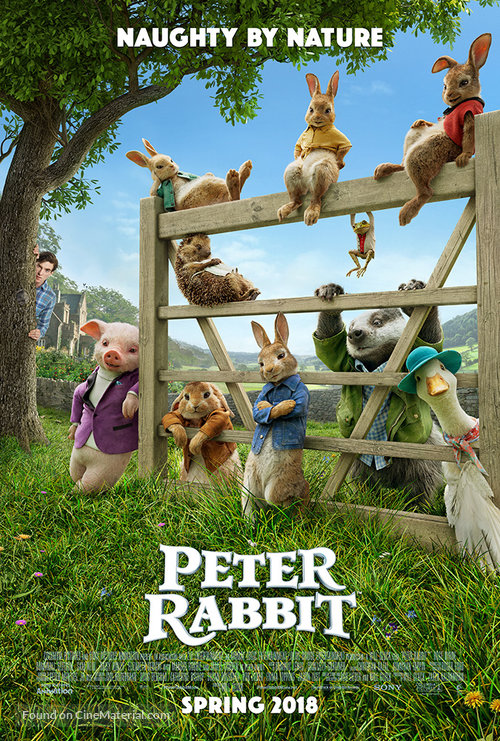
That was the experience of my dad on Saturday when he accompanied my younger son and me to Peter Rabbit. I'm reviewing it for ReelGood (link forthcoming), and this was one of those "admit four, free popcorn and soda" screenings that in the past has given us a family's worth of free admissions to the likes of Inside Out, Zootopia and Cars 3.

We admitted only three as my wife, my older son and my dad's wife decided to do different things with their Saturday afternoon. But my dad said he would come, and seemed sort of excited about it. I guess he hadn't heard the reviews.

My dad is traditionally not much of a cinephile, though I think that's changed a bit since he married my stepmother ten years ago (we don't use that term, but continuing to say "his wife" seems a bit distancing as well). She's not a cinephile either, but I do think she sees watching movies together as more of a viable social activity than my mom did -- which is weird, because I think my mom is more interested in movies than either of them. Anyway.

So my dad has been seeing a fair number of movies in recent years, but almost none of the big blockbusters. He'll see more than half of the best picture nominees and other films that tend to be more in the realm of realism. He will see almost no movies like Peter Rabbit.

There were any number of potential obstacles to his enjoyment of the movie. We had to rush to get there, as we'd packed our schedule tightly that afternoon. We didn't have our pick of seats, so to maximize what was available, he sat in the row behind my son and me. (I could have put him next to my son, but having to deal with my son fidgeting all movie, and dole out snacks to him at regular intervals, would have only provided a further obstacle.) The movie is full of slapstick and cliched pop songs. And finally, there was almost a non-stop cacophony of children talking and crying, and since we were in the front two rows before the path to the exit, there was also a non-stop stream of toddlers running around and parents taking those toddlers to the bathroom.

I turned around at the end, fearing the worst. I even had a quip planned as a kind of half-apology for having wasted his time. "A new children's classic, eh?" I said.

But he loved it.

"I thought it was fantastic!" he said.

And that had a significant amount to do with the effects used to generate the titular character and his brothers and sisters.

When I started to backpedal and explain that I was judging the movie more on its humor and use of slapstick, the result of me seeing so many computer graphics on a regular basis, he said he didn't care about that stuff. "It's a movie for kids," he said to me, and of course he's right.

And he was also right about the visual effects. Even as jaded as I am, I noticed how nice they looked. Ever since the way Sully's hair moved was a focus of discussion in Monster's University, and probably before that, I've been noticing how good hair looks in animated movies. And indeed, Peter and his brothers and sisters have that very believable moving hair thing down. My dad talked about the "verisimilitude" (one of my favorite words) of the way the rabbits were conjured, and he's right about that too. It's astonishing the verisimilitude that's possible with modern CG, if you aren't jaded by it.

Let's just say any other criticisms I might have vocalized died on the vine. I wanted my dad to think he'd made a good use of his Saturday afternoon, and he did. No reason to go and ruin that.

And as I said at the start, I too remember those moments when CG expanded my understanding of the type of magic that is possible in the movies. Those were watershed experiences in my development as a lover of movies. If this was going to be one of those for my dad, far be it from me to rain on that parade. What if Peter Rabbit is his gateway drug to a world of wondrous cinematic landscapes he's never discovered?

And because, for a moment, I was able to see CG through my dad's eyes, the movie earned an extra half-star from me. For the ways it resembles other uninspired children's movies with lame pop culture references and too many people getting hit on the head by things, it earned only two stars from me.

But for the way it turned my dad into a child, in awe of the art of cinematic illusion, I bumped it up to 2.5.

Sunday, March 18, 2018

St. Paddy's Day with Glen and Marketa

There are many different days on the calendar that strike me as ripe for a themed viewing. I usually can't let Valentine's Day pass without some sort of romantic movie, and Halloween is the occasion for a whole month of themed viewings. Rarely does Christmas come and go without at least one Christmas movie, usually more.

I'd never even thought of doing that on St. Patrick's Day. If you consult my handy dandy list of movies watched on particular days of the calendar -- you would have to know I have this -- March 17th yields the following:

Space Jam (2003), Friends With Kids (2012), The Bad Sleep Well (2015), The Brand New Testament (2017)

So I'm not particularly likely to watch anything on March 17th, as I once had a nine-year drought on that day since I started keeping track of this sort of thing back in 2002.

Now, that list doesn't capture rewatches, but here I come up empty as well in terms of thematic viewings. Since I started keeping track of that in 2006, I show only Full Metal Jacket back in 2015.

For some reason, 2018 was different. Maybe it was St. Patrick's Day falling on a Saturday, which enabled me to wear my Boston Celtics t-shirt all day. (If it had been on a weekday, that wouldn't have been work appropriate.) But yeah, I decided I was going to watch something Irish-themed that night. It may be the start of a new tradition.

My wife laughed at the phrase "Irish-themed," because she thought "Irish" would just be better. But there was a logic behind my phrasing. The first movie I'd thought of was The Departed, which I own but have not watched "in yonks," to use the Australian slang. You would not call this movie Irish, but you would call it "Irish-themed."

But The Departed is like four hours long (2:30), and I knew that was doomed when my dad and his wife stayed for an hour after dinner to play Rummikub with us. After I dropped them off I had to go pick up my bike from where I had locked it and left it earlier in the day. A 90-minute movie was much more viable.

I also own Once, my #2 movie of 2007, and had not watched that in ages either (January of 2010). And it's not only "Irish-themed," it's straight up Irish.

The last time I watched this, I remember thinking that it's such a slight little movie that I couldn't believe it had been in line to be my #1 of the year before There Will Be Blood came along. The music by Glen Hansard and Marketa Irglova was as good as ever, I thought, but was the movie much of anything without it? And then by the end, I remembered that indeed, it's so full of delightful moments and an overall delirious vibe of romance and artistic expression that duh, it's great and I should never have doubted it. I went through basically the same perceptual arc this time as well.

I don't want to give you any detailed reactions, but I will say it felt nice and right to be in Ireland on this day. I'm not Irish (or not very much, anyway), but I do always enjoy recognizing the holiday by at least wearing green. Each year I have the ambition to get green food coloring and color my beer, though I rarely do it. Did have one beer last night though.

And though the holiday doesn't really mean anything to me, I'm from Boston, a city of Irish, and March 17th does give me kind of a warm feeling of Irish love. Glad to spend it with some true Irish folk, deciphering accents and walking the lived-in streets of Dublin.

Now, to figure out if I plan to set up a themed Easter viewing. Watership Down, maybe?

Saturday, March 17, 2018

Streaming Annihilation, paying for Lady Bird

It's been a busy week involving various deadlines, so I haven't had a chance to catch you up on two bits of relevant personal movie news. Well, relevant by the standards of this blog, anyway. So I'm going to crank both of them out now.

Both involve watching movies I very much wanted to see, in ways I didn't really want to see them.

The first was on Monday, when Alex Garland's Annihilation finally became available to international viewers on Netflix.

It was a day I had been looking forward to on face value for some time. There was a while when I had been lumping together Mute and Annihilation as similar films I was anticipating about similarly, and when they both were given distribution by Netflix (in Australia) anyway, it cemented them further in my mind. Mute started getting terrible reviews, reviews with which I concur (see here), and I thought word-of-mouth for Annihilation was bad too at first. But then I started to hear the raves for Garland's sophomore effort after Ex Machina, and the appetite was whetted to unbearable levels -- especially unbearable because the movie came out three weeks ago in the U.S., and my various film outlets have been alive with chatter about it that I've had to avoid.

My desire was only to get my hands on the movie, and how didn't exactly matter. I mourned in a general sense that it would only be available on the small screen, though of course that had a certain novelty to it as well. I don't want to compare these levels of anticipation, because they wouldn't be accurate, but it would be like if someone told that you that a new Star Wars movie was suddenly going to be streaming. You'd wish you could see it in large scale, but you'd still be awash in a certain kind of thrill about it being available for free on your TV.

I also planned to review the movie for ReelGood (see here), so I thought I'd see if I could "sneak it in" before March 12 actually arrived. Even though I'm in one of the earliest time zones, I went fishing for it Sunday night, to no avail.

And then when I got home from work on Monday at about 5:45 -- nearly 18 hours into March 12 -- it still wasn't there. Stupid Netflix.

I immediately went to my Flickcharters Facebook group, where I knew various international viewers would be plenty awake and also trying to watch Annihilation, possibly also frustrated by this same lack of availability. Within minutes a couple chimed in that it was appearing where they were, and lo and behold, it turned out it dropped at 6 p.m. on March 12th. If Netflix is trying to emulate other film delivery methods, it should know that movies are available starting at about 11 a.m. on the day of their release in time for the day's first matinees -- or even midnight if they are highly anticipated.

Anyway, my wife and I did get to watch it that night as planned, and I immediately realized it was something I should be seeing on the big screen. From the opening moments I was reminded of the type of visual stylist Garland showed us in Ex Machina, and even though that had just about peak visual style, Annihilation might have been an improvement on it. I just think of those opening shots of the asteroid breaking Earth's atmosphere and striking the base of that lighthouse. Gorgeous.

I spent most of the rest of the movie trying to convince myself I was loving it more than I actually was. I was loving it a fair bit, but by the end I had to admit I merely liked it a lot. My mind was blown for individual moments here and there, and as I hinted at in my review, I don't know if I've seen something more frightening recently than the sounds of a dying woman coming out of a mutant bear's mouth. (Spoilers.) In the end, though, it felt like a lot of interesting strands, ideas and individual moments that don't totally coalesce -- though they certainly could on a second viewing. Which Netflix will easily enable me to have.

Thursday night it was another viewing with my wife, this time out in the theater for the first time in as long as either of us could remember. Seriously, is it possible that the last movie we saw together in the theater, just the two of us, was Selma? It might be.

The kids' grandparents are in town right now, and they wanted to give us a date night. What better date night than to finally, finally, FINALLY see Lady Bird?

But it wasn't easy, as I might have expected from a month of shenanigans related to seeing this movie following its release, some caused by me, some out of my control. A month to the day, in fact. (And it being February to March, that month was also exactly four weeks.)

We were supposed to go to a 6:45 showing at the Sun in Yarraville, and we even thought we might grab a quick bite to eat or at least a drink beforehand. But then the grandparents got delayed on their way back from the city, where they'd spent the day, and didn't arrive until just after 6. That was just him, and not her -- she had to go back to pick something up from their house, about a kilometer away from us, in order to make the dinner. So I went to pick her up as well, something they didn't need me to do, but accepted once I offered.

I immediately realized I'd been a fool to offer it. The drive between our house and theirs is under ten minutes round trip, but that trip is usually made just after 8 o'clock, when we've been delivering them home for the night. At just after 6, I was slogging through traffic, and it was closer to 20 minutes than ten.

As I realized I'd probably cost us Lady Bird, I went on my phone in traffic to research alternatives and found that -- weirdly enough -- there wasn't a 6:45 showing at the Sun. There was every other night in the next week, and there had been a 4:30 show that I could see there, meaning that it wasn't just that the 6:45 wasn't appearing because it was too late to buy tickets for it. Showtimes that had already passed were still displaying. This happens sometimes in Australia. Posted showtimes disappear mysteriously, as if they'd never been there.

So getting back to the house, I found myself proposing alternatives to my wife like Game Night and Tomb Raider. She proposed the alternative that we go to a different theater to see Lady Bird.

Indeed, it was playing at 7:10 at Cinema Nova, and we could still make that. But I knew they wouldn't let me get in on my critics card after the first two weeks, a standard the Sun does not adopt. So I would have to -- gasp -- pay if we wanted to see Lady Bird.

That seemed like the least of our problems though. We got caught in awful traffic on the original route we'd chosen, traffic that would have spelled doom for our showtime if I hadn't heeded my wife's suggestion of forging a different route. I usually take the "first thought, best thought" approach to traffic and think I'll make it worse for myself if I change horses midstream, but darn it if she wasn't right. The other path was almost obstacle free, and we were looking for a parking space by 7 p.m.

The final obstacle in my month-long quest to see Lady Bird came when we found our spot. It was in a permit parking area, but that's okay -- it's the neighborhood where the kids' Australian grandfather lives, so we have single-use parking passes in our glove compartment at all times. The thing about these single-use passes is that they need to guarantee they are only used a single time, so you have to write the date on them in pen. A pen we did not have.

It's right next to a school, so I quickly scooted down the footpath (sidewalk) to see if I could find a lost writing implement, not even considering that a pencil would not suffice. My wife did more or less the same. We both came up empty, and the bar on the corner was not open to pop in to ask someone for help. It was becoming a calculation of how far do we have to walk to accomplish this vs. how much time do we have before the movie starts when a woman walked by who turned out to be our savior. I always like the moment when the look of horror on a person's face softens once they realize you are only asking to use their pen for ten seconds.

The clerk at the ticket booth was someone I didn't recognize, so I made a final attempt to get in to Lady Bird for free, feigning ignorance of the two-week rule. He sniffed me out (without prejudice) but did give me an industry concession. So it was "only" $18 rather than the usual $21.

It seemed almost surreal that I was actually finally seeing the final best picture nominee of 2017, but here I was.

And my reaction was very similar to Annihilation. I spent most of the time convincing myself that I was loving it more than I actually was. Though I think, especially with the benefit of a few more days of hindsight, that I probably do come a bit closer to loving it than loving Annihilation. Both are still only four-star movies for me, and I finally answered the question of whether Lady Bird would have been a candidate for my top ten (top 20 maybe). But Lady Bird is very solid and has a couple unforgettable scenes, plus that magnetic performance by Saoirse Ronan, a personal favorite of mine. If you want a full review of a movie that's already been reviewed by everyone five months ago, you've come to the wrong place.

Now I can truly put the business of 2017 behind me and go see Tomb Raider.

Wednesday, March 14, 2018

Finally absorbing the lessons of my annual viewing series

Way back in 2010, when I started doing specific monthly viewing series in order to further cultivate my familiarity with previously unfamiliar pockets of cinema, the idea was not to expose myself once to these pockets and never go back. It was to open doors to me, and then to continue walking through those doors.

Nearly eight years later, I seem to have finally gotten the message.

When I emerged in late January from the fog of watching a dizzying series of films released in 2017, I couldn't help but notice myself finally walking through these doors I had been opening for myself for the better part of a decade. At first unintentionally, and then a little intentionally as I noticed the pattern, I began watching a glut of movies that would have fit into one of these previous series. And though it eventually became a bit intentional, culminating in tonight's viewing, all of these films were ones I took out from the library, quite innocently and unintentionally. Making sure to watch them before they were due back, once I noticed the pattern, became the intentional part.

First it was the very first film I watched in the "new viewing year," Howl's Moving Castle, which was an immediate remnant of my 2017 bi-monthly viewing series Audient Anime. I'd meant to watch it as one of the movies in that series but never had it out from the library at the right time. Undaunted by the fact that I was no longer "required" to watch it, I watched it. That was on January 26th.

On the 11th of February I watched Dogs in Space, an Australian film that my wife had previously talked up to me, which starred former INXS frontman (now deceased) Michael Hutchense. That would have fit in perfectly with my 2014 monthly series, Australian Audient.

Four days later it was Ugetsu, my second film from Kenji Mizoguchi, a director I discovered last year when I watched (and didn't really like) his film Sansho the Bailiff. His film Sansho the Bailiff, which I watched for my monthly viewing series Asian Audient. Then the very next day, it was back to Asian Audient with Kim Jee-woon's A Tale of Two Sisters.

Although I probably watch films that would qualify for this series more regularly, I did notice that on March 4th I watched Collateral Beauty, which would have been a candidate for my 2013 series Famous Flops had it already been made at that point. And as with at least one film in that series -- yes, I will unnecessarily out myself for having liked The Hottie and the Nottie -- I was quite taken with Collateral Beauty, even becoming emotional in it. (I was actually going to devote a whole post to that, but I fell behind. Just as well, as I'm still trying to convince most of you I'm not crazy for having liked The Emoji Movie. A whole post devoted to my not-dislike of Collateral Beauty might have just killed my credibility entirely.)

By this time I had the idea to write this post, but I couldn't until after tonight, when I watched Carl Theodor Dreyer's 1932 film Vampyr, as shown in the above poster art. Vampyr is classified as a silent film based on the fact that Dreyer used very little dialogue in his first sound film and relied heavily on title cards to convey the story. (The DVD copy I had did not even have subtitles for the stray lines of German dialogue, further emphasizing the show-don't-tell aesthetic of silent film.) Of course, 2016 was when I did No Audio Audient, my monthly series devoted to silent film.

Vampyr is a double whammy, though, as it would have also fit into my Getting Acquainted series, which I ran for two years in 2011 and 2012. I first fell in love with Dreyer as a result of seeing three of his films in April of 2012, and criminally have not gotten back to see another of his films since.

In fact, the only recent viewing series that has not been represented in my young 2018 viewing schedule is one that couldn't possibly be. In 2015 I cleaned up all the best picture winners that I hadn't seen in a monthly viewing series called Audient Auscars. And since I saw them all then, I can't see any of them now. However, one of my final 2017 films was The Shape of Water, which I watched on January 21st, and which would become the next best picture winner 42 days later.

If you go back to late 2017, you could even say I revisited my only other bi-monthly viewing series, which occurred in 2015, when I watched one existing Star Wars movie every two months in the lead-up to the release of The Force Awakens. We finally watched the original Star Wars with my kids on December 22nd.

Any one of these and I wouldn't have noticed it. All of them together and I just had to tell you about it.

And it's not that I don't ever go back to the types of movies I watched in these series. I've obviously seen a bunch of renowned flops since the end of 2013, and being in Australia means that I'm exposed to Australian movies more regularly than the average non-Australian viewer would be. But this was my first silent film since I watched 12 of them in 2016. A year without a silent film is not unusual for me, historically -- but it should be, and I want to make it so going forward.

I started doing these series so that I'd discover new tastes I might not have known that I had. (Or sometimes, just because I thought the name was clever.)

It's nice to finally be tasting those tastes.

Saturday, March 10, 2018

The 10,000 hours of my expertise

Malcolm Gladwell says you need to put 10,000 hours into an endeavor in order to become an expert at it.

So, having recently crossed the 5,000-film threshold, that pretty much gets me up to my 10,000 and makes me an expert on cinema.

No, your average film is not two hours long. It's shorter. But I'm over 5,000 films (5,017), plus there are the 650 films that I've seen more than once, some of them upwards of ten times. So yeah, I think I'm reaching 10,000 hours right about ... now.

And yet I feel like I have so much left to learn.

Gladwell talked about 10,000 hours of "deliberate practice," but he didn't talk about the right way to practice and the wrong way.

Presumably, if you do 10,000 hours of any task, the sheer quantity makes you an expert at it. Over that many hours, even if you choose poorly, you get the exposure you need to the medium or trade or hobby or pastime to be considered "world class," another Gladwell phrase.

Yet my own 10,000 hours seem so front-loaded toward the last 30 years that I sometimes wonder.

It became especially stark for me last week, when I realized I've seen only ten films from what is widely considered to be one of the greatest years in the history of cinema, 1939. (Also the year my dad was born, so I'm partial to that year.)

The number of films I've seen from 2015?

Two hundred twenty-seven.

It's pretty stark. But it also has an explanation. When you are a working film critic, you expect to see more films from the period that you're working than from other times. It's just a job hazard. And when you're not seeing those films, you still try to have a life. You see the classics, but you have to do other things too.

I suppose many critics gave their film love a solid foundation in college, when they were not yet working critics and ate up a wide range of influential films from early in cinema's history. But that wasn't me. I did watch those films in film classes, but on my own time, I was still watching mostly contemporary movies. That happened to be my way in to movies. Your mileage may vary.

Complicating matters for me is that I don't just see the films I've been reviewing for the past two decades, but whatever other films I can get my hands on from the release year. That's not only to broaden my appreciation of cinematic trends and current filmmakers whose careers may inform my future writing, but also because for the past 22 years, I've been ranking my films from first to worst, and everywhere in between. I've got the mentality of a big game hunter, except I'm also a small game hunter. If it's out there, I hunt it and make it part of my collection.

So it's important to do things like my annual series on this blog, where in 2018 I'm watching two films per month from respected auteurs whose work I have not seen. Of course, the mere fact of not having seen any films directed by Ernst Lubitsch prior to February underscores just how far behind I feel in my alleged expertise.

I didn't mean for this post to be "Oh woe is me, I suck at the thing I love," because I've made the choices I've made and would probably not make them differently if I had to make them again. But it is a good reminder of how vast the world of cinema is, and how watching 10,000 hours of movies is different from shooting an arrow into a target for 10,000 hours, or figure skating for 10,000 hours, or painting 10,000 hours worth of bowls of fruit. It's not an apples to apples comparison between these endeavors. I'd like to think that if I'd spent those 10,000 hours on archery, I might indeed be an Olympic archer. Ten thousand hours on movies still challenges me and leaves me with so much distance still to go.

But I'm glad that 10,000 hours in, the endeavor still feels fresh to me. If I'd felt I'd mastered it, maybe now would be the time to quit. Maybe I could just drop the mic and start on 10,000 hours of hedge animals.

Instead, I'm ready for the next 10,000.

Thursday, March 8, 2018

The kind of conversation starter we need

A really good ad campaign, that really does what it sets out to do, is always something that I think should be celebrated.

And this one's flat-out great.

Two organizations in England called Legally Black and Advocacy Academy got together recently to mount a campaign of movie posters for famous movies and TV shows with black faces where we would usually see white faces. They hung the posters at bus stops in the South London neighborhood of Brixton, and they included not only Harry Potter and the Deathly Hallows, as you see here, but the movie Titanic and the TV shows Skins and Doctor Who.

No offense to Harry Potter, Titanic, Skins and Doctor Who, but this is bloody terrific, to use the local parlance.

And in truth, the only thing those cultural products did wrong was that they came out of a society that still doesn't do a good enough job casting people of color in significant roles.

You probably can't read the fine print on the top of that poster, but it says "If you're surprised, it means you don't see enough black people in major roles."

Then at the bottom: "Join us on our mission for better black representation in the media."

Campaigns like #oscarssowhite have indeed drawn attention to this historical imbalance, and they have indeed made some good progress. But it's still true that there are certain roles where you would still never, ever see a person of color -- at least not in a film that was meant to be consumed by the masses.

Black Panther is possibly changing that too, but superhero movies are still relatively "safe" territory, in that they have a built-in audience in addition to those who are likely to champion it simply for its progressive symbolism. It's also an existing property and benefits from being the 18th (!) in a long-running interconnected "franchise" that's beloved by audiences.

But if you tried to Black Panther a children's fantasy, like Harry Potter, or a large-scale love story, like Titanic?

People would look at those posters as quizzically as I assume they are looking at these ones.

But hopefully enough of those people looking at these posters will nod along like I've been doing, to replace that quizzical look. And the more that happens, the more likely we are to get Black Harry Potter or Black Titanic at some point in the future.