Showing posts with label arnold schwarzenegger. Show all posts

Saturday, March 3, 2018

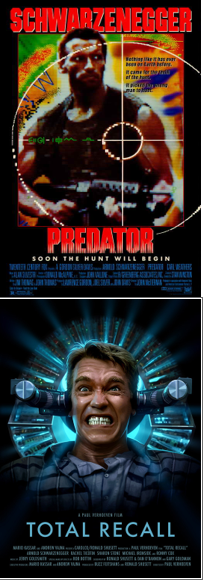
The rapid maturation of Arnie, and other thoughts on a Schwarzenegger double feature

I'd had my appetite whetted for another viewing of Total Recall when I'd heard it discussed lovingly on a recent episode of the Blank Check podcast, which I am listening to despite the fact that it frequently annoys me and the podcasters love their own show and its inside jokes too much. And I got Predator, which I'd never seen before, out from the library last weekend.

So when my wife had to opt out of our Friday night viewing to do some work, I opted in to an Arnold Schwarzenegger double feature.

It ended up being a fortuitous pairing for such a thing. Schwarzenegger has had a very long career, so if you decided to watch two of his movies, you could separate them by 40 years or longer if you wanted. Pumping Iron (1977) and Killing Gunther (2017) might make an interesting double feature, for all I know (I've only seen the former).

But by seeing movies that came out in 1987 and 1990, I focused on a very specific snapshot of his career -- and found two very different movies.

Now I must start out by saying that this would be my sixth or seventh viewing of Total Recall, first since 2012. I saw it in the theater in 1990 and have always considered it a personal favorite. It ranks #167 on my Flickchart, and it should probably be higher. So it's both a nostalgia pick and a genuinely good movie, making any apples-to-apples comparison with Predator -- a nostalgia pick and a genuinely good movie for other people, because they saw it in the theater in 1987 -- problematic.

But I couldn't help but notice how much three years matured Schwarzenegger as an actor. And I can't even credit the directors, as John McTiernan got great performances out of his whole cast in Die Hard just a year later, while Paul Verhoeven has gotten laughable performances out of a cast (Showgirls). No, this maturation was all on Arnie.

The characters are different too, I'll give you that. Predator's Dutch is a man of few words, a mercenary trained to kill. Recall's Doug Quaid also has training in lethal fighting techniques, but he thinks he's a construction worker, and even his alter ego is more a smarmy asshole than a mercenary. So more range is required of the actor in Recall than Predator.

But he gives the range, and I never thought he was capable of it until I saw this movie. I was actually a bit resistant to Schwarzenegger before Total Recall, which is why I never saw Predator when other friends were going on breathlessly about it. I'd seen Commando on cable at a friend's house, and I had a memory of it as a lot of grunting and bodies jumping on trampolines to simulate being blown up. Even when I was like 12, when I should have been at the height of my appreciation for this sort of thing, I recognized it wasn't a high watermark of sophisticated culture. I didn't see The Terminator until after T2, and I still to this day have not seen Conan the Barbarian or its sequel. In looking at his filmography, I guess both The Running Man and Twins predated Total Recall, and I certainly saw both of those. But that's the only time I've seen both of those movies, so I guess I was not sold. Coming into Total Recall, I considered him a dubious property.

The role of Doug Quaid/Hauser (I just now realized Hauser does not get a first name) changed all that, and kicked off a honeymoon period with Schwarzenegger that lasted the better part of a decade. Whereas I hadn't rewatched any of his films prior to this, Total Recall became an immediate repeat viewing for me, as did his other 1990 release, Kindergarten Cop. It was probably that film that really served as the other half of the 1-2 punch that let me know this guy was actually a capable actor, able to play more subtle emotions than were once required of him. As I watched Total Recall last night, I noticed how much relies on small shifts in his expression as he absorbs new information or gradually changes from one emotional state to another. You tell the Arnie of Predator to do that and you'd be out of luck.

My favorite Schwarzenegger film of all time, Terminator 2: Judgment Day, came out the following year. And though those three films are probably still my three favorite of his, I saw more of his than I missed from there on out. (I guess I'm still not an Arnie completist, though, because I still haven't seen 1994's Junior, and only saw 1996's Jingle All the Way for the first time this past Christmas.)

Maybe if I'd seen Predator at the time and last night was my sixth or seventh viewing of that, I'd recognize there were subtle things he was doing there. In fact, even now I can think of one. I love the scene where he first realizes that the mud is camouflaging him from the predator's vision, which relies on sensing his heat and motion. That scene is one big moment of held breath, and in that moment he displays something that the big iconic Arnold roles had lacked before then -- fear. It reminded me of one of the things I appreciate most about McTiernan's follow-up, Die Hard, in which John McClane flashes moments of the type of fear that was usually anathema to action heroes.

But I think there's little dispute that Total Recall is a role that required a real actor, and got one. Listening to that podcast reminded me that Richard Dreyfuss had been the original actor considered for Total Recall when they planned to make a different type of movie out of it. The podcasters kind of joked about Schwarzenegger's abilities when contrasted with those of Dreyfuss, and sure, Dreyfuss is a better actor. But I don't think the gap is as large as we would assume it would be. In those few years in the late 1980s, Schwarzenegger committed himself to becoming better at his craft, and it shows.

Some other thoughts ...

Predator passes the Blackdel Test

You've heard of the Bechdel Test, right? Of course you have. It's the test for gender representation in film and other works of fiction credited to cartoonist Alison Bechdel, which tests whether the story contains a minimum of two female characters who speak to each other about something other than a man. It's a purposefully minimal standard to demonstrate just how rarely films actually meet it.

Predator does not pass the Bechdel Test, as it has only one female character. But it does pass the Blackdel Test, a term I thought I invented, but when googling it, of course others have thought of it before me. It's basically the racial variant on the Bechdel Test, with black people as the underrepresented party rather than women, discussing something other than a white person rather than something other than a man.

I'd venture this is probably met more often by movies, as institutionalized sexism in films might actually be a worse problem, historically, than institutionalized racism. But that's a pretty big topic and I don't really want to dig into it or offer a definitive opinion.

I will say that you tend to notice when films of a certain era give two black people something to do that's separate from the white people, just as you would if two women were getting that spotlight. And I noticed it in Predator in this scene:


That's Bill Duke and Carl Weathers -- Mac and Dillon by name -- trying to get the drop on the predator, who does not notice them spying on him from a hidden area in the brush. They fail spectacularly, but that's not something, fortunately, that we can attribute (or that the film does attribute) to their race. The predator is just too damn smart and fast to be taken down by ordinary military stealth tactics, and camouflaging himself against the background certainly doesn't hurt.

What I think we are meant to take away from it is that both of these guys go in pursuit of the predator, rather than running from it as the other characters have done. In a short time, Duke's Mac has developed a near obsession with it, Captain Ahab style, but Weathers' Dillon is showing a different type of courage -- he's putting himself in harm's way as an attempt at redemption for his earlier deceptions, despite not naturally having the confidence that Mac has. Both of them are knowingly risking their own hides to save their dwindling number of comrades from an unimaginable threat. And, both lose their hides, Mac with a blasted head, Dillon with first a lost arm, then an impalement.

So the movie goes from two to zero black characters in the space of about a minute, but at least they were damn courageous, and for their scene together -- a couple scenes, actually, if you include the earlier interaction with the scorpion -- they talked together without talking about Arnold Schwarzenegger or Jesse Ventura. (This movie is lousy with future governors.)

Total Recall gets you home in time for corn flakes

Especially compared to Predator, I noticed how much Total Recall really moves. I mean, it trucks. While Predator feels like about 38 minutes of actual plot and about an hour of filler -- which is not to say I didn't like it -- Total Recall is only ten minutes longer and has like a million more things that happen. Because that script is fast, and it just keeps moving you along.

In the climax of the film, Ronny Cox's Vilos Cohaagen (great name) tells Quaid he is going to kill him and still be home in time for corn flakes. That always struck me as a funny line -- who eats corn flakes at night? -- but it seems to describe perfectly what Total Recall does. It gives you a great, delirious burst of sights, sounds, action and existentialism, and still lets you off the rollercoaster to get you home in time for corn flakes.

Consider the scripts side by side for a minute. Predator is deliberate, you might say; slow, if you were not being generous. There's a lot of time devoted to the setup. They don't have their first interaction with the alien until the movie is 45 minutes old. Granted, there's that whole section involving taking out the insurgents, which has plenty of wham bam thank you ma'am. So it's not like you are deprived of action until 45 minutes in. But you're deprived of what the movie is really about, which I found a bit frustrating.

Then there's Total Recall. It opens with a dream sequence on Mars. By the 15-minute mark, Quaid is strapped into a chair at Rekall. All the setup they've needed to do has been fit into these first 15 minutes. Then the movie is off and running, and it never stops to catch its breath. Yet it still manages to continue to develop its characters and have them consider the nature of free will and selfhood.

Like I said, this thing trucks.

And because I love new observations about favorite films, I'll close out with a few more Total Recall tidbits:

- The line "Clever girl" was very familiar to me, and I thought it was because that line was used in (made famous by?) Jurassic Park. But I've only seen Jurassic Park once, possibly twice all the way through, and not since the 1990s. Last night I realized that Schwarzenegger says this to Sharon Stone's character when she tries to distract him from Richter's arrival by offering him sex, and it's three years earlier than JP.

- I had forgotten how disturbing the scene is where Arnie uses that guy on the escalator as a human shield. Of course, the guy had to be dead already before our hero would consider such a thing, but once he's just a slab of meat, Arnie uses him to take as many as a dozen more bullets that would have otherwise hit him. I think that might have been a seminal moment in the 16-year-old me maturing to an adult-style violence, one that felt brutally realistic in a way, despite the fact that you can describe some of Recall's violence as cartoonish. The commitment to the violence is at least somewhat like what David Cronenberg does in a movie like The History of Violence (and there's body horror here too, so Cronenberg could have easily made Total Recall).

- I love the little bow Arnie gives after he grabs the briefcase from the woman who just yelled "Fuck you, you asshole!" Unnecessary but totally charming.

- I had forgotten how many Pepsi product placements there were in this movie. In this movie, it doesn't bother me. It shows the persistence of our familiar brands in a distant future, sort of like what Blade Runner does.

- In the scene between Marshall Bell (the host of Kuato) and Arnold, it made me realize I have met both men. I talked to Marshall Bell in a supermarket once, and I shook hands with Arnie when he was governor and I saw him getting out of his car while I was sitting in an outdoor brunch spot. (He looked past me and said "Hi, how are you" in a totally emotionless voice, if you're interested.)

- I really like the shot of the Venusville residents running out of air that's taken from behind the stopped fan. I'd never specifically noticed it until last night.

- I love the sneers Michael Ironside gives when he goes from one level of angry to the next level.

- Cohaagen's soldiers, most often led by Richter, have uniforms that look a lot like those worn by the federation troopers in Starship Troopers, which is of course also directed by Verhoeven. An interesting bit of commentary between the two films, almost as though Troopers might exist in the same universe, and that Cohaagen's flunkies become mainstreamed upstanding citizens in the fascistic future represented in Troopers?

- Ronny Cox is not only Trumpian in his behavior in this movie, he even looks a little bit like Trump.

Okay, enough for today.

Tuesday, December 26, 2017

Missing only the Stallone Christmas movie for the trifecta

If you were to name the three most iconic action stars of the 1980s, you would likely identify Arnold Schwarzenegger, Sylvester Stallone and Bruce Willis. In fact, I believe one of the Expendables movies does that very thing, getting all three together in one scene. (I only saw the first Expendables movie so I will have to take the word of some review I read.)

That designation is a little bit of a fallacy, as Willis had never done an action movie before Die Hard in 1988, and didn't get his second on his resume until Die Hard 2, which is already in 1990. But it's easier to say "the three most iconic action stars of the 1980s" than "the three most iconic action stars of the 1980s and 1990s." And besides, Die Hard is so iconic that it can fill in Willis' gaps in that decade all by itself.

Anyway, the point of telling you that is to tell you this: In the past two nights, we saw one Christmas movie each from two of those three guys.

On Christmas Eve it was Jingle All the Way, not Schwarzenegger's only foray into comedy, but his only foray into Christmas movies (that I could tell by just looking at the titles of the movies on IMDB).

On Christmas night we watched the aforementioned Die Hard for the first time in six years, not Willis' only foray into Christmas movies, but the only other of which (that I could tell just by looking at the titles of the movies on IMDB) was also a Die Hard movie: Die Hard 2.

We're just missing the Stallone Christmas movie for the trifecta, but alas, that won't be an option for Boxing Day. As far as I can tell (just by looking at the titles of the movies on IMDB), Sylvester Stallone has not made a Christmas movie.

Hadn't seen Jingle All the Way before, which is funny since I consider myself something of an Arnie completist. Then again, it's funny I consider myself that as I have also not seen Stay Hungry, Conan the Barbarian, Conan the Destroyer, Red Sonja, Raw Deal, Predator, Red Heat, Junior, End of Days, Collateral Damage, The Kid & I, The Expendables 2, Escape Plan, The Expendables 3 and Killing Gunther.

Anyway, I didn't like Jingle All the Way. Arnold's charm carries the movie farther than it should, but very little of the comedy works and the thing is just that fateful combination of slapstick and schmaltzy, with an ending that crosses over into the absurd. My wife gave up on it before the finish, and not only because it was Christmas Eve and we had to get to bed at a reasonable time. (In fact, the only reason we were watching it in the first place was that The Night Before didn't end up available on Netflix streaming in Australia, only America.)

It did allow me to see the movie that, I guess, prompted them to cast Jake Lloyd as Anakin Skywalker, though he was also in Unhook the Stars that same year, 1996. And though I hate bashing the acting of Lloyd -- especially considering what the experience of playing young Anakin has done to the guy's life -- he's really not good here, even for a child actor. There's one moment where he tears his neglectful dad a new one that I guess must have been the moment George Lucas saw the potential for petulant anger in him. Then again, Anakin isn't even petulant at that age, as far as I remember. I guess Lucas must have just thought he was really good.

As for Die Hard ... I imagine this would be my eighth viewing or so. I still remember the grand time I had on my first at that small four-screen theater that used to be at the Burlington Mall in Massachusetts, watching with a half-dozen friends and howling with laughter and joy. I commented to my wife last night that I half expect Die Hard not to be good the next time I see it, since upon its release I thought it was just another gritty Charles Bronson-type thriller that was already feeling like a moribund genre at that point. And of course, every time I watch Die Hard it's just as good as it was the time before.

So we got no Stallone, but funnily enough, Die Hard actually has him covered. As a matter of fact, it's got both of the other guys covered in various lines of dialogue.

First (chronologically), there is this line by Hans Gruber: "Just another American who saw too many movies as a child? Just another orphan of a bankrupt culture who thinks he's John Wayne? Rambo? Marshal Dillon?"

Which is perfect, of course, because Stallone played Marshal Matt Dillon on Gunsmoke.

But then, just to put the cherry on top, we get this line from John McClane: "They have missiles, automatic weapons and enough plastic explosives to orbit Arnold Schwarzenegger."

Which is perfect, because Schwarzenegger played an automatic weapon in My Life as a Machine Gun.

After the movie my wife reminded me that both Stallone and Schwarzengger were offered the part of John McClane before they somehow landed on the star of Moonlighting for their movie.

I'm just as glad we don't have to live in a world where we have to see Arnie's bulky frame trying to shimmy through an air duct as I'm glad we don't live in a world where we have to see Eric Stoltz hopping in and out of a Delorean.

Saturday, January 19, 2013

Washed-up old man -- er, men


So who's more washed up, Arnold Schwarzenegger or Johnny Knoxville?

The tagline for The Last Stand is "Retirement is for sissies," so at least we know which one is the sissy: Schwarzenegger, because he chose to retire.

Knoxville just stopped being in things.

Granted, it was never all that likely that a fruitful acting career would spring from Knoxville's origins as a charismatic daredevil willing to expose his body to a gauntlet of torture and abuse. But for awhile it was looking like it might. In the early- to mid-2000s, he was going pretty strong with roles in Big Trouble, Men in Black II, Lords of Dogtown and Dukes of Hazzard. And proving he was no mere beneficiary of the more forgiving standards of mainstream cinema, he also appeared in a John Waters movie, A Dirty Shame.

However, around 2005, he stopped appearing in projects that were not directly some kind of spinoff of his formative Jackass series. It's unclear from some quick internet searches whether this was his choice or others'. But I tend to think that most people who quit acting are forced out. It's like the athlete who chooses to retire while his/her services are still in healthy demand. It does happen, but it's extremely rare. And Knoxville was, or should have been, in the prime of his career.

In the last year or two he's begun dabbling in some apparently straight-to-video titles, and he did appear in last year's Fun Size. We are also going to see him in next month's Movie 43, which I'm really anticipating. So maybe he lost the acting bug and then got it again. Or maybe there were personal issues. Like I said, a quick internet search doesn't give me any answers.

I can say that the net result is to slightly taint Schwarzenegger's comeback by giving it a straight-to-video feel. The January release date already does that to some degree. The billing of Knoxville as the movie's most prominent co-star only completes the tainting. They could have gone with Forest Whitaker, Peter Stormare or Luis Guzman, but I guess those guys don't really have "poster names."

I'll definitely be catching up with this on video in May or June, though. I am as curious as anyone to see if Schwarzenegger's still got it. Though apparently, not curious enough to have watched Expendables 2 to make that same assessment.

Tuesday, August 7, 2012

One expected Schwarzenegger movie, one unexpected Schwarzenegger movie


On Saturday I saw two films featuring Arnold Schwarzenegger, though I really only expected to see one.

The one I expected to see was, of course, Total Recall. You know this if you read my Friday post.

The one I did not expect to see was ...

... The Long Goodbye, the 1973 Robert Altman film featuring Elliot Gould as the (then) modern-day version of Phillip Marlowe.

You may rightly ask if I'm kidding. I'm not.

You may then rightly ask, "What the hell was Arnold Schwarzenegger doing in a 39-year-old Robert Altman movie?"

The answer is, not much. He wasn't even credited. But he was in the movie, which I thought was absolutely hilarious.

If this seems impossible to you, don't forget that Schwarzenegger made his film debut in 1969, in what I am sure is a great cult classic: Hercules in New York. I've really got to see that. He was billed as Arnold Strong in Hercules, and he didn't even get to use his own voice -- his lines were dubbed because his accent was too heavy. (Arnold Strong is an especially funny stage name, because that movie also features an actor named Arnold Stang.)

The Long Goodbye was his second appearance on film, and apparently, having starred in Hercules did not warrant him even getting credited as Goon #2. He plays a thug who appears in the office of Marty Augustine (Mark Rydell), the gangster who's trying to recover a bag of cash he thinks Marlowe knows something about. Language skills weren't a problem this time, as he never opens his mouth. He does, however, reveal that body builder's physique, as the scene requires Augustine and his goons to strip down to their skivvies. (If that doesn't sound like it makes any sense, see the movie -- it's just one of the wonderfully outside-the-box moments in this terrific film.)

I laughed when I saw him. It seemed like such a disconnect. At this stage in his career, I expected Schwarzenegger to appear in marginal movies, not in classic films by the great Robert Altman. In fact, an argument could be made by certain segments of movie lovers that The Long Goodbye is the best film in which Arnold ever appeared.

I probably prefer some of Schwarzenegger's more iconic roles, as they are the ones I have grown up on and loved for years. But after finally seeing The Long Goodbye, I am convinced of its absolute brilliance. It has immediately become one of my favorite Altman films, which is saying a lot. Gould is simply perfect as Marlowe, a private dick who seems in a perpetual state of semi-confusion about the world in which he finds himself, yet nonetheless can maneuver in this world using a copious amount of street smarts and a clever sense of how to manipulate people and anticipate their next moves. A friend over the weekend described Gould as wearing a second skin of Phillip Marlowe -- you can't tell where Marlowe leaves off and Gould begins. I could go on about the world created in The Long Goodbye -- Marlowe's apartment complex alone, featuring a neighboring apartment of free-love hippies in various states of undress, might warrant an entire post. But the fact is, I've got to get to work.

And I'm pleased to say that one of those iconic Schwarzenegger roles -- Quaid/Hauser in Total Recall -- still holds up. Sure, some of the effects are dated. But with a script this tight and a performance by Schwarzenegger that has genuine sympathy and nuance -- he had come along way in those 17 years since The Long Goodbye -- I didn't care one bit about the only thing the 2012 version of this film can probably do better.

Wednesday, March 25, 2009

Throwback


Something very unusual is being released on Friday:

A straightforward action movie. With an old-school action hero.

It's a movie called 12 Rounds, and it stars professional wrestler John Cena. This is Cena's second movie, his first being the 2006 actioner The Marine. Everybody's favorite hack, Renny Harlin, is directing.

If you aren't familiar with Mr. Cena, he looks a bit like Dexter's Michael C. Hall, except inflated by a bike pump into a massive hulk.

I actually watched The Marine, and it wasn't even so I could write a quick and dirty review of it; considering the high likelihood of it being total schlock (and it was), I thought it'd be available for me to review, but lo and behold, another staffer claimed it first. No, I watched The Marine because I know a guy who appeared in it. He's in about the first 15 minutes, and he plays the buddy role. Just to show you how inept the screenplay was, he never makes another appearance. That's too bad for an additional reason other than poor plot structure -- my friend was the best part of the movie. The rest felt like a weird anachronism, something that slipped out of time from 1987.

I'm not going to try to tell you that the action movie is dead, like I once tried to tell you the thriller is dead. But I am going to say that mainstream movies haven't seen an action star like Cena in ages. Guys like Jean Claude Van Damme and Dolph Lundgren may still work, but their movies go straight to video. Arnold Schwarzenegger has retired to the governor's mansion in Sacramento. Sylvester Stallone is still making Rocky and Rambo movies, but they are intentional throwbacks, with a certain winking irony to them. Cena's movies, on the other hand, are basically unironic continuations of a formula that hasn't been truly viable since the mid-1990s.

It's not every day that we consider the transformation of action movies over the decades, but long gone are the days when you would expect to see a movie like Commando get green-lit. Action movies today must be much higher concept, so you almost don't think of them as action movies at all -- The Matrix is a good example. Most of today's action movies are a hybrid of action and some other genre, since an undiluted action movie seems to have a certain stigma attached to it. And even though it's as popular as ever to talk about cinematic violence, no longer are there movies where waves of faceless minions just get machine-gunned down mindlessly. Today's action movie is held to a higher standard of intelligence, relying a lot more on wire work and smartly choreographed fisticuffs than brute force.

Or it could just be a change in the profile of the action hero.

Cena is an imposing behemoth of a man, with a square head and biceps like mailboxes. That's all we wanted in the Ronald Reagan years, as we were proud of the massive hurt we wanted to put on anyone who got in our way. We took relish in our role as Goliath.

Today, things have shifted a little bit left of center. Even during eight suffocating years of George W. Bush, we didn't see old-school action heroes take back control of Hollywood. In their place emerged different types of action heroes, who possessed more street smarts or genuine intellect than bulging muscles. Today, we want the little guy, someone we can identify with, to serve as our hero. Not some steroid-infused giant whom you'd give a wide berth at the gym, on the off chance he'd take you out by grazing you with his shoulder.

The American national psyche has always been an interesting study in contrasts. As much as we purportedly celebrate capitalism and reward the strong -- until lately, anyway -- we also are huge fans of the underdog, most often in sports and in the movies. And even though Arnold Schwarzenegger had to fight dozens if not hundreds of bad guys in order to get Alyssa Milano back in Commando, he didn't really feel like the underdog, did he? Not enough for today's audiences anyway.

So what does the modern action hero look like? I'll tell you.

1) The Scrawny Guy. In the 1980s and 1990s, it would have been unheard of to cast an eccentric and fey post-adolescent like Toby Maguire as Spider-Man, but today, it doesn't even surprise us. That's because most action heroes are like him. Edward Norton as the Hulk -- his rippling muscles in American History X notwithstanding -- is another example. Even Matt Damon as Jason Bourne is basically just a scrawny guy who hit the gym enough to seem like an appropriate ass-kicker.

2) The South London Thug. The busiest action hero in 2009 is almost certainly Jason Statham, as the guy has made three Transporter movies, and his second Crank movie is about to be released. But he's not the only British heavy capable of knocking your teeth in, despite not looking like a pituitary freak. Daniel Craig is basically this guy as well, and if Vinnie Jones still made movies, you could throw him in too. One of Hollywood's biggest stars, Christian Bale, qualifies, especially given some of his recent brutish behavior. Clive Owen would almost qualify except he doesn't really do that much action, and he's a bit more cultured. These guys ruled in the 1960s and 1970s (Michael Caine was one), and they have now made their triumphant return.

3) The Kung Fu Star. With the advent of wire work came the advent of the Hong Kong fighter as action star. This shift in the tides, started by Jackie Chan, has made Jet Li a rich man. It's not like kung fu movies have never been popular before, but they haven't had great commercial viability in the U.S. until the last ten years. At least, not since the days of Bruce Lee. The real shift has been guys like Li starring in Hollywood films that would not otherwise be described as kung fu movies.

4) The Former Thespian. It's amazing how much the definition of an action movie has changed when you consider that Nicolas Cage is widely considered the world's most recognizeable action star. In truth, most of Cage's films are not straight-up action movies, but he has appeared in a number of films produced by one-time action king Jerry Bruckheimer. And while it may be a little bit of a stretch to call Cage a "thespian," he is an Oscar winner who was once highly respected by his peers. With his hangdog, everyman face, he almost fits into the "Scrawny Guy" category, and in keeping with that, he was once considered for the reboot of Superman, when Tim Burton was briefly attached.

5) The Comedian. No, not the guy in Watchmen. There are a growing number of guys who came from a history of making people laugh, and somehow found themselves in action movies, such as Will Smith, Robert Downey Jr., even Owen Wilson -- don't forget Wilson showed up in Behind Enemy Lines. I'm still waiting for the first action movie starring Adam Sandler or Will Ferrell.

6) The Chick Who Kicks Butt. The list of these gals is too long to mention, but I'll try anyway: Milla Jovovich, Kate Beckinsale, Charlize Theron, Halle Berry, Angelina Jolie, Sigourney Weaver, Jennifer Garner, Natalie Portman, Geena Davis, Carrie-Anne Moss, Michelle Rodriguez, Jessica Biel and Malin Akerman, to name just a few who come readily to mind. Not only has the chick action movie become possible in the last decade, but the chick who kicks butt is one of the most familiar archetypes in modern action movies -- possibly a further extension of our love of the underdog.

7) The Multi-Ethnic Brooder. Vin Diesel is the sole personification of this category, though you could add Dwayne Johnson if he brooded more. Both of these guys have sort of typical action hero credentials -- The Rock more than Diesel -- but something about their mixed ethnicity makes them a more modern, more complex entity, and quite different from the white Europeans with poor English skills who dominated in the past.

8) The Cartoon Character. A prediction more than anything else: After Kung Fu Panda, animals who kick butt are going to be all the rage. As long as it's PG-rated butt.

There may be other categories or sub-categories, but this more or less covers it.

So where does Cena fit in? To whom does he appeal? That remains to be seen. This weekend's box office will tell us something. My prediction is that 12 Rounds will do a lot better than The Marine, which scraped up only $18 million back in 2006. For one, they're putting more money into advertising this one, and I'm guessing it'll put together at least $30-$40 million by the time all is said and done, on increased awareness alone. However, that's still not a great take for an action movie, at least by the old standards.

There's sure to be one demographic to whom Cena will appeal: those same people who voted in Reagan, and gave us the first wave of modern action heroes. Yep, there's something fringe about Cena, and I'm proud to say that "fringe" now equals "Republican." The same rednecks who watch Cena crack heads in the wrestling ring will undoubtedly want to watch him crack heads on film.

Whether they'll be enough to earn a third action film for this throwback star has yet to be determined.