Showing posts with label moon. Show all posts

Friday, January 5, 2024

Charlie Kaufman movies that don't involve Charlie Kaufman

When you saw the trailer for Dream Scenario, your first thought may have been "Oh, this must be Charlie Kaufman's latest." The presence of Nicolas Cage, star of the Kaufman-written Adaptation, might have cemented that impression.

Of course, if you follow Kaufman with any degree of closeness, you'd know that Dream Scenario could only represent an earlier incarnation of the writer-turned-director. His 2020 film I'm Thinking of Ending Things -- which was my #1 of that year -- certainly indicates that he's on to much less accessible fare.

In his film about a man who suddenly starts entering everyone's dreams, even the people who don't know him, Dream Scenario director Kristoffer Borgli is certainly successful in the homage he's paying to this earlier version of Kaufman. If you want to know how successfully, you'll have to wait until my rankings are up on January 23rd. (Or, wait a few days until I write my review, which will be linked to the right.)

What I can write about today, without spoiling my impression of the film, is that it reminded me that we have a whole subgenre of films that seem as though they should have been written or directed (or both) by Kaufman -- and that Dream Scenario feels like the first we've gotten in a while. Just as soon as I venture the idea that these sorts of mindbinders might be approaching extinction, though, I think of a second one from this very year, in addition to Dream Scenario.

Here are the ones that immediately came to mind, in no particular order. In order to narrow things down a bit, I'll limit this to the time period Kaufman was actually working. 

Stranger Than Fiction (2006, Marc Forster) - Will Ferrell can hear the woman who is narrating his life as she speaks. An existential conceit straight out of the Kaufman playbook, released during the peak period of Kaufman's influence on popular films.

Cold Souls (2009, Sophie Barthes) - Is it possible Paul Giamatti has never actually appeared in a Kaufman film? He's Kaufman's perfect schlub. Here he plays an actor trying to disentangle his emotions from the emotions of his characters, who pays for a service to have his soul placed in cold storage. I can only remember this being a bit disappointing. Anyway, shades of Synecdoche, New York all over this. 

Fingernails (2023, Christos Nikou) - Here's that one from this year. People in relationships have the ability to test whether they love each other by having a fingernail torn out and analyzed. The low-fi analog technology in this film is very reminiscent of Eternal Sunshine of the Spotless Mind, as is the theme of star-crossed romance.

Vanilla Sky (2001, Cameron Crowe) - I think the cold storage of Cold Souls got me thinking about the ending of this film, which I won't spoil even though the movie is now 23 years old. It's just the sort of intricate script with high concept elements about identity that Kaufman would have dreamed up, though I actually have this ranked higher than any Kaufman film on my Flickchart, so kudos to Crowe for that.

The Truman Show (1998, Peter Weir) - This is a bit of a cheat in that it came out a year before Being John Malkovich. Kaufman was working in television but he had not yet made a movie. But the premise is similar to Dream Scenario in that the world revolves around a single ordinary man, so if Dream Scenario is like a Kaufman film, so is this. 

Click (2006, Frank Coraci) - If it were someone other than Adam Sandler in the title role here, I think this story about a man who literally fast forwards through his life would strike us as more of a Kaufman high concept mindbender. As is even with Sandler, it's pretty poignant and potent at certain parts.

Vivarium (2019, Lorcan Finnegan) - Jesse Eisenberg and Imogen Poots are trapped in an apparently empty neighborhood of identical houses from which there is no escape. The title suggests they are being watched for their reaction. Very Kaufman, and Eisenberg is another who should play a Kaufman surrogate at some point.

Her (2013, Spike Jonze) - It feels like a technicality that Kaufman is not actually involved with this. Jonze directed two of Kaufman's films, so this is sort of a cheat. And while we're cheating anyway ...

The Science of Sleep (2006, Michel Gondry) - If I'm going to list the future work of one Kaufman collaborator, I should list the future work of another. 

Swiss Army Man (2016, Daniel Scheinert & Daniel Kwan) - A buddy comedy between a suicidal man and the talking corpse that helps him find a reason to live? Yep, Kaufman could have written this.

Ruby Sparks (2012, Jonathan Dayton & Valerie Faris) - While we're already on Paul Dano, this is another one in the Stranger Than Fiction/Adaptation neighborhood, where a written character comes to life and tries to make a Kaufman-like schlub with writer's block happy. 

Moon (2009, Duncan Jones) - I'll let this stand in for a whole category of films featuring clones, as a clone gets at the existential concepts in which Kaufman always dabbles. 

It's becoming clear I could go on for quite a while listing films that narrowly qualify, with diminishing returns. But instead I'll wrap it up with the thought "You get the idea."

One thing I'll say, though, is that even when they fail, they fail in interesting ways. If someone wants to try to make a Charlie Kaufman movie, I'm always game for it -- and I don't want us collectively to forget how to do it, especially now that Kaufman himself doesn't want to be quite so on brand as to have a whole genre unto himself. 

Wednesday, January 11, 2023

A thing for movies about clones

I won't tell you how high Riley Stearns' Dual is going to end up in my year-end rankings -- I won't know myself for another two weeks.

I will tell you, though, that whatever stigma was once attached to movies about clones has long since vanished for me.

Spoiler alert for movies about clones you might not have known were about clones, so if you want to be overly cautious you can stop reading. However, only in a few cases are these movies secretly about clones, and if you are a reasonably accomplished cinephile you will likely have seen these anyway. I'm only going to mention five titles so it's not a huge risk. Though, as the newest, mild spoilers for Dual in any case. 

Making a movie about clones was once a guarantee that you had made a shit movie. Either the technology laughably disappointed, or the story did, or both. I think it was both in The 6th Day, my lowest ranked film of 2000. I didn't even bother to see Multiplicity, which came out a few years before that.

There are still plenty of bad ones I'm sure -- Gemini Man would be one example -- but the subject matter alone no longer leaves a stink on a film. In fact, I think the subject matter makes me more optimistic than it does pessimistic. Even some cloning movies that are legitimately mediocre, like the Keanu Reeves vehicle Replicas, have a certain charm for me. 

Maybe it all changed in 2009, when I named Moon my #1 movie of the year. Since this is the main spoiler choice here, I won't go too much into who is cloned and why or how. But come on, this great movie has now been out for 14 years, so if you haven't seen it, that's on you.

The next movie I'm going to mention in my trend was just from last year, so it might not seem like a very urgent trend -- but don't worry, Dual makes three, and every editor knows that three equals a trend. That was Swan Song, the one directed by Benjamin Cleary on AppleTV+ (as opposed to the one directed by Todd Stephens about an older gay man). I found that film's dealing with the existential issues related to cloning enormously moving, as the protagonist (played by Mahershala Ali) signs on to have a clone replace him without his family knowing when he contracts a terminal illness. Anyway, that movie was my #5 of the year. 

Dual -- streaming on Netflix as of last week -- has a similar premise, but does new and more comical things with it. Like Swan Song, the technology is used to replace the dying, but without fooling the family in this case. The family willingly takes on the clone as a way of softening the blow of losing the person, and may even come to like the clone as much as the original person and keep them around past the grieving phase. Of course, issues arise when the terminal patient is suddenly no longer terminal, and the clone has developed its own personhood, so the two must battle it out to the death to see which one continues the life in progress.

A ding against the movie standing tall on the strength of its clone themes is that my favorite thing about it is Stearns' deadpan sense of humor. The humor actually didn't work for me in his last film, The Art of Self-Defense, though I appreciated what he was trying to do. His film before that, which I did really like, was Faults, about a brain-washing cult -- and while there was certainly eccentricity in it, it was a lot more of a head trip movie than a comedy, deadly serious at times.

He's gotten both the head trippiness and the deadpan humor on the same page in Dual, and it's now my favorite of his three films. Karen Gillan and Aaron Paul both kill it with the absurd line deliveries, as does the rest of the cast. There's a definite artificiality in that dialogue and in the affect behind it, but in this case that's a good thing. 

And yes, it gives me interesting new things to consider about the point at which a bag of inexperienced meat resembling a person becomes that person, or at least an entity unto itself deserving of basic human rights. If you had practiced becoming a woman in order to ease the grieving for her family, and possibly live out the remainder of her natural life for her, but were then told after quite a long time that your services were no longer required, it wouldn't really be simple, now would it?

I won't spoil any more of Dual than I already have. 

But I did think it was worth spoiling as much as I have in order to give the movie a very strong recommendation to you, my dear readers, as well as to let you know that The Audient is open for business on movies about clones. 

Friday, April 15, 2022

A good use for old junk

Near the start of the pandemic it was decided that I needed a new computer. But because I am old school, I wanted a new computer that was like my old computer. I was attracted to such obsolete features as a built-in DVD player, so my wife proactively bought me a cheap-o version of this old computer, a Hewlett-Packard, without us really having said the final word on the matter as far as I was concerned. But when it arrived I was happy enough to see it. I liked this model in theory -- it had treated me well on my previous instance before that one got too old -- and I wasn't ready to be thrust into "the future," where every laptop is small and light and spartan.

The proviso was that it could just be a short-term computer to get us through the next year or so, then maybe we'd pass it on to my older son, who was about to hit double digits. We couldn't have known how short term. 

From the start there was something off about this computer. It would freeze at apparently random times, and I mean a fatal sort of freeze, which could only be cured by a reboot. The mouse just stopped moving and never moved again. 

We thought it was browser-related, but the issue occurred in other browsers as well. I searched possible fixes and toyed with different solutions, at times thinking I had gotten past it, only to have the issue rear its head again. Then the general performance, even when it wasn't freezing, started to suffer.

We might have tried to replace it under warranty, but I happened to discover that my sister had the exact same issue on her HP. That made it seem less likely that the issue wouldn't reoccur on a new piece of hardware. And by this time our circumstances had changed. My mother passed away that June, and within a couple months we started getting access to the money we had inherited from her. It seemed easier just to walk away and to buy the computer I am typing on right now -- a Dell.

I wiped that HP and gave it off to my son, which excited him to no end. But even with a fresh copy of the operating system and no applications I had installed that could have been contributing to the issue, the computer was a sluggish piece of shit. Even my computer-starved son was jack of it pretty quickly. It got placed on a shelf and started collecting dust. It did make the transfer to our new home, but pretty soon after, it could be found in a box of old technology waiting to be recycled. 

Within the last few months, another piece of our technology, this one a long-time stalwart, also fell on hard times. Our region-free DVD player, which had caused us no issues for the first eight years of its life, developed some sort of mechanical issue with its tray. I had to use various methods to force it open, and I'm sure that made it worse. I toyed with the idea of opening it up and seeing if I could set this Doohickey A back to where it needed to go in Slot B, but to be honest, I'm not very mechanical. I suspected I'd just waste a lot of time unscrewing screws. So now I guess we're ready to walk away from it, which is just as well, as we barely ever borrow movies from the library anymore.

But that left all the DVDs and BluRays that I brought over from the U.S. unplayable. Sure, some of those movies can be found on streaming, and others I could rent, or just not watch right now. We live in a world where you can get most of the movies you want at the tap of a finger, but there are some you just can't find at all right now. Take my Settling the Scorsese series, where I just cannot get my hands on a copy of New York, New York. Any precious American DVDs that I can't get my hands on otherwise would just need to wait their turn to get watched, at some point in the near or distant future.

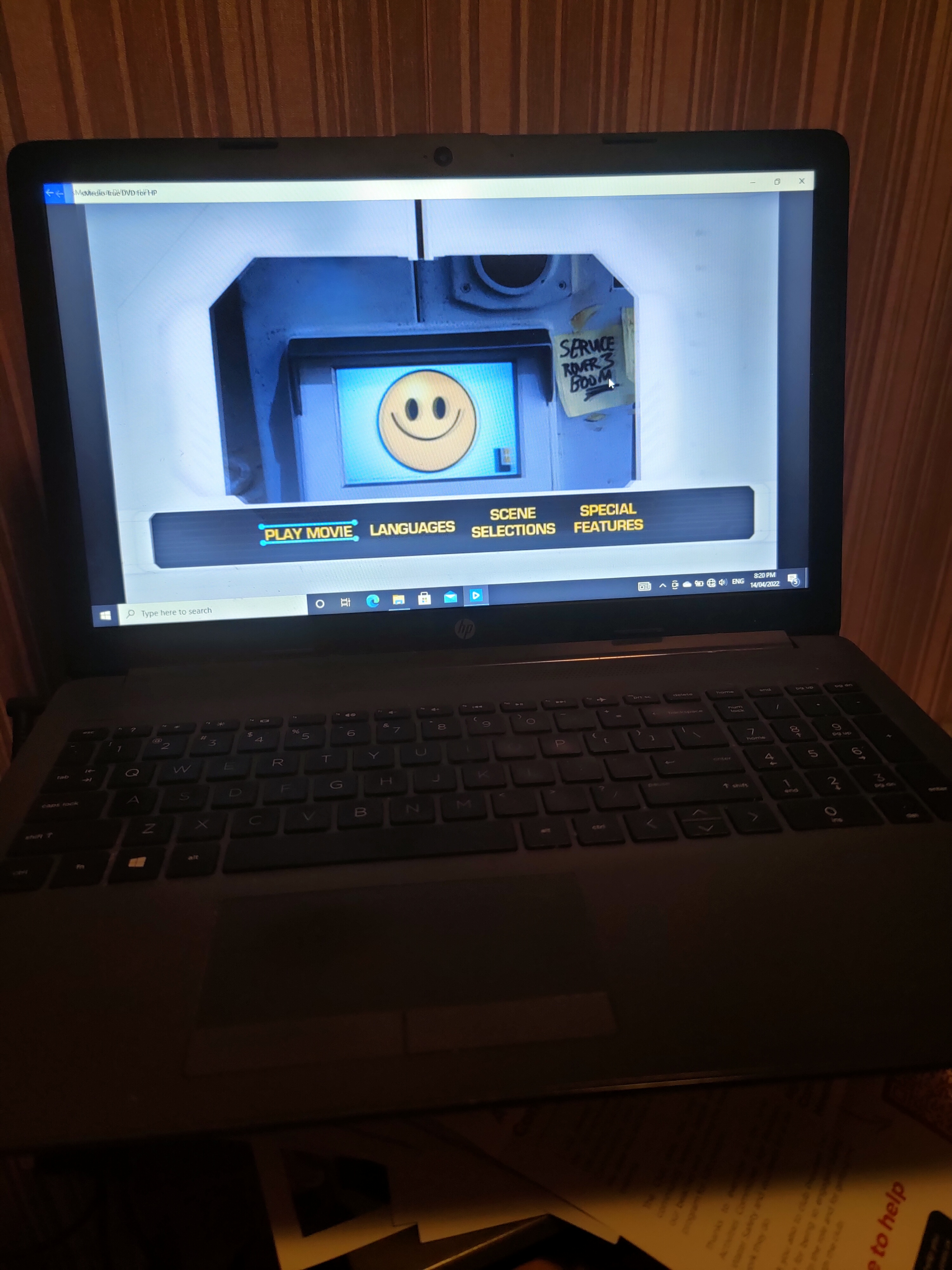
Then on Thursday night, I was planning to watch my next 25th anniversary #1. You may remember I am watching all my previous favorite films of the year, dating back to 1996, in 2022, leading toward the goal of determining my favorite year-end #1 of all time, which I will do at the end of 2022. I'd scheduled Moon, my #1 of 2009, a movie I own on a region 1 DVD that I now cannot play.

I thought about looking for it on streaming services and renting it on iTunes, but I wanted to watch it on our projector in the garage, and for some reason, iTunes rentals are incompatible with our projector. I've complained about this before. 

Then suddenly a solution occurred to me.

Now, a laptop is not restricted to playing DVDs from the region in which it was manufactured -- not that they aren't all manufactured in China -- but you can only change the DVD region a finite number of times. I think it's four or five. So if you are desperate to play something from another region, you can, but that brings you one region change closer to never being able to change the DVD region again. And heaven forbid you mess this up and end up on the wrong region for your last change.

But this doesn't matter at all on a laptop that's sitting in a box of junk waiting to be recycled.

So Thursday night I fished out that old HP, found its power cable and fired it up. By the end of its life, it had gotten so poor in the performance department that you basically couldn't do anything on it. That was how it was starting to look this time too.

But I eventually did get it to get past its various startup issues and maxed out disk usage, the source of which I have been unable to determine. I did disable various game setups my son had put on it during the short time that he had it, and maybe that helped.

I calculated that I could change the DVD region and play my American Moon DVD, because the processing required in playing a DVD was a lot less than various other activities a person might attempt. 

As it turned out, I calculated correctly.

Once I successfully changed it to region 1 -- with still three region changes left after this one should I need them -- and got the movie to start in a native player that the OS recommended to me, it was smooth sailing from there. I connected it up to the projector and watched the whole thing with nary an issue -- beyond the fact that I was falling asleep a bit. Never mind, it was the fifth time I'd seen the movie.

At first I thought the issue would be in having the necessary permissions to change the region. On a bunch of other things I'd tried to do, I was reminded that this was not an administrator account. That was by design, as we didn't want my son to be able to do anything he wanted on this computer. But it was annoying me now. Given the login/startup issues, I didn't want to try to log in as an administrator, which would require me to remember the password I'd set on it as well, some 18 months earlier. 

Turns out, you don't need to be an administrator to change the DVD region. 

The whole thing left me very pleased with myself. I immediately started brainstorming the other American DVDs I might queue up for a viewing, possibly as soon as tonight.

Now, I do still have one practical limitation. I don't believe this computer will play my American BluRays. The computer was old school enough that its internal DVD player did not include that additional capacity. Whenever we'd wanted to watch my American BluRays at my old house, we always had to use the region-free DVD player. 

A possible solution is that I connect my current external DVD player, which I use with my new computer, to the old computer. If the region is determined at the operating system level rather than the hardware level, then this player could just be a vessel for that setting. Then again, I'm not sure if that one will play BluRays either.

Another solution is just to be aware that some movies, as discussed earlier, are always going to be inaccessible for one reason or another. Maybe at some point in the future I will be able to watch those BluRays again. Maybe I never will. Life will go on either way.

The end of physical media has already arrived for most people. It hasn't yet for me. And if I can use some old junk to hang on for just a bit longer, I'll do it. 

Wednesday, March 7, 2018

The S. Darko of Moon movies

Donnie Darko is my favorite film of 2001, though I didn't actually see it until 2003. Moon is my favorite film of 2009, one I got to crown at the actual time of its release.

Neither film needs or is capable of supporting an expanded universe, though I can see why people would try. "People" in this case being a studio with the rights to Darko director Richard Kelly's intellectual property, and Moon's director himself, Duncan Jones. (Though Kelly did try to expand the Darko universe in other ways in his other films, with poor results -- a friend and I even referred to it as the "Kellyverse.")

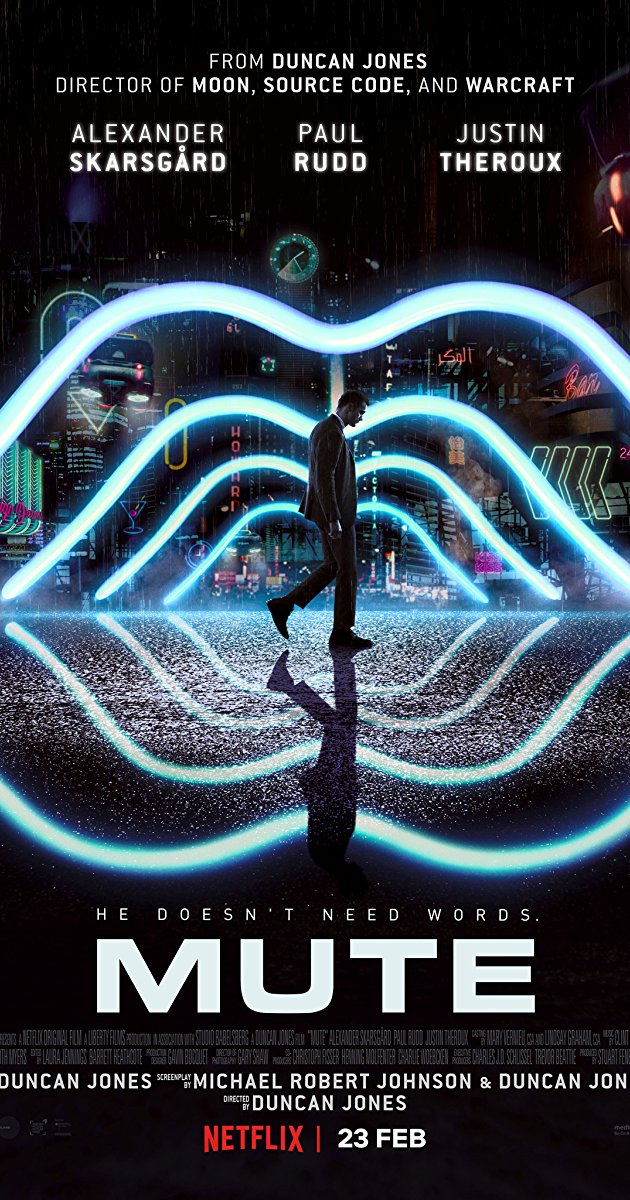
S. Darko -- released in 2009 straight to video -- was terrible. Mute -- the "spiritual sequel" to Moon released in 2018 to the modern-day equivalent of straight-to-video, Netflix -- may be even worse.

Jones was smart not to overburden his new film with references to Moon. In fact, I could detect only one scene that overtly references it, and it's really just a background shot of Moon main character Sam Bell in a courtroom on the news. (I guess that's sort of a spoiler for Moon, but you've already seen Moon, haven't you?)

But that's a level of restraint Jones does not show in any other aspect of this production. The damn thing runs for 126 meandering minutes, introducing us to awful characters in an underworld that's uninteresting. Having to watch awful characters in itself is not an issue, but when the film confuses them as kind of co-protagonists rather than the antagonists they really should be, and then even gives them morally relativistic beefs with each other, then this thing has gone way off the rails.

For all its many, many failings, S. Darko at least had the sense to exist in the same type of world with the same type of unexplained stimuli as in Donnie Darko -- wormholes, etc. It just doesn't do it interestingly, and is of poor quality in almost every aspect of its execution, most notably the acting.

The acting is okay in Mute, for the most part, but Mute's failures feel worse overall, as they are emblematic of a new type of franchising/universe-building to which Netflix is particularly susceptible. We are just coming off the cataclysmic failure of another Netflix original release, The Cloverfield Paradox, which I thought was a contender for my worst film of 2018, even at this early date. That movie was retrofitted to have elements that linked it to an existing cinematic universe, the Cloverfield universe, which itself is already a bit poorly defined, as the second film in the series was meant to exist more as a new chapter in an anthology than one that connects directly to the original Cloverfield. Needless to say, the attempt in Paradox did not work.

Mute is guilty of a similar thing, though it was premeditated and not retrofitted. The actual text of Mute has nothing to do with Moon, as the films are different stylistically and look at entirely different planets (Moon never sets foot on Earth). So the only reason it needs to be part of a Moon universe is to give the film some additional buzz for fans, to give them a reason to see what is otherwise a turd. "Spiritual sequel?" Why, Duncan? Because you decided to stick in one scene with Sam Rockwell in it? With newly minted Oscar winner Sam Rockwell in it?

Moon is full of heart and brimming with a certain type of optimism, despite being underpinned by a certain cynicism related to human beings and their tendencies. How can a movie in which the robot decides to do the right thing not be optimistic?

Nothing but the cynicism survives in Mute, a movie made even worse by the fact that it is dedicated to his father, David Bowie. This is a wretched movie that looks terrible, and its one truly sympathetic character, the character Leo (Alexander Skarsgard) who can't speak, is poorly defined and missing for weirdly large sections of the movie.

It's a waste of my time to continue picking apart Mute, but let's just say The Cloverfield Paradox cannot be my worst movie of 2018 with Mute around.

For Jones' sake, I hope he doesn't go the route of Darko director Richard Kelly, who made one brilliant film and then two awful ones, and now cannot get another movie made. Though Jones' career is on a similar downward trajectory, as his follow-up to Moon, Source Code, was liked by most people but not me, then his next movie, Warcraft, was liked by almost nobody. With two hits rather than one, Jones will probably get a few more lives than Kelly did, but if he keeps making movies like Mute, they will dry up quickly.

Monday, June 12, 2017

Super Troopers

I like to use holiday weekends to catch up on beloved favorites.

I don't know why, exactly. But something about not working on a Monday -- this time, to celebrate the birthday of the queen -- makes me want to dig back into the archives, usually from my own collection, to reacquaint myself with movies I love but maybe haven't seen in several years.

It was six years in the case of the movies I watched Saturday and Sunday nights, only one of which I want to talk about at length here. (And more than 20 years for the one I saw on Friday night, Nicolas Roeg's Don't Look Now, which I saw twice in either 1993 or 1994 as part of a film class in college, doing a visual project on a freeze frame from the movie. Did you know the color red appears in every shot in the film?)

The two movies were supposed to make for a double feature on Saturday night, as they are both in the sci-fi genre featuring various degrees of technological speculation (small amounts in the first, large amounts in the second) -- they even both contain scenes of men watching video messages where women break up with them. But Airport ended up being our second half of Saturday's double feature (as discussed here) and the second movie got shifted to Sunday night.

The first movie was Moon, my #1 movie of 2009, which I love dearly but which did not inspire me with any fresh blog-worthy insights on this viewing.

The second one was Starship Troopers, my #4 movie of 1997, and I've got a whole host of subheadings about this movie if you're ready for them. Spoilers ahead, of course.

The effects still look great

One of my most regular talking points about Starship Troopers over the years is that the visual effects still look great, even as the movie is now celebrating its 20th anniversary. However, I hadn't actually seen the movie since New Year's Day of 2011 in order to be able to sure if my words still held water.

I'm glad to say they still do -- for the most part.

I wouldn't include that last qualifier except I think I saw a few moments (perhaps only because I was straining to see them) where the outline of the effects looked barely visible against the humans and real backdrops. Though really, only barely, and even mentioning it countermands my argument in ways I don't think are really fair.

Not only do these bugs still look terrific, but they have actual weight in the physical space, which has been a serious deficiency of our current digital era. There are plenty of examples throughout the movie, but my favorite example is the one when the troopers are trying to prevent the arachnids from getting inside the fallen base as they wait for a transport to evacuate them. They've already breached the perimeter on into the landing that runs the circumference of the wall, where the troopers had just been standing moments before in their desperate attempt to stave off the attack. One of the bugs falls to ground level inside the base in his death throes, and when he does, he scatters a bunch of large, heavy metal cylinders probably used to hold propane or something, like bowling pins. Not only does that profoundly emphasize that creature's presence in the real world, but it shows just how dangerous they are -- you might die just from being hit by something they dislodge when they fall. (Or merely by their body falling, as underscored earlier when an out-of-control winged bug smears Mashall Bell's body across the pavement. Did I tell you I once said hello to Marshall Bell in Los Angeles?)

Anyway, the apparent realism of the bugs was always what made this movie indelible to me, and I'm glad to say they still look good. (Much better than the cheaper version made for Starship Trooper 3: Marauder, which I still haven't seen but whose trailer appears on my Troopers BluRay.)

The gender politics are good

Although much is made of how Troopers is a parody of Nazi propaganda -- and indeed, that's one of the many things this movie is doing -- it's actually anything but fascist in terms of its social, ethnic and gender politics. (For the purposes of this subheading, I'm focusing primarily on the gender politics.)

The two main female characters, Carmen Ibanez (Denise Richards) and Dizzy Flores (Dina Meyer), are both strong -- but different types of strong. Many action movies use "can kick your ass" as a metric for whether a female character is strong, and Dizzy does fit that description. But Carmen is mentally strong and incredibly agile, her high marks earning her a trip to cadet school, where she quickly becomes one of the fleet's best pilots. Her recklessness has a kind of precision to it. Not only does she clear the wall of the docking bay by mere meters when taking the starship out (for the very first time!) and not only is this narrow margin totally intentional, but she also later detects a gravitational pull that allows them to avoid being destroyed by an unseen asteroid. Reckless as she may be in a superficial sense, though, she's so committed to protocol that when her starship has been blown in half later on, she doesn't immediately rush for the escape pods -- she sends a mayday signal that the Roger Young is going down. In fact, she even says "I repeat," and begins to give the message again. Her commanding officer has to physically pull her away from the communications device.

And speaking of that, Brenda Strong in that role is only one of several women we see in really senior roles. The new sky marshall -- in other words, one of the most powerful humans alive -- is not only a woman, she's also African. (I'm inferring she's African from her name more than her skin color -- it's Tehat Meru.) The high school teacher who teaches them alien biology is played by golden girl Rue McClanahan, and the Roughnecks corporal who gets her arm burned off by that giant ant-like creature is also a (black) woman. Even when Ibanez goes out flying for the first time, the other trainee pilot is also a woman, played by Amy Smart.

What is so miraculous about these gender politics -- which might logically figure to be retrograde if you considered only that the actors are alums of shows like Beverly Hills 90210 and Melrose Place -- is how unobtrusive they are. No one even makes anything of how women are just as good or as tough as men -- it is just accepted as a given that they are. There may be nothing that underscores this concept more than that men and women shower together during basic training, as if it was nothing. In this strangely utopian future version of our world, the genders truly are equal.

In terms of ethnicity, you do have blacks in prominent roles throughout, though not among the main five or six characters unfortunately. But Seth Gilliam of The Wire and Walking Dead does play the role of hero at the end. And more than black-white politics, I'm interested in the fact that the world has truly become a blend in which ethnicity and country of origin have become a big melange. Some people complained about how the three main characters are from Buenos Aires yet they do not appear to be Latin American, ethnically. They do have Latin surnames, but otherwise they appear to just be white. A cynical person would (possibly correctly) attribute this to the impossibility of casting minorities in the lead of a film with a $105 million budget (and that's $105 million in 1997 dollars). (Not that the people they did cast were exactly household names.) I'd rather embrace the world this film gives us and attribute it to the ethnic diaspora pervading earth at the time, where anybody lives anywhere because there are no longer the strictly drawn prejudices we live with today.

The acting is not actually bad

One of the biggest knocks about this movie is that the actors are not good. When we say that -- and I do NOT include myself in that "we" -- we are basing it on their aforementioned soap opera origins.

But you know what? I defy you to find a truly false note in these performances.

I once thought that false note was the reactions, or lack of reactions, of the three leads to the fact that their home and everyone they know has just been wiped off the face of the map. Indeed, these reactions are, shall we say, muted. But I watched those scenes with special interest this time, and I don't find them to be as devoid of humanity as I once did. When Richards delivers the line about pretending it happened to somebody else, and the fact that she can't stop crying when she does think about it, I saw a legitimate pain behind her eyes, and it's a true method of coping that anyone who lost someone in 9/11 is probably familiar with. Starship Troopers is not about us watching people engulfed by grief, especially not if the intention is to make Carmen and Dizzy seem as strong as the film does. Richards also does a fantastic job acting out having an arachnid talon impaled through her shoulder, while Meyer's death scene is believably wild and panicky.

But what I was really noticing this time was the small choices made by Casper van Dien, who may have more of a reputation of limited range than any of the others. He has a dozen little moments that strike me as inordinately human. Like the way his expression changes, and he looks at his mom for confirmation, when his dad offers him a trip to The Outer Rings ("Zegema Beach!") rather than signing up for military service. Like his smile of realization of his own change of feelings toward Dizzy after she kisses the tank where he's convalescing (for three days!) from his arachnid leg injury. Like the subtle way he takes in the realization that he's going to get some when Richards whispers in his ear that her father isn't home. Even the moment of high humor when he calculates that 20 minutes is enough time to have sex with Dizzy before the fleet takes off. "We can do it," he says to her, then immediately starts shimmying out of his pants.

And all the rest

Like, every moment in all of the "Do you want to know more?" video segments that are interspersed throughout the narrative.

Like, the insanely gruesome violence, which gives as forthright a notion of the true violence of war as any film you are likely to see, and which continues to make me call this one of my all-time favorite war movies.

Like, the basic training sequences, which have a gee-whiz quality while also including some of that insanely gruesome violence.

Like, the fact that you can see Neil Patrick Harris' reflection in the bulbous eyeballs of the "brain bug" when he reads its mind at the end.

Like, the individual great lines of dialogue, such as my favorite ("We can ill afford another Klendathu!"), the most badass ("They don't look like much when you're scraping them off your boot.") and the most gloriously cheesy ("They sucked his brains out.").

This love fest could probably go on and on, but I'll spare you.

I'll just conclude by saying that I love this movie a little more each time I see it, and suggest that if you were one of those who originally thought you hated this movie, I advise you to see it again. It's chock full.

Thursday, January 8, 2015

Sexy Moon


I've complained before about the use of only the most steamy images to advertise a movie, especially in situations where the movie is not remotely steamy. It's a concession to the reality that sex sells.

But this week I encountered the silliest example I've seen in a while. Silly enough to warrant its own post, methinks.

My wife borrowed Moon from the library this week, forgetting that Duncan Jones' 2009 masterpiece is actually a part of our permanent collection. As much as it might interest me to watch a BluRay version of the movie -- our copy is DVD -- we needless to say have not thrown it on. (Perhaps "needless" only because I am in the throes of finishing my 2014 ranking season.)

In gathering the rentals up into a stack, however, I did notice the back of the packaging, which includes the image above as one of three "typical" shots from the film.

As if.

Those of you who have seen Moon will know that it has very little to do with Sam Bell's relationship with his wife -- or at least, not a relationship where they are both physically present. Sam is isolated in a moonbase, going slowly (rapidly?) crazy as his four-year deployment winds down into its final two weeks. He imagines returning home to Tess, his wife, and there may be a flashback or two to when they were together.

But anyone who rents this movie thinking it will be an erotic space opera will be sorely disappointed. It's not that kind of "moon."

The sad reality, though, is that tactics like this are necessary when a movie doesn't perform as well as its distributor felt it could have. It's the same reason we get the ridiculous video poster for The Matador rather than its sublime theatrical poster (see here for that particular discussion).

I guess some sexy advertising is a small price to pay for the movie getting made as the director intended it ... and for the sexy material not getting inserted into the actual product.

Thursday, July 28, 2011

Another Moon?


A little over two years ago I saw Duncan Jones' Moon for the first time. Since then, you could say I've been trying, in vain, to recreate that experience -- the experience of modestly budgeted sci-fi that has a brain, and an expansive understanding of the human condition.

Could Another Earth be another Moon?

That's what I set out to discover yesterday, when I caught the film on the back end of some errands I was running for my wife -- errands that earned me the right to cap off my evening with what turned out to be a double feature. (And in an unprecedented move that would ordinarily qualify as its own post, I actually paid for both movies -- I decided that having the opportunity to see Mike Mills' Beginners, only moments after Another Earth ended, was more important than being able to sneak in for free, which I couldn't do because the films were on different floors in the theater.)

And if I'm going to recreate the experience of Moon, I'm really going to do it right. Not only was it the same month on the calendar, but it was also the same theater, the Arclight in Hollywood, which I don't get to very often because it's not geographically convenient. Additionally, the Moon screening was even part of a separate-entrance double feature -- before watching Moon, I'd just gone to a critics screening of the documentary Soul Power, down the road in a separate theater. Yep, I was making sure these experiences mirrored each other the same way that the doppelganger Earth mirrors our Earth in Mike Cahill's debut film.

And?

Ladies and gentlemen, we have a winner.

The plots of the two movies are not ultimately very similar. Moon deals with a lone astronaut on a moon base, overseeing a mining operation for a multinational company back on Earth. Another Earth deals with an astronomy lover on Earth, racked with guilt over her role in a terrible accident, who obsesses over the discovery of a new celestial body that seems to be an exact duplicate of her planet. But the films definitely share a mindset, as well as a couple thematic elements. For example, in both films, the isolated central character stares at the skies in yearning, and in both instances, it's Earth they're yearning to reach -- the actual Earth in Moon, and so-called "Earth 2" in Another Earth. There's something they're trying to discover about themselves on that other planet, close enough to touch, but distant enough to seem impossible. In both cases, particularly in Another Earth, the main science fiction hook is something of a red herring, a means for the character to examine something about him or herself, about the very nature of identity.

They also share the same high level of quality. Not exactly the same -- Moon is the superior effort. But not by a lot. Another Earth pulls off the nifty trick of blending a high-concept sci-fi hook -- the discovery of a second Earth that's close enough to appear massive in the sky -- with what most of the story really is: a study of the way people cope with loss. In order to do that part of the story well, you need good actors, and the two leads -- Brit Marling and William Mapother -- do not disappoint. Since I don't know Marling from a hole in the ground, I was not as surprised by her performance as I was by Mapother's. He doesn't nail every scene, but he nails enough of them to make you forget that he's just Tom Cruise's cousin, a sort-of funny-looking guy who hasn't ever really had a leading role. And as for Marling ... wow. Her character experiences plenty of emotional situations in this film, and she consistently underplays every one, to great effect. However, she's also luminescent -- a fact we tend to forget, because most of the time she's overwhelmed by self-loathing. One more feather in her cap: She co-wrote and produced the film.

Points also to Cahill for giving the film a snappy visual liveliness in almost every respect, from the interesting camera angles to the thought-provoking cutaways. He really establishes a mood here, a mood of introspection and low-level scientific inquiry, and his limited use of narration and voiceover by poets and scientists really enhances it. The score, a combination of electronic music and more traditional orchestral pieces, works to keep this going. Plus there's that chill that goes down your spine, that sense of awe, every time you see that second planet Earth hanging there in the sky.

Is Another Earth another Moon? Well, I ranked Moon as my favorite film of 2009. You'll have to stay tuned until January to see if Another Earth can mirror that feat as well.

Wednesday, February 9, 2011

What a long, strange trip it's been


It takes a year for the earth to revolve around the sun, or so I'm told.

Apparently, it also takes a year for Moon to revolve around my group of friends.

I bought Duncan Jones' masterpiece (my favorite film of 2009) in January of 2010 -- the very day it became available for purchase, if memory serves. (I remember debating whether I should take the plunge for BluRay, even though I wouldn't own a BluRay player for another seven months. Wanting to watch it right away, I opted for DVD.)

But I only had it in my possession for about three weeks, which did involve that one viewing, before I sent it on a journey that just ended this past Sunday.

Last Super Bowl Sunday, I loaned it out to my friend (let's call him "Steve"), so eager was I to spread the gospel of Moon. He took it away with a smile of anticipation on his face, ready to be converted.

Only, it was a pretty slow conversion. When I asked him about it a couple months later, he hadn't watched it yet. When I checked again a couple months after that, he had watched half of it. Not a good sign. He'd watched half of it and it hadn't grabbed him. He wasn't giving up -- he just got distracted. Believe me, I understand how parenthood distracts. Still, I know he'd watched dozens of other movies to completion during the same time.

By September, he finished it, handing it over to me at a poker game, with muted positive things to say about it.

But at this same poker game was Daddy Geek Boy. He also hadn't seen it. Undaunted by the time Moon had already been away from me, I held it in my hands for about 15 seconds before handing it over to DGB.

Well, unlike Steve, Daddy Geek Boy has two kids. (Steve's second didn't arrive until December.) You can pretty much guess where this is going.

As it was coming up on a year since I loaned out Moon, I considered nudging DGB a few weeks back, in part because I thought it would be funny to write the very post I'm writing now. See, the annual Super Bowl party is at his house, and as I discussed briefly yesterday, he and his wife stuff us with amazing edibles during the game. I thought, if he could watch Moon in time for me to get it back at the next Super Bowl party, that in itself would make a funny post, about how Moon was gone from me for exactly a year. (Hey, when you write nearly every day, your standards for what makes a good post are necessarily a bit lower.)

But I ultimately decided I didn't want to "fudge it" -- I didn't want to meddle with real life for the purposes of my blog.

Fortunately, the email came in from Daddy about a week ago saying he'd gotten the chance to watch it, and that it was "awesome." I wanted to discuss it more with him at the party, but he usually had an oven mitt in one hand and a spatula in the other.

So Moon returns home after a year's journey, in which it was received with moderate appreciation at one location and more unreserved praise at the next.

Now that it leaves Daddy and comes home to Papa, it'll get watched for the fourth time since it was purchased. Soon.

Soon, Moon, soon.

Thursday, January 27, 2011

Solo men in dire straits


Now that I've revealed my favorite movie of 2010, I can freely discuss a recent pattern in my movie preferences.

For the second year in a row, I've awarded my top spot to a movie that's been carried almost exclusively by a single actor.

A single actor up shit creek, at that.

Last year, the weight of my favorite movie, Moon, fell on Sam Rockwell's shoulders. This year, 127 Hours was in the capable hands -- so to speak -- or arms -- so to speak -- of James Franco.

And boy did they knock my socks off.

I'm assuming you know plenty about 127 Hours. Not only is the subject ostentatious enough to have gotten your attention, even if the film was not otherwise on your radar, but both the film and its lead just got nominated for Oscars. (I did a little fist pump when 127 Hours was announced as one of the best picture nominees, because some conventional wisdom had The Town claiming that spot -- which would have been fine with me, if it weren't coming at the expense of the best movie of the year.)

But let me explain to you a little bit about Moon, if you don't know about that one. Moon is the story of an astronaut (Rockwell) who's the only human on a lunar base, with only a computer (voice of Kevin Spacey) to provide companionship. The base is owned by a lunar mining company, which employs humans for three-year stints. Rockwell's Sam Bell is in the final two weeks of his own three-year stint, and is starting to get just a little bit batty. But when he takes a patrol vessel out to examine some damaged mining equipment, things take a turn for the ... surreal. To say anything more than that would be a disservice to those who haven't seen it. (And if you're in that group, by all means, get out there and watch it.)

I'm trying to figure out what impresses me so much about these movies and these performances -- why I'm drawn to them at the expense of other films. I'm sure part of it has to do with the basic commitment shown by the actors. Put another way, I'm impressed by how hard it is for them to do the thing they're charged with doing: keeping us entertained for the better part of two hours, without an assist from any other performers. Both Moon and 127 Hours do have other actors who appear sporadically, but they are mostly either in video transmissions or dreams/hallucinations. At the core, Rockwell and Franco have been given the responsibility of engrossing us, all by themselves, and they each hit the ground running.

But I'm also wondering if this is a broader thing for me, something that stretches back longer than the last two years. Moon and 127 Hours are distinctive for their lack of other actors, but the character type may be something I've been rewarding for longer than that. And once you expand the definition of a "solo man," you can go back most of the last decade.

Each of the films I've crowned as my best film of the year -- dating all the way back to 2002 -- have a strong performance by the lead male, playing a character known for his loneliness and isolation, or more generously, his independence. Shall we take a look?

2008 - The Wrestler. Mickey Rourke's Randy "The Ram" Robinson is definitely approaching the twilight of his career -- and possibly of his life, if you look at those heart issues -- alone. He lives in a trailer, and his life is comprised of benign but disinterested neighborhood kids, co-workers in the wrestling industry who are more acquaintances than friends, and the occasional stripper who makes the mistake of being nice to him. He's trying to reach out to his estranged daughter as a last-gasp effort not to die alone.

2007 - There Will Be Blood. Daniel Day-Lewis' Daniel Plainview is a self-made man in every respect of the word. Not only does he not need anyone else, but he imagines it would weaken him to let anyone get close enough to him to take the credit for his achievements. His natural suspicion of others and their motives further alienates anyone who might wish him well. In fact, after bearing at least partial responsibility for the deafening of his adopted son, he sends him away, widening the gap between himself and other human beings.

2006 - Children of Men. Although the quest to safely shepherd the first pregnant woman in 20 years is, in its most essential form, a collaborative effort shared by a handful of dedicated individuals, Clive Owen's Theo Faran is essentially bearing this burden himself. He's carrying the weight of his own dead child, and as the story progresses, the others who have tenuous connections to him start slipping out of the picture as well. In many ways he is the portrait of loneliness, doing his stoic duty in the public eye, but bursting into floods of uncontrollable emotion in private.

2005 - Hustle & Flow. Terrence Howard's D-jay is surrounded by prostitutes of varying levels of loyalty, but he is a fiercely independent man who has carved his own world out of his own raw materials. His quick temper and deep-burning passion make him a lone wolf walking through his own environment and playing by his own rules.

2004 - Eternal Sunshine of the Spotless Mind. Jim Carrey's Joel Barish is painfully shy. He's drawn out by Clementine Kruczynski (Kate Winslet), but his essential shyness and alienation are only highlighted by the procedure he undergoes to have Clementine erased from his memory. It's like Clementine's influence was never there, and left to his own instincts, he's cut off from the world, unable even to sustain eye contact without becoming acutely aware of himself.

2003 - Lost in Translation. Bill Murray's Bob Harris is so alienated, he has to go to Tokyo just to symbolize the idea that he's a foreigner in his own life. Like all these other characters, he flirts with making connections, and perhaps Bob succeeds more than these others with his necessarily fleeting connection to Scarlett Johansson's Charlotte. But we can tell that Bob's sadness and isolation cannot be cured by a single positive interaction -- they will reset upon his return to America, which makes this beautiful film a kind of tragedy as well.

2002 - Adaptation. Nicolas Cage's Charlie Kaufman is perhaps a more exaggerated (and less handsome) version of Carrey's Joel Barish, which is appropriate since the real-life Kaufman wrote both scripts. Socially awkward to the point of distraction, Cage's Kaufman stumbles through life sweating, stammering, unable to make eye contact, and living in a prison of his own overactive mind, with the mitigating factor that he's capable of producing absolute brilliance on the page.

At this point we run into a clear exception to the rule. In 2001, I awarded Robert Altman's ensemble film Gosford Park with my top honors for the year. However, even with this there is a bit of an asterisk. Although I stand by the choices I've made with every film I've honored as my favorite, I secretly believe that I was blown away by Gosford Park in a way that was somewhat temporary. The film that had been holding the top slot all year, and is what I sort of now believe was my true #1 of that year, was Christopher Nolan's Memento, which has got isolation and loneliness written all over it. (My actual favorite film of 2001, which I didn't see until two years later, meaning I couldn't rank it, is Donnie Darko. But there's no alienation or isolation in that movie, is there?)

In 2000? Yeah, it was Michael Almereyda's modern update of Hamlet starring Ethan Hawke. Has there ever been a character in the history of the world who embodies isolation more than Hamlet?

Okay, the streak officially stops at this point. My favorite film in 1999 was Run Lola Run, whose main character was a woman, a woman not particularly known for her isolation. And then my favorite film of 1998 was Happiness, another ensemble. I think a dozen years is a good place to stop.

(Not only are those 11 different directors -- Danny Boyle, Duncan Jones, Darren Aronofsky, Paul Thomas Anderson, Alfonso Cuaron, Craig Brewer, Michel Gondry, Sofia Coppola, Spike Jonze, Christopher Nolan and Michael Almeyreda -- but they're also 11 different talented actors: James Franco, Sam Rockwell, Mickey Rourke, Daniel Day-Lewis, Clive Owen, Terrence Howard, Jim Carrey, Bill Murray, Nicolas Cage, Guy Pearce and Ethan Hawke. Not bad.)

So as I dig deeper into this post -- which is going places I didn't even imagine when I started writing it -- what am I discovering about myself? Am I some kind of loner? Or is there at least a loner part of me that I see mirrored in the cinema that affects me most profoundly? And what does it say about me that almost all of these films are depressing in one way or another?

It's something I'll have to chew over, I suppose. And it's something I will certainly keep in the back of my mind as I start ranking for 2011.

Before I go, I do think I should return quickly to the original idea of a single actor using a brilliant performance to carry a film. I thought I should tell you that I don't consider this an automatic recipe for greatness. The last film I watched before my deadline on Monday night was Buried. You know, the movie where Ryan Reynolds spends 98 minutes trapped inside a coffin. (It says on the right that the last movie I watched was Casino Jack and the United States of Money, but that's because I started watching Casino Jack first and still had about 30 minutes to watch after finishing Buried.)

Buried ranked only 48th in my year-end rankings. Granted, the last film of the year always kind of gets the shaft, as you end up finishing it only an hour or two before you finalize your rankings. We all know it's helpful to let a movie marinate for a bit before you can be sure what you think about it. However, having to rush to judgment can actually result in too high of a ranking -- in fact, I'm not 100% sure that the film I saw on Sunday night, Animal Kingdom, deserved to be ranked as high as tenth.

Ryan Reynolds is good (though not brilliant) in Buried, and the set-up is good (though not brilliant). But where the movie really fails -- relative to the success of Moon and 127 Hours at least -- is that you feel the minutes passing the way you don't in those other films. That's probably director Rodrigo Cortes' point, to some extent. The film is clearly trying to feel claustrophobic, to simulate the experience of time passing interminably in such an enclosed space, and in fact, when at one point it's discussed that Reynolds has been in the coffin for two hours, it feels like it's been much longer. Points to Buried for that. Meanwhile, Moon and 127 Hours are not really trying to make you feel the claustrophobia of their situations, and the passage of time is not a significant detail. (That's a funny thing to say about 127 Hours, whose title involves the amount of time Aron Rolston is trapped by that rock, but Danny Boyle is not that interested in making time seem to pass slowly in the film -- that's my point.)

I should pause here to say that I was also bothered by various narrative choices in Buried -- the petulant reactions Paul Conroy has to the people who try to help him, how wantonly he uses a limited amount of Zippo fluid (before he even knows that there are at least four (!) other light sources available in the coffin -- a logistical necessity of the camera having to see Reynolds' face), and how wantonly he uses his limited cell phone battery, which those trying to help him are using to attempt to track his location.

But why those other two films are great and why Buried is only pretty good is because ultimately, Buried makes you tire of Ryan Reynolds. The feat Sam Rockwell and James Franco achieved is so amazing precisely because it's so counterintuitive -- you should need to see other actors in a film in order to be entertained the whole time. Buried's pretty goodness, then, is the logical thing, while the other films' greatness is the surprise.

And when it comes to films I love, surprising me is a really good start. Especially since few films actually do surprise us these days.

Thursday, March 11, 2010

Trying to capitalize


This post is only tangentially about the Oscars.

The official nationwide release date of Jason Reitman's Up in the Air was December 23, 2009. In other words, exactly 76 days before it was released yesterday on DVD. That's barely two-and-a-half months. On www.moviefone.com, it's still listed in a pull-down menu of current theatrical releases categorized as "Popular Movies," and in fact, it's still playing at two theaters near my house, only one of which is a second-run theater. It doesn't even open in Japan until a week from Saturday, though that's hardly the most relevant piece of information I'm presenting, given the delays we sometimes see in the international release of Hollywood films.

The point is: Why the quick trigger on getting Up in the Air out on DVD and BluRay?

Well, the answer occurred to me pretty quickly: They wanted to release it the Tuesday after the Oscars, at the moment of its greatest possible relevance to prospective renters and buyers. Optimistically, they hoped people would rush out to rent/buy the best picture winner, which it looked like Up in the Air might just be when critics started buzzing about it last fall. Instead, Up in the Air quickly went from hero to zero, picking up none of the six Oscars for which it was nominated. Precious: Based on the Novel 'Push' by Sapphire used a similar strategy, hitting the shelves on Tuesday as well. But its wide release was November 20th, more than a month before Up in the Air, so this didn't strike me as strange. (And, it should be mentioned, things worked a bit better for Precious at the Oscars, as it picked up two statues.)

But the real point in me mentioning the DVD release of Up in the Air this morning is that it made me realize there is no objective standard for the gestation period between theatrical release and video release of a particular movie. We tend to think of it as three to four months after the movie was released, but it's not as simple as that. It's really a matter of what's the right time for that movie.

First and foremost, you don't want to cannibalize a movie's potential box office by releasing it on DVD too early -- and since Up in the Air is still probably playing in a hundred theaters around the country, there was that potential. It's the reason we probably won't see Avatar on DVD until at least July or August. The movie had its wide release five days before Up in the Air, but it only just started making under $10 million at the box office this past weekend, and will probably play in some theaters into April. Then a July or August DVD release won't seem so strange.

An extreme example of it being the right time for a particular movie is Christmas movies. Releasing a Christmas movie three or four months after it was in theaters doesn't make a bit of sense, because no one wants to watch a Christmas movie in April. So if you miss a Christmas movie, you have to wait until the following November to see it. That is, with one prominent exception that I love to reference. The disaster known as Surviving Christmas, which starred Ben Affleck and James Gandolfini, was released so early in 2004's "Christmas season" (on October 22nd), and performed so poorly at the box office ($11.1 million), that they released it on DVD in time for the very same Christmas, desperate to recoup any of their investment. Hey, it was the right time for that movie.

And then there are the examples of the films that take a weirdly long time to come out on DVD. My favorite film of 2009, Duncan Jones' Moon, had its limited release on June 12, 2009 (limited is as wide as the release got). I saw it in the theater in early July, but my wife didn't. Needless to say, I was eager to show it to her, and expected to be able to do so by October, November at the latest. It finally became available on January 12th of this year, exactly seven months after it was released. What made that more agonizing is that I visited a Blockbuster sometime in late October/early November, and Moon was listed with a mid-November release date on that board of upcoming releases behind the checkout stand. When I went back later and had the January 12th date quoted to me, I figured I must have imagined seeing the title up there. Only in researching it now do I realize someone must have made a mistake -- that November 16th date was when it was released on DVD in England, the director's home country.

I guess the fact that some movies come out on DVD only 76 days after they're released in theaters gives me some hope. I'm making a conscious effort to save money this year, and part of that effort will be not to see so many films in the theater that will leave me wishing I'd paid rental prices. If any of the first batch of 2010 films gets that quick of a release, I'll only need to wait another two weeks for them to come out.

Like Daybreakers, for example. I wanted to see Daybreakers in the theater, and in fact wrote about that back in January. But not so fast, Vance. I now see Daybreakers has been given a June 1st release on DVD. That's 144 days after it was released in theaters, and about 120 days after it left them.

Like I said, you never can tell.

Wednesday, February 3, 2010

"2009, you are clear for landing."


Aren't you glad you don't have to read another 15-word description of why I'm watching so many movies?

It's Oscar nomination morning, which means my personal 2009 film rankings are finally in the books. (That was 16 words.)

Each year around June, when I've seen a scant dozen movies released that year, I can never imagine that I'll actually get my list up to a respectable number by the following January/February. But it's a bit more than a respectable number this year. Actually, a bit more than a bit more. Actually, this year, I'm ranking twenty-six (26) more movies than I did last year -- and last year was a personal record. Which means I have a better than average chance of actually having seen all ten (grrr) of the best picture nominees. (Which, as I type this, are about three minutes away from being announced.)

Excuse me, I'm going to go pour a cup of coffee. (It's 5:31 a.m. where I am.)

So if you've never read one of my year-end lists, I'll include some disclaimers that let me off the hook for some difficult decisions. Each critic/enthusiast uses slightly different criteria when ranking movies. Mine is pretty much straightforward, but I do follow this basic guideline: I judge a movie based on how it fulfills its own potential. Which is why best picture nominees The Hurt Locker, Up, District 9 (!) and The Blind Side (!!!) don't rank as highly as what many people would consider lesser movies -- they left me wanting in important ways, while those other films drove it home more satisfactorily.

Also, if you see some film that you think belonged to 2008 (or God forbid, 2007), just trust me that I agonized over it, and came to the conclusion that I wouldn't have reasonably been able to see it -- like, it was released only in another country -- until this year.

Okay, that's about all you need. Here we go:

1. Moon
2. Where the Wild Things Are
3. Precious: Based on the Novel 'Push' by Sapphire
4. Anvil! The Story of Anvil
5. Away We Go
6. Sin Nombre
7. Inglourious Basterds
8. Watchmen
9. The Education of Charlie Banks
10. Fantastic Mr. Fox
11. Two Lovers
12. Humpday
13. Star Trek
14. Zombieland
15. Disney's A Christmas Carol
16. The Messenger
17. Monsters vs. Aliens
18. Sugar
19. An Education
20. The Escapist
21. Departures
22. The Men Who Stare at Goats
23. Cold Souls
24. The Girlfriend Experience
25. World's Greatest Dad
26. 2012
27. Drag Me to Hell
28. Food, Inc.
29. The Soloist
30. Big Fan
31. The Cove
32. Sleep Dealer
33. Invictus
34. The Princess and the Frog
35. Up in the Air
36. Whatever Works
37. Avatar
38. Samson and Delilah
39. The Road
40. Surrogates
41. I Love You, Man
42. The Hangover
43. Knowing
44. Soul Power
45. Coraline
46. Crank High Voltage
47. Paranormal Activity
48. Mary and Max
49. Cloudy with a Chance of Meatballs
50. The Proposal
51. Michael Jackson's This Is It
52. He's Just Not That Into You
53. Taking Woodstock
54. Extract
55. Funny People
56. The Time Traveler's Wife
57. Antichrist
58. Police, Adjective
59. The Invention of Lying
60. 9
61. The Lovely Bones
62. Up
63. Tyson
64. Nine
65. District 9
66. The International
67. Duplicity
68. The Hurt Locker
69. In the Loop
70. (500) Days of Summer
71. Observe and Report
72. Jennifer's Body
73. Whip It
74. Couples Retreat
75. The Blind Side
76. Ghosts of Girlfriends Past
77. The Boondock Saints II: All Saints Day
78. My Tehran for Sale
79. The Ugly Truth
80. Brothers
81. Julie & Julia
82. Sunshine Cleaning
83. A Perfect Getaway
84. Management
85. Transformers: Revenge of the Fallen
86. The Fourth Kind
87. Taken
88. Crazy Heart
89. Battle for Terra
90. Astro Boy
91. Adventureland
92. Dead Snow
93. Lymelife
94. Miss March
95. The Unborn
96. Land of the Lost
97. New in Town
98. Post Grad
99. The Mysteries of Pittsburgh
100. Year One
101. The Uninvited
102. Paper Heart
103. G.I. Joe: The Rise of Cobra
104. Death in Love
105. Inkheart
106. Confessions of a Shopaholic
107. Gamer
108. Gigantic
109. Terminator Salvation
110. Push
111. The Box
112. Paul Blart: Mall Cop
113. The Final Destination

Most regret not seeing in time to rank them: Bad Lieutenant: Port of Call New Orleans, Black Dynamite, Good Hair, The Informant!, A Serious Man, A Single Man

Okay, I saw nine of ten best picture nominees. Nobody's perfect.

And even if you don't usually comment, I'd love to hear what you think. Compliment me for lavishing praise on the criminally underseen Moon. Tear me a new one for dissing Up and The Hurt Locker.

All I have is my voice, and as usual, I'm willing to use it.

Stay tuned tomorrow for my list of the top 25 films of the last decade. And thanks as always for checking in.