Showing posts with label greed. Show all posts

Saturday, June 30, 2018

Audient Auteurs: Chris Marker

This is the fifth in my 2018 series Audient Auteurs, in which I'm considering two films per month by acclaimed directors -- or "auteurs" -- whose movies I have never seen before.

It's a busy June in Audient Auteurs, as I am both correcting something I tried to do in February and cheating at the same time.

In February I placed a library reservation for a single DVD that would net me both of my monthly viewings, as you can get Chris Marker's feature length Sans Soleil and his short film La Jetee on the same single disc. It seemed a good pairing for the shortest month on the calendar. But the library told me they couldn't find the movie despite it being listed as in stock at one particular location, and ultimately I had to cancel my reservation to remove the distracting apology in red typeface from my account.

Then, on a random trip to a different branch of the library last week, before I had started watching either of the movies for the auteur I'd initially selected for June (the patiently waiting Agnes Varda), I found the disc in question. Or possibly another version of it. It's hard to say. So Agnes will get bumped to July.

The reason it's a bit of a cheat, though, is that La Jetee is not a feature film. In fact, I have not even entered it into any of my film lists, since I use those lists for only features (and a few shorts that were grandfathered in before I made that rule, like Un Chien Andalou). But the movie is such an important text among cinephiles, especially those who cherish Terry Gilliam's 12 Monkeys (which is a feature- length reimagining of La Jetee), that I made the exception. It's a film I'd been meaning to see probably since 12 Monkeys came out, which was 23 years ago now, and I wouldn't even know who Marker was or consider him a candidate for this series without it.

And his candidacy is certainly supported by the other ways he conforms to our idea of what an auteur is. As the two films I watched are not alike each other stylistically, I have a hard time saying if his auteurism is borne out through his style. But they share a distinct mentality that seems to permeate his work, if I'm understanding him correctly. Marker's films consider the past with a skeptical eye, a sense of fatalism and a preference for montage. They take the literal truth, tease it and prod it and produce a metaphorical truth, as demonstrated in one of his famous quotations: "Rarely has reality needed so much to be imagined."

Chris Marker is not his real name, which explains to me my long-time confusion over the fact that his name does not sound French. He was born Christian Francois Bouche-Villeneuve, and I can certainly understand why that name called out for a pseudonym. He claims to have chosen this specific pseudonym because it would be pronounceable in most languages and he wanted to travel the world. Which he did.

Marker is also classified as a writer, photographer and multimedia artist, and his films, even when they are documentaries, are thought of as essays more than anything else. He's associated with the Left Bank Cinema movement of the late 1950s, and it's easy to see how his films are in conversation with others from that movement, particularly Alain Resnais. (Varda is also considered part of that movement, so I guess we'll be continuing in this vein in July.)

As might be consistent with what we know about him already, Marker was very secretive about his past, refusing to confirm his place of birth despite a number of far-flung rumors supported by some facts, and even his date of birth was not known with certainty (though he appears to have confirmed it as July 22nd, which was also the date in 2012 when he died). He served in the resistance in German-occupied France in World War II, and became a paratrooper in the U.S. Air Force during the war as well, for reasons he probably would also not divulge if he were alive and you asked him. His extensive travels after the war as a journalist and photographer certainly give us context for the second film I'm going to discuss.

La Jetee (1962)

What you probably know is that La Jetee is a 26-minute short film that provided the inspiration, and more or less the narrative structure, for 12 Monkeys. What you might not know, although you probably do, is that it's composed entirely of still photographs. (Well, not entirely -- there's one single insert of a woman blinking her eyes somewhere around the middle.)

The fascination over this stylistic approach should have led me to La Jetee years ago, even if my love for 12 Monkeys didn't. Maybe I just never knew where to get it. The library the other day is the first time I recall being face to face with a physical copy of the movie, and though I could probably find it on the internet, I was never specifically compelled to, since the time of its greatest and most urgent novelty to me was before the internet existed.

I figured I'd be taken with the approach, but only when I started watching did I realize why, or the other movie it reminded me of. As part of my silent movie monthly series two years ago, No Audio Audient, I watched Erich von Stroheim's Greed. Some of the footage of Greed has been lost over the years, but the version I watched, which absolutely blew me away, supplemented the lost footage with still photographs of it that had survived. I don't know why, but the use of still photography felt more profound to me than the moving image might have been, almost like it was an intentional artistic choice. The fact that the camera would pan across the still photo, allowing us to take in parts of the scene individually, gave me a sense of being ensconced in the scene, and also kind of "eavesdropping on history."

I was immediately greeted with that same sensation watching La Jetee, especially in its opening five minutes, which set the scene at the airport -- the same location that bookends the action in 12 Monkeys. Where I was not quite as satisfied as I hoped to be with La Jetee was the part between the book ends. I'm not sure if it was false expectations of what that content would be based on 12 Monkeys, or just a failure to become fully invested on their own terms, but the biometric experiments that cause the narrator to time travel to spend time with a woman he didn't know, in happier times, felt like they could have been more, I don't know, sci fi? We're talking a difference of 33 years between La Jetee and 12 Monkeys, and a very different sensibility between him and Terry Gilliam, but I couldn't help wishing Marker had included some more Gilliamesque elements in these scenes, which are mostly straightforward pictures of a man and woman walking in parks and viewing animals in a museum. Which is patently ridiculous, as Marker is the creator of the content and Gilliam just the interpreter. I guess it goes back to my theory that you often like the first version of a song you hear the best, whether it's the original, the cover, or the dance remix.

I do imagine it was quite profound seeing this movie at the time, as even without any Gilliamesque elements it's pretty mind-blowing in terms of the post-apocalyptic world it presents, and the time travel conundrums that are featured within that world. So I think it's a stunning achievement, but I'll never be able to consider it or watch it outside the context of 12 Monkeys.

Sans Soleil (1983)
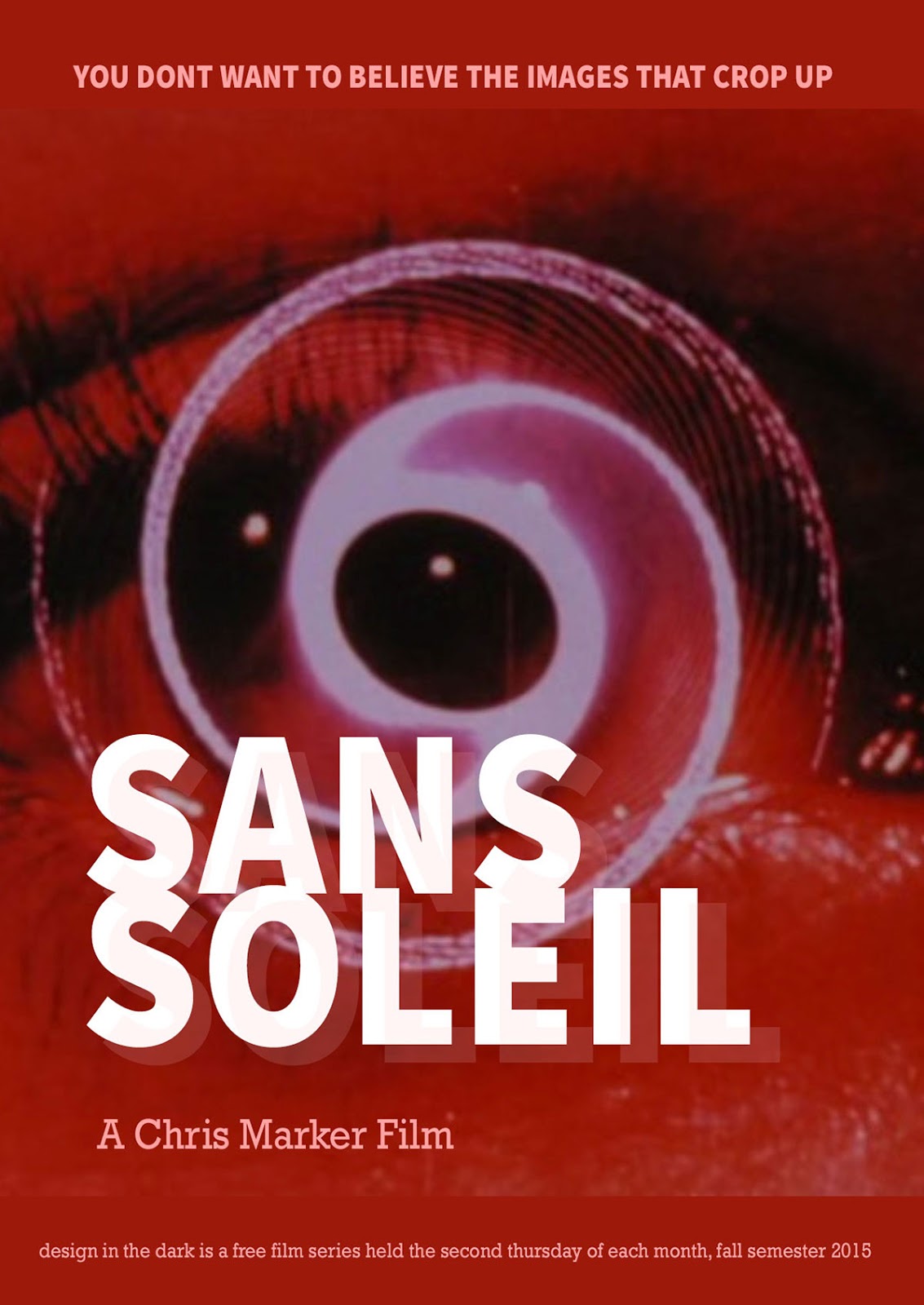
We jump forward two decades for Marker's next film, which is equally oblique in its style but in entirely different ways. Movement is key in this film, but narrative is not. In fact, for most of the time I was watching Sans Soleil I could not make heads nor tails of it. Ultimately, I realized that was the point.

It's clear Sans Soleil is an essay in the truest sense of that word, and right out of the gate it reminded me of something like Godfrey Reggio's Koyaanisqatsi, which was actually released only a year before. But I guess I still expected the essay to have more of a narrative backbone than this does. The purported backbone, if Marker were being held down by a studio asking him to justify the budget for his film, would be a study of the culture of Japan and an attempt to view it through a lens of the country's history, pre- and post-atomic era. But it's really hard to get anything quite that concrete from the film. From the almost constant flow of mostly obscure narration, which are fictional letters written from the fictional cinematographer who was supposed to be shooting the movie in question, it's clear that Marker is trying to tease out and toy with ideas of our perception of time, truth and history. Which allows him to do pretty much anything he wants.

And so the film also contains interludes set in Cape Verde, Paris, Iceland and San Francisco, the latter almost entirely in service to a five-minute tangent on Alfred Hitchcock's Vertigo. There is also, quite disturbingly and quite famously (it appears on one of the posters for this movie I did not choose), a scene of a giraffe being shot by hunters. You see it take on the first few bullets and start staggering around, and then when it is finally grounded but not yet dead, you see a hunter shoot it in the head at point blank range. Yep, that's what this movie is about.

There are also some other fascinating bits that play like montages out of horror movies, such as the image above of the close-up of an eye (I mentioned Un Chien Andalou earlier in this piece, didn't I?) and these terrifying images of Japanese people involved in what looks like acts of voyeurism, one after another until the effect becomes almost unbearable. However, many sections of the film almost feel mundane, showing Japanese women walking the streets of Tokyo in kimonos.

As I said, I didn't know what to make of this, and for a while I was turned off by it. Gradually, I got in step with it and decided that instead of being self-indulgent and disdainful of cinematic conventions, it was profound and immediate. I don't think it's a movie I'm going to come back to regularly, or possibly even at all, but like the films of countryman and compatriot Resnais, it produces a sensation in the viewer that is far greater than the sum of its parts. Just because we can't understand why Marker chose to film what he chose, why he constructed it in the sequence he constructed it, or what most of it means, it does not mean it doesn't have a disquieting and discomfiting effect on the viewer that defies description. The "ecstatic truth" that Werner Herzog seeks in his projects is something that comes through in spades in Sans Soleil.

Okay! Agnes Varda finally gets her turn in July, and pretty soon, as my iTunes rental of Faces Places (which is the second movie I will watch) expires in about 15 days. We'll see if I get some of that Marker sensibility in Varda's work.

Saturday, December 17, 2016

No Audio Audient: Greed, or how to watch a four-hour movie in 24 hours


This is the final installment of my 2016 series No Audio Audient, and now I will be taking a short/long break from silent movies. (No judgment, though; I quite enjoyed it.)

Sometimes, when finishing one of these year-long series on my blog, I metaphorically collapse in a heap from exhaustion.

Sometimes, though, I save the best for last.

And sometimes, it's both.

I'm not going to say Erich von Stroheim's Greed was the best film I watched for this series -- I also gave a full five stars to Sherlock Jr., and I can't say who would win in a face-off -- but it certainly ended things on a strong, if long, note. Especially given the baggage I brought into it, the difficulty I had getting a hold of it, and the difficulty I had carving out the significant time investment to watch it -- in the thick of the holiday season at that.

I'll address those in that order.

First, the baggage. Even without knowing much about Greed, I always associated it in my mind with Griffith's Intolerance, which I also watched for this series. Both are silent movies, both have abstract nouns as their titles, both figured to take an epic and multi-faceted approach to examining their chosen abstract nouns, and both are incredibly long. Because I didn't like Intolerance very much -- respected it somewhat, but didn't like it -- I worried that Greed would be another yucky spoonful of medicine. As it turns out, Greed is a far more focused effort than Intolerance, in spite of its epic running time, and that's just the first of myriad differences between the two.

Then there was the difficulty in getting my hands on it. I mistakenly believed that Greed, like most silent movies, is in the public domain, meaning that a multitude of versions would be available to watch on Youtube. I actually can't say for sure that it's not in the public domain, but I will tell you that a number of the Youtube links that apparently go to this movie end up saying that the content is not available for copyright reasons, providing pretty good circumstantial evidence. I did, however, find one available at about an hour and 47 minutes, a severely truncated version of the movie, though I thought I didn't care at that point. (See: previous comment about the holidays and exhaustion). Only after about five minutes did I realize that the title cards were in Italian. This was what stopped me in the midst of the November viewing I had planned, and forced me to rent it from iTunes instead. In retrospect, I realized I might have been able to turn on English subtitles (a funny option for a silent movie), but I'm glad I didn't recognize that at the time, because von Stroheim's full (or close to full) vision was what I ended up loving.

Which leads directly to my difficulty watching the movie. That difficulty arose from something I didn't notice until after I'd already started my iTunes download: that the version I was downloading was four hours long. I've never downloaded anything close to that long from iTunes -- I don't think I've even crossed the three-hour mark. It's not a problem of hard drive space, but a problem of time. No matter how long the movie is, you have to watch it during a 24-hour window before your rental expires. (It's the one time I wish I were linked up to the Australian iTunes instead of the U.S. one, because Australia gives you two days.) So I planned out how I would manage it very carefully. Having identified Tuesday as a viewing date because my wife was going to a Christmas party that night -- she didn't go, but that's neither here nor there -- I brought my computer in to work at lunch just so I could get an early start. I watched 20 minutes during lunch, then another 40 here and there before I finally got time to myself at night to tackle the remaining three hours. Figuring I'd watch the final few minutes the next morning if I just got too tired, I managed to avoid that fate by pulling in to the fish line around 12:30. And managed to write 40 Christmas cards (well, addressed 40 envelopes and stuffed in the cards) as I was doing it. So really, I watched it in just about exactly half of the 24 hours promised in the title of this post. Given that most of the remaining 12 hours would have been comprised of sleeping and working, it was still pretty tight.

How could I give a movie five stars if I were also addressing 40 Christmas cards?

A movie like Greed exceeds the status of a movie -- it becomes more like an experience, one you don't have to be closely watching every single second. At this point I should probably tell you more about it.

Even this four-hour version is a severely truncated version of von Stroheim's original vision. The film he originally made was more than eight hours long, and it was seen by only a dozen people. Needless to say, this version was hacked up by the studio, since even back in 1924 people were not watching eight-hour movies. The extra footage has subsequently been lost. The version that emerged was between two and three hours, as I understand it, and was a source of intense sadness and frustration to its director -- especially after the dozen who watched his original cut praised it as the greatest film ever made. (Not the same type of claim back then as it would be today, with nearly a century more movies to choose from, but still.)

The version I watched from iTunes was a 1999 attempted restoration of the director's original vision. This was managed with still photographs of the scenes that were cut and subsequently lost, inserted into the narrative at relevant junctures. Most of the cuts came from two subplots involving four other characters that are truly tangential to the main narrative -- one understands why the studios cut their material. But since the stills still existed, the restoration team placed them according to von Stroheim's original specifications. Realizing that still photographs don't play particularly well in an art form that relies on movement, the stills are given a sense of movement by the panning of the camera, the focusing in on certain parts of it, etc. And the content and composition of these photos is so rich that you really do feel like you're seeing the parts that were lost. As a technique, it reminded me a bit of that part of Butch Cassidy and the Sundance Kid where they show the passage of time in these guys' lives from still photos pored over lovingly by the camera. I almost feel like I preferred the Greed still photo approach to if I'd actually been able to see the moving images, as it made the movie feel like a historical relic of something that really happened -- like one would review old photos to get a window into the way the world once was. I found the effect captivating, and that it played an essential role in building this world.

What world? I should probably tell you a little bit about the story, which is remarkably simple. It's the story of a California miner named McTeague, who has a rotten streak he inherited from his no-good drunkard father, who dies early on. His mother begs a traveling dentist to take her son on as an apprentice, to get him out of this life, and indeed, McTeague picks up a new career. He falls in love with a patient, the cousin and intended fiancee of one of his best friends, who reluctantly agrees to let the more smitten McTeague step in and court her. She's initially resistant to a romantic involvement but is eventually convinced to marry McTeague. Just before they are able to get married, a lottery ticket wins her the very large sum of $5,000, leading to resentment from her cousin, who now regrets having allowed McTeague to step in. As they get married, she has a strange reluctance to ever spend any of the $5,000, which leads to ... well, not good things.

If this movie were directed by D.W. Griffith, this would be just one of six stories meant to illustrate the concept of greed. Von Stroheim restricted himself to three, two of which are the aforementioned subplots that were cut out of the movie, and indeed, I do believe they had significantly less screen time than his main narrative thrust. This leaner decision did wonders for me. I wasn't constantly left wondering which plot was progressing in which way, the feeling that overtook me as I steadily began paying only half my attention to Intolerance. Even while addressing Christmas cards, though, I could easily keep abreast of what was happening in Greed, a pace partly managed by the captivating use of the still photographs. I did seek clarification on a couple things in Wikipedia afterward, but they were minor.

And something about this story just blew me away. We burrow down deep into it. I mean, deep. In a weird way I was comparing it to the French storybooks about Babar the elephant, which I actually tease for their formidable length and their odd mixture of sweeping epic and minor detail. One we have, for example, tries to do everything from capture the entire building of a village, to talking about a single math lesson where someone thought that 4+4 = 9. I don't have time to explain it much better than that as this piece is already reaching a daunting length, but just know that that doesn't work in a children's story. But it works like gangbusters in a movie made for adults -- or at least, when the vision behind that movie is von Stroheim's. The depth of the development of these characters resembled something it might take a TV series a couple seasons to capture, as you bunkered down with them and really lived their lives with them. Greed is renowned for being shot on location, and I think that plays a big role here -- you get San Francisco of the era, as well as Death Valley, and dozens of other locations somewhere in between. The difference between location and a studio set is profound.

The performances here are also amazing. Von Stroheim gets real subtlety from his actors, as we watch emotions creep over their faces -- he didn't feel like had to have them play to the back of the theater at all. So Greed also feels more modern in its approach in this respect. I'll name the primary three in case their relatives are reading: Gibson Gowland as McTeague, Zasu Pitts as his wife Trina and Jean Hersholt as his friend-cum-rival, Marcus Schouler.

I'm quite sure I could go on about this movie for another hour or two of typing time. I'll just close by saying that the movie's cumulative effect is profound and immersive, and where it goes is uncompromising and bleak, worthy of the blackest crime thrillers -- and feeling years ahead of its time in that respect as well. The Death Valley climax is a real show stopper. The weight of everything that's happened and how it's all resolved just leaves you speechless.

I do have one final thought, though. At the very beginning of Greed, when von Stroheim's credit is on the screen, it says "Personally directed by Erich von Stroheim." Never seen the word "personally" inserted in there, and initially I thought it was kind of funny. The more I watched, and the more I realized the type of epic vision (I need a synonym for that word) that was compromised by what the studio did to his film, I felt the tragedy of that extra adverb. He did put his whole personal self into the movie, but it was just too large, too ungainly, and too brilliant for its time. His contemporaries didn't know what to do with it. Maybe we would today.

And on that note, we bring No Audio Audient to a close. Well, not quite. I imagine I'll have a post to wrap it up in January, but that's a consideration for another day. I'll also be giving you a little taste of the movies I'll be watching each month in 2017, since I've already got my idea for next year (as well as 2018, come to think of it, though I'll wait a year before telling you about that). But 2017's monthly series will wait for another day as well.

For today, back to getting ready to get on an airplane in five days, and all the things I still have to do before then.