You’d think that there would not be any good “annoyingly
long movie titles.” The very name discounts the possibility of them being good.
You’d think that there would not be any good “annoyingly
long movie titles.” The very name discounts the possibility of them being good.
But I think it’s possible for something to be annoyingly
long and still good, or at least, still funny.
Today I hope to throw some words at the topic of annoyingly
long movie titles, inspired by the upcoming release of Birds of Prey: And
the Fantabulous Emancipation of One Harley Quinn, which is decidedly an
example of the latter. As in, the worst.
Come on, it’s just Birds of Prey, screw all that
other noise. And most movie marquees around the country and the world will,
indeed, be screwing all that other noise. You will not see the full title of
this movie on any movie marquee in the world. But you will see it on every
poster for the movie, albeit in significantly smaller type, which means some
idiot in the marketing department at the studio is still trying to make And
the Fantabulous Emancipation (breath) of One Harley Quinn happen.
But not every annoyingly long title is And the Fantabulous
Emancipation of One Harley Quinn. Maybe it’s only because I really liked
the movie, naming it my #1 movie of 2014 and one of the top 25 of the last
decade, but this new title reminds me most of Birdman or (The Unexpected
Virtue of Ignorance), a title for which I developed a limited fondness. As they
are both, broadly, superhero movies, I even feel like Harley Quinn (I’m not
writing that damn thing out again) is borrowing inspiration from Birdman. Both
also seem to have pretentious ambitions, which again, I accept because the
movie really worked for me in Birdman’s case.
Of course, probably the best example of the annoyingly long
movie title is the one that does so specifically for the purposes of humor.
Well, you might argue that most annoyingly long movie titles are done for
humor, as otherwise you’d just switch to something more palatable. But there
are certainly degrees to which the humor does or does not work.
Take, for example, Borat: Cultural Learnings of America
for Make Benefit Glorious Nation of Kazakhstan. Borat’s broken, some might
say strangled, English was one of the biggest jokes about the character, so a
title that is grammatically awkward, unduly worshipful of the man’s home
country, and also gets at an obsession with America and its pop culture, is like
killing three birds with one stone. I’ve made it a point of pride that I can roll
off this title without any errors, when asked. (Because that particular
scenario arrives just about every day.)
But long character-based titles don’t work just because it’s
a somewhat beloved character. Sometimes they just try our patience. A couple years
ago, the movie with the longest title on my whole movie list came out. It was
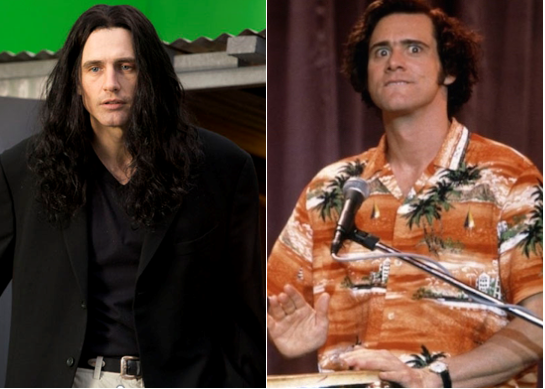
called Jim & Andy: The Great Beyond – Featuring a Very Special,
Contractually Obligated Mention of Tony Clifton. So Tony Clifton may not be
beloved, but Jim Carrey and Andy Kaufman may both be, to varying degrees. But
this title pretty much just made me smack my forehead. Suffice it to say that I
definitely had to look up the correct wording just now.
The movie whose title is long just to make fun of the idea
of long titles is also usually a bust. The first movie I’m discussing today
that I haven’t seen is a prime example of that. That would be Don’t be a Menace
to South Central While Drinking Your Juice in the Hood. Now that I’ve
written it out, I think the title is not trying to make fun of the idea of long
titles so much as it is being silly by trying to literally string together
about four different titles. At least it’s better than Shriek If You Know
What I Did Last Friday the 13th. There’s one more of these
titles that is like twice this length but I’m having trouble tracking it down.
My favorite purely innocent long title is The Englishman
Who Went Up a Hill But Came Down a Mountain. I suppose there is something
cheeky about this – they could have figured out a simpler title if they’d
wanted to – but the title does do an admirable job of describing what the movie
is about, as it is about a provincial debate in the Welsh countryside about
whether a local elevated surface is better described as a hill or a mountain.
For a while, this was my favorite movie title to bring up in joke circumstances,
when I was looking for something awkward to encapsulate a small, idiosyncratic
non-blockbuster.
Supplanting The Englishman Who Went Up a Hill But Came
Down a Mountain as my go-to random long title was Jeanne Dielmann,
23 quai du Commerce, 1080 Bruxelles, which is not an easy choice as I
always have to look up the exact wording, but is fun anyway. As this is an
arthouse film with a very serious demeanor, this title exists to capture the
everyday humdrum quality of a person’s life by naming the movie after her
street address, not to be whimsical in any way, shape or form.
It’s probably worth including a subsection in this post
about earnest documentaries with long subtitles, like Going Clear:
Scientology and the Prison of Belief or If a Tree Falls: A Story of the
Earth Liberation Front or Magic Trip: Ken Kesey’s Search for a Kool
Place, but I don’t know that their length is “annoying.” Or if it is, it’s
only annoying because it sounds more like the name of a graduate thesis than
a movie.
I’m sure I’m only scratching the surface of movies whose
titles test our patience and don’t always reward us, but I can’t end this
discussion without mentioning probably the actual best movie to be guilty of a
thing like this, which is Dr. Strangelove, or How I Learned to Stop Worrying
and Love the Bomb. If Stanley Kubrick did it, there has to be some merit
there, right?
As for this new movie coming out, I think the main things
that annoy me about the title are that it a) makes up a word, b) uses the
word “one” as though pretending we don’t know who Harley Quinn is, and c) suggests that the movie is entirely about the fact that she has been “emancipated”
from her relationship with the Joker, or at least so it would appear.
I think I’ve had enough references to the Joker for a couple years, thank you
very much.