Showing posts with label the tree of life. Show all posts

Thursday, April 4, 2013

Still processing


When you're not sure whether you liked a movie a lot or a little, but are still processing it two days later, there's your answer.

Spring Breakers is the kind of movie that makes you realize that the mere exercise of grappling with your complex feelings about a movie makes it pretty damn good.

What's turning out to be the most divisive movie of the year so far doesn't have me divided anymore. I'm not going to say it's a masterpiece, but it's a shot of cinematic adrenaline that feels unique at the same time that it feels familiar.

If that sounds like a contradiction, welcome to Harmony Korine's latest film. It's all about contradictions. It's high culture and low culture. It's a critique and a celebration of the pursuit of hedonism. It's a comedy and a horror movie.

My first instinct after the credits started to roll (literally; I turned my phone on right then and there) was to text the following to my friend who had already seen it: "Spring Breakers: the Tree of Life of spring break movies."

I'd say that was an oversimplification, except comparing something to The Tree of Life is never an activity that should be described as simple.

The surface comparison I was making is that both movies have arthouse pretensions ("pretensions" in a value neutral sense) and that both contain a lot of what I called "B-roll" when I talked about The Tree of Life. If you're not familiar with the term "B-roll," it's basically secondary footage that doesn't accomplish anything more than setting the scene or tone. It's really a TV journalism term: If you are interviewing kids on the street about a new viral phenomenon, you might shoot some footage of the outside of their high school, or a street sign, or a skate park, to set the scene of where you're doing the interviews. That's B-roll. Of course, B-roll in an arthouse film would be a lot less strictly functional and mundane. The B-roll I think of in The Tree of Life is stuff like sprinklers watering a lawn, or a curtain blowing lightly in the wind.

My contention was that The Tree of Life had altogether too much B-roll, especially in its second half, when I thought it started to lose focus. Spring Breakers might also have too much, but at least much of the Spring Breakers B-roll contains gyrating bodies, lines of cocaine sniffed off of torsos, and geysers of foamy beer.

Before I get sidetracked forever on a discussion of B-roll, let me use this as a transition to discuss what this movie is doing. The movie is damn near suffused with shots of naked breasts, slow-mo clouds of weed smoke coming out of bongs, and water cascading over bikini-clad bodies. Such unbridled indulgence would be easy to criticize, especially since Korine isn't so straightforward and moralistic as to outright condemn what he's showing us. When you show us lots of boobs without making a direct indictment of what you're doing, you could certainly be accused of exploitation.

Except art is rarely very effective when it tells us exactly what to think. Covering your ass from a moral standpoint rarely makes for provocative or memorable art. Surely, the bacchanalian pursuits documented in Spring Breakers go plenty of places that strip the romanticism from those pursuits, so Korine does indict them on some level. But the line is so fine -- especially with the repeated focus on the bodies of these barely post-teen women, some of whom cut their teeth on Disney productions -- that it's meant to discomfit us.

And discomfit us it does. While titillating us. While making us hate ourselves for that. While indulging in some gonzo iconography that's simultaneously cheeky and profound.

The best way to describe the visual scheme/concepts of Spring Breakers is somewhere between Point Break, Drive, Oliver Stone's Savages (which I actually haven't seen) and any number of Tony Scott's more in-your-face movies (maybe Domino). So there's a contradiction built into the movies I'm comparing it to as well. I say I really like this movie, yet I don't love any of the movies that I'm comparing it to (the ones I've seen, anyway). In fact, I don't even like Domino, and I think the Point Break comparison really has to do with beach bums committing violent crimes while donning masks.

The fact that I've written nearly 800 words, and don't feel like I've started to scratch the surface of Spring Breakers, is another indication of how much I liked it.

But see, until the brilliant last scene of the movie, I wasn't even sure if I liked it. My guess is that's by design. You're supposed to feel a bit queasy, a bit disgusted with what's on display, a bit uncertain whether Korine is driving you off a cliff, a bit uncertain whether that's actually a bad thing.

I've read at least a couple truly excellent reviews of Spring Breakers, and because I'm writing this post under time constraints, I'm not going to try to achieve that level of insight about the film. However, I will refer you to both of them if you're interested: Here's one and here's the other. I'm sure there are plenty of others, and I'm sure there are even some negative reviews that make really convincing arguments.

That's what this processing is all about. It's a film having an internal life inside you as you chew it over for days and even weeks. Even if I have another phase where my affection turns into disdain, I'll know that the movie truly provoked me, which means it's "good" by any measure.

Sunday, May 29, 2011

Squeezed out by a sellout


Way #42 to botch an illegal theatrical double feature: The second movie is sold out.

Actually, "botch" is not the right word for it -- some quick thinking actually saved me some potential embarrassment at the theater tonight.

See, I went to see a 7:45 showing of Terrence Malick's The Tree of Life (more on that in a moment), and the ending lined up perfectly with the beginning of a 10:15 showing of Woody Allen's Midnight in Paris. I'd lucked in to an advantageous positioning of the screening rooms, the kind necessary to pull it off -- once you pass the ticket taker, you have access to five different theaters, two of which were playing my movies.

The thing I didn't anticipate, but should have, was that the 10:15 showing of Midnight in Paris might sell out. I knew the theater had been crawling with people all day and that a lot of earlier shows had sold out, but the 10:15? It seemed at least reasonable that it would escape that fate.

So I got texted permission from my wife (no peeps from the baby) and headed in to the theater. By walking confidently I passed the three ushers at the front without any of them asking me if they could show me to my seat. The theater was probably 3/4 full and it was about 10:14. So I went as far back as I could and chose a reasonable seat.

I hadn't been sitting for more than 30 seconds when I realized that although I hadn't needed the ushers to show me to my seat (probably because I didn't have one), many others were not so confident in their own ability to follow a straightforward system of row letters and seat numbers. If the person who had my seat was the next one into the theater, the usher would point them to the correct seat and immediately see that I was in it. At which point an incident might arise where my ticket needed to be produced. A ticket I didn't have.

I quickly jumped into the aisle and pretended to be very involved in my cell phone. My intention was to wait it out until they dimmed the lights and reassess my situation. Actually, I did text my wife to thank her for allowing me to catch the second movie. But before I even finished the text, I changed its wording to tell her I was coming home after all. An usher came in to greet us over the microphone (standard practice in this theater) and told us that although it might not look like it right now, this show was sold out. Okay, that seems pretty straightforward -- time for me to leave. Which I did.

I don't know that I could have really watched a whole second movie after The Tree of Life sapped the life out of me. I spent the first hour of that movie enthralled by the experience of watching it, and the final 78 minutes checking my watch.

I've worked my way around to giving a grudging respect to Malick's poetic abstractions. I love Badlands (though I'm not sure if that counts as a Malick film the way we know it today) and I despised The Thin Red Line, though I did appreciate it better when I watched it again for my Second Chances series last year. In the meantime I also saw The New World, and was swept away by the beautiful cinematography, which carried me through the more Malick-y parts (of which there were of course very many). After tonight, Days of Heaven is his one film that has still eluded me.

And so I knew full well what to expect when coming in. I expected a beautiful-looking film with lots of character voiceover -- not to be confused with narration, because there's nothing about this VO that's expository in the slightest. I expected a dreamy quality to all the action and a non-sequential narrative. And I expected (though this is kind of covered by "beautiful-looking") some of the best cinematography you can find on screen today. I expected what some of the audience was obviously not expecting, as some of our audience walked out. (I couldn't tell how many, because some of them were undoubtedly going to the bathroom -- but any time I saw two people go out together, I doubted it was a bathroom break.)

And yet I still wanted something more concrete from Malick, even though I knew I shouldn't expect it. I hoped it would all lead to a more satisfying payoff than what I got -- even though again I knew I shouldn't expect it. The movie does have a payoff, for sure -- there's definitely Malick's version of a climax. But that climax didn't bring it all home for me.

And yes, I had trouble staying awake. I had a busy day after a night of sleep interrupted by baby feedings, so my inability to focus for the entire time was not exactly a surprise, especially in this film. I'd come prepared with Girl Scout mint cookies, Altoids and a five-hour energy drink, but none ultimately did the trick. I was especially disappointed in the five-hour energy drink, though this should come as no surprise because it's never worked for me in the past. I keep thinking that next time will be the time it gives me the jolt I need to make it through the end of a movie I started too late at night (7:45 may have been too late for this movie), but the swigs I took of it tonight actually seemed to make me more sleepy. I'd take a swig and close my eyes for one of those jolt-awake naps less than 15 seconds later. They should call it "10-second energy drink" instead.

I prioritized The Tree of Life over a myriad of other viewing options primarily because of its recent win at Cannes. However, the Cannes winners have always exemplified the iconoclastic spirit of that festival -- I sometimes think that Cannes gives out prizes only to films that they know will divide audiences, just to be contrarian. List of Cannes winners that fit this description in another post.

So if you like Malick, this film is defintiely for you. If you don't or are not sure ... well, are you willing to pay theatrical prices to see a bevy of astonishingly beautiful images on the big screen, even if that's all you end up taking away from it?

That's for you to decide.

Tuesday, June 22, 2010

Too Shebulba


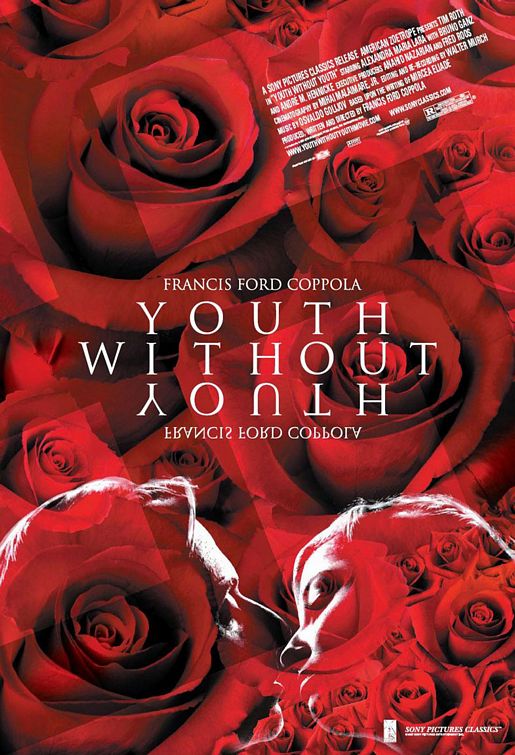
It was exactly five weeks between when I received Youth Without Youth in the mail and when we finally watched it on Saturday.

My wife and I both knew the critics had railed against Francis Ford Coppola's movie. But the reason I originally moved it to the top of my queue was that she had expressed some interest in seeing it. Since that made two of us, I knew it would get watched, eventually. Had I had my way, we would have watched it weeks ago -- I like to keep my mail rentals moving back and forth. She, on the other hand, was daunted not only by the expectation of poor quality, but by the running time. It was only just over two hours, but she had it in her head that it was pushing three.

It may just as well have been. When the credits started rolling, I turned to her and said, "You know, that film kind of reminded me of--"

"Shebulba?" she finished.

There's a reason we're married.

"Shebulba" is our nickname for Darren Aronofsky's The Fountain. In The Fountain, Hugh Jackman's character is floating through space on a crop of land enclosed in a bubble, which is dominated by a giant tree. We're never told quite what to make of this tree, but we know Jackman's character is immortal, because we see him as a conquistador, as a doctor fighting to cure his sick wife (Rachel Weisz) in present day, and presumably in the future, when it's possible that the only parts of Earth that remain are him and this tree, floating through space for eternity. At several points, he looks up at the tree, or outer space, or something, and reverentially whispers the following word: "Shebulba." Who or what Shebulba is, we also don't know.

Youth Without Youth was definitely a little too Shebulba.

(Some minor spoilers ahead.)

There's no immortal man or immortal tree, but a 70-year-old Dominic Matei (Tim Roth) does rejuvenate into a man half his age after being struck by a bolt of lightning that basically incinerates his body. Instead of dying, he's suddenly younger, he grows a new set of teeth, and he has the ability to absorb all the knowledge of a book just by passing his hand over it. This is to say nothing of his new ability with languages and his unexplained telekinetic powers. Oh, and did we mention that he now has a doppleganger who may or may not be imaginary? But the comparison with The Fountain really kicks into gear when Dominic's decades-spanning soulmate is introduced. We learn at the start that he loves someone named Laura, and later he meets her -- though she's now known as Veronica (Alexandra Maria Lara) -- just before she's about to be struck by lightning herself. The lightning doesn't have the same effect on her -- instead, it makes her think she's someone living in ancient India, who can speak only Sanskrit. She eventually shakes herself free of the split personality, but only temporarily. Each night she awakens speaking a more and more ancient language. It's an epic love story, these lightning strike victims with their very different powers.

If that last paragraph left you wondering what the hell Coppola was thinking, you're not the only one. (He didn't actually make up the story -- the movie was adapted from a story by Romanian author Mircea Eliade.) I actually found this one more watchable than The Fountain, but not by much.

So it got me thinking which other films are way too Shebulba for their own good. Without any further ado:

1) Solaris (2002, Stephen Soderbergh). Ponderous existential sci-fi movie in which characters may or may not actually be there, and people may or may not actually be having the experiences they may or may not actually be having. You heard me right. I don't know if Andrei Trakovsky's 1972 original was any more clear, nor whether it was even supposed to be. I'm sure there are plenty of people out there who worship Solaris, but I'm not one of them.

2) Mulholland Drive (2001, David Lynch). I'm not sure if it's fair to call David Lynch's films "Shebulba," exactly -- he's got a whole brand of weirdness going on that's unique to himself. But Mulholland Drive deserves the designation if any of his films do, though I may be saying that primarily because the whispered word "Shebulba" reminds me of the whispered word "Silencio" that factors into the ponderous third act of Mulholland Drive. I understand The Lost Highway is pretty Shebulba, but I haven't seen it so I can't attest to that personally.

3) The Tree of Life (2010, Terrence Malick). Okay, I'm cheating a little here. This movie has not even come out yet, so I can't possibly know what kind of movie it is. However, it does involve an actual Shebulba in the title -- a life-giving tree, an immortal tree, something like that. And having seen a couple Malick films and written quite a bit about Malick recently, I'm convinced that he's got a Shebulba in him, even if his films so far have had the kind of surface-level realism that should logically remove them from the Shebulba realm.

4) Lady in the Water (2006, M. Night Shyamalan). There are no time jumps or alternate layers of reality in this movie, but all the discussion of narfs and scrunts and other mythological creatures takes this movie into the same la-la-land of inscrutable ambitiousness as Shebulba. Plus, I like any opportunity I get to dump on this movie, which I consider one of the worst I've ever seen.

A couple films I love despite their potential Shebulbosity: The Cell, Donnie Darko

I'm sure there are more, but all this thinking about Shebulba makes my head hurt too much for a Monday morning. I'd love to hear of any Shebulba films you might like to add.