Showing posts with label knowing noir. Show all posts

Sunday, December 12, 2021

Knowing Noir: Bogart Reckoning

This is the final installment of my 2021 series watching film noir.

I finally found the right Humphrey Bogart movies.

That's right, I said "movies." If you thought this was only a 12-movie series, you've got some bonus material coming your way.

If you recall, my guiding principle in launching this series a year ago was to struggle with a chicken-or-the-egg scenario: Was I cool on noir because I don't like Humphrey Bogart, or do I not like Humphrey Bogart because I'm cool no noir?

I started with a Bogart movie (In a Lonely Place) and I always knew I would finish with a Bogart movie. I ended up finishing with three, giving Knowing Noir 14 movies rather than just 12.

If you want to know how I decided to add complication to my schedule in the month of December, a month in which I am also moving to a new house while planning to have no noticeable dropoff in the Christmas I provide my family, well I'll tell you.

I had pretty much decided on one particular Bogart title to finish my noir series, but just to be sure, I decided to go through the other titles that were still sitting in the Letterboxd list I had been adding to all year, just to see what other classic noir I'd be neglecting by not selecting them. I noticed two other titles that also featured Bogart still appearing unwatched in that list. (At least two, but I stopped after two.)

I figured, if I'm trying to decide whether I like Humphrey Bogart or not, let's not let it come down to just one more movie. Let's let it come down to three, and be certain about it one way or the other.

And just so I didn't let the extra ambition swallow me as my month got busier, making me regret I'd decided to add two titles, I front-loaded my three viewings and got them all in the books by December 9th.

Dead Reckoning (1947, John Cromwell)

I finally found the right Bogart movies, but this was not one of them. My first movie of December, on the first of the month, just left me deeper in doubt of its star.

I could tell how little Dead Reckoning was stimulating my engagement with noir by how few notes I took while watching it. Taking notes during a film is tedious and it's something I don't usually do, even though some critics think that helps when you are reviewing a movie. But in this series I've been doing it, since I was specifically trying to notice noir characteristics that I wanted to write about here.

Here is the sum total of what I wrote for this movie:

Bogie's face completely in shadow talking to police
Sexist
Bad singing scene
"The problem with women is that they ask too many questions. They should just spend all their time being beautiful."
She's bad

The "she" there was Lizabeth Scott, Bogart's co-star, who seems intended as a stand-in for Lauren Bacall. I just didn't think her performance was good at all, though it does certainly qualify as a femme fatale. There was something weird about her voice -- was it too deep? not sultry enough? Anyway, ten days later I don't remember. But I just found her off the whole time and I never recovered from it.

The bigger problem, though, was Bogart. I figured out something about Bogart that I guess should not come as a surprise, though it took one of the later films I watched this month for me to reach this conclusion retroactively: If he's not working with a skilled director, he's just not that good. In Dead Reckoning I really noticed how his acting style could best be described as "waiting to say his lines." They say that acting is reacting, but in most of his scenes here, I felt like he was just waiting for the other person to finish speaking so he could spurt out the next bit of his rapid-fire dialogue. (I don't actually know if John Cromwell is considered a good director or not, since I haven't seen any of his other films, but this movie does not provide strong evidence in his favor.) 

One convention that has thankfully fallen by the wayside underscored this. It was common in films from that era to see only one half of a phone conversation, and in order not to deaden the pace of the film, the speaker barely pauses for the other person to say anything. The other person is speaking so quickly, and both parties are assimilating what the other person says so instantaneously, that we can hear the whole conversation in about the time it would take just to hear Bogart's half. And that's including him repeating things the other person said so we can understand them. This may not be Bogart's fault, and it may not even be the director's fault, since as I said, it was a convention of films from that era. But taken in combination with the fact that I was already judging Bogart's acting style pretty harshly, it didn't paint a flattering portrait of his skill with the craft.

As you can also see from one of my notes, I really don't like it when Bogart plays a sexist character. Obviously that would be/could be true to life for whatever character he's playing, and I certainly don't hold it against other performers when they play characters who don't respect women. But with Bogart, he's praised for this cool demeanor, dismissive attitudes and quick hard-boiled dialogue, which are part of what made him an icon. I don't dig the role of sexism in completing that picture of the man as a myth and legend.

It occurs to me I haven't told you anything about the plot of Dead Reckoning, and given that I have to write about two other films today, I'm not inclined to start now. Let's just say it involves all the typical double-crosses, paths crossed with unsavory characters, several instances of the protagonist being knocked out and awakening later next to dead bodies. Maybe after 12 months of this I'm just bored of these tropes.

Let's move on.
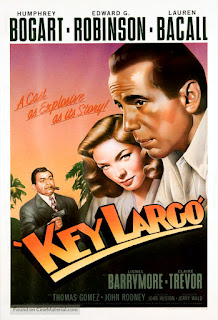
Key Largo (1948, John Huston)

What a difference a week makes.

On December 8th I had this month's second Wednesday date with Humphrey Bogart, and finally, I became smitten.

I took a comparative ream of notes on Key Largo, and as soon as I started watching it, I was sorry it would have to share real estate with two other films in my final Knowing Noir post, because I could talk about this movie all day.

I won't. I'll try to be economic. We'll see how I do.

It was immediately clear what a difference it made for Bogart to be in the hands of a good -- nay, great -- director. John Huston did wonders for Bogart in 1948, and I suppose vice versa, as this was also the year they collaborated on what has always been my favorite Bogart film, Treasure of the Sierra Madre. I think I like Key Largo even better.

The first difference I noticed was technical, as it was immediately clear the thought Huston was putting into camera placements and movements. Huston will zoom in or pan to capture a particularly useful piece of visual information, and one camera setup that seemed simple had a profound effect in terms of just using the available resources to create visual dynamism. There's a moment near the beginning when Bogart's character is pulling in a boat that's moored in a Key Largo harbor, and the camera sits on the boat, getting closer to Bogart and Lauren Bacall with every tug he gives it. As I write this out it does not seem as interesting as it felt in the moment, but it acted as a symbol of how I was in the hands of a man with clear storytelling notions that he knew how to convert into reality.

The other thing I knew I loved about Key Largo, once it became pretty clear what its parameters were, was its choice to take place all in a single location, giving it the contours of a proper frame story. I will tell you about the plot of this particular film, because it's elegantly simple -- and that's something I've determined, over the course of this series, is a boon to any film noir. Bogart plays Frank McCloud, a World War II veteran who travels to the titular locale to visit the widow (Bacall) and father (Lionel Barrymore) of his fellow soldier and friend who died in the war. He's arrived at the Largo Hotel, which they run, at the wrong time for potentially three reasons: 1) It's the offseason, meaning it's incredibly hot and the hotel is not actually open to guests; 2) A hurricane is expected to bear down at any moment; 3) The hotel actually does have a group of ominous looking "guests," who have rented it out for a "fishing trip" -- but really to receive a package delivered from Cuba that will make them a lot of money. In fact, this gang of sketchy guys turns out to be run by the infamous mobster Johnny Rocco (Edward G. Robinson). I suppose there's a fourth reason, which is that police are in the area looking for a couple young Native American men who escaped from prison, who are friends with the widow and her father.

I don't really know the order in which to talk about the things I loved about Key Largo so I will just have at it and see how I go.

I suppose it's best to start with Bogart. It was immediately clear to me how much a director like Huston gets out of this actor. He's specifically not just waiting to say his next line, as you can really see the impact on his face of whatever new piece of information has just crept into his awareness, whether that's a line of dialogue or a shift in the dynamics of a scene (usually inspired by a line of dialogue, I suppose). Key Largo is no less talky than any other noir -- I suppose since it's contained to one location, it might even be more so -- but all the dialogue is to a purpose, clearly advancing the stakes or deepening the portrayals of the characters. I noted that even Rocco's flunkies all had distinct personalities, something the film needn't have done but carries off with a minimum of effort and a maximum of impact. But as you can see I am already getting sidetracked. I started off talking about Bogart.

The full breadth of his charisma is apparent in a role like that of Frank McCloud, where he isn't just lighting up cigarettes and dismissing dames. This is clearly not a sexist character, which is certainly a benefit, but neither is he a purely righteous character either. There's a moment where he reacts to a situation with what appears to be cowardice, and which he writes off as a result of his own self-interest. Later events will prove that this is a bit of bluster and a tendency to be hard on himself, but Key Largo has room for McCloud to be complicated, a man motivated by fear and calculation rather than just the sort of imperviousness to harm that characterizes some of Bogart's shallower performances. You can see Huston taking Bogart and turning him into a human being rather than just a collection of tics and tropes.

Sadly for Bogart, he doesn't get to be the most interesting performer here. That's Edward G. Robinson as Johnny Rocco. What a portrayal. Robinson and screenwriter Richard Brooks (who co-wrote with Huston) depict a gangster whom we can dislike on a human scale, without having to go over the top. In lesser films and probably in newer films, Robinson would have been required to be cruel at every turn, and build up a body count so we can hiss him with more relish. Instead, we get a powerful but extremely intelligent man, one whose ego does motivate him to take certain small reprisals against the people who have insulted him, but who acts out of pragmatism at every turn. Yes he's cruel, and sometimes it's for sport, but what we get here is a man who understands the lay of the land, the advantages and disadvantages he has in any moment, and to what extent a personal insult directed at him should actually impede the larger scheme he has in mind. That doesn't mean there's no room for his character to have linguistic flourishes and moments where he laughs at or withers another character with his comments. It all makes for a dynamic and life-sized portrayal of maliciousness. 

It was also really wonderful to see Bacall here, especially so soon after Lizabeth Scott in Dead Reckoning. It's clear what the real deal can do in such direct contrast to a fake. She's comparatively passive as a character, but just her acting -- her reacting, really -- makes it clear how much of a pro she is. There's always something interesting going on on her face, and her sheer charisma is disarming.

Basically I just loved this simple setup that takes place over the course of one afternoon and one evening at this shuttered hotel, with a dozen characters factoring in, also including the gangster's moll, played memorably by Claire Trevor. You'd think there would be a sort of inertness to the film because it doesn't leave the hotel, but nothing could be further from the truth. The narrative just propels things forward and changes the dynamics in forever appealing ways. I think of my favorite film that could be characterized as noir, the Wachowskis' Bound, and how that really all takes place in one apartment. This is just the right setup for me I think.

Three final notes before I will force myself to move on:

1) I love the choice to have this set during the offseason in Key Largo. I expected a film like this to showcase the area at its peak, which probably would have made it feel more ordinary, and also involved multiple locations. It's much better as it is, taking what could have been a travelogue of sorts and turning it into a location that's out of place and time.

2) Some dialogue exchanges that I have to include, just because I loved the writing. I will present them with minimal context in the interest of space and time:

A character's description of a hurricane: "The ocean gets up on its hind legs and walks right across the land."

When a police officer talks about getting hit over the head: "I made a break for the door and the lights went out again."
The mobster who hit him: "I'm the electrician."

"Everybody has their first drink, don't they? But everybody ain't a lush."

"You don't like the storm, do you Rocco? Show it your gun why don't you. If it doesn't stop, shoot it."

"Your head says one thing and your whole life says another. Your head always loses."

3) Although this is clearly film noir, it deviates from it in several important ways. For one, neither Bacall nor Trevor, the only two women in the story, is a femme fatale. It occurs to me that maybe the mere idea of a femme fatale is a problem for me, as it feeds the protagonist's latent sexism, which I've already acknowledged is a problem I have with Bogart. Maybe a solid, not overly complicated story that has a sprinkling of noir elements, but doesn't need to tick all the boxes, is just the type of noir for me.

The Harder They Fall (1956, Mark Robson)

It seems fitting to end with what was also Humphrey Bogart's last movie. He died the following year, when all the drinking and smoking led to fatal esophageal cancer.

In truth, you can sort of see that the end was near for him in this film -- not because his performance is limited, but because his skin looks a bit sallow, the wrinkles and bags around his eyes becoming more pronounced. It's hard to know if that's just because he had crossed over into his late fifties, or because the makeup design intended to draw out the way the character has been worn down by life. But I have to think Bogart's cancer would have had something to do with it. 

The interesting thing about finishing with this film is that I'm not sure it's actually noir. The Wikipedia entry leads by describing it as a "boxing film noir," which is how I was able to shortlist it for this series, and also a point in favor of its inclusion, as I knew I'd be getting a sort of hybrid film that would provide a nice variation on what I'd been watching. As it turns out, it was so much of a variation that I'm not even sure if noir is a useful label for this movie. Maybe by this point in his career -- its end -- any movie featuring Bogart would get the noir label as long as it was set primarily in cities and there was some sort of criminal element to it.

The Harder They Fall is more of a sports corruption movie, and it's a dandy. The story involves Bogart's Eddie Willis, a character who prompted me to wonder how many times Bogart played a character named Eddie. He's a former journalist who is looking for his nest egg, so he takes a job writing publicity for an up-and-coming boxer from Argentina named Toro Moreno (Mike Lane), the property of corrupt promoter Nick Benko (Rod Steiger). The only thing is, although Toro looks the part, he can neither land nor take a punch. This is no obstacle in the corrupt world of boxing, though -- not when every fighter Moreno fights can be paid to take a dive.

As I was watching this movie a very flattering point of comparison came up in my head. It made me think of my favorite Billy Wilder film, Ace in the Hole, which is also about a journalist who exploits innocents to advance his career. Eddie has a conscience but he's also in it for the wrong reasons, and over the course of the movie, a man who comes on the scene as a joke -- the hulking boxer who is hopelessly untrainable -- really wins our sympathies as a tragic figure, exploited by the machinery of corruption. The great face of this villainy in this film is Steiger, with his absolute disdain for morality, for the hapless boxers who are reluctant necessities for his money-making schemes. 

It's a bracingly critical portrait of American sports and American capitalism, though I don't think it's actual noir. There are criminal elements, sure, and there are times when men in fedoras run around in menacing fashion, especially near the end -- almost as though there were an 11th hour attempt to associate The Harder They Fall with noir. Really, though, this is just an exceptional story of greed and the losing battle against it, which takes aim not only at sports but also at journalism. It's also really funny in spots as the satire is on point throughout. Then it can turn on a dime and spend significant energy on brain-damaged boxers who are chewed up and spat out at the other end, left penniless by the huge cuts of their pay taken by the various managers and other skimmers who helped give them a "career."

And I'm glad to report that Bogart is again really good in this film. I don't know Mark Robson's work either, but the performance he gets out of Bogart speaks well of his abilities. This is a sort of perfect swan song for the actor, as he's fighting his own personal battle with selling out and exploitation -- and coming out victorious, I'm glad to say. Not that this was not a typical journey for a Bogart character, but I suppose he could have just as easily ended on a role where he thought "you dames are all alike," and lost that battle. 

In the end, the version of Bogart I wanted to like won out in a similar way. Now that I've ended with two films that showed me what I must have always wanted from the actor, I feel a lot better about him on the whole. I just need to find the right movies, and I'm hoping there are some more out there that will give me the feeling that Key Largo and The Harder They Fall have given me. 

As an additional note: If I had watched only one movie in December, it would have been Key Largo, so I still would have ended on in this happy place (rather than the Lonely Place where I started off) with Bogart. But I'm glad I fit in the other two, for different reasons -- one I loved, and the other helped me put my finger on the versions of Bogart's screen persona that I don't like. 

Because this may be the only good place to squeeze it in, I wanted to tell you that my viewing of The Harder They Fall was part of a Harder They Fall double feature. Knowing that the 2021 Netflix all-Black western directed by Jeymes Samuel was also on my upcoming viewing schedule, I decided to watch both movies called The Harder They Fall in the same evening, which was last Thursday, December 9th. That was about four hours of movie, but I managed to finish it up in the wee hours of the morning. And I really liked the Samuel movie as well, though not as much as Bogart's farewell.

Ordinarily at the conclusion of a series like this, I like to look back and added another couple hundred words recapping the movies I saw and what I ultimately took away from the experience. I kind of still want to do that, but I think I've written enough for today -- and since, as I said before, I still have Christmas shopping and house moving to do, I don't think it's worth it to test your reading stamina any further for now. 

But I do hope to officially recap the series in the next couple weeks. Tune back in to see if I manage to fit it in.

Saturday, November 20, 2021

Knowing Noir: Detour

This is the penultimate month of my series watching classic film noir that I haven't yet seen.

Just in time for the end of Knowing Noir, my November viewing has brought me a combination of traits that has been elusive so far in this series. It's been difficult for me to find a movie that both really worked for me, and also clearly demonstrated what I think of as the core characteristics of noir. But Detour has answered the call.

Also one of the shortest movies in this series at only 67 minutes, Edmund G. Ulmer's 1945 film is a simple, straightforward movie that has noir tropes galore. "Simple and straightforward" are adjectives someone would rarely ascribe to film noir, but I've determined they are things my simple little brain desperately needs.

It's the story of a man named Al Roberts (Tom Neal), a New York piano player who is hitchhiking his way across the country to be with his girlfriend, Sue (Claudia Drake), who left New York to pursue Hollywood stardom. Al is picked up by a man going the same direction and with the same destination, but Charles Haskell Jr. (Edmund MacDonald) dies mysteriously while Al is taking his turn driving, after popping a number of pills. (So I guess maybe it's not that mysterious.) Al panics when he realizes he will be blamed for murdering Haskell if he notifies the police, so he hides the body and assumes the man's identity in case someone should pull him over and ask why he's driving the car. He hopes to ditch the whole ruse when he reaches California and picks up with Sue again.

His fatal flaw is that he's got the desire to pay forward all the favors others did him when they picked him up to give him a ride. He picks up hitchhiker Vera (Ann Savage) at one of his next stops, and as luck would have it, she recognizes he's not Haskell because she rode part of the way with Haskell as part of her own cross country excursion. Trouble ensues.

I can't/won't discuss too much more of the plot because there isn't all that much more without getting into spoilers. If I had been tasked with summarizing other films in this series, I'd probably need at least two more paragraphs just to lay the groundwork of what was going on. Its (I'll use the word again) simplicity is Detour's most deceptively brilliant aspect.

The next would have to be Ann Savage. She's a whip-smart femme fatale who has a withering comment coming out of the side of her mouth at any given moment. She reminded me a bit of what I know of Mae West, which is not all that much -- I know her famous line of dialogue is "Come up and see me sometime." (A little googling shows me that also become her signature song.) Assuming we think of West as a sort of tart and tough woman who can take care of herself, while also having a gift for linguistics, just check out a couple of the key quips from Savage in Detour:

"What did you do, kiss him with a wrench?"

And then later, referring to the same deceased Charles Haskell, after Al protests his innocence:

"Sure, sure, he died of old age."

And later, while drunk:

"Am I tight? As a primadonna's corset."

Savage's performance may be one of the most enjoyable in the whole series. While most of the leads and almost as many of the femme fatales have blended into the woodwork as this series has gone on, Savage will always be easy for me to remember in Detour.

Tom Neal's Al Roberts was better than the average protagonist in this series as well, with a couple of his own good, hard-boiled noir comments, such as:

"She looked as though she'd just been thrown off the crummiest freight train in the world."

And:

"My goose was cooked."

And a good description of money and its meaning in the lives of the people who seek it out:

"Little green things with George Washington's picture, that men slave for, commit crimes for, die for."

The physical environment of a noir film is also well established here. Before he and Sue leave New York, they walk through an environment that is so suffused with fog that you could easily mistake it for London. The film also relies on silhouettes several times, notably the backup musicians as Sue sings, and there are even venetian blinds in the hotel room where Al and Vera stay, through which he furtively looks for anyone following them. 

One of my favorite intentional uses of noir techniques was a moment when Al is in a Nevada cafe, pondering the events that have come before (but which we have yet to see). Ulmer darkens everything around his protagonist and lights only his eyes, a sort of beacon of last hope that we know will also soon be snuffed. 

I could continue to sing the film's praises but it's a Saturday morning and I have a busy day today. Just know that this is exactly the type of noir I hoped to find when I first envisioned this series.

But I've still got one more month to go, and that means a date with the man who also provided inspiration for this series: Humphrey Bogart. As of right now, I've got something interesting planned to close the series, but I won't reveal it now in case it doesn't work out. 

Wednesday, October 6, 2021

Knowing Noir: Laura

This is the tenth in my 2021 monthly series watching classic film noir.

When taking my notes on Otto Preminger's Laura -- something I don't normally do while watching movies, but do in this series so I don't forget any choice noir nuggets in my monthly write-up -- I switched from doing it on my phone, as I had been, to scrawling on a notebook in the dark. I'm not sure if the disorienting nature of my choice caused me to write down less about Laura, but write down less I did.

One of the other reasons I wrote less, though, was that the 1944 film did not scream out "FILM NOIR" to me, even though I know it is considered one of the most illustrative examples of the form. Sometimes I wonder if just having a guy in a fedora and a trenchcoat -- Dana Andrews' appearance for pretty much the entire movie -- qualifies a film as an example of noir.

I guess I consider Laura more of a murder mystery, which I don't think is the same thing as noir. Yes, there's a detective investigating the details of the case, yes there are suspects, yes there are surprises, and yes, I suppose things happen that could qualify as double crosses. Still, noir did not occur to me as the immediate identifying genre assignment for this film, even with Andrews delivering clipped noir patter, smoking an endless number of cigarettes, and wearing the hell out of that fedora.

SPOILERS FOR LAURA TO FOLLOW

I suppose I've come to think of noir as being signified most by the presence of a fatale, femme or -- as we saw last month -- homme. Laura does not have such a character, not really, even though the beautiful Gene Tierney certainly looks the part. As a side note, Tierney is yet another iconic actress I am only encountering for the first time this month, though I was certainly familiar with her name, if only because I feel like it should be "Jean" not "Gene." When I think of Gene Tierney I think of this guy:

(That's Lawrence Tierney, known to us young'uns from his role in Reservoir Dogs. No relation, obviously.)

Anyway, it's hard to be a femme fatale in a movie when you are dead from the opening scene. That's why we needed a spoiler alert for Laura, though. Her character is not, of course, dead, but rather, presumed dead because a corpse with a face full of buckshot was found in her apartment, meeting her general description. The casting of Tierney might have tipped audiences off  that she wasn't dead, as they would not have needed an actress of Tierney's stardom just to pose for the portrait that hangs in the living room of her apartment, where most of the action takes place. There are a few flashback scenes, but I'm wondering if audiences at the time guessed that she would be returning from the dead before it even happened.

But does she actually return from the dead? 

The detective played by Andrews -- Mark McPherson -- falls in love with Laura as he investigates her death, with the portrait serving as a constant catalyst for his increasing affections. At a little way past the movie's midpoint, he falls asleep in an armchair in front of the portrait, and the camera zooms in on him. When it zooms back out, he is awakened by Laura returning to her apartment after a sojourn in the country, where she had gone to consider whether to marry a useless playboy she'd been dating (Vincent Price, showing no signs of his sinister future typecasting).

In today's cinematic parlance, this camera movement would unambiguously indicate that what follows is McPherson's dream. If he has indeed fallen in love with Laura, naturally he would be conjuring a scenario whereby they could still be together, and such a scenario would only be possible in his dreams. Interestingly, the movie never pushes this theory any further than what the viewer chooses to interpret, as the rest of the film plays out realistically as though Laura was really never dead. We've seen this trick enough in modern day, though, that I couldn't help but conclude that this might be the most valid interpretation of the second half of the film.

That ambiguity is probably the most interesting part of the movie for me, and it alone elevates the film. At this writing I think I have to think about it more before I decide whether to give it 3.5 or 4 stars on Letterboxd. Although I was never bored, I did spend a fair amount of time being underwhelmed by Laura, perhaps having built it up in my head a bit because I knew its reputation. Because so much of the action takes place in Laura's apartment, the film does feel a bit inert from time to time in terms of its dramatic action. However, especially if that ambiguity about its second half is intentional, that earns it a lot more points. 

Another thing going for it was the clarity of its plot, which I could always follow even though it does contain some twists and turns. The narrative complexity, especially the clumsy narrative complexity of a film like The Big Sleep, has been a big barrier of entry for me in past noirs, and Laura avoids all of those pitfalls. It's clean and it has some really interesting characters, notably the effete writer played by Clifton Webb, Waldo Lydecker, a snob who prefers typing his newspaper articles from his bathtub.

The Waldo Lydecker character is particularly interesting as he starts out as our narrator -- perhaps writing a newspaper column -- but he does not stay in that role throughout the film. In fact, there are a number of scenes where he is not present, so if he's telling the story, he would have no way of knowing what was happening in these scenes. I'm not sure if this is a bit of intentional misdirection on Preminger's part, or more like carelessness. If we're seeing him as an unreliable narrator, that's usually a narrator who is telling us about events at which he or she was present, before we ultimately learn that we cannot trust his or her perspective on those events. Narrating events at which you were not present is a different kettle of fish, and I'm undecided on whether it totally works or not.

One more comment on the cast. It was great to see Judith Anderson appear, even if she didn't make nearly the impression she made as Mrs. Danvers in Hitchcock's Rebecca

In doing a quick search just now related to how widely the second half of Laura is interpreted by its audiences as a dream -- and let's just say there don't seem to be as many people writing about that as I would have thought -- I also hit upon questions about whether Laura herself is considered to be a femme fatale. The conclusion by one particular writer is that yes, but not because she tempts men to their doom. Rather, it's because her presence indirectly causes death. I like that secondary definition of what it means to be a femme fatale, and that has helped Laura settle in better among the other movies I would more clearly define as noirs in this series.

Okay, only two months left on the calendar. Think I've got my final movie in December picked out, now I just have to choose between a half-dozen other finalists for the November slot. 

Tuesday, September 21, 2021

Knowing Noir: The Postman Always Rings Twice

This is the latest in my 2021 monthly series watching classic film noirs.

I've been watching film noirs for nine months now, and I think I may have just encountered my first homme fatale.

You know, a male version of a femme fatale. I assumed the term existed, because I couldn't be the first person to think it up, though it's obviously far less common than a femme fatale. The first result in google is not a description of the term, but a 2019 Korean film of the same name. (Whereas the 2002 movie Femme Fatale is all the way down at the second result when you google that term.)

I'm not sure if The Postman Always Rings Twice considers John Garfield's Frank Chambers to be an homme fatale -- which is one of the reasons the film is not as successful as it might have been -- but all the evidence is there. 

Sure, the film introduces Lana Turner's Cora Smith like she might be the standard femme fatale, as Frank's first glimpse of her is her bare legs. She's a beauty and she does tempt Frank to go on a wayward path, which would fit the normal description of a femme fatale. But I'd argue that Frank's impact on her is far worse than hers on him.

Despite her not really flirting with him at all, Frank takes it upon himself, very early in this residency at a roadside restaurant where he's assisting the husband and wife who own it, to kiss her -- the wife of the man who's been nothing but kind to him and taken him into his employ. She doesn't return the kiss, and in fact, according to Frank's narration, she spends the next week or so steering clear of him and not making eye contact with him. So who's at fault in tempting whom, exactly?

Frank's own description of himself reminded me of descriptions of other femme fatales so far in this series. He always tells people his "feet are itching to go places," which suggests the same sort of lack of dependability implied in the comment "You're like a leaf floating from one gutter to another." That was Jeff Bailey's description of Kathie Moffat in last month's Out of the Past, and you might say the same thing about Frank Chambers. He's reckless and he's brazen and he doesn't care if he gets caught or who he hurts. He can always just move on to the next town.

If the movie had seen through the notion that he's ruining Cora's life, rather than vice versa, it might have felt like a profound inverse of the normal noir tropes. But not particularly far into the noir period (1946, though James Cain's novel was written in 1934), it doesn't seem like director Tay Garnett or screenwriters Harry Ruskin and Niven Busch are interested in exploring anything very radical. When they do inevitably fall for each other and they do decide to kill Cora's husband -- a task it takes them two separate schemes to accomplish -- the movie wants us to believe it's Cora's idea. But it's Frank who first utters the idea -- though he later swears he was not serious -- and besides, it's Frank who throws himself at her with such shameless gusto. (Gusto that's all the more reprehensible given that Nick Smith's greatest sin is that he's a bit of a drunk and that he might be just a tad domineering of his younger wife, but really, in sort of an amiable way, if such a thing is possible.)

Another thing that set me against Frank is that I didn't find John Garfield very compelling in his role. I though this was my first experience with the actor, and since he died at only age 39, that wouldn't have been such a surprise. As it turns out, he was also in Gentleman's Agreement, but I don't remember him from that. I just felt he was pretty low on charisma, and certainly out of the league of someone like Lana Turner. (I can see from Wikipedia that he was blacklisted as a possible communist, which makes me feel bad for him -- though it doesn't make him any more charismatic.)

Turner is another one of those actresses like Rita Hayworth, who I know by reputation more than from seeing her films. In fact, I know Turner primarily from the fact that she's a character in L.A. Confidential, only very briefly. Despite her appearing in more than 70 films, the only other one I'd seen was The Imitation of Life, which finds her seeming much older even though it's only 13 years after Postman. Here she is in her ingenue prime at about age 26, though I can't for the life of me figure out why they wanted to put her in some sort of white headdress for most of the movie, when her hair looks so much nicer out. 

She had the charisma that Garfield lacked, and she elevates him on screen enough to give them a good, steamy chemistry. However, I found the story itself to be quite protracted, with the characters alternating wildly between loving and hating each other as they get in and out of legal trouble. The scenes depicting their attempts to kill Cora's husband are probably the best, if only because they represent bursts of action in what is otherwise a story weighed down by a lot of talking.

I started out taking notes for other noir elements -- you know, shadows and the like -- but I didn't keep it going very long, in part because I was so tired Monday night when I watched it. And because I am also tired now as I write this, I'll leave off here. 

But I can't go without mentioning one face in this movie that was really familiar to me: Hume Cronyn. I had always known Cronyn from his appearance in Cocoon, and had never seen him as a younger man. Never mind the fact that I spent the first half of the movie thinking he was one character before realizing he was another.

Three months left of this series, with plenty of choices left -- though fewer now that I have been unable to source a second movie I wanted to watch, Otto Preminger's Laura. You may remember I was frustrated in a previous attempt to get my hands on Kiss Me Deadly. Still, there's obviously quite a lot left that I haven't seen, and actually not too many slots left if I plan to close with another Bogart film in December. 

Tuesday, August 24, 2021

Knowing Noir: Out of the Past

This is the eighth in my 2021 series watching classic film noirs, one per month.

I don't know if I've stopped paying attention at the crucial moment of every film noir I've ever seen, or if the films really are plotted too complexly for my little brain to follow, but I've finally seen a prototypical film noir where I actually knew what was going on. 

Now, I've seen a number of noirs for this series that I don't consider prototypical noirs, where the story was no problem. But as soon as one person starts double-crossing another person who's already double-crossing another person, my brain sort of shuts off.

That's how Jacques Tourneur's Out of the Past was structured, but you know what? I could follow it. I could figure it out. I could stay oriented within the story. 

Maybe there's hope for me after all.

Or maybe there's hope for film noir.

If I had to surmise why this is, I'd suggest it might have something to do with the presence of familiar faces. Sure, Humphrey Bogart is a familiar face, and there have been similarly familiar faces in other films I've seen. But the two male co-stars of this 1947 film, Robert Mitchum and Kirk Douglas, were both still working well into my career as a cinephile. Heck, Douglas only just died last year. So in some real ways they feel like my stars, not hand-me-downs from a previous generation, and I guess that makes them somehow more relatable. 

So with a little bit of investment in the stars, and a little bit of kindness from screenwriter Daniel Mainwaring (adapting his own novel Build My Gallows High), I finally got everything I want from noir in one tidy, 97-minute package: star wattage, clear and present noir tropes, and a story that didn't make my head ache.

There's definitely some narrative finesse going on here, but I do think this story is also less complicated than my shining example of noir narrative confusion, that being The Big Sleep. Because I'm accustomed to giving you a little plot synopsis here, let's get on with that.

Mitchum's character (Jeff Bailey, later Jeff Markam) is living an idyllic life in small-town California outside of Lake Tahoe when his old life catches up with him. (In fact, I think David Cronenberg's A History of Violence must have drawn some inspiration from this.) He's involved in a chaste romance with a local woman (Virginia Huston) and runs a local service station. But what he used to do was work as a private investigator, and he took a job tracking the girlfriend of a crime boss (Douglas) from New York to Mexico. She fled after shooting him and taking off with $40,000 of his money (or so he tells Jeff), and Jeff has accepted the contract to bring her back. Only, when he finds the woman, Kathie Moffat (Jane Greer), he falls for her, and they devise plans for a new life together.

That of course goes awry, which we know for several reasons, one of which is that Jeff is telling this story to his current girlfriend (Ann by name) in flashback as he goes to meet Whit Sterling (Douglas) a second time, years after the original story. This can't end well for Jeff.

The other reason we know it went awry is that Kathie Moffat is pretty much the femme fatale to end all femme fatales. Her powers of seduction over Jeff and over the audience are clear. During the section of the film set in Acapulco, I conveniently forgot that she was wanted for two serious crimes (attempted murder and theft) and wondered if Out of the Past was not going to turn out more like a sweeping romance than a film noir. See, that's the thing about a good femme fatale -- you are powerless to resist her suggestions because she's just so enchanting. And so was I enchanted by Greer's Kathie, I suppose.

I didn't take a lot of notes on Out of the Past but I did take down one choice bit of dialogue that Jeff uses to describe Ann, during one of the moments when her spell on him is broken. He says to her "You're like a leaf floating from one gutter to another," which is kind of a perfect description -- it not only encapsulates her beauty (I think we think of a leaf as something beautiful) but also her changeability, her willingness to sell out one side to the other depending on what is in her best interests. But wherever she lands, it's a gutter. 

The film has a number of twists and turns from there that I don't need to get into here. But, as I said previously, I was able to follow them, and that was just a dynamite feeling. 

I liked the cast quite a bit beyond Mitchum, Douglas and Greer, but since I've already spent a few words on her, I owe them the same. There's an interesting switcheroo here between those two, in my experience of them as performers. Douglas is usually the dashing hero -- think Spartacus -- while Mitchum is the creepy figure of menace -- think Night of the Hunter. Here they're reversed, and they both do the thing the other one is known for quite well. Of course, both of those films were still distant on the horizon at this point. It's kind of hard to believe that Douglas wouldn't make Spartacus for another 13 years, as I think of him as being fully in his prime on that film, while he's already supposed to be a person of power and influence here. It's kind of hard to believe he's only 31 here and would be 44 in Spartacus.

The thing I liked about Mitchum is that, although you can rely on him for some quippy retorts, he's not the type of remote, inaccessible figure that I find most noir heroes to be. He shows some soul here, some moments of world weary frailty, not just sneer and snark. 

Technically speaking, Out of the Past makes for an interesting noir entry because while it does hew closely to noir tropes, it doesn't spend much time at all in urban environments. There are scenes in both New York and San Francisco, but rural Mexican and Lake Tahoe adjacent locations are more the norm. However, Tourneur cleverly uses the noir trope of shadows on characters' faces quite effectively, only he uses more rustic shadow-throwing shapes when the nearest venetian blinds are hundreds of miles away. One memorable scene between Jeff and Ann occurs in the woods, with the moon throwing the shadows of tree branches on their faces.

In fact, the use of lighting is extremely compelling overall in this film. I can think of a number of shots where the light falls on a character's face in just such a way, illuminating one of the two speakers while throwing the other in the dark. Nicholas Musuraca's cinematography is just one of this film's exceptional technical elements.

I think I could go on with Out of the Past, but I also think this is a good place to stop.

However, I will say that noir never fails to be consummately noir. Even though I mostly followed it, I did read the plot synopsis on Wikipedia afterward, just in case. 

Four more installments of this series, and still plenty of choices left, so we'll see where I go from here in September.

Saturday, July 10, 2021

Knowing Noir: Kansas City Confidential

This is the seventh in my 2021 monthly series watching classic film noirs I haven't seen.

There's a basic prerequisite to my labelling a film as film noir or not, and it sort of comes down to this: I do it if there is not a more dominant genre assignment that presents itself.

For this reason, Kansas City Confidential -- much as it read to me as an obvious noir before I sat down to watch it -- presents some problems for me.

First and foremost, I would argue that Kansas City Confidential is a bank heist film, and since that's its own genre, or prominent subgenre, it takes some of the shine off the movie as a straight-up noir. 

Now, the heist itself takes place in the first ten minutes, and the rest of the movie is all fallout from it. Of course, that basic apportioning of time also describes most other movies that feature a bank heist, as they tend to involve both the leadup to, and consequences of, the heist. (And some movies that feature bank heists are not bank heist movies at all. As Exhibit A, I give you The Dark Knight, whose more dominant genre assignment is, of course, romantic comedy.)

Whether Kansas City Confidential is a true noir or not, it was one of the better films I've seen in this series -- a series where the least typical noirs have tended to speak to me the most. Also, it seems to be a real progenitor of films like Reservoir Dogs, and I think you'll see why in a moment.

The basic setup is that there's a mystery organizer, called Mr. Big, who is gathering together two-bit hoods to pull off "the perfect bank job." He wears a mask to shroud himself in mystery, and they all must wear masks as well so as not to be able to inform on each other if they get caught. If this all doesn't sound like Reservoir Dogs, well how about the fact that Mr. Big actually looks a bit like Lawrence Tierney? 

(I guess this observation is not unique to me. I see the internet has plenty of material on how Kansas City Confidential may have inspired Quentin Tarantino. And given how much scholarship there is on Tarantino I should not be surprised.)

(Interesting side note: In examining Tierney's credits, I wondered if he himself might have actually been in Kansas City Confidential. He isn't, but he was working in 1952 when the film was released, and in fact appeared in The Greatest Show on Earth, which won best picture that year. I find this sort of funny because Greatest Show had been one of only three films released in 1952 I had seen prior to this. I've seen plenty of films in the surrounding years, but 1952 just represents this random blind spot in my personal filmography.) 

One thing that surprised me about the structure of the film is that the main character becomes the truck driver they frame by escaping from the bank in a duplicate of his flower truck. When the police arrest this guy and interrogate him, I expected him to be just the small role of a patsy, disappearing from the narrative immediately afterward. Instead, once he is cleared, he becomes this determined vengeance seeker, trying to track down the bank robbers to see who it is who tried to frame him. That's Joe Rolfe, played by John Payne.

I don't need to continue along to give you a full plot synopsis, but let's just say that Rolfe follows the trail of these guys before it goes cold, as they are expected to meet up again in Mexico to get their share of the loot.

If I'm looking for clear noir elements, I can tell you that this film has its share of men wearing fedoras. I can find the noir elements on a superficial level, to be sure. The plot also has serpentine noir elements involving double crosses, though it was refreshing to have the plot be easy to follow, unlike some noir films I've seen. 

But some of the more prominent tropes of the genre are a little harder to find, like a femme fatale. A couple female characters do get introduced to the narrative when the action shifts to Mexico, but to call either of them a femme fatale would be a massive stretch. One is a Mexican woman (Dona Drake) trying to sell trinkets to tourists -- she has more screen time than that description suggests -- and the other is the daughter of the character who turns out to be Mr. Big, which I will avoid spoiling here even though the movie is nearly 70 years old. (By the time you meet her you've also met Mr. Big.) This character is played by Coleen Gray, and she's super sunny in her disposition, preventing any confusion with a typical femme fatale. (She's also the film's weak spot in terms of acting, and to make matters worse she's also saddled with some of its worst dialogue.)

Mr. Big's daughter aside, the film is really strong overall, and I found the main character's journey and where the story goes both to be very clever. 

I guess I might have to stop worrying about what is and isn't noir as this series concludes over its second half. I've got that list I created at the start of the year that I'm working from, that I have been adding to as I've been going, even though I haven't needed any more options. So I'll probably just dive into a movie like Out of the Past, which I've been wanting to see for a long time, without worrying about how many fedoras, venetian blinds, private dicks and femme fatales it may have. In fact, I expect this to be my August movie, assuming I can find it. (And taking a quick look at it on Wikipedia, it actually looks more like typical noir anyway.)

Wednesday, June 30, 2021

Knowing Noir: Murder, My Sweet

This is the sixth in my 2021 series watching notable film noirs.

Now here is a Noir with a capital N.

After two of my favorite movies of this series (Gaslight and The Hitch-Hiker) were only questionable inclusions under the noir umbrella, and some of the more clear-cut examples didn't really do it for me (such as D.O.A.), I determined I needed some more definite specimens of the genre to get this series back on track in terms of its mission statement: to help me determine what I think of noir as a genre.

(Talk amongst yourselves. I'll give you a topic: Noir is not a genre, but rather a style. Discuss.)

I had hoped to do that with what seemed like quintessential noir: 1955's Kiss Me Deadly, directed by Robert Aldrich. But just because something is a quintessential example of a genre (or a style) does not necessarily make it readily available, and for the life of me, I could not source Kiss Me Deadly. Hopefully that will change before the end of the year.

So in June, I pivoted to 1944's Murder, My Sweet, directed by Edward Dmytryk, not realizing that it's noir to the nth degree: It's actually the first film appearance of Raymond Chandler's famed detective Philip Marlowe. And Chandler pretty much invented film noir, even while not straying outside the pages of a novel.

The novel in question was 1940's Farewell, My Lovely, which I think is also a movie. (Yep, 1975, starring Robert Mitchum.) I now see on Wikipedia that Murder, My Sweet actually went by the name of the novel in the U.K. (which means probably also here in Australia), but since I'm U.S.-centric and I rented this from U.S. iTunes, there's no question of what I will call it here.

Murder, My Sweet predated Humphrey Bogart's first appearance as Marlowe by two years, making it particularly appropriate for this series, as Bogart himself is intrinsically intertwined in the mission statement of Knowing Noir.

In fact, since I've now seen Bogart as Marlowe twice (The Big Sleep and The Maltese Falcon), I was a bit taken aback to see Dick Powell playing the role, as he seemed too clean-cut for my tastes (even while using the same rapid-fire, quippy dialogue that characterizes Marlowe). Of course, checking into it now, I see that Falcon is actually a Dashiell Hammett novel and Bogart plays Sam Spade, but honestly -- what's the difference between Dashiell Hammett and Raymond Chandler, really, or between Philip Marlowe and Sam Spade? (Purists would likely kill me.) 

In any case, it doesn't change the fact that whatever I thought of Bogart, he set the template for this hard-boiled detective in my mind, and Powell did not seem grizzled enough by comparison. Still, I ended up liking his performance more than I like those of Bogart, which continues to put Bogart behind the 8 ball in terms of ultimately converting me. (Incidentally, Powell was a very familiar name, but do you know how many of his other movies I've seen? Zero.)

Wikipedia also clearly credits Murder, My Sweet as being one of the first film noirs (along with Double Indemnity, which I have grown to really love) and crucial in the development of the genre, so it's clearly where I should have started this series rather than waiting until June to get to it.

But because I find Chandler's novels so densely plotted and serpentine -- not from reading any, only from seeing them adapted on screen -- I had a similar experience with this as I did with The Big Sleep, which is kind of my poster boy for why I think I don't like film noir. In a film like this, if you miss one character name or one connection of that character to another character at the start of the film, you're never going to recover. And so it was with Murder, My Sweet, which I watched mostly in ignorance of what was actually happening, leaving my only outlet for comprehending it in retrospect to read the Wikipedia plot synopsis after I was finished. 

Okay, I've just done that. It really didn't help. Though I can see why I was disoriented from near the start, and it wasn't just because I was on my second movie of the night, and clearly not at my most mentally acute. The story appears to have three different branches that come together over the course of the narrative, but when each one is introduced (in that most classic of noir tropes, a prospective customer arriving at the private dick's office), it seems unrelated to the previous one, and therefore, a sort of narrative error rather than part of a premeditated structure. That brought the "Now who's this guy again?" factor, which was already going to be present anyway, up to 11. To get any of the obligatory references to the plot in a piece like this out of the way, I'll just say that it involves finding a lost woman, recovering a missing jade necklace, jealousy, and multiple murders and schemes to murder someone that may or may not come to fruition. (Hence, the title.) 

Being lost in the plot should have been a surefire recipe for disaster, as it was with The Big Sleep, but in this case I got past it, because the other noir elements were so strong, and adhered so strongly to the dictionary definition of the genre (or style). In fact, I made reams of notes, including a series of quotes, mostly spoken by Marlowe in either dialogue or voiceover, that seemed part and parcel to what we now think of as noir. Namely:

"There's something about the dead silence of an office building at night."

"The joint looked like trouble, but that didn't bother me."

"A black pool opened under my feet, with no bottom. I dived in."

"There are a lot of things about this I don't know. Some things I'll never know." (How true! Ha ha)

And finishing with an exchange between Marlowe and Anne Shirley's Ann Grayle:

"I don't think you know what side you're on."
"I don't know what side anybody's on. I don't even know who's playing today."

Those last two moments were great encapsulations of what it feels like to be lost within the plot of a movie -- as lost as the movie's protagonist, apparently -- but let's use that "black pool" quote as a transition to something else I want to talk about.

In that quote he's referring to the moment when unconsciousness arrives, and that gets at one of the noir tropes I enjoy the most -- the fact that the noir protagonist (usually a private eye) is always getting beat up. Marlowe sinks into the "black pool" at least three times in this movie, the last of which involves a gun flash right next to his eyes that temporarily blinds him. You aren't really a private eye unless you emerge from the experience bloodied and bruised from multiple skirmishes, most of which you lost badly, and most of which were the result of your inquisitive nature, your failure to show proper fear of a massive hoodlum towering over you, and your acerbic wit. Marlowe also spends three days alternating between mania and catatonia in a sanitorium after being drugged by one of his adversaries, as an early twist on the detective-getting-beat-up trope. 

What's more, Dmytryk includes an on-screen graphic with these "dark pool" moments, where we see the screen being sort of covered by an encroaching black tar that eventually fills the whole screen. (But one whose viscosity is a bit thinner, so it can move quickly.) This was just one of the film's visual effects that I appreciated, which I frankly did not expect in a film made in 1944 -- and one of the first of its kind. In his frequent moments between states of consciousness, Marlowe has a couple dream sequences that feature superimposed imagery and hallucinatory moments like a series of imaginary doors leading off into oblivion. There's a time when he feels in a thick fog and likens it to the world being covered by a spider web, and the screen has such a spider web filter over the images.

I'm starting to go a bit long on Murder, My Sweet, but so as not to shortchange any of my notes, I'll finish with a few rapid-fire noir moments that I appreciated:

- Marlowe opens and closes the story by being interrogated under the hot lights by the police. That's both a classic noir moment and a classic noir narrative framing device, with the core story told in flashback, as part of a "confession" of sorts.

- There are a lot of shadows/silhouettes of men wearing fedoras.

- The film has not one, but two characters who could potentially function as a femme fatale -- the aforementioned Ann Grayle and Helen Grayle, played by Claire Trevor. 

- Marlowe wears a wife-beater undershirt at one point.

- There are slatted doors, though no venetian blinds that I noticed. 

Powell obviously didn't continue as Marlowe, as Bogart took up the role next. I'm not sure why that is, but I won't look into it because I've already done enough research for this piece. (You know I hate research!) I will say that iTunes, in its little write-up about the movie, described Powell's casting as "controversial at the time." I really should look into that, but frankly, I've got to get on to other things in my day.

I'll try to keep up with the more prototypical noirs in July, with Kansas City Confidential and Laura among my options. 

Wednesday, May 5, 2021

Knowing Noir: The Hitch-Hiker

This is the fifth in my 2021 noir series.

There are a number of things I'm learning about film noir as this series goes on, and one of them is that noir encompasses quite a wide range of films -- and in fact, more and more feels like a time period in which a certain type of film was made than a genre unto itself. (Or possibly that people misapply the label.)

I was looking for something short to watch on Monday night after returning from a day trip for work that required driving an hour and 20 minutes in each direction, and again I slept poorly the night before. (If this seems like deja vu, I wrote about these same conditions last week when I talked about this year's Oscars, having done a similar day trip.) So I pulled up the Kanopy app on AppleTV and came across The Hitch-Hiker, which barely cracked 70 minutes.

Of course, the length was not the first thing that drew me to it. Rather, I'd heard it discussed on Filmspotting last year when they were doing an overlooked auteurs marathon focusing on mid-century female directors, Ida Lupino being one of those. They discussed this film, and though I don't remember a word they said about it -- I like to "listen loosely" when a film I haven't seen is being discussed -- I did remember that they liked it.

But the third factor that really helped me choose it for Monday night is that it was listed as a film noir in the brief summary on Kanopy. I have plenty of candidates for this series and was only a few days into the new month, so I could have waited, but a bird in the hand beats two in the bush.

If asked to place The Hitch-Hiker in a genre myself, I probably would have chosen the generic designation "crime film." In fact, so ahead of its time was Lupino's film that I think of it almost as a New Hollywood creation or even an independent film from the 1980s or 1990s, except that of course the look of the actors and certain design details tie it to the year it was made: 1953. But it occurred to me that the terms "film noir" and crime film" could be used interchangeably, as almost every noir would feature the commission of some sort of crime, and the related unsavory characters. I certainly think noir has elements that give it its own distinctive feel, but maybe narrowing the definition to only movies with femme fatales and detectives (or characters who function as detectives, narratively speaking) does the whole term a disservice.

One element I would have previously considered noir-disqualifying is that most of this film takes place during the day. It's the story of two men who are traveling from California to Mexico on a fishing trip, who make the ill-fated decision to pick up a hitchhiker (or "hitch-hiker," as the term was apparently known at the time). The hitchhiker in question happens to be on a killing spree. I wondered if they'd never seen a movie that made them aware of the dangers of picking up strangers by the side of the road, but maybe that wasn't actually a thing back then. Maybe this is the movie other people watched as a cautionary tale.

Another non-noir detail is that there is no femme fatale -- in fact, there's nary a woman in the entire film, if memory serves. That seems especially interesting since the film is directed by a woman, but she is content to step entirely out of her own perspective here -- if only because maybe that was the only way she would have been allowed to make the movie at the time.

The men are played by Edmond O'Brien and Frank Lovejoy, and though they seemed familiar to me, I didn't realize until after the film that O'Brien should be quite familiar to me -- as the star of the last movie I watched for this series. That's right, O'Brien was the lead in my April movie, D.O.A., which I didn't like half as much as I liked this. The interesting thing was that as I was watching him, I thought he actually sort of reminded me of the inspiration for this series: Humphrey Bogart. As a measure of how my appreciation for Bogart has yet to grow during this series (having still only watched one of his films in this series, In a Lonely Place), I think I actually prefer O'Brien.

While those two give sort of interchangeable performances -- not in a bad way -- the real standout here is William Talman as the sadistic hitchhiker. He's a real menace, though I appreciated how his character was, generally speaking, not merely nasty for the sake of it. I guess that comment requires some clarifying, as I just called him "sadistic." He can be mean for sure, and mess with people for sport -- there's a scene where he makes one of the two men, who is an excellent shot, shoot a beer can out of the other's hand in a William Tell situation. (That's right, William Talman doing William Tell.) But there are any number of situations where the men try to escape or otherwise contradict his wishes, and he doesn't punish them. That could be because he needs them, or believes he does, on his escape attempt into Mexico. But I also just think it's because he's a human being and he doesn't need to do the worst possible thing in every scenario for us to loathe him. The loathing he earns from us is more human-sized.

There isn't really a lot to the story and the movie itself is quite brief, only 71 minutes. So why did I like it so much? Hard to say. I really respect the filmmaking as Lupino brings quite a sense of distinction and sense of precision to it. As I alluded to earlier, it contains nary a feminine element to it. I mention that not because it is "better" for her to have made a movie that would most likely be mistaken for the work of a man, but just because I find it interesting. According to Wikipedia, she was the first woman ever to direct a film noir. (Which lends a second opinion to this film's correct categorization as noir.) She was also an actress, and you can tell when you see her photo:

Again, judging only the book by its cover, this does not at all conform to my expectations of how a person who makes a gritty crime thriller should look. I don't know, maybe I expected her to look more like this:

The Hitch-Hiker is basically a B movie elevated by its superior elements. Maybe because of its Mexican setting or maybe because of the dynamic between the characters, I was actually sort of reminded of my favorite Bogart film, which is decidedly not noir: The Treasure of the Sierra Madre. It's a story of what men do when they don't trust each other and are caught in a scenario that exacerbates that distrust. And it's a damn fine one.

Because this is another deviation from the "traditional noir" I had hoped to focus on, I'll get back into more expected territory in June with something like Kiss Me Deadly or Kansas City Confidential

Tuesday, April 6, 2021

Knowing Noir: D.O.A.

This is the fourth in my 2021 series watching film noir I have not yet seen.

In an attempt to return to a more "typical noir" territory in April after two months watching movies that adhered less to the standard noir components, I ended up with D.O.A., the Rudolph Mate film released in either 1949 or 1950, depending on where you look. (It had a December 1949 Los Angeles premiere, so I've decided to go with 1949 for my own records.)

D.O.A. doesn't feature a private dick or an obvious femme fatale, but it deals with a notary who becomes kind of an amateur private dick as he tries to solve his own murder. As you would know from the 1988 Dennis Quaid remake -- if you are about my age, though I haven't seen it -- the lead character is fatally poisoned, and has only days if not hours to discover who put the lethal mickey in his drink. 

Unfortunately, being back into similar territory to where I started -- not liking the Humphrey Bogart vehicle In a Lonely Place -- I quickly grew weary of the fast-paced pileup of dialogue in D.O.A. Making me wonder if it's not Bogart himself I object to, but any performance that imitates the rapid-fire rhythms of a Bogie performance. And that's the type of performance Edmond O'Brien -- who even looks a little like Bogart -- gives here.

I won't get too much into a plot description. Sorting out the serpentine plot is never one of the things I like most about any movie, and the fact that many noirs feature serpentine plots has been a barrier to entry for me in the past. I barely have time to absorb the misdirection the plot wants to give me before it's revealed as a misdirection, minimizing the amount my mind might be blown by such a reveal.

But I did have a basic issue with the way the action is structured in this film, which may be a consequence of its tight 83-minute runtime. After learning he's been poisoned -- his whiskey didn't taste very good the night before -- O'Brien's Frank Bigelow proceeds to make the rounds visiting suspects or people who may have other information about what happened to him. Rather improbably, this also includes a plane flight to Los Angeles, when he's currently vacationing in San Francisco. Given the short remainder of his lifespan that has been diagnosed by not one, but two doctors, it seems hard to believe that he'd lose four hours on the logistics related to getting to Los Angeles, especially if he's expecting to return to San Francisco in the same day. It felt like one of the many less believable moments in the TV show 24.

The real problem with all of Bigelow's scurrying around, though, is it's only possible as a result of disinterested parties providing him the exact information he needs with almost no prompting. In what would seem to be a direct violation of basic customer services, such as privacy, hotel employees and others who don't know him from a hole in the ground are receptive to his every inquiry, and provide answers without even really figuring out who he is. If his busy schedule only allows him to be in a particular place for a couple minutes, you better bet he'll extract the information he needs in that limited time, because the script requires it in order to maintain momentum. 

It becomes increasingly ridiculous as the film goes on. Even people who would stand to be compromised by giving up this information give it up freely. Included in this group are the brother and widow of a man who committed suicide the day before, who receive him without question despite their fragile emotional state. Not only is this not believable, but it reduces Bigelow's agency as a character. Instead of having to be clever and sleuth out the answers he needs based on available clues, all he has to do is physically go to the location where these people are and they will cough up the information with little or no incident. As a result, the movie is really just a series of scenes of talking heads in rooms. (There's a little bit of action near the end, but it felt too little, too late.)

The reason Bigelow was poisoned also disappointed me. I thought a good noir cause would be responsible, like a jealous husband knocking off his competition. But no, it's Bigelow's work as a notary that does him in. His signature was on a shipment of iridium that turns out to have been stolen. I guess killing Bigelow is considered an essential part of covering their tracks, even if he was just performing his professional duties and ignorant to the actual content of the shipment. I'd hoped his murder would stem from a tragic flaw, but it's more just a matter of being caught in the crossfire.

That's not to say Bigelow does not have a tragic flaw. He leaves his girlfriend/secretary (Pamela Britton) behind at home on the trip to San Francisco, as it's heavily suggested he wants to chase tail while he's out of town. This despite the fact that she is sweet and beautiful and obviously loves him very much. 

The way his wandering eye is depicted, though, is silly and intentionally comedic, which is wildly out of of sync with the rest of the tone. As he first checks into his hotel and attends a party, and his head is turned by every curvaceous figure that passes him, the soundtrack actually employs a slide whistle to approximate his level of stimulation. It seems hard to believe I'm not joking when I say this. The slide whistle goes through its range of notes from low to high, suggesting in the most goofy way possible that he's becoming aroused. I could see this in a comedy, but not in a noir whose tragic ending is already known to us. 

I suppose this whole sequence is necessary for the Hays Code, which was big on punishing characters with sketchy morals. In a way, Bigelow's downfall is the result of a tragic flaw, as his prospective philandering is what puts him in that bar that night, flirting with women. Of course, the criminal conspiracy dates back several months, so you'd figure he would have been targeted no matter where he spent that particular evening. But I think one of the reasons he's portrayed as such a horndog is to make us accept it a little more easily when he's unable to miraculously find the cure for what ails him. If he dies, he deserves it on some level. We're meant to appreciate the film's twists and turns purely on a narrative level without having any problematic feelings toward the protagonist that complicate our enjoyment. 

On a purely technical level, there's not a lot that reminded me of noir tropes here. Much of the action seems to take place during the day, the brighter the sunlight the better. The most interesting technical innovation is a long tracking shot that opens the movie, following Bigelow from behind as he makes his way through a police station to the homicide division, where he famously reports his own murder. But it didn't feel like it owed anything to the film's status as a noir. 

Even though I'm 0-2 on movies that "feel" like noir and 2-2 with those adhering to a broader definition, I think the former is where I need concentrate, as that will really allow me to continue interrogating the premise on which this series was founded. With that in mind, on to May. 

Saturday, March 13, 2021

Knowing Noir: Gaslight

This is the third in my 2021 monthly series seeing classic noir films I have not yet seen.

Watching my March movie for Knowing Noir was a bit of a rollercoaster. My first instinct was that I had made a grave mistake, and the movie wasn't a noir at all. My second was a growing understanding of just how slippery a term "film noir" actually is, and that it can apply to movies that, on their surface, don't seem to qualify as noir. 

Fortunately, every point of this rollercoaster was a moment where I smiled with glee in terms of the film's quality.

George Cukor's 1944 film Gaslight was a film I have wanted to see for some time, and was glad this series was finally giving me the opportunity. It's the rare film that has provided us a household word, one that has become well-known to anyone who follows politics, especially recently. Numerous articles critical of Donald Trump have described what he does to followers and opponents alike as "gaslighting," as denying the reality of clearly observable truths merely through his power of suggestion. Of course, like most political terminology, both sides use it to describe the tactics of the other, so Trump's own base would be quite familiar with it as well.

The term comes from this film, and it has to do with one small detail of a much larger scheme to convince a young married woman, Paula (Ingrid Bergman), that she's going crazy. Her new husband, Gregory (Charles Boyer), has tricked her into moving back into the house where her aunt, a famous opera singer, was murdered when Paula was just 14 -- and was present in the house at the time. Paula is resistant to the idea, but he uses smooth reasoning and other tricks to reduce her objection to it. His purpose is to search for the opera singer's valuable jewels, a search that was interrupted when Paula's arrival on the scene forced the murderer to flee. Gregory was that man, though of course Paula doesn't know that.

In order to search for the jewels among the singer's belongings, which have been moved to the attic to placate Paula, Gregory has to create an atmosphere of self-doubt around Paula, by suggesting she's hearing and seeing things, losing some objects and stealing others. The servants in the house unwittingly help his cause, as one loathes Paula and the other is hard of hearing. Paula steadily falls apart in the wake of this apparent evidence of things she doesn't remember doing, and is considerably more susceptible to his suggestions given the revelation -- possibly false -- that her own mother was crazy.

The title comes in in terms of the lights in their home, which brighten and dim when Gregory is in the attic searching for the jewels. When he turns on the lights in one part of the house, they necessarily dim elsewhere as gas must rush into the pipes to accommodate the new request for an additional light source. However, no one in the house, including the servants, takes note of these changes in the level of the lights, proving that Gregory's subterfuge has been successful. Once no one else can confirm any of Paula's observations, she's less likely to believe his footsteps in the attic are anything more than a figment of her active imagination. 

I couldn't really tell the extent to which the servants may be in on the scheme, though we never explicitly see Gregory enlisting them. Without their explicit involvement, though, Gregory could not be sure the others would support his attempt to gaslight his wife, to use the title as we would use it in a modern sense. That may be a bit of a loose thread in the plot, though it's supported by the servants' respective deficits (one's loathing, the other's poor hearing ... and eyesight?).

Okay, back to why I almost gave up on this movie as my March noir.

As you might guess from the prevalence of gaslights, this movie is not set in the 1930s or 1940s, the more typical time period for a film noir. No, it's in London of 1875, a time of carriages and lamplighters and all sorts of other Dickensian details one does not usually associated with hard-boiled detectives and femme fatales. When I checked Wikipedia, I saw that the film is described in its opening paragraph as a "psychological thriller," not a film noir.

I had wanted to see the movie anyway, and it was early enough in the month for me to just shift gears and watch something else for this series for March. But then, while still watching, I started poking around on the internet using "gaslight" and "film noir" as my search terms. And there were a lot of hits.

As it turns out, and this could just have to do with the period in which it was made, Gaslight was thought of by many as a film noir for things like its lighting scheme and its character dynamics, even if its subject matter does not traditionally suggest that assignation. (I knew I wasn't crazy for selecting it for this series. Don't gaslight me, world.) And this is where I started to learn a bit more about the debate about film noir.

There's a lot of argument about what film noir actually is. While some cineastes consider it a genre, others will go no further than to call it a "style." I learned something that might have been obvious if I'd thought about it, but is still pretty illuminating. The term "film noir" is used retrospectively to refer to the films from that period, and only came into being in the 1970s. At the time, most of those movies were referred to as "melodramas."

There is also considerable debate about particular films and whether we should consider them noir or not. The impression I got from a quick scan of the Wikipedia page is that there are a number of noir elements, only some of which may be present in any noir film we see. Whether enough are present or not for a person to call it "noir" is kind of something that person has to decide on an individual basis. It's a kind of "you know it when you see it" thing.

When I started watching Gaslight, I thought I knew I was not seeing it. The setting and time period initially ruled it out for me. But after reading that article, I know that a narrow viewpoint of what constitutes noir is not consistent with how the term has been used over the years. I feel like there are certain settings that simply could not be noir -- like, say, a movie about King Arthur and the knights of the round table -- but 19th century England is close enough in noir spirit not to be one of those dealbreakers. I suppose you could make a noir about King Arthur, too, if you got your design details right.

Lighting is a big element of noir, and this movie has the word "light" in its actual title. The idea of light works metaphorically in this film as well, as Paula is being "kept in the dark" by her husband. The actual amount of light that falls on her face, given the vicissitudes of the gaslights, is a noir detail if ever there was one. 

I'm still finding my way around all the design details of a film noir, but one thing the Wikipedia article referenced was the likelihood of "unbalanced compositions." I don't specifically recall that from Gaslight, but it's something to keep my eye on going forward, and reminds me that this aspect of the mis en scene might exist in productions from a range of subject matters. 

If you're going for noir's more obvious tropes, you've got a femme fatale here too. In her terrific screen debut, which actually earned her an Oscar nomination, Angela Lansbury plays the servant that loathes Paula, if not an actual co-conspirator for Gregory than certainly someone with no moral compunction about deception. Although we never see anything romantic between her and Gregory, she flirts with him recklessly and he is receptive to it. Her eyes just suggest mischief. 

Overall I was just really caught up in this film, a great example of suspense and clever screenwriting. I particularly enjoyed the performance of Charles Boyer, watching him adapt on the fly to changes in his circumstances like a first-rate con man. In a moment where Paula insists on going out for the evening, and will do so even without him, Gregory's initial response is to remind her how her recent behavior makes her unfit to appear in proper society. When she won't be dissuaded, instead of doubling down and giving her additional backbone in her rebellion, he changes his tone and cheerfully accompanies her on the outing. In that moment he's developed a plan to strengthen his own position, to force Paula to make a public scene when he pretends to find his pocket watch hidden in her purse in the middle of a high society music performance. Her resulting breakdown will provide further proof, both to others and to Paula herself, that he should keep her home under lock and key, making his own job that much easier.

If I have one quibble about the plot, it's that it takes Gregory entirely too long to find the jewels, especially when they are ultimately revealed to be hiding in plain sight. However, this is necessary to get a Scotland Yard detective played by Joseph Cotten (a personal favorite) involved in the plot, so I will allow it.

This series has taken a notable turn toward the positive in the past couple months. After two sort of atypical examples of film noir, I think I'll opt for something featuring a hard-boiled detective in April, though what that will be remains to be seen. 

Saturday, February 13, 2021

Knowing Noir: Gun Crazy

This is month two of Knowing Noir, my 2021 series devoted to classic film noirs.

No, this is not a series devoted entirely to films from 1950 -- I am now singing King Princess' "1950" in my head -- but you wouldn't know it from the first two choices. Joseph H. Lewis' Gun Crazy is the second Knowing Noir entrant from that year after we started last month with In a Lonely Place. ("I love it when we play 1950 ...")

Before I started watching, I had my doubts that this was, in fact, a good entrant for this series, as I thought it had more of a Bonnie & Clyde vibe than an In a Lonely Place vibe. (The former being just a twinkle in someone's eye at that point.)

Then the opening shot of Gun Crazy is a lonely street corner caught in a downpour of rain, and I thought, "All good."

The story does proceed along Bonnie & Clyde lines, but it makes sure to continue employeeing noir tropes so we don't ever forget what kind of film we're watching. 

The story involves a man (John Dall) who has been obsessed with guns since he was a kid. (He's played by Russ Tamblyn, Amber's father, as a 14-year-old.) As the title would imply, the obsession is sort of a mania, as we open on him breaking a store window on that rainy night in order to steal a gun on display. He's caught when he stumbles in the rain, and the gun slides over the wet pavement to the foot of a police officer. In court, we see his sister defend him and various flashbacks that establish his initial interest in shooting, and his abhorrence over the idea of killing after he shoots a baby chicken. 

Bart Tate wants to make a living involving shooting and becomes interested in a traveling show in which novelty shooting is one of the main attractions. That's also where he meets Laurie (Peggy Cummings), one of the performers, who can shoot cigarettes out of people's mouths and other daring stunts. They have a shoot-off that establishes their mutual love for marksmanship and paves the way for them to become romantically involved, though I had to laugh over the idea of someone coming out of the crowd and being entrusted with a live gun. Even if you could be certain that they would not turn on the audience and start shooting random people, you'd have to then trust that they would be accurate enough not to kill whatever hapless person was on the receiving end of the stunt.

Anyway, it's clear they share an obsession with guns, but Laurie's may not be as comparatively innocent as Bart's. She might not have a problem with killing. In fact, she might sort of like it.

I won't go into specifics on where the story goes, but in order to talk about Laurie's influence on Bart, I'll make suggestions that you could probably infer from your assumptions of how a felt like might play out. 

The thing that makes Gun Crazy most resemble a film noir (that opening rainy street corner notwithstanding) is Laurie's classic role as a femme fatale. Bart is not a detective, but he is a guy handy with a gun who has some of the classic character flaws that define a noir protagonist (he has a kind of sweaty addiction to guns, one that makes him hyperventilate a bit) while also having a generally unpoisoned moral compass (he won't kill, even animals). She's established as a bad influence on him right from the start -- not someone with a bad agenda, necessarily, but someone who will enable him in ways he shouldn't be enabled. And her own gun mania is far worse than his, as it turns out.

There were a couple key moments I noticed that seemed like classic femme fatale behavior. When the pair inevitably turn toward crime, as you might have already guessed from my Bonnie & Clyde comparison, it's because they don't have any money, and Laurie tells Bart she can't live on the $40/week he might be able to earn from a legitimate job with his skill set. At one point she also tells him she'll "try to be good," which stood out to me as a confession of her destructive nature. 

At the time it was made, Gun Crazy could have probably gotten away with having Laurie solely responsible for Bart's downfall, as we were not as enlightened on gender politics back then as we are today, to say the least. But to the script's credit -- and I just noticed this was written by Dalton Trumbo -- she's a more complicated character than that, mostly supportive and less Lady MacBeth-ish than she could have been. She certainly does steer Bart in wrong directions, but Bart might have been headed in those directions without her help, from what we've seen of him earlier in the movie. He's presented as an addict, and an addict doesn't need much to veer off the course toward recovery.

So this is another way Gun Crazy works really well. The movie happens to be about guns, but it could be about any kind of addiction. Addiction to alcohol was not widely dramatized at the time, which is probably why the best picture winner The Lost Weekend was such a revelation to audiences a few years before this, despite being painfully on-the-nose by today's standards. Gun Crazy much more effectively depicts addiction through an intermediary, guns, an addiction which afflicts far fewer people. Substance addiction is more effectively explored metaphorically than literally. 

I ended up surprised at the ways this movie is subtle, given its pulpy presentation. That poster sells it almost as a piece of exploitation, with a title that, while accurate, is very sensationalist in nature. But this is quality filmmaking, not some pre-code B movie as it appears to be. I was particularly impressed by some of the unbroken takes, which involve characters moving from the sidewalk into a vehicle, and the camera following in the back seat of the car as it makes its way down the street, without any edits. (I also like the low angle shot through the steering wheel as they're driving, which seems to underscore their mounting panic -- something The Lost Weekend also would have done a lot more ham-fistedly.) 

If we're looking for a final noir touch, which I thought was surely intentional, the movie climaxes in a swampy environment where the characters are hiding. There's a shot where thin fern leaves cast a shadow on their faces, very similar to the width and general appearance of the classic shadow cast on the faces of noir characters by venetian blinds. 

Looks like I'm back on track with noir. Since I chose this month's movie when I wrote last month's post, might as well keep that going and commit myself to my March movie now. And that may be the one I'm most in most need of seeing in the whole series, In a Lonely Place notwithstanding. That's 1944's Gaslight, the film that contributed an entire concept to our lexicon, a concept we're all the more familiar with nowadays as we rid ourselves of the stench of Donald Trump, and particularly as we watch him on trial for impeachment.

See you then.