Showing posts with label the fountain. Show all posts

Tuesday, February 16, 2021

Still too Shebulba

Eleven years ago on this blog I wrote a piece called "Too Shebulba," which was inspired by Darren Aronofsky's The Fountain. It was about movies, like The Fountain, that span generations if not centuries, and feature mystical/sci-fi concepts that are presented as is, without much attempt to explicate them -- leading to expressionistic narratives that are better appreciated emotionally than cognitively, if it they're appreciated at all.

Of course, the concept of "Shebulba" was my mishearing of the actual word from the movie, Xibalba, the name for the Mayan underworld. It's also the name of a nebula with a dying star in the movie, though that's not a real thing. Having said in that piece that the movie never tells you what "Shebulba" means clearly shows how little I was paying attention to Aronofsky's film, or that I checked out earlier than I thought I had. There's a minute's worth of dialogue about it and then a couple other references over the course of the narrative. Given the movie, you can't really blame me for checking out. 

The correct spelling "Xibalba" was pointed out to me, very helpfully, in the comments section of that post. There were four unique commenters on that post, as a matter of fact. In a development befitting of a movie like The Fountain, those commenters have all disappeared into the ether over the decade since then, either gone on to other things (most likely) or possibly gone on to meet their maker (less likely but technically possible). Blogging has become almost an archaic form of mass communication, so it's placing me in a very Shebulba frame of mind this morning as I think wistfully about times past. (I should say, one of the commenters is actually one of my best friends and he is alive and well.)

Even though I know now the word is "Xibalba," "Shebulba" remains a useful way of talking about the thing I was talking about 11 years ago -- movies with their heads so far up their own asses that even superlative filmmaking technique or performances cannot really redeem them.

And I'm sorry to say, The Fountain is still an example of that type of movie.

Saturday night, I watched Aronofsky's third feature for the first time since I originally watched it on video back in the summer of 2007. It seems hard to believe that I would not have prioritized seeing this in the theater -- however Shebulba it looked, it was still from the guy who directed Requiem for a Dream, and deserved to be reckoned with. My viewing mentality has become much more completist in the 14 years since.

It also seems hard to believe this was only Aronofsky's third feature. He released Requiem in 2000, and though it was polarizing to say the least, it should have earned him a follow-up movie pretty quickly, given the evident talent on display. Instead, it was six more years before The Fountain came out, likely because that's just the type of movie it is -- it's hard to direct a movie quickly while your head is up your ass.

Given that the majority of Aronofsky's four subsequent films have been big hits with me, including a #1 movie of the year (The Wrestler) and two top 20 finishers (Black Swan and mother!), I thought it was definitely worth going back and watching The Fountain through the lens of the career that would follow. Actually, both Noah and mother! have been a bit Shebulba to varying degrees, the former an occasional success for me and the latter an unqualified one. In the context of the career Aronofsky would go on to have, The Fountain might seem less like a square peg.

Yeah nah.

This was pretty much just as difficult to sit through the second time as it was the first. I may have been a bit more engaged, as I did notice the Xibalba references this time (probably because I was looking for them), but I simply could not extract any additional emotional resonance from the film. Aronofsky clearly thinks of this as a centuries-spanning love story, but that just doesn't land with me.

And it should, because I am susceptible to that type of project. I've just reminded you on Friday, in my post about the new movie Long Story Short, that I love stories that deal with the uncontrollable slippage of time, particularly those where characters age at different rates from each other, leading to exquisite melancholy. As Hugh Jackman's character is immortal here, and may have witnessed everything from the death of his love to the death of the entire planet earth, he fits this description to a T, as does the movie.

Even though I definitely see what Aronofsky is doing more this time, the execution of it is just too scrambled, only fitfully successful, for me to really improve my perception of the movie. I still end up asking myself if the two characters played by Rachel Weisz actually bear any relationship to one another, or if one just reminds him of the other physically, which is why he fell for her. I still have more questions than answers about how he lived his life for hundreds of years (if not thousands, we can't tell how far in the future the version of himself enclosed in the bubble floating in space is actually living) as essentially an undead vampire, such that he'd become a respected medical doctor without any record of him having attended medical school, or even graduated high school.

I guess you are not supposed to think about these things in The Fountain if it is working for you. That's the expressionistic part over the cognitive part. And the key is believing the love between the two characters, without which you don't really get the sense that they have a centuries-spanning connection that defies logic. I didn't, so the movie falls flat for me.

Since we are talking about matters of eternal life and lack thereof, I guess this will probably be the last time in my life I watch The Fountain. Saying you will probably never watch a movie again shouldn't, but does, seem fatalistic somehow. I mean, realistically, you will never again see 75% of the movies you have seen, if not more. 

But maybe in this case I have the nagging feeling there's a nut in The Fountain I still haven't cracked, meaning the potential still exists for me to do so at some point. After all, one of the commenters in my 2010 post said he thought it was this generation's 2001: A Space Odyssey, and it took until my third viewing of that one for me to really appreciate it. Now it's in my top 20 of all time.

Maybe on my own death bed, when my life is slipping through my fingers, and these themes have a maximum possible resonance for me as I stare eternity in the face, I will watch The Fountain a third time, and it will finally not be too Shebulba. 

Saturday, October 27, 2012

If Neo and Lola had a baby


Three directors.

Two men and one former man who now identifies as female.

Two siblings (once brothers) and one who isn't related to them.

Two Americans and one German.

The directors of two of the best films of 1999 (The Matrix and Run Lola Run).

Lana Wachowski and Tom Tykwer and Andy Wachowski, as they are credited. Always in that order. (Ladies first I guess.)

However you slice it, Cloud Atlas is going to be interesting.

But will it be good?

Cloud Atlas looks like the classic example of a love-it-or-hate-it movie, and so far, the hate-its seem to be winning. You could say that its 52 Metascore means that those two opposing sentiments are averaging out almost perfectly, but if you were translating that score into a letter grade, it would be an F, not the C you would expect for a love-it-or-hate-it movie. (Then again, a straight translation doesn't work -- whereas a score of 59 or lower is an F in school, you're really probably looking at a Metascore of 25 or lower for the equivalent of an F. So I guess 52 probably really is a C, since it is described as "Mixed or Average Reviews.")

Yeah, I probably could have reconfigured that last paragraph to remove my faulty initial assumption altogether.

In any case, Cloud Atlas looks very much like the next installment in my series of movies that are "Too Shebulba," as described in this post. To refresh your memory, the term was inspired by Darren Aronofsky's The Fountain, in which the characters appear in several different time periods and the futuristic version of Hugh Jackman is left whispering the word "Shebulba!" at a tree floating through outer space. One of my commenters corrected my spelling of the term, explaining that the character is referring to the Mayan underworld Xibalba. However, the term was born as "Shebulba," and that's how it will stay for my purposes.

In fact, if Cloud Atlas most closely resembles one single movie, I'd say The Fountain is it. Especially as it seems to focus on a man and a woman whose love affair stretches out over generations and in different incarnations of themselves -- here Tom Hanks and Halle Berry, there Jackman and Rachel Wiesz. And if it does really resemble The Fountain, that's bad news for me, since I found that movie to be an interesting failure at best.

But then I return to the directors themselves, and consider some of the boundary-pushing movies they've made over the years. I mentioned The Matrix and Run Lola Run, but each director or directing pair has a second movie that I absolutely love -- in the case of the Wachowskis, even more than The Matrix, and in the case of Tom Tykwer, slightly less than Run Lola Run. The Wachowskis' Bound is among my 30 favorite films of all time, and Tykwer's Perfume: The Story of a Murderer is probably among my top 50. Both movies mesmerize me, and both demonstrate that these directors or directing teams have the kind of range that could make them perfect choices for an ambitious opus like Cloud Atlas.

I will probably find out Sunday night. Until then, I will continue to marinate in a sense of wary anticipation about what kind of weird and potentially brilliant oddity lies ahead of me.

Tuesday, June 22, 2010

Too Shebulba


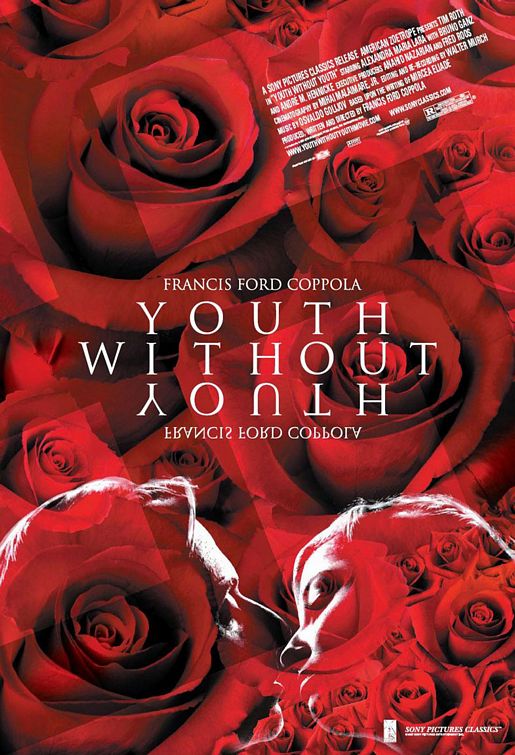
It was exactly five weeks between when I received Youth Without Youth in the mail and when we finally watched it on Saturday.

My wife and I both knew the critics had railed against Francis Ford Coppola's movie. But the reason I originally moved it to the top of my queue was that she had expressed some interest in seeing it. Since that made two of us, I knew it would get watched, eventually. Had I had my way, we would have watched it weeks ago -- I like to keep my mail rentals moving back and forth. She, on the other hand, was daunted not only by the expectation of poor quality, but by the running time. It was only just over two hours, but she had it in her head that it was pushing three.

It may just as well have been. When the credits started rolling, I turned to her and said, "You know, that film kind of reminded me of--"

"Shebulba?" she finished.

There's a reason we're married.

"Shebulba" is our nickname for Darren Aronofsky's The Fountain. In The Fountain, Hugh Jackman's character is floating through space on a crop of land enclosed in a bubble, which is dominated by a giant tree. We're never told quite what to make of this tree, but we know Jackman's character is immortal, because we see him as a conquistador, as a doctor fighting to cure his sick wife (Rachel Weisz) in present day, and presumably in the future, when it's possible that the only parts of Earth that remain are him and this tree, floating through space for eternity. At several points, he looks up at the tree, or outer space, or something, and reverentially whispers the following word: "Shebulba." Who or what Shebulba is, we also don't know.

Youth Without Youth was definitely a little too Shebulba.

(Some minor spoilers ahead.)

There's no immortal man or immortal tree, but a 70-year-old Dominic Matei (Tim Roth) does rejuvenate into a man half his age after being struck by a bolt of lightning that basically incinerates his body. Instead of dying, he's suddenly younger, he grows a new set of teeth, and he has the ability to absorb all the knowledge of a book just by passing his hand over it. This is to say nothing of his new ability with languages and his unexplained telekinetic powers. Oh, and did we mention that he now has a doppleganger who may or may not be imaginary? But the comparison with The Fountain really kicks into gear when Dominic's decades-spanning soulmate is introduced. We learn at the start that he loves someone named Laura, and later he meets her -- though she's now known as Veronica (Alexandra Maria Lara) -- just before she's about to be struck by lightning herself. The lightning doesn't have the same effect on her -- instead, it makes her think she's someone living in ancient India, who can speak only Sanskrit. She eventually shakes herself free of the split personality, but only temporarily. Each night she awakens speaking a more and more ancient language. It's an epic love story, these lightning strike victims with their very different powers.

If that last paragraph left you wondering what the hell Coppola was thinking, you're not the only one. (He didn't actually make up the story -- the movie was adapted from a story by Romanian author Mircea Eliade.) I actually found this one more watchable than The Fountain, but not by much.

So it got me thinking which other films are way too Shebulba for their own good. Without any further ado:

1) Solaris (2002, Stephen Soderbergh). Ponderous existential sci-fi movie in which characters may or may not actually be there, and people may or may not actually be having the experiences they may or may not actually be having. You heard me right. I don't know if Andrei Trakovsky's 1972 original was any more clear, nor whether it was even supposed to be. I'm sure there are plenty of people out there who worship Solaris, but I'm not one of them.

2) Mulholland Drive (2001, David Lynch). I'm not sure if it's fair to call David Lynch's films "Shebulba," exactly -- he's got a whole brand of weirdness going on that's unique to himself. But Mulholland Drive deserves the designation if any of his films do, though I may be saying that primarily because the whispered word "Shebulba" reminds me of the whispered word "Silencio" that factors into the ponderous third act of Mulholland Drive. I understand The Lost Highway is pretty Shebulba, but I haven't seen it so I can't attest to that personally.

3) The Tree of Life (2010, Terrence Malick). Okay, I'm cheating a little here. This movie has not even come out yet, so I can't possibly know what kind of movie it is. However, it does involve an actual Shebulba in the title -- a life-giving tree, an immortal tree, something like that. And having seen a couple Malick films and written quite a bit about Malick recently, I'm convinced that he's got a Shebulba in him, even if his films so far have had the kind of surface-level realism that should logically remove them from the Shebulba realm.

4) Lady in the Water (2006, M. Night Shyamalan). There are no time jumps or alternate layers of reality in this movie, but all the discussion of narfs and scrunts and other mythological creatures takes this movie into the same la-la-land of inscrutable ambitiousness as Shebulba. Plus, I like any opportunity I get to dump on this movie, which I consider one of the worst I've ever seen.

A couple films I love despite their potential Shebulbosity: The Cell, Donnie Darko

I'm sure there are more, but all this thinking about Shebulba makes my head hurt too much for a Monday morning. I'd love to hear of any Shebulba films you might like to add.