Showing posts with label twelve monkeys. Show all posts

Saturday, April 2, 2022

A sad explanation for Bruce Willis' choices

Two 1990s action icons may have seen their careers end this week -- one by his own stupid actions, and one by something far less within his control. 

Bruce Willis had taken on the aspect of a laughingstock in recent years, a man so indiscriminate in his choices that he might have appeared in a teenager's first backyard movie if there were a couple thousand dollars in it for him.

But aphasia is no joke, and now we may never see Willis in a movie again. 

It was announced this week that the actor has been diagnosed with a form of brain damage that prevents its victim from being able to formulate or comprehend language. Presumably, that includes the speaking of lines of movie dialogue, and the ability to react to other people's lines of dialogue.

It means he's retiring from the business.

It's a sad day. 

Sadder: Apparently he was really being taken advantage of on set. It was clear he didn't know what was going on, couldn't remember his lines, etc. But they just kept on rolling him out there, making money off him. One might argue they did it to make Willis himself enough money so that he would be set once he could no longer work, but I'm skeptical. 

I can't remember where Willis stands in our good graces outside of the bad movies he's been appearing in, whether he's on the correct side politically (I remember some possible Republican leanings) or whether he's a good guy personally (I remember Kevin Smith hated him on Cop Out). I suspect the undeniable charm and charisma he once displayed had long since curdled into something far more toxic. I could look it up, but today is not the day to do so. 

At the height of his powers, though, what a movie star.

I won't go on at length about him as I might in an "in memoriam" piece -- he isn't dead -- but I did think it would be nice to highlight the top five times Willis' star wattage made a huge difference in a movie. That doesn't mean only that a "big name" was needed for the role, or that being a star was what made his performance in it memorable. I could have just called this "top five Bruce Willis roles" but I don't think that's exactly what I mean either. Maybe it is, you be the judge. 

Anyway, here is the list. 

5. Looper (2012) - This was sort of a comeback for Willis as it followed a long fallow period for the actor -- fallow as in not fruitful, though still as busy as ever. Especially paired with Rian Johnson's heady and intriguing concept, it reenergized our relationship with Willis, and Willis did his part to vanquish the accusations that he cared less and complained more. (I suppose he may have complained behind the scenes, but I didn't hear about it.) It's an interesting role in the sense that there is something sinister about it -- there's a moment of very poor judgment that leads to him committing a truly horrific action -- but it all comes from a place of sorrow, informed by all this foreknowledge of his preordained fate, and the loss of a loved one. Anyway, the performance really works for the film.

4. Twelve Monkeys (1996) - Willis really works well with heady subject matter involving time travel, doesn't he? He really communicates the disorientation his character finds himself in in Terry Gilliam's film, which involves trips through war zones, both actual (World War I) and metaphorical (an insane asylum). It's also a performance that eschews vanity, as he's broken and beaten up and sometimes without any clothes. Especially against a performance by Brad Pitt that's characterized by all its tics, you can appreciate how Willis underplays this material, and you really get a sense of his chemistry with Madeleine Stowe.

3. The Sixth Sense (1999) - This was not the first "unexpected" usage of Bruce Willis but it continues his ability to pair up with directors with a certain vision. Willis' work with M. Night Shyamalan was truly of the internal variety -- particularly in their follow-up collaboration, Unbreakable -- and Willis played that perfectly in setting up one of the biggest surprise twists in recent film history. (From which Shyamalan himself may have never fully recovered, artistically, as it set him off on the path that has caused us all to laugh at him so much.) This was one of the first times I remember feeling real pathos for a Willis character, which was present in other of his films but overshadowed by a more dominant tone, such as confidence or wise-cracking.

2. Pulp Fiction (1994) - Less than a decade after he even came on the radar for most of us, Willis already felt like a surprise addition to Quentin Tarantino's follow-up to Reservoir Dogs, and perhaps the first example (along with John Travolta) of Tarantino's knack for 70's style stunt casting, where a big name comes along at the end of the opening cast list to really put a spin on your expectations. Butch Coolidge is probably Willis' second most iconic role, though funnily enough, I just had to look up what his last name was. (Do they ever even say it in the movie?) This role may demonstrate more range than Willis has ever displayed in one performance, from the eternal take of Butch quietly listening to Marcellus' speech, to the anger and frustration involved with the loss of his watch, to baby talk with his girlfriend. This, here, is a star.

1. Die Hard (1988) - Number one had to be Die Hard. The best action movie of all time remains one of the all-time best breakout performances for a movie star. Willis' everyday NYC cop, unwittingly transplanted to La La Land for Christmas, is effortlessly identifiable to the audience -- not because we are police officers or would have any clue how to singlehandedly take down a building full of terrorists, but because John McClane handles every new piece of information with exactly the bemusement/frustration that we would feel, and with the ingenuity we would hope to produce. He's the ultimate aspirational character for a certain brand of audience member, who wants to brave in a time of extreme danger but also knows he or she could end up pulling broken glass fragments out of bloodied feet and praying aloud not to die. 

Honorable mention: 

The Story of Us (1999) - This is a personal favorite that I had to throw in there. It's a different sort of role for Willis, where he plays the estranged husband of Michelle Pfeiffer and the father of two kids. They have a trial separation while the two kids are off at summer camp, and the film considers the couple's present, history, and future together during the course of that summer. I suppose it has the contours of a romantic comedy -- which is actually how we first got to know Willis in Moonlighting -- but it's more poignant and contemplative than funny, and I don't think it produces any easy answers, even if it finishes in a way that feels easier than such a real world situation might be. I love this movie for its ultimate optimism, for the performances (Pfeiffer slays me in a scene near the end), and for its attention to detail, particularly a montage of moments from their history set to "Classical Gas."

All six of those movies were movies I had already tagged on my blog and written about previously. Yep, Bruce Willis has definitely been a big part of my cinematic upbringing. 

As one indication of how poor his choices had been, and how much he was being taken advantage of, he doesn't just have one or two roles in the can, as many actors who are taken from us prematurely do. No, Willis has eight movies in the can. Whether any of them will be worth a squirt of piss, or 90 to 120 minutes of our time, is another matter. 

But maybe we'll be ten percent more likely to watch those movies, and other movies he's made in the past decade, just to appreciate him -- and to see if we can see the signs of this terrible affliction. I regret any time I referred to one of his performances as "sleepwalking" through a movie. It now seems clear that giving those performances was extremely difficult for him, even if it was, at some point, the laziness and disinterest talking rather than the aphasia.

But as I said earlier, today is not the day to impugn Bruce Willis, nor to call in to question any of his past choices. Maybe even the right-wing political leanings were evidence of the aphasia. That would explain a lot.

Until they have a cure, fare thee well, Bruce.

Saturday, May 2, 2020

My first actual virus movie during the pandemic

While cinephiles, or just regular people, were flocking to the likes of Contagion and Outbreak way back in the early days of the pandemic -- remember March? -- I apparently preferred my cinematic considerations of our current situation to be more metaphorical, like The Platform and Vivarium.

Well, on day whatever-it-is, I've finally gotten to an actual virus movie.

Twelve Monkeys started percolating around in my brain for reasons I can't remember a week or two ago. It has been 11 years since I'd seen it, and it's also a movie that's lodged in my top 100 on Flickchart (currently #86), so with all the Flickcharting I've been doing lately, I've seen its poster come up a bunch of times. I'd never actually watched the DVD copy I bought a couple years ago, and I decided it was time to see if it really deserves to hold such a lofty position in my personal rankings.

Plus, you know, the whole virus thing.

Twelve Monkeys is not your typical virus movie. There's nary a moment when you see someone succumbing to the effects of the virus, which makes it quite unusual among virus movies you would actually tag with that label. But the virus is one of the first things you hear about in the movie in the opening text. Even if it's more like a background to the movie and an eventuality the heroes are trying to prevent -- even if they kind of know they can't -- it's still essential to what Twelve Monkeys is.

But because the virus is always something either in the characters' past or in their future, Twelve Monkeys didn't specifically scratch a virus itch for me. I enjoyed watching it, though I was a bit in and out, a consequence of it being Friday night after a long week working from home (ha) and, probably more pertinently, of having done a 46-minute run after work ended.

As much as I still like the movie, though, it does seem clear that it's probably not my 86th favorite movie of all time. Somewhere in the top 100 to 200 range -- maybe closer to 200 -- is probably more accurate. And that's another reason revisiting movies like this is useful, as in my future Flickcharting, it might lose to some movies it was previously beating, which will get it closer to that proper spot.

I think part of the reason it scaled to those heights was that it was that particular catnip for a particular type of cinephile: the perfectly timed head trip movie. Everyone has some. For millennials, maybe it was when Inception came out in 2010. For me, at the ripe old age of 46, it was when Twelve Monkeys came out in 1995, not long after I'd turned 22. It was one of them, anyway.

My 2009 viewing probably chilled a little of my affection for the movie, though obviously not enough to knock it down significantly in Flickchart. (I think it may have been as high as the 40s at one point.) My 2020 viewing will probably further contextualize it for me in terms of my actual all-time favorites.

Another reason I'd been interested in revisiting Twelve Monkeys is that I saw the source material from which it was adapted, Chris Marker's La Jetee, two years ago. I probably really needed to watch them back-to-back, though, as now I have forgotten enough about La Jetee to have it significantly inform last night's Twelve Monkeys viewing, just as I had forgotten enough about Twelve Monkeys for it to have meaningfully spoken to La Jetee two years ago. Oh well, opportunity missed.

One thing I did gain from this most recent viewing, in addition to all the things that had given me pleasure previously, was to note how many actors appear in it that I didn't know at the time, though know much better now. For one, two members of the Army of the 12 Monkeys are Lisa Gay Hamilton and Matt Ross, she of any number of films and he of Silicon Valley. Then you've got a young Christopher Meloni as a detective. These people had careers before I was aware of them? How rude!

It was interesting to watch this with an awareness of the cancel culture that has come to surround Terry Gilliam, who has made any number of unfortunate statements in recent years. I won't dredge those up to see if any of them were racially unfortunate, but I couldn't help feel a bit icky about the portrayal of the black characters in this movie. I don't think these were the only black characters, but suffice it to say that there were at least three whose portrayal is problematic by today's standards. For one there is the asylum orderly, who seems to be the Nurse Ratched of this place. He has a ringleader quality to him and seems a bit sadistic, handling Bruce Willis' James Cole very roughly. Then there's the ex-con Cole beats to death, who had been trying to rape Madeleine Stowe's Katherine Railly. Finally Cole has an intense argument with a black female airport worker, who won't let him past. While that's her job, the film makes clear to show how much attitude she gives him. These may have just been accidents, and in 1995 we certainly weren't looking for those things the way we do today, but they don't play so hot 25 years later.

One last thing to report is that this viewing has inspired me to change how I refer to the movie. I had always written the title as 12 Monkeys, and that is indeed how it appears on most of the posters. (You will see I specifically selected a poster where that is not the case.) In the actual movie, though, the title appears as Twelve Monkeys, which must be said to represent the truest interpretation of the intentions of Terry Gilliam et al. It's the same argument as in the case of David Fincher's Se7en, and I finally gave in on that one as well. So I've gone in and changed how I spell it in my various lists. I've even changed the spelling on the tag you see below, which had one previous usage (back when I wrote about La Jetee two years ago).

Now that we are past the initial coronavirus panic -- and have flattened the curve quite well here in Australia, with still fewer than 100 dead in the whole country -- I may no longer feel as compelled to watch a proper virus movie. And with a possible easing of local restrictions as soon as May 11th, the future depicted in Twelve Monkeys seems a little less closer to becoming reality.

Saturday, June 30, 2018

Audient Auteurs: Chris Marker

This is the fifth in my 2018 series Audient Auteurs, in which I'm considering two films per month by acclaimed directors -- or "auteurs" -- whose movies I have never seen before.

It's a busy June in Audient Auteurs, as I am both correcting something I tried to do in February and cheating at the same time.

In February I placed a library reservation for a single DVD that would net me both of my monthly viewings, as you can get Chris Marker's feature length Sans Soleil and his short film La Jetee on the same single disc. It seemed a good pairing for the shortest month on the calendar. But the library told me they couldn't find the movie despite it being listed as in stock at one particular location, and ultimately I had to cancel my reservation to remove the distracting apology in red typeface from my account.

Then, on a random trip to a different branch of the library last week, before I had started watching either of the movies for the auteur I'd initially selected for June (the patiently waiting Agnes Varda), I found the disc in question. Or possibly another version of it. It's hard to say. So Agnes will get bumped to July.

The reason it's a bit of a cheat, though, is that La Jetee is not a feature film. In fact, I have not even entered it into any of my film lists, since I use those lists for only features (and a few shorts that were grandfathered in before I made that rule, like Un Chien Andalou). But the movie is such an important text among cinephiles, especially those who cherish Terry Gilliam's 12 Monkeys (which is a feature- length reimagining of La Jetee), that I made the exception. It's a film I'd been meaning to see probably since 12 Monkeys came out, which was 23 years ago now, and I wouldn't even know who Marker was or consider him a candidate for this series without it.

And his candidacy is certainly supported by the other ways he conforms to our idea of what an auteur is. As the two films I watched are not alike each other stylistically, I have a hard time saying if his auteurism is borne out through his style. But they share a distinct mentality that seems to permeate his work, if I'm understanding him correctly. Marker's films consider the past with a skeptical eye, a sense of fatalism and a preference for montage. They take the literal truth, tease it and prod it and produce a metaphorical truth, as demonstrated in one of his famous quotations: "Rarely has reality needed so much to be imagined."

Chris Marker is not his real name, which explains to me my long-time confusion over the fact that his name does not sound French. He was born Christian Francois Bouche-Villeneuve, and I can certainly understand why that name called out for a pseudonym. He claims to have chosen this specific pseudonym because it would be pronounceable in most languages and he wanted to travel the world. Which he did.

Marker is also classified as a writer, photographer and multimedia artist, and his films, even when they are documentaries, are thought of as essays more than anything else. He's associated with the Left Bank Cinema movement of the late 1950s, and it's easy to see how his films are in conversation with others from that movement, particularly Alain Resnais. (Varda is also considered part of that movement, so I guess we'll be continuing in this vein in July.)

As might be consistent with what we know about him already, Marker was very secretive about his past, refusing to confirm his place of birth despite a number of far-flung rumors supported by some facts, and even his date of birth was not known with certainty (though he appears to have confirmed it as July 22nd, which was also the date in 2012 when he died). He served in the resistance in German-occupied France in World War II, and became a paratrooper in the U.S. Air Force during the war as well, for reasons he probably would also not divulge if he were alive and you asked him. His extensive travels after the war as a journalist and photographer certainly give us context for the second film I'm going to discuss.

La Jetee (1962)

What you probably know is that La Jetee is a 26-minute short film that provided the inspiration, and more or less the narrative structure, for 12 Monkeys. What you might not know, although you probably do, is that it's composed entirely of still photographs. (Well, not entirely -- there's one single insert of a woman blinking her eyes somewhere around the middle.)

The fascination over this stylistic approach should have led me to La Jetee years ago, even if my love for 12 Monkeys didn't. Maybe I just never knew where to get it. The library the other day is the first time I recall being face to face with a physical copy of the movie, and though I could probably find it on the internet, I was never specifically compelled to, since the time of its greatest and most urgent novelty to me was before the internet existed.

I figured I'd be taken with the approach, but only when I started watching did I realize why, or the other movie it reminded me of. As part of my silent movie monthly series two years ago, No Audio Audient, I watched Erich von Stroheim's Greed. Some of the footage of Greed has been lost over the years, but the version I watched, which absolutely blew me away, supplemented the lost footage with still photographs of it that had survived. I don't know why, but the use of still photography felt more profound to me than the moving image might have been, almost like it was an intentional artistic choice. The fact that the camera would pan across the still photo, allowing us to take in parts of the scene individually, gave me a sense of being ensconced in the scene, and also kind of "eavesdropping on history."

I was immediately greeted with that same sensation watching La Jetee, especially in its opening five minutes, which set the scene at the airport -- the same location that bookends the action in 12 Monkeys. Where I was not quite as satisfied as I hoped to be with La Jetee was the part between the book ends. I'm not sure if it was false expectations of what that content would be based on 12 Monkeys, or just a failure to become fully invested on their own terms, but the biometric experiments that cause the narrator to time travel to spend time with a woman he didn't know, in happier times, felt like they could have been more, I don't know, sci fi? We're talking a difference of 33 years between La Jetee and 12 Monkeys, and a very different sensibility between him and Terry Gilliam, but I couldn't help wishing Marker had included some more Gilliamesque elements in these scenes, which are mostly straightforward pictures of a man and woman walking in parks and viewing animals in a museum. Which is patently ridiculous, as Marker is the creator of the content and Gilliam just the interpreter. I guess it goes back to my theory that you often like the first version of a song you hear the best, whether it's the original, the cover, or the dance remix.

I do imagine it was quite profound seeing this movie at the time, as even without any Gilliamesque elements it's pretty mind-blowing in terms of the post-apocalyptic world it presents, and the time travel conundrums that are featured within that world. So I think it's a stunning achievement, but I'll never be able to consider it or watch it outside the context of 12 Monkeys.

Sans Soleil (1983)

We jump forward two decades for Marker's next film, which is equally oblique in its style but in entirely different ways. Movement is key in this film, but narrative is not. In fact, for most of the time I was watching Sans Soleil I could not make heads nor tails of it. Ultimately, I realized that was the point.

It's clear Sans Soleil is an essay in the truest sense of that word, and right out of the gate it reminded me of something like Godfrey Reggio's Koyaanisqatsi, which was actually released only a year before. But I guess I still expected the essay to have more of a narrative backbone than this does. The purported backbone, if Marker were being held down by a studio asking him to justify the budget for his film, would be a study of the culture of Japan and an attempt to view it through a lens of the country's history, pre- and post-atomic era. But it's really hard to get anything quite that concrete from the film. From the almost constant flow of mostly obscure narration, which are fictional letters written from the fictional cinematographer who was supposed to be shooting the movie in question, it's clear that Marker is trying to tease out and toy with ideas of our perception of time, truth and history. Which allows him to do pretty much anything he wants.

And so the film also contains interludes set in Cape Verde, Paris, Iceland and San Francisco, the latter almost entirely in service to a five-minute tangent on Alfred Hitchcock's Vertigo. There is also, quite disturbingly and quite famously (it appears on one of the posters for this movie I did not choose), a scene of a giraffe being shot by hunters. You see it take on the first few bullets and start staggering around, and then when it is finally grounded but not yet dead, you see a hunter shoot it in the head at point blank range. Yep, that's what this movie is about.

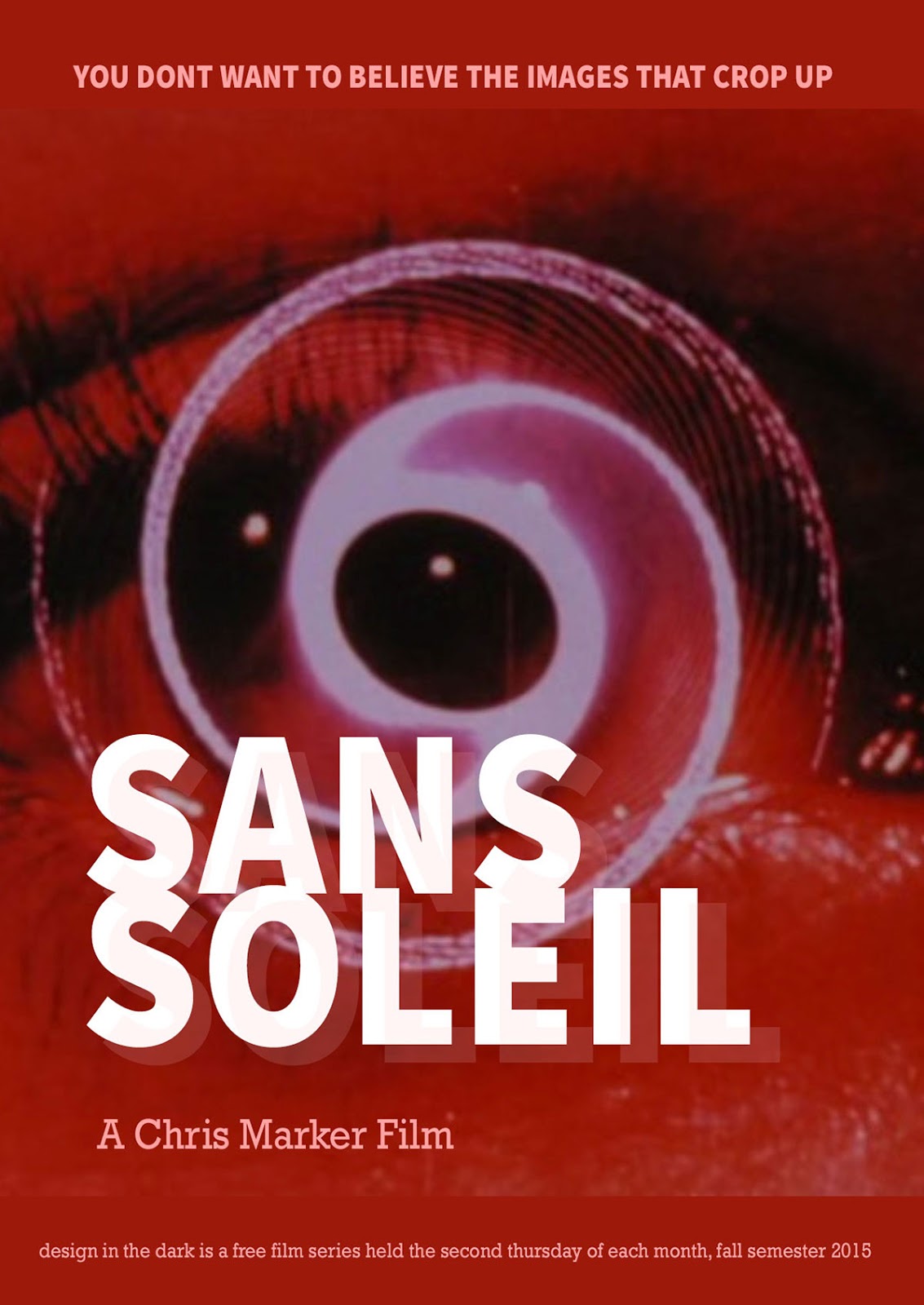
There are also some other fascinating bits that play like montages out of horror movies, such as the image above of the close-up of an eye (I mentioned Un Chien Andalou earlier in this piece, didn't I?) and these terrifying images of Japanese people involved in what looks like acts of voyeurism, one after another until the effect becomes almost unbearable. However, many sections of the film almost feel mundane, showing Japanese women walking the streets of Tokyo in kimonos.

As I said, I didn't know what to make of this, and for a while I was turned off by it. Gradually, I got in step with it and decided that instead of being self-indulgent and disdainful of cinematic conventions, it was profound and immediate. I don't think it's a movie I'm going to come back to regularly, or possibly even at all, but like the films of countryman and compatriot Resnais, it produces a sensation in the viewer that is far greater than the sum of its parts. Just because we can't understand why Marker chose to film what he chose, why he constructed it in the sequence he constructed it, or what most of it means, it does not mean it doesn't have a disquieting and discomfiting effect on the viewer that defies description. The "ecstatic truth" that Werner Herzog seeks in his projects is something that comes through in spades in Sans Soleil.

Okay! Agnes Varda finally gets her turn in July, and pretty soon, as my iTunes rental of Faces Places (which is the second movie I will watch) expires in about 15 days. We'll see if I get some of that Marker sensibility in Varda's work.