Showing posts with label richard kelly. Show all posts

Wednesday, March 7, 2018

The S. Darko of Moon movies

Donnie Darko is my favorite film of 2001, though I didn't actually see it until 2003. Moon is my favorite film of 2009, one I got to crown at the actual time of its release.

Neither film needs or is capable of supporting an expanded universe, though I can see why people would try. "People" in this case being a studio with the rights to Darko director Richard Kelly's intellectual property, and Moon's director himself, Duncan Jones. (Though Kelly did try to expand the Darko universe in other ways in his other films, with poor results -- a friend and I even referred to it as the "Kellyverse.")

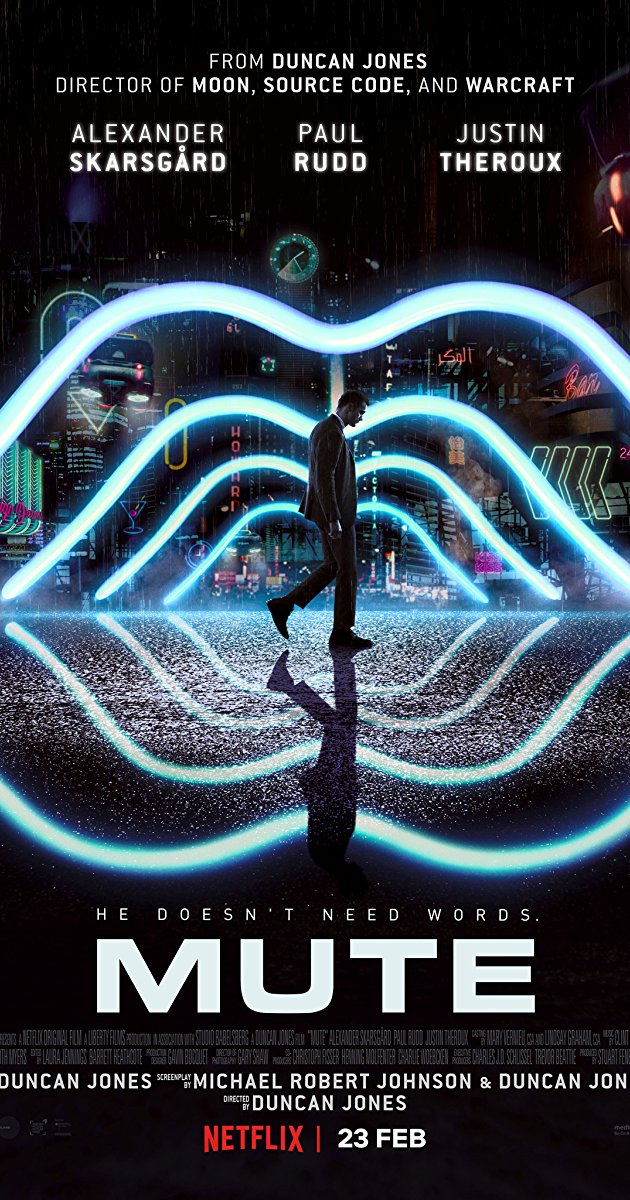
S. Darko -- released in 2009 straight to video -- was terrible. Mute -- the "spiritual sequel" to Moon released in 2018 to the modern-day equivalent of straight-to-video, Netflix -- may be even worse.

Jones was smart not to overburden his new film with references to Moon. In fact, I could detect only one scene that overtly references it, and it's really just a background shot of Moon main character Sam Bell in a courtroom on the news. (I guess that's sort of a spoiler for Moon, but you've already seen Moon, haven't you?)

But that's a level of restraint Jones does not show in any other aspect of this production. The damn thing runs for 126 meandering minutes, introducing us to awful characters in an underworld that's uninteresting. Having to watch awful characters in itself is not an issue, but when the film confuses them as kind of co-protagonists rather than the antagonists they really should be, and then even gives them morally relativistic beefs with each other, then this thing has gone way off the rails.

For all its many, many failings, S. Darko at least had the sense to exist in the same type of world with the same type of unexplained stimuli as in Donnie Darko -- wormholes, etc. It just doesn't do it interestingly, and is of poor quality in almost every aspect of its execution, most notably the acting.

The acting is okay in Mute, for the most part, but Mute's failures feel worse overall, as they are emblematic of a new type of franchising/universe-building to which Netflix is particularly susceptible. We are just coming off the cataclysmic failure of another Netflix original release, The Cloverfield Paradox, which I thought was a contender for my worst film of 2018, even at this early date. That movie was retrofitted to have elements that linked it to an existing cinematic universe, the Cloverfield universe, which itself is already a bit poorly defined, as the second film in the series was meant to exist more as a new chapter in an anthology than one that connects directly to the original Cloverfield. Needless to say, the attempt in Paradox did not work.

Mute is guilty of a similar thing, though it was premeditated and not retrofitted. The actual text of Mute has nothing to do with Moon, as the films are different stylistically and look at entirely different planets (Moon never sets foot on Earth). So the only reason it needs to be part of a Moon universe is to give the film some additional buzz for fans, to give them a reason to see what is otherwise a turd. "Spiritual sequel?" Why, Duncan? Because you decided to stick in one scene with Sam Rockwell in it? With newly minted Oscar winner Sam Rockwell in it?

Moon is full of heart and brimming with a certain type of optimism, despite being underpinned by a certain cynicism related to human beings and their tendencies. How can a movie in which the robot decides to do the right thing not be optimistic?

Nothing but the cynicism survives in Mute, a movie made even worse by the fact that it is dedicated to his father, David Bowie. This is a wretched movie that looks terrible, and its one truly sympathetic character, the character Leo (Alexander Skarsgard) who can't speak, is poorly defined and missing for weirdly large sections of the movie.

It's a waste of my time to continue picking apart Mute, but let's just say The Cloverfield Paradox cannot be my worst movie of 2018 with Mute around.

For Jones' sake, I hope he doesn't go the route of Darko director Richard Kelly, who made one brilliant film and then two awful ones, and now cannot get another movie made. Though Jones' career is on a similar downward trajectory, as his follow-up to Moon, Source Code, was liked by most people but not me, then his next movie, Warcraft, was liked by almost nobody. With two hits rather than one, Jones will probably get a few more lives than Kelly did, but if he keeps making movies like Mute, they will dry up quickly.

Monday, June 23, 2014

One masterpiece and two pieces of shit


It's an exaggeration to call American Splendor a masterpiece ... but not when compared to the two pieces of shit Shari Springer Berman and Robert Pulcini have made since then.

The most recent piece of shit being the Kristen Wiig vehicle Girl Most Likely, which I saw on Saturday night. 

The directing team may have made other pieces of shit since American Splendor came out in 2003, but I haven't seen their documentary Wanderlust, their feature The Extra Man or their HBO movie Cinema Verite. The middle of those three, at least, was reviewed unfavorably.

I can, however, vouch for the shittiness of both Girl Most Likely and their 2007 Scarlett Johansson vehicle The Nanny Diaries.

What I find profound about their filmography is not the disparity in quality between their best film and everything else, nor the quite obvious reality that people who are capable of making good films are also capable of making bad ones. It's the disparity in the ambitions of their movies that strikes me as particularly odd.

How different in purpose is a movie like American Splendor, a quirky indie dramedy that uses a great performance from Paul Giamatti to get inside the head of a unique American personality, and the tween-focused Nanny Diaries, in which a pre-selectivity Johansson awkwardly navigates icky sitcom-style scenarios related to her employment?

And then you've got Girl Most Likely, a dime-a-dozen indie comedy about the most common protagonist we seem to have at the movies these days: the late twentysomething woman who loses her job and her man in the opening ten minutes, causing her to spiral downward in comically dysfunctional ways. Even with the best efforts of Wiig, this is a particularly egregious entry in that genre.

Of course, to blame Berman and Pulcini for the direction of their careers entirely misses the point. One assumes they wanted to make other movies in the vein of American Splendor, but were limited to a smaller selection of movies studios actually deemed them suitable to make. Perhaps The Nanny Diaries and Girl Most Likely were the best of what was left over when other directors with more heat were all squared away on projects.

In considering the larger "one masterpiece and two pieces of shit" model, it's much more useful to blame a guy like Richard Kelly, who has been given free rein on a number of projects with similar ambitions to his original masterpiece, Donnie Darko. It's just that he's majorly screwed up those opportunities. Southland Tales and The Box were incredible misfires that were entirely of Kelly's own doing, though Southland Tales is just odd enough to be worth watching. 

Maybe the real ticket for Berman and Pulcini is to return to the world of documentaries from whence they came. I don't know what it is about documentaries, but they are almost never pieces of shit.

I'll tell you one reason I was glad to see Girl Most Likely, though: It had been since January 12th (Black Rock) that I'd given a movie I'd seen under 2 stars on Letterboxd, and since way back on November 22nd (Only God Forgives) that I'd handed out only a single star. I may prefer masterpieces, but I like my ratio of masterpieces to shit to be a little less lopsided.

This piece of shit was overdue. 

Friday, November 6, 2009

A wonder stuck on one hit


Back in 2003, shortly after I first saw Donnie Darko, I was having a conversation about it with a friend. This was my second friend to show a slavish devotion to this one-of-a-kind film, the friend who introduced it to me being the first. Seeing that others were crazy about it as well helped deepen my appreciation of the cinematic discovery I'd just made.

The name of the director, Richard Kelly, came up, and I asked my friend what the deal was with him. Ordinary name, no previous credits that I was aware of. "I don't know," answered the friend, his voice rising at the end to indicate his own amazement. "He just came out of nowhere I guess."

And so I came to mythologize Richard Kelly as some kind of J.D. Salinger of filmmaking, a guy who had burst on the scene to present us this singular vision, then might just slink back into the shadows of seclusion. I cautiously dared to hope for an impressive follow-up to Donnie Darko, but I almost couldn't imagine Kelly producing anything else. It was like Donnie Darko was so mind-blowing that it could exist as the entirety of his career, and that would be enough. What else was there to say?

And maybe he should have stopped right there after all.

You see, Richard Kelly is as much a flesh-and-blood human being as the rest of us, and his subsequent career choices have each been painful reminders of that fact. The Box, his third directorial assignment, due out tomorrow, does not figure to change that.

But let's take things in chronological order.

1) Domino (2005, Tony Scott). The first time Kelly's name materialized in the credits after Donnie Darko was in this hyper-stylized assault on your senses, a truly vulgar creation designed to glamorize the life of Hollywood princess-turned-bounty hunter Domino Harvey (Keira Knightley). Tony Scott took his worst instincts and turned Kelly's script into a jittery, stroke-inducing strobe light of a movie, which fetishizes violence, cigarette smoking, and pop culture. I blame this turkey more on Scott than Kelly, but mostly because I have Kelly on a pedestal -- the bare bones of his script couldn't have been that good.

2) Southland Tales (2007, Richard Kelly). All the large-scale ideas that got smaller-scale execution in Donnie Darko get driven over the top here. A truly epic mess about a cross-section of truly idiotic characters in Los Angeles of the not-too-distant future, Southland Tales tackles nothing less than Big Brother, terrorism, nuclear holocaust, neo-Marxism, celebrity, alternative energy, drug abuse, the Iraq War, and time travel. Most bizarre is the cast of has-beens, featuring the likes of Jon Lovitz, Cheri Oteri, John Laroquette, Wallace Shawn, Nora Dunn and Curtis Armstrong, with Seann William Scott, Dwayne Johnson, Sarah Michelle Gellar and Mandy Moore serving as the supposed A-listers of the group. It's as bad as it sounds, but I'd be lying if I didn't admit that it occasionally crosses into the territory of "so bad it's good." Will probably be a cult film at some point, but not the way Donnie Darko is considered a cult film.

3) The Box (2009, Richard Kelly). As this movie has not come out yet, I am left only to speculate. But let's just say the ads have not inspired me with very much confidence. The scenario -- "if you press this button, you will be given $1 million, and someone you don't know will die" -- almost sounds chilling. But the ads have inadvertently echoed the terminology of the Saw franchise, as Frank Langella (missing the left half of his face) says the words "Make your choice," echoing the command spoken by Tobin Bell's Jigsaw numerous times throughout that series. What's more, outside of Langella, it's not a very heavyweight cast -- Cameron Diaz and James Marsden have their time and place, but a Richard Kelly mind-tripper doesn't seem to be one of them. In fact, the cast is one of the main elements that undermined Southland Tales, though that wouldn't have been good even with a slate of Oscar winners. To give a couple more first impressions: The footage looks grainy and washed out, and the poster is as generic as can possibly be, befitting an anonymous thriller from the 1980s more than a potential masterpiece from a supposed wunderkind.

4) Other projects. Kelly's name is often heard in connection with Knowing, the Nicolas Cage vehicle that came out earlier this year. He was once attached as director (The Crow's Alex Proyas eventually did the deed), and he is listed as a screenwriter on the film some places, but not others. The confusion is just as well for my current thesis, since I actually liked Knowing. Then there are a couple other films he's produced through his production company, called Darko Entertainment, including World's Greatest Dad and I Hope They Serve Beer in Hell. I liked the former and did not see the latter, but I thought the trailer for the latter looked absolutely terrible (a bachelor party gone horribly wrong -- ho hum). It's funny, in looking up Kelly's credits, I see he is also listed as an executive producer on a film I'm going to be seeing this afternoon, in an advanced screening, called Rogue's Gallery. My wife works for/with one of the other executive producers, which is how we're getting in.

Since there are really only three main films after Darko where Kelly's been credited with a significant contribution -- one of which has not even come out yet -- it may be both premature and unfair for me to go on record as disappointed in him. After all, The Box could just as easily give me those Darko chills again. I should know, from plenty of experience, that films are often much better or much worse than they appear in their ads.

So instead of specifically indicting Kelly, let me just say this: It ain't easy being a genius. You have to keep following up and following up and following up, and any future project that isn't viewed as improving on your body of work, inevitably detracts from it instead. Maybe Kelly will never again make anything nearly so good as Donnie Darko. Since I currently have the film ranked as my third-favorite of all time, I could hardly blame him for this.

Here's hoping that Richard Kelly can settle somewhere in the middle -- that he can stop monkeying around with bombastic, untranslatable visions, in a vein effort to duplicate Darko, and can just be satisfied making solidly crafted movies instead.

Before he was the director of Donnie Darko, Kelly was just a film student at USC, a guy with two short films to his credit. He was human like the rest of us, and can be so again.