Friday, January 2, 2015

Straddling years


I was straddling quite a bit this late December-early January. In this post, I'll let you know about each instance of that -- and also exactly what I mean by "straddling." (Sounds pretty dirty.)

Paddington

I know the storybook Paddington has British origins and is big with British little boys and girls, but it was something that got read in my American household as well. I think there are a lot of other American households of the late 1970s and early 1980s who could say the same.

Yet the release of the Paddington movie is straddling a regrettable line between 2014 and 2015. In the U.K. and Australia, it was released as a holiday family movie, way back on December 11th. In the U.S., though, it won't come out for another two weeks, making it part of the studios' January dumping grounds.

It's unfortunate, because Paddington might have done well during the U.S. Christmas season -- from what I saw of the movie, anyway.

See, Paddington also straddles an unfortunate line between little kid movie and big kid movie. We went to it on December 30th when it was raining in Hobart (Tasmania), scuttling or at least delaying a bunch of our plans. The theater was not set up for the big crowds, apparently, as we barely made it in to the movie on time despite arriving a half-hour early.

My four-year-old sat rapt the entire time, never saying a word and only asking me for an atypically small amount of the Pods (chocolate cookie treat) we had purchased at the concession stand. Then, with no preview whatsoever of his mounting horror, he told me that the movie was too scary and that he wanted to go home. The big finale was already on and the movie would be over in ten more minutes, but he had to go now. And I knew that this is what parents sometimes had to do, so reluctantly, I left a movie before it was over for the first time in as long as I can remember. Is it possible it was the first time ever?

In truth, a pretty charming movie had started to sour on me by that point, and it didn't much matter that I missed the ending because by then it was easy to predict how it would finish. (What movie isn't, you could argue.)

Where it made its biggest mistake -- other than having Nicole Kidman as a murderous taxidermist, that is -- was the false advertising of the poster you see above. Paddington most definitely should have been set at Christmastime, in the snowy London on that poster. In fact, shouldn't every movie set in London be filmed in the winter, making everything look all the more magical? But it's not. In fact, this is how Paddington is being advertised in the U.S.:


What's oddest about this, when juxtaposed with the Australian poster, is that it looks like a summer movie to Americans and a winter movie to Australians. While it is actually summer in Australia and winter in America.

Had they actually set it at Christmas, the studio would have been compelled to release it in December in the U.S., positioning it as a prestige holiday family release and getting the tons of bucks that go along with that. Instead, it's coming out Martin Luther King Day weekend -- the best January release date, to be sure, but still a January release date. Maybe they thought the holiday season competition from Annie and Night at the Museum 3 would just be too stiff.

The real problem for me, with this release date, was that I was unsure whether I should even bother to see it in the theater. Based on interest alone, we'd see it, since we've read the Paddington book to my son upwards of 20 times. It's one of our only stories, in fact, where I've bothered to perfect voices for all the characters. But at a time of the year when I'm packing in viewings for my year-end list, I didn't know if I should properly count it for 2014, since most American critics (with whom I compare and contrast my year-end lists) will be counting it as a 2015 movie.

The decision was taken out of my hands, however, when my wife and mother-in-law worked up a momentum to have me take my son to the movie when the rains started falling. Big Hero 6 was also an available option, but before I knew it a showtime had been identified and a plan was in place. Maybe he would have actually sat through the entirety of that one.

The Trip to Italy

I engaged in a different kind of straddling on New Year's Eve. My wife had made it clear, earlier in the day, that she did not expect to still be up at midnight. This was certainly a first in our ten years of knowing each other ... but it was also the first New Year's we've had two children. (In fact, last New Year's Eve we spent in the hospital, ready to give birth to the second just hours later. Happy birthday, D!)

Having two children has taken its toll on my wife, and since we were out of town and none of our friends were around anyway, she saw it as just another opportunity to catch up on sleep. I'm glad to say that she did awaken for the midnight fireworks, having still been awake for the 9:30 edition, and we watched those together from my mother-in-law's porch, overlooking the harbor. It was pretty magnificent.

So if this were going to be just another night for her, I decided to make it just another night for me -- and queued up a movie on Netflix.

I didn't figure to finish The Trip to Italy before the clock struck midnight, but by starting it around 10:15, I would make it pretty close. Alas, two beers at dinner did their work on me, and I engaged in a nap of maybe 30-40 minutes when the movie was about 20 minutes old. Awakening at around 11:15, I knew that there was no chance I would finish the movie in 2014.

As my New Year's Eve plans have always been more lively than this, I had never previously faced a situation where I didn't know whether to credit a viewing for one year or another. That kind of thing doesn't matter in the slightest to your average person, but to listmakers and their ilk, it can take on greater significance. I keep track of the total number of movies I see each month and each year, and just for the purposes of record keeping, I needed to know whether to file Michael Winterbottom's film under 2014 or 2015.

I normally have a fairly straightforward system for determining on which day I've seen a movie. If I start it before midnight but finish it after, the movie will be credited to whichever day I watched more of the movie. If it's too close to tell, I give preference to the first day. The one clear exception to this is that if I start a movie one day, but then don't finish it until another day and have watched another complete movie in the interim, the movie is always credited to the day I finished it -- even if there are just five minutes remaining. It's not a perfect system but it's the one I'm comfortable with.

Because of checking Facebook and preparing for the countdown to midnight, to the extent that I did so (I watched the seconds tick off for the final minute), I ended up watching less than half of The Trip to Italy before midnight. Yet I wanted very definitely for it to become my 212th new movie of 2014, rather than my first new movie of 2015, because a) it would break the tie with 2005, which also featured 211 new movies, and b) it would tend to deemphasize the fact that, yes indeed, I spent my New Year's Eve watching a movie and doing little else.

But I ended up having more than an hour of the 108-minute movie remaining, and I ultimately had to acknowledge that I'd need to settle for 211 movies in 2014 and get myself going on 2015.

And this is now far, far more than you ever cared to know about how my mind works.

Wednesday, December 31, 2014

A strong year in Australian cinema


I promised you a recap of my Australian Audient series, but I always knew I wanted to combine it with a reflection on movies that were actually released in Australia in 2014. So read on, because that's the very hybrid I've written.

I chose Australian Audient as my 2014 monthly series because I wanted to deepen my appreciation of Australian cinematic history, and begin to commune cinematically with my new country. This in turn seemed to sharpen my awareness/appreciation of the new Australian movies coming out ... especially relative to the scarcity of titles from decades past.

Weirdly, even given the entire history of Australian cinema to choose from, there were only a few titles I had to leave off my shortlist of movies to watch for this series. Granted, many of the classics are movies I have already seen, either on my own or shown to me in the 10 years I have known my wife. But I was still rather amazed at the relative paucity of titles to choose from, especially in places you'd think you'd be able to find them (the local video store, public libraries, etc.). What also surprised me was how relatively recent Australia's cinematic history is. I didn't watch a single movie in the series made before 1980, and in fact, sitting here right now, cannot think of examples of movies made prior to then other than Wake In Fright ... which had to be unearthed even to be rereleased to audiences last year. (I should have rewatched Not Quite Hollywood: The Wild, Untold Story of Ozploitation! before I started the year, but most of the movies featured there are out of print and almost impossible to get your hands on, anyway.)

(Okay, there's also Mad Max (1979) and Picnic at Hanging Rock (1975).)

So that got me thinking about the here and now, and how surprised I was/am at the quality coming out of this country. Or maybe not even so much the quality as the international prominence of these films ... since some of them did disappoint me.

And seeing one after another really interesting, internationally recognizeable or in some other way globally relevant film hit the theaters, I started to gain a sense of paternal pride over my newly adopted home. I started to see Australian cinema as "the little guy" showing up big on the world stage.

The ironic thing about this viewpoint is that now is perhaps the worst moment in the history of Australian cinema to talk about local successes. As my wife, who is very close to all this for her work, will attest, Australian audiences are less interested than ever about shelling out money to see homegrown movies -- a truth rendered indisputable by the anemic box office for these films. She attributes this to the historically limited appeal of the subject matter of Australian movies -- for a while, there were a lot of domestic dramas and low-level crime movies that didn't have high-concept hooks -- but also to the skyrocketing ticket costs. If you have only $20 a week to spend on the movies, are you going to spend it on a movie about Sydney drug addicts, or Guardians of the Galaxy?

Yet I still find the slate of Australian movies released this year, as a whole, to be a really exciting bunch, one that got a lot of international play. Here's just a few of them:

The Rover (David Michod). The post-apocalyptic follow-up from the director of the internationally acclaimed (and Oscar-nominated) film Animal Kingdom. One of my disappointments, but a film that contains a lot of things I like.

Felony (Matthew Saville). An Australian crime drama written by and starring one of Hollywood's rising stars (Joel Edgerton), featuring another rising star (Jai Courtney) and interesting enough to have attracted one of Britain's great living thespians (Tom Wilkinson). The pride goes into overdrive on this one, as I count the director among my friends.

The Babadook (Jennifer Kent). Considered by many to be the best and most exciting horror film of the year. William Friedkin even calls it the scariest movie he's ever seen. Who knew Australians could make horror movies?

These Final Hours (Zak Hilditch). Surprised this did not get an American release, given its gritty take on an arriving apocalypse. I include this here even though it didn't have the international (or local) success it should have, in part because it was such a deft entry into the end-of-the-world genre, and represents a big canvas type of thinking that is often absent from Australian films.

Tracks (John Curran). This feels like a little bit of a cheat as it was directed by an American, but it stars it-girl Mia Wasikowska and deals with a woman trekking across half of Australia on foot. It got a U.S. release and I suppose functioned as kind of a thematic precursor to Jean-Marc Vallee's Wild.

Charlie's Country (Rolf de Heer). Haven't seen this, but know it will be brilliant. Rolf de Heer (Ten Canoes) knows what he's doing, and he brought his latest sensitive look into the lives of Aboriginals all the way to Cannes.

Predestination (Michael & Peter Spierig). This has the polish of a Hollywood movie and stars Ethan Hawke, but has not actually been released in the U.S. yet. Undoubtedly the best-looking Australian film of the year, and it's absolutely massive on the concept front, involving all sorts of time-travel pretzel logic.

Wolf Creek 2 (Greg McLean). As much as I loathed this movie -- and I loathed it -- it is nonetheless a horror franchise that has made a splash internationally. With the exception of something like the Mad Max series, Australian movies are also not historically known for spawning sequels.

The Water Diviner (Russell Crowe). Only just released this week and isn't coming out in the U.S. until April, but it's Russell Crowe's directorial debut, and that has to be worth something in terms of prominence.

I, Frankenstein (Stuart Beattie). Well, it was shot here, and is listed as a joint Australian-U.S. production, but this feels more like a regular Hollywood movie.

There, that's ten. Did I convince you? I'm not sure if I convinced myself.

So okay, let's move on to the portion of this post that explicitly wraps up Australian Audient.

I don't usually go to the trouble to look back on the series I write on The Audient -- or maybe it was just that last year's series, Famous Flops, ended up being such a dud for me that I wanted to leave it behind as quickly as I could. But in the case of Australian Audient, the series achieved such a focus and seeming cohesiveness that I looked forward to each new entry, rather than it feeling like homework. In the rear view mirror, it looks to me like a nice little project I can wrap up with a bow and move on from. (Because if I had to do a second year of Australian Audient, I'd really be scraping the bottom of the barrel for movies I both hadn't seen and could actually get my hands on.)

I don't have too much profound to say in terms of overarching comments, but I did want to note that there was only one film I saw for this series that I genuinely did not like. And even that film was more silly than awful.

So I'll just end by ranking my films and offering the star ratings I gave them on Letterboxd. I don't know, just because.

1. Breaker Morant (1980, Bruce Beresford) - 4.5 stars
2. Rabbit-Proof Fence (2002, Phillip Noyce) - 4.5 stars
3. Strictly Ballroom (1992, Baz Luhrmann) - 4 stars
4. Gallipoli (1981, Peter Weir) - 3.5 stars
5. A Cry in the Dark (1988, Fred Schepisi) - 3.5 stars
6. Phar Lap (1983, Simon Wincer) - 3.5 stars
7. Tracks (2014, John Curran) - 3.5 stars
8. Dead Calm (1989, Phillip Noyce) - 3 stars
9. Mystery Road (2013, Ivan Sen) - 3 stars
10. The Rover (2014, David Michod) - 3 stars
11. Garage Days (2002, Alex Proyas) - 3 stars
12. BMX Bandits (1983, Brian Trenchard-Smith) - 2 stars

Maybe moving to Australia has turned me into an old softie. Haven't spent enough time with Mick Dundee yet, apparently.

Bonus points to Phillip Noyce, the only director who got two movies into the series.

Okay! You are also owed a preview of my 2015 series. So here's what I'll be doing:

I started these monthly series way back in 2010 to help me achieve particular goals. Well, one of my longest-standing film goals is to see all the Oscar best picture winners. I'm still at least 20 short, probably more than that, despite acknowledging this goal as long as ten or 15 years ago.

So in 2015, I will knock a dozen more off my list. My monthly series will be Audient Auscars -- see what I did there? -- and will involve whichever dozen of the following are easiest to get my hands on:

The Broadway Melody
Cimarron
Cavalcade
The Life of Emile Zola
All the King's Men
The Greatest Show on Earth
Around the World in 80 Days
Gigi
West Side Story
Tom Jones
My Fair Lady
Patton
Gandhi 
Platoon
The Last Emperor

And quite possibly the 2014 best picture winner if I don't see it before my ranking deadline.

Okay, so 15 I haven't seen, not 20.

If I manage to get my hands on all of these, I'll only have three (or four) still to watch at the end of 2015. Let's see if I can do it.

See you back here in January.

Tuesday, December 30, 2014

The scariest movie of 1999


Warning: Willow Creek spoilers ahead.

Question: How did Bobcat Goldthwait celebrate the 15th anniversary of The Blair Witch Project?

Answer: He remade it.

Except, you know, not nearly as good.

I had been trying not to hear very much about Willow Creek, the latest from the iconoclastic director who brought us such movies as Shakes the Clown, Sleeping Dogs Lie, World's Greatest Dad and God Bless America (actually, I think that's all the movies he's brought us). What I had heard was that I shouldn't hear any more. I knew it was a found footage movie and I knew it was about Bigfoot (the poster tells you as much), but beyond that I didn't know anything.

From the tones in which it was vaguely referenced on various podcasts, I had a sense it took brave risks that didn't pay off, which suggested to me a kind of formal daring of which Goldthwait is certainly capable. I thought it might start out as a found footage movie, then break down the fourth wall and show the actors involved in the task of making the found footage movie. For example.

Uh uh. It's just The Blair Witch Project with Sasquatch.

Like, it's shockingly derivative of The Blair Witch Project. It's like Bob Goldthwait didn't ever see The Blair Witch Project, and wanted to blow our minds with the landmark idea of a movie where a small group of people gets lost in the woods while making a documentary about a creature from local folklore. Except, he had to have seen it, else he could not have copied its details so exactly.

Now, there's a compliment embedded in my accusation of theft, because Willow Creek is indeed scary at times. There's a long take at about the film's three-quarter mark where the tension and fear build to an almost unbearable crescendo, based only on some unusual noises outside a tent.

But the terror of unplaceable sounds in the woods was one of the key elements that made Blair Witch so unbearable. Goldthwait's approach is nothing new, or if so, it's only new in the sense that the movie's most squirm-inducing shot goes on for something like ten minutes. That actual tingle of fear over the sound of the unknown? That's all Blair Witch.

And the climax of the film? It's so Blair Witch that it hurts. You get a momentary glimpse of something shocking/new, then the camera ceases to have a living operator. And then the credits roll.

What's so irritating about Willow Creek, though, is that its half-hour plus of setup is so frightfully dull that it seems like an intentional choice by Goldthwait. You get our protagonists interviewing some locals to set the scene, and you get some warnings by other locals not to stick their nose in where it doesn't belong, all shot at an amateur distance of more than 15 feet way, enhancing the idea that these people are not professionals (but decreasing the tension). Pretty typical stuff, but it's so incredibly bland that it felt willful, almost spiteful. More generously, it felt like a necessary anti build-up that would make Goldthwait''s eventual act of pulling the rug out from under us all the more shocking.

Nope. It's just bad technique. It's just bad filmmaking.

The idea of someone copying Blair Witch, of maybe introducing it to a new generation of teenagers, doesn't surprise me in the least. When nearly everything is getting remade these days, a movie that only steals the same basic premise of another movie seems fair game.

No, the shocking part is that it's this director doing this. Shall we examine some of the movies he's made previously? (Warning: Bob Goldthwait career spoilers to follow.)

Shakes the Clown is about an alcoholic clown framed for murder.

Sleeping Dogs Lie is about a woman dealing with the aftermath of an impulsive act of bestiality.

World's Greatest Dad is about a father who ghost writes his son's suicide note and other material after his son dies of auto-erotic asphyxiation.

God Bless America is about a middle-aged man and a teenage girl who go on a killing spree of people who behave annoyingly.

In short, Bobcat Goldthwait does not have a conventional bone in his body. So where did this act of utter conventionality come from?

One can only guess.

Willow Creek is not an inept movie. It has moments that will send chills up your spine, and it knows how to milk those moments into a string of moments, even a sustained period of dread. Not just any hack can do that.

And Willow Creek might in fact have been the most frightening time at the movies in 1999, if it had come out a few months before Blair Witch and stolen that movie's thunder. But Willow Creek arrived at a time when found footage is a completely moribund genre, especially those movies where documentary filmmakers go missing during the course of their own investigations.

Bobcat Goldthwait usually feels 15 years ahead of his time. Then how did he get so far behind?

Monday, December 29, 2014

The happy return of an old gadget


Those items appearing down the right side of my blog are called "gadgets" in blogger terminology, and I've just brought an old one back.

You'll notice it under Most Recently Seen for the First Time and Most Recently Revisited, and it's my list of movies I've most recently reviewed.

When I was writing reviews for AllMovie.com, a gig that lasted me from the year 2000 to the year 2011 (with an externally imposed break that lasted from late 2003 to early 2005), I would update this gadget to show you the three most recent movies I had reviewed for the site. I tended to write at least a half-dozen reviews a month, so this gadget was regularly updated.

But as 2012 wore on and it became pretty clear I wasn't going to immediately return to a reviewing gig, I sadly retired the gadget. It was a rough moment, believe me.

Now, though, I'm proud to say it's ripe for revival.

I'm not getting paid to write reviews again. Any former or would-be critic can tell you that ship has pretty much sailed.

But I do have a new gig with an Australian film website called ReelGood, which is reachable at www.reelgood.com.au. It's a gorgeous-looking site that posts all variety of film content. I started out writing lists for them (10 Movies That Changed Outer Space at the Movies was one example), something I intend to continue doing. But the last three pieces I've written have been reviews, and three is the magic number for bringing my Most Recently Reviewed gadget back to life.

Oh happy day.

When I returned from the U.S., I had something unique to offer the site's editor-in-chief, which was that I had seen Birdman and Foxcatcher -- both movies that don't open in Australia until January. He leaped at the opportunity to get up early reviews of them, and liked my writing enough that he quickly began talking about getting me to attend some media screenings, especially while he is on vacation during January. So I may not have any pay immediately forthcoming, but to film lovers, free screenings are a kind of currency of their own.

After I saw The Interview on Christmas and realized it was not yet reviewed for the site, I reached out to the editor and told him I could review it, it being so time sensitive and all. He'd actually caught it as well -- he must also have a VPN that tricks the internet into thinking he's in the U.S. -- but was too "flat out" to write the review, what with his holiday coming up. As it turns out I disagreed with him on the movie, but he was again incredibly happy with what I'd written -- even if he characterized his take as "the exact opposite."

I'm now confident enough in where this will go that it's time to bring the old gadget back.

Except it's not exactly the same as the old gadget. The old gadget was just text, informing you of the film I'd reviewed but not telling you where you could actually read the review. That's because I was keeping my blogger identity hidden under a blogger handle, something I felt was necessary at the time. I don't know what service I hoped to provide my readers by just telling you what I'd reviewed, except that it was just a way to document my activities.

Well, now I've got a much more effective way that's also useful to you. That list is now a link list rather than a text list, meaning it's comprised of links to the reviews. You can see not only what I've been up to, but what I think about what I've been up to. So have at it, readers -- check out my thoughts on Birdman, Foxcatcher and The Interview over at ReelGood.

Me, I'll just bask in the warmth of this warm Tasmanian morning as I look out over Hobart harbor from the deck of my mother-in-law's house. And pretty soon think about updating the blurb at the top of my gadgets, which still says I'm "between gigs."

And wonder, with a tinge of self-satisfied glee, what movie I may be reviewing next.

Sunday, December 28, 2014

Korean Christmas


Korean Jesus is a character in 21 Jump Street. Korean Christmas is something we inadvertently celebrated at my house this year.

First it was watching Snowpiercer, directed by South Korean auteur Bong Joon-ho, on Christmas Eve. Then it was starting the Korean-financed animated movie The Nut Job, which includes an animated version of K-Pop star Psy, to wile away Christmas afternoon with the kids. (I finished it the next morning.) Then finally, on Christmas night, we demonstrated solidarity in our fight against oppressive dictatorships by renting The Interview, perpetrating our own type of "hacking" by using a VPN to convince Youtube Movies that we were actually in the United States.

I've already written about Snowpiercer and I hardly think it's worth spending much of my breath on one of the five worst animated movies I've ever seen, so that frees me up to spend the lion's share of this post on the most buzzed about movie of the past two weeks: The Interview. Before doing that, though, I'll give my standard coincidence disclaimer: We only ever intended to watch one of these three movies within a space of 36 hours, and I didn't even know The Nut Job was Korean until the closing credits.

That's right, we originally had a favorite lined up to watch on Christmas night (Perfume: The Story of a Murder, Anonymous and Elf were all discussed), but then Sony continued a very successful campaign to save face by making their controversial film The Interview available on a variety of online rental platforms. There was no way we were not going to do our share to strike a blow at the heart of North Korea -- and I'm glad to say that we survived the screening without a single threat to our lives.

We were only planning to watch it as a part of an international campaign to thumb our noses at the North Koreans, though. Bad early buzz on the film had convinced us that it wasn't going to be very shrewd or funny. I was excited to see it, but mostly in the same way I'd be excited to get my hands on any contraband material. I wanted to see what all the fuss was about. (In terms of year-end lists, I was also excited to have early access to a movie that won't be available in Australian theaters until January 22nd, meaning I had already written it off for inclusion on my 2014 list.)

And then we both laughed harder than we had laughed at any movie in years.

Seriously, I think I might have laughed over 50 times during this movie. It was one of those instances of comedic syzygy, where every choice Seth Rogen and Evan Goldberg made seemed to be a brilliant one, and the cumulative effect just put us both into a delirium of enjoyment. Oh, this is not highbrow. But it's the best lowbrow comedy I've seen in ages, and it has an overall highbrow rationale behind its existence.

Part of my lowered expectations had to do with a cynicism over Rogen's reason for making the movie in the first place. When I heard that Sony had scrapped the Christmas release of The Interview (but before realizing that they may not release it theatrically at all), I quickly wrote up a reaction that I never published. I'm glad now that I didn't publish it, because the thrust of the piece was that Rogen may have deserved this for making the movie in bad faith. I had this idea that he came up with the idea through a haze of weed smoke as a way simply to fuck with North Korea, because there was nothing they could do about it and fuck them. And so when I learned that North Korea did plan to do something about it, and that something was successful, I honestly though it was part of Rogen's just desserts. Not because I didn't believe in freedom of expression, but because I thought Rogen's motivations were essentially juvenile.

Having seen the movie, I disagree wholeheartedly that it was made on a lark. Rogen and Goldberg clearly did their research. The sets look terrific, and like a good approximation of what the Kim compound probably really looks like. The characters are written with real complexity, as the film does not contain a single two-dimensional bad guy. Kim himself is one of the film's most complicated characters, though ultimately, he is indeed revealed to be a genuine bastard. For a while, though, Rogen and Goldberg seduce us into thinking he could be someone a lot more sympathetic than we assume him to be.

The Interview is a combination of smart and dumb humor, committed performances, and a real sense of political intention.

If you haven't already done so, make this a Korean Christmas season in your household as well.

Friday, December 26, 2014

Polar express


The Polar Express, cinematically, is a largely disappointing and sometimes depressing 2004 film by Robert Zemeckis. It appears in the dictionary next to the term "uncanny valley."

However, in literary terms, it is the wonderful 1985 storybook by Chris Van Allsburg that inspired the movie. It's a painterly beauty whose every page is saturated with steam engines, children in bathrobes drinking hot chocolate, snowflakes, and magic. The story details the travels of a young boy to the North Pole on the titular locomotive, to meet Santa Claus and see him give out the first gift of Christmas. They go through forests and snowy plains and craggy mountains, all to end up at the cheery glow of industrial warmth that is the North Pole. For me, it's Christmas incarnate.

That's because my family has been reading it on Christmas Eve probably since my sister and I were teenagers. Every year when we were all together on Christmas Eve -- even into our adulthood -- my dad would read us the story. I soaked in the magic like a ten-year-old, even when I was a 30-year-old.

I believe I have now read it to my own son each of his five Christmases, even when he was only four months old. This year on Christmas Eve, I read it to two sons for the first time -- the second one crawling around and desperately trying to pull down the lamp.

It wasn't lost on me, then, that my wife and I immediately -- "immediately" meaning about 90 minutes later when they finally both went to sleep -- proceeded to watch the adult version of The Polar Express, otherwise known as Snowpiercer.

Two stories about trains speeding through wintry landscapes on the same evening? What were the chances? We should have watched Transsiberian and made it a triple feature.

I had already seen Snowpiercer in theaters, but my wife missed it, and it seemed of a sufficiently grand scale to make it our Christmas Eve viewing, even though nothing remotely cheery happens in the entire film. Yet you wouldn't call Snowpiercer depressing, either -- it's that strange tonal triumph of which Bong Joon-ho is so often capable.

It wasn't like we specifically scheduled it for Christmas Eve originally (hence the Polar Express alignment being happenstance rather than premeditated theme). We had figured to watch it one of the weekends leading up to Christmas. But part of the reason I delayed it was that I'd purchased us a new version of the HDMI adapter that allows us to watch stuff on my wife's Mac on our TV. The old one crapped out about six months ago, and since Snowpiercer is streaming on Netflix, we'd have been watching it on the computer without that cable. However, it was also fun to make that new cable my own "first gift of Christmas," which I presented to her moments after the kids finally left us in peace.

I don't have a lot else to say, I guess. As the passengers and the locomotive itself are always in distress, Snowpiercer has a lot more in common with the distended movie version of The Polar Express than the placid and lovely storybook. Coincidence is enough of an inspiration, and often the only inspiration, for me to write a post.

The movie does have one comical way in which it is diametrically opposed to The Polar Express, and not just that it's an R-rated movie for adults with tons of bloodshed. While the North Pole is, in a manner of speaking, the only place the train goes in The Polar Express, it's the only place the train does not go in Snowpiercer. Here, check out this route map, as seen in the film:


Oh, and Australia gets the short shrift as well. Hey, that's alright -- the outback is probably a pretty nice temperature on this future snow-covered earth, so those of us down there can just stay put.

I did wonder as I was watching Snowpiercer this time whether someone actually did the math, and determined that a train traveling at this breakneck speed would indeed take an entire year to circumnavigate the earth. Doesn't seem like it would, even with this circuitous route. In fact, if you told me that it would take less than two months to cover this route, I'd believe you.

It's just one of many, many, many ways we are asked to suspend disbelief while watching Snowpiercer. Here are a few others, and watch out for minor spoilers.

1) If everyone boarded the train on the day it started running, at Yekaterina Bridge in Russia, wouldn't all the passengers in steerage be Russians?

2) If the front section of the train is so fancy and has all these rooms of unimaginable excess, where are all the private living quarters?

3) If the train hasn't stopped for 17 years, why does everything in the fancy section seem like it's brand new, and how do they renew all their finite resources?

4) Who catches the ten million roaches needs to make all the protein blocks, and where do those roaches spend most of their time?

5) How do the passengers in steerage have dozens if not hundreds of axes?

6) Why does Wilford's henchman fire through the train's windows at his targets, with a very low probability of hitting his targets but a very high probability of destroying the windows?

And so forth.

So yeah, Snowpiercer definitely suffered a little bit from a second viewing. The thrill of discovering what will happen next, what's awaiting our intrepid heroes in the next car, is clearly key to the enjoyment of the film. Once you know, it's just not as satisfying, and there are plenty of nits to pick if you want to. It's only dropped one spot in my year-end rankings so far, but further position corrections could be forthcoming.

Still, on an Australian Christmas Eve in which the light didn't fade from the sky until sometime after 9 p.m., it was nice to be reminded of the parts of the planet that are, indeed, covered by snow.

Thursday, December 25, 2014

Christmas in July in December


One of the most unusual movies to come out this summer had to be Happy Christmas, which released in the U.S. on July 25th.

As a movie, there's nothing "unusual" about it at all. In fact, writer-director Joe Swanberg would probably wear its "usualness" as a badge of honor, as the ostensible goal of mumblecore films (he helped found that movement) is to depict everyday life.

The unusual part is that a movie with the word "Christmas" in the title came out nowhere near Christmastime. Though they did throw the marketing team a bone by releasing on the 25th of July, which is the informal date of "Christmas in July." (We held our Christmas party that night at my old summer job, I can tell you that much.) The fact that the 25th happened to be a Friday, the traditional release day for new movies, meant they didn't even have to bend over backwards to make it work.

Still, salvaging a gimmicky release date doesn't mean that the move makes a lot of sense from a marketing perspective.

However, it does go with the film's sensibility. Movies about Christmas actually released at Christmastime inevitably carry big expectations ... big expectations that a Joe Swanberg movie was never meant to satisfy. A Joe Swanberg movie was better off being consumed by most of us on Netflix ... and its July release date meant that it was perfectly situated to be watched by most of us at Christmastime.

So my wife and I watched it on Sunday night, December 21st, with our own tree twinkling just off to the left of the screen.

And darn it if I did not enjoy the hell out of this movie.

That wasn't a foregone conclusion. Even though I traditionally love mumblecore -- the Duplass brothers can do (almost) no wrong in my eyes -- I did not really dig Swanberg's last movie, Drinking Buddies, which was (quite surprisingly) the first Swanberg film I'd seen. The characters in that film may be raucous and playful with one another, but there was an essential off-putting quality to them and a lack of warmth in the film overall.

Not so with Happy Christmas. I felt Joe Swanberg's empathy seeping through every frame of this movie. And I wasn't necessarily sure Swanberg had empathy, having watched him as an actor this past year in movies like You're Next and The Sacrament -- both of which I liked (the latter a lot more than the former), but neither of which is what you would exactly call optimistic about humanity.

Happy Christmas gets the humanity just about perfect, and in turn becomes a perfect delivery on the promise of the non-ironic reading of its title. It's not like there's no conflict here, but the conflict is life-sized and believable, and deals with relatable human foibles. Everything is so low-key that you aren't bracing yourself for some operatic tragedy in the third act. It's just a small-scale human dramedy set against a Christmas backdrop, with delightfully intuitive improvised performances from its cast of seasoned pros. (I always love me some Anna Kendrick, and I don't always love me some Lena Dunham, but she worked very well here in a supporting role. Plus, how often do we get to see Melanie Lynskey speak in her native Kiwi accent? Meanwhile, Joe Swanberg is so cool that he doesn't even include his own name on the poster, though he's got about the same sized role as the people he does list.)

Then there's the fact that the movie operated on a very personal level for us, dealing as it does with how to maintain your sense of self and identity while having to adjust your working life following the birth of a child. Both my wife and I have had to deal with that before -- she initially, me more recently. To make matters yet more relatable, Lynskey's character is trying to find the time to get back to her writing -- something my wife has been struggling with, especially since the birth of our second, but even since the birth of our first. Then you've got a woman from New Zealand married to a guy from America, living in America ... well, that was us just 18 months ago, if you swap New Zealand for Australia. So yeah, this was "our movie."

And it made for quite the nice Christmas treat.

For most of you, this will post will publish on your Christmas Eve. That means you still have time to watch it on the 24th or the 25th, since you almost certainly have Netflix, and you may not have already figured out what your Christmas-themed viewing will be.

It would have been plenty delightful in July, but it's all the more so now.

Merry -- make that, Happy -- Christmas, everyone.

Wednesday, December 24, 2014

Frozen indoctrination: End of Year 1


While Christmas shopping one recent weekend and being beset by "Let It Go" and various department store employees dressed up like Elsa and Anna, I came to a rather startling realization:

Frozen has only been with us for a single year.

This movie has been so entrenched into the very fabric of kid culture that it seems hard to imagine it, but last Christmas season, Frozen wasn't even a full-fledged phenomenon yet. In fact, in Australia, it hadn't even been released yet. Disney's big animated features tend to come out on Boxing Day, as is happening with Big Hero 6 this year.

So this is actually only the first Christmas season in which Frozen merchandise has even been an option for Australian children. I'm sure a small amount of it was bought speculatively last year based on the advanced marketing and some positive buzz from the U.S., but this time last year, Australian children didn't know Frozen (the movie about ice princesses and a plucky snowman) from Frozen (the movie about skiers stranded on a lift and being devoured by wolves).

Now, though, it feels like the images and songs from this movie are as familiar to us as the images and songs from The Little Mermaid ... perhaps the last time there was such an unimaginable furor over something released by Disney.

You could argue that Beauty and the Beast was the greater critical darling and The Lion King the more far-reaching overall phenomenon, but in terms of entrancing little girls, nothing beat The Little Mermaid.

So it is with Frozen. Storywise, Frozen has nothing on Tangled or even Wreck-It Ralph. (I can make these broad statements because it's my blog, and in my world, Tangled is The Greatest Animated Achievement of the Past 20 Years.) But in terms of entrancing little girls, even Disney's first recent movie designed to do that doesn't stand a chance.

Adding to that, it's also a Lion King-sized overall phenomenon. Now you see the secret to Frozen's power.

But Mr. Crankypants -- that's me, the Tangled lover -- still can't see what all the fuss is about. The movie has a couple good songs, sure, but even its undeniably greatest scene -- "Let it Go" -- strikes a person as odd in terms of what the movie is trying to convey in that moment. So wait, which bastards have been getting her down that she has to walk away from? And why is she dressing up in her icy winter ballroom gown and walking a runway? Isn't this supposed to be feminism lite?

I never really got into the characters, and I felt there were whole avenues that ended up as red herrings. (Why is there a whole song devoted to cultivating ice when the movie never spends any time on it otherwise? What purpose do those little ogre people serve?)

The failure to see this film's flaws is what frustrates me so much about the collective Frozen brainwashing of our young people. One of the things that makes Tangled so brilliant is its script. There isn't an ounce of fat in that movie, it's so damn tight. Frozen? It often feels like nothing but fat.

But I suppose what frustrates me the most is the fact that the movie's message is being prized above all else in considering its quality. Tangled made the apparently cardinal sin of having the princess interested in a man. Because Frozen is about a bond between sisters, it is viewed as more progressive and a further step away from the long Disney history of which it is supposed to be deeply ashamed. Maleficent and Brave (Disney via Pixar) both push men to the side as well and are lauded for their "I don't need no man" modern sensibilities.

But these are weak stories, especially Brave. Yes, it's about a mother and daughter. But it's also about a daughter who places a curse on her mother that ends up turning her into a bear. Let's not get so bogged down on the forest that you can't see the trees.

So I feel like the collective narrative has been to celebrate Frozen's focus on a sister-sister relationship, instead of a boy-girl relationship, like the one in Tangled. I count my wife as one of those concerned that Rapunzel doesn't have enough of her own agency in Tangled, since Flynn Rider is ultimately the one who chooses to make a (temporarily) fatal sacrifice for her. He is, therefore, "saving" her. These people forget, though, that Rapunzel tried to issue herself a life sentence of servitude to Mother Gothel to save him, only he flipped the tables on her. He who sacrifices last wins, I guess.

Now I'm really straying from my original point. My original point being that here we are, one year into Frozen's reign as The Greatest Animated Achievement of the Past 20 Years, and the blind adoration accorded this movie leaves me a little uncomfortable. This is a lesser cinematic product being celebrated like a greater one, and that's why I fearlessly refer to the cult-like worship of it as an indoctrination.

Closing on a more positive note, though, I will say that we owe Frozen for one of the funnier moments on our recent trip to the U.S. It was night 2 of the trip and we had just landed in Boston, where we would be picking up a rental car and driving out to my mom's house in Bedford. After we signed the paperwork and headed out to choose from about a half-dozen options (and when did this weird kind of inexactitude become normal practice when renting vehicles?), my son inexplicably ran ahead of us, turned around, and screamed:

"LET IT GO! LET IT GO! DON'T BOTHER ME ANYWAY!"

It was an awesome release that really punctured the stress. We laughed and laughed and continued to mention it for the rest of the trip.

And I kind of love that he got the lyrics wrong in such a funny way.

Take that, Frozen.

That's one kid out there who isn't fully under your spell.

Tuesday, December 23, 2014

Hiding the evidence of my addiction


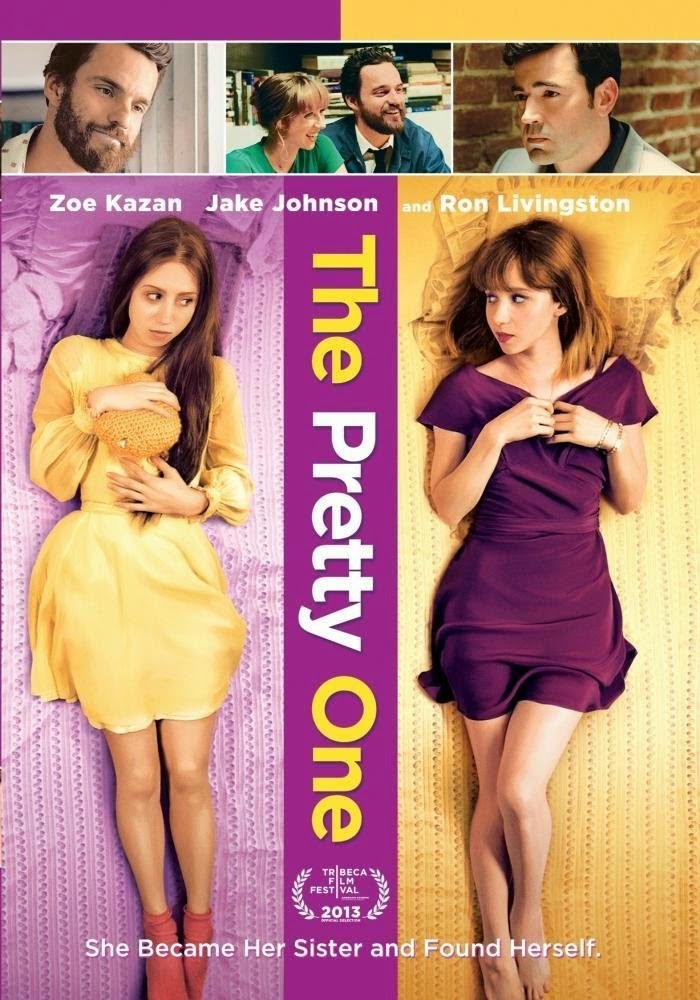
I spent parts of Sunday and Monday nights watching the Zoe Kazan vehicle The Pretty One, but I might as well have been watching hardcore pornography.

That's just how much I kept the viewing hidden from my wife.

It's not that I am ashamed of this movie in particular, or the quantity of movies I'm watching in general -- though my wife does give me shit about that last one, particularly this time of year. Rather, it's that I sometimes don't want my wife to know what lengths I've gone to in order to feed my addition. (Though she's finding out right now if she cares to read this.)

See, I only rented The Pretty One because I stopped by Video Ezy in Flemington on Saturday afternoon on my way back from the mall, where I was doing some last-minute Christmas shopping. And the only reason I stopped by Video Ezy was because I wanted to see what options they had physically sitting on their shelves, as I plan for the final stretch of my 2014 viewing season.

Not, probably, a reason to delay my return to help my wife with my older son, the bigger handful of the two, especially as they were involved in a cookie-making ordeal, the true magnitude of which I didn't know until I got home.

I did have my younger son with me, so I was doing my share of the babysitting in addition to some much-needed shopping that helped my wife as much as it did me (two key presents for her family were obtained on that trip, as well as a couple big ticket items for our older son). But as my one-year-old is far less demanding, especially when he can take in all the sights and sounds of the outside world, I felt a little bit like I was on a break, and extending that break by 15 minutes in order to hop off the tram and scan a shelf of new releases.

So, needless to say, The Pretty One had to be kept hidden like an illicit stash of dirty magazines.

I started by hiding it on my shelf in our bedroom, but then realized that I might want to start watching it at a time when I could not discreetly extract it without her noticing. So then I moved it to a higher shelf in our bathroom, where it stayed until I started to watch it on Sunday night -- making sure to give my wife a 20-minute buffer after she already said she was going to sleep. And when I couldn't finish it that night, I made sure to return it to that bathroom shelf, so that its existence would continue to go undocumented.

All a bit absurd, you will agree, but I need to maintain the fiction with my wife that I am only sort of movie crazy, not full on.

It's not the first time this fall that I've kept one of my rentals totally hush hush. I did the same for Life After Beth and Lucy, mostly because both of those were also situations where I had to go out of my way either to rent them, or to return them. Wanting only to avoid the momentary discomfort of my wife shaking her head and giving me one of those "you'll never change" expressions, I kept the movies secret.

The reason that's even more ridiculous is that my wife had already seen Lucy (on the plane) and was recommending I see it. So instead of actually notifying her at the time I watched it, we'll just fast-forward to a time when I will magically have already seen it, and the exact circumstances of my viewing will seem unimportant to her.

Oh, the things we do for ... love? Is that accurate? Or the things we do just to keep the peace?

Anyway, my wife is indeed supportive of this addiction, for the most part. She didn't even give me a hard time when I sent her an email with a list of titles I am trying to watch before January 15th, so she could select the ones she wants to watch with me. Perhaps that's only because I tried to steal her thunder by writing things like "low priority!" and "I know you will laugh at me, but ..."

In truth, doing this is just practical. There will be some remaining 2014 movies that she will really want to see with me, and it's useful for me to know which others I can just rent and watch after she goes to sleep.

I assumed The Pretty One was one of the latter, and that what she doesn't know I watched won't hurt her.

The funny thing is that even if she saw me watching it, her mind would not immediately go to "You rented this while you were supposed to be coming straight home from the mall, didn't you?" If she even cared to ask -- if she even bothered to make a comment about the fact that I was watching something -- where or when I got it would not be the kind of thing that would interest her. I'm hiding the movie from an imaginary clone of myself, not the actual person who is my wife.

Tonight I will mask its return to Video Ezy behind a trip to rent The Babadook, which she has already seen but which she is keen to rewatch with me. Shortly after renting The Pretty One I made sure to firm up our plans to watch The Babadook on Christmas Eve Eve, so I'd have reason to go to Video Ezy regardless.

Jeez, with this level of scheming, it's a waste that I'm not addicted to something that's actually harmful.

Monday, December 22, 2014

The indefinite article


I did not like Le Week-End. Let's get that out of the way at the start.

But instead of bagging on it from the get-go, today I'm coming back to struggling with something that I don't think I've actually written about previously, even though it bothers me from time to time:

How to alphabetize movies with foreign titles?

I struggled with this most recently when I watched L'Atalante, not knowing whether I should put it under L or under A. Translated to English, the title is The Atalante (it's the name of a boat), which would always be alphabetized under A.

However, I was uncertain enough with that decision that I put it to the Flickcharters group on Facebook. One guy came back with what I thought was a convincing argument. He said that libraries alphabetize foreign titles by the first letter that appears, even if it is an article, because they don't assume their English-speaking customers understand any language other than English. If you had no idea how French worked as a language, you would certainly look for L'Atalante under L, not A.

I bought that. But then I watched Le Week-End and I doubted it again.

The title is The Week-End. Then why am I alphabetizing it under L? I wouldn't alphabetize it under T if it were in English. And complicating matters further, it's not even a foreign film. It's an English language film that takes place in Paris.

The uncertainty goes way back. I watched El Mariachi sometime in the mid-1990s, and always alphabetized it under E. I knew that El meant The, of course, but my argument was that there was something essentially iconic about the title: EL MARIACHI. Like, if there were some lesser-known Spanish language film called El Orso (The Bear), I wouldn't consider it an iconic title and therefore would just file it under O.

But then El Mariachi's alphabetization got directly challenged by El Topo, which I saw a couple years ago. (And yes, you'd really think I would have seen a movie whose title started with El sometime between the mid-1990s and a couple years ago, but I don't recall having this debate with myself once in the interim.) El Topo is a probably more iconic title than El Mariachi, but I was less familiar with it, having never been around to watch midnight movies in New York in the late 1970s. This one seemed like a clear-cut case of needing to be alphabetized under T.

As I sit here and type this, I am not actually sure what I'm doing with these two movies right now. Let me go and check and I'll be right back.

I guess the grandfather clause applies, because I added El Topo as Topo, El but left El Mariachi as El Mariachi.

French titles have all followed the El Topo model ... with the exception of L'Atalante. For example, La Boum was once filed under L, but the last time I revisited this question, I recategorized it under B.

The question then becomes: Why do we translate some titles and not others? I might as well call La Boum The Party in my records, but I don't. That's because it was introduced to me (in French class, no less) as La Boum. I have thought of it as such since. (For a fuller discussion of this topic, see here.)

I think I would be okay with either methodology if I could just pick one and stick to it. But apparently I can't, which is the most frustrating part for an anal-retentive listmaker by myself. I just can't categorize L'Atalante under A and I just can't categorize Le Week-End under L. Is it just the fact that the L has an apostrophe, and it looks too funny to write Atalante, L' ? (It's so funny that I had to leave a space after the apostrophe just so I could distinguish it from the question mark at the end of that last sentence.)

One thing is certain: Le Week-End is no good under any taxonomy. It's Le Merde.

Truth in advertising, though: It took me almost a whole weekend to watch it. I started watching it admittedly too late on Thursday night, and internet problems prevented me from making the progress toward finishing it I needed to make. I had only 40 minutes or so left to watch on Friday night, but caught only 20 more before I was done in. I managed to finally finish it after midnight on Saturday.

I suppose I should tell you what I found so objectionable about it: the incredibly mercurial nature of Lindsay Duncan's wife character. You get that Jim Broadbent may not have been a perfect husband to her, but also that he always tried, and is probably guilty of being an eccentric old goof more than any actual sin. Yet her behavior toward him is consistently inconsistent. One minute she's looking at him with absolute disdain, the next she's laughing and flirting, and the next she's talking about divorce. It's maddening, and the film's lack of any forward momentum in other respects just makes it feel incredibly tedious. By the time Jeff Goldblum shows up as an annoying third wheel of sorts, the whole thing has become Une Catastrophe.

But would I file that catastrophe under U, or C?

Sunday, December 21, 2014

Under the Skin under the stars

The Rooftop Cinema in Melbourne is something I've been hearing about for years -- long before I lived here, in fact. My wife made a reference to it as long ago as our 2009 visit -- or was it our 2007 visit? -- but once we moved here, I managed to forget I ever knew it existed.

So it was with great pleasure on my part that she revived it as a date night option when discussing what we'd do when her sister babysat our kids on Saturday night. Lately she hasn't wanted to spend precious date nights on going to the movies, thinking them a poor use of our adult time, so that was a plus as well.

Our other option would have also been interesting, and will surely be the topic of an upcoming post: the Moonlight Cinema, which is in the botanical gardens and is more like the cemetery screenings we used to attend in Los Angeles. They were playing Big Hero 6 -- a preview of Big Hero 6, which doesn't open here until Boxing Day -- on the same night.

But the seductive pull of the Rooftop Cinema, with its chance to fulfill long unfulfilled (and long-forgotten) yearnings, was too much for me, even though I had already seen Under the Skin, and I usually use this time of year to focus on new viewings. She hadn't seen it, and I'm glad to say Under the Skin is a movie I want to share with people I love. (I also made a fairly convincing argument that if she envisions a date night as a time to be away from children, she hardly wants to go to a screening of Big Hero 6, which will be packed with them.)

Late-year rewatches also help me settle on a final resting place in my rankings for movies I really like, and I was keen to determine whether I just really like, or actually love, Under the Skin.

We started off with dinner across the street at a dumpling place -- mmmm -- and arrived at the top of the Curtin Building on Swanston street about a half-hour before the 9:30 start. (And remember, it's summer here, so 9:30 is about as early as you can be certain there won't be too much light in the sky.)

I thought I'd top this post with the only picture I took there -- the view from our seats -- but this one from their website gives you a much better idea what the whole venue looks like:


As soon as we got there, I realized my wife had been the smart one when she brought a jacket with a furry hood. I'd scoffed at this outerwear when we were leaving, paying more attention to the season than the actual temperatures (and the actual expected temperatures at night on a seventh-floor rooftop). I did have a lighter jacket with me, but suffice it to say we did indeed "hire" a blanket for $5. (In the interview, the blanket did a convincing job describing how it had warmed other people in the past, so it got the job).

By the time we took our seats, we could scarcely stay in them, filled as we were with that "kid in a candy store" mentality of what we would eat/drink first. Really, it was the drinks that had us in a minor tizzy, because we quickly determined that the burger and fry place below and to the left of the screen would be serving us up some french fries. (We had envisioned getting a dessert, but the lack of those options and the need for something warm quickly converted us to a dose of fried food to bolster our regrettably small number of dumplings.)

Off to the lower left of the picture you see above, there's a bar, with all manner of beer and cocktails. Having passed an up-scale Mexican restaurant as we ascended to the roof, I had margaritas on the brain, but my wife had sussed out a pale ale when she concluded that margaritas were too dear at $17 a pop. I agreed, but then disagreed with her assessment of the price. She must have viewed the second digit incorrectly, because margaritas were only $12, which we both deemed viable. When I came back with the two drinks and the blanket a few minutes later, she had our fries. I experienced a moment's regret when it seemed certain we would finish the fries well before the start of the movie, but in fact, the last scraps sustained us until about the movie's ten-minute mark.

As for Under the Skin itself, I felt about the same toward it, and perhaps a smidge less enthused if anything. After it was over, I told my wife that it was probably the movie I admired the most this year without actually loving it, and the second viewing confirmed that. That still puts it pretty high up on my list (actual spot to be revealed in about three weeks). My wife ... well, she's a mother who started the night with a margarita, so she admitted to struggling to stay awake and feeling like the movie had kept her at arm's length. Also a very valid reaction to Under the Skin. She did have lots of very complimentary things to say about it, though.

And as suggested in the title of this post, the stars did soon assert themselves against the darkening sky, and the effect was pretty damn magical. Perhaps even more magical, though, was something that was also really ghastly to think about ...

Okay, go back to the picture above ... see the lighted spire protruding from the top of that building about 2/3 over to the right, the one immediately to the right of the tallest building? About halfway in I noted that there were several hundred creatures flying in the air above that light, bathing in its warmth like moths. At first I thought they were moths, except that if they were, we would never have been able to see them from so far away.

Know what they were?

Bats.

If anyone ever told you bats could not be beautiful, they apparently weren't sitting on top of a roof in downtown Melbourne on December 20th of 2014.

Thursday, December 18, 2014

Deleting the internet


Men, Women & Children spoilers to follow. 

During the first half of Men, Women & Children, I was already mentally composing a post in my Facebook film discussion group which would read "Most unfairly maligned movie of the year: Men, Women & Children."

Then the movie went on a half-hour too long, and culminated in three instances of parents "deleting their children's internet" within about ten minutes of screen time.

Now, the biggest obstacle faced by movies with interweaving narratives is how to reach a satisfying climax that does not rely on a tragic or overwrought resolution to each story. Last year's movie Disconnect, which explores similar issues of "how we live in the internet age," was a particularly egregious offender in this regard, as there was literally a montage of three simultaneous instances of violence at the climax of the three main storylines.

Men, Women & Children does not go that far ... it seems to have consciously styled itself as a more life-sized entity. However, it does reveal itself as somewhat absurd when, consecutively, the following three things happen:

- Security fascist Jennifer Garner discovers that her daughter has been hiding a Tumblr account from her in which she wears wigs and says things without her mother censoring her, and she subsequently deletes everything on her daughter's desktop and changes all of her passwords.

- Divorced dad Dean Norris reads comments posted by his son's internet acquaintances on a World of Warcraft type game, about having sex with the mother who abandoned them, and promptly deletes his son's player account.

- Misguided mom Judy Greer learns that her teenage daughter didn't get accepted into a reality show competition because the website containing pictures of her daughter strays too close to child pornography, and she takes down the website. (A website where the mom herself was the primary photographer, mind you.)

Um, gee, Jason Reitman -- do you think the solution to all the world's problems is parents getting more involved in their children's internet use?

It's not quite as black-and-white as that, because the first two of these actions are ultimately portrayed as the wrong move to have made (Garner learns she isn't letting her daughter just be a teenager, and Norris' son tries to commit suicide). But the message that the internet has compromised our collective humanity rings loudly indeed.

And I suppose that's why this movie has been maligned. The similarity of the resolution of these stories stuck in the craw of even someone like me, the rare person who has positive things to say about the movie as well.

So, let's devote a paragraph to some of those positives. For starters, this movie is not nearly as overwrought as I thought it would be. Reitman seems to have heeded certain lessons about previous films that delved into this type of subject matter, but failed to heed others. However, the lessons he did heed result in this movie having a lot more nuance than you might think, both in its view of the world (there are almost no purely villainous characters) and in its execution of the drama (the actors and the dialogue are both better than they might need to be). The movie also has one of my favorite soundtracks of 2014.

It was looking up the soundtrack on iTunes afterward, though, that made me realize an irony about Men, Women & Children -- I didn't actually need to go to the theater to see this movie, as it was already available, you guessed it, on the internet. In fact, it didn't even bear the typical iTunes new release rental price of $5.99 or $6.99. I could have rented this movie for a mere $3.99 in standard definition.

I think this says something about just how much this movie came and went. Having seen the trailer months ago, I had this movie on my radar for plenty of time. Yet I didn't hear anyone talking about it in the U.S. when it was released -- the substantial negative buzz originated from its screening in Toronto in September. I thought it wasn't due in theaters until Christmastime, and then one day I realized it had already come and gone (making fewer than $1 million in the U.S.) and was playing here in Australia without much fanfare.

The reason I chose it on Tuesday, for discount movie night at the Sun Theatre in Yarraville, was because it was the movie I most wanted to see that was not already available from iTunes (or so I thought). You see, we find ourselves in a weird time of the year in Australia, where the holiday releases are just out of reach, and some of the stuff that's hitting theaters now is also debuting on video in the U.S. Other contenders for a discount night movie included things like The Captive and The Congress, but I knew those could be gotten for half of even the discount price via Apple. I thought I was being smart by grabbing something that wouldn't otherwise be available to me until after my ranking deadline in January, but alas, no.

Well, at least I got one half of a good movie out of it ... and a movie that is, indeed, probably more maligned than it truly deserves to be.