Saturday, March 12, 2016

Let's talk about the Wachowskis


I'm about to tiptoe into a minefield of political correctness, and I'm not sure I'm ready for it.

Whoops! Here I go.

A couple months ago it occurred to me that it must be highly unusual for there to be more than one gay child in any given family. If we are to accept the notion that homosexuals constitute ten percent of the population, which is pretty much agreed upon at this point, and that homosexuality is a biologically determined rather than socially determined predisposition, which is pretty much agreed upon at this point, then every family with ten children would have one gay child. That also means that there would only be one gay child out of every five families with two children. As usual you have to pick "the right five families" to get those results, since it would be easy to inadvertently select two families with gay children and feel like your statistics weren't bearing out the conventional wisdom. Of course, that's not how statistics work and I am now belaboring a point for no reason.

The point is, most families do not have ten children. In fact, few even have five. So if you're looking at the typical family that has no more than three children, having two of them come out of the closet as gay would seem to be highly unlikely. In fact, depending on their political leanings and personal prejudices, those parents might have long, dark nights of the soul trying to figure out what they "did wrong" or how they contributed to an environment in which their kids might "become gay."

So it would seem even stranger, wouldn't it, for two children in the same family to extend gender and sexual identity norms outward to an even further degree and declare themselves both to be transgender.

Yet that's what we have gotten this week from the former Larry and Andy Wachowski, who now go by the names Lana and Lilly. They're film directors, which is why we're talking about this subject at all on a blog devoted to movies. (And it's now officially time to change the name of the label I apply to posts when I discuss these two, which had been "the wachowski brothers.")

Lana Wachowski has been with us for some years now. Various rumors seeped out at various different times, but by 2008 she had transitioned, and by 2010, the former Larry had started to become widely acknowledged and credited as Lana.

This past week we were introduced to Lilly, who, unlike her sister, decided to ditch the first initial of her birth name and make a full transition of moniker as well as gender. Well, "decided" may be an inaccurate term for what the former Andy Wachowski did. If you read her angry confirmation of being transgender, Lilly was forced to come out to the world by prying journalists, trying to grab hold of the last vestiges of it being on her own terms.

Through one rather startling piece of news, the Wachowskis have managed to throw all our notions of nature vs. nurture completely out of whack.

I call the news "startling" because I can count the number of famous transgender people on basically one hand. In fact, if I want to go beyond Lana and Caitlin Jenner, I have to really think about it. And no, the stars of Tangerine don't count as "famous."

So to get both former brothers, now sisters, of a famous directing pair saying they prefer to be referred to with pronouns that are different from the ones they were born with, is unusual indeed.

Here's where it gets really thorny from the standpoint of political correctness.

Is it really possible for this to be a biologically defined rather than a socially defined choice?

They say that no one decides to be gay, and of course that's true. But it's a bit of a grayer area when it comes to gender. Surely transgender people say, and I believe them, that they always felt like they should have been the other gender, and their transition to the other gender is only a means of correcting biology's mistake.

But could biology really have made the same mistake with both brothers in the same family? Is there no nurture factor at play whatsoever?

I have to wonder.

I don't know how may quizzical opinion pieces like the one I am writing now have been published, simply because this is a very "dangerous" issue -- it's one where if you say the wrong thing, you will be shouted down on the internet and both your sensitivity and your basic humanity will be questioned.

So don't get me wrong. I don't care that the Wachowskis are now sisters instead of brothers. I just wonder how it happened.

The way to approach talking about this is of course from the perspective I have chosen -- the matter of biological likelihood. Whereas extensive research tells us that one in ten are gay, research about people self-identifying as transgender tends to relate more to responses to surveys. And Google tells me that only .3 % of the population identifies themselves as transgender.

So that would mean that in a family that had 300 children, one would be transgender. Or at least, that would be the one that was willing to admit it.

And maybe it's the second part that has more to do with it. Lana was willing to admit it. Lilly wasn't. Or not yet, anyway. Or not to us, anyway. Maybe the number of transgender people who are unwilling to acknowledge their true nature to themselves -- or more to the point, to a society ready to judge them -- is a lot higher.

But still ... two in one family? At least they have two natural-born sisters, Julie and Laura, meaning that "only" 50% of the children of Lynne and Ron Wachowski are transgender. Though 100% of them are now women.

Lilly addressed the apparent unlikelihood of it all in an acidic joke that gets at the larger tone of the letter in which she came out as transgender. She wrote that "my father ... injected praying mantis blood into his paternal ball-sac before conceiving each of his children to produce a brood of super women, hellbent on female domination." I sure hope the aforementioned Ron Wachowski is not one of those aforementioned parents with their aforementioned long, dark nights of the souls.

I don't really know what to conclude. But I also find it laughable to suggest that the former Andy saw what his former brother, now sister, had decided to do with her life and thought that it "seemed like a fun thing to do." I mean, there's loving and admiring a person, and then there's undertaking a radical life change that will put you at odds with a large percentage of the people you meet, and make some of them actually want to kill you.

So the conclusion is: Biology is sometimes a funny thing.

But it also makes you wonder: If we are saying that people have no choice about being transgender, and that means that there is a biological component to it, doesn't that also mean that it's something that could be in a person's genes, and therefore inherited by one generation from the previous one?

It's certainly a question the Wachowskis and their unusual circumstances prompt us to ask. But I also think it's one scientists have looked into and rejected, at least when it comes to homosexuality. Or at least that if it's a gene, it's massively recessive, which is why it doesn't often manifest in the actual sexuality of offspring. (Or the fact that gay people often don't procreate, so they can't pass it on.) If there is an inherited biological aspect to a person's sexuality, I haven't heard about it -- though that could also be because it would just cause too much hysteria among people who blame themselves for "making their child gay."

Okay, I think I better quit before my carefully chosen words start to betray me and I say something that someone interprets as insensitive. Because believe me, I've got nothing but love on the topic of changing genders. I have a good friend whose child is transgender and Tangerine was one of my favorite movies of last year, which I've already seen twice. (And yes, I know this sounds like the "I'm not racist, I have a black friend" argument. But really, I'm not.)

What I do wonder is whether this will have any impact on the Wachowskis' future as directors -- or whether we will be able to distinguish the impact on their careers from the impact of continuing to make expensive movies that don't perform well. Although we really like Sense8, one could argue that the Wachowskis have been failing, at least on the big screen, ever since the first Matrix. While the two Matrix sequels made their money, they were critically lambasted. Some of their releases since then have received slightly warmer reviews (Cloud Atlas), but some of them have been both critical and commercial failures (Speed Racer and Jupiter Ascending). By Andy Wachowski coming out as transgender at the same time as Hollywood having good financial reasons for withdrawing creative control from the siblings, a perfect storm has been created where it will be impossible to distinguish people's moral judgments about them from people's financial judgments.

Well, here's hoping they get to make more seasons of Sense8 (it's been renewed) and that their next movie marries their undeniable vision with something that sort of makes sense and has a lot more box office appeal. Then Hollywood will have every reason to keep betting on them and we can all be happy.

I also hope Lilly Wachowski can be personally happy, given the way she was thrust out into the cold light of day, against her will, into a world that suddenly became much harder for her.

Friday, March 11, 2016

Unsafe


I've been dreading watching Gaspar Noe's Enter the Void again. Dreading it.

Maybe not as much as I've been dreading watching Gaspar Noe's Irreversible again, but dreading it nonetheless.

Ordinarily, if you were dreading watching a movie a second time, the solution would be simple. You just wouldn't watch it a second time.

But that's what makes Noe's movies so unusual. You don't really want to watch them again because of the ways they've unsettled you, but you are also magnetically drawn to them. They're like a drug you know you shouldn't take because it gives you a terrible trip, but there's also something unforgettable about that terrible trip. Something transcendent, even.

Ironically, it was not quite getting this sensation from Noe's latest, last year's Love, that pushed Enter the Void up to the top of my rewatch list, that prompted me to cue it up on Netflix Thursday night.

Love was compelling on a basic level and it was easily recognizable as a Noe film. Its X-rated eroticism was actually pretty sexy, and it goes to the margins of being haunting. But it falls short of the mindfuck that is both Enter the Void and Irreversible, the other of which I will probably now be prompted to watch at some point in the coming months as well. And even ejaculating penises grow repetitive after a while.

I suppose one might argue that parts of Enter the Void grow repetitive, but that's part of their hypnotic charm. "Charm" would be the wrong word, though. Definitely the wrong word. "Spell" is better. "Fever dream" might be even better. "Nightmare" might ultimately be correct.

I won't tell you a whole lot about Enter the Void, mostly because I don't recommend it for just anybody, so selling any particular person on watching it is not my goal. Also, it's worth not knowing exactly what's going to happen to you when you start watching it.

But I'll tell you what happens RIGHT when you start watching it, when the mood is set via the complete credits of the movie assaulting you right off the bat. No, it's not the slow northward crawl you get with most credits. It's a strobing, stroke-inducing blast of information in different fonts of different sizes, different production company logos, different languages, and even probably some hieroglyphs. Then there's the intense, driving music that also pummels you. It's Noe's unique way of preparing you for the shocks to your senses that are about to follow.

Ironically, what then follows is completely different in tone and speed. The movie starts with slow, dreamy POV shots of an American drug dealer living in Tokyo, first as he gets high (and stares up into the swirly colors of the ceiling for about ten minutes), then as he goes to a bar to deliver some drugs to a partner.

And that's when things go really off the rails.

And don't even get me started on that car crash.

What both Enter the Void and Irreversible -- you know, the one with the brutal extended rape scene -- do so well is that they create a feeling that you are unsafe. They are suffused with ominous foreboding, the kind that manifests itself in the score and in all the visuals, the kind that seeps into your skin. Noe's is a dark, sad, violent world, where good people come to bad ends. It's also invigorating and bracing and impossible to forget.

Once I tackle my second viewing of Irreversible -- oh Lord, that rape scene -- I'll need to go back and watch Noe's first feature, I Stand Alone, his only feature I have yet to see. It came out in 1998 and, I understand, is just as hard to watch as his other films, with the possible exception of Love, which may dangle you over the edge a couple times but never drops you.

And for a new Noe film, it'll be quite the wait. Never have fewer than four years elapsed between his films, and it was seven years from Irreversible in 2002 to Enter the Void in 2009.

So will Noe again leave me feeling unsafe, in whatever film he makes in 2020 or 2021?

I'm already dreading it.

Thursday, March 10, 2016

IMDB's outlier


The 50 highest ranked movies by the users of IMDB reads like a typical list of the usual suspects -- The Usual Suspects actually being one of them, at #25.

And then there's the one that comes in at #38, which I suspect most of the fans of the other 49 have only heard of because of its inclusion on this list.

It's Eric Toledano and Olivier Nakache's The Intouchables, a heartwarming French dramedy from 2011 starring mostly people that IMDB's heavily American viewership have never heard of, which would also describe the film's co-directors. Or so we would think it was heavily American, if The Intouchables didn't prove to the exception to that rule.

I myself had actually heard of these directors, as I have seen their follow-up film, 2014's Samba, which also stars the outrageously charming and charismatic Omar Sy. But before yesterday, The Intouchables was one of only two of the IMDB top 50 I had yet to see, the other being The Green Mile just behind it at #40.

In fact, I'd guess most viewers would figure this as a French remake of Brian De Palma's 1987 film, The Untouchables, about Elliot Ness and Al Capone. The two have nothing to do with one another, of course. This is a story of a French billionaire paralyzed from the neck down, who invites one of the least likely candidates for the job -- a Senegalese immigrant with a healthy distrust of authority and a wicked sense of humor -- to be his arms and legs, as it were.

Having now finally seen the movie, I can understand why its broad populism would have earned it a place on this list -- but only just. There are certainly far more effective crowd pleasers that are nowhere near this list, and that were made in Hollywood, seemingly making them far more likely to climb a list featuring the likes of Star Wars, The Dark Knight and The Godfather in the top ten. In fact, its 8.5 star rating makes The Intouchables the fifth highest ranked foreign language film on IMDB, behind only Seven Samurai, City of God (itself an unusual inclusion), Life is Beautiful and Spirited Away (though many were likely to have experienced this last with an English language dub). But even if we narrow it down to French language films based on real-life paralyzed people, I'd like to see The Diving Bell and the Butterfly a lot higher than this.

So what, did a bunch of French viewers just stuff the ballot boxes for what became the country's second biggest box office hit of all time?

Something like that must be the case, but if so, why don't we see that phenomenon occur more with Bollywood films? We already know that Indians represent a powerful voting bloc on IMDB, as more than 44,000 of them engaged in a movement to make a movie called Gunday the all-time lowest rated on IMDB -- not because of the film's astounding ineptitude, but because it had some political affiliations that they found objectionable. Yet their best efforts have only managed to push a nearly three-hour 2009 comedy called 3 Idiots to #113 on IMDB. (For reference, Deadpool is already up at #78).

A little googling might discover the answer for me, but for now I'm just interested in musing about these statistical anomalies. They always fascinate me. Some movies' successes in an open and democratic forum like this are just kind of inexplicable, as are some movies' total failures. At #67, Citizen Kane seems to have claimed a particularly low spot on this list, since it is almost always in the top five of any critics' list of all-time great movies. Though that said, Vertigo -- the current title holder for best film of all time in the 2012 Sight & Sound poll -- is three slots lower than that at #70. If you go four slots lower, you get 1957's Witness for the Prosecution, a film I've heard of but am not even really embarrassed about not having seen. Before clicking on it just now, I could not even have told you its director (Billy Wilder) or any of its stars (Tyrone Power, Marlene Dietrich, Charles Laughton). Who can explain it? Not I.

As I said earlier, though, I can explain the appeal of The Intouchables. It's a warm and fun movie. Still, it's a bit broad and does almost nothing unexpected, other than delivering us an absolutely joyous Omar Sy performance. Given how predictable it is, I gave it "only" 3.5 stars on Letterboxd.

I guess people's love for this movie is one of its intouchable aspects.

Saturday, March 5, 2016

Netflix clues in


A moment passed in our house on Friday night, a moment we thought would be earth-shattering when it finally came, but one we ended up greeting with a shrug instead.

It was the moment we decided we'd probably be giving up our U.S. Netflix account.

Two-and-a-half years ago, when we first moved to Australia, such a thing was unheard of. In fact, our ability to continue using Netflix through a proxy was one of our lifelines that eased our transition from routines that comforted us to a new way of doing things. Netflix, after all, did not exist at all in Australia at that point, and the site was set to function only within the confines of countries where it was actually offered. It was supposed to fail entirely when you tried to access it from Australia.

This was where the proxy came in. The proxy (ours was/is called Hola) tricked the website into thinking we were still in the good old U.S. of A. We streamed as usual and counted ourselves lucky that such a thing existed.

Then in early 2015 (or was it even 2014?), Netflix landed on Australia's shores. We got occasional glimpses of how spare the offerings were compared to the U.S., as discussed here, whenever our proxy was accidentally shut off and we tried to access the site. Each time we breathed a sigh of relief that the use of proxies had not yet been cracked down upon. And the more Netflix encroached into the world market -- do I hear now that it's in 190 countries? -- the less likely it seemed that the company would worry about people illegally accessing the catalogues from other countries. Local customers would just be happy with their local Netflixes, and that would be that.

But then a couple months ago my wife reported reading an article that Netflix was, indeed, planning to crack down on proxies. I pooh-poohed it. I'd believe it when I saw it, I told her.

On Friday night, I finally saw it. Probably a lot longer after they'd started doing it than I thought, which feeds into my larger point.

We'd been continuing to watch Netflix through a proxy, or so we thought, for some time now. But in reality, it appears as though we'd been watching only stuff that Netflix was only too happy to have us watch, no matter what country we watched it in -- Netflix original programming like Beasts of No Nation, A Very Murray Christmas, and just recently, their smart and funny series Love, produced by Judd Apatow. Either that or other TV shows they were offering in both places, like Maron or Parks and Recreation.

On Friday night I finally decided, for the first time in ages I guess, to watch a movie from somewhere down in the depths of my queue. As you can probably tell from the poster above, it was Amy Heckerling's Clueless, which I had not watched since sometime in the late 1990s. (It had come up a couple times in the past week, first when Stacey Dash appeared on the Oscars, then when it was referenced in a podcast I listen to. I guess I saw it as a sign to end my Clueless drought.)

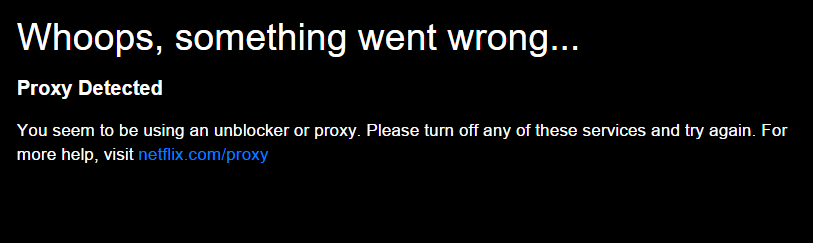
Netflix greeted the attempt with the following message:


I needn't visit the advertised address. I knew what this was all about. But I tried again anyway. A couple times.

When it didn't work, I turned off Hola and saw my Netflix My List shrink radically before my eyes. There were still some decent titles, but not the wealth of options that had just been there.

And not Clueless, either.

Oh well. I hadn't been married to Clueless anyway.

When my wife came through the room again on her way to bed, I reported what had happened and she said, "Oh well. I guess we should stop paying for our U.S. account."

Just like that, we both shrugged and the moment was over.

Just like that, a large swath was cut out of our potential viewing schedule on any given night.

But you know what? It didn't really matter. And here's one of the reasons why.

We subscribe to an Australian-based stream service called Stan, and you know what? Stan has a ton of good offerings. (We also subscribe to something called Presto, which has not as many good offerings but does have the distinction of offering Mr. Robot, which we were watching with increasingly less interest until we stopped two episodes short of completing the season. Presto is not doing well and may go by the wayside.)

Not only does Stan have a really great selection of movies -- most notably having just added Mad Max: Fury Road, which we both want to rewatch -- but we can watch it via an app on our TV, meaning no longer do we have to plug in one of our laptops with an HDMI cable. We can do that with Netflix as well, but the perceived reliance on our proxy had been preventing us, as such an intermediary does not work through the TV.

So as soon as Netflix robbed me of Clueless, I flicked on the Stan app and scrolled through page after page of offerings, just in the comedy category and mostly things I thought were pretty damned decent, until I found an acceptable substitute:

Clueless.

Which I then proceed to watch, and determine that it had not aged particularly well. It's now a 3.5-star film for me rather than a 4-star film, but that's not really germane to this discussion.

What is germane is the symbolism of the passing of the torch from Netflix to Stan, at least in our household. And how little that moment seemed to matter, in the moment. I didn't find what I wanted on Netflix, but without missing a beat I found it on Stan -- and didn't even have to hook up my laptop.

Oh, we'll probably still subscribe to Netflix in Australia. There are still things we want to watch that we can only get on Netflix. Enough of them that it'll probably make a new subscription worth it.

And it'll feel kind of nice to actually be above board, to not fear the nebulous menace of potential legal reprisals, to actually use the app on our TV to connect to Netflix.

And if we want an actual decent selection of movies, we'll always have Stan.

The world is becoming more and more globalized the deeper we move into the 21st century. Sometimes that's not a good thing, but more often it is. And sometimes, when it seems like it's a bad thing, it's really just a thing. And the competition offers you another thing that's just as good or better.

So the next time I'm looking for a little guilty pleasure to fulfill my movie viewing needs, and my selection of current library loans seem just too cerebral for a Friday night viewing, I'll remember Stan's page after page of offerings -- in the comedy section alone.

And I'll remember less and less the time when Netflix was my lifeline in a new and frightening world.

Friday, March 4, 2016

Lost Ark


When I went to see the Coens' Hail, Caesar! last week, I had the odd experience of seeing only a single trailer before the film.

It was odd both for the number of trailers -- the usual total is about three for this theater -- as well as for the film being advertised, which was first released 14 years ago in its native country and a dozen years ago in Australia.

I discovered that night that Alexander Sokurov's Russian Ark was returning to Australian cinemas, for reasons I have yet to figure out despite several internet searches devoted to the subject.

And it reminded me that watching this film is a conquest I started but never completed.

If you haven't heard of Russian Ark, you obviously aren't as big a fan of the long take as I am. Since I was so wowed by the work of Emmanuel Lubezki in Children of Men -- though I suppose it goes back 15 years earlier to my first exposure to an audacious single take in Robert Altman's The Player -- I have considered myself something of a devotee of long, unbroken shots in film. Russian Ark should have been right up my alley, then, as it is constituted of nothing but one unbroken 96-minute take. The shot goes through the Russian State Hermitage Museum and involves 2,000 cast members enacting scenes from Russian history in gorgeous costumes.

Unfortunately, I chose to watch that 96-minute shot starting at something like 10 o'clock at night, something like two years ago. I got through about 15 minutes and never resumed. It wasn't that I was bored, but ... okay, yeah, I was a little bored. Sleep was the dominant obstacle, but boredom definitely factored in.

But I can count the number of films I've started and not finished on two hands, so seeing this trailer for this movie piqued my interests, especially since I couldn't otherwise fathom why it was being re-released on April 7th. (And the internet is still unwilling to tell me.)

One thing I find especially odd about the timing is that the movie boasts itself as the longest unbroken take in cinema history, or at least it was at the time it was made in 2002. As it so happens, an even longer single take is being released to Australian theaters next Thursday -- and this one I have already seen.

It's the 2015 film Victoria, which I meant to devote its own entire post when I saw it late last year, specifically because of the kind of technical feat that usually turns me to jelly.

Victoria, a German film directed by Sebastian Schipper, runs a full 42 minutes longer than Russian Ark on that one single shot. Yes, that means you are watching the same shot, without any edits, for 138 minutes. And it's possibly even more ambitious than (what I saw of) Russian Ark, in that it is not confined to a locked down building in which everything is under the director's control. This shot goes in and out of cars, apartment buildings and bars, up and down streets, up and down stairwells, and who knows where else.

And it was one of the most prominent examples I can think of where a technique that I love and admire this much left me this cold.

It's not coming out in Australia until next week, but I rented it on iTunes back in December based on the much earlier U.S. release date. Not 15 minutes into this story of the titular woman who stumbles out of a bar and gets caught up with a gang of friendly but unstable men who go on a crime spree, I start to squirm, conscious of how long I would be stuck in this movie with this device. Don't get me wrong -- on a purely technical level, it is absolute genius, a feat to be celebrated as one of the greats of the last 15 years in terms of pure degree of difficulty. But as an actual story with actual characters I care about and things I care about happening to them ... it didn't work. And just as I said I felt trapped inside the awful movie Open Windows in this post because of its gimmick of all taking place on a computer screen, I felt trapped inside Victoria, a decidedly better film that just doesn't quite work despite the heroic efforts of its actors, its cinematographer, its other logical support staff and especially its actors.

Fresh off that experience (relatively speaking), I don't know that I'm eager to give Russian Ark another go right away -- though going to see it in the theater would be one way to ensure I didn't yield to a flight impulse. It would also be a way to ensure I spent too much money on it, since I doubt my critics card would be accepted for this special engagement. Plus I think it's still streaming on Netflix, though I may be wrong about that.

I'll locate that lost Ark one day, though.

Wednesday, March 2, 2016

From best picture to worst


Monday was a queer day in the old-fashioned sense of that word, before it had anything to do with a person's sexuality. It was a day we only get on the calendar every four years, a day I have traditionally celebrated (the last two times, anyway) by watching something absolutely god-awful. However, since it was also the same day the Oscars were playing (in Australia, anyway), it was a day where I needed to cram in a three-plus hour awards show as well -- one that we couldn't start until after we put our kids to bed.

Somehow I managed it all. Thank goodness for the earlier recording of the telecast and the ability to fast forward commercials.

It was truly odd to go from the producers of Spotlight accepting the best picture win to watching the opening shitty frames of Manos: The Hands of Fate on YouTube less than five minutes later.

Manos is the third in a grand tradition of February 29th films, joining the Nicolas Cage version of The Wicker Man in 2008 and Howard the Duck in 2012. But Manos created a whole new level of terrible that few if any films have ever matched.

For those not familiar with it, Manos is a 1966 low-budget "horror" directed, written by and starring a man named Harold P. Warren. It gained notoriety when it went under the Mystery Science Theater 3000 lens, its sheer indescribable awfulness having helped it transcend the more pedestrian sort of badness displayed by the other movies that show skewered.

How awful? Let me try to tell you.

But first some "plot."

It involves a "young" couple in a convertible and their daughter (Warren is not particularly "young"), who are trying to find an inn where they're supposed to be staying. They get lost and instead come across a home tended to by an eccentric proprietor who is acting strangely and advises them that he watches over the place "while the master is away." Unable to find their way back, they reluctantly go inside and see a mysterious painting of a man and his ghoulish-looking dog. Ultimately the family's dog escapes outside and is killed, and eventually they discover "the master" and his small clutch of wives, i.e., captives.

The very broad strokes of this story preview something chilling, but all it takes is one second of viewing this movie to realize that it may be the worst movie ever made. Every creative element that goes into the making of a movie is delivered at a Z-minus grade of quality. You could probably argue until the cows came home about whether the photography, the editing, the lighting, the sound or the acting was the worst element of the movie, but the directing is the one element that seems to encompass all of those, so let's just say that this is almost definitely the worst directed movie ever made.

Vance, how many god-awful movies have you seen to make a statement as bold as that?

Not nearly all of them, to be sure. But watching any one minute of Manos -- literally, choose randomly from the entire 68 minutes -- will convince you that it's almost not possible for someone to make a film more incompetently than this one is made. Ten random homeless people could make a better movie than this if they replaced this film's ten most important collaborators.

To call the editing haphazard doesn't even come close to describing the depth of its ineptness. The film is cobbled together from camera angles shot either three degrees to the left or right of the previous shot, played consecutively with each other rather than as a return shot after a cutaway. The camera is rarely if ever set up in a location that makes the most sense for capturing the action, with crucial objects sometimes appearing half out of the frame. Lighting has been applied so indifferently to the proceedings that sometimes it bathes the performers in a blinding whiteness, and other times it is totally absent, so you can't even see anyone's face. And let's talk for a minute about the ADR. Clearly films on this budget would not have synchronous dialogue that you could hear clearly, but the post-dubbed dialogue doesn't even come close to matching the mouths in the pictures. Plus even the silence is noisy, as the soundtrack has a background noise that sounds a bit like air being released from a tube, a constant stream of polluted quiet.

The terrible acting and directing deserve their own paragraph. The best you can say about the acting is that people's reactions are in keeping with the general mood of what's expected of them -- in other words, no one sounds happy when they are supposed to sound sad. Literally any and every other acting sin is committed here, from excessive flatness (that's Warren) to giant, over-the-top scenery chewing (Diane Mahree and Tom Neyman, as his wife and "the master" respectively). What is most odd, though, are the delayed reactions, the two- to three-second pauses after lines of dialogue that would seem to require an immediate response. You can almost see Warren off camera saying something like "Wait ... let it sink in. Pause for effect." Though to be honest, the notion that Warren had any guiding principle whatsoever on how to direct this movie is baffling.

And then there are just the hilarious things that transpire in this movie. I can't mention them all, but there is the repeated sub-plot of another couple who keeps getting harassed by the same police officer while making out in the back of their convertible. For a while I thought this had something to do with the rest of the movie, but I honestly can't figure out what it is. Then there's the supposedly horrific scene where a victim gets slapped to death by the master's crazed wives. I'm not talking about a brutal episode of violent slapping that bludgeons someone to death. I'm talking about five or six mid-strength slaps that somehow result in the victim expiring. There's also the absurdity of the fact that the father carries around a drawn gun for the last 15 or so minutes, even when there are no villains nearby and when he is trying to do things that require the dexterity of his hands, like pick up and carry his daughter. He's pretty damn lucky he didn't accidentally discharge a bullet into her temple. (Spoiler alert.)

What's truly terrible about this giant collection of cluelessness, though, is that it generally does not have the delicious moments of grand spectacle that distinguish other such terrible movies. There's no "You're tearing me apart, Lisa!" (The Room). There's no "OH MY GOD!" (Troll 2). I suspect that if they tried to show Manos: The Hands of Fate as a midnight movie (and I'm sure somebody's considered if they haven't actually done it), I have no idea what would work as the "bring down the house" moments. It's like a slow, trudging march toward an ending that seems like it will never arrive. I find myself wondering how they tackled this challenge in that MST3K appearance that brought the film to prominence. They must have come up with something good, otherwise we probably wouldn't even know about it at all.

The movie is of course fascinating for the simple reason that someone (Warren, I guess) looked at this dailies every day and said "Yup! Nailed it." But let's just say, not fascinating enough for me to ever watch it again.

When I get around to ranking this on Flickchart, I will seriously be considering it for my lowest spot on the chart.

Never too early to start planning for February 29th, 2020, right? Suggestions welcome.

It's a Saturday, so I definitely won't be watching the Oscars the same day.

Tuesday, March 1, 2016

#oscarsnosly


Three nights earlier I had been on a podcast saying that the Oscars didn't interest me much anymore because they contained few if any surprises.

So what a surprise the 88th annual Academy Awards ended up having in store for me Monday night (Australia time). A couple, actually.

Unfortunately, they weren't all good.

If you had asked me to pick any one award that I thought was a total lock, I would have told you it was Sylvester Stallone winning best supporting actor for Creed. Yes, perhaps even ahead of Inside Out winning best animated feature and Leonardo DiCaprio winning best actor.

But it did not happen.

Instead the award went to the deserving Mark Rylance, who might have been my second choice, but a distant second to good old Sly.

And yet again one of the acting performances closest to my heart, the one with at least a 50/50 shot at winning, goes against me.

There are likely numerous examples over the years, but the ones that leap immediately to mind are the losses by Bill Murray in Lost in Translation, Mickey Rourke in The Wrestler (both to Sean Penn, actually), and Michael Keaton just last year in Birdman. All three of those men were the leads in my favorite movie of the year. As it happens again with the secondary lead in my second favorite of the year, I guess I have to cover my ass with an ironic #oscarssowhite and #oscarssomale and #oscarssoold to account for my choices for the performances I most wanted to see awarded.

I'm sure in that same time there have been wins that delighted me just as heartily, but it's the tough losses I remember most. I didn't realize how much I wanted Stallone, who is otherwise not a favorite of mine and historically never has been, to win, until he didn't.

But not all the surprises were bad.

Spotlight taking home best picture made for probably my biggest surprise in that category since Crash sucker-punched us all back in 2005 -- a moment I mentioned in that ReelGood podcast as the last time I was really surprised in general by the Oscars. I'd venture I've guessed the best picture winner correctly in every Oscars since then, even at the times I was desperately rooting for a different winner (The Social Network). So it was a nice surprise to see Spotlight beat out presumed favorite The Revenant, which had the in-show momentum of having just picked up best actor and best director, yielding the spotlight (if you will) to a movie that hadn't picked up an award since the evening's very first (best original screenplay).

What wasn't a surprise to anyone who has marveled at what he can do on a stage is how Chris Rock struck the perfect tone for his monologue and ensuing comments about race throughout the evening. He hit hard, but he hit in both directions, which was an incredibly smart and in itself a bit unpredictable way of handling his predicament. He let Will Smith and Jada Pankett have it even harder than those allegedly perpetrating the racism, to the extent that one wonders if those two will ever attend another Oscars. (Pinkett may not have the option, since, as he so bitingly pointed out, she wouldn't have been invited in the first place.)

The most killer segment that had me laughing hardest was when Whoopi Goldberg, Leslie Jones, Tracy Morgan and Rock himself made their way into parodies of some of the most nominated films, there to exemplify the lengths black actors must go to to get cast in Oscar-worthy films. Morgan brought gales of laughter in drag as The Danish Girl, danish in this case being a reference to the pastry he was cramming in his mouth, but then Rock outdid him as the black astronaut stranded on Mars that two NASA officials (played by Martian cast members Jeff Daniels and Kristen Wiig) would not pay $2,500 to save. "I can hear you mother[bleepers]!" Rock says as they do the cost-benefit analysis within earshot over a satellite video link. "I don't see a black astronaut stranded in space. Do you?" Wiig says to Daniels through winks.

Other general thoughts:

- The scrolling of the thank yous didn't accomplish anything, as many of them ended up being repeated anyway and they just gave the whole thing a cable news network feel.

- Why were only three of the five songs performed? Were the other two nominees too busy to attend?

- As moved as we were all supposed to be by the Lady Gaga song, her gesticulations, vocal or otherwise, were just so wild that I couldn't help cracking to my wife that she was reminding me of Barbra Streisand.

- I didn't get the sense that the black actors and actresses who presented felt they had done some kind of deal with the devil. It seemed to be more or less just business as usual, and that was good.

- More of the comedic banter worked than usual. I liked Ryan Gosling and Russell Crowe going back and forth about the number of Oscars they had between them, and Tina Fey pretending to be drunk was great. Sarah Silverman and Sacha Baron Cohen (as Ali G) proved just random enough to keep us on edge and never know what they might say next.

- I was interested to note a correction of previous awards biases in favor of actresses over actors. Best supporting actor was plunged deep into the program, as many as ten awards after best supporting actress, and best actress came a whole two awards earlier than best actor (broken up by best director). Maybe they thought that in a year they were being criticized anyway, just go for broke and lean male as well as white?

- The only one of Rock's lines of commentary that left me feeling a little funny was the objection to women being asked about more than their dresses, but it did set up his funniest line of the night, which was: "If George Clooney came to the Oscars wearing a lime green tuxedo and a swan coming out of his ass, I guarantee you they'd ask him: George, what are you wearing?"

- Other than DiCaprio, who gave one of the most succinct and poised speeches I've ever seen at the Oscars, the acceptance speeches were pretty dull. And not only because the music started playing most of them to their finish not 15 seconds in.

- That guy who said he may be the first openly gay person to receive an Oscar pretty much has to be incorrect about that. Even keeping in mind the word "openly," I'd say there had to have been at least five others in the last decade alone.

- Dave Grohl's In Memorium performance of "Blackbird" was a highlight.

- Even if their movie didn't win, Alejandro Gonzalez Inarritu and Emmanuel Lubezki set astonishing precedents by winning awards both back-to-back and back-to-back-to-back. I'm not looking this up right now, but I'm kind of wondering if anyone has ever won Oscars in three straight ceremonies like Chivo did this year. Probably Edith Head or somebody. I know for certain that only two other directors have ever taken home back-to-back trophies. Good on them.

- With my own predictions, I was on a roll at the start of the night. I got something like the first seven correct before finally failing to pick Mad Max: Fury Road for the first time when I should have. After that my track record returned to being mediocre.

- Our recording ran out in the middle of the producers' acceptance speech for Spotlight. Oh well.

Okay, now I must go to bed as it is 2:21 a.m. here, and what the hell am I still doing awake.

Monday, February 29, 2016

Insanity incarnate, and other Oscar thoughts


I haven't done my usual amount as a lead-up to the Oscars this year on my blog. In fact, I've done almost nothing.

So I thought I'd get in a couple quick thoughts in case you came to The Audient to prime yourself for this year's awards.

First off, the image you see next to you.

This is an event my friend Ross from my Flickchart discussion group on Facebook is attending. It's at the AMC 14 Georgetown in the D.C. area. (He's currently about to start The Revenant as I type this, but I'm posting it much later than I'm typing it, so you can't read this and still go try and catch the 5:10 a.m. showing of The Martian. Sorry.) That's right, all eight best picture nominees during a 24-hour period, with only short breaks in between. They charge $65 per ticket.

While on the one hand I think he's totally crazy -- especially since he's already seen all the movies, some of them more than once -- on the other it's something I totally would love to do some year. I'm curious how seeing all the nominees in such close proximity would change my thoughts on their respective merits.

I'd also love to be the one programming it. Specifically, the one deciding which films belong in which time slots, and whether that would reveal your own personal biases. Whoever did it this year has done a pretty good job. Brooklyn (the only one I have yet to see) seems like a nice soft introduction to the experience, a film that is totally suitable for a morning time slot. This could also reveal the biases of the programmer, as the first one is obviously the one everyone will be freshest for. The Big Short seems to make a pretty logical follow-up, keeping things at least comedic if not light throughout, then Room hits you with a bunch of depressing shit mid-afternoon. The Revenant keeps you down at that level to such an extent that Spotlight, even though it's about child molestation by Catholic priests, seems like a comparative ray of light. Spotlight is also in what's considered the most traditional time slot for a centerpiece, though as the fifth film it's debatable whether that really matters at that point. Mad Max of course makes a terrific midnight movie (it's essentially the most critically acclaimed midnight movie of all time). Bridge of Spies gets kind of the short shrift I suppose, but one hopes that residual energy from Mad Max would give it something of a boost. Then The Martian, well, this is when you really sleep I guess, if you weren't already doing so during Spies. But being the last movie also gives it something of a position of program prominence. You'll feel like Matt Damon just trying to survive at that point.

I don't ever expect to live in the D.C. area, but maybe one of the theaters will do this in a city where I do live someday.

Michael Keaton vs. his former director

If conventional wisdom holds and this is a best picture race that boils down to The Revenant vs. Spotlight -- though I'm told not to count out The Big Short -- then one of two creative people will be a repeat winner from last year.

Actually, there are probably any number of creative people Alejandro Gonzalez Inarritu used on both Birdman and The Revenant, most prominently cinematographer (and likely three-time winner) Emmanuel Lubezki. But for the purposes of simplicity, let's boil this down to Michael Keaton vs. Inarritu.

Keaton was of course the star and one-time frontrunner for best actor in Birdman, and when he lost to Eddie Redmayne, I at least hoped that appearing in the best picture winner would serve as a nice consolation prize. Now he's up for just the latter prize this year with Spotlight.

Inarritu, on the other hand, won best director for Birdman. If The Revenant wins best picture, it will be the first time in history that the same person has directed consecutive best picture winners. Another best director win would just be icing on the cake, and both of these things might happen, even though The Revenant has earned its share of backlash.

I guess I'm rooting for Keaton to come out on top in this battle.

Although I didn't see Spotlight in time to rank it with my 2015 rankings, it would have been a contender for my top ten for sure. What's more evident as time goes by is that I would not rank The Revenant in my top ten if compiling my rankings today, even as amazing as the movie looks. It got my #9 spot, already falling from the #4 spot where I had initially inserted it after seeing it. Given another week it might have been down around #15 or even #20. I still think it's a very good film, but I also think that at its core, it's pretty empty. As is, though, it's my highest ranked best picture nominee, so I can't say I'd be entirely disappointed if it won.

How we almost didn't see the Oscars

The Oscars will of course play live while we are at work on Monday, so we'll need to stop checking the internet as soon as Sunday at 5:30 PST/8:30 EST rolls around. (Which will be right when my lunch starts, so at least I'll get in some morning internetting).

It airs on Australian TV both live, and delayed to start at some weird time at night, like 9:45. We obviously want to record the live one so we can start watching it with our dinner, though even then my wife might not make it through the whole thing. (She didn't last year.)

But any and all plans came within about 24 hours of being scuttled.

Until around Sunday morning at 9:30, we didn't have any idea why we weren't getting any TV channels on our TV.

Since neither we nor our kids tend to watch much on live TV these days, we hadn't troubleshot it very aggressively. But as the Oscars snuck up on us this year, we realized only recently that we needed to get it sorted out prior to Monday, or else it wouldn't be possible to either record the show or watch its delayed broadcast.

We'd tried restarting our Fetch box, our intermediary device that offers us on-demand and queues of free programming, mostly television shows. The on-demand was working fine, but not the TV channels. I'd also felt to the back of the TV to see if the antenna was plugged in, and it surely was.

By Sunday morning I was really worrying. It was too late to get a vendor involved or to try to replace a malfunctioning Fetch box. I started wondering if the Oscars were the kind of thing you could catch on YouTube, or even buy somewhere on the internet.

Fortunately, my wife -- the real brains of our operation -- had the good sense to check the other side of the antenna, the wall side. It was here that it was unplugged, likely by one of our kids.

Now we have the Oscars set to record and can be fairly certain that they actually will do so.

Whew.

Enjoy the ceremony, and check this space for my obligatory post-Oscars recap. Even though I was slack on pre-Oscars posts, I do (sort of) commit to providing you one of these.

Sunday, February 28, 2016

Should we protect our children from spoilers?


We live in an age of excessive spoiler awareness, whether it comes in the form of trying to avoid having things spoiled for you, or watching your own behavior to guard against the inadvertent perpetration of spoilers.

It's not surprising, then, that these tendencies spill over even into areas that sort of don't make sense, like the example I'm about to give you.

But that doesn't mean I'm even sure that my instincts shouldn't have kicked in to prevent spoilers from reaching their targets.

One of my very best and oldest friends (who will actually probably be reading this) sent us a late Christmas package that we only just opened, more than two weeks after it actually arrived at our house. This friend and I joked about how it was truly telling that it took me two weeks to open a box we'd received in the mail -- not because that reflected badly on me, but because it was in some way a realistic assessment of how busy we both consider our lives to be. (His share of that, I suppose, was sending us a Christmas package in late January.)

We finally set aside a Saturday morning to open the package, Saturday having been chosen as the best possible time for the contents of the package not to distract our kids from another imminent task, like going to school or going to bed. So after morning TV we finally turned our attentions to it.

It was a great and very generous package of five total gifts, only one of which I will focus on today: It was a six-book collection of Little Golden Books, that classic children's series with the distinctive gold spine, with a Star Wars theme. Upon removing the shrink wrap, I discovered that the number of books was no coincidence. Each book contained an encapsulation of the plot of one of the six Star Wars films prior to The Force Awakens.

Great present, right? Especially for little kids with an inborn interest in Darth Vader and stormtroopers?

Yes and no. Don't get me wrong, dear friend who is probably reading this, I love the present. But I can't deny that my first thought upon seeing it was:

"Well, there goes the surprise of the great 'No, I am your father' moment from The Empire Strikes Back."

See, my kids have not yet seen any of the Star Wars movies. It's a subject of some debate in our house. I myself saw the original in the theater when I was not yet 4, so I've got one son who is currently 18 months older than that and has yet to see it. This may tell you what side of this debate I come down on, but I'll admit that I myself was taken aback by The Force Awakens, particularly, you know, that part when that thing happens. You know, the thing. That thing seemed too traumatic for my son to handle -- it was nearly too traumatic for me to handle, and I'm 37 years older than he is. So in that moment I became glad I hadn't succeeded on my plan to binge watch those movies with him in time for us to see The Force Awakens in the theater. (I just binge watched them myself instead.)

But what this does mean is that although my son is quite familiar with the names of these characters and knows some basic traits about them, he still has no idea what actually happens to them. I have thus been preserving these films as surprises to be unleashed upon him when that moment finally does arrive.

That's where these Little Golden Books become problematic.

As they are Star Wars-related content actually aimed at him, he's sure to go through all six within our first 24 to 48 hours of owning them. He'll know that Darth Vader is Luke's father from a little book with a golden spine, not from having one of the late 20th century's great cinematic surprises revealed during an actual viewing.

What I'm trying to tell myself as I prepare for the now-inevitable is that the value of preserving a movie's secrets for a child is pretty minimal anyway.

For one, I'm not sure that he doesn't already know those secrets. We do have a Star Wars book in which characters like C3PO and Chewbacca are introduced, not in story format but with short descriptions and arrows pointing at various features and little infographic boxes that say things like "Did You Know?" That book doesn't spoil anything, I don't think, but what about that little Lego Star Wars video we borrowed from the library a few months back? It wasn't one of the Lego Star Wars movies, and now that I think about it I'm not even 100% sure it was Lego. I think it was a parody-style adventure of characters from the Star Wars universe aimed at children -- and by that I mean something meta and inside jokey, where Darth Vader might make wisecracks about the trials of being a parent. You know, the type of thing that might sail over a child's head but is basically a spoiler incarnate.

And oh yeah, then there was one of the other presents in the package:


Yeah, that pretty much takes care of it without even having to read the Little Golden Book of Episode V.

As you're reading this post, those of you who aren't my friend are probably thinking "Remind me never to get you a present, Vance, if this is how you thank a person," and those of you who are my friend are probably thinking "Oh shit, I really fucked up." Nonsense. I do love the presents, and what I'm really doing here is grappling with the notion of how we are expected to preserve the purity of our child's viewing experiences when society is basically conspiring to spoil things for them all the time. Darth Vader and Son is actually displayed prominently at a number of bookstores we visit, and I've had it in my hand and flipped through its pages a couple times (which is one of the reasons I was so glad to get it). But that also means that this bookstore has no regard for a child who may have already seen Star Wars but not yet Empire, and who can reasonably recognize that little tyke in the picture as a snowcone-eating Luke Skywalker. Society no longer considers it reasonable or even possible to preserve the "No, I am your father" moment. Even by writing this post I am assuming you don't need to have that secret kept from you.

And it's nothing new. Many spoilers have become so normalized in culture that it's just assumed that people now them by this point. I mean, surely many of us saw Citizen Kane already knowing that Rosebud was a sled, or saw Soylent Green already knowing that (yeah, I already didn't spoil that in a post earlier this week because I actually did spoil that for my wife before we both watched it for the first time). Interestingly, I'm noting right now that Citizen Kane came out almost exactly the same number of years before I was born (32) as Star Wars came out before my son was born (33). God, that really makes me feel old.

So the point is, there are certain movies that come pre-spoiled, and I think Star Wars (or more correctly, The Empire Strikes Back) is probably one of those. When my son does finally watch The Empire Strikes Back, maybe as a present for turning six in August, it won't matter to him that he already knows the film's big surprise. He'll just love that he's seeing lightsabers and blasters and ships and stormtroopers. A spoiler involving a moment of soap opera melodrama would probably be lost on him whether he knew it beforehand or not, and he certainly won't be sophisticated enough to perceive it as a moment of ruined surprise that should cause him disappointment. In fact, you really only deal with that being an issue when someone becomes a blase early teenager, and all they want to do is express disdain and contempt over the fact that they were supposed to be surprised by something but were not. "Yawn, boring, already knew that," this teenager might say.

Well, my son will not be a teenager when he sees these movies for the first time. And the dopey grin he will wear will probably be unchanged by knowing that Darth Vader's sperm created Luke Skywalker, or even that Darth Vader was once a shitty little pipsqueak running around on Tatooine a long time before that.

In a way these books might even pave the way for an earlier viewing. Once he has grappled with the deaths of Obi-Wan Kenobi, Qui-Gon Jinn and the likes in these books, the revelations of those plot elements in the actual movies will not shock him. It'll just be the glorious moving realization of that giant neon concept in his brain known as STAR WARS.

Maybe I'll convince my wife we don't even have to wait until he's six.

Saturday, February 27, 2016

No Audio Audient: Sherlock, Jr.


This is the second in my 2016 series No Audio Audient, in which I catch up with one silent film per month.

I've been chastising myself lately for being too indiscriminate with my high star ratings on Letterboxd. I'm desperately trying, by hook or by crook, to recalibrate my personal rating system, so a wider range of the available star ratings can be used to fairly describe my feelings about the movies I see.

But if I can't give five stars to one of the most delightful and imaginative silent films I have ever seen, I don't know when I can give it.

And even watching it late at night, after I'd tried to go to bed but tossed and turned for 20 minutes before giving up, didn't damper my appreciation of it.

Buster Keaton's Sherlock, Jr. was one of the films that prompted me to choose this as my series for 2016, and it was what I meant to start with last month before a separate movie challenge led me to select the Harold Lloyd vehicle The Freshman instead. If I'm not mistaken, Chicago film critic Michael Phillips chose it as one of his ten films to submit to the Sight and Sound list in 2012 -- either actually, or as a theoretical ballot composed just for his appearance on Filmspotting for their Sight and Sound-themed episode. I hadn't had all that much familiarity with it prior to that, but quickly stashed the title away in the back of my mind for future use.

It's a 45-minute "feature" (remember, I'm expanding my usually rigid definition of what constitutes a feature for the purposes of this series) from 1924, involving a projectionist (Keaton) who is studying to be a detective (as the poster above shows you). He's also in love with a girl and is trying to buy her a fancy box of chocolates that will help woo her, but is poor and can only afford a $1 box of chocolates. His rival, the "local sheik," is also poor, but steals the girl's father's pocket watch in order to pawn it and buy her a $3 box of chocolates. He slips the pawn ticket into Keaton's character's pocket in order to frame him for the crime once it is discovered. Keaton's own amateur detective work to find the culprit leads to himself, and he's banished from the girl's home. Upon returning to work, he dreams himself away into the film he's watching, replacing the actors with people from his life and trying again to solve the crime on celluloid.

Although the film ultimately ends up having a fairly well defined plot, Sherlock, Jr. is as close as I've seen to a film that exists purely to celebrate the possibilities of cinema and their inherent joys. This film is full of lovely optical tricks, which had to have been comparatively simple by today's standards, but whose actual mechanical details still sort of escaped me as I sat there watching them. The proof in the pudding of their success was that I didn't want to try to figure out what they'd done. I just wanted to sit there, reveling in it.

The most notable instance of this is probably when Keaton first tries to join the film in his dream, and he actually runs up to the screen and dives forward into it. That in itself is impressive, but it's only a prelude of things to come. As is always the case in the silent films of Keaton and Charlie Chaplin, the hero must be constantly challenged by changing circumstances out of his control, and in this case, that couldn't have a more literal interpretation. The image on the movie screen keeps changing to scenes from different movies, such that the item he's sitting on in one scene will suddenly be gone; he'll be on dry land one moment and standing in the water the next; he'll be alone, and then moments later he'll be joined by tigers, which pass before him in the foreground to prove it's not just some visual trick. (I mean, it is a visual trick, but it invites you to believe it isn't.)

This type of sensibility is demonstrated throughout. There's a part where Keaton is being chased, and he meets a strange man in alley with a briefcase. The man seems to be offering him a way out. Before we know it, the man has opened his briefcase in front of him, in the classic position of a peddler showing you his wares. But instead of wares, it's some kind of portal to another dimension -- or simply to the other side of the fence, I guess. We see Keaton run forward and dive into the briefcase, still held at chest level for the man, so not only is he diving in to the briefcase, he's diving into the space where the man's chest should be. Only later is it revealed that he's on the other side of the fence. Again, how they did it had to have been fairly simple -- by today's standards. But I don't want to know, because the illusion was so damn pleasing on its own terms.

Then there's the part where Keaton is driving in a car with the woman and the car goes through all kinds of transformations as it's going along, losing its top, losing its bottom, driving over surfaces it should not be able to drive over, driving over surfaces that are present only for the very moment that the car is passing. As ever, Keaton and his passenger are completely stone-faced. Keaton's ability to underplay a zany moment is perhaps unparalleled in cinematic history.

Then there's the scene where he's playing pool with a #13 ball that is rigged to explode, only he doesn't know it (or does he?). It's actually incredibly tense as we watch him execute one shot after another that miraculously does not involve any incidental contact with that particular ball. This took some incredible trick shooting on Keaton's part, and it's not a feat we should just take in stride -- though by making it look so easy, Keaton does indeed invite us to do that.

I also love the moment when he perfectly rides one of those wooden arms that prevents cars from crossing train tracks, down from the top of the building to the back of a passing convertible. It's not a trick in this case, just one of Keaton's famous perfectly executed stunts.

I could probably go on, as I feel like I have not even scratched the surface of what's stuffed into these 45 minutes. But let me instead end by discussing the final scene, and if you really want a spoiler alert about a movie that is 92 years old, well here it is.

Sherlock, Jr. does end happily for its protagonist, who wakes up from his dream to discover that his girl has gleaned the true identity of the thief and has come to reconcile with him. It's then that we learn that as with his detective aspirations, the projectionist has modeled all his behaviors and goals on the cinema. He looks up at the screen to discover that characters in the movie are also having a romantic reconciliation. Clueless how to do this on his own, he simply mimics the behavior of the movie's romantic lead. And here we are reminded of one of the main philosophical underpinnings of the study of art and culture, which is that life imitates art. And the comparatively young medium of cinema is the perfect way for that occur.

Watching Sherlock, Jr. was also highly informative in the wake of listening to the episode of You Must Remember This on Keaton, which discusses his disastrous decision to sign with MGM and give over creative control on his movies to the studio. When Keaton was at Metro in the 1920s, he was allowed to do whatever he wanted because it was always a financial (and critical) success. But once sound came in, which more or less coincided with the signing of his MGM contract, Keaton became creatively castrated, and he promptly stopped being able to create things with this seemingly effortless sense of artistic joy and imagination. And so I felt like I watched this movie with an extra layer of sentimentality, as I knew that Keaton's days as a genius free to frolic within his element were numbered.

If that's not a five-star movie, I don't know what is.

Next month I'm inclined to start diving into some of the three-hour silent epics I've been meaning to watch for years, but I expect March to be a particularly busy month for me, so let's instead jump back in time ten years from the first two films I've watched in this series and check out the 72-minute Regeneration from 1915. I know nothing about it except it was recently recommended in my Flickchart group on Facebook, and that it's available on Youtube.

Friday, February 26, 2016

No smuggling snacks on a first date


I knew a 9:30 showing of Hail, Caesar! would be a difficult proposition given that I was coming off a night of wicked insomnia.

The fact that decorum and propriety prevented me from smuggling in any snacks made the prospect even more daunting.

I should not have gone to the movie at all. But you see, this was a first date, so I could not possibly cancel.

No ladies, I'm not back out on the market. In fact, this was a date with a man.

No gentlemen, I'm not newly out of the closet. This was a "date" with the father of one of my son's friends. Our families have gotten together on a couple occasions, but this was the first time he and I were getting together solo -- and because this is a friendship I'd like to encourage, I wasn't about to let the first ticklings of a cold or a terrible night's sleep send him an ambiguous message about my interest level.

And because you like to make a good impression on a first date, I couldn't be seen lugging in my backpack stocked with my usual selection of sodas and sweets that are intended to keep me from falling asleep, now could I?

So I reluctantly coughed up the money for an ice cream cone (they call them "Choctops" because the cones have a layer of frozen chocolate coating to keep them from becoming prematurely misshapen) and a large Coke, knowing that these would likely both be gone sooner than they could really be of any use keeping me awake. I mean, you're lucky if an ice cream cone even lasts you the trailers. The Coke was gone by the movie's 35-minute mark.

And that's when the fight began.

Oh, the fight.

My eyelids were too powerful. They were as heavy as dumbbells. I'd never willingly succumb to sleep in a theater, and even less so when sitting next to someone that I actually know. But the need was strong. Oh so very strong.

And I still had an hour left in this silly, disjointed movie.

As sometimes happens, I feel like I watched Hail, Caesar! in kind of a fugue state -- I was technically awake, but my recall of plot details was shoddy, and I'd have failed a pop quiz if one had been given to me. When we got out, I had to ask my date how certain key plot points had resolved themselves. I discovered that although I was watching the images, it appears my mind was not correctly computing the meaning behind them.

And without having dug my way nearly to the bottom of a tin of cinnamon Altoids, I wouldn't have had even that.

The good news, if you want to call it that, is that my date also did not like the movie. "It left me cold," was his response to my query if he'd liked it. "It left me out cold" would have been a good rejoinder on my part.

So at least the fact that Hail, Caesar! was genuinely uninteresting and misguided played a role in the stupor in which I found myself. It would have been a real shame if I'd missed out on something great, rather than something mediocre. I think Hail, Caesar! is just one of the Coens' jokes I don't get, and believe me, there have been a lot of those in the past 15 years. (Inside Llewyn Davis being the notable exception as one of my favorite films of 2013.)

Better yet, when he dropped me off we discussed the timing for a second date.

Thursday, February 25, 2016

Traumatizing animal movies of our childhoods


For the generation before my wife and me, Old Yeller probably would have taken the prize as the movie about animals that most traumatized its young viewers. But in 1957, our parents were still in high school, and to this day I still haven't seen the movie.

However, we do each have one for children of the 1970s, though I didn't discover what mine was until watching hers.

But first, I had to read the book.

I came across Watership Down pretty much as I've come across a lot of the things I've read over the past couple years since moving to Australia -- I picked it off the shelves of my wife's books that we got out of storage when we moved back here. (Or rather, she back, me for the first time.)

Of course, I'd known about it since I was a child. I still distinctly remember discovering it on a shelf in one of my elementary school classes, and not believing someone when they told me it was about rabbits. I thought it must have to do with some sort of naval military battle, and the disconnect between the title and what it was actually about kind of fried my noodle.

Spoiler warning -- I am about to talk freely about plot details from Watership Down.

At that time, I only learned that it was about rabbits. Over the years, I gained the knowledge that it was about rabbits fighting each other in rather gruesome ways, and that it was not for the faint of heart. In short, I learned that things did not come good for these rabbits. (Erroneously, as it turned out, but I'll come to that in a moment.)

When I showed my wife that this was the latest book of hers I had chosen -- this was last May or June -- a look of horror fleeted across her face. She admitted to me that that look was more derived from the film than the book, she having been subjected to the film at a very early age -- too early of an age. I can see someone blindly prescribing it to her as just some harmless animated fluff about rabbits, and her little seven-year-old mind getting scarred by the images before her. (She was actually seven in 1978 when the movie came out, though I don't know if she saw it then or later on.)

And so I read this book with a sense of extreme foreboding about what was to come, similar to the foreboding I felt when I watched Suspiria, having heard it discussed as the scariest film of all time. As Richard Adams developed his rabbit characters wonderfully, my dread increased, suspecting that many if not all of them would die horrible deaths. This was something confirmed by a friend of mine, who upon hearing that I was reading the book made some comment about all the rabbits dying. Apparently he didn't think of it as a spoiler since he thought it was just one of those things that was common knowledge, like the fact that the food in Soylent Green is made of _______.

So you can imagine my surprise when I reluctantly waded into the book's final pages, steeling myself for a bloodbath, and discovered that not only do almost all of the rabbits we care about live, but the one who dies does so years later in old age, looking proudly over the prosperous warren he helped build.

Huh?

On the one hand I was a bit relieved. I didn't want Hazel and Fiver and Bigwig and Blackberry and all the rest to have their throats ripped out by the evil General Woundwart. But part of me felt like I had been duped. Hard lessons about life as a rabbit were meant to be delivered by Adams' book, and that simply did not happen. Or not to the extent that I was led to believe, anyway.

Since finishing the book (and really, loving it) I had been eager to watch the movie, and the opportunity arose the other week when I was at the library and saw it there among their collection. I got it on the schedule this past Tuesday.

I didn't still have the foreboding about mass rabbit extermination with which I had read the book, but I did know this movie had sort of traumatized my wife, so I was immediately looking for the ways in which it might have done that. At which point I realized that I was unlikely to get that from a movie made in 1978 and featuring a theme song by Art Garfunkel. Those were different times.

Don't get me wrong -- there are traumatic elements in this film. There's the scene (done rather abstractly) where all the rabbits in the old warren are killed when men fill in their runs after sending poisonous gases down to kill them. (That's not just man being nasty; that's man preparing to erect a building.) There's the brief and rather bloodless death of a rabbit that gets grabbed by an owl in the early going. There's the scene where Bigwig gets bloodied from a snare, and they think he's dead. There's the scene where Hazel gets shot (but also survives). Then there's the real carnage at the end, when Bigwig and Woundwort cover each other in their respective gore, though neither is killed in this scene. The real bloodbath is when the farmer's dog, having been unleashed on Woundwort's attacking rabbits when the good rabbits gnaw through the rope that had tethered him to the shed, kills about four rabbits (including Woundwort, though that's off screen and unconfirmed). But those are the bad rabbits, who might deserve to die under certain brands of morality.

But I certainly didn't experience these as traumatizing at the ripe old age of 42. I don't think it's that I lacked the ability to imagine how a young child would experience watching Watership Down. Rather, I realized it was because I had something from about that age that pushed the envelope farther in terms of animal-on-animal violence.

That movie was Don Bluth's The Secret of NIMH, which caught me at age eight or nine in 1982.

And now it's time for some Secret of NIMH spoilers.

The stories bear some striking similarities. Both deal with timid creatures whose homes are threatened by the oblivious progress of man, as Mrs. Brisby and her family of mice must flee the plow in its first run through the fields after the frost. She enlists intelligent rats, who were part of an experiment at the National Institute of Mental Health, to help move the home. Both stories even feature the unexpected assistance of a bird, as Jeremy the crow works with Mrs. Brisby much the same way that Kehaar, the injured seagull the rabbits help in Watership, returns the favor by helping them smuggle does out of Efrafa, the domain of the ruthless Woundwort.

The difference between the two movies, beyond the ages at which I saw them, is that NIMH seems to go for it more in terms of the cruelty and violence the rats display toward each other. As this is a bit more of a fantastical realm than the comparative realism of Adams' work, the rats engage each other in sword fights and actually try to murder each other for power. (Woundwort isn't quite a murderer -- he's merely a tyrant who seeks to control his people, and only attempts murder for vengeance. Subtle distinction I know.) Anyway, I remember how taken aback I was by the evil rat Jenner making hay from the death of their spiritual leader, Nicodemus, who is crushed under a pulley system that flies apart when the rats are trying to move the Brisby home during a storm. Not only does he try to kill the heroic Justin, leader of the guards, but he does kill his sidekick Sullivan when Sullivan objects to the depths of Jenner's malevolence. Jenner himself eventually dies as well. Not only all this, but we know from the beginning that Mrs. Brisby's son, Timothy, might die if he's forced to move before his pneumonia is cured, that Mrs. Brisby's husband was killed by the farmer's cat, and that NIMH may be coming to kill the rats that escaped.

Pretty heavy stuff for an eight-year-old, yes?

And yet The Secret of NIMH was a cherished favorite that I watched repeatedly, probably upwards of a dozen times in total. (We had a video tape recorded off The Movie Channel, which made repeated viewings that much easier.) The intense violence governing the lives of these animals got under my skin, but in a way that drew me in rather than repelling me.

I suppose if I want to keep this theme going, my next project will be to see one of the two versions of George Orwell's Animal Farm, which I actually did read in junior high, and which has film versions from both the generation before mine (1955) and the generation after (1999).

From the looks of them, neither version figures to be very bloody, and there are certainly no sword fights.