Saturday, March 5, 2022

A Foo Fighters-themed week

It all began on Monday, when one of my co-workers started an unnecessarily long email sub-thread, branching off a legitimate thread about our upcoming two-day conference in Ballarat. She informed us all in capital letters, which may have even been a novelty-sized font, that she had tickets for the Foo Fighters on Friday night.

This was a surprising little bit of information. I hadn't consciously realized that international acts had returned to touring in Australia. In fact, they haven't; the Foo Fighters are the first. 

It gets a bit stranger from there. Instead of touring the country, they are playing a single performance. Instead of that single performance being in a big capital city like Sydney, Melbourne or Perth, it's in Geelong -- which, like Ballarat, is one of the lesser-sized cities here in Victoria. Granted, it's about an hour away from Melbourne, and certainly a significant percentage of the crowd will be Melburnians, but the Melbourne Cricket Grounds or Marvel Stadium would have been a far more logical place for them to play. 

They're funny like that. It's consistent with their decision to play Cesena, Italy a few years back, though granted, that was in response to a viral video where a thousand Italian musicians got together to simultaneously play the Foos' song "Learn to Fly," as documented both on YouTube and in a documentary I saw at MIFF last year called We Are the Thousand, which has yet to achieve any sort of widespread distribution as far as I can tell. (From an article about the concert I found online: "Singer Dave Grohl is understood to have called up his record label and begged them to make the concert happen, insisting he wanted to be the first international act to play Down Under.")

The lack of distribution for We Are the Thousand doesn't mean the Foo Fighters aren't plenty well represented at the movies, as I discovered upon reaching Ballarat Wednesday. I had a cheeky plan not to report to the informal dinner the night before the conference began -- so informal that no one had actually told me where to go, though I could have found out easily enough -- because I wanted to go to our favorite Ballarat Mexican restaurant and then catch a movie at the Regent Theater, which I've visited on two previous Ballarat trips to see 1917 and Promising Young Woman. 

There wasn't a third best picture nominee in the offing, but there was Studio 666, the new horror comedy starring the Foo Fighters that I'd only just heard of a few weeks earlier. (Which I suppose I shouldn't write off as a possible Oscar nominee this time next year, ha ha.) It features the six current members of the band recording their tenth album in a mansion in Encino, where another band met its untimely demise 30 years earlier after the lead singer started worshipping the devil and slaughtering his own bandmates. (Didn't really happen but makes for a good story.) 

I enjoyed the movie -- helped, I'm sure, by two coconut and cucumber margaritas -- and also wrote my review while in Ballarat. That's linked here. I wrote it between Thursday morning, before our first session, and Thursday afternoon, during a break before dinner. I mocked it up for posting during a bout of insomnia at the hotel in the middle of Thursday night -- not dissimilar to the bouts of insomnia that lead this movie's version of Dave Grohl down a dark path. While it leads Dave to some rather gruesome things that I won't spoil here, it only led me to struggle through the Friday sessions, and I'm sure my four drinks with Thursday night's dinner and the bar afterward didn't help. But having mocked it up also meant I could publish it Friday morning before the weekend.

The Friday session I didn't struggle through was when they hired a local Ballarat entertainment act to perform for us and provide us an activity during lunch. I suppose this guy specializes in the particular schtick he presented to us, which is to host a workplace trivia while also playing for us on his acoustic guitar. It might sound lame but it was fun. I don't do trivia nearly often enough for how good I am at it. (My team won, thanks in part to some questions my movie knowledge enabled me to answer.)

And what was this guy wearing?

Well, funny you should ask. It was a Foo Fighters t-shirt with the band's name stylized in the same way as the Vegemite logo. 

Now, we had no indication that this guy was planning to make the trek from Ballarat to Geelong, though the journey would have taken him only an hour and ten minutes, and he finished up with us in plenty of time for him to make such a journey. In any case, I doubt his wearing the t-shirt was just a coincidence. Maybe he'll see my co-worker there. Or, saw her there as the show happened last night.

Now I'm back in Melbourne and I don't really expect to hear about the Foo Fighters again this week. 

Friday, March 4, 2022

The double standard for heterosexual ogling

Now, I don't want to launch into some sort of harangue that boils down to "Why can't white heterosexual men do this particular thing anymore?" So I hope that's not how this will come across, but since I've only just started writing I can't be sure.

I was recently listening to the Slate Spoiler Special, where the hosts -- both women -- were talking about The Lost Daughter. One of them mentioned -- really just in passing, mind you -- that Peter Sarsgaard looked very handsome in this film. It was just once and no assessment of any other actors' looks was ever proffered. 

I have to acknowledge up front that Dakota Johnson was also described as being beautiful, but it was in a slightly more catty fashion -- like not everyone can be as beautiful as Dakota Johnson. 

The particulars of this discussion are not what interested me, but rather, what they prompted me to think about. (And if I'm being honest, I might say that I probably wouldn't even be writing this post if I hadn't thought up a title that I really liked.)

It occurred to me that women are still allowed to talk about how attractive men are, but the reverse is not true.

It's okay. REALLY it's okay. We heterosexual white men have already had our millennia in the sun.

But is it too much to ask for neither side to talk about how attractive the other is?

But Vance, you say. They also talked about how attractive an actress was.

Correct. I still say that a man could not get away with the same "both ways" approach. (Plus, and here's a good jab at heterosexual men, we are still not that comfortable with talking about other men being attractive, though I hope I am an exception to this.) They could talk about ten attractive men, but once a comment was made about a woman, that would be the thing that stood out.

Oops. I'm starting to sound like a bit of a troglodyte. Let's see if I can get back on track. 

I think the real solution here, and this solution might be a bit the enemy of free speech, is to use code words. Don't say "beautiful," say "elegant." Say "radiant." Say "sultry." These words are more descriptive anyway, they are more based on what appear to be sort of objective rather than subjective assessments, and they are things you can usually get away with.

I find myself in this position all the time, wanting to convey to my audience that I find a person -- man or woman -- physically attractive, but not wanting to come off like a skeevy pervert. Or worse than a skeevy pervert, someone who belittles a person by focusing only on his or her physical attributes, and not all the other components of a well-rounded persona.

So what I might say is something like "Although Dakota Johnson is certainly physically attractive, what comes through is her energy with her fellow performers." I've said that she's attractive, but I've said it parenthetically, like you forced me to acknowledge it as part of making a different argument. If you are focusing only on the fact of her beauty, you are doing it wrong.

I guess that's the distinction I made in this discussion of The Lost Daughter. Johnson's appearance was mentioned as an essential aspect to an argument they were trying to make about the character, that her beauty in some way informs how others interact with her in the story. In the case of Sarsgaard, it seemed more like a random mention, like they couldn't help talking about how he looked because it was one of the first impressions they got, and in a discussion involving spontaneous commentary about a piece of art, it was something that quickly fought its way to the front of their brain and escaped their lips. Of course, it could also be argued that Sarsgaard's appearance is relevant to the character, as this character prompts Jessie Buckley's character to leave her husband, and you can't discount the role of his appearance in such a choice. They didn't make that argument, however.

But maybe there's something more subtle going on here that I should acknowledge. Maybe this is a much more pernicious double standard.

Maybe because there has been a history of actresses being valued for their appearance above all else, including acting talent, I am less surprised to hear a woman's appearance being discussed than I am a man's. Actors, conversely, are valued for their appearance often as a secondary consideration, though it should be said you can't make it far in the movies as an unattractive actor unless you are really good. But you don't have to be nearly as good as an unattractive actor as you have to be as an unattractive actress, and as an extension of this, this is also why actors can have six-decade careers, but actresses usually max out at three decades if they're lucky. (Plus they also say men can get more attractive as they age, while women don't, which is again based on age-old cultural norms that should be repudiated whenever possible.)

Now, we shouldn't leave a discussion like this without touching on another double standard that involves what homosexual people can do in this same situation. It is perfectly fine for a gay podcaster to go on at length about how hot someone of their same gender is, as this does not really strike us as the same sort of objectification as when straight podcasters do it. This likely has to do with a couple things: 1) you can talk more loosely about someone of your same gender the same way people of the same race can talk more loosely about each other, 2) such a sex-positive rant is considered to be part of their exuberant persona, something they can't turn off, and 3) gay podcasters are given a longer leash on stuff like this because they themselves have only recently been allowed to be openly gay on a podcast. Or in the past, they could be openly gay but then maybe they'd be relegated only to a spot on a queer-themed podcast. Sadly but regrettably true. So the male gays are allowed their male gaze as a form of reparation. 

I'd say that the more politically disadvantaged you have been, historically, the more latitude you are given on this -- except that as a minority heterosexual male, you are still not allowed to verbally ogle a woman you find attractive.

In short, I'm fine with what the Slate Spoiler Special podcasters did, and it's uncharitable that I am even singling them out given that this type of thing is pretty widespread. It just happens to be the example that prompted me to put pen to paper, so to speak. Writing 1,500 words about it may seem like I'm not fine with it, but as you know, these ideas just get my mental juices flowing, and hey, there's my keyboard!

I guess it's just disappointing that we live in an era where people treat each other so poorly that we have generally lost the ability to call someone else attractive, because it is viewed as part of a climate of hostility rather than a climate of generosity. At its core, when you are calling someone attractive you are paying them a compliment, and you don't mean to indicate that attractive is the only thing they are. But we have long since lost the ability of allowing individual comments to be taken on their own at face value, because we simply can't make it the standard to judge someone's opinions within the context of all the opinions they may have expressed on a particular podcast. If you are only just starting to listen to that particular podcast at that particular moment, you might be outraged, and you'd have every right to be.

In the end, we need to think of our daughters -- lost or otherwise. 

Thursday, March 3, 2022

Yay Ukraine, boo Russia

I picked an opportune time to catch up on Flee, the first film ever to receive Oscar nominations in three seemingly incompatible categories: best documentary feature, best animated feature and best international feature. I suppose a movie like Waltz With Bashir, which this resembles, could have pulled off the same feat had the Academy properly appreciated it when it came out. 

Really good movie. I've had a good start of the week watching four-star 2021 Oscar nominees, with CODA and this on consecutive nights. Flee is the sort of movie that would have perfectly filled the outsider animation slot I always reserve at MIFF, as it also reminds me of a MIFF movie called Chris the Swiss from a few years back. Probably the reason I call it "really good" rather than great -- though it might be great -- is because of the existence of predecessors like Waltz With Bashir and Chris the Swiss. Presumably members of the Academy lauded this as much as they did because they thought it was a completely original vision, when really, it owes quite a debt to those two other films. 

I say it's opportune because the film ever-so-subtly alludes to the conflict in Ukraine, which was no more than simmering at the time the film was made. 

Some mild spoilers to follow. 

Flee concerns a man named Amin -- not his real name as his identity is being protected -- who is currently living in Denmark, looking back on an emigration from Afghanistan that had many fits and starts, including a long, sad period in Moscow where he and his family hid indoors all day watching Mexican soap operas because they didn't have the proper paperwork to walk the streets without being harassed by corrupt Russian police officers. He's also gay, but to quote Leslie Nielsen, "that's not important right now."

It's actually two long, sad periods in Russia because he gets sent back there at one point after successfully leaving. I suppose it's better than getting sent back to Afghanistan, but only just.

We see, in the animations of his memory, Amin and and his family being shaken down by these corrupt officers, who regularly relieve them of watches, rings, and whatever cash they happen to have on their person. The only thing you can really say for them is that they honor the code between bribers and bribees -- unwitting or otherwise -- in that they at least let them walk after extracting this fee from them. I suppose they could have taken the money and sent them back to Afghanistan. 

At one point, when Amin and his brother have been thrown into the back of a windowless truck, also in the truck is a frightened girl of about their age, and about their geographic origin in the world. Again Amin and his brother are let go after the fee is extracted, but the girl is not so lucky. Two officers go in and shut the door, presumably proceeding to have their way with her. All present-day Amin can say, with tears in his eyes, is that he should have stopped it. Of course, Amin had the power to do no such thing in that situation. 

Because he's looking back from present day in Copenhagen, we know this eventually had a happy ending -- for Amin at least. And true enough, when he does finally get connected up with a more expensive trafficker who won't leave him in the pitch black hull of a boat crossing the Baltic Sea for two days with 40 other people, and he's assigned Copenhagen as his ultimate destination, do you know what the airline is that finally escorts him to freedom?

Ukraine International Airlines.

You could almost hear an imaginary crowd cheering when that name came up on the screen. 

I have to wonder if this was a sign of intentional solidarity by director Jonas Poher Rasmussen, even before the fact, or if it was just a coincidental real-life detail that he didn't change. Nor is there anything else Ukraine-related that happens in the movie. Nor should the actively villainous behavior of Russian police officers and the passively heroic behavior or Ukrainian pilots be extrapolated outward to represent the souls of the other citizens of those countries. There are wonderful people in Russia and incredible jerks in Ukraine, just like anywhere else.

But it did make for a timely metaphor for what's going on right now, and felt incredibly satisfying to watch.

Wednesday, March 2, 2022

I relate to this guy

I said I'd be back to frivolous posts the day after I posted about Ukraine.

I did not lie. This is as frivolous as it gets. 

I finally watched CODA on Monday night, wiping the egg off my face for having missed that it was available on AppleTV+, and therefore, I could have easily watched it before my ranking deadline. That leaves Nightmare Alley as the only BP nominee I have yet to see.

There are probably lots of things I could say about this lovely little movie, which definitely gave me the sniffles (twice) at the end, but today I want to talk about peanut butter.

Now, I have always found there to be something a bit piggy about a little habit I have of eating peanut butter directly out of the jar. I usually don't dive straight into the jar; the situation more often arises when I've run out of crackers and still want a few more knifefuls of the stuff before I'm fully satisfied. (I am actually eating peanut butter and crackers as I type this.)

There shouldn't be anything inherently gross about it -- it's packed full of protein and heart-healthy fats -- but because it sort of looks to be in the same family as other jarred condiment-like sweets, like jam and fudge ice cream topping, you sort of feel like a gluttonous little kid who can't get enough when you just eat it by the spoonful.

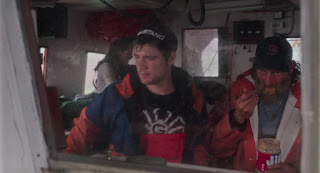
Not Frank Rossi. He does it on the job, in front of his son and anyone else who cares to see:


Of course, Frank is the deaf fisherman who is the father of our main character, Ruby. He's played by Troy Kotsur. 

Kotsur has been nominated for an Oscar for his work, and rightly so. He deserves to have his work spoken of outside of his ability to eat peanut butter, but here we are. (But I'll just throw this in: It was a moment by him in the final scene that got my waterworks the flowing-est.)

Frank realized what I have realized but still can't fully accept on face value: Peanut butter tastes good, it is (relatively) good for you, and it's quick. An argument could be made that you are actually detracting from the value of its nutrients by adding two slices of gluteny bread, which just goes straight to your thighs, even if it makes the eating experience more socially acceptable.

If it's good enough for Frank, it's good enough for me.

Frank also favors Jif, another good choice. That used to be what I bought when I lived in America. Always the creamy, never the crunchy, though I can't tell just from this shot which kind Frank has here. Skippy never did it for me to the same extent. What other brands are there? Peter Pan? Smuckers? I don't have an American grocery shelf nearby to check.

Since moving to Australia, though, I have discovered the world's best peanut butter:


Which is weird, because Australians aren't historically very big on peanut butter as a sandwich ingredient. They'll go with vegemite (of course) and jam for kids -- yuck, not in the same sandwich -- but not usually peanut butter. Which is especially the case now that everyone is hypersensitive about nut allergies. I don't know if it has a bright future, I only know I have no trouble getting it, which is all that matters to me for now. 

Yes I do think it's a bit funny that the company is called Sanitarium.

I should say that there is one additional reason I relate to Frank: He's wearing a Boston Red Sox cap. I have two such caps that are basically identical to this.

I'm not a deaf fisherman though.

Tuesday, March 1, 2022

Ukraine

As you can probably see, I've been cheerily marching along on this blog, writing posts of both a frivolous and contemplative nature, despite the fact that a massive war has broken out in Europe.

Having a backlog of posts I had written but not yet posted does not excuse the behavior entirely. I've also written new posts that were time sensitive or have only occurred to me within the past week.

This is not to say I have not been thinking about Ukraine. And it's only responsible for me to finally relay those thoughts to the public on my blog, even though they do not relate to the movies as such.

I've been struggling to put the Russian invasion in the proper context in my head. On the one hand, I wonder how different this is from similar awful situations in Afghanistan or Syria. On the other, I know that anything involving one of the world's biggest military powers and most dangerous bad actors has potentially worldwide ramifications, up to and including World War III, though I still can't quite bring myself to believe that's a possible outcome. I also know that unlike those two other conflicts, this involves a foreign state invading another state, and the U.S. isn't even involved. (Yet.)

I never know quite how to behave in these situations when it comes to social media or this blog. There are certain things that happen in the world that disqualify a person from engaging in the sort of light banter I like to participate in on Facebook, or talking about what actor has appeared in the most best picture winners on this blog. I'm trying to figure out if this is one of those situations.

But even when we can definitively identify situations that qualify as that, I am never going to devote all my time on social media or this blog to them. "The show must go on" is the appropriately drama-related cliche that applies here.

I also, though, cannot just keep writing these posts without a post like this one, letting you know I'm not some heartless monster who isn't even thinking about these things. I hope I didn't need to post this for you to know that about me. 

And there is, actually, a way to relate this to the movies. My wife was the Australia-based producer on a 2019 film shot in Ukraine called A Family. She had a relationship with its Australian director and cinematographer, who shot the film in Kyiv in 2017 or thereabouts. They had a Ukrainian producer organizing all the day-to-day logistics of the shoot, while my wife did all the things like get the film finished back here and get it into film festivals.

The still above is from A Family, and feels appropriate to the hope for peace we all share. Well, all except Vladimir Putin I guess. 

As far as we know, everyone associated with the film is alright. My wife has been in touch with the Ukrainian producer and some others who worked on the film, who are displaced from their homes in many instances, actually taking up arms in others, and in all other ways showing the absolute courage, pride and determination of a group of citizens under a dire threat to their way of life and their very lives.

So yes, I'm thinking about Ukraine. I don't know when I will post about it again. Tomorrow I will surely go back to posting something frivolous. It doesn't mean I'm not thinking about it.

You know this. But I thought it was worth saying anyway. 

Monday, February 28, 2022

A Madea homecoming

I thought I'd slide this one in under the wire for Black History Month, though I don't know if the conclusions I reach will feel particularly empowering.

You might look at this post and say "You're slipping, Vance. Just using the name of a new movie as the subject matter of your post, in its entirety? You can do better than that."

The more observant of you will notice, though, that this is not what I'm doing. If I were putting a title in the subject of my post, the words would all be capitalized, and there would be italics. 

In this case, the homecoming to Madea in my Sunday night viewing of A Madea Homecoming is a personal one. And I don't even need to italicize the word "Madea" because it is the name of a franchise. I don't italicize casual references to "Batman" and "Star Wars," unless I am talking about 1989's Batman or 1977's Star Wars. With a whopping dozen titles in its extended universe over 17 years, there are now more Madea movies than there are either Batman or Star Wars movies (only just). 

It's a homecoming for me because I used to watch most of these movies. I saw five of the first seven, starting with Diary of a Mad Black Woman in 2005. I saw Madea's Family Reunion and Meet the Browns before missing my first, which was Madea Goes to Jail. I also missed I Can Do Bad All By Myself before I was back on board for the next two, Madea's Big Happy Family and Madea's Witness Protection. Tyler Perry has been a busy man, as there have been a number of films he's directed since 2005 that are only Madea adjacent, some of which I have also seen (The Family That Preys, Temptation: Confessions of a Marriage Counselor and A Fall From Grace, while I've missed such films as Daddy's Little Girls, Why Did I Get Married? and its dubiously titled sequel, Why Did I Get Married Too?). 

I suppose calling them "Madea adjacent" is not fully accurate, since if there were an explicit connection to Perry's drag matriarch, they would be part of the extended universe on Wikipedia. I think of them as Madea adjacent, I suppose, simply because they involve Perry. That's how prominent this character has been for him. 

But I haven't seen any of the Madea movies -- A Madea Christmas, Boo! A Madea Halloween, Boo 2! A Madea Halloween and A Madea Family Funeral -- since I moved to Australia, which is probably not a coincidence. Before these movies started debuting on Netflix -- A Madea Homecoming is the second to do so -- you had to either see them in the theater (something I still don't think I've ever done) or rent them. Suffice it to say that movies that specifically examine the experience of Black people in America, that aren't also critically acclaimed, have only belatedly become available in Australia in any real way. If the latest Madea movie had a theatrical debut, I doubt it would actually play in Australian theaters, even today. For the distributor, I imagine it is a simple cost-benefit analysis, and they've determined that the cost to advertise and distribute Madea movies in Australia is not justified by the historically paltry benefit of expected ticket sales.

But I always wanted to watch these movies, not because I thought a) I'm the target audience for them, or b) I had any real chance to enjoy them as much as Perry hoped I would. In truth, I have enjoyed a number of them, and if I hadn't started out impressed by Diary of a Mad Black Woman -- impressed with reservations, I should note -- then maybe I never would have continued. It's sort of a miracle I did, considering how much I hated Madea's Family Reunion. 

No, I wanted to watch them for the film critic idealism of giving every widely released film an equal opportunity (loaded phrase there) to be reviewed. And also for the attempt to use Roger Ebert's empathy machine -- that's what he called cinema -- to put myself in the perspective of the people who were its target audience. Even if Madea's hijinks are a tad to broad for me personally, I thought I could figure out how to judge them on their own terms, and decide what worked and what didn't work within that specific context. Plus there was also a melodramatic story in each of these that was running parallel to the Madea hijinks, with Diary of a Mad Black Woman in particular establishing that template. Just because I'm calling it melodrama -- even Perry would probably call it melodrama -- doesn't mean I'm undercutting it, as some of that material is quite effective.

I did review a handful of these for AllMovie, where I was writing back in the 2000s, including each of the first three -- though probably none after that, given how I wound down writing for that site in 2011. Mission accomplished I suppose.

Now in 2022, on the last day of Black History Month, I am trying to decide whether I will review A Madea Homecoming.

For one thing there is the whole Australian audience thing I alluded to earlier. I'm pretty sure that my largely hipster audience on ReelGood is not going to care that much, if at all, about the latest Madea movie. It's what the distributors decided ages ago when they decided against an incursion into Australia. It's not these hipsters' fault; they just weren't raised on it. And they rightly identify a lowest common denominator aspect to it that keeps them away, even if they are trying to be more woke. They might read a Madea review as a way to gawk at it and see what I'd say about it, but not because of any actual interest in seeing the movie.

Or maybe they identify the thing that I've identified over the years that make me hesitant to even watch these movies: 

How negative can I be about them before it starts to seem like I'm engaged in a sort of race-based cruelty, or at the very least, like I'm tone deaf and uncharitable?

Aye, there's the rub. Because Perry's Madea movies are made specifically with the least discerning potential audience members in mind -- audience members who are drawn to the broadness and ability to laugh at themselves unselfconsciously -- they rarely make for truly accomplished cinema. Perry randomly throws in a few attempts at creative scene transitions, but they stick out for how indiscriminately they are used, calling attention to the attempt to be something that these movies clearly aren't. 

When you are accustomed to judging something according to relatively high standards for use of the tools of cinema, it's hard to engage with a film that doesn't care about that at all -- especially when it's made by someone demographically different than yourself. 

It's an issue I keep returning to on this blog: how to engage with art made by creators of other genders, races, sexual orientations or gender identities, and say you dislike the work without it seeming like a function of your constitutional inability to relate to it.

If I do review the movie -- and I really need the content this week, which is why I chose to watch it on Sunday -- I know there is no chance I will give it any more than two stars, which translates to 4/10 on ReelGood's rating system. I'll give you a couple reasons why, after a SPOILER warning.

The film opens with one of the broadest sequences I have seen in any of these movies. The recurring character played by David Mann, Mr. Brown, is preparing a BBQ for his son's visit, in celebration of his son being named valedictorian of his class. Madea and her perpetually incorrect brother, Joe (also Perry), are watching these preparations with bemusement. Brown is overwhelming the BBQ with lighter fluid, finishing up one bottle and going on to the next. He goes through about three normal sized lighter fluid bottles this way, then moves on to the sort of gas can you keep in the back of your car if you run out of gas and have to walk to a gas station, complete with the long nozzle. He continues this activity despite Joe finally coming out to tell him he's put on too much. 

Of course he's put on too much. An infant would know he'd put on too much. But he keeps going. For like five minutes.

When he finally lights the match, he immediately goes up in flames and runs around the yard. For like five minutes. Okay maybe one minute. As if discounting the possibility that he could burn to death, neither Madea nor Joe does much to help. Madea "hilariously" fills up a tea cup of water to try to douse him. When that has little effect, she tries the hose, only to find its stream to be piddly. Finally she gets Joe to trip Brown so his own body contact with the ground will douse the flames, something Brown might have figured out himself if he weren't in an (understandable) state of total panic. Of course, neither would this probably really work. 

As you might guess, Brown only has a few burnt piece of clothing, notably the ass missing from his pants. Otherwise he's fine. 

I have no idea if a Black audience finds this funny. I did not find it funny. The whole scene is ill-conceived and makes everyone in it look bad. 

Fortunately, there's nothing else quite this broad in the movie.

For me, Madea movies have always been saved, if they were saved, by the plot that does not directly involve Madea. There are some movies in the Madea cinematic universe -- like Meet the Browns -- that only feature her tangentially, like one broad comic scene, usually involving her toting a gun, that is at odds with the rest of the movie, but is shoehorned in for audiences who just came to see Madea. Madea is best used like a spice, in small rather than overwhelming quantities.

This implies that most of these movies are up to something different and often socially progressive, which is the real saving grace of the Madea series. These movies have tackled domestic abuse and other serious topics over the years.

A Madea Homecoming gets off on the right foot in this regard. After the broad opening, we meet Brown's son Tim (Brandon Black) and his "friend" Davi (Isha Blaaker). (I don't actually know if we "meet" Tim or if he was in other movies that I haven't seen.) You'll see why I use those quotation marks on "friend" in a moment. They're driving home and talking about how Tim really wants to come out to his family, and how Davi is encouraging him but is reluctant to do the same himself. It is heavily implied that these two are lovers, and some physical contact they make further invites that interpretation.

This is very promising. The Black community has struggled with its acceptance of homosexuality, which would be a politically prudent venture as Blacks and gays both have a friend in the Democratic party. Perry wants to tackle this and confront the audiences who may love Madea but not love gays.

Except then he backs off. Rather incredibly, it is revealed that Davi is not lovers with Tim, but rather, has been carrying on an affair with Tim's mother, Laura (Gabrielle Dennis). See, I told you it was melodramatic. At first we think Tim is so shocked at this revelation because Davi has been simultaneously carrying on an affair with him and his own mother, which would raise a lot of questions indeed. I mean, we're sure, based on what the film has told us, that Tim and Davi are dating. As it turns out, he's just mad because Davi didn't tell him, and because it's weird for Tim's best friend to be dating his own mother, meaning Davi could potentially become Tim's stepfather. 

So instead of confronting audiences with two gay men in love on screen, Perry gives us only one gay man who is not seen in a sexual context whatsoever. Baby steps, I guess. But this is a rather shocking form of purposeless misdirection, and I'm almost tempted to watch it again just to determine how bogus it really is, how heavily the film implied, if not outright stated, that Tim and Davi are in a relationship.

So how can I write a review of A Madea Homecoming without saying that the film bungles both the broad Madea scenes and the positive social messaging?

How indeed. And I'm still trying to decide whether I will.

I can't artificially inflate the grade. I could talk myself into a 4/10, but this film is really more of a 3/10 at best. I didn't really laugh -- again, not the target demographic -- and I didn't get the feels from anything the film was trying to do politically. 

So what value does it serve for me to review this film for a bunch of Australian hipsters who wouldn't watch it anyway, for whom my low rating is basically a confirmation of the bias they already bring into it? 

It's like when someone is behaving like a jackass on the road, and when you finally pass them, you can't resist the urge to look over and see who it was. This is almost always a fraught activity. You are effectively trying to figure out if the driving confirms some sort of pre-existing bias in yourself. The only time it wouldn't confirm that is if the person in the other car looked exactly like you.

I don't watch Madea movies to confirm biases, either my own or anyone else's. But I'm not in the habit of censoring myself either.

Stay tuned to see if this pops up in my reviews to the right. This could be a thorny one. 

Sunday, February 27, 2022

Audient Bollywood: Pyaasa

This is the second in a year full of getting acquainted with Bollywood, one movie per month.

Having started this series in January on really solid ground with 1998's Dil Se, I was ready in February to go back and do something that I kind of felt the instinct to start out with: see a really formative Bollywood film.

Unfortunately, iTunes was no help whatsoever.

The first five or so movies I checked from my Bollywood watchlist that were pre-1980, iTunes had none of them. Then I started checking some other titles I'd had earmarked as likely choices for this series for one reason or another, and it didn't have many of them either.

Just when I started to panic -- and was very close to renting something from the past five years that featured a gay relationship, which I thought would be interesting -- I found a goldmine of Bollywood on Amazon Prime. Including the first "formative" film I'd checked for on iTunes, 1957's Pyaasa. Amazon will be a likely source for most of the rest of the films I watch in this series, given its generous quantity of such films. (Netflix has a number as well, but you won't be surprised to learn they are more recent titles.)

Now, Pyaasa is pretty old -- 16 years older than I am, which makes it pretty old -- but it is not the oldest Indian language film I have ever seen. That honor goes to Satyajit Ray's Pather Panchali, which came out two years earlier but cannot rightly be considered a Bollywood film because it did not emerge from the studio system that comprises Bollywood. (I believe I'm correct in phrasing the basic parameters of Bollywood in that way; I'm just starting out, so you will have to forgive any minor inaccuracies as I discuss these movies.) I googled it to be sure, and Pather Panchali was produced by the government of West Bengal, which definitely sounds outside the commercial sphere of Bollywood.

And Pather Panchali made me a little concerned about Pyaasa. Because there are aspects of its production that are very rough -- much rougher than what a commercially funded film could produce just two years later -- Pather Panchali threw up a little bit of a barrier with me that I never got past. I should clarify that a movie looking rough is not, in itself, reason for me to reject it, but I'm just trying to convey the experience I had with this particular film. The roughness of the filmmaking (sorry Ray, I'm sure you are brilliant) kept me from full engaging at the start, and the story never really brought me in. I am surely wrong about Pather Panchali and someday I would like to revisit it, plus see the other movies in the Apu trilogy, to learn how wrong I really am. (There's a longer discussion of my thoughts on Pather Panchali here if you are interested.)

Despite some worrisome moments in the first ten minutes, Pyaasa is not Pather Panchali.

I should discuss the significance of those first ten minutes before we get on to the film proper. Like Pather Panchali before it, I couldn't get through Pyaasa on my first attempt. While in that case, sleep overtook me, here it was something entirely external to the experience of watching the movie. I first tried to watch Pyaasa on the night the Oscar nominations were announced -- I say "night" because here in Australia, those announcements occur at about 12:20 a.m. I had budgeted exactly the amount of time I'd need to watch the two hour and 20 minute movie, with a few short breaks, before tuning in live to see who'd be competing this year for best picture. But at about the ten-minute mark of Pyaasa, my wife came into the living room to talk to me about something -- don't remember what -- and that conversation took maybe 15 minutes. By that point, the window for Pyaasa had been lost, and I watched Andrew Bujalski's far shorter Funny Ha Ha instead.

I wasn't able to get back to Pyaasa for two weeks, frittering away most of February in the process. There were a couple times I considered putting it on, but it was too late or I was too tired. Simply put, Pyaasa was starting to assume the epic scale of a real chore in my head. It's short by Bollywood standards, but it's long by the standards of most films, and I was really worried about another Pather Panchali experience, plus maybe with singing. The first ten minutes of Pyaasa might have been more polished than Pather Panchali, but not significantly, and I didn't feel myself immediately engaged by the characters. (In case you didn't know, Pyaasa is also black and white, which again is something that factors into the way we prejudge a movie and its possible resources.)

The singing part was the part I was not sure about. As I try to come to a definition of what Bollywood is -- even though it is many things -- I've been asking myself whether singing and dancing is a quintessential part of it. Obviously Bollywood is a behemoth producing hundreds of movies a year, and they cannot all feature singing and dancing. But more to the point, are the movies on my Bollywood watchlist primarily going to have been "recommended" to me because they contain singing and dancing? Is a person making lists of essential Bollywood films going to consider that in the lists they make? Were singing and dancing there from the start, or did they only come later?

I soon learned that yes, singing and dancing were there from the start -- but only if you consider the musical era in Hollywood to be "the start." Bollywood has the same lengthy history that Hollywood has, with films dating back to the turn of the 20th century, so obviously, not much singing then.

I've been yammering at you for quite a while and I haven't really even gotten into the movie yet.

Pyaasa is considered a classic example of the form and is directed by Guru Dutt, who is also its star. As I was watching the film, I did some quick math and decided that Dutt could possibly still be alive today, so I looked it up. Nope, and nope by a lot. He died only seven years later at age 39, from what was either an accidental or intentional mixing of alcohol and sleeping pills. He had already tried to kill himself twice, so it was probably the latter. But he was a huge star before then and I'm thinking I might encounter him again, depending on how many older films I watch in this series.

Dutt plays a poet named Vijay, whose poetry cannot gain any traction with publishers because it deals with social issues rather than romance. His brothers hate him but he has the love of his loyal mother, who is not in great health. He quits his menial blue collar job after his foreman throws out his poetry, knowing what it was but not caring, and soon after there's an episode where the same poems (salvaged from the trash) are sold as scrap paper by his malicious brothers, which he must track down. I love the notion that in India of the late 1950s, scrap paper was something that was sold -- though not for very much money, which becomes a metaphor for how Vijay thinks the world sees him.

He must track down this scrap paper, which leads him to a street walker named Gulabo (Waheeda Rehman), who bought the scrap paper. (What a prostitute needs with scrap paper, I'm not sure.) Speaking of engaging with social issues ... I think I imagined that a Bollywood movie might try to steer clear of tackling issues like prostitution, but maybe Dutt had plenty in common with Vijay, refusing the lures of commercialism and trying to succeed with topics he really cares about. By all accounts that worked with Pyaasa.

His encounter with Gulabo confirmed the thing I hadn't been sure of, and couldn't be sure of despite some melancholy singing in the film's opening minutes -- the movie does indeed follow (create?) the template for future Bollywood films, which is to break from the story for (sometimes lengthy) songs. Now, to say there is dancing in the way there is in a film like Dil Se would not be correct. Given what we know of Dutt, he would likely shun the big commercial dance number, and indeed, what dance we see here is minimal and never involves more than two people. In the one case where there are two people dancing, they are waltzing, not performing Bollywood dance.

It was really useful to see this sort of origin of future Bollywood, because it suggests that there was something common in the DNA of these films, even when the subject matter was not frivolous. A movie with this story would never be a musical in Hollywood, but Dutt's usage of songs, sprinkled regularly throughout, suggests something deeper within the culture that expects this sort of expression on film. 

To be fair, the songs have a textual purpose as well. Vijay's poetry is something that is meant to be sung, in the style of classical Indian music, and it's possible that all the songs in the film are "realistic," in that they involve material really being sung by the characters to each other in that moment, not the metaphorical expression of their thoughts and feelings that comprise a Hollywood musical. Like, in a Hollywood musical a character would probably never say to another "Remember that song you sung to me earlier?", because the song would exist in this nebulous space between a thing that really happened and a thing that didn't really happen. I think all the songs in Pyaasa really happened, but they are spaced out the way they would be in a Hollywood musical, so the effect is similar on the overall thrust of the film.

I quite liked the songs, but as the movie went on, I really liked the story. It picks up incredibly in its second half, after drifting a little too much for my tastes in the first half. It gets really complicated and interesting, also following Vijay's previous love, Meena (Mala Sinha), who didn't marry him because he was poor, as well as the person she did marry, Ghosh (played by an actor who goes by the single moniker Rehman), who also happens to be a literary publisher. Ghosh rejects Vijay's initial attempt to publish, though there later comes a reason he wants to publish the poems, which allows for a really fascinating look at such topics as greed, betrayal and artistic integrity.

By the end, the story actually takes on some aspects of the story of Jesus Christ, which I found really interesting from a movie with these origins. It's possible it also resembles a story in Hinduism or Islam, so I might just be being narrow-minded in my interpretation, but as a western viewer I only have my own reference points.

Long story short -- it may be too late for that at this point -- by the end I was really overwhelmed with how much I liked the movie. In its second half it moved from somewhere around three stars, all the way up to 4.5. And whether my reaction was really more appropriately a four-star reaction, I felt happy to honor Pyaasa in this way -- maybe sort of a makeup call for the paltry 2.5 stars I had given Pather Panchali.

I don't have my movie picked out for March yet, but thanks to Amazon, I have plenty of choices. There are three or four movies on my watchlist that I had heard of prior to starting this series, so it may be time to take down one of those, so I can intersperse the others throughout the rest of the year. 

Saturday, February 26, 2022

Why don't we know Franklyn Farnum?

I was thinking idly about actors appearing in best picture winners the other day. I decided to find out which actor has appeared in the most best picture winners, and of course, that's just the kind of information Wikipedia is eager to offer me.

The vast majority of actors on Wikipedia's "List of actors appearing in multiple Best Picture winners" have appeared in two or three films, but there are a few who went beyond that. Wallis Clark was fortunate enough to appear in five, all of them in the 1930s, while Bess Flowers equaled that total, split between the 1930s and 1950s. (I guess she spent the 1940s recovering from a terrible heroin addiction, leading her to a period of heroine withdrawal. Get it? Heroine?)

Head and shoulders above the others was an actor who appeared in a whopping seven best picture winners: The Life of Emile Zola (1937), Going My Way (1944), The Lost Weekend (1945), Gentleman's Agreement (1947), All About Eve (1950), The Greatest Show on Earth (1952) and Around the World in 80 Days (1956).

But perhaps the more remarkable thing about Franklyn Farnum is that he is listed as having 1,100 film credits overall. That's a lot.

The even more remarkable thing is that I've never heard of him.

I'm no expert on classic Hollywood -- I don't know Wallis Clark or Bess Flowers either -- but if someone had appeared in 1,100 movies and seven best picture winners, I feel like I should know about him, if not from his actual body of work, then at least as the answer to a trivia question.

But nope, totally in the dark on Farnum, and the picture of him doesn't even help me say "Oh yeah, that guy."

I guess back in those days, especially if you were under contract from a studio, it was more like a 9 to 5 job than the project-based acting of today. If they needed someone to walk through the background of a movie and maybe say one line, there was Franklyn Farnum, having a cigarette outside of a sound stage and waiting for his next assignment. Maybe the more remarkable thing is that someone actually noticed he was in all these movies and committed his feat to permanence via Wikipedia.

I looked through Farnum's 1,100 credits on IMDB and it turns out I've only seen ... nah, I didn't do that. Even I am not that crazy. I know I've seen seven of his films, anyway, since I've seen every best picture winner. I'm sure you can add a dozen others.

I wonder if Farnum was even appreciated in his time, recognized as a familiar face by the average moviegoer. His best picture accomplishment -- something he himself was certainly aware of -- would probably not have been general knowledge until the internet age, relying as it does on resources like IMDB.

Today, it seems hard to imagine any actor with this ability to spread himself over multiple quality projects, which means his record is likely never to fall. As some indication of that, among actors still living, no one has more than three, though there are about ten of those. There are the names you might expect in that group, like Meryl Streep, Morgan Freeman and Dustin Hoffman; names you'd expect if you thought about it for a second, like Talia Shire; and names you would not expect, like Beth Grant. 

If this post can contribute in some small way to the world knowing about Franklyn Farnum -- Frank to his friends -- then I'm glad to oblige.

Friday, February 25, 2022

My funeral film festival

NOTE: I do not have a terminal illness, am not contemplating my own death, and do not expect to die in the near future. The following is a thought experiment only.

Dana Stevens doesn't like lists, except when she does.

The Slate film critic and co-host of the Slate Culture Gabfest tells us that she doesn't like ranking her top ten films of each year. She will reluctantly produce a list of her ten favorites, but she will not order them. She won't fit herself into that mold even when she's a guest on the Filmspotting year-end podcast, in which the ranking of films from ten to one provides a crucial part of the episode's structure. While the other three hosts ranked their 2021 top tens from favorite to least favorite, she boldly stuck with her own convictions and just offered ten titles without further assessment of their respective worth.

But I stand by my argument -- maybe never explicitly stated as such -- that a person doesn't go into film criticism without having some sort of mental framework for expressing their appreciation of film. I suspect there are few critics out there who are in it only for the purity of the written word, without being driven on some level by a tendency to rank, to assign star ratings, to produce letter grades or to make lists. 

Well I've just discovered how that manifests itself in Dana, how she demonstrates that little bit of obsessiveness that lets me relate to her just a bit more than I already did.

On their recent year-end "call-in" show of the Gabfest -- which I caught up with only very belatedly, and which features emails and voicemails from their listening audience, not actual live interaction -- Dana and her co-hosts (Stephen Metcalf and Julia Turner) answered the following listener question: "What one song would you want played at your funeral?" Naturally this led to a bit of riffing, with each providing more than one song and Dana even taking the opportunity to talk about movies, though without mentioning specific titles. 

It was revealed that Dana has a Spotify playlist of songs to play at her funeral, a comment that took her co-hosts aback. I assume it shocked them because they thought it flew in the face of Dana's free-spirited ways -- both in her stated dislike of lists, and in terms of the optimism she unfailingly projects. Dana clarified that she is not specifically planning out her funeral or anything so morbid as that, but more than anything, these are songs she wants to be forever associated with her, to the extent that they might live on after her on the internet. She also explained that she frequently adds songs to this list, so at this point it obviously far exceeds the number that could be played at a funeral, and complicates the task of anyone trying to interpret the list as practical posthumous funeral-planning advice from the departed.

It was also revealed that Dana has a wild fantasy about an entire weekend devoted to remembering her, though not in a somber way of course -- just a hope that she could live the sort of life that would encourage family and friends to devote extra time to honoring her, in the form of a three-day party that would be a direct benefit to them, not just a tribute to her. Part of that, she revealed, was that it might take place all at one house and there would be a room devoted to showing a funeral film festival.

She has that list of titles as well, but "that's a topic for another podcast."

I see you, Dana. You like lists. 

(I know, I know. It was never lists she didn't like, it was ranked lists.)

Funeral film festival. Huh. 

It obviously got me thinking: What would I curate for my own funeral film festival?

I was originally going to call this post "Your funeral film festival" rather than "My funeral film festival," because a) I didn't want to give anyone a heart attack who thinks I'm announcing some sort of fatal illness, b) I didn't want to give the impression I am depressed or gloomily contemplating the end of my own life, and c) the idea of planning my own funeral gives me the heebee jeebees. But the reality is, the rest of this post is what I'd consider showing at my own funeral film festival, were such a thing to occur, and were I in a position to help plan it beforehand. (And hey, if you're reading this at some point in the future after I have already died, but before I've already been buried, see if this sort of thing might be practical! I might not be kidding! Or it can be months later as a memorial! I don't care! I'll be dead anyway!)

One thing I should say is that whatever I write about here is bound to change between now and whenever I die. I'd say I hope it changes a lot because I hope that is 40 years from now, but then again, it might not change a lot even if it is 40 years from now. There's a good argument to be made that when you are nearing 50, you have already seen the movies that are going to seem the most important to you on your deathbed.

I figure ten titles is a good number to consider. You show two on Friday night after everyone arrives, five scattered throughout the day on Saturday and another three on Sunday, letting everyone leave to get back to their lives by mid-afternoon. 

The key, though, is that this is not just another variation on "What are your ten favorite films of all time?" Pulp Fiction is currently my #3 on Flickchart, but no way is that making an appearance at a film festival in celebration of my life. 

So the following ten titles I've chosen are also titles that deal in some way with the bittersweetness of life, that have the heart and earnestness to be about something bigger while also, usually, not taking themselves too seriously. I want my mourners to enjoy these movies, not be hit over the head with how final and irrevocable death is.

For the purposes of maximum possible enjoyment for the widest range of people, I'm also considering only titles that aren't known for being divisive. For example, I think a movie like Vanilla Sky is excellent at contemplating themes of the fragility of what we have, but I know some people loathe that movie (even if they are wrong). I don't need a movie that some people hate -- plus a polarizing figure like Tom Cruise -- ruining the celebration of my life. 

Finally I thought it was wise to limit my pool of candidates to my top 500 films on Flickchart, as I want these to be films I really cherish. I want at least the people who know me well to think of me when they think of these films. It turned out I didn't get even that far, as the shortlist of 18 candidates included no movies ranked lower than #394 on my chart. 

So without any further preamble, here are the ten films I've chosen in the year 2022 for this festival. In honor of Dana, I'm not ranking them, though that wouldn't make sense anyway. It makes more sense to provide approximate time slots for them, so that is what I have done.

And then I decided to go from ten to 14. 

Here's what I figured. No one is going to watch all of the films. It takes someone insane -- like me -- to watch 14 movies over three days, something I've done on several occasions. But I'm already dead in this scenario. I expect an average mourner to watch three, maybe four films in total, either ones they haven't seen before or special favorites. Hopefully there will be enough mourners that each screening will seem suitably well attended. 

There will be movies that some people just don't like, despite my trying to avoid that as stated above. Depending on where it's held, maybe they want to go play an hour of tennis as a little change of pace, assuming I don't die in winter. Maybe they've booked themselves into the spa. Maybe they want to join the bongo circle, where my more musically inclined friends are banging out a tribute to me on the drums. Maybe they want to participate in the cooking class and learn to make authentic Mediterranean cuisine in my honor. Hey, I don't know what new interests I'll have by then.

So it seems that I can schedule this thing chockablock, with only short breaks between each movie (though you will see I've allocated meal breaks on Saturday and Sunday). Since it's my special weekend -- even though I won't be there to appreciate it -- might as well pack in the goodness as tightly as I can.

The only time restrictions I insisted on obeying were to start the movies late enough on Friday that people didn't have to leave work too early, depending on how far they had to travel, and to get them out of there by late afternoon/early evening on Sunday, so they have some chill out time when they get home before they have to go to bed. One last chance to reflect on me and my greatness.

Oh, and no movies during the hours when people are typically sleeping. I can see a marathon like that working and I know people will have some long, dark nights of the soul contemplating how empty the world will feel after my death, but I want them to be fresh for the next day's slate of films. 

So -- now without any further preamble -- here's the schedule for the weekend. Get there early if you can. 

Friday

Arrival/check-in from 3 p.m.

6 p.m. - Defending Your Life
(1991, dir. Albert Brooks) 111 minutes
Flickchart: #25

(Program note: Dinner to be consumed during film, available at buffet in adjoining room)

Why this film? I want to kick off the weekend on a lighter note, and this film's opener lets us know right away what we're in for, as Brooks' Daniel Miller is killed in a head-on car collision listening to Barbra Streisand in his brand new Porsche convertible, distracted from the road while trying to pick up some compact discs that have spilled into the passenger side footwell. He is then immediately pushed in a wheelchair through the hospital-like corridors of the afterlife, freshly deceased and none too pleased about it, though he's very tired so he can only muster a hangdog half-frown. Before long Meryl Streep shows up to add a total splash of delight to Daniel's trip through the afterlife, where he'll defend in a court of law a dozen key life decisions to determine if he gets to move on to the next plane of existence, or is instead forced to return to earth to give it another shot. In among the hilarity there's some real profundity in Brooks' best film, and I think this gets the audience laughing while never losing sight of the core questions of how we try to move past the fears in life that hold us back.

8:15 p.m. - Cinema Paradiso 
(1988, dir. Giuseppe Tornatore) 155 minutes
Flickchart: #116

Why this film? The main course of night 1, as it were, is also the longest film that will play, and one of the least to do directly with death. As you would know if you've seen it, this is really a love letter to the movies and to people whose childhoods had a love of cinema as wallpaper. As it follows the main character from that young age to adulthood, when he has left his hometown in the distant rearview mirror, it does contemplate life and loss and the things that live on only in our memories. And of course when (spoiler alert!) the loveable old projectionist Alfredo (Philippe Noiret), who is earlier blinded in a fire at the cinema, does die, it's the occasion for our main character, Salvatore (played by different actors at different ages), to reminisce on his formative years, and finally return home. The climactic piece of film he views -- this I won't spoil if you haven't seen it -- creates just the sort of emotional release my mourners may be needing. 

11 p.m. - Wild Strawberries
(1957, dir. Ingmar Bergman) 91 minutes
Flickchart: #394

Why this film? As the lowest ranked film on my Flickchart that will play, it might also not surprise you that this is among the least familiar to me of the movies I've chosen. I've seen it twice, but the most recent viewing was more than ten years ago now. I'm choosing it, though, for a couple reasons. One is that the themes of looking back on life near its end stick with me, even if the specifics of the story don't. Another is that it would sort of honor my (still living, but probably not at this point) dad, whose favorite film is Bergman's The Seventh Seal -- and even though the chess with death bit is certainly the kind of thing you might gladly feature in a funeral film festival, that film didn't connect with me to the extent it did my dad. But the biggest reason that I've chosen it for this late-night slot is that it has an ethereal, existential quality that befits late-night contemplation, though I'm sorry I'm making you read subtitles after midnight on what has already been an emotionally draining day.

                                                        *************

Saturday

8 a.m. - Breakfast - Pastries, bagels and some hot foods available

9 a.m. - The Iron Giant
(1999, dir. Brad Bird) 87 minutes
Flickchart: #10

Why this film? So what does my first animated film of the festival, a lovely little story about a boy and his robot, have to do with ... oh wait a minute. Death is all over this thing, as one of the most miraculous feats The Iron Giant pulls off is to make young viewers consider the preciousness of life without it totally bumming them out. The giant's first contemplation of mortality, when he gently nudges the lifeless body of the deer, is a tonal masterstroke, enhanced exponentially by Vin Diesel's childlike line readings of the giant's curiosity about death. Then near the end -- again spoiler if you haven't seen the movie -- everyone must contemplate the near certainty of their own impending death when a nuclear missile is headed directly for their small Maine town, with only a heroic metal martyr standing in its way. (Plus the setting is a nice way to honor my New England upbringing, and my dad actually lives in Maine.) The Iron Giant still makes me cry after like seven viewings, so yeah, this one is making the cut.

11 a.m. - A Matter of Life and Death
(1946, dir. Michael Powell & Emeric Pressburger) 104 minutes
Flickchart: #327

Why this film? This is the only film in the festival that I've seen only once -- I saw it only a year ago for the first time -- but hopefully that will change before I shuffle off this mortal coil. It'll keep the mostly light vibe going during the daytime hours (yes, Iron Giant is mostly light despite the threat of nuclear holocaust). The story is about a World War II British fighter pilot (David Niven) who is going down over the English Channel, and in his last moments before certain death, he falls in love with the American radio operator (Kim Hunter) whom he sends a distress signal. Except he doesn't die, rather, awakening on the banks of the water within range of this woman and his fellow British soldiers. This may all be a state of limbo, though, as he can't explain his failure to die, and starts seeing visions of envoys from the afterlife, who will eventually have him in a trial that's sort of similar to what happens in Defending Your Life. This movie's delightful spirit, ahead-of-its-time philosophizing (especially for a mainstream film) and yes, even special effects, simply knocked my socks off. This is joyous in its ruminations on that thin membrane between life and death that we all find ourselves in on a daily basis. And maybe it will convince some of my mourners that I'm not actually dead.

1 p.m. - Lunch - Sandwiches

2 p.m. - Four Weddings and a Funeral
(1994, dir. Mike Newell) 117 minutes
Flickchart: #39

Why this film? If A Matter of Life and Death didn't keep the light afternoon vibe going, then this fellow British film definitely will, as only one-fifth of it is dour, if you are going by the math in the title. This is the movie whose inclusion I am most justifying on the basis of "I just love it," with the excuse of the title explicitly referencing a funeral to further strengthen my choice. I do think the portion related to Gareth's death is handled quite well, especially as it does, indeed, change the tone of the film for about 15 minutes. If someone read a poem at my funeral that was as beautiful as W.H. Auden's "Funeral Blues," it'd probably bring a tear to my own eye as I'm lying in the casket listening to it. And then the rest of this film is just such a delight to be in the presence of for two hours. The traveling party of friends, going from one wedding to the next (with a funeral inserted in there for good measure), is the sort of feeling I'd like my mourners to have, dropping absurd witticisms and catty remarks if the mood strikes them. Hey, it's a funeral but it doesn't have to be depressing. 

4:15 p.m. - Truly, Madly, Deeply
(1990, dir. Anthony Minghella) 106 minutes
Flickchart: #150

Why this film? British much? I didn't realize until typing this out that this makes my third straight film from Jolly Old. You'd think I were an Anglophile or something. And I realized I lied earlier -- I've only seen this film once as well, probably due more to its scarcity than anything else. (I think I looked for it a while back and determined you basically can't get it, but I'll kick the can down the road on that problem and leave it for whoever's curating this festival.) There's some real lovely melancholy in this film, as a woman (Juliet Stevenson) is visited by her recently deceased boyfriend (Alan Rickman), who basically takes up residence in their house and even brings some of his deceased musician buddies with him on occasion. (This would go well with the aforementioned bongo circle.) This is definitely a comedy of sorts in that Nina ultimately gets a bit irritated by Jamie, a necessary part in the healing process that allows her to move on. And if I remember correctly, we ultimately realize that was all part of Jamie's plan -- to allow her to say goodbye and to appreciate her loved one a last time, but then to pave the path for a happy rest of her life. 

6:15 p.m. - Rabbit Hole
(2010, dir. John Cameron Mitchell) 91 minutes
Flickchart: #121

Why this film? I haven't wanted so far to put people in direct touch with their anguish, but if anyone wants to just have it out with their emotions, this is the film for them. I don't suppose a movie about the death of a child is ever going to be light in any respect. But the film that was my #3 for the last decade (meaning its Flickchart ranking should increase once it gets the right duels) is just such a powerhouse emotional experience that I couldn't leave it on the sidelines. It doesn't only deal with the emotions, but rather, how they eat away at your relationships and steadily drive you to disassociate with your own life. If that were where it ended, though, it would be a big downer, and not worthy of inclusion here. Nicole Kidman's and Aaron Eckhart's grieving parents reach a place where they can go forward, with that rock in their pocket -- that's how Dianne Wiest's character describes it -- still there, but maybe a little lighter every day. This is another film that leaves me as an absolute wreck every time, but it's not the child's getting hit by a car -- which occurs before the start of the narrative -- that does it. It's the way family and friends surround them at the end, in a showing of love I'd like this particular weekend gathering to emulate.

8 p.m. - Dinner - Selection of surf and turf

9 p.m. - Harold and Maude
(1971, dir. Hal Ashby) 91 minutes
Flickchart: #203

Why this film? If Wild Strawberries honored my father, who is still living, then Harold and Maude honors my mother, who is no longer with us. This was her favorite film and it quickly became a favorite of mine as well, especially after watching it again the night she died in 2020. I love the mixture of tones in this film, as Harold puts on increasingly elaborate fake suicide attempts, which get a blase reaction from his own mother and are clearly played for comedy, and Ruth Gordon's dialogue is almost exclusively naughty and devil may care, as her paradoxical joie de vivre comes shining through. Of course, this movie ends in a very sad place for Harold, who might actually be suicidal -- though what he chooses to do with those instincts speaks volumes of hope. If everything else the film does right were not enough, I'm loving the idea of hearing some Cat Sevens at my funeral film festival -- even if I won't actually be "hearing" it. (But who knows, don't rule out me manifesting as a ghost and watching from the back row.)

11 p.m. - A Ghost Story
(2017, dir. David Lowery) 92 minutes
Flickchart: #157

Why this film? Now that we're closing in on the witching hour, I want to get back into that existential, midnight movie headspace I tried to create on the first night with Wild Strawberries. This one flirts more with the actual horror genre, as there are things in this film that feel very unnerving -- even though we're seeing everything that's happening with a recently deceased man who walks around draped in a bedsheet with two eerily sightless eye holes, so there are no jump scares or the like. (That's Casey Affleck, and let's hope the world has forgiven him a bit more before I die.) (And wait, there is one jump scare, involving a piece of construction equipment of all things.) There are parts of this movie that go purposefully slowly, and there are parts that speed past us before we even notice -- which I think must be sort of how eternity actually feels. This film doesn't only travel forward in time, it travels backward, never ceasing to be completely and utterly profound at any moment. But I mightn't include it if it didn't end up someplace hopeful, or at least someplace immensely emotionally satisfying. I still remember sobbing in the theater after the last shot, though your mileage may vary.  

                                                         *************

Sunday

8 a.m. - Breakfast - Eggs benedict, huevos rancheros, raspberry waffles with mascarpone cheese, four-egg omelette with truffle drizzle, Belgian crepes with a glazed apricot reduction, Wheaties

9 a.m. - My Neighbor Totoro
(1988, dir. Hayao Miyazaki) 87 minutes
Flickchart: #70

Why this film? You've had a hard past two days, with ten films that have put you through the ringer, in toto if not individually. Nothing to freshen you on Sunday morning like a little palette cleanser like this. If you think "Hey Vance, what the hell does My Neighbor Totoro have to do with death?" I would respond first and foremost "Shut up, it's my funeral film festival, I do what I want!" in my best Cartman voice. In reality, though, this wondrous little life-affirming miracle with incredibly low stakes does indeed have death lurking in the background. There's something ever so slightly melancholy to the adventures of young Satsuki and Mei, which is that their mother is in the hospital, and because they are children rarely told the unvarnished truth, they have no idea how bad it is. Is their mother possibly on the verge of dying? I mean, they actually moved house to be closer to her, which doesn't sound promising. Because Miyazaki would rather teach children about life while keeping their innocence firmly intact, it all resolves well for Mrs. Kusakabe, you'll be glad to hear -- with no small help from a cat bus, a Totoro, a couple Totoro helpers and a whole attic full of dust bunnies. And maybe, nearing this end of the weekend, you'll be glad to know it will all resolve well for you, even if I'm not still around to help you with that. 

11 a.m. - Tanna
(2016, dir. Bentley Dean & Martin Butler) 87 minutes
Flickchart: #98

Why this film? Tanna wasn't actually on my original shortlist, but I kept coming back to it in my head, and when I expanded the field to 14, it was easy to find a spot for it. We go from one lush Pacific Ocean setting to another, as the film is a sort of Romeo & Juliet story among the indigenous people of the title island, located in Vanuatu. Because I'm name-checking Shakespeare's most famous depiction of star-crossed lovers, you know that there's got to be death involved here somewhere -- hate to give that spoiler since I know a lot of you reading this right now won't have seen my #5 of the last decade. But I might be including this as much for the idyllic paradise in which it takes place -- as close to a vision of heaven as a religious skeptic like me can get -- as for what ultimately transpires between the central lovers. The way one child in this film expresses her grief, like no non-professional actor of that age I've ever seen, and the way the film ends with a sort of communal celebration, are both things I want to bring to you as you near the end of this epic journey in my honor.

1 p.m. - Lunch - Taco bar

2 p.m. - Away From Her
(2006, dir. Sarah Polley) 110 minutes
Flickchart: #346

Why this film? Depending on how I die, this could be the most topical film in the festival. It's the only film dealing with the thing that could very well be my own cause of death: dementia, or the complications that arise from it. That's what got my mother and her mother before that, as well as my grandfather on my father's side. (The jury is still out on my own father, who is as mentally sharp as ever at age 82.) I'm not including the film so much for its subject matter, though I can't deny that's a factor. (A film like The Father might actually be more powerful to me, but it's a bit too intense.) No, the film impresses as much as it does because of Sarah Polley's grace in depicting the illness that affects Julie Christie's character, while her long-time husband, Gordon Pinsent, can only look on helplessly. No way at age 27 Polley should have been this astute about the frailty of the mental faculties of the older set, and from having watched her documentary about her own family (Stories We Tell), I don't even think it was from her own personal experience. What I find so lovely about this film is not Christie's performance, which is very good, but she's playing a character who basically no longer has any agency over her choices. Rather, it's the man who can choose, her husband, who grows to implicitly understand all the best things for her, even when she turns her attention to another man in the home where she now lives. That's an act of the purest love on his part, and I only hope my wife could give me the same "gift" under those circumstances. As a little change of pace, the character does not actually die in the end -- fancy that. 

4 p.m. - Raising Arizona
(1987, dir. Joel Coen) 94 minutes
Flickchart: #1

Why this film? And we save the best for last. Breathe a sigh of relief, people -- you got there. And your reward is my #1 movie of all time, plus a chance to really relax and have a good time. Aside from it being my #1, and that seeming like a good choice to send me off in its own right, there are indeed other reasons I've chosen to include this in my funeral film festival. (Don't make me pull out my Cartman voice again.) Although it is not always in the text, mortality hangs over this film. It's there in Ed's desire to produce a child and extend herself onward past her own finite lifespan. It's there in HI's dreams of a man in black on a motorcycle coming to kill him. It's there in Gale and Evelle's attempts to liberate themselves from prison, and their panicked screams when they think they might have killed the baby while driving off with his car seat on top of their car. But -- you'll be surprised to learn, or maybe you won't because it's my favorite movie -- this movie makes me emotional too. It's all about HI's new dream that ends the movie, where he imagines himself off into the future, with real kids that really belong to him, and the moment when he's sitting at a large dinner table full of hypothetical future family members, his back to the camera, and a hypothetical grown daughter smiles and touches him on the cheek, and says one word:

"Dad."

(Plus I love the idea of the last thing in the festival, to send people off, being Carter Burwell's incredible score over the closing credits, and all the joyous ululating it entails.)

                                                       *************

I think I've got a good representation of tones, genres, time periods and parts of the world. There may be something I haven't covered but hey, even in death, I'm not perfect.

There were a few films I considered that involved suicide, but in a poignant way, like Abbas Kiarostami's Taste of Cherry. And though I'd love to include an Iranian film, I can't have any mixed messaging out there if the cause of my death is the slightest bit ambiguous. (Besides, Harold and Maude covers suicide pretty well without seeming like a cinematic suicide note.) 

Other honorable mentions from my top 500:

Ghost (1990, Jerry Zucker)
Flickchart: #31
Obviously I love it, but it's too earnest and cheesy for some people, plus maybe it's more about love than death.

Coco (2017, Lee Unkrich)
Flickchart: #139
Appropriate themes and light tone with a powerhouse ending, but I didn't need a third animated film.

Henry Poole is Here (2009, Mark Pellington)
Flickchart: #168
Thematically it works and I obviously really like it, but I think most people don't like it and it's a bit too religious for what I want to convey in this context.  

Dreams (1990, Akira Kurosawa)
Some beautiful themes and possible landscapes of the afterlife, but I decided to let My Neighbor Totoro be my sole representative for the cinema of Japan. 

I'm sure there are great choices for the theme beyond my top 500. Maybe I'll save them for if I come back to life and die a second time.

It occurs to me that this might make more sense as a lineup -- or might make more sense as a film festival at all -- if I'm taken before my time. Nobody's going to film festivals honoring 93-year-old senior citizens, because most of the people who would go would also be 93, if they're even still alive. The existence of the festival implies a sort of melancholy and wistfulness over how much the person still had to give. At 93, you ain't giving much if you're giving anything at all. 

However, if I have died young and you remember this post, tell my wife, because it might not be too late for her to start planning! 

I might be kidding! But I might not be!

Thursday, February 24, 2022

Star rating dispersal

I've started something this year that I hope will make my end of year tasks a little easier.

When I post the breakdown of my movies in my year-end wrap-up -- last year, it was 170 -- by how many got each of the ten available star ratings, it has historically required me to go through Letterboxd making little hash marks for each rating. The numbers look pretty similar each year, with 3.5 stars always having the most, followed by four and three. 

The trouble with this approach, though, is that a) it's tedious, and b) it's easy to miss one movie, and realize the numbers don't add up when you get to the end. If that happens, either you count again, which is even more tedious, or you just fudge it by adding one to one of the categories, usually the one with the most, since statistically, that's the one you were most likely to have missed. I believe I have done both things in the past.

This year, I decided to just keep track of it as I go, and save myself an hour of work next January.

So I've got my spreadsheet in which I can add the movies as I go, in a column devoted to their star rating. If I do forget and miss one, it is hypothetically easier to figure out which one I missed if I copy all the existing titles, sort them alphabetically and paste them side-by-side with my rankings, also sorted alphabetically.

The only thing I worry about is that by having a knowledge of how many I've given out in each star rating, I could be biasing myself toward stacking the deck in favor of a particular outcome. If I'm only counting at the end of the year, I have no way of knowing and the end result is sort of a surprise. But if, let's say, four stars has a chance to overtake 3.5 stars for the most in the year -- which I can glean easily enough by a glance at the list -- maybe I'm ten percent more likely to go four stars for my final viewing of the year, when I'm on the fence between that and 3.5. Do I think this is a concern in reality? No, but it did occur to me.

Anyway, I'm telling you all this because it has led to a funny realization with my first seven movies of 2022: They have been given seven different star ratings. And I can tell you for sure that this was not on purpose as an early incarnation of the thing I was worried about in the previous paragraph. 

No, I can genuinely say that my first seven films of 2022 break down as follows:

Bigbug (4 stars)
Death on the Nile (3.5 stars)
Hotel Transylvania: Transformania (3 stars)
Gold (2.5 stars)
Uncharted (2 stars)
Home Team (1.5 stars)
The Sky is Everywhere (.5 stars)

Spoiler alert for the relative placement of these films in my year-end list. 

Now, if my next three viewings are a 4.5 star, a five-star and a one-star, you'll know there are shenanigans for sure.

This obviously can't continue much longer -- three more viewings at most. And at the moment I'm not sure what my next 2022 viewing will be, so I don't know if it has any realistic shot at 4.5 stars, though I give that out with some regularity (15 times in 2021). Five and one are considerably less likely. 

But while it's continuing I'm enjoying it. I might actually be getting the most joy from having given out a .5 star rating, as discussed earlier this week in this post, since it's something I didn't do in all of 2021.

And will I miss the thing where I take a stroll down memory lane at the end of the year, making hash marks on a piece of paper (always a satisfying exercise) as I remember the movies that made up my 2022?

Could be. And hey, if that's the case, I can always ditch this new practice in 2023. 

As for Bigbug, the most recent addition to my 2022 list ... Jean-Pierre Jeunet is back! In his first feature since 2013 and the first I've seen since 2009, he crushes it. Well, four stars' worth of crushing it, anyway. Check out my review here.

Wednesday, February 23, 2022

Problematic punctuation that could have been avoided

I was doing some Flickcharting the other day, and Julius Onah's Luce from 2019 landed in between Bridget Jones's Diary and Wild Things after the approximately dozen duels that help determine a movie's initial placement in my chart. 

Because I make note of things like this in a spreadsheet -- because of course I do -- I had to record the names of the two movies it landed between as part of my process. 

I initially spelled Bridget Jones's Diary wrong, momentarily confusing it for the spelling I would choose if I weren't aware there was a movie and had to put these three words together in a vacuum. I'd go with Bridget Jones' Diary and be done with it.

The spelling that was actually chosen was a good way to emphasize how they wanted the title to be pronounced, which is Bridget Joan-Zez Diary. So at least there's that.

The thing is, this whole situation could have been avoided entirely.

Bridget Jones is not a real person, is she? 

Then why the hell couldn't she have just been Bridget Smith?

Or Bridget Johnson?

Or Bridget Brown? With this one you even get the alliteration. 

You might say "Well Bridget Smith's Diary just doesn't sound iconic," but what do you know from iconic? You only think the actual title sounds iconic because you've heard it so many times. Take yourself back to a time when you hadn't heard it, which you obviously cannot do, and one would sound the same as the other.

I guess I just don't get why people make these things harder on themselves than they need to be. A friend of mine posted on Facebook the other day that she was getting confused between characters on Battlestar Galactica named Jack and Jackson. YOU HAVE ALL THE NAMES IN THE KNOWN UNIVERSE, PLUS MADE-UP NAMES THAT NO ONE'S EVER HEARD OF. JUST CHOOSE A NAME FOR THE SECOND CHARACTER THAT DOESN'T MAKE HIM INDISTINGUISHABLE FROM THE FIRST.

Surely it's worse to force people to confront their mislearned grammar from the third grade, when our minds were first blown by how to write possessives when the word ended in S. No solution was good. No second S? Sucks. Second S? Sucks. The apostrophe looks like it's in the wrong place no matter what option you choose, the two S's look stupid next to each other (he says as he writes "two S's"), and without the S it violates what we thought we just learned about how to do possessives.

This alone would be reason enough for me not to name a child Thomas or Charles.

But no, Bridget Jones is the character name Helen Fielding chose for her 1996 novel, and in the process, she fucked us. 

Well, I hope you laughed your way all the way to the bank, Helen. And that you stopped fielding questions about this choice 25 years ago. (See, two can play at the game of causing name-related headaches for other people.)